R for Analytics is now live

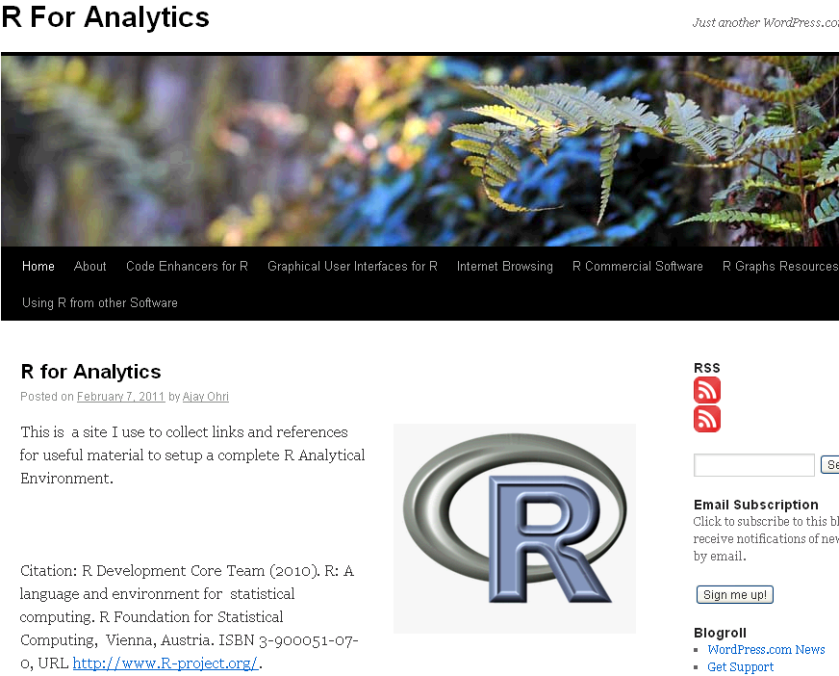
Okay, through the weekend I created a website for a few of my favourite things.

It’s on at https://rforanalytics.wordpress.com/

Graphical User Interfaces for R


Jerry Rubin said: “Don’t trust anyone over thirty

I dont trust anyone not using atleast one R GUI. Here’s a list of the top 10.


Code Enhancers for R

Here is a list of top 5 code enhancers,editors in R

R Commercial Software

A list of companies and software making (and) selling R software (and) services. Hint- it is almost 5 (unless I missed someone)

R Graphs Resources

R’s famous graphing capabilities and equally famous learning curve can be made a bit more humane- using some of these resources.

Internet Browsing

Because that’s what I do (all I do as per my cat) , and I am pretty good at it.

Using R from other Software

R can be used successfully from a lot of analytical software including some surprising ones praising the great 3000 packages library.

(to be continued- as I find more stuff I will keep it there, some ideas- database access from R, prominent R consultants, prominent R packages, famous R interviewees 😉 )

ps- The quote from Jerry Rubin seems funny for a while. I turn 34 this year.

Lyx Releases 2

Ubuntu Login
Image via Wikipedia

Lyx releases new version- now if only there was a SIMPLE way to put R code in a Lyx existing text class (having tried Sweave and sweaved myself into knots ! 😦

and I hope Ubuntu Linux 10.10  netbook fixes the curious case of disappearing menu bar in Lyx

see https://bugs.launchpad.net/ubuntu/+source/indicator-appmenu/+bug/619811

(Hint start Lyx using from the terminal:
QT_X11_NO_NATIVE_MENUBAR=1 lyx)

Latest News from the

http://www.lyx.org/News#item2

We are pleased to announce the release of LyX 1.6.9


Beta Release: LyX 2.0.0 beta 4 released.

February 6, 2011

We are pleased to announce the fourth public pre-release of LyX 2.0.0.
Except usual bugfixing we fixed random crashes connected with the new background export and compilation feature.

As far as new features is considered it is now possible

  • to set the table width,
  • customize the language package per document,
  • export LyX files as a single archive containing linked material (e.g. images) directly via export menu.


Since this is most probably the last beta release we also added convertor for old (1.6) preference files which are automatically checked on the startup now.


SAS to R Challenge: Unique benchmarking

Flag of Town of Cary
Image via Wikipedia

An interesting announcemnet from Revolution Analytics promises to convert your legacy code in SAS language not only cheaper but faster. It’ s a very very interesting challenge and I wonder how SAS users ,corporates, customers as well as the Institute itself reacts

http://www.revolutionanalytics.com/sas-challenge/

Take the SAS to R Challenge

Are you paying for expensive software licenses and hardware to run time-consuming statistical analyses on big data sets?

If you’re doing linear regressions, logistic regressions, predictions, or multivariate crosstabulations* there’s something you should know: Revolution Analytics can get the same results for a substantially lower cost and faster than SAS®.

For a limited time only, Revolution Analytics invites you take the SAS to R Challenge. Let us prove that we can deliver on our promise of replicating your results in R, faster and cheaper than SAS.

Take the challenge

Here’s how it works:

Fill out the short form below, and one of our conversion experts will contact you to discuss the SAS code you want to convert. If we think Revolution R Enterprise can get the same results faster than SAS, we’ll convert your code to R free of charge. Our goal is to demonstrate that Revolution R Enterprise will produce the same results in less time. There’s no obligation, but if you choose to convert, we guarantee that your license cost for Revolution R Enterprise will be less than half what you’re currently paying for the equivalent SAS software.**

It’s that simple.

We’ll show you that you don’t need expensive hardware and software to do high quality statistical analysis of big data. And we’ll show that you don’t need to tie up your computing resources with long running operations. With Revolution R Enterprise, you can run analyses on commodity hardware using Linux or Windows, scale to terabyte-class data problems and do it at processing speeds you would never have thought possible.

Sign up now, and we will be in touch shortly.

Take the challenge


—————————-

SAS is a registered trademark of the SAS Institute, Cary, NC, in the US and other countries.

*Additional statistical algorithms are being rapidly added to Revolution R Enterprise. Custom development services are also available.

**Revolution Analytics retains the right to determine eligibility for this offer. Offer available until March 31, 2011.

LibreOffice Stable Release launched

Non Oracle Open Office completes important milestone- from the press release

The Document Foundation launches LibreOffice 3.3

The first stable release of the free office suite is available for download

The Internet, January 25, 2011 – The Document Foundation launches LibreOffice 3.3, the first stable release of the free office suite developed by the community. In less than four months, the number of developers hacking LibreOffice has grown from less than twenty in late September 2010, to well over one hundred today. This has allowed us to release ahead of the aggressive schedule set by the project.

Not only does it ship a number of new and original features, LibreOffice 3.3 is also a significant achievement for a number of reasons:

– the developer community has been able to build their own and independent process, and get up and running in a very short time (with respect to the size of the code base and the project’s strong ambitions);

– thanks to the high number of new contributors having been attracted into the project, the source code is quickly undergoing a major clean-up to provide a better foundation for future development of LibreOffice;

– the Windows installer, which is going to impact the largest and most diverse user base, has been integrated into a single build containing all language versions, thus reducing the size for download sites from 75 to 11GB, making it easier for us to deploy new versions more rapidly and lowering the carbon footprint of the entire infrastructure.

Caolán McNamara from RedHat, one of the developer community leaders, comments, “We are excited: this is our very first stable release, and therefore we are eager to get user feedback, which will be integrated as soon as possible into the code, with the first enhancements being released in February. Starting from March, we will be moving to a real time-based, predictable, transparent and public release schedule, in accordance with Engineering Steering Committee’s goals and users’ requests”. The LibreOffice development roadmap is available at http://wiki.documentfoundation.org/ReleasePlan

LibreOffice 3.3 brings several unique new features. The 10 most-popular among community members are, in no particular order:

  1. the ability to import and work with SVG files;
  2. an easy way to format title pages and their numbering in Writer;
  3. a more-helpful Navigator Tool for Writer;
  4. improved ergonomics in Calc for sheet and cell management;
  5. and Microsoft Works and Lotus Word Pro document import filters.

In addition, many great extensions are now bundled, providing

PDF import,

a slide-show presenter console,

a much improved report builder, and more besides.

A more-complete and detailed list of all the new features offered by LibreOffice 3.3 is viewable on the following web page: http://www.libreoffice.org/download/new-features-and-fixes/

LibreOffice 3.3 also provides all the new features of OpenOffice.org 3.3, such as new custom properties handling; embedding of standard PDF fonts in PDF documents; new Liberation Narrow font; increased document protection in Writer and Calc; auto decimal digits for “General” format in Calc; 1 million rows in a spreadsheet; new options for CSV import in Calc; insert drawing objects in Charts; hierarchical axis labels for Charts; improved slide layout handling in Impress; a new easier-to-use print interface; more options for changing case; and colored sheet tabs in Calc. Several of these new features were contributed by members of the LibreOffice team prior to the formation of The Document Foundation.

LibreOffice hackers will be meeting at FOSDEM in Brussels on February 5 and 6, and will be presenting their work during a one-day workshop on February 6, with speeches and hacking sessions coordinated by several members of the project.

The home of The Document Foundation is at http://www.documentfoundation.org

The home of LibreOffice is at http://www.libreoffice.org where the download page has been redesigned by the community to be more user-friendly.

*** About The Document Foundation

The Document Foundation has the mission of facilitating the evolution of the OOo Community into a new, open, independent, and meritocratic organization within the next few months. An independent Foundation is a better reflection of the values of our contributors, users and supporters, and will enable a more effective, efficient and transparent community. TDF will protect past investments by building on the achievements of the first decade, will encourage wide participation within the community, and will co-ordinate activity across the community.

*** Media Contacts for TDF

Florian Effenberger (Germany)

Mobile: +49 151 14424108 – E-mail: floeff@documentfoundation.org

Olivier Hallot (Brazil)

Mobile: +55 21 88228812 – E-mail: olivier.hallot@documentfoundation.org

Charles H. Schulz (France)

Mobile: +33 6 98655424 – E-mail: charles.schulz@documentfoundation.org

Italo Vignoli (Italy)

Mobile: +39 348 5653829 – E-mail: italo.vignoli@documentfoundation.org

Chapman/Hall announces new series on R

Rice University, Houston, Texas, USA - Cohen H...
Image via Wikipedia
R Authors get more choice and variety now-
http://www.mail-archive.com/r-help@r-project.org/msg122965.html
We are pleased to announce the launch of a new series of books on R. 

Chapman & Hall/CRC: The R Series

Aims and Scope
This book series reflects the recent rapid growth in the development and 
application of R, the programming language and software environment for 
statistical computing and graphics. R is now widely used in academic research, 
education, and industry. It is constantly growing, with new versions of the 
core software released regularly and more than 2,600 packages available. It is 
difficult for the documentation to keep pace with the expansion of the 
software, and this vital book series provides a forum for the publication of 
books covering many aspects of the development and application of R.

The scope of the series is wide, covering three main threads:
• Applications of R to specific disciplines such as biology, epidemiology, 
genetics, engineering, finance, and the social sciences.
• Using R for the study of topics of statistical methodology, such as linear 
and mixed modeling, time series, Bayesian methods, and missing data.
• The development of R, including programming, building packages, and graphics.

The books will appeal to programmers and developers of R software, as well as 
applied statisticians and data analysts in many fields. The books will feature 
detailed worked examples and R code fully integrated into the text, ensuring 
their usefulness to researchers, practitioners and students.

Series Editors
John M. Chambers (Department of Statistics, Stanford University, USA; 
j...@stat.stanford.edu)
Torsten Hothorn (Institut für Statistik, Ludwig-Maximilians-Universität, 
München, Germany; torsten.hoth...@stat.uni-muenchen.de)
Duncan Temple Lang (Department of Statistics, University of California, Davis, 
USA; dun...@wald.ucdavis.edu)
Hadley Wickham (Department of Statistics, Rice University, Houston, Texas, USA; 
had...@rice.edu)

Call for Proposals
We are interested in books covering all aspects of the development and 
application of R software. If you have an idea for a book, please contact one 
of the series editors above or one of the Chapman & Hall/CRC statistics 
acquisitions editors below. Please provide brief details of topic, audience, 
aims and scope, and include an outline if possible.

We look forward to hearing from you.

Best regards,Rob Calver (rob.cal...@informa.com)
David Grubbs (david.gru...@taylorandfrancis.com)
John Kimmel (john.kim...@taylorandfrancis.com)


PAW Blog Partnership

Please use the following code  to get a 15% discount on the 2 Day Conference Pass: AJAY11.


Predictive Analytics World announces new full-day workshops coming to San Francisco March 13-19, amounting to seven consecutive days of content.

These workshops deliver top-notch analytical and business expertise across the hottest topics.

Register now for one or more workshops, offered just before and after the full two-day Predictive Analytics World conference program (March 14-15). Early Bird registration ends on January 31st – take advantage of reduced pricing before then.

Driving Enterprise Decisions with Business Analytics – March 13, 2011
James Taylor, CEO, Decision Management Solutions
NEW – R for Predictive Modeling: A Hands-On Introduction – March 13, 2011
Max Kuhn, Director, Nonclinical Statistics, Pfizer
The Best and Worst of Predictive Analytics: Predictive Modeling Methods and Common Data Mining Mistakes – March 16, 2011
John Elder, Ph.D., CEO and Founder, Elder Research, Inc.
Hands-On Predictive Analytics – March 17, 2011
Dean Abbott, President, Abbott Analytics
NEW – Net Lift Models: Optimizing the Impact of Your Marketing – March 18-19, 2011
Kim Larsen, VP of Analytical Insights, Market Share Partners

Download the Conference Preview or view the Predictive Analytics World Agenda online

Make savings now with the early bird rate. Receive $200 off your registration rate for Predictive Analytics World – San Francisco (March 14-15), plus $100 off each workshop for which you register.

Register now before Early Bird Price expires on January 31st!

Additional savings of $200 on the two-day conference pass when you register a colleague at the same time.


Using R from within Python

Python logo
Image via Wikipedia

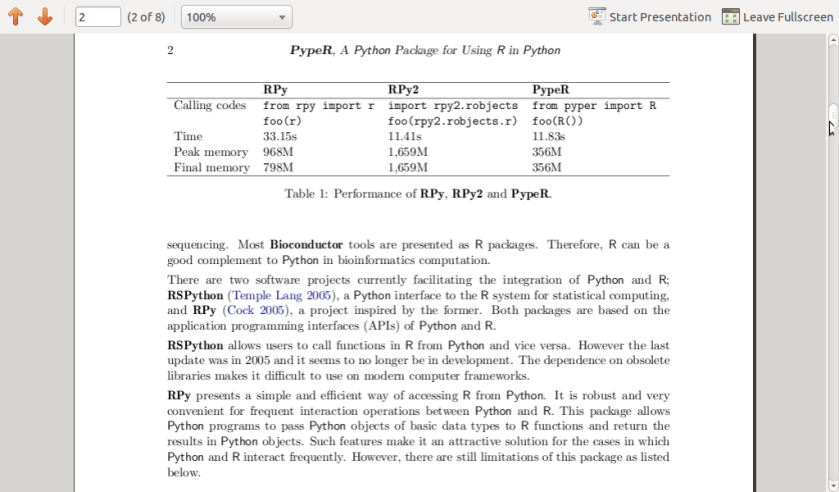
I came across this excellent JSS paper at www.jstatsoft.org/v35/c02/paper

on a Python package called PypeR which allows you to use R from within Python using the pipe functionality.

It is an interesting package and given Python’s increasing buzz , one worthy to be checked out by people using or thinking Python in their packages.


Citation:
	@article{Xia:McClelland:Wang:2010:JSSOBK:v35c02,
	  author =	"Xiao-Qin Xia and Michael McClelland and Yipeng Wang",
	  title =	"PypeR, A Python Package for Using R in Python",
	  journal =	"Journal of Statistical Software, Code Snippets",
	  volume =	"35",
	  number =	"2",
	  pages =	"1--8",
	  day =  	"30",
	  month =	"7",
	  year = 	"2010",
	  CODEN =	"JSSOBK",
	  ISSN = 	"1548-7660",
	  bibdate =	"2010-03-23",
	  URL =  	"http://www.jstatsoft.org/v35/c02",
	  accepted =	"2010-03-23",
	  acknowledgement = "",
	  keywords =	"",
	  submitted =	"2009-10-23",
	}