The Statistical Abstract of the United States, published since 1878, is the authoritative and comprehensive summary of statistics on the social, political, and economic organization of the United States.
Use the Abstract as a convenient volume for statistical reference, and as a guide to sources of more information both in print and on the Web.
Sources of data include the Census Bureau, Bureau of Labor Statistics, Bureau of Economic Analysis, and many other Federal agencies and private organizations.
From the last table you can see , while the number of officers killed or feloniously killed decreased by 20% in past five years, the number of officers assaulted by firearms grew by 20% in the same period.
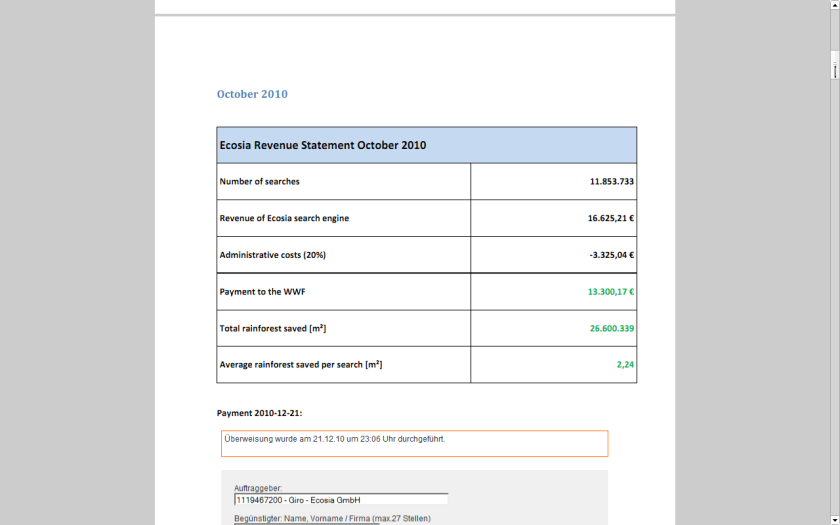
I recently found an interesting example of a website that both makes a lot of money and yet is much more efficient than any free or non profit. It is called ECOSIA
If you see a website that wants to balance administrative costs plus have a transparent way to make the world better- this is a great example.
World’s largest tropical forest reserve (38,867 square kilometers, or about the size of Switzerland)
Home to about 14% of all amphibian species and roughly 54% of all bird species in the Amazon – not to mention large populations of at least eight threatened species, including the jaguar
Includes part of the Guiana Shield containing 25% of world’s remaining tropical rainforests – 80 to 90% of which are still pristine
Holds the last major unpolluted water reserves in the Neotropics, containing approximately 20% of all of the Earth’s water
One of the last tropical regions on Earth vastly unaltered by humans
Significant contributor to climatic regulation via heat absorption and carbon storage
Click per milli (or CPM) gives you a very low low conversion compared to contacting ad sponsor directly.
But its a great data experiment-
as you can monitor which companies are likely to be advertised on your site (assume google knows more about their algols than you will)
which formats -banner or text or flash have what kind of conversion rates
what are the expected pay off rates from various keywords or companies (like business intelligence software, predictive analytics software and statistical computing software are similar but have different expected returns (if you remember your eco class)
NOW- Based on above data, you know whats your minimum baseline to expect from a private advertiser than a public, crowd sourced search engine one (like Google or Bing)
Lets say if you have 100000 views monthly. and assume one out of 1000 page views will lead to a click. Say the advertiser will pay you 1 $ for every 1 click (=1000 impressions)
Then your expected revenue is $100.But if your clicks are priced at 2.5$ for every click , and your click through rate is now 3 out of 1000 impressions- (both very moderate increases that can done by basic placement optimization of ad type, graphics etc)-your new revenue is 750$.
Be a good Samaritan- you decide to share some of this with your audience -like 4 Amazon books per month ( or I free Amazon book per week)- That gives you a cost of 200$, and leaves you with some 550$.
Wait! it doesnt end there- Adam Smith‘s invisible hand moves on .
You say hmm let me put 100 $ for an annual paper writing contest of $1000, donate $200 to one laptop per child ( or to Amazon rain forests or to Haiti etc etc etc), pay $100 to your upgraded server hosting, and put 350$ in online advertising. say $200 for search engines and $150 for Facebook.
Woah!
Month 1 would should see more people visiting you for the first time. If you have a good return rate (returning visitors as a %, and low bounce rate (visits less than 5 secs)- your traffic should see atleast a 20% jump in new arrivals and 5-10 % in long term arrivals. Ignoring bounces- within three months you will have one of the following
1) An interesting case study on statistics on online and social media advertising, tangible motivations for increasing community response , and some good data for study
2) hopefully better cost management of your server expenses
3)very hopefully a positive cash flow
you could even set a percentage and share the monthly (or annually is better actions) to your readers and advertisers.
go ahead- change the world!
the key paradigms here are sharing your traffic and revenue openly to everyone
donating to a suitable cause
helping increase awareness of the suitable cause
basing fixed percentages rather than absolute numbers to ensure your site and cause are sustained for years.
Over the month long break I took, I was helping firm up my ideas for R for Analytics , I also took a break and read some books. Here are brief reviews of two, three of them-
1) Hindu Myths
This is a classical book translated from original Sanskrit written by Professor Wendy O Flaherty of University of Chicago. I found some of the older myths very interesting in terms of contradictions, retelling the same story in a modified way by another classic, the beautiful poetic and fantastic imagery evoked by Hindu myths. Some stories are as relevant in prayers, fasts and religious ceremonies as they were around 11000 years while most have morphed , edited or even distorted.
It should help the non Indian reader understand why hundreds of millions of conservative Indians worship Shiv Ling ( or literally an idol of the Phallus of Shiva), the Hindu two cents of creation of the universe, and the somewhat fantastic stories on super heroes /gods/ in the ancient world.
The book suffers from a few drawbacks in my opinion-
1) Sanskrit is a bit like Latin- you can lose not just the flavor but original meaning of words and situational context. Some of the stories made better sense when i read a more recent Hindi translation.
2) An excessive emphasis on sexual imagery rather than emotional imagery. The author seems wonder struck to read and translate ancient indians were so matter of fact about physical relationships. However the words were always written in discrete poetic than crass soft pornography.
3) Almost no drawings or figures. This makes the book a bit dense to read at 300 pages.
I liked another book on Hindu Myths (Myth= Mithya which I read in 2009) and you can see if you can read it if you find the topic interesting.
A Handbook of Hindu Mythology
Hindus have one God.
They also have 330 million gods: male gods, female gods, personal gods, family gods, household gods, village gods, gods of space and time, gods for specific castes and particular professions, gods who reside in trees, in animals, in minerals, in geometrical patterns and in man-made objects.
Then there are a whole host of demons.
But no Devil.
Mere Christianity by C S Lewis is a classic book on reinterpreting Christianity in modern times. However the author wrote this when World War 2 was on and it seems more like a British or Anglo Saxon interpretation of beliefs of Christ Jesus– who was actually a Jewish teacher born in Middle East Asia.
While the language and reading makes it much easier to read- it is recommended more at Western audiences, than Eastern ones, as it seems some of the parables are a more palatable re interpretation of the New Testament. The Bible is a deceptively easy book to read, the language is short and beautiful-and the original parables in the Gospels remain powerful easy to understand.
C S Lewis tends to emphasize morality than religiosity or faith, and there is not much comparison with any other faith or alternative morality. Dumbing down the Bible so as to market it better to reluctant consumers seems to be Mr Lewis intention and it is not as scholarly a work as an exercise in pure prose.
However it is quite good as a self improvement book and is quite better than the “You Can Win” kind of books or even business concept books.
Note- I find reading books on religion as good exercises in reading the fountain source of philosophies. As a polytheist- I tend to read more than one faith.
its going to be a more business analytics than a stats perspective ( I am a MBA /Mech Engineer)
and use cases would be business analytics cases. Do write to me if you need help doing some analytics in R (business use cases)- or want something featured. Big focus would be on GUI and easier analytics, using the Einsteinian principle to make things as simple as possible but no simpler)
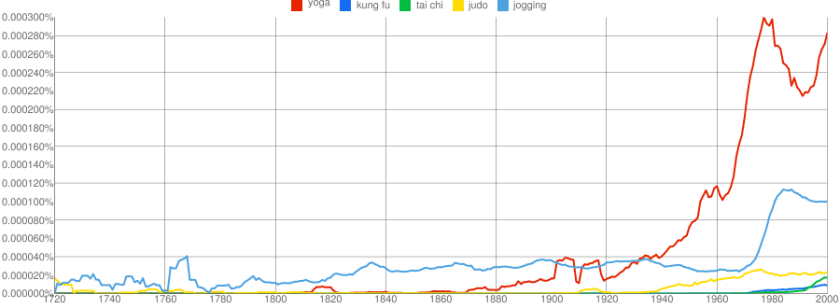
Here is a terrific data visualization from Google based on their digitized books collection. How does it work, basically you can test the frequency of various words across time periods from 1700s to 2010.
Like the frequency and intensity of kung fu vs yoga, or pizza versus hot dog. The basic datasets scans millions /billions of words.
When you enter phrases into the Google Books Ngram Viewer, it displays a graph showing how those phrases have occurred in a corpus of books (e.g., “British English”, “English Fiction”, “French”) over the selected years. Let’s look at a sample graph:
This shows trends in three ngrams from 1950 to 2000: “nursery school” (a 2-gram or bigram), “kindergarten” (a 1-gram or unigram), and “child care” (another bigram). What the y-axis shows is this: of all the bigrams contained in our sample of books written in English and published in the United States, what percentage of them are “nursery school” or “child care”? Of all the unigrams, what percentage of them are “kindergarten”? Here, you can see that use of the phrase “child care” started to rise in the late 1960s, overtaking “nursery school” around 1970 and then “kindergarten” around 1973. It peaked shortly after 1990 and has been falling steadily since.
(Interestingly, the results are noticeably different when the corpus is switched to British English.)
Corpora
Below are descriptions of the corpora that can be searched with the Google Books Ngram Viewer. All of these corpora were generated in July 2009; we will update these corpora as our book scanning continues, and the updated versions will have distinct persistent identifiers.
Informal corpus name
Persistent identifier
Description
American English
googlebooks-eng-us-all-20090715
Same filtering as the English corpus but further restricted to books published in the United States.
British English
googlebooks-eng-gb-all-20090715
Same filtering as the English corpus but further restricted to books published in Great Britain.
I had recently asked some friends from my Twitter lists for their take on 2011, atleast 3 of them responded back with the answer, 1 said they were still on it, and 1 claimed a recent office event.
Anyways- I take note of the view of forecasting from
The most primitive method of forecasting is guessing. The result may be rated acceptable if the person making the guess is an expert in the matter.
Ajay- people will forecast in end 2010 and 2011. many of them will get forecasts wrong, some very wrong, but by Dec 2011 most of them would be writing forecasts on 2012. almost no one will get called on by irate users-readers- (hey you got 4 out of 7 wrong last years forecast!) just wont happen. people thrive on hope. so does marketing. in 2011- and before
and some forecasts from Tom Davenport’s The International Institute for Analytics (IIA) at
Regulatory and privacy constraints will continue to hamper growth of marketing analytics.
(I wonder how privacy and analytics can co exist in peace forever- one view is that model building can use anonymized data suppose your IP address was anonymized using a standard secret Coco-Cola formula- then whatever model does get built would not be of concern to you individually as your privacy is protected by the anonymization formula)
Anyway- back to the question I asked-
What are the top 5 events in your industry (events as in things that occured not conferences) and what are the top 3 trends in 2011.
I define my industry as being online technology writing- research (with a heavy skew on stat computing)
My top 5 events for 2010 were-
1) Consolidation- Big 5 software providers in BI and Analytics bought more, sued more, and consolidated more. The valuations rose. and rose. leading to even more smaller players entering. Thus consolidation proved an oxy moron as total number of influential AND disruptive players grew.
2) Cloudy Computing- Computing shifted from the desktop but to the mobile and more to the tablet than to the cloud. Ipad front end with Amazon Ec2 backend- yup it happened.
3) Open Source grew louder- yes it got more clients. and more revenue. did it get more market share. depends on if you define market share by revenues or by users.
Both Open Source and Closed Source had a good year- the pie grew faster and bigger so no one minded as long their slices grew bigger.
4) We didnt see that coming –
Technology continued to surprise with events (thats what we love! the surprises)
Revolution Analytics broke through R’s Big Data Barrier, Tableau Software created a big Buzz, Wikileaks and Chinese FireWalls gave technology an entire new dimension (though not universally popular one).
people fought wars on emails and servers and social media- unfortunately the ones fighting real wars in 2009 continued to fight them in 2010 too
5) Money-
SAP,SAS,IBM,Oracle,Google,Microsoft made more money than ever before. Only Facebook got a movie named on itself. Venture Capitalists pumped in money in promising startups- really as if in a hurry to park money before tax cuts expired in some countries.
2011 Top Three Forecasts
1) Surprises- Expect to get surprised atleast 10 % of the time in business events. As internet grows the communication cycle shortens, the hype cycle amplifies buzz-
more unstructured data is created (esp for marketing analytics) leading to enhanced volatility
2) Growth- Yes we predict technology will grow faster than the automobile industry. Game changers may happen in the form of Chrome OS- really its Linux guys-and customer adaptability to new USER INTERFACES. Design will matter much more in technology on your phone, on your desktop and on your internet. Packaging sells.
False Top Trend 3) I will write a book on business analytics in 2011. yes it is true and I am working with A publisher. No it is not really going to be a top 3 event for anyone except me,publisher and lucky guys who read it.
3) Creating technology and technically enabling creativity will converge at an accelerated rate. use of widgets, guis, snippets, ide will ensure creative left brains can code easier. and right brains can design faster and better due to a global supply chain of techie and artsy professionals.
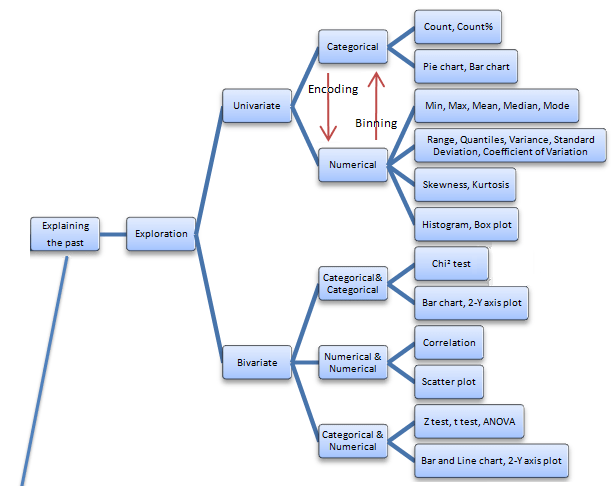
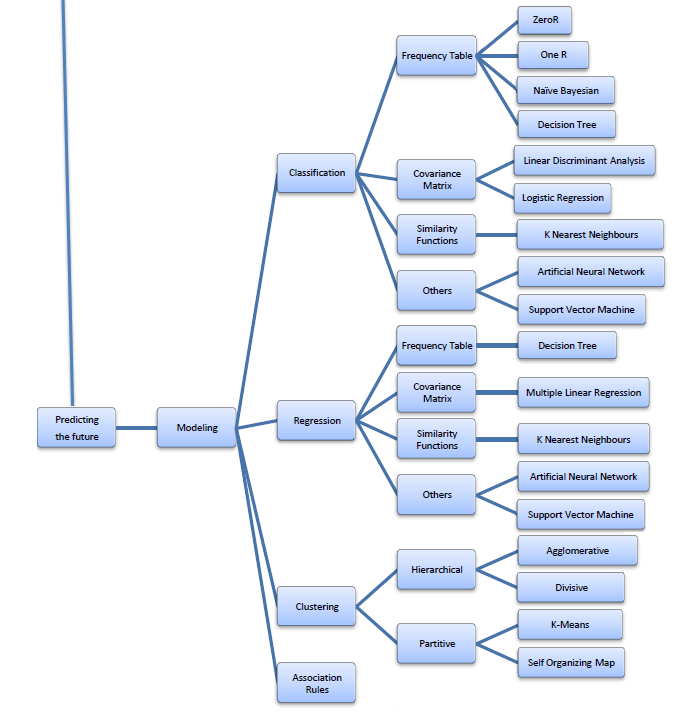
Best of All- I really liked this online book created by Professor S. Sayad
Its succinct and beautiful and describes all of the Data Mining you want to read in one Map (actually 4 images painstakingly assembled with perfection)
The best thing is- in the original map- even the sub items are click-able for specifics like Pie Chart and Stacked Column chart are not in one simple drop down like Charts- but rather by nature of the kind of variables that lead to these charts. For doing that- you would need to go to the site itself- ( see http://chem-eng.utoronto.ca/~datamining/dmc/categorical_variables.htm
Again- there is no mention of the data visualization software used to create the images but I think I can take a hint from the Software Page which says software used are-









 DECISION STATS