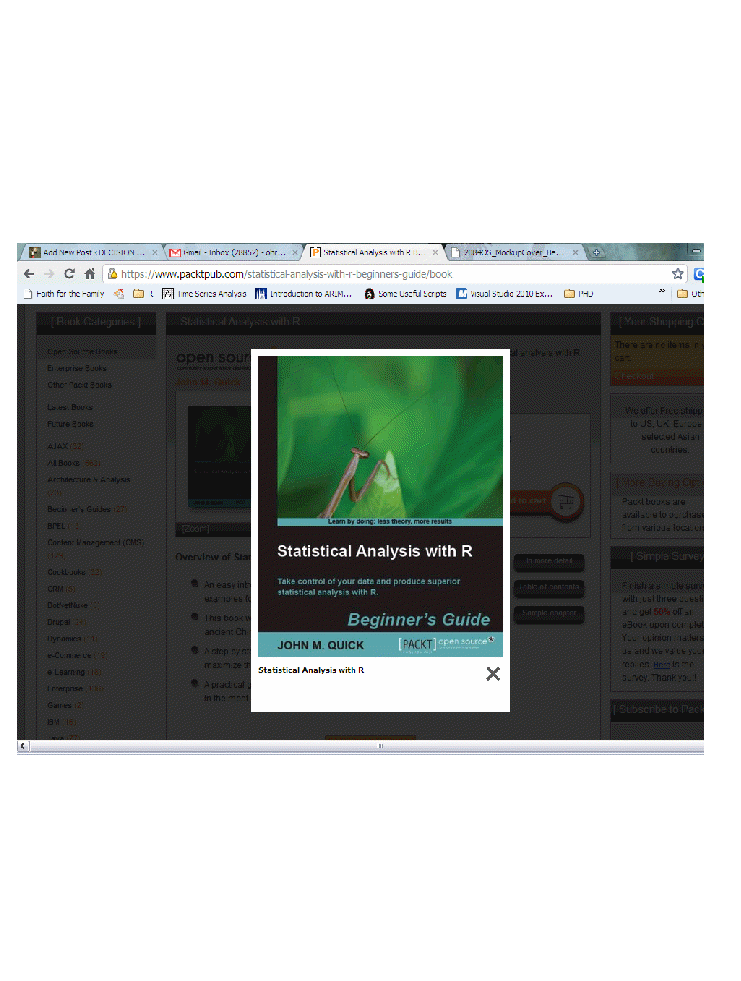
Statistical Analysis with R- by John M Quick

I was asked to be a techie reviewe for John M Quick’s new R book “Statistical Analysis with R” from Packt Publishing some months ago-(very much to my surprise I confess)-

I agreed- and technical reviewer work does take time- its like being a mid wife and there is whole team trying to get the book to birth.

Statistical Analysis with R- is a Beginner’s Guide so has nice screenshots, simple case studies, and quizzes to check recall of student/ reader. I remember struggling with the official “beginner’s guide to R” so this one is different in that it presents a story of a Chinese Army and how to use R to plan resources to fight the battle. It’s recommended especially for undergraduate courses- R need not be an elitist language- and given my experience with Asian programming acumen – I am sure it is a matter of time before high schools in India teach basic R in final years ( I learnt quite a shit load of quantum physics as compulsory topics in Indian high schools- but I guess we didnt have Jersey Shore things to do)

Congrats to author Mr John M Quick- he is doing his educational Phd from ASU- and I am sure both he and his approach to making education simple informative and fun will go places.

Only bad thing- The Name Statistical Analysis with R has atleast three other books , but I guess Google will catch up to it.

This book is here-https://www.packtpub.com/statistical-analysis-with-r-beginners-guide/book

Bringing Poetry to Life

Here is a new poetry book.

———————————————————————————————–

I’m excited to let you know about Carol Calkins who is releasing her first book of poetry entitled Bring Poetry to Life. This book is a powerful compilation of poetry touching on the most important moments in our everyday lives from new beginnings, to special people and events, to endings and saying goodbye.  Carol who found her life purpose through poetry is excited to release the first of a series of poetry books on Amazon. Grab your copy of Bring Poetry to Life today on Amazon.com – Find out more about Carol and her new book at http://www.bringpoetrytolife.com

We Said Goodbye a Thousand Times


Don’t be sad about my parting

Don’t feel like you never said goodbye

For you and I both know deep in our hearts

That We Said Goodbye a Thousand Times

And shared so much love and joy every day


Be happy that I am now at peace

Be joyful that I have lived a wonderful life

Be happy that we have shared so much together


And remember I am always with you in a thought and a sigh

Every day when you see the beauty in nature think of me

Every day when you see the colorful flowers think of me

Every day when you see a frisky animal prancing around think of me

Every day when you look into the eyes of someone you love think of me


And know beyond a doubt that I am with you in everything you do

And know beyond a doubt that I am with you in everything you say

And know beyond a doubt that I am with you in every quiet moment of your life


Don’t be sad about my parting

Don’t feel like you never said goodbye

For you and I both know deep in our hearts

That We Said Goodbye a Thousand Times

And shared so much love and joy every day


Top R Interviews


Portrait of baron A.I.Vassiliev (later - count)
Image via Wikipedia


Here is a list of the Top R Related Interviews I have done (in random order)-

1) John Fox , Creator of R Commander

https://decisionstats.com/2009/09/14/interview-professor-john-fox-creator-r-commander/

2) Dr Graham Williams, Creator of Rattle

https://decisionstats.com/2009/01/13/interview-dr-graham-williams/

3) David Smith, back when he was community Director of then Revolution Computing.

https://decisionstats.com/2009/05/29/interview-david-smith-revolution-computing/

and his second interview

https://decisionstats.com/2010/08/03/q-a-with-david-smith-revolution-analytics/

4) Robert Schultz, the first CEO of Revolution Computing (now Analytics)

https://decisionstats.com/2009/01/31/interviewrichard-schultz-ceo-revolution-computing/

5) Bob  Muenchen, author of R for SAS and SPSS users AND R for Stata users

https://decisionstats.com/2010/06/29/interview-r-for-stata-users/

https://decisionstats.com/2008/10/16/r-for-sas-and-spss-users/

6) Karim Chine, creator Biocep, Cloud Computing for R

https://decisionstats.com/2009/06/21/interview-karim-chine-biocep-cloud-computing-with-r/

7) Paul van Eikeran, Inference for R,the first enterprise package to use R from within MS Office.

https://decisionstats.com/2009/06/04/inference-for-r/

8) Hadley Wickham, creator GGPlot and R Author

https://decisionstats.com/2010/01/12/interview-hadley-wickham-r-project-data-visualization-guru/

Thats a lot of R interviews- I need to balance them out a bit I guess.

Interview Michael J. A. Berry Data Miners, Inc

Here is an interview with noted Data Mining practitioner Michael Berry, author of seminal books in data mining, noted trainer and consultantmjab picture

Ajay- Your famous book “Data Mining Techniques: For Marketing, Sales, and Customer Relationship Management” came out in 2004, and an update is being planned for 2011. What are the various new data mining techniques and their application that you intend to talk about in that book.

Michael- Each time we do a revision, it feels like writing a whole new book. The first edition came out in 1997 and it is hard to believe how much the world has changed since then. I’m currently spending most of my time in the on-line retailing world. The things I worry about today–improving recommendations for cross-sell and up-sell,and search engine optimization–wouldn’t have even made sense to me back then. And the data sizes that are routine today were beyond the capacity of the most powerful super computers of the nineties. But, if possible, Gordon and I have changed even more than the data mining landscape. What has changed us is experience. We learned an awful lot between the first and second editions, and I think we’ve learned even more between the second and third.

One consequence is that we now have to discipline ourselves to avoid making the book too heavy to lift. For the first edition, we could write everything we knew (and arguably, a bit more!); now we have to remind ourselves that our intended audience is still the same–intelligent laymen with a practical interest in getting more information out of data. Not statisticians. Not computer scientists. Not academic researchers. Although we welcome all readers, we are primarily writing for someone who works in a marketing department and has a title with the word “analyst” or “analytics” in it. We have relaxed our “no equations” rule slightly for cases when the equations really do make things easier to explain, but the core explanations are still in words and pictures.

The third edition completes a transition that was already happening in the second edition. We have fully embraced standard statistical modeling techniques as full-fledged components of the data miner’s toolkit. In the first edition, it seemed important to make a distinction between old, dull, statistics, and new, cool, data mining. By the second edition, we realized that didn’t really make sense, but remnants of that attitude persisted. The third edition rectifies this. There is a chapter on statistical modeling techniques that explains linear and logistic regression, naive Bayes models, and more. There is also a brand new chapter on text mining, a curious omission from previous editions.

There is also a lot more material on data preparation. Three whole chapters are devoted to various aspects of data preparation. The first focuses on creating customer signatures. The second is focused on using derived variables to bring information to the surface, and the third deals with data reduction techniques such as principal components. Since this is where we spend the greatest part of our time in our work, it seemed important to spend more time on these subjects in the book as well.

Some of the chapters have been beefed up a bit. The neural network chapter now includes radial basis functions in addition to multi-layer perceptrons. The clustering chapter has been split into two chapters to accommodate new material on soft clustering, self-organizing maps, and more. The survival analysis chapter is much improved and includes material on some of our recent application of survival analysis methods to forecasting. The genetic algorithms chapter now includes a discussion of swarm intelligence.

Ajay- Describe your early career and how you came into Data Mining as a profession. What do you think of various universities now offering MS in Analytics. How do you balance your own teaching experience with your consulting projects at The Data Miners.

Michael- I fell into data mining quite by accident. I guess I always had a latent interest in the topic. As a high school and college student, I was a fan of Martin Gardner‘s mathematical games in in Scientific American. One of my favorite things he wrote about was a game called New Eleusis in which one players, God, makes up a rule to govern how cards can be played (“an even card must be followed by a red card”, say) and the other players have to figure out the rule by watching what plays are allowed by God and which ones are rejected. Just for my own amusement, I wrote a computer program to play the game and presented it at the IJCAI conference in, I think, 1981.

That paper became a chapter in a book on computer game playing–so my first book was about finding patterns in data. Aside from that, my interest in finding patterns in data lay dormant for years. At Thinking Machines, I was in the compiler group. In particular, I was responsible for the run-time system of the first Fortran Compiler for the CM-2 and I represented Thinking Machines at the Fortran 8X (later Fortran-90) standards meetings.

What changed my direction was that Thinking Machines got an export license to sell our first machine overseas. The machine went to a research lab just outside of Paris. The connection machine was so hard to program, that if you bought one, you got an applications engineer to go along with it. None of the applications engineers wanted to go live in Paris for a few months, but I did.

Paris was a lot of fun, and so, I discovered, was actually working on applications. When I came back to the states, I stuck with that applied focus and my next assignment was to spend a couple of years at Epsilon, (then a subsidiary of American Express) working on a database marketing system that stored all the “records of charge” for American Express card members. The purpose of the system was to pick ads to go in the billing envelope. I also worked on some more general purpose data mining software for the CM-5.

When Thinking Machines folded, I had the opportunity to open a Cambridge office for a Virginia-based consulting company called MRJ that had been a major channel for placing Connection Machines in various government agencies. The new group at MRJ was focused on data mining applications in the commercial market. At least, that was the idea. It turned out that they were more interested in data warehousing projects, so after a while we parted company.

That led to the formation of Data Miners. My two partners in Data Miners, Gordon Linoff and Brij Masand, share the Thinking Machines background.

To tell the truth, I really don’t know much about the university programs in data mining that have started to crop up. I’ve visited the one at NC State, but not any of the others.

I myself teach a class in “Marketing Analytics” at the Carroll School of Management at Boston College. It is an elective part of the MBA program there. I also teach short classes for corporations on their sites and at various conferences.

Ajay- At the previous Predictive Analytics World, you took a session on Forecasting and Predicting Subsciber levels (http://www.predictiveanalyticsworld.com/dc/2009/agenda.php#day2-6) .

It seems inability to forecast is a problem many many companies face today. What do you think are the top 5 principles of business forecasting which companies need to follow.

Michael- I don’t think I can come up with five. Our approach to forecasting is essentially simulation. We try to model the underlying processes and then turn the crank to see what happens. If there is a principal behind that, I guess it is to approach a forecast from the bottom up rather than treating aggregate numbers as a time series.

Ajay- You often partner your talks with SAS Institute, and your blog at http://blog.data-miners.com/ sometimes contain SAS code as well. What particular features of the SAS software do you like. Do you use just the Enterprise Miner or other modules as well for Survival Analysis or Forecasting.

Michael- Our first data mining class used SGI’s Mineset for the hands-on examples. Later we developed versions using Clementine, Quadstone, and SAS Enterprise Miner. Then, market forces took hold. We don’t market our classes ourselves, we depend on others to market them and then share in the revenue.

SAS turned out to be much better at marketing our classes than the other companies, so over time we stopped updating the other versions. An odd thing about our relationship with SAS is that it is only with the education group. They let us use Enterprise Miner to develop course materials, but we are explicitly forbidden to use it in our consulting work. As a consequence, we don’t use it much outside of the classroom.

Ajay- Also any other software you use (apart from SQL and J)

Michael- We try to fit in with whatever environment our client has set up. That almost always is SQL-based (Teradata, Oracle, SQL Server, . . .). Often SAS Stat is also available and sometimes Enterprise Miner.

We run into SPSS, Statistica, Angoss, and other tools as well. We tend to work in big data environments so we’ve also had occasion to use Ab Initio and, more recently, Hadoop. I expect to be seeing more of that.

Biography-

Together with his colleague, Gordon Linoff, Michael Berry is author of some of the most widely read and respected books on data mining. These best sellers in the field have been translated into many languages. Michael is an active practitioner of data mining. His books reflect many years of practical, hands-on experience down in the data mines.

Data Mining Techniques cover

Data Mining Techniques for Marketing, Sales and Customer Relationship Management

by Michael J. A. Berry and Gordon S. Linoff
copyright 2004 by John Wiley & Sons
ISB

Mining the Web cover

Mining the Web

by Michael J.A. Berry and Gordon S. Linoff
copyright 2002 by John Wiley & Sons
ISBN 0-471-41609-6

Non-English editions available in Traditional Chinese and Simplified Chinese

This book looks at the new opportunities and challenges for data mining that have been created by the web. The book demonstrates how to apply data mining to specific types of online businesses, such as auction sites, B2B trading exchanges, click-and-mortar retailers, subscription sites, and online retailers of digital content.

Mastering Data Mining

by Michael J.A. Berry and Gordon S. Linoff
copyright 2000 by John Wiley & Sons
ISBN 0-471-33123-6

Non-English editions available in JapaneseItalianTraditional Chinese , and Simplified Chinese

A case study-based guide to applying data mining techniques for solving practical business problems. These “warts and all” case studies are drawn directly from consulting engagements performed by the authors.

A data mining educator as well as a consultant, Michael is in demand as a keynote speaker and seminar leader in the area of data mining generally and the application of data mining to customer relationship management in particular.

Prior to founding Data Miners in December, 1997, Michael spent 8 years at Thinking Machines Corporation. There he specialized in the application of massively parallel supercomputing techniques to business and marketing applications, including one of the largest database marketing systems of the time.

Trrrouble in land of R…and Open Source Suggestions

Recently some comments by Ross Ihake , founder of R Statistical Software on Revolution Analytics, leading commercial vendor of R….. came to my attention-

http://www.stat.auckland.ac.nz/mail/archive/r-downunder/2010-May/000529.html

[R-downunder] Article on Revolution Analytics

Ross Ihaka ihaka at stat.auckland.ac.nz
Mon May 10 14:27:42 NZST 2010


On 09/05/10 09:52, Murray Jorgensen wrote:
> Perhaps of interest:
>
> http://www.theregister.co.uk/2010/05/06/revolution_commercial_r/

Please note that R is "free software" not "open source".  These guys
are selling a GPLed work without disclosing the source to their part
of the work. I have complained to them and so far they have given me
the brush off. I am now considering my options.

Don't support these guys by buying their product. The are not feeding
back to the rights holders (the University of Auckland and I are rights
holders and they didn't even have the courtesy to contact us).

--
Ross Ihaka                         Email:  ihaka at stat.auckland.ac.nz
Department of Statistics           Phone:  (64-9) 373-7599 x 85054
University of Auckland             Fax:    (64-9) 373-7018
Private Bag 92019, Auckland
New Zealand
and from http://www.theregister.co.uk/2010/05/06/revolution_commercial_r/
Open source purists probably won't be all too happy to learn that Revolution is going to be employing an "open core" strategy, which means the core R programs will remain open source and be given tech support under a license model, but the key add-ons that make R more scalable will be closed source and sold under a separate license fee. Because most of those 2,500 add-ons for R were built by academics and Revolution wants to supplant SPSS and SAS as the tools used by students, Revolution will be giving the full single-user version of the R Enterprise stack away for free to academics. 
Conclusion-
So one co-founder of R is advocating not to buy from Revolution Analytics , which has the other co-founder of R, Gentleman on its board. 
Source- http://www.revolutionanalytics.com/aboutus/leadership.php

2) If Revolution Analytics is using 2500 packages for free but insisting on getting paid AND closing source of it’s packages (which is a technical point- how exactly can you prevent source code of a R package from being seen)

Maybe there can be a PACKAGE marketplace just like Android Apps, Facebook Apps, and Salesforce.com Apps – so atleast some of the thousands of R package developers can earn – sorry but email lists do not pay mortgages and no one is disputing the NEED for commercializing R or rewarding developers.

Though Barr created SAS, he gave up control to Goodnight and Sall https://decisionstats.wordpress.com/2010/06/02/sas-early-days/

and Goodnight and Sall do pay their developers well- to the envy of not so well paid counterparts.

3) I really liked the innovation of Revolution Analytics RevoScalar, and I wish that the default R dataset be converted to XDF dataset so that it basically kills

off the R criticism of being slow on bigger datasets. But I also realize the need for creating an analytics marketplace for R developers and R students- so academic version of R being free and Revolution R being paid seems like a trade off.

Note- You can still get a job faster as a stats student if you mention SAS and not R as a statistical skill- not all stats students go into academics.

4) There can be more elegant ways of handling this than calling for ignoring each other as REVOLUTION and Ihake seem to be doing to each other.

I can almost hear people in Cary, NC chuckling at Norman Nie, long time SPSS opponent and now REVOLUTION CEO, and his antagonizing R’s academicians within 1 year of taking over- so I hope this ends well for all. The road to hell is paved with good intentions- so if REVOLUTION can share some source code with say R Core members (even Microsoft shares source code with partners)- and R Core and Revolution agree on a licensing royalty from each other, they can actually speed up R package creation rather than allow this 2 decade effort to end up like S and S plus and TIBCO did.

Maybe Richard Stallman can help-or maybe Ihaka has a better sense of where things will go down in a couple of years-he must know something-he invented it, didnt he

On 09/05/10 09:52, Murray Jorgensen wrote:
> Perhaps of interest:
>
> http://www.theregister.co.uk/2010/05/06/revolution_commercial_r/

Please note that R is "free software" not "open source".  These guys
are selling a GPLed work without disclosing the source to their part
of the work. I have complained to them and so far they have given me
the brush off. I am now considering my options.

Don't support these guys by buying their product. The are not feeding
back to the rights holders (the University of Auckland and I are rights
holders and they didn't even have the courtesy to contact us).

--
Ross Ihaka                         Email:  ihaka at stat.auckland.ac.nz
Department of Statistics           Phone:  (64-9) 373-7599 x 85054
University of Auckland             Fax:    (64-9) 373-7018
Private Bag 92019, Auckland
New Zealand

GNU PSPP- The Open Source SPSS

If you are SPSS user (for statistics/ not data mining) you can also try 0ut GNU PSPP- which is the open source equivalent and quite eerily impressive in performance. It is available at http://www.gnu.org/software/pspp/ or http://pspp.awardspace.com/ and you can also read more at http://en.wikipedia.org/wiki/PSPP

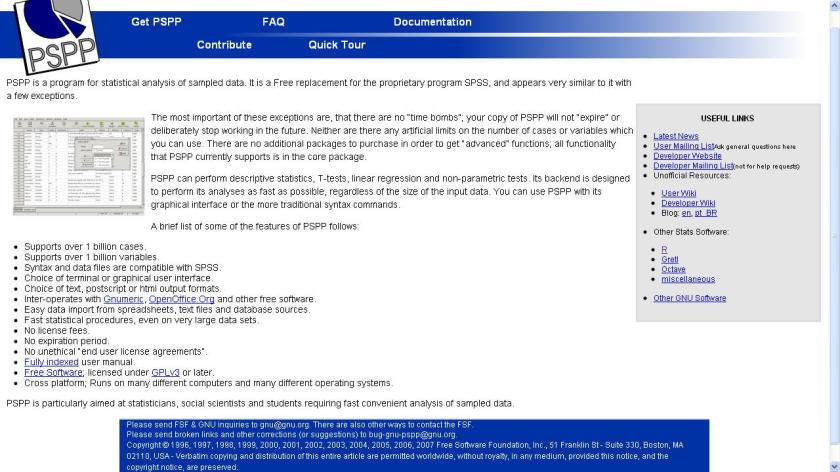
PSPP is a program for statistical analysis of sampled data. It is a Free replacement for the proprietary program SPSS, and appears very similar to it with a few exceptions.

[ Image of Variable Sheet ]The most important of these exceptions are, that there are no “time bombs”; your copy of PSPP will not “expire” or deliberately stop working in the future. Neither are there any artificial limits on the number of cases or variables which you can use. There are no additional packages to purchase in order to get “advanced” functions; all functionality that PSPP currently supports is in the core package.

PSPP can perform descriptive statistics, T-tests, linear regression and non-parametric tests. Its backend is designed to perform its analyses as fast as possible, regardless of the size of the input data. You can use PSPP with its graphical interface or the more traditional syntax commands.

A brief list of some of the features of PSPP follows:

  • Supports over 1 billion cases.
  • Supports over 1 billion variables.
  • Syntax and data files are compatible with SPSS.
  • Choice of terminal or graphical user interface.
  • Choice of text, postscript or html output formats.
  • Inter-operates with GnumericOpenOffice.Org and other free software.
  • Easy data import from spreadsheets, text files and database sources.
  • Fast statistical procedures, even on very large data sets.
  • No license fees.
  • No expiration period.
  • No unethical “end user license agreements”.
  • Fully indexed user manual.
  • Free Software; licensed under GPLv3 or later.
  • Cross platform; Runs on many different computers and many different operating systems.

PSPP is particularly aimed at statisticians, social scientists and students requiring fast convenient analysis of sampled data.

and

Features

This software provides a basic set of capabilities: frequencies, cross-tabs comparison of means (T-tests and one-way ANOVA); linear regression, reliability (Cronbach’s Alpha, not failure or Weibull), and re-ordering data, non-parametric tests, factor analysis and more.

At the user’s choice, statistical output and graphics are done in asciipdfpostscript or html formats. A limited range of statistical graphs can be produced, such as histogramspie-charts and np-charts.

PSPP can import GnumericOpenDocument and Excel spreadsheetsPostgres databasescomma-separated values– and ASCII-files. It can export files in the SPSS ‘portable’ and ‘system’ file formats and to ASCII files. Some of the libraries used by PSPP can be accessed programmatically; PSPP-Perl provides an interface to the libraries used by PSPP.

Origins

The PSPP project (originally called “Fiasco”) is a free, open-source alternative to the proprietary statistics package SPSS. SPSS is closed-source and includes a restrictive licence anddigital rights management. The author of PSPP considered this ethically unacceptable, and decided to write a program which might with time become functionally identical to SPSS, except that there would be no licence expiry, and everyone would be permitted to copy, modify and share the program.

Release history

  • 0.7.5 June 2010 http://pspp.awardspace.com/
  • 0.6.2 October 2009
  • 0.6.1 October 2008
  • 0.6.0 June 2008
  • 0.4.0.1 August 2007
  • 0.4.0 August 2005
  • 0.3.0 April 2004
  • 0.2.4 January 2000
  • 0.1.0 August 1998

Third Party Reviews

In the book “SPSS For Dummies“, the author discusses PSPP under the heading of “Ten Useful Things You Can Find on the Internet” [1]. In 2006, the South African Statistical Association presented a conference which included an analysis of how PSPP can be used as a free replacement to SPSS [2].

Citation-

Please send FSF & GNU inquiries to gnu@gnu.org. There are also other ways to contact the FSF. Please send broken links and other corrections (or suggestions) to bug-gnu-pspp@gnu.org.

Copyright © 1996, 1997, 1998, 1999, 2000, 2001, 2002, 2003, 2004, 2005, 2006, 2007 Free Software Foundation, Inc., 51 Franklin St – Suite 330, Boston, MA 02110, USA – Verbatim copying and distribution of this entire article are permitted worldwide, without royalty, in any medium, provided this notice, and the copyright notice, are preserved.

Q&A with David Smith, Revolution Analytics.

Here’s a group of questions and answers that David Smith of Revolution Analytics was kind enough to answer post the launch of the new R Package which integrates Hadoop and R-                         RevoScaleR

Ajay- How does RevoScaleR work from a technical viewpoint in terms of Hadoop integration?

David-The point isn’t that there’s a deep technical integration between Revolution R and Hadoop, rather that we see them as complementary (not competing) technologies. Hadoop is amazing at reliably (if slowly) processing huge volumes of distributed data; the RevoScaleR package complements Hadoop by providing statistical algorithms to analyze the data processed by Hadoop. The analogy I use is to compare a freight train with a race car: use Hadoop to slog through a distributed data set and use Map/Reduce to output an aggregated, rectangular data file; then use RevoScaleR to perform statistical analysis on the processed data (and use the speed of RevolScaleR to iterate through many model options to find the best one).

Ajay- How is it different from MapReduce and R Hipe– existing R Hadoop packages?
David- They’re complementary. In fact, we’ll be publishing a white paper soon by Saptarshi Guha, author of the Rhipe R/Hadoop integration, showing how he uses Hadoop to process vast volumes of packet-level VOIP data to identify call time/duration from the packets, and then do a regression on the table of calls using RevoScaleR. There’s a little more detail in this blog post: http://blog.revolutionanalytics.com/2010/08/announcing-big-data-for-revolution-r.html
Ajay- Is it going to be proprietary, free or licensable (open source)?
David- RevoScaleR is a proprietary package, available to paid subscribers (or free to academics) with Revolution R Enterprise. (If you haven’t seen it, you might be interested in this Q&A I did with Matt Shotwell: http://biostatmatt.com/archives/533 )
Ajay- Any existing client case studies for Terabyte level analysis using R.
David- The VOIP example above gets close, but most of the case studies we’ve seen in beta testing have been in the 10’s to 100’s of Gb range. We’ve tested RevoScaleR on larger data sets internally, but we’re eager to hear about real-life use cases in the terabyte range.
Ajay- How can I use RevoScaleR on my dual chip Win Intel laptop for say 5 gb of data.
David- One of the great things about RevoScaleR is that it’s designed to work on commodity hardware like a dual-core laptop. You won’t be constrained by the limited RAM available, and the parallel processing algorithms will make use of all cores available to speed up the analysis even further. There’s an example in this white paper (http://info.revolutionanalytics.com/bigdata.html) of doing linear regression on 13Gb of data on a simple dual-core laptop in less than 5 seconds.
AJ-Thanks to David Smith, for this fast response and wishing him, Saptarshi Guha Dr Norman Nie and the rest of guys at Revolution Analytics a congratulations for this new product launch.