Revolution #Rstats Webinar

David Smith of Revo presents a nice webinar on the capabilities and abilities of Revolution R- if you are R curious and wonder how the commercial version has matured- you may want to take a look.

click below to view an executive Webinar

——————————————————————————————-

Revolution R Enterprise—presented by author and blogger David Smith:

Revolution R: 100% R and More
On-Demand Webinar

This Webinar covers how R users can upgrade to:

  • Multi-processor speed improvements and parallel processing
  • Productivity and debugging with an integrated development environment (IDE) for the R language
  • “Big Data” analysis, with out-of-memory storage of multi-gigabyte data sets
  • Web Services for R, to integrate R computations and graphics into 3rd-Party applications like Excel and BI Dashboards
  • Expert technical support and consulting services for R

This webinar will be of value to current R users who want to learn more about the additional capabilities of Revolution R Enterprise to enhance the productivity, ease of use, and enterprise readiness of open source R. R users in academia will also find this webinar valuable: we will explain how all members of the academic community can obtain Revolution R Enterprise free of charge.

—————————————————————————————

contact -1-855-GET-REVO or via online form.
info@revolutionanalytics.com | (650) 330-0553 | Twitter @RevolutionR

Credit Downgrade of USA and Triple A Whining

As a person trained , deployed and often asked to comment on macroeconomic shenanigans- I have the following observations to make on the downgrade of US Debt by S&P

1) Credit rating is both a mathematical exercise of debt versus net worth as well as intention to repay. Given the recent deadlock in United States legislature on debt ceiling, it is natural and correct to assume that holding US debt is slightly more risky in 2011 as compared to 2001. That means if the US debt was AAA in 2001 it sure is slightly more risky in 2011.

2) Politicians are criticized the world over in democracies including India, UK and US. This is natural , healthy and enforced by checks and balances by constitution of each country. At the time of writing this, there are protests in India on corruption, in UK on economic disparities, in US on debt vs tax vs spending, Israel on inflation. It is the maturity of the media as well as average educational level of citizenry that amplifies and inflames or dampens sentiment regarding policy and business.

3) Conspicuous consumption has failed both at an environmental and economic level. Cheap debt to buy things you do not need may have made good macro economic sense as long as the things were made by people locally but that is no longer the case. Outsourcing is not all evil, but it sure is not a perfect solution to economics and competitiveness. Outsourcing is good or outsourcing is bad- well it depends.

4) In 1944 , the US took debt to fight Nazism, build atomic power and generally wage a lot of war and lots of dual use inventions. In 2004-2010 the US took debt to fight wars in Iraq, Afghanistan and bail out banks and automobile companies. Some erosion in the values represented by a free democracy has taken place, much to the delight of authoritarian regimes (who have managed to survive Google and Facebook).

5) A Double A rating is still quite a good rating. Noone is moving out of the US Treasuries- I mean seriously what are your alternative financial resources to park your government or central bank assets, euro, gold, oil, rare earth futures, metals or yen??

6) Income disparity as a trigger for social unrest in UK, France and other parts is an ominous looming threat that may lead to more action than the poor maths of S &P. It has been some time since riots occured in the United States and I believe in time series and cycles especially given the rising Gini coefficients .

Gini indices for the United States at various times, according to the US Census Bureau:[8][9][10]

  • 1929: 45.0 (estimated)
  • 1947: 37.6 (estimated)
  • 1967: 39.7 (first year reported)
  • 1968: 38.6 (lowest index reported)
  • 1970: 39.4
  • 1980: 40.3
  • 1990: 42.8
    • (Recalculations made in 1992 added a significant upward shift for later values)
  • 2000: 46.2
  • 2005: 46.9
  • 2006: 47.0 (highest index reported)
  • 2007: 46.3
  • 2008: 46.69
  • 2009: 46.8

7) Again I am slightly suspicious of an American Corporation downgrading the American Governmental debt when it failed to reconcile numbers by 2 trillion and famously managed to avoid downgrading Lehman Brothers.  What are the political affiliations of the S &P board. What are their backgrounds. Check the facts, Watson.

The Chinese government should be concerned if it is holding >1000 tonnes of Gold and >1 trillion plus of US treasuries lest we have a third opium war (as either Gold or US Treasuries will burst)

. Opium in 1850 like the US Treasuries in 2010 have no inherent value except for those addicted to them.

8   ) Ron Paul and Paul Krugman are the two extremes of economic ideology in the US.

Reminds me of the old saying- Robbing Peter to pay Paul. Both the Pauls seem equally unhappy and biased.

I have to read both WSJ and NYT to make sense of what actually is happening in the US as opinionated journalism has managed to elbow out fact based journalism. Do we need analytics in journalism education/ reporting?

9) Panic buying and selling would lead to short term arbitrage positions. People like W Buffet made more money in the crash of 2008 than people did in the boom years of 2006-7

If stocks are cheap- buy. on the dips. Acquire companies before they go for IPOs. Go buy your own stock if you are sitting on  a pile of cash. Buy some technology patents in cloud , mobile, tablet and statistical computing if you have a lot of cash and need to buy some long term assets.

10) Follow all advice above at own risk and no liability to this author 😉


Updated Interview Elissa Fink -VP Tableau Software

Here is an interview with Elissa Fink, VP Marketing of that new wonderful software called Tableau that makes data visualization so nice and easy to learn and work with.

Elissa Fink, VP, Marketing

Ajay-  Describe your career journey from high school to over 20 plus years in marketing. What are the various trends that you have seen come and go in marketing.

Elissa- I studied literature and linguistics in college and didn’t discover analytics until my first job selling advertising for the Wall Street Journal. Oddly enough, the study of linguistics is not that far from decision analytics: they both are about taking a structured view of information and trying to see and understand common patterns. At the Journal, I was completely captivated analyzing and comparing readership data. At the same time, the idea of using computers in marketing was becoming more common. I knew that the intersection of technology and marketing was going to radically change things – how we understand consumers, how we market and sell products, and how we engage with customers. So from that point on, I’ve always been focused on technology and marketing, whether it’s working as a marketer at technology companies or applying technology to marketing problems for other types of companies.  There have been so many interesting trends. Taking a long view, a key trend I’ve noticed is how marketers work to understand, influence and motivate consumer behavior. We’ve moved marketing from where it was primarily unpredictable, qualitative and aimed at talking to mass audiences, where the advertising agency was king. Now it’s a discipline that is more data-driven, quantitative and aimed at conversations with individuals, where the best analytics wins. As with any trend, the pendulum swings far too much to either side causing backlashes but overall, I think we are in a great place now. We are using data-driven analytics to understand consumer behavior. But pure analytics is not the be-all, end-all; good marketing has to rely on understanding human emotions, intuition and gut feel – consumers are far from rational so taking only a rational or analytical view of them will never explain everything we need to know.

Ajay- Do you think technology companies are still predominantly dominated by men . How have you seen diversity evolve over the years. What initiatives has Tableau taken for both hiring and retaining great talent.

Elissa- The thing I love about the technology industry is that its key success metrics – inventing new products that rapidly gain mass adoption in pursuit of making profit – are fairly objective. There’s little subjective nature to the counting of dollars collected selling a product and dollars spent building a product. So if a female can deliver a better product and bigger profits faster and better, then that female is going to get the resources, jobs, power and authority to do exactly that. That’s not to say that the technology industry is gender-blind, race-blind, etc. It isn’t – technology is far from perfect. For example, the industry doesn’t have enough diversity in positions of power. But I think overall, in comparison to a lot of other industries, it’s pretty darn good at giving people with great ideas the opportunities to realize their visions regardless of their backgrounds or characteristics.

At Tableau, we are very serious about bringing in and developing talented people – they are the key to our growth and success. Hiring is our #1 initiative so we’ve spent a lot of time and energy both on finding great candidates and on making Tableau a place that they want to work. This includes things like special recruiting events, employee referral programs, a flexible work environment, fun social events, and the rewards of working for a start-up. Probably our biggest advantage is the company itself – working with people you respect on amazing, cutting-edge products that delight customers and are changing the world is all too rare in the industry but a reality at Tableau. One of our senior software developers put it best when he wrote “The emphasis is on working smarter rather than longer: family and friends are why we work, not the other way around. Tableau is all about happy, energized employees executing at the highest level and delivering a highly usable, high quality, useful product to our customers.” People who want to be at a place like that should check out our openings at http://www.tableausoftware.com/jobs.

Ajay- What are most notable features in tableau’s latest edition. What are the principal software that competes with Tableau Software products and how would you say Tableau compares with them.

Elissa- Tableau 6.1 will be out in July and we are really excited about it for 3 reasons.

First, we’re introducing our mobile business intelligence capabilities. Our customers can have Tableau anywhere they need it. When someone creates an interactive dashboard or analytical application with Tableau and it’s viewed on a mobile device, an iPad in particular, the viewer will have a native, touch-optimized experience. No trying to get your fingertips to act like a mouse. And the author didn’t have to create anything special for the iPad; she just creates her analytics the usual way in Tableau. Tableau knows the dashboard is being viewed on an iPad and presents an optimized experience.

Second, we’ve take our in-memory analytics engine up yet another level. Speed and performance are faster and now people can update data incrementally rapidly. Introduced in 6.0, our data engine makes any data fast in just a few clicks. We don’t run out of memory like other applications. So if I build an incredible dashboard on my 8-gig RAM PC and you try to use it on your 2-gig RAM laptop, no problem.

And, third, we’re introducing more features for the international markets – including French and German versions of Tableau Desktop along with more international mapping options.  It’s because we are constantly innovating particularly around user experience that we can compete so well in the market despite our relatively small size. Gartner’s seminal research study about the Business Intelligence market reported a massive market shift earlier this year: for the first time, the ease-of-use of a business intelligence platform was more important than depth of functionality. In other words, functionality that lots of people can actually use is more important than having sophisticated functionality that only specialists can use. Since we focus so heavily on making easy-to-use products that help people rapidly see and understand their data, this is good news for our customers and for us.

Ajay-  Cloud computing is the next big thing with everyone having a cloud version of their software. So how would you run Cloud versions of Tableau Server (say deploying it on an Amazon Ec2  or a private cloud)

Elissa- In addition to the usual benefits espoused about Cloud computing, the thing I love best is that it makes data and information more easily accessible to more people. Easy accessibility and scalability are completely aligned with Tableau’s mission. Our free product Tableau Public and our product for commercial websites Tableau Digital are two Cloud-based products that deliver data and interactive analytics anywhere. People often talk about large business intelligence deployments as having thousands of users. With Tableau Public and Tableau Digital, we literally have millions of users. We’re serving up tens of thousands of visualizations simultaneously – talk about accessibility and scalability!  We have lots of customers connecting to databases in the Cloud and running Tableau Server in the Cloud. It’s actually not complex to set up. In fact, we focus a lot of resources on making installation and deployment easy and fast, whether it’s in the cloud, on premise or what have you. We don’t want people to have spend weeks or months on massive roll-out projects. We want it to be minutes, hours, maybe a day or 2. With the Cloud, we see that people can get started and get results faster and easier than ever before. And that’s what we’re about.

Ajay- Describe some of the latest awards that Tableau has been wining. Also how is Tableau helping universities help address the shortage of Business Intelligence and Big Data professionals.

Elissa-Tableau has been very fortunate. Lately, we’ve been acknowledged by both Gartner and IDC as the fastest growing business intelligence software vendor in the world. In addition, our customers and Tableau have won multiple distinctions including InfoWorld Technology Leadership awards, Inc 500, Deloitte Fast 500, SQL Server Magazine Editors’ Choice and Community Choice awards, Data Hero awards, CODiEs, American Business Awards among others. One area we’re very passionate about is academia, participating with professors, students and universities to help build a new generation of professionals who understand how to use data. Data analysis should not be exclusively for specialists. Everyone should be able to see and understand data, whatever their background. We come from academic roots, having been spun out of a Stanford research project. Consequently, we strongly believe in supporting universities worldwide and offer 2 academic programs. The first is Tableau For Teaching, where any professor can request free term-length licenses of Tableau for academic instruction during his or her courses. And, we offer a low-cost Student Edition of Tableau so that students can choose to use Tableau in any of their courses at any time.

Elissa Fink, VP Marketing,Tableau Software


Elissa Fink is Tableau Software’s Vice President of Marketing. With 20+ years helping companies improve their marketing operations through applied data analysis, Elissa has held executive positions in marketing, business strategy, product management, and product development. Prior to Tableau, Elissa was EVP Marketing at IXI Corporation, now owned by Equifax. She has also served in executive positions at Tele Atlas (acquired by TomTom), TopTier Software (acquired by SAP), and Nielsen/Claritas. Elissa also sold national advertising for the Wall Street Journal. She’s a frequent speaker and has spoken at conferences including the DMA, the NCDM, Location Intelligence, the AIR National Forum and others. Elissa is a graduate of Santa Clara University and holds an MBA in Marketing and Decision Systems from the University of Southern California.

Elissa first discovered Tableau late one afternoon at her previous company. Three hours later, she was still “at play” with her data. “After just a few minutes using the product, I was getting answers to questions that were taking my company’s programmers weeks to create. It was instantly obvious that Tableau was on a special mission with something unique to offer the world. I just had to be a part of it.”

To know more – read at http://www.tableausoftware.com/

and existing data viz at http://www.tableausoftware.com/learn/gallery

Storm seasons: measuring and tracking key indicators
What’s happening with local real estate prices?
How are sales opportunities shaping up?
Identify your best performing products
Applying user-defined parameters to provide context
Not all tech companies are rocket ships
What’s really driving the economy?
Considering factors and industry influencers
The complete orbit along the inside, or around a fixed circle
How early do you have to be at the airport?
What happens if sales grow but so does customer churn?
What are the trends for new retail locations?
How have student choices changed?
Do patients who disclose their HIV status recover better?
Closer look at where gas prices swing in areas of the U.S.
U.S. Census data shows more women of greater age
Where do students come from and how does it affect their grades?
Tracking customer service effectiveness
Comparing national and local test scores
What factors correlate with high overall satisfaction ratings?
Fund inflows largely outweighed outflows well after the bubble
Which programs are competing for federal stimulus dollars?
Oil prices and volatility
A classic candlestick chart
How do oil, gold and CPI relate to the GDP growth rate?


Calling #Rstats lovers and bloggers – to work together on “The R Programming wikibook”

so you think u like R, huh. Well it is time to pay it forward.

Message from a dear R blogger, Tal G from Tel Aviv (creator of R-bloggers.com and SAS-X.com)

———————————————————————————————————-
Calling R lovers and bloggers – to work together on “The R Programming wikibook”
Posted: 20 Jun 2011 07:05 AM PDT

This post is a call for both R community members and R-bloggers, to come and help make The R Programming wikibook be amazing:

Dear R community member – please consider giving a visit to The R Programming wikibook. If you wish to contribute your knowledge and editing skills to the project, then you could learn how to write in wiki-markup here, and how to edit a wikibook here (you can even use R syntax highlighting in the wikibook). You could take information into the site from the (soon to be) growing list of available R resources for harvesting.

Dear R blogger, you can help The R Programming wikibook by doing the following:

Write to your readers about the project and invite them to join.
Add your blog’s R content as an available resource for other editors to use for the wikibook. Here is how to do that:
First, make a clear indication on your blog that your content is licensed under cc-by-sa copyrights (*see what it means at the end of the post). You can do this by adding it to the footer of your blog, or by writing a post that clearly states that this is the case (what a great opportunity to write to your readers about the project…).
Next, go and add a link, to where all of your R content is located on your site, to the resource page (also with a link to the license post, if you wrote one). For example, since I write about other things besides R, I would give a link to my R category page, and will also give a link to this post. If you do not know how to add it to the wiki, just e-mail me about it (tal.galili@gmail.com).
If you are an R blogger, besides living up to the spirit of the R community, you will benefit from joining this project in that every time someone will use your content on the wikibook, they will add your post as a resource. In the long run, this is likely to help visitors of the site get to know about you and strengthen your site’s SEO ranking. Which reminds me, if you write about this, I always appreciate a link back to my blog

* Having a cc-by-sa copyrights means that you will agree that anyone may copy, distribute, display, and make derivative works based on your content, only if they give the author (you) the credits in the manner specified by you. And also that the user may distribute derivative works only under a license identical to the license that governs the original work.

———-

Three more points:

1) This post is a result of being contacted by Paul (a.k.a: PAC2), asking if I could help promote “The R Programming wikibook” among R-bloggers and their readers. Paul has made many contributions to the book so far. So thank you Paul for both reaching out and helping all of us with your work on this free open source project.

2) I should also mention that the R wiki exists and is open for contribution. And naturally, every thing that will help the R wikibook will help the R wiki as well.

3) Copyright notice: I hereby release all of the writing material content that is categoriesed in the R category page, under the cc-by-sa copyrights (date: 20.06.2011). Now it’s your turn!

———-

List of R bloggers who have joined: (This list will get updated as this “group writing” project will progress)

R-statistics blog (that’s Tal…)
Decisionstats.com (That’s me)
……………………………………………………………………………….
3) Copyright notice: I hereby release all of the writing material content of this website, under the cc-by-sa copyrights (date: 21.06.2011). Now it’s your turn!

https://decisionstats.com/privacy-3/

Content Licensing-
This website has all content licensed under
http://creativecommons.org/licenses/by-sa/3.0/
You are free:
to Share — to copy, distribute and transmit the work
to Remix — to adapt the work

What is a White Paper?

Christine and Jimmy Wales
Image via Wikipedia

As per Jimmy Wales and his merry band at Wiki (pedia not leaky-ah)- The emphasis is mine

What is the best white paper you have read in the past 15 years.

Categories are-

  • Business benefits: Makes a business case for a certain technology or methodology.
  • Technical: Describes how a certain technology works.
  • Hybrid: Combines business benefits with technical details in a single document.
  • Policy: Makes a case for a certain political solution to a societal or economic challenge.
——————————————————————————————————————————————————


white paper is an authoritative report or guide that helps solve a problem. White papers are used to educate readers and help people make decisions, and are often requested and used in politics, policy, business, and technical fields. In commercial use, the term has also come to refer to documents used by businesses as a marketing or sales tool. Policy makers frequently request white papers from universities or academic personnel to inform policy developments with expert opinions or relevant research.

Government white papers

In the Commonwealth of Nations, “white paper” is an informal name for a parliamentary paper enunciating government policy; in the United Kingdom these are mostly issued as “Command papers“. White papers are issued by the government and lay out policy, or proposed action, on a topic of current concern. Although a white paper may on occasion be a consultation as to the details of new legislation, it does signify a clear intention on the part of a government to pass new law. White Papers are a “…. tool of participatory democracy … not [an] unalterable policy commitment.[1] “White Papers have tried to perform the dual role of presenting firm government policies while at the same time inviting opinions upon them.” [2]

In Canada, a white paper “is considered to be a policy document, approved by Cabinet, tabled in the House of Commons and made available to the general public.”[3] A Canadian author notes that the “provision of policy information through the use of white and green papers can help to create an awareness of policy issues among parliamentarians and the public and to encourage an exchange of information and analysis. They can also serve as educational techniques”.[4]

“White Papers are used as a means of presenting government policy preferences prior to the introduction of legislation”; as such, the “publication of a White Paper serves to test the climate of public opinion regarding a controversial policy issue and enables the government to gauge its probable impact”.[5]

By contrast, green papers, which are issued much more frequently, are more open ended. These green papers, also known as consultation documents, may merely propose a strategy to be implemented in the details of other legislation or they may set out proposals on which the government wishes to obtain public views and opinion.

White papers published by the European Commission are documents containing proposals for European Union action in a specific area. They sometimes follow a green paper released to launch a public consultation process.

For examples see the following:

 Commercial white papers

Since the early 1990s, the term white paper has also come to refer to documents used by businesses and so-called think tanks as marketing or sales tools. White papers of this sort argue that the benefits of a particular technologyproduct or policy are superior for solving a specific problem.

These types of white papers are almost always marketing communications documents designed to promote a specific company’s or group’s solutions or products. As a marketing tool, these papers will highlight information favorable to the company authorizing or sponsoring the paper. Such white papers are often used to generate sales leads, establish thought leadership, make a business case, or to educate customers or voters.

There are four main types of commercial white papers:

  • Business benefits: Makes a business case for a certain technology or methodology.
  • Technical: Describes how a certain technology works.
  • Hybrid: Combines business benefits with technical details in a single document.
  • Policy: Makes a case for a certain political solution to a societal or economic challenge.

Resources

  • Stelzner, Michael (2007). Writing White Papers: How to capture readers and keep them engaged. Poway, California: WhitePaperSource Publishing. pp. 214. ISBN 9780977716937.
  • Bly, Robert W. (2006). The White Paper Marketing Handbook. Florence, Kentucky: South-Western Educational Publishing. pp. 256. ISBN 9780324300826.
  • Kantor, Jonathan (2009). Crafting White Paper 2.0: Designing Information for Today’s Time and Attention Challenged Business Reader. Denver,Colorado: Lulu Publishing. pp. 167.ISBN 9780557163243.

Tom Davenport to Keynote at PAW New York

Unidentified building, Babson College - IMG 0443
Image via Wikipedia

message from Predictive Analytics World. If you are NY based you may want to drop in and listen.———————————————————————————-Tom Davenport to Keynote at
Predictive Analytics World New York

Take advantage of Super Early Bird Pricing by May 20th and recognize savings of $400. Additional savings when you bring the team*

Announcing Tom Davenport Keynote:
Thomas Davenport Every Day Analytics:
Making Leading Edge Commonplace
Thomas Davenport
President’s Distinguished Prof, Babson College
Author, Competing on Analytics & Analytics at Work

Join your peers October 17-21, 2011 at the Hilton New York for Predictive Analytics World, the business event for predictive analytics professionals, managers and commercial practitioners, covering today’s commercial deployment of predictive analytics, across industries and across software vendors.

PAW NYC
 promises to once again break records as the biggest cross-vendor predictive analytics event ever. The conference program is packed with the top predictive analytics experts, practitioners, authors and business thought leaders, including keynote addresses from Thomas Davenport, author of Competing on Analytics: The New Science of Winning, and PAW Program Chair Eric Siegel, plus special sessions from industry heavy-weights Usama Fayyad and John Elder.

RAVE REVIEWS:I came to PAW because it provides case studies relevant to my industry. It has lived up to the expectation and I think it’s the best analytics conference I’ve ever attended!

Shaohua Zhang, Senior Data Mining Analyst
Rogers Telecommunications

Hands down, best applied analytics conference I have ever attended. Great exposure to cutting-edge predictive techniques and I was able to turn around and apply some of those learnings to my work immediately. I’ve never been able to say that after any conference I’ve attended before!

Jon Francis, Senior Statistician
T-Mobile

PAW NYC’s agenda covers black box trading, churn modeling, crowdsourcing, demand forecasting, ensemble models, fraud detection, healthcare, insurance applications, law enforcement, litigation, market mix modeling, mobile analytics, online marketing, risk management, social data, supply chain management, targeting direct marketing, uplift modeling (net lift), and other innovative applications that benefit organizations in new and creative ways.


Take advantage of Super Early Bird Pricing and realize
$400 in savings before May 20, 2011.

Note:  Each additional attendee from the same company registered at the same time receives an extra $200 off the Conference Pass.

Register Now!


eMetrics New York

Using R from within Python

Python logo
Image via Wikipedia

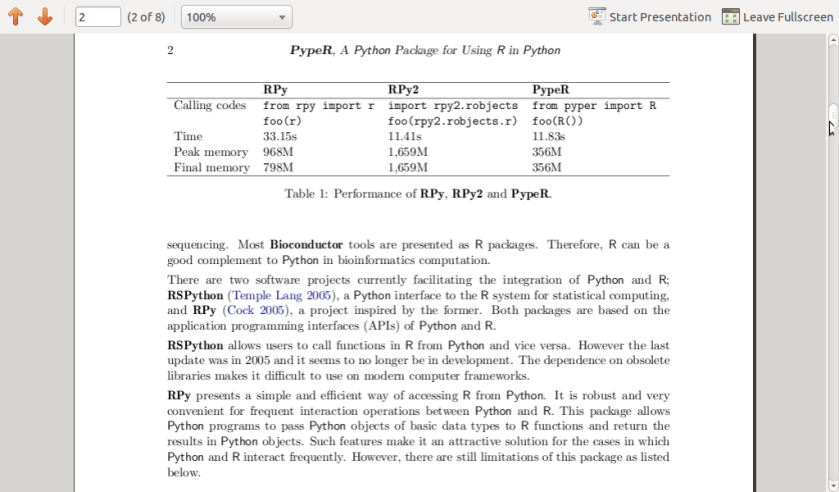
I came across this excellent JSS paper at www.jstatsoft.org/v35/c02/paper

on a Python package called PypeR which allows you to use R from within Python using the pipe functionality.

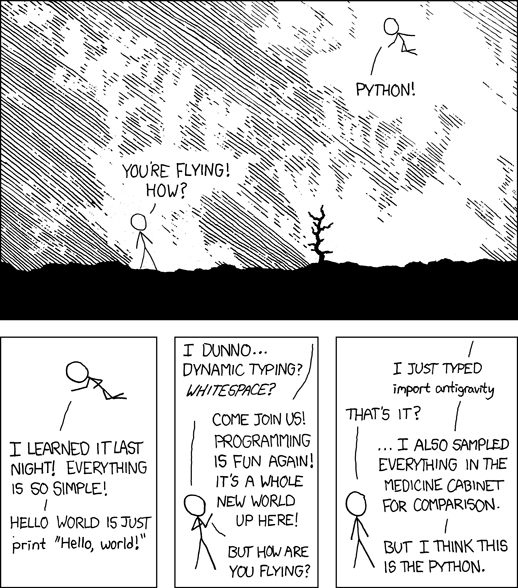
It is an interesting package and given Python’s increasing buzz , one worthy to be checked out by people using or thinking Python in their packages.


Citation:
	@article{Xia:McClelland:Wang:2010:JSSOBK:v35c02,
	  author =	"Xiao-Qin Xia and Michael McClelland and Yipeng Wang",
	  title =	"PypeR, A Python Package for Using R in Python",
	  journal =	"Journal of Statistical Software, Code Snippets",
	  volume =	"35",
	  number =	"2",
	  pages =	"1--8",
	  day =  	"30",
	  month =	"7",
	  year = 	"2010",
	  CODEN =	"JSSOBK",
	  ISSN = 	"1548-7660",
	  bibdate =	"2010-03-23",
	  URL =  	"http://www.jstatsoft.org/v35/c02",
	  accepted =	"2010-03-23",
	  acknowledgement = "",
	  keywords =	"",
	  submitted =	"2009-10-23",
	}