The SEO mess on joining blog aggregators


Mug shot of Paris Hilton.
Image via Wikipedia


If you are an analytics blogger who writes, and is aggregated on an analytical community- read on- Here’s how blog aggregation communities can help you lose 30% of all future traffic long term, while giving you a short term.

The problem is not created by Blogging Communities (like R-Bloggers, or PlanteR, or Smart Data Collective or AnalyticBridge or even BeyeBlogs )

It is created by the way Google Page Rank is structured- you see given exactly the same content on two different we pages- Google Page Rank will place the higher Page Rank results higher. This is counter intutive and quite simple to rectify- The Google Spider can just use the Time Stamp for choosing which article was published where first (Obviously on your blog, AND then later to the aggregator).

How bad is the mess? Well joining ANY blog aggregation will lead to an instant lift of upto 10-50 % of your current traffic as similar bloggers try and read about you. However you can lose the long term 30% proportion which is a benchmark of search engine created traffic for you.

So do you opt out of blog aggregation? No. It’s a SEO mess and it’s unfair to punish your blog aggregator, most of whom are running on ad-supported sponsors or their own funds on dry fumes to publish your content. Most of the fore mentioned communities are created by excellent people I interacted with heavily- and they are genuinely motivated to give readers an easy way to keep up with blogs. Especially Smart Data Collective, Analyticbridge and R-bloggers whose founders I have known personally.

You can do one thing- create manual summaries in the excerpt feature of your blog posts- it’s just below the WordPress page. And switch your RSS feed to summary rather than full. It avoids losing keyword rank to other websites, it prevents the Blog Aggregation from gaining too much influence in key word related searches, and it keeps your whole eco system happy, Best of All it helps readers of Blog Aggregators- since most of them use a summary on the front page anyways.

An additional thought on Google Page Rank- something I have sulked over but not spoken for a long long time.  It ignores the value of reader- If Bill Gates, Steve Jobs, and 500 ceos from Fortune 500 companies read my blog but do not link to it- it will count daily traffic as 500. Probably it will give more weightage to Paris Hilton fans.

A suggestion-humbly- you can use IP Address lookup of visitors to see if traffic is coming from corporate sources or retail sources -Clicky from GetClicky does this. Use it as feedback in Google Analytics as well as Google Trends.

And maybe PageRank needs to add quantity and quality of visitors as additional variables . Do a A/B test guys some Chi Square juice- its not quite Mad Men Adverting but its still good fun.


PageRank
Image via Wikipedia


and the world is one big community as per xkcd


Microsoft Online Games

No, this is not about the X Box kind of games. It is about Microsoft ‘s tactical shift in the online space from going it alone, and building stuff itself, –to partnering, and sometimes investing and exiting business.

In Blogs- It recently announced a migration of MS Live Spaces to WordPress.com – It gives Automattic 30 million more users- no small change consider there were 26 million existing WP users.

Microsoft Messenger, which is the oldest online app in the suite, now provides instant messaging services to about 350 million users, and from now on Windows Live Writer works specifically with the WordPress.com blog service by default. Hopefully Skype, and Google Voice will show MS the way to monitize that business app yet.

Google buying blogger-blogspot seems to have done little, but given Biz Stone room to create another content disruption-Twitter.

With the round of lawsuits by proxy, in Android -Motorola, or for acquisitions – MS is just doing what Marc Anderseen (who’s apparently a better VC than Paul Allen was), Sun and co did to it in the nineties.

Google seems to be regretting putting a spade in the Yahoo acquisition- that would have tied up a big chunk of Idle MS cash- leaving it little room for niche investments (like the 250 mill that helped Facebook ramp up in time).

The real surprise here could be Apple- it has shown little interest in cloud computing- and it seems to be testing the waters with Ping. But Apple sure smells competition- and Android is doing to Iphone what Windows did to the Mac in the early 1990’s.

Google lacks presence in online gaming (despite it’s own Zynga investment)- and needs to start monetizing properties like Android OS (say 10$ for every phone license ??), Google Maps (as an app for GPS) and Google Voice. Indeed it may be time for the big G to start thinking of spinning off atleast some products- earning better returns, while retaining control (dual stock splits) and killing those anti trust lawyer fees forever.

As the Ancient Chinese said, May you live in interesting times. Fun to watch the online games people play.


The auto-suggest link/tags for WP.com blogs

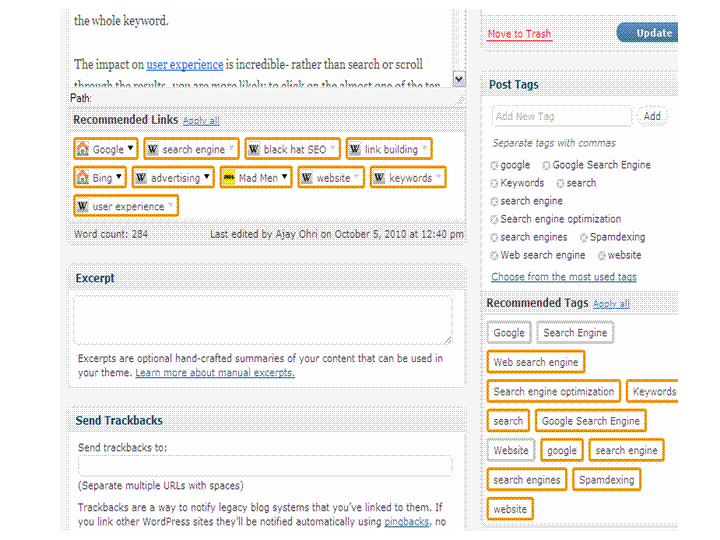
WordPress.com blogs have a great new option for generating tags, and links and thus improving their search engine optimization for posts.

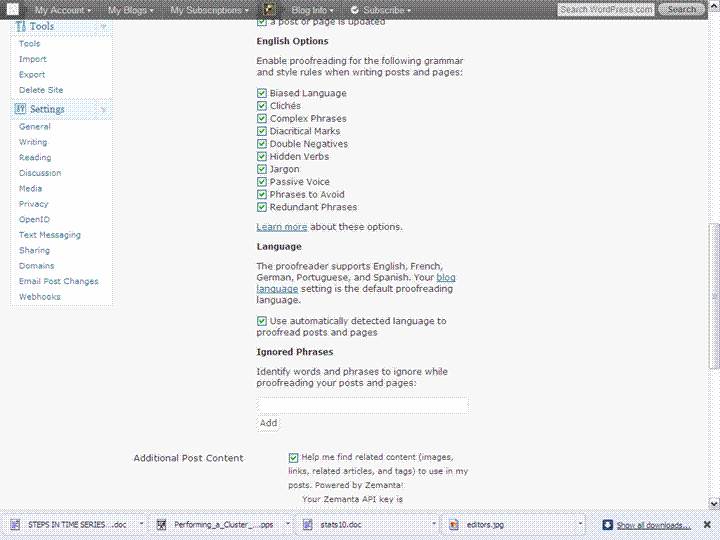
Just go to Users-Personal Settings- and check the options shown. Thats it every time you write a post it suggests links and tags. Links are helpful for your readers (like Wikipedia links to understand dense technical jargon, or associated websites). Tags help to classify your contents so that all visitors to the web site including spiders ,search engines and your readers can search it better.

The bad thing is I need to go back to all 1025 posts on this site and auto generate tags for the archives ! Oh well. Great collaboration between zementa and Automattic for this new feature.

Open Source and Software Strategy

Curt Monash at Monash Research pointed out some ongoing open source GPL issues for WordPress and the Thesis issue (Also see http://ma.tt/2009/04/oracle-and-open-source/ and  http://www.mattcutts.com/blog/switching-things-around/).

As a user of both going upwards of 2 years- I believe open source and GPL license enforcement are general parts of software strategy of most software companies nowadays. Some thoughts on  open source and software strategy-Thesis remains a very very popular theme and has earned upwards of 100,000 $ for its creator (estimate based on 20k plus installs and 60$ avg price)

  • Little guys like to give away code to get some satisfaction/ recognition, big guys give away free code only when its necessary or when they are not making money in that product segment anyway.
  • As Ethan Hunt said, ” Every Hero needs a Villian”. Every software (market share) war between players needs One Big Company Holding more market share and Open Source Strategy between other player who is not able to create in house code, so effectively out sources by creating open source project. But same open source propent rarely gives away the secret to its own money making project.
    • Examples- Google creates open source Android, but wont reveal its secret algorithm for search which drives its main profits,
    • Google again puts a paper for MapReduce but it’s Yahoo that champions Hadoop,
    • Apple creates open source projects (http://www.apple.com/opensource/) but wont give away its Operating Source codes (why?) which help people buys its more expensive hardware,
    • IBM who helped kickstart the whole proprietary code thing (remember MS DOS) is the new champion of open source (http://www.ibm.com/developerworks/opensource/) and
    • Microsoft continues to spark open source debate but read http://blogs.technet.com/b/microsoft_blog/archive/2010/07/02/a-perspective-on-openness.aspx and  also http://www.microsoft.com/opensource/
    • SAS gives away a lot of open source code (Read Jim Davis , CMO SAS here , but will stick to Base SAS code (even though it seems to be making more money by verticals focus and data mining).
    • SPSS was the first big analytics company that helps supports R (open source stats software) but will cling to its own code on its softwares.
    • WordPress.org gives away its software (and I like Akismet just as well as blogging) for open source, but hey as anyone who is on WordPress.com knows how locked in you can get by its (pricy) platform.
    • Vendor Lock-in (wink wink price escalation) is the elephant in the room for Big Software Proprietary Companies.
    • SLA Quality, Maintenance and IP safety is the uh-oh for going in for open source software mostly.
  • Lack of IP protection for revenue models for open source code is the big bottleneck  for a lot of companies- as very few software users know what to do with source code if you give it to them anyways.
    • If companies were confident that they would still be earning same revenue and there would be less leakage or theft, they would gladly give away the source code.
    • Derivative softwares or extensions help popularize the original softwares.
      • Half Way Steps like Facebook Applications  the original big company to create a platform for third party creators),
      • IPhone Apps and Android Applications show success of creating APIs to help protect IP and software control while still giving some freedom to developers or alternate
      • User Interfaces to R in both SAS/IML and JMP is a similar example
  • Basically open source is mostly done by under dog while top dog mostly rakes in money ( and envy)
  • There is yet to a big commercial success in open source software, though they are very good open source softwares. Just as Google’s success helped establish advertising as an alternate ( and now dominant) revenue source for online companies , Open Source needs a big example of a company that made billions while giving source code away and still retaining control and direction of software strategy.
  • Open source people love to hate proprietary packages, yet there are more shades of grey (than black and white) and hypocrisy (read lies) within  the open source software movement than the regulated world of big software. People will be still people. Software is just a piece of code.  😉

(Art citation-http://gapingvoid.com/about/ and http://gapingvoidgallery.com/

Creating a Blog Aggregator for free

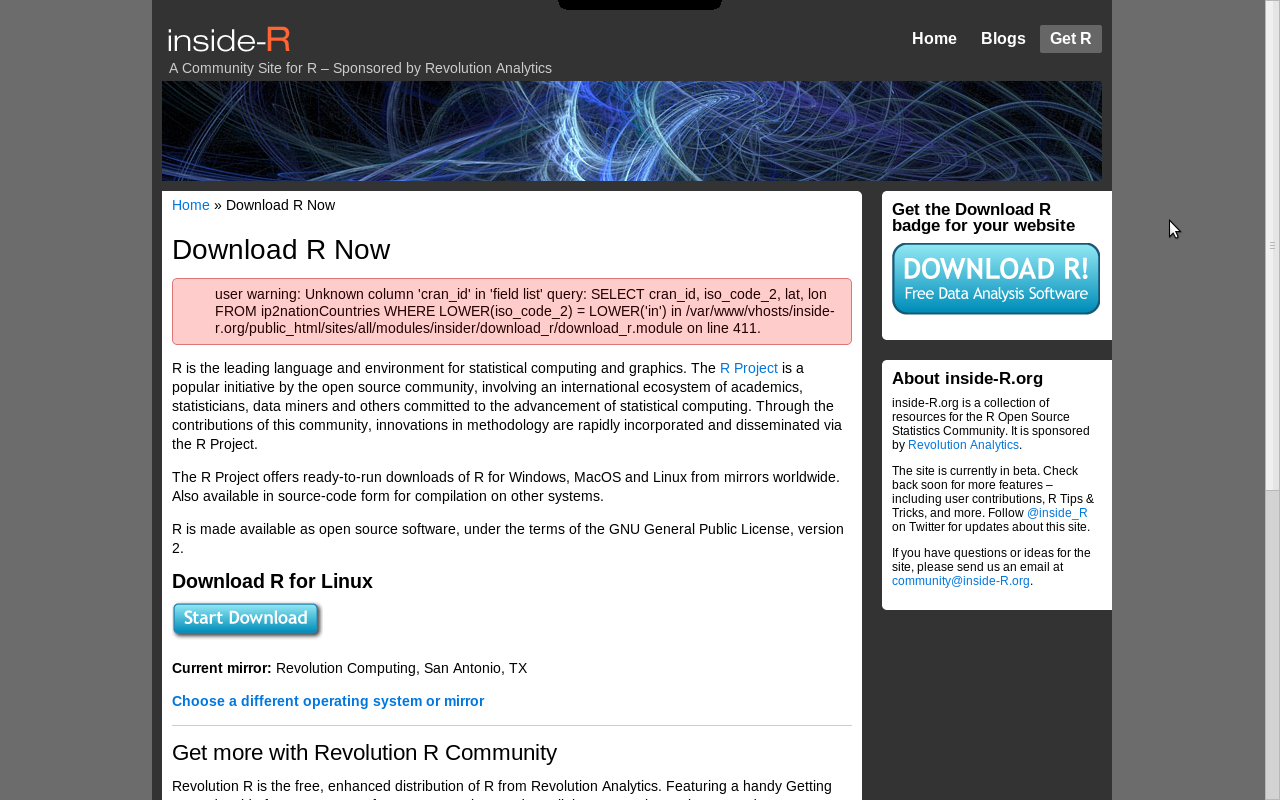
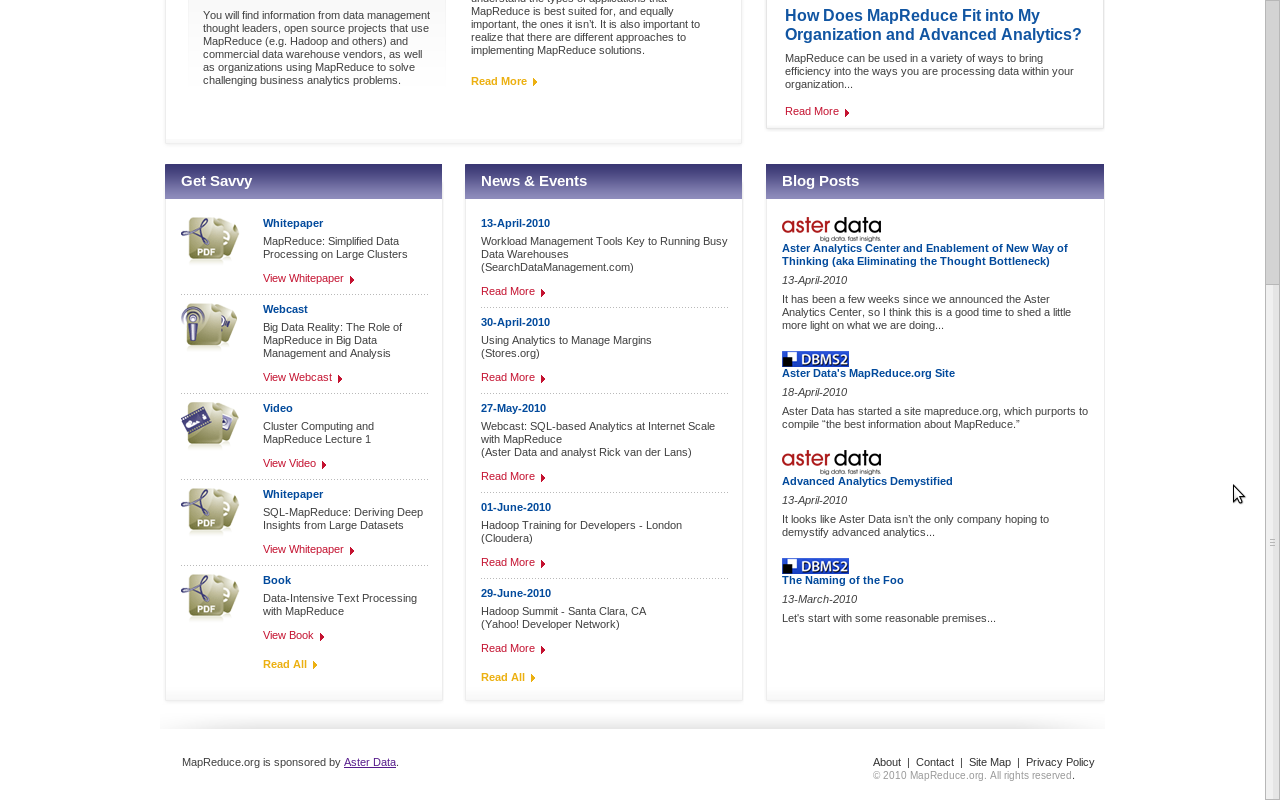
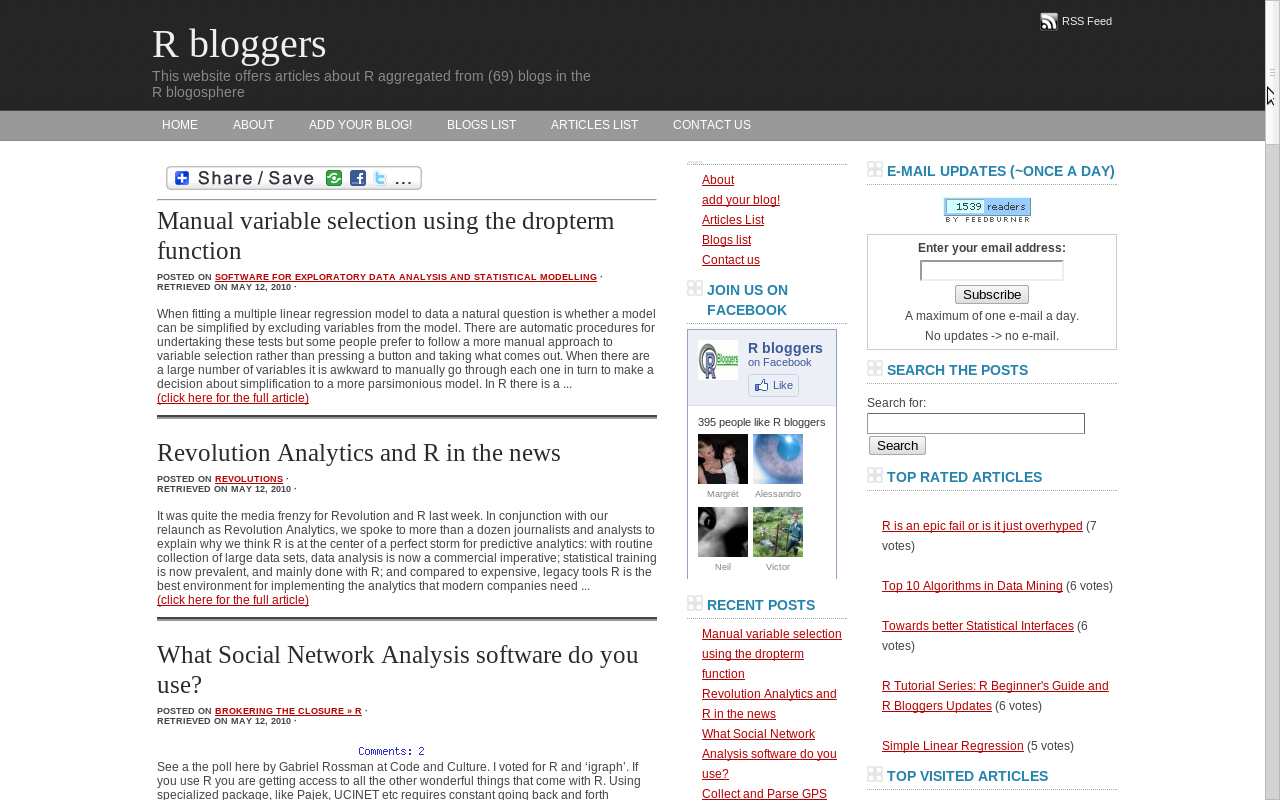
I discovered an increasing trend of Blog Aggregators ( Blog Lists have been around for a long time). Several sites come in this category- http://bigdatanews.com/ (which is a GreenPlum /AsterData sponsored site on Big Data) , http://mapreduce.org/ (which is a site on MapReduce that has an inbuilt blog aggregator but is more of a community website – I will explain the difference below) , http://www.r-bloggers.com/ (which is an excellent aggregation of 69 R Bloggers sites that is built by Tal and is currently not sponsored/independent) and http://smartdatacollective.com/ which is sponsored by Teradata and uses http://wordframe.com which is a paid software) and some others like http://www.biblogs.com/ (which is Adsense supported 🙂 ) and http://javablogs.com/Welcome.jspa (an aggregator on Java) (or even http://feministblogs.org/).

CMS Based Blog Aggregator

CMS Based Blog Aggregator/ Community Site

CMS Based Community Site with an inbuilt Blog Aggregator feed

I am noting blog aggregator as a distinct website that pulls in automated content from RSS feeds , may or maynot be moderated, and usually revolves around a certain domain or topic. It is slightly different from community websites which have Lists of Blogs as part of many other features, and boutique collection of blogs like http://www.b-eye-network.com/blogs/index.php

and Intelligent Enterprise ( http://intelligent-enterprise.informationweek.com/blog/index.jhtml) as they have selected authors and have more than Blogs as their featured content including News etc. Since community is a buzz word- many websites claim to be community websites while retaining the look and feel of a CMS- Blog Aggregator.

WordPress Enabled Blog Aggregator

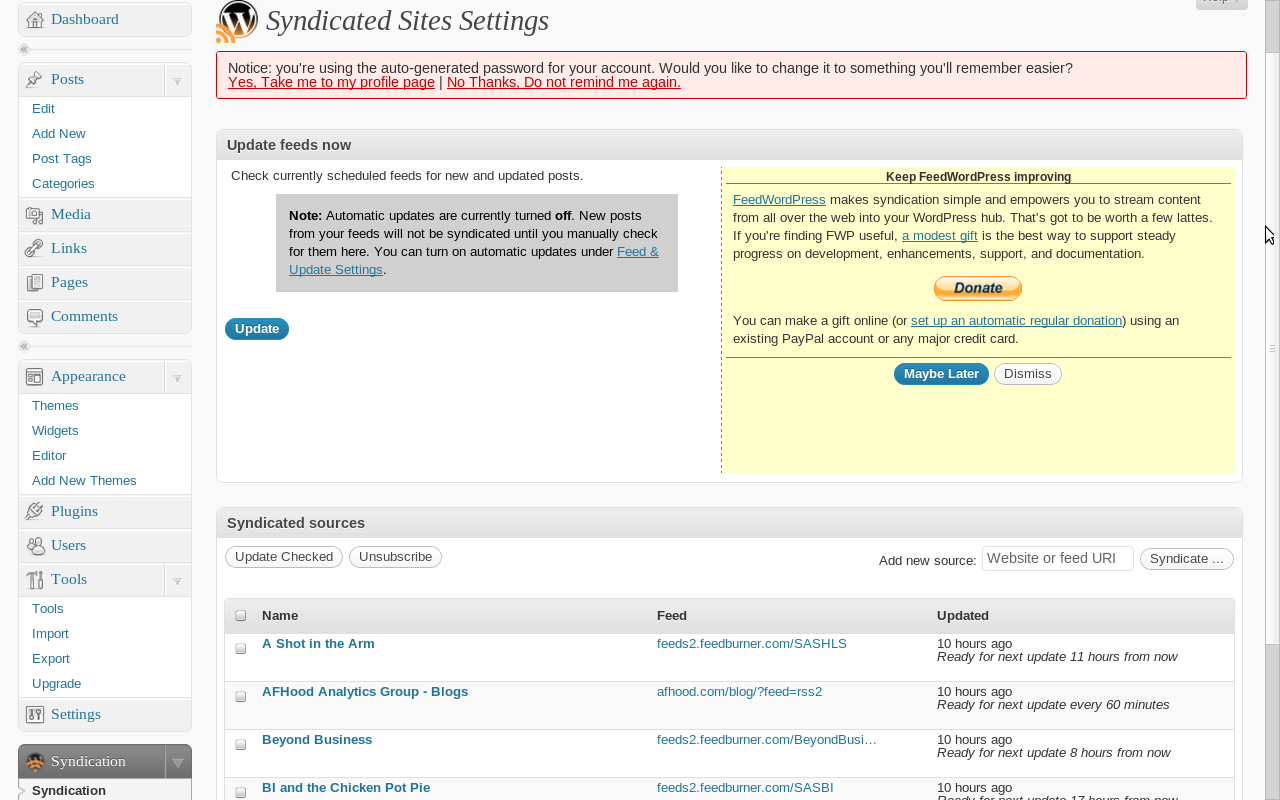
Anyways, if you have a WordPress Installation- you can create a Blog Aggregator for free. Basically there is a wordpress-plugin called FeedWordPress http://wordpress.org/extend/plugins/feedwordpress/

Doing so you can simply addin as many RSS feeds as you like –

(see a screenshot below).

Of course – you can use Twitterfeed to create a Twitter Aggregator/ Fire Hose that simply pulls in Post Titles, and can link them using Facebook-LinkedIn-Twitter apps to your RSS feed of the aggregated website. 🙂

Building a website /content aggregator is just a few clicks away and free for anyone with a website and some passion for a topic. It is really free and painless 🙂

Automated Content Aggregation

Here is a way to create Content Aggregator-

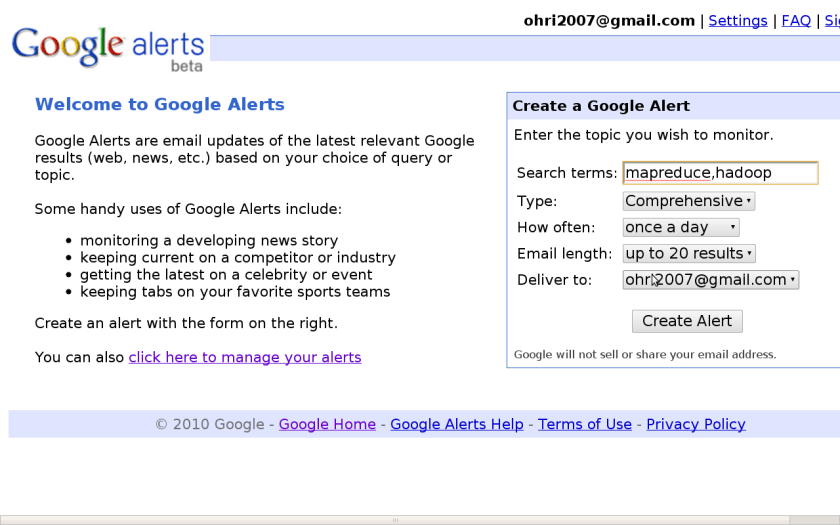
1) Create a Google Alert for keywords (like say MapReduce and Hadoop)

at http://google.com/alerts

2) Create a WordPress.com free blog and enable the Auto Post by Email Feature (using manage my blogs in Settings- Reading in Left Bottom Margin). This creates an email with random numbers that can enable you for sending emails and thus auto posting.

3) Create an Email Filter in your Gmail Account to auto forward this to the post by Email Account

Note you can thus create an auto aggregator and pick and choose for creating a Keyword specific or domain specific newsletter. It is all free and takes 15 minutes to set up, and is then automated.

Interview Sarah Blow – Girly Geekdom Founder

Here is an interview with Sarah Blow, community manager of the famous twitter startup TweetMeMe which is very popular to bloggers and founder of Girly Geek Dinners – a community effort to promote women in areas of technology and sciences.

Sarah tweets under the name Girly Geek while I tweet under the name Dude of Data, so I met her by chance on the Twitter.

Here is the interview-

1) Describe your career in science from high school to your present position.

That could take a while…. High School for me was split into Middle School for 2 years where Science was dull but practical and Secondary School where Science was a lot of fun and I set the table on fire in the chemistry lesson… My Chemistry teacher always reminds me how incendiary I am! and High School was up north for my A levels where I didn’t choose science subjects as I really wasn’t sure about the science teachers there. However at the last school I did an AS in computer science and it was my teacher there that recommended I considered a career in the technology industry. Originally I was considering law. As a young child I wanted to study law and go to Cambridge. As I grew up I guess things changed, I loved playing with my Commadore 64 and was good with databases etc so my natural progression was to Computer Science.

I didn’t study A Level maths so my options were somewhat limited however I got my first choice University placement at Manchester University (UMIST as it was then). Whilst there I won a scholarship to do my Masters of Enterprise in Computer Science and then went onto my first job as a Software Engineer at Cardinal Health. Then I started the Girl Geek Dinners and decided a change was in order in terms of my career as I found I was good at the community aspect of engaging people with technology. So I looked around for a while and then moved to my current position as Community Manager at TweetMeme.

B) What are the challenges and complexities in managing the community for Tweetmeme

TweetMeme has over 150 million buttons across hundreds of thousands of websites around the world crossing language, location, content management systems and server farms. As such it is my role to ensure those buttons are installed and working as the users require. That’s a LOT of users and a LOT of buttons to look after. I also support the developers that help to create the plugins for the different content management platforms and those using our API. The complexities of all this are the different languages, implementations, levels of understanding of code and template editing as well as the conversational language translations. In my case I speak and can understand French, some German, some Spanish and some Italian. However Google Translate is my friend!

I also communicate with the press and news services, put announcements up on our blog site, and create the support documentation found in our help area and on our forums. When users feedback comments and suggestions I also represent them and their views within technical meetings and in the design decision process. So really my role is incredibly varied and covers a real range of things.

2) Why are there so few women in science compared to other fields- even though it is quite a lucrative profession.

I think there are many barriers from when you grow up and what your parents expect you to do as a career, through to career advice at schools through to what options you choose at GCSE and what maths paper you do (higher or lower) as these do have a big impact on what doors you leave open or close. I also believe personal choice and interest areas have a lot to do with what you consider as a potential career option. Many people just don’t consider computing as a career these days as computers are fundamental to all jobs.

When you look at what jobs you considered as a young child did you aspire to be the next Bill Gates or was it more likely a fighter pilot, fireman or something similarly heroic. Many females look to nursing/ doctor roles as their heroic roles or law where they can put baddies behind bars. Many look to vetinary sciences or forensic science too.

What you aren’t told as a child is where there are heroic jobs in the real world that can lead you to do wonderful things and yet still be able to make money and have fun!

3) Describe your work at GirlyGeekdom on promoting women geeks. ( or women in science careers)

This question mentions specifically the GirlyGeekdom site http://girlygeekdom.com which was a blog site that I created a few years ago after starting Girl Geek Dinners where I could create and bring together interesting geeky content to inspire others to use, play with and enjoy. I wanted to create a fun and energetic environment where anyone male or female could feel like they were in a little geeky world. Which is where the name of the site GirlyGeekdom came from. The promotion of women geeks is only part of what we do on the site but it does bring together issues from around the world and hopefully move beyond that to bring sensible conclusions and a route forward. One thing I didn’t want the site to be was a list of complaints and issues with no attempt at finding solutions.

To help encourage more females into the industry we let them know about awards and intiatives that identify great female role models. We interview interesting people from the tech industry when we come across them and place them into our inspire series of video’s. We also have regular competitions supported by industry sponsors to get young people interacting with our site. We have both serious and non-serious content and we have a range of volunteer writers from around the world submitting great inspirational articles.

4) What are some tools you can recommend for getting un interested students interested in science careers.

One of the great recent tools to get young people interested in science based careers is to mix some of the things they already love doing with science. So for example recently I was introduced to the Manga Guide series which is basically a merge of manga stories with scientific based content in a fun non-science based story approach. This sort of thing is great for getting those who haven’t considered science as fun to look at it in a different way but still with the opportunity to learn more about it!

Other tools include advice on how to work your way through the University Clearing process, including all the links to useful sites recommended by the UK govornment etc. If you don’t get your first choices for uni, then why you should consider computer science or similar subjects as a suitable alternative!

5) How important is work life balance for you? What do you do to de stress.

Work life balance is very important to me and I get a LOT of requests on my time regarding both GirlyGeekdom, Girl Geek Dinners, my day job, friends, family and my hobbies. As such I have to tread a very fine balancing act to ensure that I meet expectations in all of those areas. A large part of doing that is actually to set reasonable expectations with each group of people with regard to my time and availability. I’m actually very lucky as my work isn’t too far from home and as such I do get to spend time there.

I work for a start up company called TweetMeme as their Community Manager so I’m on the internet daily looking after their community. I also do a lot of things outside of that. I tend to rest at lunchtime and take the breaks that I need. I don’t tend to work through every break I get as I’ve tried that in the past and that just tires me out. Instead I tend to time box things. So work is generally my standard office hours. I use my phone for emails on the go and tend to keep up with those then and when I’m at home cooking my tea! (Multi tasking works well!) I keep weekends free for friends and family as much as I can and evenings are a combination of GirlyGeekdom, Girl Geek Dinners, social events for work and spending time with family or relaxing.

In terms of what I do to de-stress… I do a range of things. I’m a member of a really nice gym which has some beautiful swimming pools which I love! So you’ll find me in the gym or the pool if it’s been a particularly crazy week. Or alternatively enjoying a good film at home or a good book and some relaxing music. Then at the weekends you’ll find me doing the more fun stuff that takes time to do! So I’m into rock climbing, white water kayaking, kite surfing and diving. In the summer I also get back into my roller blading!

6) Can we expect a Girly Geekdom in United States. What about a book?

In terms of a GirlyGeekdom in the US… well if someone from the US wants to write on the site they are always welcome, they just need to ask. We already have Girl Geek Dinners out there in 9 different locations, so there’s nothing to stop more of them happening. I’d love to do a Girl Geek conference which may well be called GirlyGeekdom but I don’t think that will be 2010… but it could be a 2011 possibility! As for a book! That’s an interesting question. I’ve considered it but right now I don’t have the time to write one, so if I did then it would probably be a combination of blog posts and ideas or the how to guide on GIrl Geek Dinners.

About SARAH-

Contacts who are into the new media space can contact her through Twitter or via LinkedIn. For those who are into the more traditional channels of communication then you can contact Sarah via e-mail. A more detailed perspective is given on her blog here.