Broad Guidelines for Graphs

Here are some broad guidelines for Graphs from EIA.gov , so you can say these are the official graphical guidelines of USA Gov

They can be really useful for sites planning to get into the Tableau Software/NYT /Guardian Infographic mode- or even for communities of blogs that have recurrent needs to display graphical plots- particularly since communication, statistical and design specialists are different areas/expertise/people.

Energy Information Administration Standard

Broad Guidelines for Graphs-I am reproducing an example from EIA ‘s guidelines for graphs-
http://www.eia.gov/about/eia_standards.cfm#Standard25

Energy Information Administration Standard 2009-25

Title: Statistical Graphs
Superseded Version: Standard 2002-25
Purpose: To ensure the utility (usefulness to intended users) and objectivity (accuracy, clarity, completeness, and lack of bias) of energy information presented in statistical graphs.
Applicability: All EIA information products.
Required Actions:

  1. Graphs should be used to show and compare changes, trends and/or relationships, and to assist users in visualizing the conclusions drawn from the data represented.
  2. A graph should contain sufficient Continue reading “Broad Guidelines for Graphs”

Top Ten Business Analytics Graphs-Line Charts (2/10)

A line chart is one of the most commonly used charts in business analytics and metrics reporting. It basically consists of two variables plotted along the axes with the adjacent points being joined by line segments. Most often used with time series on the x-axis, line charts are simple to understand and use.
Variations on the line graph can include fan charts in time series which include joining line chart of historic data with ranges of future projections. Another common variation is to plot the linear regression or trend line between the two variables  and superimpose it on the graph.
The slope of the line chart shows the rate of change at that particular point , and can also be used to highlight areas of discontinuity or irregular change between two variables.

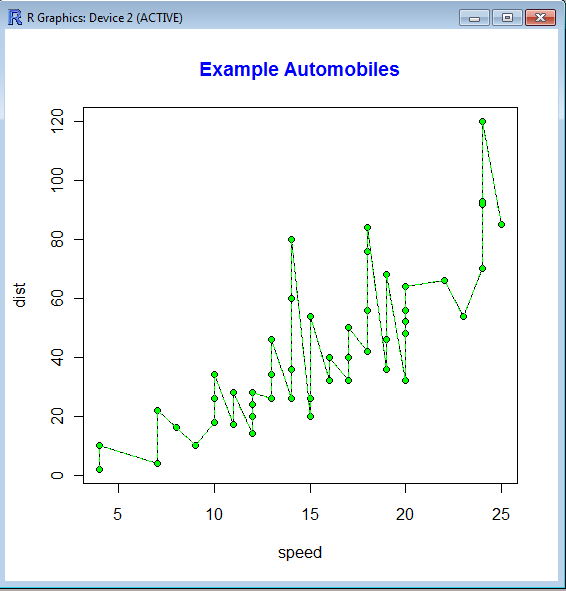
The basic syntax of line graph is created by first using Plot() function to plot the points and then lines () function to plot the lines between the points.

> str(cars)
‘data.frame’:   50 obs. of  2 variables:
$ speed: num  4 4 7 7 8 9 10 10 10 11 …
$ dist : num  2 10 4 22 16 10 18 26 34 17 …
> plot(cars)
> lines(cars,type=”o”, pch=20, lty=2, col=”green”)
> title(main=”Example Automobiles”, col.main=”blue”, font.main=2)

An example of Time Series Forecasting graph  or fan chart is http://addictedtor.free.fr/graphiques/RGraphGallery.php?graph=51

Contest for SAS Users and Students

Heres a new contest for SAS users. The prizes are books, so students should be interested as well.

From http://www.sascommunity.org/mwiki/images/b/bc/PointsforprizesRules.pdf

HOW TO ENTER: To qualify for entry, go to the sasCommunity.org web site located at http://www.sascommunity.org/wiki/Main_Page
between April 11, 2011 and May 9, 2011 and either add or edit valid content as described herein to earn award points.
Creation of a first time profile on www.sascommunity.org will earn 1,000 points. For each valid article creation or edit, 100
points will be earned. Articles and subsequent edits should adhere to the sasCommunity.org terms of use as outlined on
http://www.sascommunity.org/wiki/sasCommunity:Terms_of_Use. All points’ accumulation will end at 5:00 PM GMT on
May 9, 2011 and only those points earned between 8:00 AM GMT on April 11, 2011 and 5:00 PM GMT on May 9, 2011
will be counted in this contest. Contest entries made through the Internet will be declared made by the registered user of
the sasCommunity.org profile account. Sponsor is not responsible for phone, technical, network, electronic, computer
hardware or software failures of any kind, misdirected, incomplete, garbled or delayed transmissions. Sponsor will not be
responsible for incorrect or inaccurate entry information, whether caused by entrants or by any of the equipment or
programming associated with or utilized in the contest.
ELIGIBILITY: The contest is open to all sasCommunity.org members 18 year of age or older on the start date of the
contest. Void where prohibited by law. Employees (including immediate family members and/or those living in the same 
household of each), the Sponsor, members of the sasCommunity.org Advisory Board, SAS Global Users Group Executive 
Board, their advertising, promotion and production agencies, the affiliated companies of each, and the immediate family 
members of each are not eligible. 

PRIZE: Three (3) prizes will be awarded based on total points accumulated during the contest as follows:
 1stPlace: 3 SAS®Press books - not to exceed $250 in combined retail value;
 2ndPlace: 2 SAS®Press books - not to exceed $150 in combined retail value; and
 3rdPlace: 1 SAS®Press book - not to exceed $100 in retail value.

What’s New

http://www.sascommunity.org/wiki/Main_Page

New Points for Prizes Contest
Points for Prizes Contest
Win SAS books!
Contribute content or SAS code to sasCommunity.org for your chance to WIN! To qualify, simply add or edit articles between April 11, 2011 and May 9, 2011 (GMT). Creation of a first-time profile on sasCommunity.org gives you 1,000 points. For each valid article creation or edit, 100 points will be earned. The user with the most points collected during this time wins SAS Press Books!

Become a sasCommunity Guru
Thanks for Contributing to sasCommunity.org!
New sasCommunity.org Point System
The sasCommunity support team has been hard at work adding new features and is pleased to announce a points system that recognizes each user’s contributions to the site. Every time you contribute by creating a page, updating it, or just doing a little wiki gardening, you earn points.Earning points is automatic and simple – all you have to do is contribute! Creating your account starts you with 1000 points and all the current users have been credited with points dating back to the site coming online in April 2007.

The Lover: A Poem


The Lover

Your emerald eyes,

Like dewdrops glistening on green grass.

The shine in them,

Is like the twinkling of the stars.

You’re ivory skin,

Reminds me of the moonlight.

Like a gorgeous lily

Colored in silvery white.

Your sunkissed hair,

Blowing gently in the breeze.

I do not look long,

My breath may freeze.

You’re sideways glance,

As sharp as a knife.

Like a Greek goddess or a marble sculpture,

Brought to life.

Your poise, your grace,

Guides my moving pen.

Your beauty brings out,

The poet within.

The tinkle of your soft voice remains in my ears,

Long after you are long gone.

Your memory drives me crazy,

Makes me want to break out in a song.


Alas, my dear

I am in love with your beauty

But not with you.

This sounds like an obsession,

For this love is not true.

I am a passionate man,

With much passion to spare.

As soon as you leave my thoughts,

Someone else is already there.


Top Ten Graphs for Business Analytics -Pie Charts (1/10)

I have not been really posting or writing worthwhile on the website for some time, as I am still busy writing ” R for Business Analytics” which I hope to get out before year end. However while doing research for that, I came across many types of graphs and what struck me is the actual usage of some kinds of graphs is very different in business analytics as compared to statistical computing.

The criterion of top ten graphs is as follows-

1) Usage-The order in which they appear is not strictly in terms of desirability but actual frequency of usage. So a frequently used graph like box plot would be recommended above say a violin plot.

2) Adequacy- Data Visualization paradigms change over time- but the need for accurate conveying of maximum information in a minium space without overwhelming reader or misleading data perceptions.

3) Ease of creation- A simpler graph created by a single function is more preferrable to writing 4-5 lines of code to create an elaborate graph.

4) Aesthetics– Aesthetics is relative and  in addition studies have shown visual perception varies across cultures and geographies. However , beauty is universally appreciated and a pretty graph is sometimes and often preferred over a not so pretty graph. Here being pretty is in both visual appeal without compromising perceptual inference from graphical analysis.


so When do we use a bar chart versus a line graph versus a pie chart? When is a mosaic plot more handy and when should histograms be used with density plots? The list tries to capture most of these practicalities.

Let me elaborate on some specific graphs-

1) Pie Chart- While Pie Chart is not really used much in stats computing, and indeed it is considered a misleading example of data visualization especially the skewed or two dimensional charts. However when it comes to evaluating market share at a particular instance, a pie chart is simple to understand. At the most two pie charts are needed for comparing two different snapshots, but three or more pie charts on same data at different points of time is definitely a bad case.

In R you can create piechart, by just using pie(dataset$variable)

As per official documentation, pie charts are not  recommended at all.

http://stat.ethz.ch/R-manual/R-patched/library/graphics/html/pie.html

Pie charts are a very bad way of displaying information. The eye is good at judging linear measures and bad at judging relative areas. A bar chart or dot chart is a preferable way of displaying this type of data.

Cleveland (1985), page 264: “Data that can be shown by pie charts always can be shown by a dot chart. This means that judgements of position along a common scale can be made instead of the less accurate angle judgements.” This statement is based on the empirical investigations of Cleveland and McGill as well as investigations by perceptual psychologists.

—-

Despite this, pie charts are frequently used as an important metric they inevitably convey is market share. Market share remains an important analytical metric for business.

The pie3D( ) function in the plotrix package provides 3D exploded pie charts.An exploded pie chart remains a very commonly used (or misused) chart.

From http://lilt.ilstu.edu/jpda/charts/chart%20tips/Chartstip%202.htm#Rules

we see some rules for using Pie charts.


  1. Avoid using pie charts.
  2. Use pie charts only for data that add up to some meaningful total.
  3. Never ever use three-dimensional pie charts; they are even worse than two-dimensional pies.
  4. Avoid forcing comparisons across more than one pie chart


From the R Graph Gallery (a slightly outdated but still very comprehensive graphical repository)

http://addictedtor.free.fr/graphiques/RGraphGallery.php?graph=4

par(bg="gray")
pie(rep(1,24), col=rainbow(24), radius=0.9)
title(main="Color Wheel", cex.main=1.4, font.main=3)
title(xlab="(test)", cex.lab=0.8, font.lab=3)
(Note adding a grey background is quite easy in the basic graphics device as well without using an advanced graphical package)


Delay Deny Obfuscate

Picture of the "Anonymous Hate Crimes&quo...
Image via Wikipedia


delay deny obfuscate
remember all the promises you break
and all the love you fake
aint no piece of cake

even though the oaths you take
became lines in sand that you stake
cleaning the leaves of time you rake
much depends on the choices you make

going on anon till this rhythm i must break
sometimes you know when it is too much to take
mourning now in your personal life’s wake
you earned this trip to the melancholy lake

how much more how long till you break
down and confess your appearances are fake
you never anyone except your ego to partake
on your thirst for glory to slake

delay deny obfuscate
delude spin and permeate
love is good and addictive but so is hate
much depends on what all you rate

fear uncertainty doubt and cloud
are your companions most profound
is it just today or were

you always this loud


What to do if you see a possible GPL violation

GNU Lesser General Public License
Image via Wikipedia

Well I have played with software (mostly but not exclusively) analytical, and I admire the zeal and energy of both open source and closed source practioners- all having relatively decent people executing strategies their investors or owners tell them to do (closed source) or motivated by their own self sense of cool-change the world-openness (open source)

What I dont get is people stealing open source code- repackaging without adding major contributions- claiming patent pending stuff- and basically making money by creating CLOSED source from the open source software-(as open source is yet to break the enterprise glass cieling)

you are either open source or you arent.

bi- sexuality is okay. bi-codability is not.

Next time you see someone stealing some community’s open source code- refer to this excellent link.


But, we cannot act on our own if we do not hold copyright. Thus, be sure to find out who the copyright holders of the software are before reporting a violation.

http://www.gnu.org/licenses/gpl-violation.html

Violations of the GNU Licenses

If you think you see a violation of the GNU GPLLGPLAGPL, or FDL, the first thing you should do is double-check the facts:

  • Does the distribution contain a copy of the License?
  • Does it clearly state which software is covered by the License? Does it say anything misleading, perhaps giving the impression that something is covered by the License when in fact it is not?
  • Is source code included in the distribution?
  • Is a written offer for source code included with a distribution of just binaries?
  • Is the available source code complete, or is it designed for linking in other non-free modules?

If there seems to be a real violation, the next thing you need to do is record the details carefully:

  • the precise name of the product
  • the name of the person or organization distributing it
  • email addresses, postal addresses and phone numbers for how to contact the distributor(s)
  • the exact name of the package whose license is violated
  • how the license was violated:
    • Is the copyright notice of the copyright holder included?
    • Is the source code completely missing?
    • Is there a written offer for source that’s incomplete in some way? This could happen if it provides a contact address or network URL that’s somehow incorrect.
    • Is there a copy of the license included in the distribution?
    • Is some of the source available, but not all? If so, what parts are missing?

The more of these details that you have, the easier it is for the copyright holder to pursue the matter.

Once you have collected the details, you should send a precise report to the copyright holder of the packages that are being misused. The copyright holder is the one who is legally authorized to take action to enforce the license.

If the copyright holder is the Free Software Foundation, please send the report to <license-violation@gnu.org>. It’s important that we be able to write back to you to get more information about the violation or product. So, if you use an anonymous remailer, please provide a return path of some sort. If you’d like to encrypt your correspondence, just send a brief mail saying so, and we’ll make appropriate arrangements.

Note that the GPL, and other copyleft licenses, are copyright licenses. This means that only the copyright holders are empowered to act against violations. The FSF acts on all GPL violations reported on FSF copyrighted code, and we offer assistance to any other copyright holder who wishes to do the same.

But, we cannot act on our own if we do not hold copyright. Thus, be sure to find out who the copyright holders of the software are before reporting a violation.