
Open Source Business Intelligence: Pentaho and Jaspersoft

Here are two products that are used widely for Business Intelligence_ They are open source and both have free preview.

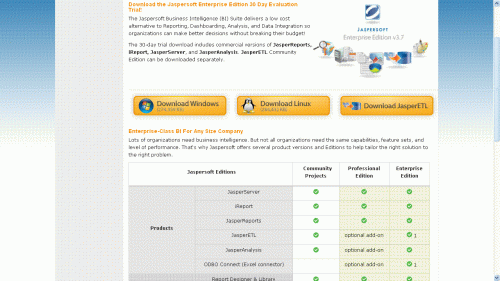
Jaspersoft-For the Enterprise version click on the screenshot while for the free community version you can go to

http://jasperforge.org/projects/jasperserver
Interestingly (and not surprisingly) Revolution Analytics is teaming up with Jaspersoft to use R for reporting along with the Jaspersoft BI stack.

ADVANCED ANALYTICS ON DEMAND IN APPLICATIONS, IN DASHBOARDS, AND ON THE WEB

FREE WEBINAR WEDNESDAY, SEPTEMBER 22ND @9AM PACIFIC

DEPLOYING R: ADVANCED ANALYTICS ON DEMAND IN APPLICATIONS, IN DASHBOARDS, AND ON THE WEB

A JOINT WEBINAR FROM REVOLUTION ANALYTICS AND JASPERSOFT

Date: Wednesday, September 22, 2010
Time: 9:00am PDT (12:00pm EDT; 4:00pm GMT)
Presenters: David Smith, Vice President of Marketing, Revolution Analytics
Andrew Lampitt, Senior Director of Technology Alliances, Jaspersoft
Matthew Dahlman, Business Development Engineer, Jaspersoft
Registration: Click here to register now!

R is a popular and powerful system for creating custom data analysis, statistical models, and data visualizations. But how can you make the results of these R-based computations easily accessible to others? A PhD statistician could use R directly to run the forecasting model on the latest sales data, and email a report on request, but then the process is just going to have to be repeated again next month, even if the model hasn’t changed. Wouldn’t it be better to empower the Sales manager to run the model on demand from within the BI application she already uses—daily, even!—and free up the statistician to build newer, better models for others?

In this webinar, David Smith (VP of Marketing, Revolution Analytics) will introduce the new “RevoDeployR” Web Services framework for Revolution R Enterprise, which is designed to make it easy to integrate dynamic R-based computations into applications for business users. RevoDeployR empowers data analysts working in R to publish R scripts to a server-based installation of Revolution R Enterprise. Application developers can then use the RevoDeployR Web Services API to securely and scalably integrate the results of these scripts into any application, without needing to learn the R language. With RevoDeployR, authorized users of hosted or cloud-based interactive Web applications, desktop applications such as Microsoft Excel, and BI applications like Jaspersoft can all benefit from on-demand analytics and visualizations developed by expert R users.

To demonstrate the power of deploying R-based computations to business users, Andrew Lampitt will introduce Jaspersoft commercial open source business intelligence, the world’s most widely used BI software. In a live demonstration, Matt Dahlman will show how to supercharge the BI process by combining Jaspersoft and Revolution R Enterprise, giving business users on-demand access to advanced forecasts and visualizations developed by expert analysts.

Click here to register for the webinar.

Speaker Biographies:

David Smith is the Vice President of Marketing at Revolution Analytics, the leading commercial provider of software and support for the open source “R” statistical computing language. David is the co-author (with Bill Venables) of the official R manual An Introduction to R. He is also the editor of Revolutions (http://blog.revolutionanalytics.com), the leading blog focused on “R” language, and one of the originating developers of ESS: Emacs Speaks Statistics. You can follow David on Twitter as @revodavid.

Andrew Lampitt is Senior Director of Technology Alliances at Jaspersoft. Andrew is responsible for strategic initiatives and partnerships including cloud business intelligence, advanced analytics, and analytic databases. Prior to Jaspersoft, Andrew held other business positions with Sunopsis (Oracle), Business Objects (SAP), and Sybase (SAP). Andrew earned a BS in engineering from the University of Illinois at Urbana Champaign.

Matthew Dahlman is Jaspersoft’s Business Development Engineer, responsible for technical aspects of technology alliances and regional business development. Matt has held a wide range of technical positions including quality assurance, pre-sales, and technical evangelism with enterprise software companies including Sybase, Netonomy (Comverse), and Sunopsis (Oracle). Matt earned a BA in mathematics from Carleton College in Northfield, Minnesota.


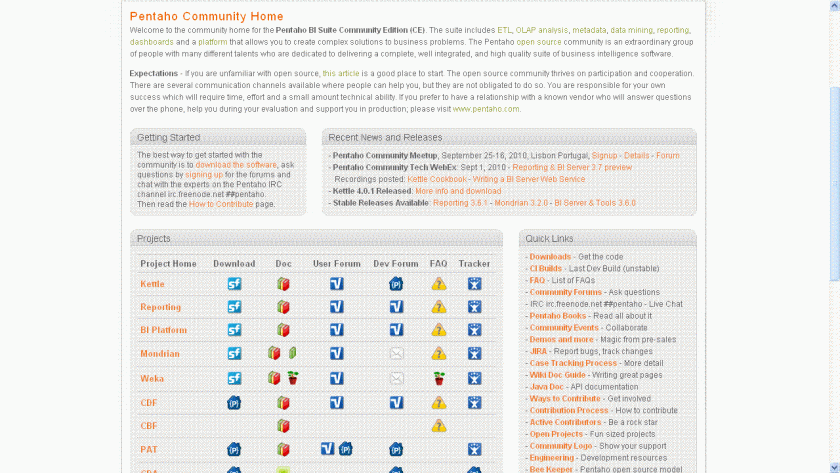
The second widely used BI stack in open source is Pentaho.

You can download it here to evaluate it or click on screenshot to read more at
http://community.pentaho.com/

http://sourceforge.net/projects/pentaho/files/Business%20Intelligence%20Server/

Data Mining 2010:SAS Conference in Vegas

An interesting conference which I attended last year, this year one of the main guests is an ex professor of mine at UTenn. I am India bound this year though for family reasons.

http://www.sas.com/events/dmconf/over.html

Latest News

Early Bird Special
Register for M2010 before Sept. 17 and save $200 on conference fees!

Additional Data Mining Resources
Find additional data mining resouces including links to whitepapers, webinars, audio seminars, videos, blogs and online communities.

Location
Caesars Palace
Las Vegas, NV

Conference: October 25-26
Pre-conference workshops: October 24
Post-conference training: October 27-29

The M2010 Data Mining Conference is an international educational conference and exhibition for data mining practitioners including analysts, statisticians, programmers, consultants and anyone involved with data management within their organization, Hosted by SAS, M2010 is now in its 13th year and has become the world’s largest data mining conference, attracting over 600 people from various industries including Financial Services, Retail, Insurance, Technology, Education, Healthcare, Pharmaceutical, Government and more.

This conference is the top-choice for serious education and career networking. Conference highlights include

  • 6 keynotes
  • 36 sessions
  • 6 session tracks
  • exhibit hall
  • poster session
  • SAS software training
  • educational workshops
  • special events
  • networking opportunities
  • predictive modeling certification testing event.

Session Topics

  • Business applications
  • Data augmentation
  • Perspectives from the financial services industry
  • Fraud detection
  • Perspectives from the healthcare industry
  • New and emerging technologies
  • Perspectives from the retail industry
  • Data mining in marketing
  • Retention and Life Cycle Analysis
  • Text mining
  • And more! (View session abstracts.)

Aster Data hires Quentin Gallivan as CEO

AsterData formally marked phase 2 of it’s rapid growth story by getting as new CEO Quentin Gallivan (of Postini before it was sold to Google and also Pivotlink).

Founders (and Stanfordians) Mayan Bawa stays as Chief Customer Officer and Tasso Argyros as CTO. It has a very deja vu feel -like Eric Schmidt coming in CEO of Google in the glory days past.  Indeed the investment team in Google and AsterData is quite similar and so are the backgrounds of the founders.

AsterData of course creates the leading MapReduce (also created by Google) solution for providing BI infrastructure for big data and has been rapidly been expanding into new frontiers for Big Data.

Aster Data Appoints New Chief Executive Officer

Quentin Gallivan Joins Aster Data as CEO to Lead Company to Next Level of Growth

San Carlos, CA – September 9, 2010– Aster Data, a proven leader dedicated to providing the best data management and data processing platform for big data management and analytics, today announced the appointment of Quentin Gallivan as President and CEO. Gallivan brings more than 20 years of senior executive experience to the leading analytics and database company. With Aster Data achieving tremendous growth in the past year, Gallivan will take Aster Data to the next level, further accelerating its market leadership, sales, channel partnerships and international expansion.  Founding CEO Mayank Bawa, who grew the company from its inception based on the founders’ research at Stanford University, and whose passion for helping customers uniquely unlock the value of their data, will take on the role of Chief Customer Officer.  Bawa, in his new role, will lead the Company’s organization devoted to ensuring the success, longevity and innovation of its fast-growing customer base. Together, Gallivan and Bawa, along with co-founder and Chief Technology Officer, Tasso Argyros, will deliver on the the Company’s mission to help customers discover more value from their data, achieve deep insights through rich analytics and do more with their massive data volumes than has ever been possible.

Gallivan joins Aster Data with over 20 years of leadership experience in the high-tech industry and has held a variety of CEO and senior executive positions with leading technology companies. Before joining Aster Data, Gallivan served as CEO at PivotLink, the leading provider of business intelligence (BI) solutions delivered via Software as a Service (SaaS), where he rapidly grew the company to over 15,000 business users, from mid-sized companies to Fortune 1000 companies, across key industries including financial services, retail, CPG manufacturing and high technology. Prior to Pivotlink, Gallivan served as CEO of Postini where he scaled the company to 35,000 customers and over 10 million users until its eventual acquisition by Google in 2007.  Gallivan also served as executive vice president of worldwide sales and services at VeriSign where he was instrumental in growing the business from $20 million to $1.2 billion and was responsible for the design and execution of the global distribution strategy for the company’s security and services business. Gallivan also held a number of key executive and leadership positions at Netscape Communications and GE Information Services.

“We are delighted to have someone of Quentin’s caliber, who is a veteran of both emerging and established technology companies, lead Aster Data through our next stage of growth,” said Mayank Bawa, Chief Customer Officer and co-founder, Aster Data. “His significant experience around growing organizations and driving operational excellence will be invaluable as he takes Aster Data forward. I’m excited to shift my focus to customers and their success; to bring our innovations to our customers worldwide to help them unlock deep value from their growing data volumes.”

“I am very excited to be joining Aster Data and taking on the challenge of augmenting its already impressive level of growth and success.  Aster Data is very well respected and established in the marketplace, has an enviable solution for big data management that uniquely addresses both big data storage and data processing, an impressive client list and a very talented team,” said Quentin Gallivan, President and CEO, Aster Data. “My task will be to leverage these assets, help shape a new market and provide operational guidance and strategic direction to drive even greater value for shareholders, customers and employees alike.”

Rapid Miner- R Extension

Here is a new video which shows exactly how you can use Rapid Miner and R together. Advantages of using both together is using Rapid Miner’s GUI (including the flowchart style for data mning) and adding R statistical functionality to it.

From http://rapid-i.com/content/view/219/1/

The web site features a video showing how easy R models and scripts can be integrated into the RapidMiner analysis processes. RapidMiner offers a new R perspective consisting of the known R console together with the great plotting facilities of R. All variables as well as R scripts can be stored in the RapidMiner Repository and used from there which helps to organize the usually large number of scripts. Furthermore, widely used modeling methods are directly integrated as RapidMiner operators as usual.

“This is a huge step for open source data analysis. RapidMiner offers a great user interface, a clear process structure and lots of ETL and analysis capabilities necessary for real-world problems. R adds a lot of flexibility and many analysis and data manipulation methods. The result is the by far most powerful data transformation and analysis solution worldwide. And this analysis power is now combined with the ease-of-use already known from RapidMiner.” states Dr. Ingo Mierswa, CEO of Rapid-I.

Visit the RCOMM 2010 and learn more about how to integrate analysis and preprocessing methods offered by R as well as how to use the new R perspective offering a full R console and access to all R plotters.

Thus Rapid Miner is one more mainstream software (after SPSS, SAS etc) to add R functionality to it.

Dryad- Microsoft's answer to MR

While reading across the internet I came across Microsoft’s version to MapReduce called Dryad- which has been around for some time, but has not generated quite the buzz that Hadoop or MapReduce are doing.

http://research.microsoft.com/en-us/projects/dryadlinq/

DryadLINQ

DryadLINQ is a simple, powerful, and elegant programming environment for writing large-scale data parallel applications running on large PC clusters.

Overview

New! An academic release of Dryad/DryadLINQ is now available for public download.

The goal of DryadLINQ is to make distributed computing on large compute cluster simple enough for every programmers. DryadLINQ combines two important pieces of Microsoft technology: the Dryad distributed execution engine and the .NET Language Integrated Query (LINQ).

Dryad provides reliable, distributed computing on thousands of servers for large-scale data parallel applications. LINQ enables developers to write and debug their applications in a SQL-like query language, relying on the entire .NET library and using Visual Studio.

DryadLINQ translates LINQ programs into distributed Dryad computations:

  • C# and LINQ data objects become distributed partitioned files.
  • LINQ queries become distributed Dryad jobs.
  • C# methods become code running on the vertices of a Dryad job.

DryadLINQ has the following features:

  • Declarative programming: computations are expressed in a high-level language similar to SQL
  • Automatic parallelization: from sequential declarative code the DryadLINQ compiler generates highly parallel query plans spanning large computer clusters. For exploiting multi-core parallelism on each machine DryadLINQ relies on the PLINQ parallelization framework.
  • Integration with Visual Studio: programmers in DryadLINQ take advantage of the comprehensive VS set of tools: Intellisense, code refactoring, integrated debugging, build, source code management.
  • Integration with .Net: all .Net libraries, including Visual Basic, and dynamic languages are available.
  • and
  • Conciseness: the following line of code is a complete implementation of the Map-Reduce computation framework in DryadLINQ:
    • public static IQueryable<R>
      MapReduce<S,M,K,R>(this IQueryable<S> source,
      Expression<Func<S,IEnumerable<M>>> mapper,
      Expression<Func<M,K>> keySelector,
      Expression<Func<K,IEnumerable<M>,R>> reducer)
      {
      return source.SelectMany(mapper).GroupBy(keySelector, reducer);
      }

    and http://research.microsoft.com/en-us/projects/dryad/

    Dryad

    The Dryad Project is investigating programming models for writing parallel and distributed programs to scale from a small cluster to a large data-center.

    Overview

    New! An academic release of DryadLINQ is now available for public download.

    Dryad is an infrastructure which allows a programmer to use the resources of a computer cluster or a data center for running data-parallel programs. A Dryad programmer can use thousands of machines, each of them with multiple processors or cores, without knowing anything about concurrent programming.

    The Structure of Dryad Jobs

    A Dryad programmer writes several sequential programs and connects them using one-way channels. The computation is structured as a directed graph: programs are graph vertices, while the channels are graph edges. A Dryad job is a graph generator which can synthesize any directed acyclic graph. These graphs can even change during execution, in response to important events in the computation.

    Dryad is quite expressive. It completely subsumes other computation frameworks, such as Google’s map-reduce, or the relational algebra. Moreover, Dryad handles job creation and management, resource management, job monitoring and visualization, fault tolerance, re-execution, scheduling, and accounting.

    The Dryad Software Stack

    As a proof of Dryad’s versatility, a rich software ecosystem has been built on top Dryad:

    • SSIS on Dryad executes many instances of SQL server, each in a separate Dryad vertex, taking advantage of Dryad’s fault tolerance and scheduling. This system is currently deployed in a live production system as part of one of Microsoft’s AdCenter log processing pipelines.
    • DryadLINQ generates Dryad computations from the LINQ Language-Integrated Query extensions to C#.
    • The distributed shell is a generalization of the pipe concept from the Unix shell in three ways. If Unix pipes allow the construction of one-dimensional (1-D) process structures, the distributed shell allows the programmer to build 2-D structures in a scripting language. The distributed shell generalizes Unix pipes in three ways:
      1. It allows processes to easily connect multiple file descriptors of each process — hence the 2-D aspect.
      2. It allows the construction of pipes spanning multiple machines, across a cluster.
      3. It virtualizes the pipelines, allowing the execution of pipelines with many more processes than available machines, by time-multiplexing processors and buffering results.
    • Several languages are compiled to distributed shell processes. PSQL is an early version, recently replaced with Scope.

    Publications

    Dryad: Distributed Data-Parallel Programs from Sequential Building Blocks
    Michael Isard, Mihai Budiu, Yuan Yu, Andrew Birrell, and Dennis Fetterly
    European Conference on Computer Systems (EuroSys), Lisbon, Portugal, March 21-23, 2007

    Video of a presentation on Dryad at the Google Campus, given by Michael Isard, Nov 1, 2007.

    Also interesting to read-

    Why does Dryad use a DAG?

    he basic computational model we decided to adopt for Dryad is the directed-acyclic graph (DAG). Each node in the graph is a computation, and each edge in the graph is a stream of data traveling in the direction of the edge. The amount of data on any given edge is assumed to be finite, the computations are assumed to be deterministic, and the inputs are assumed to be immutable. This isn’t by any means a new way of structuring a distributed computation (for example Condor had DAGMan long before Dryad came along), but it seemed like a sweet spot in the design space given our other constraints.

    So, why is this a sweet spot? A DAG is very convenient because it induces an ordering on the nodes in the graph. That makes it easy to design scheduling policies, since you can define a node to be ready when its inputs are available, and at any time you can choose to schedule as many ready nodes as you like in whatever order you like, and as long as you always have at least one scheduled you will continue to make progress and never deadlock. It also makes fault-tolerance easy, since given our determinism and immutability assumptions you can backtrack as far as you want in the DAG and re-execute as many nodes as you like to regenerate intermediate data that has been lost or is unavailable due to cluster failures.

    from

    http://blogs.msdn.com/b/dryad/archive/2010/07/23/why-does-dryad-use-a-dag.aspx

      Software Lawsuits :Ergo

      The latest round of software lawsuits makes things more interesting especially for Google. There are two notable developments

      1) Google’s pact with Verizon for Even more Open Internet -From

      http://googlepublicpolicy.blogspot.com/2010/08/joint-policy-proposal-for-open-internet.html

      A provider that offers a broadband Internet access service
      complying with the above principles could offer any other additional or differentiated services. Such other services would have to be distinguishable in scope and purpose from broadband . Internet access service, but could make use of or access Internet content, applications or services
      and could include traffic prioritization.

      2) Oracle’s lawsuit against Google for Intellectual Property enforcement of Java for Android. ( read here http://news.cnet.com/8301-30685_3-20013549-264.html

      I once joked about nothing remains cool forever not even Google (see https://decisionstats.wordpress.com/2008/08/05/11-ways-to-beat-up-google/ ) and I did not foresee the big G beating itself into knots on its own.

      It is hard to sympathize with Google (or Oracle or Verizon) but this is a mess that is created when lawyers (with a briefcase) steal value rather than a thousand engineers can create value.

      Interestingly Google owns the IP for Map Reduce – so could it itself sue the Hadoop community over terms of royalty someday-like Oracle did with Java- hmmmmm interesting revenue stream

      All in all I would be happy to see zero tiers on an internet (wireless or wired) and even Java developers to make some money on writing code. Open source is not free source.

      Indian Offshoring IPOs dismal performance

      Using Yahoo Finance, I plotted the past three years stock price of Indian Offshores  (Genpact, Wns, Exl) and in comparison with Indian Software companies (Infosys, Wipro, TCS, Sify) and market index.

      The following insights emerge-

      1) Indian Software companies have constantly created wealth.

      2) Indian Offshoring companies have constantly lost market value – perhaps because they were able to dump IPO prices at much higher prices by creating hype.

      3) You are much better off investing in Indian stock market or a blue chip Indian software company than take part in an Indian offshorers IPO.

      4) SIFY lost most value and its founder CEO is now in jail for fraud. The fraud was he added phantom employees, and phantom revenue to boost balance sheet. Auditors from PwC (were jailed) included a board member of Indian Chartered Accountants and Satyam (SIFY) had won awards for corporate governance. It makes sense to do rigorous cash flow due diligence this side of the pond.

      5) I won no stock in any of this companies  (not surprisingly) but do have a portfolio of mutual funds (index).

      So the next time you are promised the moon by an Indian IPO- KPO, remember to do the math 😉