Hadley’s tutorials on R Visualization

Here are a set of extremely nice tutorials from Hadley Wickham  (creator of ggplot) and whom we interviewed here at https://decisionstats.wordpress.com/2010/01/12/interview-hadley-wickham-r-project-data-visualization-guru/

Hadley is teaching two short courses at Vanderbilt university (read at http://gettinggeneticsdone.blogspot.com/2010/07/hadley-wickhams-ggplot2-data.html)

or download code and presentations here at http://had.co.nz/vanderbilt-vis/

They are a set of very very lucid and easy to understand presentations so even if you know very little R, or just want to learn visualization you can refer to them.

Here is the first lesson by Prof Hadley on Basics in Visualization using R.

My latest creation

I have just teamed up to create my latest venture called Kush Cognitives (Kush is my son). The firm is gonna make websites, build statistical analysis and offer social media offerings. It’s my latest venture and it merges all my previous ones and skills. After almost 3 years of working on and off with multiple people, this one is with a friend in the US.

Over the years (since 2007) I have made http://virtua-analytics.com (defunct), Swarajya Analytics Private Limited (www.swanplc.com – now sold) and now Kush Cognitives. I have gone through the models of proprietorship and corporation and now partnership.

Kush Cognitives is hosted at Decisionstats.com (as our flagship website) and we have shifted the blog to Decisionstats.Wordpress.com

We are aiming at the startups and small and medium segments first, but we retain capabilities for bigger clients as well. Lesser Bullshit and More Bang for your Buck.

So wish us luck- and if you need any social media advice, statistical analysis to be done, or technical matters of creating websites-This also includes training customization in R , SAS  , and statistical software but from a more practical point of view from a user angle. We are able to cater to both US and Indian clients.

give us a buzz at http://decisionstats.com

regards

Ajay Ohri

Image Courtesy-michelangelo

R Excel :Updated

It was really nice to see the latest version of R Excel at http://rcom.univie.ac.at/ and bundled together in an aptly named package called R and Friends.

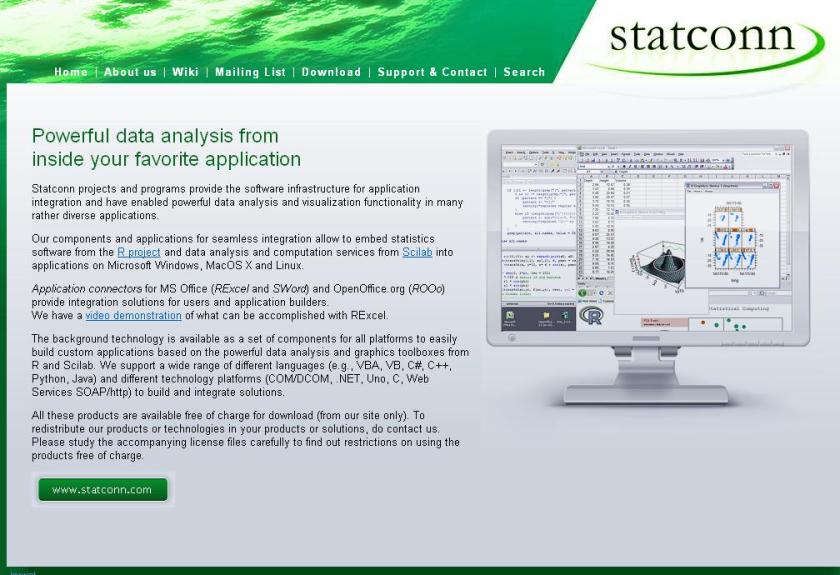
The look and feel of the package as well as ease of installing are really professional. I also liked the commercial equivalent at http://www.statconn.com/

However much older-guardians and  die- hards of command line,  feel that GUI is like putting lipstick on a pig, but we respectfully demur.

What does R Excel do? Well for one it can put the R Commander Interface INSIDE your Excel Spreadsheet. That makes it easy to use and a familiar interface even if you are newbie to R- (assuming you have done some Excel)

Download the latest version here

RAndFriends

This package will automatically install and configure

  • R 2.11.1
  • rscproxy 1.3-1
  • rcom 2.2-1

It will also download and install a suitable version of the statconnDCOM server and of RExcel during installation. Therefore you will need a working Internet connection during the installation process.
This version of RAndFriends was created 20100516.

Download RAndFriendsSetup2111V3.1-5-1

We also give you information how to download all sources for R and the R packages included in RAndFriends.

Also read a paper on R and SAS interoperability (using HMisc package from Dr Harrell) at Holland Numerics

http://www.hollandnumerics.co.uk/pdf/SAS2R2SAS_paper.pdf

Towards better analytical software

Here are some thoughts on using existing statistical software for better analytics and/or business intelligence (reporting)-

1) User Interface Design Matters- Most stats software have a legacy approach to user interface design. While the Graphical User Interfaces need to more business friendly and user friendly- example you can call a button T Test or You can call it Compare > Means of Samples (with a highlight called T Test). You can call a button Chi Square Test or Call it Compare> Counts Data. Also excessive reliance on drop down ignores the next generation advances in OS- namely touchscreen instead of mouse click and point.

Given the fact that base statistical procedures are the same across softwares, a more thoughtfully designed user interface (or revamped interface) can give softwares an edge over legacy designs.

2) Branding of Software Matters- One notable whine against SAS Institite products is a premier price. But really that software is actually inexpensive if you see other reporting software. What separates a Cognos from a Crystal Reports to a SAS BI is often branding (and user interface design). This plays a role in branding events – social media is often the least expensive branding and marketing channel. Same for WPS and Revolution Analytics.

3) Alliances matter- The alliances of parent companies are reflected in the sales of bundled software. For a complete solution , you need a database plus reporting plus analytical software. If you are not making all three of the above, you need to partner and cross sell. Technically this means that software (either DB, or Reporting or Analytics) needs to talk to as many different kinds of other softwares and formats. This is why ODBC in R is important, and alliances for small companies like Revolution Analytics, WPS and Netezza are just as important as bigger companies like IBM SPSS, SAS Institute or SAP. Also tie-ins with Hadoop (like R and Netezza appliance)  or  Teradata and SAS help create better usage.

4) Cloud Computing Interfaces could be the edge- Maybe cloud computing is all hot air. Prudent business planing demands that any software maker in analytics or business intelligence have an extremely easy to load interface ( whether it is a dedicated on demand website) or an Amazon EC2 image. Easier interfaces win and with the cloud still in early stages can help create an early lead. For R software makers this is critical since R is bad in PC usage for larger sets of data in comparison to counterparts. On the cloud that disadvantage vanishes. An easy to understand cloud interface framework is here ( its 2 years old but still should be okay) http://knol.google.com/k/data-mining-through-cloud-computing#

5) Platforms matter- Softwares should either natively embrace all possible platforms or bundle in middle ware themselves.

Here is a case study SAS stopped supporting Apple OS after Base SAS 7. Today Apple OS is strong  ( 3.47 million Macs during the most recent quarter ) and the only way to use SAS on a Mac is to do either

http://goo.gl/QAs2

or do a install of Ubuntu on the Mac ( https://help.ubuntu.com/community/MacBook ) and do this

http://ubuntuforums.org/showthread.php?t=1494027

Why does this matter? Well SAS is free to academics and students  from this year, but Mac is a preferred computer there. Well WPS can be run straight away on the Mac (though they are curiously not been able to provide academics or discounted student copies 😉 ) as per

http://goo.gl/aVKu

Does this give a disadvantage based on platform. Yes. However JMP continues to be supported on Mac. This is also noteworthy given the upcoming Chromium OS by Google, Windows Azure platform for cloud computing.

Special Issue of JSS on R GUIs

An announcement by the Journal of Statistical Software- call for papers on R GUIs. Initial deadline is December 2010 with final versions published along 2011.

Announce

Special issue of the Journal of Statistical Software on

Graphical User Interfaces for R

Editors: Pedro Valero-Mora and Ruben Ledesma

Since it original paper from Gentleman and Ihaka was published, R has managed to gain an ever-increasing percentage of academic and professional statisticians but the spread of its use among novice and occasional users of statistics have not progressed at the same pace. Among the reasons for this relative lack of impact, the lack of a GUI or point and click interface is one of the causes most widely mentioned. But, however, in the last few years, this situation has been quietly changing and a number of projects have equipped R with a number of different GUIs, ranging from the very simple to the more advanced, and providing the casual user with what could be still a new source of trouble: choosing what is the GUI for him. We may have moved from the “too few” situation to the “too many” situation
This special issue of the JSS intends as one of its main goals to offer a general overview of the different GUIs currently available for R. Thus, we think that somebody trying to find its way among different alternatives may find useful it as starting point. However, we do not want to stop in a mere listing but we want to offer a bit of a more general discussion about what could be good GUIs  for R (and how to build them). Therefore, we want to see papers submitted that discuss the whole concept of GUI in R, what elements it should include (or not), how this could be achieved, and, why not, if it is actually needed at all. Finally, despite the high success of R, this does not mean other systems may not treasure important features that we would like to see in R. Indeed, descriptions of these nice features that we do not have in R but are in other systems could be another way of driving the future progress of GUIs for R.

In summary, we envision papers for this special issue on GUIs for R in the following categories:

– General discussions on GUIs for statistics, and for R.

– Implementing GUI toolboxes for R so others can program GUIs with them.

– R GUIs examples (with two subcategories, in the desktop or in the cloud).

– Is there life beyond R? What features have other systems that R does not have and why R needs them.

Papers can be sent directly to Pedro Valero-Mora (valerop@uv.es) or Ruben Ledesma (rdledesma@gmail.com) and they will follow the usual JSS reviewing procedure. Initial deadline is December 2010 with final versions published along 2011.

====================================================
Jan de Leeuw; Distinguished Professor and Chair, UCLA Department of Statistics;
Director: UCLA Center for Environmental Statistics (CES);
Editor: Journal of Multivariate Analysis, Journal of Statistical Software;

Protected: Analyzing SAS Institute-WPS Lawsuit

This content is password-protected. To view it, please enter the password below.

Protected: SAS Institute lawsuit against WPS Episode 2 The Clone Wars

This content is password-protected. To view it, please enter the password below.