Updated Interview Elissa Fink -VP Tableau Software

Here is an interview with Elissa Fink, VP Marketing of that new wonderful software called Tableau that makes data visualization so nice and easy to learn and work with.

Elissa Fink, VP, Marketing

Ajay-  Describe your career journey from high school to over 20 plus years in marketing. What are the various trends that you have seen come and go in marketing.

Elissa- I studied literature and linguistics in college and didn’t discover analytics until my first job selling advertising for the Wall Street Journal. Oddly enough, the study of linguistics is not that far from decision analytics: they both are about taking a structured view of information and trying to see and understand common patterns. At the Journal, I was completely captivated analyzing and comparing readership data. At the same time, the idea of using computers in marketing was becoming more common. I knew that the intersection of technology and marketing was going to radically change things – how we understand consumers, how we market and sell products, and how we engage with customers. So from that point on, I’ve always been focused on technology and marketing, whether it’s working as a marketer at technology companies or applying technology to marketing problems for other types of companies.  There have been so many interesting trends. Taking a long view, a key trend I’ve noticed is how marketers work to understand, influence and motivate consumer behavior. We’ve moved marketing from where it was primarily unpredictable, qualitative and aimed at talking to mass audiences, where the advertising agency was king. Now it’s a discipline that is more data-driven, quantitative and aimed at conversations with individuals, where the best analytics wins. As with any trend, the pendulum swings far too much to either side causing backlashes but overall, I think we are in a great place now. We are using data-driven analytics to understand consumer behavior. But pure analytics is not the be-all, end-all; good marketing has to rely on understanding human emotions, intuition and gut feel – consumers are far from rational so taking only a rational or analytical view of them will never explain everything we need to know.

Ajay- Do you think technology companies are still predominantly dominated by men . How have you seen diversity evolve over the years. What initiatives has Tableau taken for both hiring and retaining great talent.

Elissa- The thing I love about the technology industry is that its key success metrics – inventing new products that rapidly gain mass adoption in pursuit of making profit – are fairly objective. There’s little subjective nature to the counting of dollars collected selling a product and dollars spent building a product. So if a female can deliver a better product and bigger profits faster and better, then that female is going to get the resources, jobs, power and authority to do exactly that. That’s not to say that the technology industry is gender-blind, race-blind, etc. It isn’t – technology is far from perfect. For example, the industry doesn’t have enough diversity in positions of power. But I think overall, in comparison to a lot of other industries, it’s pretty darn good at giving people with great ideas the opportunities to realize their visions regardless of their backgrounds or characteristics.

At Tableau, we are very serious about bringing in and developing talented people – they are the key to our growth and success. Hiring is our #1 initiative so we’ve spent a lot of time and energy both on finding great candidates and on making Tableau a place that they want to work. This includes things like special recruiting events, employee referral programs, a flexible work environment, fun social events, and the rewards of working for a start-up. Probably our biggest advantage is the company itself – working with people you respect on amazing, cutting-edge products that delight customers and are changing the world is all too rare in the industry but a reality at Tableau. One of our senior software developers put it best when he wrote “The emphasis is on working smarter rather than longer: family and friends are why we work, not the other way around. Tableau is all about happy, energized employees executing at the highest level and delivering a highly usable, high quality, useful product to our customers.” People who want to be at a place like that should check out our openings at http://www.tableausoftware.com/jobs.

Ajay- What are most notable features in tableau’s latest edition. What are the principal software that competes with Tableau Software products and how would you say Tableau compares with them.

Elissa- Tableau 6.1 will be out in July and we are really excited about it for 3 reasons.

First, we’re introducing our mobile business intelligence capabilities. Our customers can have Tableau anywhere they need it. When someone creates an interactive dashboard or analytical application with Tableau and it’s viewed on a mobile device, an iPad in particular, the viewer will have a native, touch-optimized experience. No trying to get your fingertips to act like a mouse. And the author didn’t have to create anything special for the iPad; she just creates her analytics the usual way in Tableau. Tableau knows the dashboard is being viewed on an iPad and presents an optimized experience.

Second, we’ve take our in-memory analytics engine up yet another level. Speed and performance are faster and now people can update data incrementally rapidly. Introduced in 6.0, our data engine makes any data fast in just a few clicks. We don’t run out of memory like other applications. So if I build an incredible dashboard on my 8-gig RAM PC and you try to use it on your 2-gig RAM laptop, no problem.

And, third, we’re introducing more features for the international markets – including French and German versions of Tableau Desktop along with more international mapping options.  It’s because we are constantly innovating particularly around user experience that we can compete so well in the market despite our relatively small size. Gartner’s seminal research study about the Business Intelligence market reported a massive market shift earlier this year: for the first time, the ease-of-use of a business intelligence platform was more important than depth of functionality. In other words, functionality that lots of people can actually use is more important than having sophisticated functionality that only specialists can use. Since we focus so heavily on making easy-to-use products that help people rapidly see and understand their data, this is good news for our customers and for us.

Ajay-  Cloud computing is the next big thing with everyone having a cloud version of their software. So how would you run Cloud versions of Tableau Server (say deploying it on an Amazon Ec2  or a private cloud)

Elissa- In addition to the usual benefits espoused about Cloud computing, the thing I love best is that it makes data and information more easily accessible to more people. Easy accessibility and scalability are completely aligned with Tableau’s mission. Our free product Tableau Public and our product for commercial websites Tableau Digital are two Cloud-based products that deliver data and interactive analytics anywhere. People often talk about large business intelligence deployments as having thousands of users. With Tableau Public and Tableau Digital, we literally have millions of users. We’re serving up tens of thousands of visualizations simultaneously – talk about accessibility and scalability!  We have lots of customers connecting to databases in the Cloud and running Tableau Server in the Cloud. It’s actually not complex to set up. In fact, we focus a lot of resources on making installation and deployment easy and fast, whether it’s in the cloud, on premise or what have you. We don’t want people to have spend weeks or months on massive roll-out projects. We want it to be minutes, hours, maybe a day or 2. With the Cloud, we see that people can get started and get results faster and easier than ever before. And that’s what we’re about.

Ajay- Describe some of the latest awards that Tableau has been wining. Also how is Tableau helping universities help address the shortage of Business Intelligence and Big Data professionals.

Elissa-Tableau has been very fortunate. Lately, we’ve been acknowledged by both Gartner and IDC as the fastest growing business intelligence software vendor in the world. In addition, our customers and Tableau have won multiple distinctions including InfoWorld Technology Leadership awards, Inc 500, Deloitte Fast 500, SQL Server Magazine Editors’ Choice and Community Choice awards, Data Hero awards, CODiEs, American Business Awards among others. One area we’re very passionate about is academia, participating with professors, students and universities to help build a new generation of professionals who understand how to use data. Data analysis should not be exclusively for specialists. Everyone should be able to see and understand data, whatever their background. We come from academic roots, having been spun out of a Stanford research project. Consequently, we strongly believe in supporting universities worldwide and offer 2 academic programs. The first is Tableau For Teaching, where any professor can request free term-length licenses of Tableau for academic instruction during his or her courses. And, we offer a low-cost Student Edition of Tableau so that students can choose to use Tableau in any of their courses at any time.

Elissa Fink, VP Marketing,Tableau Software


Elissa Fink is Tableau Software’s Vice President of Marketing. With 20+ years helping companies improve their marketing operations through applied data analysis, Elissa has held executive positions in marketing, business strategy, product management, and product development. Prior to Tableau, Elissa was EVP Marketing at IXI Corporation, now owned by Equifax. She has also served in executive positions at Tele Atlas (acquired by TomTom), TopTier Software (acquired by SAP), and Nielsen/Claritas. Elissa also sold national advertising for the Wall Street Journal. She’s a frequent speaker and has spoken at conferences including the DMA, the NCDM, Location Intelligence, the AIR National Forum and others. Elissa is a graduate of Santa Clara University and holds an MBA in Marketing and Decision Systems from the University of Southern California.

Elissa first discovered Tableau late one afternoon at her previous company. Three hours later, she was still “at play” with her data. “After just a few minutes using the product, I was getting answers to questions that were taking my company’s programmers weeks to create. It was instantly obvious that Tableau was on a special mission with something unique to offer the world. I just had to be a part of it.”

To know more – read at http://www.tableausoftware.com/

and existing data viz at http://www.tableausoftware.com/learn/gallery

Storm seasons: measuring and tracking key indicators
What’s happening with local real estate prices?
How are sales opportunities shaping up?
Identify your best performing products
Applying user-defined parameters to provide context
Not all tech companies are rocket ships
What’s really driving the economy?
Considering factors and industry influencers
The complete orbit along the inside, or around a fixed circle
How early do you have to be at the airport?
What happens if sales grow but so does customer churn?
What are the trends for new retail locations?
How have student choices changed?
Do patients who disclose their HIV status recover better?
Closer look at where gas prices swing in areas of the U.S.
U.S. Census data shows more women of greater age
Where do students come from and how does it affect their grades?
Tracking customer service effectiveness
Comparing national and local test scores
What factors correlate with high overall satisfaction ratings?
Fund inflows largely outweighed outflows well after the bubble
Which programs are competing for federal stimulus dollars?
Oil prices and volatility
A classic candlestick chart
How do oil, gold and CPI relate to the GDP growth rate?


RapidMiner launches extensions marketplace

For some time now, I had been hoping for a place where new package or algorithm developers get at least a fraction of the money that iPad or iPhone application developers get. Rapid Miner has taken the lead in establishing a marketplace for extensions. Is there going to be paid extensions as well- I hope so!!

This probably makes it the first “app” marketplace in open source and the second app marketplace in analytics after salesforce.com

It is hard work to think of new algols, and some of them can really be usefull.

Can we hope for #rstats marketplace where people downloading say ggplot3.0 atleast get a prompt to donate 99 cents per download to Hadley Wickham’s Amazon wishlist. http://www.amazon.com/gp/registry/1Y65N3VFA613B

Do you think it is okay to pay 99 cents per iTunes song, but not pay a cent for open source software.

I dont know- but I am just a capitalist born in a country that was socialist for the first 13 years of my life. Congratulations once again to Rapid Miner for innovating and leading the way.

http://rapid-i.com/component/option,com_myblog/show,Rapid-I-Marketplace-Launched.html/Itemid,172

RapidMinerMarketplaceExtensions 30 May 2011
Rapid-I Marketplace Launched by Simon Fischer

Over the years, many of you have been developing new RapidMiner Extensions dedicated to a broad set of topics. Whereas these extensions are easy to install in RapidMiner – just download and place them in the plugins folder – the hard part is to find them in the vastness that is the Internet. Extensions made by ourselves at Rapid-I, on the other hand,  are distributed by the update server making them searchable and installable directly inside RapidMiner.

We thought that this was a bit unfair, so we decieded to open up the update server to the public, and not only this, we even gave it a new look and name. The Rapid-I Marketplace is available in beta mode at http://rapidupdate.de:8180/ . You can use the Web interface to browse, comment, and rate the extensions, and you can use the update functionality in RapidMiner by going to the preferences and entering http://rapidupdate.de:8180/UpdateServer/ as the update server URL. (Once the beta test is complete, we will change the port back to 80 so we won’t have any firewall problems.)

As an Extension developer, just register with the Marketplace and drop me an email (fischer at rapid-i dot com) so I can give you permissions to upload your own extension. Upload is simple provided you use the standard RapidMiner Extension build process and will boost visibility of your extension.

Looking forward to see many new extensions there soon!

Disclaimer- Decisionstats is a partner of Rapid Miner. I have been liking the software for a long long time, and recently agreed to partner with them just like I did with KXEN some years back, and with Predictive AnalyticsConference, and Aster Data until last year.

I still think Rapid Miner is a very very good software,and a globally created software after SAP.

Here is the actual marketplace

http://rapidupdate.de:8180/UpdateServer/faces/index.xhtml

Welcome to the Rapid-I Marketplace Public Beta Test

The Rapid-I Marketplace will soon replace the RapidMiner update server. Using this marketplace, you can share your RapidMiner extensions and make them available for download by the community of RapidMiner users. Currently, we are beta testing this server. If you want to use this server in RapidMiner, you must go to the preferences and enter http://rapidupdate.de:8180/UpdateServer for the update url. After the beta test, we will change the port back to 80, which is currently occupied by the old update server. You can test the marketplace as a user (downloading extensions) and as an Extension developer. If you want to publish your extension here, please let us know via the contact form.

Hot Downloads
«« « 1 2 3 » »»
[Icon]The Image Processing Extension provides operators for handling image data. You can extract attributes describing colour and texture in the image, you can make several transformation of a image data which allows you to perform segmentation and detection of suspicious areas in image data.The extension provides many of image transformation and extraction operators ranging from Wavelet Decomposition, Hough Circle to Block Difference of Inverse probabilities.

[Icon]RapidMiner is unquestionably the world-leading open-source system for data mining. It is available as a stand-alone application for data analysis and as a data mining engine for the integration into own products. Thousands of applications of RapidMiner in more than 40 countries give their users a competitive edge.

  • Data IntegrationAnalytical ETLData Analysis, and Reporting in one single suite
  • Powerful but intuitive graphical user interface for the design of analysis processes
  • Repositories for process, data and meta data handling
  • Only solution with meta data transformation: forget trial and error and inspect results already during design time
  • Only solution which supports on-the-fly error recognition and quick fixes
  • Complete and flexible: Hundreds of data loading, data transformation, data modeling, and data visualization methods
[Icon]All modeling methods and attribute evaluation methods from the Weka machine learning library are available within RapidMiner. After installing this extension you will get access to about 100 additional modelling schemes including additional decision trees, rule learners and regression estimators.This extension combines two of the most widely used open source data mining solutions. By installing it, you can extend RapidMiner to everything what is possible with Weka while keeping the full analysis, preprocessing, and visualization power of RapidMiner.

[Icon]Finally, the two most widely used data analysis solutions – RapidMiner and R – are connected. Arbitrary R models and scripts can now be directly integrated into the RapidMiner analysis processes. The new R perspective offers the known R console together with the great plotting facilities of R. All variables and R scripts can be organized in the RapidMiner Repository.A directly included online help and multi-line editing makes the creation of R scripts much more comfortable.

#Rstats gets into Enterprise Cloud Software

Defense Agencies of the United States Departme...
Image via Wikipedia

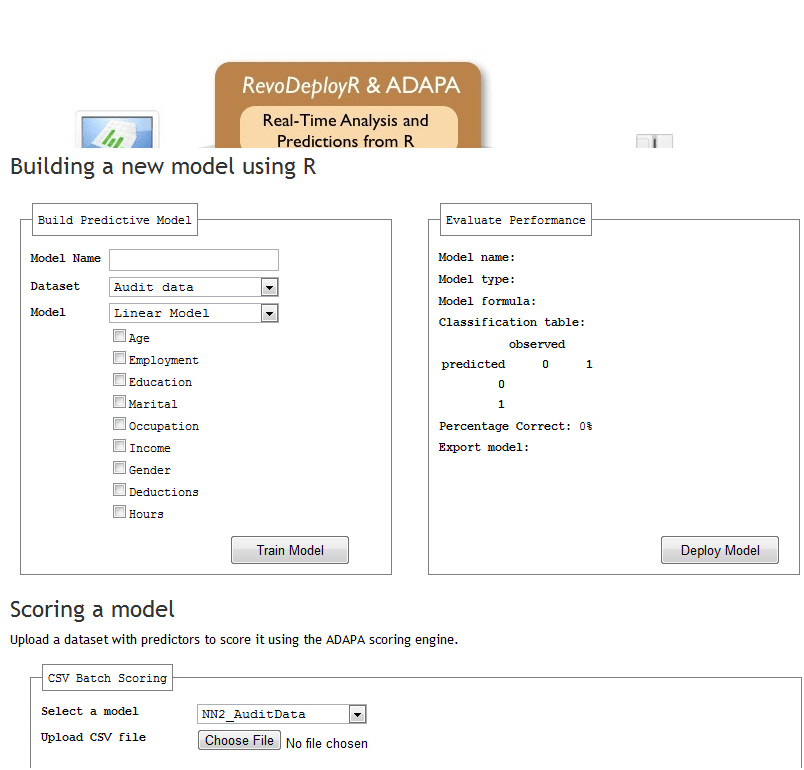
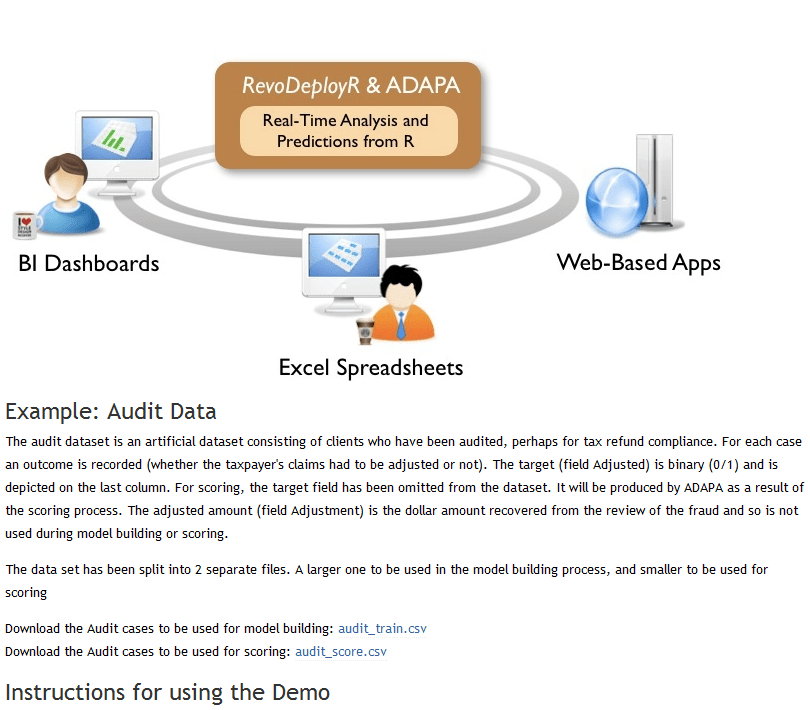
Here is an excellent example of how websites should help rather than hinder new customers take a demo of the software without being overwhelmed by sweet talking marketing guys who dont know the difference between heteroskedasticity, probability, odds and likelihood.

It is made by Zementis (Dr Michael Zeller has been a frequent guest here) and Revolution Analytics is still the best shot in Enterprise software for #Rstats

Now if only Revo could get into the lucrative Department of Energy or Department of Defense business- they could change the world AND earn some more revenue than they have been doing. But seriously.

Check out http://deployr.revolutionanalytics.com/zementis/ and play with it. or better still mash it with some data viz and ROC curves.- or extend it with some APIS 😉

Heritage offers 3 million chump change for Monkeys

My perspective is life is not fair, and if someone offers me 1 mill a year so they make 1 bill a year, I would still take it, especially if it leads to better human beings and better humanity on this planet. Health care isnt toothpaste.

Unless there are even more fine print changes involved- there exist several players in the pharma sector who do build and deploy models internally for denying claims or prospecting medical doctors with freebies, but they might just get caught with the new open data movement

————————————————————————————————–

A note from KDNuggets-

Heritage Health Prizereleased a second set of data on May 4. They also recently modified their ruleswhich now demand complete exclusivity and seem to disallow use of other tools (emphasis mine – Gregory PS)

21. LICENSE
By registering for the Competition, each Entrant (a) grants to Sponsor and its designees a worldwide, exclusive (except with respect to Entrant) , sub-licensable (through multiple tiers), transferable, fully paid-up, royalty-free, perpetual, irrevocable right to use, not use, reproduce, distribute (through multiple tiers), create derivative works of, publicly perform, publicly display, digitally perform, make, have made, sell, offer for sale and import the entry and the algorithm used to produce the entry, as well as any other algorithm, data or other information whatsoever developed or produced at any time using the data provided to Entrant in this Competition (collectively, the “Licensed Materials”), in any media now known or hereafter developed, for any purpose whatsoever, commercial or otherwise, without further approval by or payment to Entrant (the “License”) and
(b) represents that he/she/it has the unrestricted right to grant the License. 
Entrant understands and agrees that the License is exclusive except with respect to Entrant: Entrant may use the Licensed Materials solely for his/her/its own patient management and other internal business purposes but may not grant or otherwise transfer to any third party any rights to or interests in the Licensed Materials whatsoever.

This has lead to a call to boycott the competition by Tristan, who also notes that academics cannot publish their results without prior written approval of the Sponsor.

Anthony Goldbloom, CEO of Kaggle, emailed the HHP participants on May 4

HPN have asked me to pass on the following message: “The Heritage Provider Network is sponsoring the Heritage Health Prize to spur innovation and creative thinking in healthcare. HPN, however, is a medical group and must retain an exclusive license to the algorithms created using its data so as to ensure that the algorithms are used responsibly, and are only used to provide better health care to patients and not for improper purposes.
Put simply, while the competition hopes to spur innovation, this is not a competition regarding movie ratings or chess results. We hope that the clarifications we have made to the Rules and the FAQ adequately address your concerns and look forward to your participation in the competition.”

What do you think? Will the exclusive license prevent you from participating?

Heritage prize= 3mill now open

I am still angry with THE netflix for 1 mill I lost out. No sweat! this time the money is 3 times as much, it is legit, and yes baby you can change the world, make it a better place and get rich.! see details below-http://www.heritagehealthprize.com/c/hhp/Data

HERITAGE HEALTH PRIZE DATA FILES

You must accept this competition’s rules before you’ll be able to download data files.

IMPORTANT NOTE: The information provided below is intended only to provide general guidance to participants in the Heritage Health Prize Competition and is subject to the Competition Official Rules. Any capitalized term not defined below is defined in the Competition Official Rules. Please consult the Competition Official Rules for complete details.

Heritage Provider Network is providing Competition Entrants with deidentified member data collected during a forty-eight month period that is allocated among three data sets (the “Data Sets”). Competition Entrants will use the Data Sets to develop and test their algorithms for accurately predicting the number of days that the members will spend in a hospital (inpatient or emergency room visit) during the 12-month period following the Data Set cut-off date.

HHP_release2.zip contains the latest files, so you can ignore HHP_release1.zip. SampleEntry.CSV shows you how an entry should look.

Data Sets will be released to Entrants after registration on the Website according to the following schedule:

April 4, 2011 Claims Table – Y1 and DaysInHospital Table – Y2

May 4, 2011

All other Data Sets except Labs Table and Rx Table

From https://www.kaggle.com/

The $3 million Heritage Health Prize opens to entries

It’s been one month since the launch of the Heritage Health Prize. The prize has attracted some great publicity, receiving coverage from the Wall Street JournalThe EconomistSlate andForbes.

By now, people have had a good chance to poke around the first portion of the data. Now the fun starts! HPN have released two more years’-worth of data, set the accuracy threshold and are opening up the competition to entries. The data are available from the Heritage Health Prize page. Good luck to all participants!

The Deloitte/FIDE Chess Ratings Competition results

The Deloitte/FIDE Chess Ratings Competition attracted one of the strongest fields ever seen in a Kaggle Competition. The competition attracted 189 teams, ranging from chess ratings  experts to Netflix Prize winners. As Jeff Sonas wrote on the Kaggle blog last week, the  competition has far exceeded his expectations. A big congratulations the provisional winner, Tim Salimans, an econometrician at Erasmus University in Rotterdam. We look forward to reading about the approaches used by top performers on the Kaggle blog. We also look forward to the results of the FIDE prize, which could see the introduction of a new chess ratings system.

ICDAR 2011 Competition Results

The ICDAR 2011 competition also finished recently. The competiiton required participants to develop an algorithm that correctly matched handwriting samples. The winners were Lewis Griffin and Andrew Newell from the University College London who achieved Kaggle’s first ever perfect score by managing to match every sample correctly! Andrew and Lewis have posted a description of their winning method on the Kaggle blog.

Revolution R Enterprise

Since R is the most popular language used by Kaggle members, the Revolution Analytics team is making Revolution R Enterprise (the pre-eminent commercial version of R) available free of charge to Kaggle members. Revolution R Enterprise has several advantages over standard R, including the ability to seemlessly handle larger datasets. To get your free copy, visit http://info.revolutionanalytics.com/Kaggle.html.
Kaggle-in-Class

As many of you know, Kaggle offers a free platform, Kaggle-in-Class, for instructors who want to host competitions for their students. For those interested in hearing more about the use of Kaggle-in-Class as a teaching tool, Susan Holmes and Nelson Ray from Stanford University share their experience in a webinar organized by the Consortium for the Advancement of Undergraduate Statistics Education.

FlattR goes free for all bloggers

This is the Flattr right now
Image via Wikipedia

Email from people at FlattR. What is FlattR- social micropayments. like small Paypal button that gives a fraction of your monthly budget (say 2 euros) to people you retweet/like (called Flattered in this social media service).

Some angels are smiling over some bays , it seems. congrats FlattR and their team (which includes tech team of largest bit torrent search engine in the world). Apparently this was done in time for the royal wedding.

Important service announcement

Hello!

Flattr’s first year has been great. And not just for us but for tens of thousands of bloggers, podcasters, developers, designers and other creators out there. Just ask Tim. We’re now making an important change to the service, one which should open the floodgates of Flattr, if you will.
From May 1st we no longer require users to flattr others before they can be flattrd. Or in other words, it’s not mandatory to add money to your account to have an active Flattr button.

How does this affect you?

If you’re mainly using Flattr to make payments you will soon have much more content to flattr.If you’re using Flattr both to make and receive payments then you no longer need to check your balance at the end of each month to see whether your Flattr button is still active or not. It is and always will be.

If your Flattr button was once deactivated because balance dropped to zero, it is now active again. Forever.

This makes Flattr simpler

We have good reasons for making this change and we’ve just added a post about it on our blog. In a nutshell, we just didn’t need to force the give before you get principle onto people. During the the last year we’ve learned that people want to flattr the content they like and therefore we decided to drop any rules that made the service restrictive or outright complicated.We hope you’ll like the simpler more straightforward Flattr. If you have any comments, questions or feedback please get in touch via our blog or support page.

Linus, Peter and the rest of Flattr team

Top Ten Business Analytics Graphs-Line Charts (2/10)

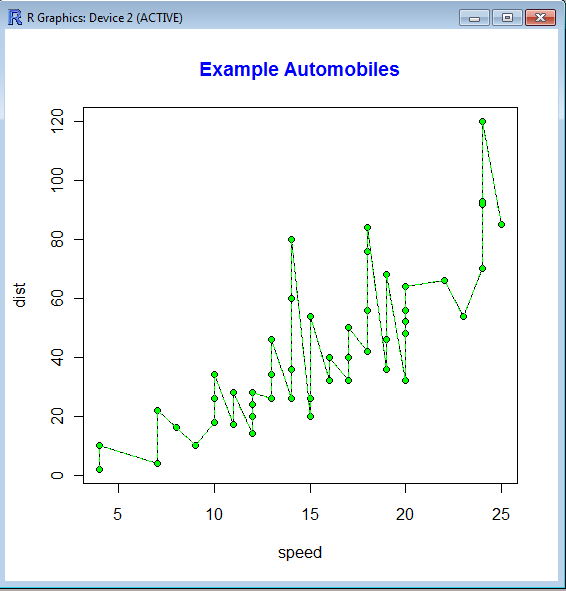
A line chart is one of the most commonly used charts in business analytics and metrics reporting. It basically consists of two variables plotted along the axes with the adjacent points being joined by line segments. Most often used with time series on the x-axis, line charts are simple to understand and use.
Variations on the line graph can include fan charts in time series which include joining line chart of historic data with ranges of future projections. Another common variation is to plot the linear regression or trend line between the two variables  and superimpose it on the graph.
The slope of the line chart shows the rate of change at that particular point , and can also be used to highlight areas of discontinuity or irregular change between two variables.

The basic syntax of line graph is created by first using Plot() function to plot the points and then lines () function to plot the lines between the points.

> str(cars)
‘data.frame’:   50 obs. of  2 variables:
$ speed: num  4 4 7 7 8 9 10 10 10 11 …
$ dist : num  2 10 4 22 16 10 18 26 34 17 …
> plot(cars)
> lines(cars,type=”o”, pch=20, lty=2, col=”green”)
> title(main=”Example Automobiles”, col.main=”blue”, font.main=2)

An example of Time Series Forecasting graph  or fan chart is http://addictedtor.free.fr/graphiques/RGraphGallery.php?graph=51