A GUI based SDK for making Apps for Mobiles (Android)- that you can then put in the Android Marketplace.
Watch a 60 sec video on that!

A GUI based SDK for making Apps for Mobiles (Android)- that you can then put in the Android Marketplace.
Watch a 60 sec video on that!
Some changes at Decisionstats-
1) We are back at Decisionstats.com and Decisionstats.wordpress.com will point to that as well. The SEO effects would be interesting and so would be the Instant Pagerank or LinkRank or whatever Coffee/Percolator they use in Cali to index the site.
2) AsterData is no longer a sponsor- but Predictive Analytics Conference is. Welcome PAWS! I have been a blog partner to PAWS ever since it began- and it’s a great marketing fit. Expect to see a lot of exclusive content and interviews from great speakers at PAWS.
3) The Feedblitz newsletter (now at 404 subscribers) is now a weekly subscription to send one big big email rather than lots of email through the week- this is because my blogging frequency is moving up as I collect material for a new book on business analytics that I would probably release in 2011 (if all goes well, touchwood). Linkedin group would be getting a weekly update announcement. If you are connected to Decisionstats on Analyticbridge _ I would soon try to find a way to update the whole post automatically using RSS and Ning.com . or not. Depends.
4) R continues to be a bigger focus. So will SPSS and maybe JMP. Newer softwares or older softwares that change more rapidly would get more coverage. Generally a particular software is covered if it has newer features, or an interesting techie conference, or it gets sued.
5) I will occasionally write a poem or post a video once a week randomly to prove geeks and nerds and analysts can have fun (much more fun actually dont we)
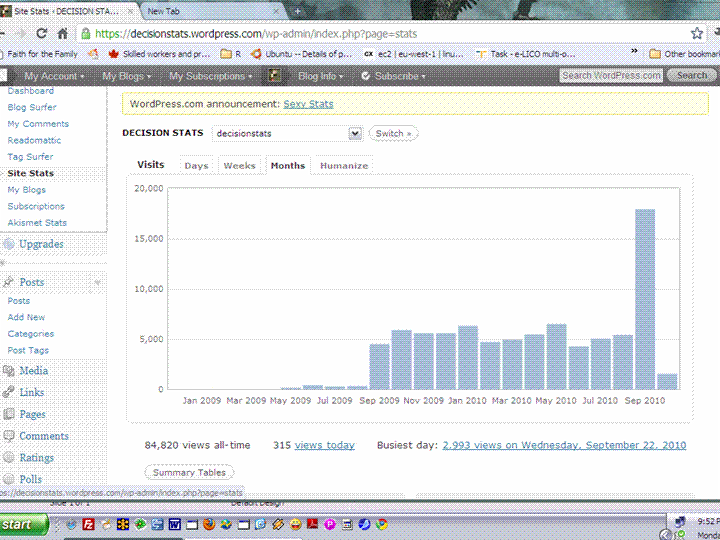
Thanks for reading this. Sept 2010 was the best ever for Decisionstats.com – we crossed 15,000 + visitors and thanks for that again! I promise to bore you less and less as we grow old together on the blog 😉
Rudyard Kipling, The White Man’s Burden
Take up the White Man’s burden–Send forth the best ye breed–
Go bind your sons to exile To serve your captives’ need;
To wait in heavy harness, On fluttered folk and wild–
Your new-caught, sullen peoples, Half-devil and half-child.
Take up the White Man’s burden–In patience to abide,
To veil the threat of terror And check the show of pride;
By open speech and simple, An hundred times made plain
To seek another’s profit, And work another’s gain.
Take up the White Man’s burden– The savage wars of peace–
Fill full the mouth of Famine And bid the sickness cease;
And when your goal is nearest The end for others sought,
Watch sloth and heathen Folly Bring all your hopes to nought.
Take up the White Man’s burden–No tawdry rule of kings,
But toil of serf and sweeper–The tale of common things.
The ports ye shall not enter,The roads ye shall not tread,
Go mark them with your living,And mark them with your dead.
Take up the White Man’s burden–And reap his old reward:
The blame of those ye better,The hate of those ye guard–
The cry of hosts ye humour (Ah, slowly!) toward the light:–
“Why brought he us from bondage, Our loved Egyptian night?”
Take up the White Man’s burden–Ye dare not stoop to less–
Nor call too loud on Freedom To cloke your weariness;
By all ye cry or whisper, By all ye leave or do,
The silent, sullen peoples Shall weigh your gods and you.
Take up the White Man’s burden– Have done with childish days–
The lightly proferred laurel, The easy, ungrudged praise.
Comes now, to search your manhood Through all the thankless years
Cold, edged with dear-bought wisdom, The judgment of your peers!
This famous poem, written by Britain‘s imperial poet, was a response to the American take over of the Phillipines after the Spanish-American War.(published in 1899)
source
http://www.fordham.edu/halsall/mod/kipling.html
Rudyard Kipling, The White Man’s Burden
Take up the White Man’s burden–Send forth the best ye breed–
Go bind your sons to exile To serve your captives’ need;
To wait in heavy harness, On fluttered folk and wild–
Your new-caught, sullen peoples, Half-devil and half-child.
Take up the White Man’s burden–In patience to abide,
To veil the threat of terror And check the show of pride;
By open speech and simple, An hundred times made plain
To seek another’s profit, And work another’s gain.
Take up the White Man’s burden– The savage wars of peace–
Fill full the mouth of Famine And bid the sickness cease;
And when your goal is nearest The end for others sought,
Watch sloth and heathen Folly Bring all your hopes to nought.
Take up the White Man’s burden–No tawdry rule of kings,
But toil of serf and sweeper–The tale of common things.
The ports ye shall not enter,The roads ye shall not tread,
Go mark them with your living,And mark them with your dead.
Take up the White Man’s burden–And reap his old reward:
The blame of those ye better,The hate of those ye guard–
The cry of hosts ye humour (Ah, slowly!) toward the light:–
“Why brought he us from bondage, Our loved Egyptian night?”
Take up the White Man’s burden–Ye dare not stoop to less–
Nor call too loud on Freedom To cloke your weariness;
By all ye cry or whisper, By all ye leave or do,
The silent, sullen peoples Shall weigh your gods and you.
Take up the White Man’s burden– Have done with childish days–
The lightly proferred laurel, The easy, ungrudged praise.
Comes now, to search your manhood Through all the thankless years
Cold, edged with dear-bought wisdom, The judgment of your peers!
This famous poem, written by Britain‘s imperial poet, was a response to the American take over of the Phillipines after the Spanish-American War.(published in 1899)
source
http://www.fordham.edu/halsall/mod/kipling.html
So I am still testing Revo R on the 64 bit AMI i created on the weekend and I really like the code snippets feature in Revolution R.
Code Snippets work in a fairly simply way.
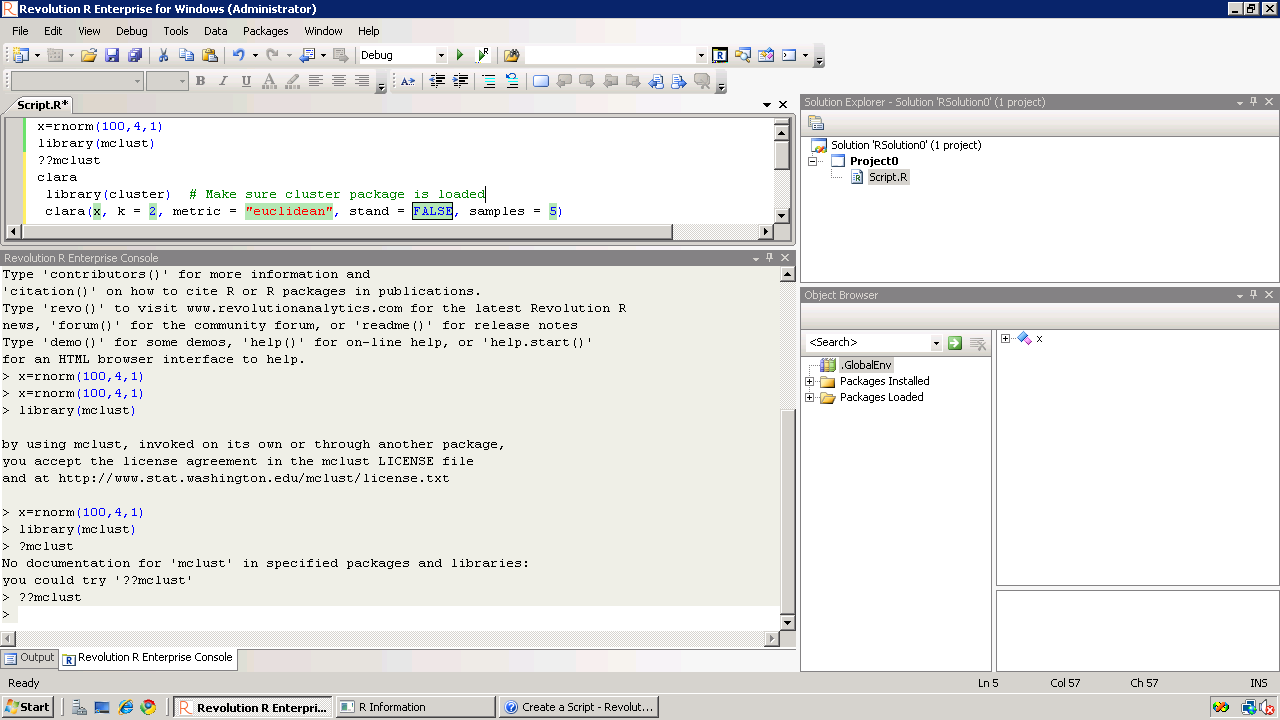
Right click– Click on Insert Code Snippet.
You can get a drop down of tasks to do- (like Analysis) Selecting Analysis we get another list of tasks (like Clustering).
Once you click on Clustering you get various options. Like clicking clara will auto insert the code
Now even if you are averse to using a GUI /or GUI creators don’t have your particular analysis you can basically type in code at an extremely fast pace.
It is useful to people who do not have to type in the entire code, but it is a boon to beginners as the parameters in function inserted by code snippet are automatically selected in multiple colors.
Also separately if are typing code for a function and hover, the various parameters for that particular function are shown.
Quite possibly the fastest way to write R code- and it is un matched by other code editors I am testing including Vim,Notepad++,Eclipse R etc.
The RPE (R Productivity Environment for windows- horrible bureaucratic name is the only flaw here) thus helps as it is quite thoughtfully designed. Interestingly they even have a record macro feature – which I am quite unsure of , but looks like automating some tasks. That’s next 🙂
See screenshot –
It would be quite nice to see the new Revo R GUI if it becomes available if it is equally intuitively designed considering it now has the founders of SPSS and one founder of R* as it’s members-it should be a keenly anticipated product. again Revolution could also try creating a Paid Amazon AMI and try renting the software by the hour at least as technology demonstrator as the big analytics world seems unaware of the work they have been up to.
without getting much noise on how much the other founder of R loves Revo 😉 )
What is RFM Analysis?
Recency Frequency Monetization is basically a technique to classify your entire customer list. You may be a retail player with thousands of customers or a enterprise software seller with only two dozen customers.
RFM Analysis can help you cut through and focus on the real customer that drives your profit.
As per Wikipedia–
http://en.wikipedia.org/wiki/RFM
RFM is a method used for analyzing customer behavior and defining market segments. It is commonly used in database marketing and direct marketing and has received particular attention in retail.
RFM stands for
To create an RFM analysis, one creates categories for each attribute. For instance, the Recency attribute might be broken into three categories: customers with purchases within the last 90 days; between 91 and 365 days; and longer than 365 days. Such categories may be arrived at by applying business rules, or using a data mining technique, such asCHAID, to find meaningful breaks.
—————————————————————————————————-
Even if you dont know what or how to do a RFM, see below for an easy to do way.
I just got myself an evaluation copy of a fully loaded IBM SPSS 19 Module and did some RFM Analysis on some data- the way SPSS recent version is it makes it very very useful even to non statistical tool- but an extremely useful one to a business or marketing user.
Here are some screenshots to describe the features.
1) A simple dashboard to show functionality (with room for improvement for visual appeal)
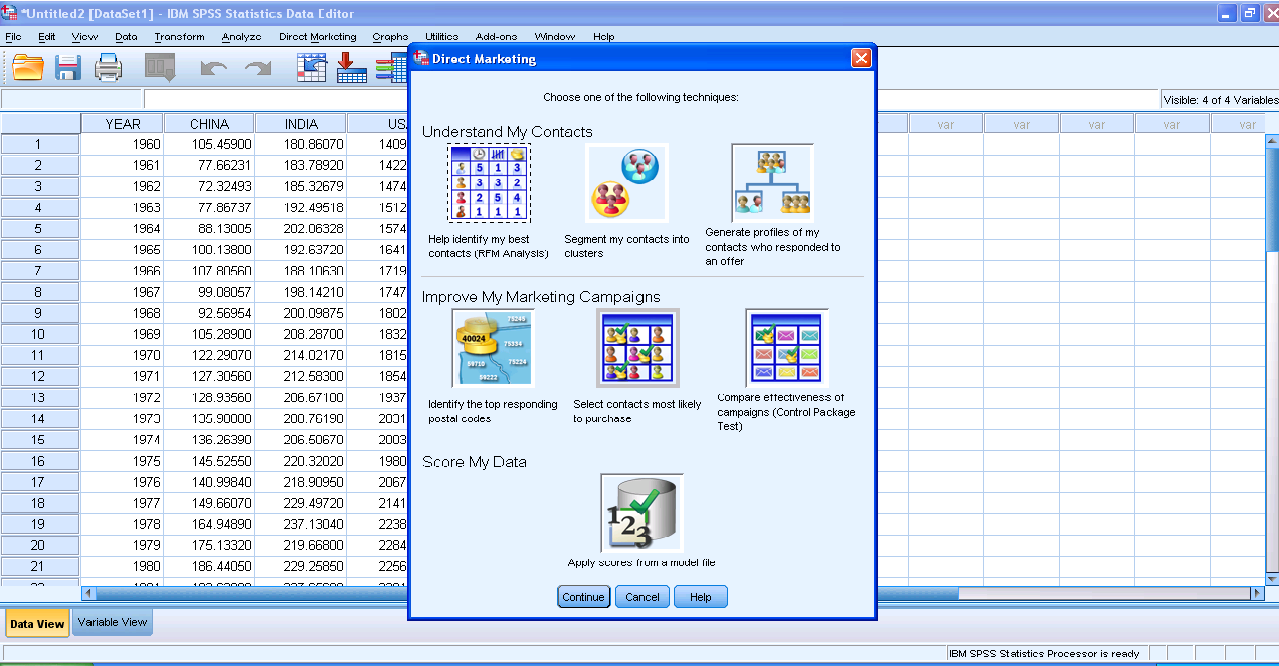 2) Simple Intuitive design to inputting data
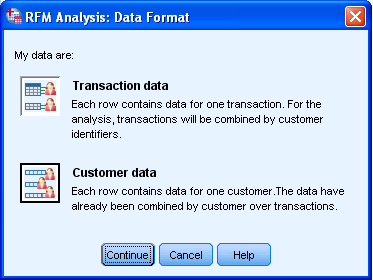 3) Some options in creating marketing scorecards
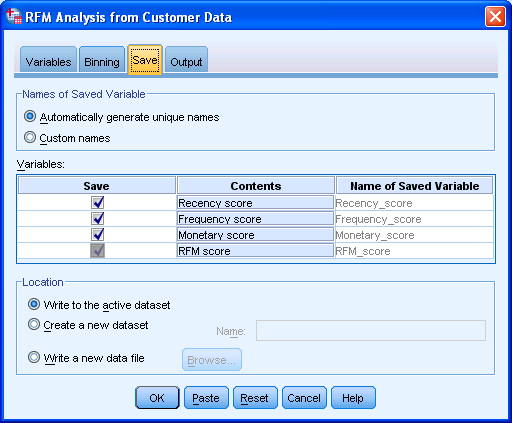 4) Easy to understand features for a business audiences
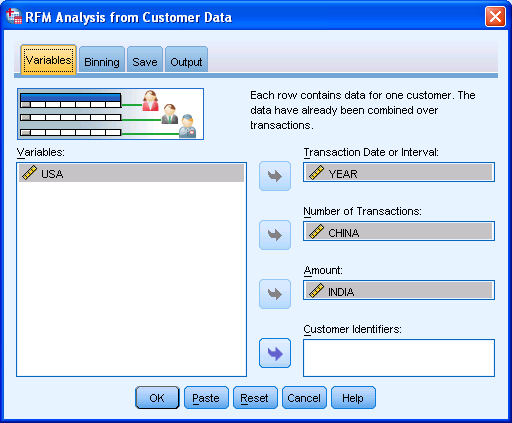
rather than pseudo techie jargon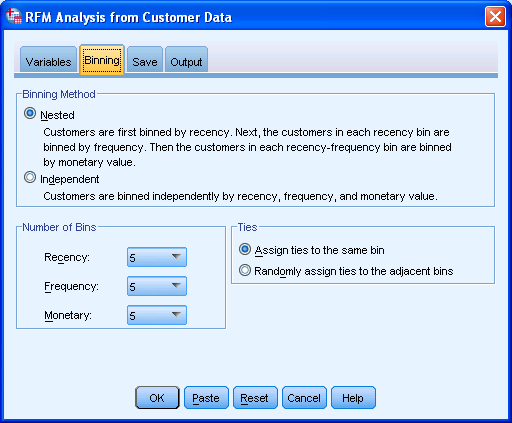 5) Note the clean design of the GUI in specifying data input type
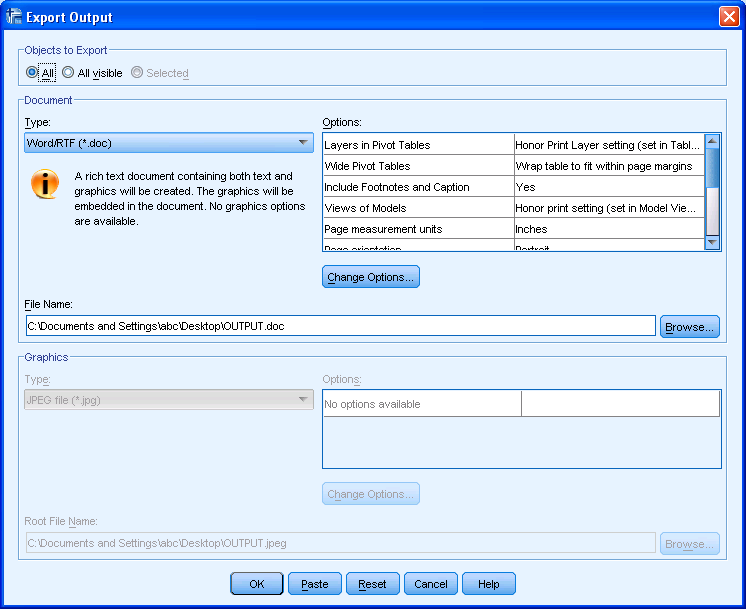
 6) Again multiple options to export results in a very user friendly manner with options to customize business report
 7) Graphical output conveniently pasted inside a word document rather than a jumble of images. Auto generated options for customized standard graphs.
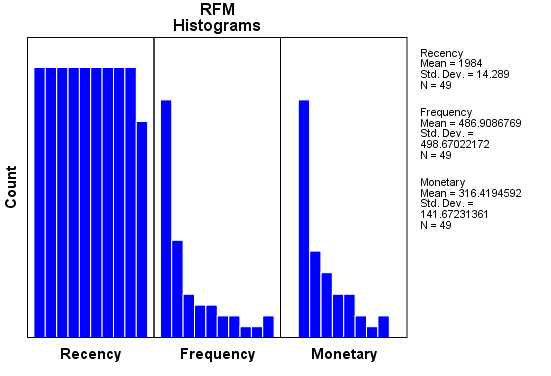 8) An attractive heatmap to represent monetization for customers. Note the effect that a scale of color shades have in visual representation of data.
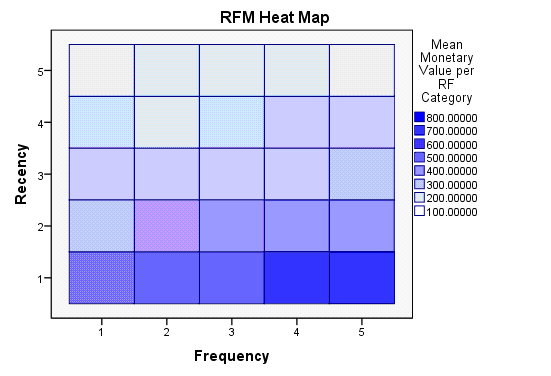 9) Comparative plots placed side by side with easy to understand explanation (in the output word doc not shown here)
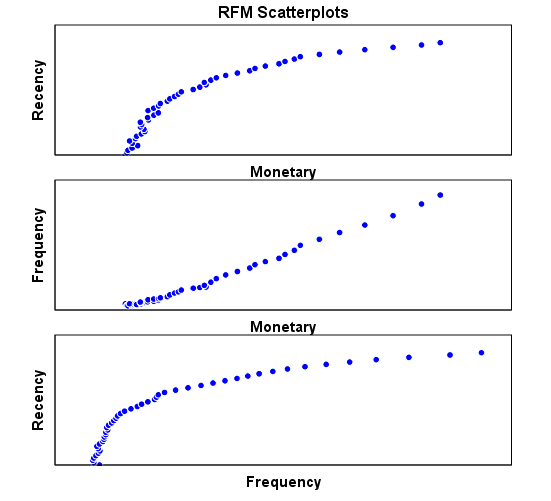 10) Auto generated scores attached to data table to enhance usage.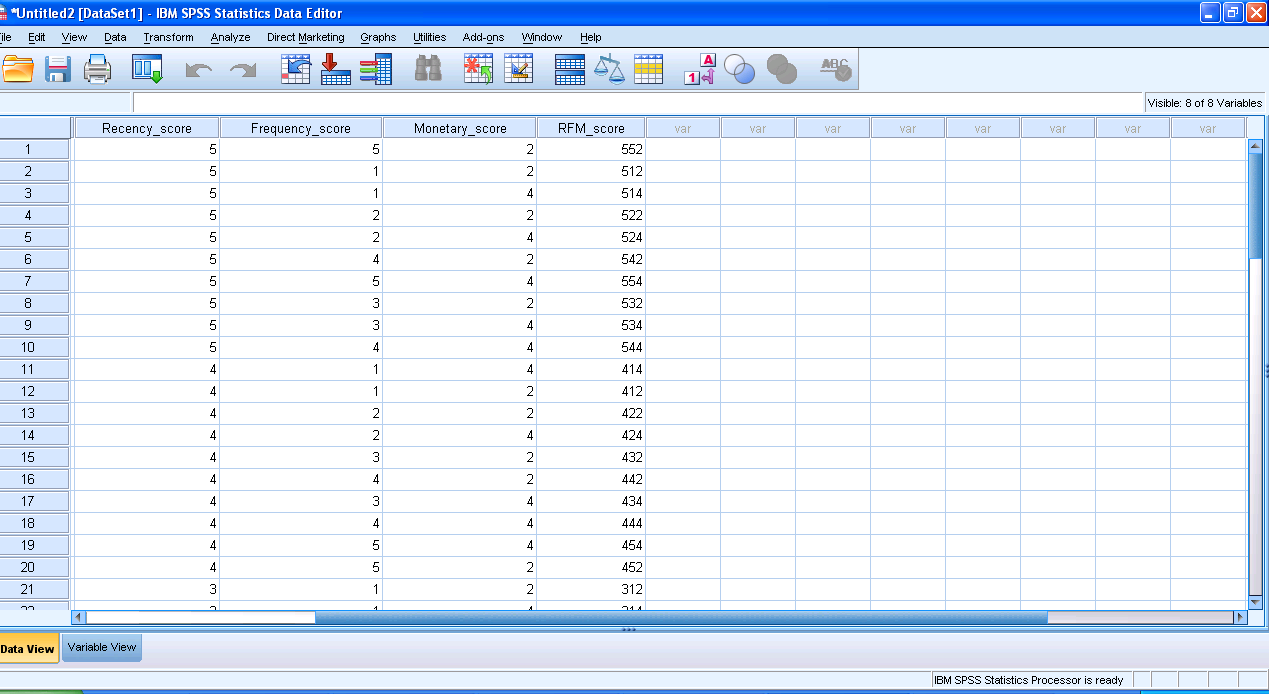
Note here I am evaluating RFM as a marketing technique (which is well known) but also the GUI of IBM SPSS 19 Marketing Analytics. It is simple, and yet powerful into turning what used to be a purely statistical software for nerds into a beautiful easy to implement tool for business users.
So what else can you do in Marketing Analytics with SPSS 19.
IBM SPSS Direct Marketing
The Direct Marketing add-on option allows organizations to ensure their marketing programs are as effective as possible, through techniques specifically designed for direct marketing, including:
• RFM Analysis. This technique identifies existing customers who are most likely to respond to a new offer.
• Cluster Analysis. This is an exploratory tool designed to reveal natural groupings (or clusters) within your data. For example, it can identify different groups of customers based on various demographic and purchasing characteristics.
• Prospect Profiles. This technique uses results from a previous or test campaign to create descriptive profiles. You can use the profiles to target specific groups of contacts in future campaigns.
• Postal Code Response Rates. This technique uses results from a previous campaign to calculate postal code response rates. Those rates can be used to target specific postal codes in future campaigns.
• Propensity to Purchase. This technique uses results from a test mailing or previous campaign to generate propensity scores. The scores indicate which contacts are most likely to respond.
• Control Package Test. This technique compares marketing campaigns to see if there is a significant difference in effectiveness for different packages or offers.
Click here to find out more about Direct Marketing.
In my interactions with the world at large (mostly online) in the ways of data, statistics and analytics- I come across people who like to call themselves analysts.
As per me, there are 4 kinds of analysts principally,
1) Corporate Analysts- They work for a particular software company. As per them their product is great and infallible, their code has no bugs, and last zillion customer case studies all got a big benefit by buying their software.
They are very good at writing software code themselves, unfortunately this expertise is restricted to Microsoft Outlook (emails) and MS Powerpoint ( presentations). No they are more like salesmen than analysts, but as Arthur Miller said ” All salesmen (person) are dreamers. When the dream dies, the salesman (person) dies (read transfers to bigger job at a rival company)
2) Third -Party Independent Analsyst- The main reason they are third party is they can not be tolerated in a normal corporate culture, their spouse can barely stand them for more than 2 hours a day, and their Intelligence is not matched by their emotional maturity. Alas, after turning independent analysts, they realize they are actually more dependent to people than before, and they quickly polish their behaviour to praise who ever is sponsoring their webinar, white paper , newsletter, or flying them to junkets. They are more of boutique consultants, but they used to be quite nifty at writing code, when younger, so they call themselves independent and “Noted Industry Analyst”
3) Researcher Analysts- They mostly scrape info from press releases which are mostly written by a hapless overworked communications team thrown at a task at last moment. They get into one hour call with who ever is the press or industry/analyst relations honcho is- turn the press release into bullet points, and publish on the blog. They call this as research Analysts and give it away for free (but actually couldnt get anyone to pay for it for last 4 years). Couldnt write code if their life depended on it, but usually will find transformation and expert somehwere in their resume/about me web page. May have co -authored a book, which would have gotten them a F for plagiarism had they submitted it as a thesis.
4) Analytical Analysts- They are mostly buried deep within organizational bureaucracies if corporate, or within partnerships if they are independent. Understand coding, innovation (or creativity). Not very aggressive at networking unless provoked by an absolute idiot belonging to first three classes of industry analyst. Prefer to read Atlas Shrugged than argue on business semantics.
Next time you see an industry expert- you know which cluster to classify them 😉

Image Citation-

 DECISION STATS