Making NeW R

Tal G in his excellent blog piece talks of “Why R Developers  should not be paid” http://www.r-statistics.com/2010/09/open-source-and-money-why-r-developers-shouldnt-be-paid/

His argument of love is not very original though it was first made by these four guys

I am going to argue that “some” R developers should be paid, while the main focus should be volunteers code. These R developers should be paid as per usage of their packages.

Let me expand.

Imagine the following conversation between Ross Ihaka, Norman Nie and Peter Dalgaard.

Norman- Hey Guys, Can you give me some code- I got this new startup.

Ross Ihaka and Peter Dalgaard- Sure dude. Here is 100,000 lines of code, 2000 packages and 2 decades of effort.

Norman- Thanks guys.

Ross Ihaka- Hey, What you gonna do with this code.

Norman- I will better it. Sell it. Finally beat Jim Goodnight and his **** Proc GLM and **** Proc Reg.

Ross- Okay, but what will you give us? Will you give us some code back of what you improve?

Norman – Uh, let me explain this open core …

Peter D- Well how about some royalty?

Norman- Sure, we will throw parties at all conferences, snacks you know at user groups.

Ross – Hmm. That does not sound fair. (walks away in a huff muttering)-He takes our code, sells it and wont share the code

Peter D- Doesnt sound fair. I am back to reading Hamlet, the great Dane, and writing the next edition of my book. I am glad I wrote a book- Ross didnt even write that.

Norman-Uh Oh. (picks his phone)- Hey David Smith, We need to write some blog articles pronto – these open source guys ,man…

———–I think that sums what has been going on in the dynamics of R recently. If Ross Ihaka and R Gentleman had adopted an open core strategy- meaning you can create packages to R but not share the original where would we all be?

At this point if he is reading this, David Smith , long suffering veteran of open source  flameouts is rolling his eyes while Tal G is wondering if he will publish this on R Bloggers and if so when or something.

Lets bring in another R veteran-  Hadley Wickham who wrote a book on R and also created ggplot. Thats the best quality, most often used graphics package.

In terms of economic utilty to end user- the ggplot package may be as useful if not more as the foreach package developed by Revolution Computing/Analytics.

Now http://cran.r-project.org/web/packages/foreach/index.html says that foreach is licensed under http://www.apache.org/licenses/LICENSE-2.0

However lets come to open core licensing ( read it here http://alampitt.typepad.com/lampitt_or_leave_it/2008/08/open-core-licen.html ) which is where the debate is- Revolution takes code- enhances it (in my opinion) substantially with new formats XDF for better efficieny, web services API, and soon coming next year a GUI (thanks in advance , Dr Nie and guys)

and sells this advanced R code to businesses happy to pay ( they are currently paying much more to DR Goodnight and HIS guys)

Why would any sane customer buy it from Revolution- if he could download exactly the same thing from http://r-project.org

Hence the business need for Revolution Analytics to have an enhanced R- as they are using a product based software model not software as a service model.

If Revolution gives away source code of these new enhanced codes to R core team- how will R core team protect the above mentioned intelectual property- given they have 2 decades experience of giving away free code , and back and forth on just code.

Now Revolution also has a marketing budget- and thats how they sponsor some R Core events, conferences, after conference snacks.

How would people decide if they are being too generous or too stingy in their contribution (compared to the formidable generosity of SAS Institute to its employees, stakeholders and even third party analysts).

Would it not be better- IF Revolution can shift that aspect of relationship to its Research and Development budget than it’s marketing budget- come with some sort of incentive for “SOME” developers – even researchers need grants and assistantships, scholarships, make a transparent royalty formula say 17.5 % of the NEW R sales goes to R PACKAGE Developers pool, which in turn examines usage rate of packages and need/merit before allocation- that would require Revolution to evolve from a startup to a more sophisticated corporate and R Core can use this the same way as John M Chambers software award/scholarship

Dont pay all developers- it would be an insult to many of them – say Prof Harrell creator of HMisc to accept – but can Revolution expand its dev base (and prospect for future employees) by even sponsoring some R Scholarships.

And I am sure that if Revolution opens up some more code to the community- they would the rest of the world and it’s help useful. If it cant trust people like R Gentleman with some source code – well he is a board member.

——————————————————————————————–

Now to sum up some technical discussions on NeW R

1)  An accepted way of benchmarking efficiencies.

2) Code review and incorporation of efficiencies.

3) Multi threading- Multi core usage are trends to be incorporated.

4) GUIs like R Commander E Plugins for other packages, and Rattle for Data Mining to have focussed (or Deducer). This may involve hiring User Interface Designers (like from Apple 😉  who will work for love AND money ( Even the Beatles charge royalty for that song)

5) More support to cloud computing initiatives like Biocep and Elastic R – or Amazon AMI for using cloud computers- note efficiency arguements dont matter if you just use a Chrome Browser and pay 2 cents a hour for an Amazon Instance. Probably R core needs more direct involvement of Google (Cloud OS makers) and Amazon as well as even Salesforce.com (for creating Force.com Apps). Note even more corporates here need to be involved as cloud computing doesnot have any free and open source infrastructure (YET)

_______________________________________________________

Debates will come and go. This is an interesting intellectual debate and someday the liitle guys will win the Revolution-

From Hugh M of Gaping Void-

http://www.gapingvoid.com/Moveable_Type/archives/cat_microsoft_blue_monster_series.html

HOW DOES A SOFTWARE COMPANY MAKE MONEY, IF ALL

SOFTWARE IS FREE?

“If something goes wrong with Microsoft, I can phone Microsoft up and have it fixed. With Open Source, I have to rely on the community.”

And the community, as much as we may love it, is unpredictable. It might care about your problem and want to fix it, then again, it may not. Anyone who has ever witnessed something online go “viral”, good or bad, will know what I’m talking about.

and especially-

http://gapingvoid.com/2007/04/16/how-well-does-open-source-currently-meet-the-needs-of-shareholders-and-ceos/

Source-http://gapingvoidgallery.com/

Kind of sums up why the open core licensing is all about.

Web R- Elastic R and RevoDeploy R

I had a skype video chat with Karime Chine and he was kind enough to walk me through the new portal Elastic-R at http://www.elastic-r.org

Basically you can work on a collaborative basis in this with multiple users working on excel as well as R projects.

Some screenshots-in a short presentation I made on my notes during K Chine’s presentation

Also, Revolution Analytics is coming out with a Web Services product for R

RevoDeployR: Web Services for R

Both are very powerful uses of R for cloud computing- and it would be interesting if the original cloud computing champion Google gets into the R Project.

KXEN Update

Update from a very good data mining software company, KXEN –

  1. Longtime Chairman and founder Roger Haddad is retiring but would be a Board Member. See his interview with Decisionstats here https://decisionstats.wordpress.com/2009/01/05/interview-roger-haddad-founder-of-kxen-automated-modeling-software/ (note images were hidden due to migration from .com to .wordpress.com )
  2. New Members of Leadership are as-
John Ball, CEOJohn Ball
Chief Executive Officer

John Ball brings 20 years of experience in enterprise software, deep expertise in business intelligence and CRM applications, and a proven track record of success driving rapid growth at highly innovative companies.

Prior to joining KXEN, Mr. Ball served in several executive roles at salesforce.com, the leading provider of SaaS applications. Most recently, John served as VP & General Manager, Analytics and Reporting Products, where he spearheaded salesforce.com’s foray into CRM analytics and business intelligence. John also served as VP & General Manager, Service and Support Applications at salesforce.com, where he successfully grew the business to become the second largest and fastest growing product line at salesforce.com. Before salesforce.com, Ball was founder and CEO of Netonomy, the leading provider of customer self-service solutions for the telecommunications industry. Ball also held a number of executive roles at Business Objects, including General Manager, Web Products, where delivered to market the first 3 versions of WebIntelligence. Ball has a master’s degree in electrical engineering from Georgia Tech and a master’s degree in electric

I hope John atleast helps build a KXEN Force.com application- there are only 2 data mining apps there on App Exchange. Also on the wish list  more social media presence, a Web SaaS/Amazon API for KXEN, greater presence in American/Asian conferences, and a solution for SME’s (which cannot afford the premium pricing of the flagship solution. An alliance with bigger BI vendors like Oracle, SAP or IBM  for selling the great social network analysis.

Bill Russell as Non Executive Chairman-

Bill Russell as Non-executive Chairman of the Board, effective July 16 2010. Russell has 30 years of operational experience in enterprise software, with a special focus on business intelligence, analytics, and databases.Russell held a number of senior-level positions in his more than 20 years at Hewlett-Packard, including Vice President and General Manager of the multi-billion dollar Enterprise Systems Group. He has served as Non-executive Chairman of the Board for Sylantro Systems Corporation, webMethods Inc., and Network Physics, Inc. and has served as a board director for Cognos Inc. In addition to KXEN, Russell currently serves on the boards of Saba, PROS Holdings Inc., Global 360, ParAccel Inc., and B.T. Mancini Company.

Xavier Haffreingue as senior vice president, worldwide professional services and solutions.
He has almost 20 years of international enterprise software experience gained in the CRM, BI, Web and database sectors. Haffreingue joins KXEN from software provider Axway where he was VP global support operations. Prior to Axway, he held various leadership roles in the software industry, including VP self service solutions at Comverse Technologies and VP professional services and support at Netonomy, where he successfully delivered multi-million dollar projects across Europe, Asia-Pacific and Africa. Before that he was with Business Objects and Sybase, where he ran support and services in southern Europe managing over 2,500 customers in more than 20 countries.

David Guercio  as senior vice president, Americas field operations. Guercio brings to the role more than 25 years experience of building and managing high-achieving sales teams in the data mining, business intelligence and CRM markets. Guercio comes to KXEN from product lifecycle management vendor Centric Software, where he was EVP sales and client services. Prior to Centric, he was SVP worldwide sales and client services at Inxight Software, where he was also Chairman and CEO of the company’s Federal Systems Group, a subsidiary of Inxight that saw success in the US Federal Government intelligence market. The success in sales growth and penetration into the federal government led to the acquisition of Inxight by Business Objects in 2007, where Guercio then led the Inxight sales organization until Business Objects was acquired by SAP. Guercio was also a key member of the management team and a co-founder at Neovista, an early pioneer in data mining and predictive analytics. Additionally, he held the positions of director of sales and VP of professional services at Metaphor Computer Systems, one of the first data extraction solutions companies, which was acquired by IBM. During his career, Guercio also held executive positions at Resonate and SiGen.

3) Venture Capital funding to fund expansion-

It has closed $8 million in series D funding to further accelerate its growth and international expansion. The round was led by NextStage and included participation from existing investors XAnge Capital, Sofinnova Ventures, Saints Capital and Motorola Ventures.

This was done after John Ball had joined as CEO.

4) Continued kudos from analysts and customers for it’s technical excellence.

KXEN was named a leader in predictive analytics and data mining by Forrester Research (1) and was rated highest for commercial deployments of social network analytics by Frost & Sullivan (2)

Also it became an alliance partner of Accenture- which is also a prominent SAS partner as well.

In Database Optimization-

In KXEN V5.1, a new data manipulation module (ADM) is provided in conjunction with scoring to optimize database workloads and provide full in-database model deployment. Some leading data mining vendors are only now beginning to offer this kind of functionality, and then with only one or two selected databases, giving KXEN a more than five-year head start. Some other vendors are only offering generic SQL generation, not optimized for each database, and do not provide the wealth of possible outputs for their scoring equations: For example, real operational applications require not only to generate scores, but decision probabilities, error bars, individual input contributions – used to derive reasons of decision and more, which are available in KXEN in-database scoring modules.

Since 2005, KXEN has leveraged databases as the data manipulation engine for analytical dataset generation. In 2008, the ADM (Analytical Data Management) module delivered a major enhancement by providing a very easy to use data manipulation environment with unmatched productivity and efficiency. ADM works as a generator of optimized database-specific SQL code and comes with an integrated layer for the management of meta-data for analytics.

KXEN Modeling Factory- (similar to SAS’s recent product Rapid Predictive Modeler http://www.sas.com/resources/product-brief/rapid-predictive-modeler-brief.pdf and http://jtonedm.com/2010/09/02/first-look-rapid-predictive-modeler/)

KXEN Modeling Factory (KMF) has been designed to automate the development and maintenance of predictive analytics-intensive systems, especially systems that include large numbers of models, vast amounts of data or require frequent model refreshes. Information about each project and model is monitored and disseminated to ensure complete management and oversight and to facilitate continual improvement in business performance.

Main Functions

Schedule: creation of the Analytic Data Set (ADS), setup of how and when to score, setup of when and how to perform model retraining and refreshes …

Report
: Monitormodel execution over time, Track changes in model quality over time, see how useful one variable is by considering its multiple instance in models …

Notification
: Rather than having to wade through pages of event logs, KMF Department allows users to manage by exception through notifications.

Other products from KXEN have been covered here before https://decisionstats.wordpress.com/tag/kxen/ , including Structural Risk Minimization- https://decisionstats.wordpress.com/2009/04/27/kxen-automated-regression-modeling/

Thats all for the KXEN update- all the best to the new management team and a splendid job done by Roger Haddad in creating what is France and Europe’s best known data mining company.

Note- Source – http://www.kxen.com


Google AppInventor -Android and Business Intelligence

Here is a great new tool for techies to start creating Android Apps right away- even if you have no knowledge of the platform. Of course there are existing great number of apps- including my favorite Android Data Mining App in R – called AnalyticDroid http://analyticdroid.togaware.com/

Basically it calls the Rattle (R Analytical Tool To Learn Easily) Data Mining GUI -enabling data mining from an Android Mobile using remote computing.

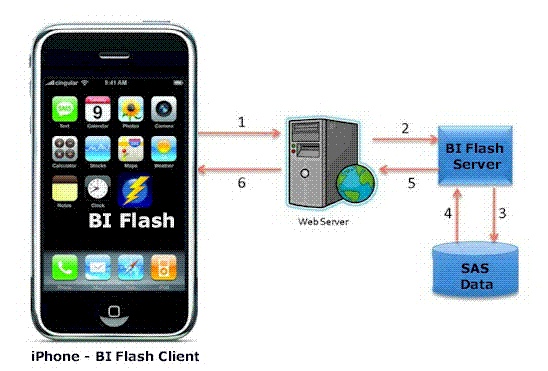
I dont know if any other statistical application is available on Android Mobiles- though SAS did have a presentation on using SAS on IPhone

http://www.wuss.org/proceedings09/09WUSSProceedings/papers/dpr/DPR-Truong.pdf


SAS Mobile -Iphone App

All you need to do is go to http://appinventor.googlelabs.com/about/index.html and request access (yes there is a 2 week approval waiting line)

Because App Inventor provides access to a GPS-location sensor, you can build apps that know where you are. You can build an app to help you remember where you parked your car, an app that shows the location of your friends or colleagues at a concert or conference, or your own custom tour app of your school, workplace, or a museum.
You can write apps that use the phone features of an Android phone. You can write an app that periodically texts “missing you” to your loved ones, or an app “No Text While Driving” that responds to all texts automatically with “sorry, I’m driving and will contact you later”. You can even have the app read the incoming texts aloud to you (though this might lure you into responding).
App Inventor provides a way for you to communicate with the web. If you know how to write web apps, you can use App Inventor to write Android apps that talk to your favorite web sites, such as Amazon and Twitter.

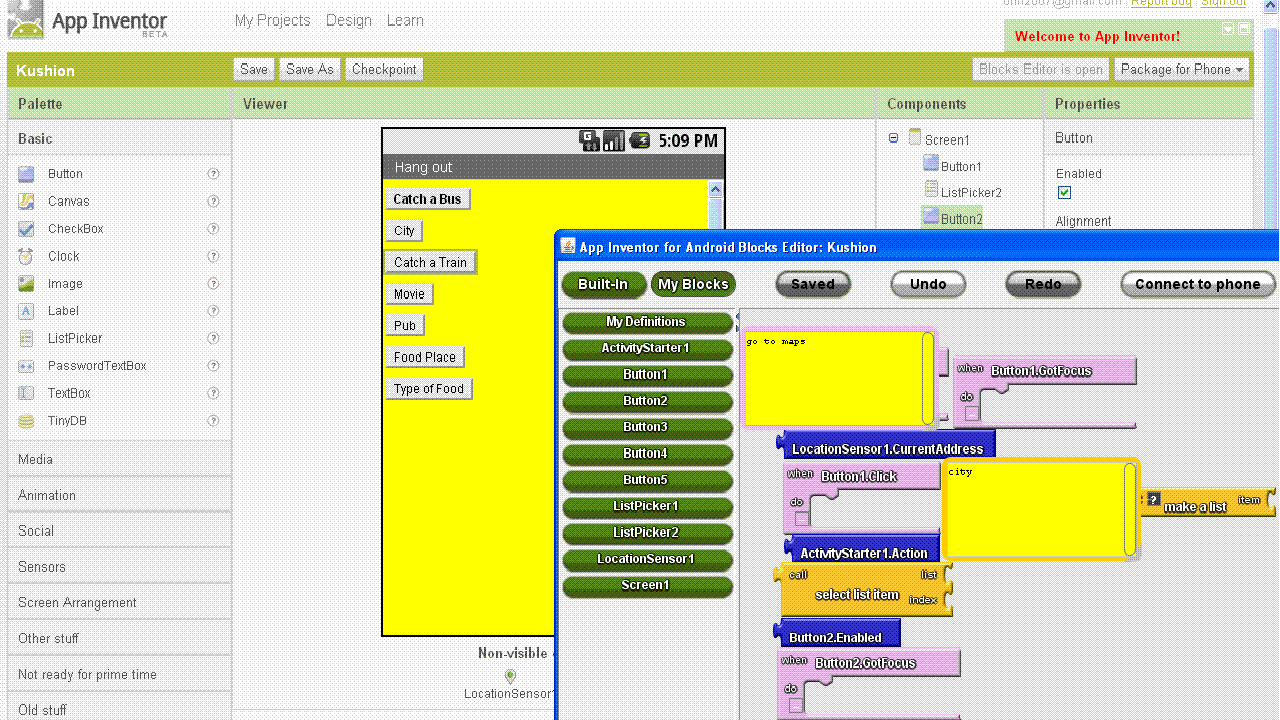
Here is a not so statistical Android App I am trying to create called Hang-Out

using the current GPS location of your phone to find nearest Pub, Movie or Diner and catch Bus- Train based on your location city, the GPS and time of request and schedule of those cities public transport- very much WIP

Google moving on from MapReduce: rest of world still catching up

Apparently it is true as per the Register, but details in a paper next month- It is called Google Caffeine.

http://www.theregister.co.uk/2010/09/09/google_caffeine_explained/

Caffeine expands on BigTable to create a kind of database programming model that lets the company make changes to its web index without rebuilding the entire index from scratch. “[Caffeine] is a database-driven, Big Table–variety indexing system,” Lipkovitz tells The Reg, saying that Google will soon publish a paper discussing the system. The paper, he says, will be delivered next month at the USENIX Symposium on Operating Systems Design and Implementation (OSDI).

and interestingly

MapReduce, he says, isn’t suited to calculations that need to occur in near real-time.

MapReduce is a sequence of batch operations, and generally, Lipkovits explains, you can’t start your next phase of operations until you finish the first. It suffers from “stragglers,” he says. If you want to build a system that’s based on series of map-reduces, there’s a certain probability that something will go wrong, and this gets larger as you increase the number of operations. “You can’t do anything that takes a relatively short amount of time,” Lipkovitz says, “so we got rid of it.”

With Caffeine, Google can update its index by making direct changes to the web map already stored in BigTable. This includes a kind of framework that sits atop BigTable, and Lipkovitz compares it to old-school database programming and the use of “database triggers.”

but most importantly

In 2004, Google published research papers on GFS and MapReduce that became the basis for the open source Hadoop platform now used by Yahoo!, Facebook, and — yes — Microsoft. But as Google moves beyond GFS and MapReduce, Lipokovitz stresses that he is “not claiming that the rest of the world is behind us.”

But oh no!

“We’re in business of making searches useful,” he says. “We’re not in the business of selling infrastructure

But I say why not- Search is good and advertising is okay

There is more (not evil) money in infrastructure (of big data) as there is in advertising. But the advertising guys disagree

Open Source Business Intelligence: Pentaho and Jaspersoft

Here are two products that are used widely for Business Intelligence_ They are open source and both have free preview.

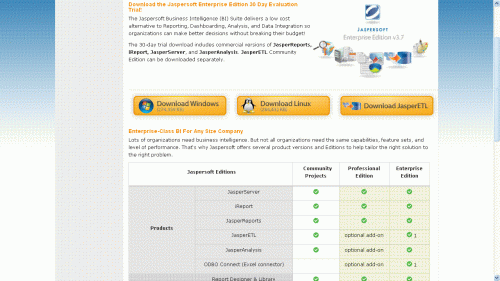
Jaspersoft-For the Enterprise version click on the screenshot while for the free community version you can go to

http://jasperforge.org/projects/jasperserver

Interestingly (and not surprisingly) Revolution Analytics is teaming up with Jaspersoft to use R for reporting along with the Jaspersoft BI stack.

ADVANCED ANALYTICS ON DEMAND IN APPLICATIONS, IN DASHBOARDS, AND ON THE WEB

FREE WEBINAR WEDNESDAY, SEPTEMBER 22ND @9AM PACIFIC

DEPLOYING R: ADVANCED ANALYTICS ON DEMAND IN APPLICATIONS, IN DASHBOARDS, AND ON THE WEB

A JOINT WEBINAR FROM REVOLUTION ANALYTICS AND JASPERSOFT

Date: Wednesday, September 22, 2010
Time: 9:00am PDT (12:00pm EDT; 4:00pm GMT)
Presenters: David Smith, Vice President of Marketing, Revolution Analytics
Andrew Lampitt, Senior Director of Technology Alliances, Jaspersoft
Matthew Dahlman, Business Development Engineer, Jaspersoft
Registration: Click here to register now!

R is a popular and powerful system for creating custom data analysis, statistical models, and data visualizations. But how can you make the results of these R-based computations easily accessible to others? A PhD statistician could use R directly to run the forecasting model on the latest sales data, and email a report on request, but then the process is just going to have to be repeated again next month, even if the model hasn’t changed. Wouldn’t it be better to empower the Sales manager to run the model on demand from within the BI application she already uses—daily, even!—and free up the statistician to build newer, better models for others?

In this webinar, David Smith (VP of Marketing, Revolution Analytics) will introduce the new “RevoDeployR” Web Services framework for Revolution R Enterprise, which is designed to make it easy to integrate dynamic R-based computations into applications for business users. RevoDeployR empowers data analysts working in R to publish R scripts to a server-based installation of Revolution R Enterprise. Application developers can then use the RevoDeployR Web Services API to securely and scalably integrate the results of these scripts into any application, without needing to learn the R language. With RevoDeployR, authorized users of hosted or cloud-based interactive Web applications, desktop applications such as Microsoft Excel, and BI applications like Jaspersoft can all benefit from on-demand analytics and visualizations developed by expert R users.

To demonstrate the power of deploying R-based computations to business users, Andrew Lampitt will introduce Jaspersoft commercial open source business intelligence, the world’s most widely used BI software. In a live demonstration, Matt Dahlman will show how to supercharge the BI process by combining Jaspersoft and Revolution R Enterprise, giving business users on-demand access to advanced forecasts and visualizations developed by expert analysts.

Click here to register for the webinar.

Speaker Biographies:

David Smith is the Vice President of Marketing at Revolution Analytics, the leading commercial provider of software and support for the open source “R” statistical computing language. David is the co-author (with Bill Venables) of the official R manual An Introduction to R. He is also the editor of Revolutions (http://blog.revolutionanalytics.com), the leading blog focused on “R” language, and one of the originating developers of ESS: Emacs Speaks Statistics. You can follow David on Twitter as @revodavid.

Andrew Lampitt is Senior Director of Technology Alliances at Jaspersoft. Andrew is responsible for strategic initiatives and partnerships including cloud business intelligence, advanced analytics, and analytic databases. Prior to Jaspersoft, Andrew held other business positions with Sunopsis (Oracle), Business Objects (SAP), and Sybase (SAP). Andrew earned a BS in engineering from the University of Illinois at Urbana Champaign.

Matthew Dahlman is Jaspersoft’s Business Development Engineer, responsible for technical aspects of technology alliances and regional business development. Matt has held a wide range of technical positions including quality assurance, pre-sales, and technical evangelism with enterprise software companies including Sybase, Netonomy (Comverse), and Sunopsis (Oracle). Matt earned a BA in mathematics from Carleton College in Northfield, Minnesota.


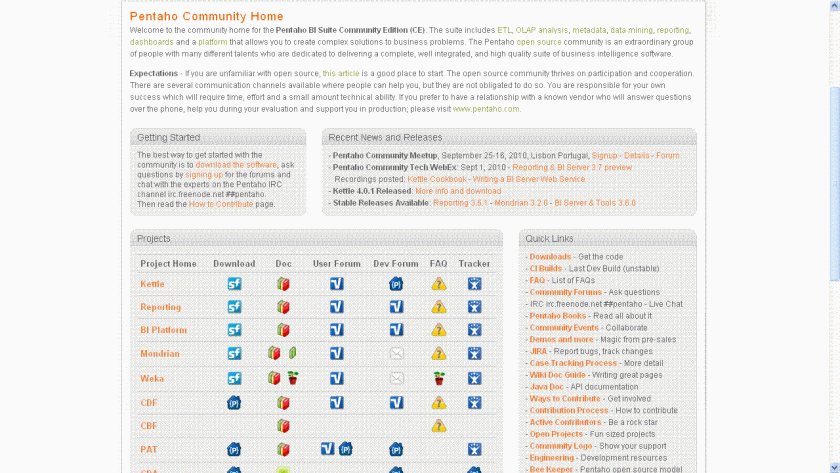
The second widely used BI stack in open source is Pentaho.

You can download it here to evaluate it or click on screenshot to read more at

http://community.pentaho.com/

http://sourceforge.net/projects/pentaho/files/Business%20Intelligence%20Server/

Amazon announces Micro Instances for cloud computing

From Amazon http://aws.amazon.com/ec2

Micro instances provide 613 MB of memory and support 32-bit and 64-bit platforms on both Linux and Windows. Micro instance pricing for On-Demand instances starts at $0.02 per hour for Linux and $0.03 per hour for Windows.

Customers have asked us for a lower priced instance type that could satisfy the needs of their less demanding applications. Micro instances are optimized for applications that require lower throughput, but which still may consume significant compute cycles periodically. Micro instances provide a small amount of consistent CPU resources, and also allow you to burst CPU capacity when additional cycles are available.

Micro instances are available immediately in all regions, and we invite you to go and try one out for yourself today! Learn more about Amazon EC2’s new Micro instances ataws.amazon.com/ec2.

Micro Instances

Instances of this family provide a small amount of consistent CPU resources and allow you to burst CPU capacity when additional cycles are available. They are well suited for lower throughput applications and web sites that consume significant compute cycles periodically.

  • Micro Instance 613 MB of memory, up to 2 ECUs (for short periodic bursts), EBS storage only, 32-bit or 64-bit platform

So dont buy that new CPU yet- use existing hardware in tandem with these micro instances (and internet) to compute- (but  only if your corporate IP administrator wasn’t trained in Windows only certifications 😉