
GNU PSPP- The Open Source SPSS

If you are SPSS user (for statistics/ not data mining) you can also try 0ut GNU PSPP- which is the open source equivalent and quite eerily impressive in performance. It is available at http://www.gnu.org/software/pspp/ or http://pspp.awardspace.com/ and you can also read more at http://en.wikipedia.org/wiki/PSPP
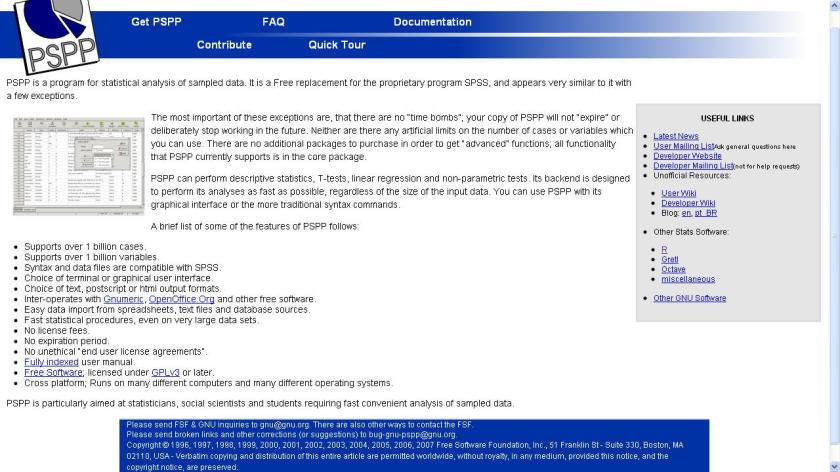
PSPP is a program for statistical analysis of sampled data. It is a Free replacement for the proprietary program SPSS, and appears very similar to it with a few exceptions.

[ Image of Variable Sheet ]The most important of these exceptions are, that there are no “time bombs”; your copy of PSPP will not “expire” or deliberately stop working in the future. Neither are there any artificial limits on the number of cases or variables which you can use. There are no additional packages to purchase in order to get “advanced” functions; all functionality that PSPP currently supports is in the core package.

PSPP can perform descriptive statistics, T-tests, linear regression and non-parametric tests. Its backend is designed to perform its analyses as fast as possible, regardless of the size of the input data. You can use PSPP with its graphical interface or the more traditional syntax commands.

A brief list of some of the features of PSPP follows:

  • Supports over 1 billion cases.
  • Supports over 1 billion variables.
  • Syntax and data files are compatible with SPSS.
  • Choice of terminal or graphical user interface.
  • Choice of text, postscript or html output formats.
  • Inter-operates with GnumericOpenOffice.Org and other free software.
  • Easy data import from spreadsheets, text files and database sources.
  • Fast statistical procedures, even on very large data sets.
  • No license fees.
  • No expiration period.
  • No unethical “end user license agreements”.
  • Fully indexed user manual.
  • Free Software; licensed under GPLv3 or later.
  • Cross platform; Runs on many different computers and many different operating systems.

PSPP is particularly aimed at statisticians, social scientists and students requiring fast convenient analysis of sampled data.

and

Features

This software provides a basic set of capabilities: frequencies, cross-tabs comparison of means (T-tests and one-way ANOVA); linear regression, reliability (Cronbach’s Alpha, not failure or Weibull), and re-ordering data, non-parametric tests, factor analysis and more.

At the user’s choice, statistical output and graphics are done in asciipdfpostscript or html formats. A limited range of statistical graphs can be produced, such as histogramspie-charts and np-charts.

PSPP can import GnumericOpenDocument and Excel spreadsheetsPostgres databasescomma-separated values– and ASCII-files. It can export files in the SPSS ‘portable’ and ‘system’ file formats and to ASCII files. Some of the libraries used by PSPP can be accessed programmatically; PSPP-Perl provides an interface to the libraries used by PSPP.

Origins

The PSPP project (originally called “Fiasco”) is a free, open-source alternative to the proprietary statistics package SPSS. SPSS is closed-source and includes a restrictive licence anddigital rights management. The author of PSPP considered this ethically unacceptable, and decided to write a program which might with time become functionally identical to SPSS, except that there would be no licence expiry, and everyone would be permitted to copy, modify and share the program.

Release history

  • 0.7.5 June 2010 http://pspp.awardspace.com/
  • 0.6.2 October 2009
  • 0.6.1 October 2008
  • 0.6.0 June 2008
  • 0.4.0.1 August 2007
  • 0.4.0 August 2005
  • 0.3.0 April 2004
  • 0.2.4 January 2000
  • 0.1.0 August 1998

Third Party Reviews

In the book “SPSS For Dummies“, the author discusses PSPP under the heading of “Ten Useful Things You Can Find on the Internet” [1]. In 2006, the South African Statistical Association presented a conference which included an analysis of how PSPP can be used as a free replacement to SPSS [2].

Citation-

Please send FSF & GNU inquiries to gnu@gnu.org. There are also other ways to contact the FSF. Please send broken links and other corrections (or suggestions) to bug-gnu-pspp@gnu.org.

Copyright © 1996, 1997, 1998, 1999, 2000, 2001, 2002, 2003, 2004, 2005, 2006, 2007 Free Software Foundation, Inc., 51 Franklin St – Suite 330, Boston, MA 02110, USA – Verbatim copying and distribution of this entire article are permitted worldwide, without royalty, in any medium, provided this notice, and the copyright notice, are preserved.

Business Analytics Analyst Relations /Ethics/White Papers

Curt Monash, whom I respect and have tried to interview (unsuccessfully) points out suitable ethical dilemmas and gray areas in Analyst Relations in Business Intelligence here at http://www.dbms2.com/2010/07/30/advice-for-some-non-clients/

If you dont know what Analyst Relations are, well it’s like credit rating agencies for BI software. Read Curt and his landscaping of the field here ( I am quoting a summary) at http://www.strategicmessaging.com/the-ethics-of-white-papers/2010/08/01/

Vendors typically pay for

  1. They want to connect with sales prospects.
  2. They want general endorsement from the analyst.
  3. They specifically want endorsement from the analyst for their marketing claims.
  4. They want the analyst to do a better job of explaining something than they think they could do themselves.
  5. They want to give the analyst some money to enhance the relationship,

Merv Adrian (I interviewed Merv here at http://www.dudeofdata.com/?p=2505) has responded well here at http://www.enterpriseirregulars.com/23040/white-paper-sponsorship-and-labeling/

None of the sites I checked clearly identify the work as having been sponsored in any way I found obvious in my (admittefly) quick scan. So this is an issue, but it’s not confined to Oracle.

My 2 cents (not being so well paid 😉 are-

I think Curt was calling out Oracle (which didnt respond) and not Merv ( whose subsequent blog post does much to clarify).

As a comparative new /younger blogger in this field,
I applaud both Curt to try and bell the cat ( or point out what everyone in AR winks at) and for Merv for standing by him.

In the long run, it would strengthen analyst relations as a channel if they separate financial payment of content from bias. An example is credit rating agencies who forgot to do so in BFSI and see what happened.

Customers invest millions of dollars in BI systems trusting marketing collateral/white papers/webinars/tests etc. Perhaps it’s time for an industry association for analysts so that individual analysts don’t knuckle down under vendor pressure.

It is easier for someone of Curt, Merv’s stature to declare editing policy and disclosures before they write a white paper.It is much harder for everyone else who is not so well established.

White papers can take as much as 25,000$ to produce- and I know people who in Business Analytics (as opposed to Business Intelligence) slog on cents per hour cranking books on R, SAS , webinars, trainings but there are almost no white papers in BA. Are there any analytics independent analysts who are not biased by R or SAS or SPSS or etc etc. I am not sure but this looks like a good line to  pursue 😉 – provided ethical checks and balances are established.

Personally I know of many so called analytics communities go all out to please their sponsors so bias in writing does exist (you cant praise SAS on a R Blogging Forum or R USers Meet and you cant write on WPS at SAS Community.org )

– at the same time someone once told me- It is tough to make a living as a writer, and that choice between easy money and credible writing needs to be respected.

Most sponsored white papers I read are pure advertisements, directed at CEOs rather than the techie community at large.

Almost every BI vendor claims to have the fastest database with 5X speed- and benchmarking in technical terms could be something they could do too.

Just like Gadget sites benchmark products, you can not benchmark BI or even BA products as it is written not to do so  in many licensing terms.

Probably that is the reason Billions are spent in BI and the positive claims are doubtful ( except by the sellers). Similarly in Analytics, many vendors would have difficulty justifying their claims or prices if they are subjected to a side by side comparison. Unfortunately the resulting confusion results in shoddy technology coming stronger due to more aggressive marketing.

My latest creation

I have just teamed up to create my latest venture called Kush Cognitives (Kush is my son). The firm is gonna make websites, build statistical analysis and offer social media offerings. It’s my latest venture and it merges all my previous ones and skills. After almost 3 years of working on and off with multiple people, this one is with a friend in the US.

Over the years (since 2007) I have made http://virtua-analytics.com (defunct), Swarajya Analytics Private Limited (www.swanplc.com – now sold) and now Kush Cognitives. I have gone through the models of proprietorship and corporation and now partnership.

Kush Cognitives is hosted at Decisionstats.com (as our flagship website) and we have shifted the blog to Decisionstats.Wordpress.com

We are aiming at the startups and small and medium segments first, but we retain capabilities for bigger clients as well. Lesser Bullshit and More Bang for your Buck.

So wish us luck- and if you need any social media advice, statistical analysis to be done, or technical matters of creating websites-This also includes training customization in R , SAS  , and statistical software but from a more practical point of view from a user angle. We are able to cater to both US and Indian clients.

give us a buzz at http://decisionstats.com

regards

Ajay Ohri

Image Courtesy-michelangelo

Towards better analytical software

Here are some thoughts on using existing statistical software for better analytics and/or business intelligence (reporting)-

1) User Interface Design Matters- Most stats software have a legacy approach to user interface design. While the Graphical User Interfaces need to more business friendly and user friendly- example you can call a button T Test or You can call it Compare > Means of Samples (with a highlight called T Test). You can call a button Chi Square Test or Call it Compare> Counts Data. Also excessive reliance on drop down ignores the next generation advances in OS- namely touchscreen instead of mouse click and point.

Given the fact that base statistical procedures are the same across softwares, a more thoughtfully designed user interface (or revamped interface) can give softwares an edge over legacy designs.

2) Branding of Software Matters- One notable whine against SAS Institite products is a premier price. But really that software is actually inexpensive if you see other reporting software. What separates a Cognos from a Crystal Reports to a SAS BI is often branding (and user interface design). This plays a role in branding events – social media is often the least expensive branding and marketing channel. Same for WPS and Revolution Analytics.

3) Alliances matter- The alliances of parent companies are reflected in the sales of bundled software. For a complete solution , you need a database plus reporting plus analytical software. If you are not making all three of the above, you need to partner and cross sell. Technically this means that software (either DB, or Reporting or Analytics) needs to talk to as many different kinds of other softwares and formats. This is why ODBC in R is important, and alliances for small companies like Revolution Analytics, WPS and Netezza are just as important as bigger companies like IBM SPSS, SAS Institute or SAP. Also tie-ins with Hadoop (like R and Netezza appliance)  or  Teradata and SAS help create better usage.

4) Cloud Computing Interfaces could be the edge- Maybe cloud computing is all hot air. Prudent business planing demands that any software maker in analytics or business intelligence have an extremely easy to load interface ( whether it is a dedicated on demand website) or an Amazon EC2 image. Easier interfaces win and with the cloud still in early stages can help create an early lead. For R software makers this is critical since R is bad in PC usage for larger sets of data in comparison to counterparts. On the cloud that disadvantage vanishes. An easy to understand cloud interface framework is here ( its 2 years old but still should be okay) http://knol.google.com/k/data-mining-through-cloud-computing#

5) Platforms matter- Softwares should either natively embrace all possible platforms or bundle in middle ware themselves.

Here is a case study SAS stopped supporting Apple OS after Base SAS 7. Today Apple OS is strong  ( 3.47 million Macs during the most recent quarter ) and the only way to use SAS on a Mac is to do either

http://goo.gl/QAs2

or do a install of Ubuntu on the Mac ( https://help.ubuntu.com/community/MacBook ) and do this

http://ubuntuforums.org/showthread.php?t=1494027

Why does this matter? Well SAS is free to academics and students  from this year, but Mac is a preferred computer there. Well WPS can be run straight away on the Mac (though they are curiously not been able to provide academics or discounted student copies 😉 ) as per

http://goo.gl/aVKu

Does this give a disadvantage based on platform. Yes. However JMP continues to be supported on Mac. This is also noteworthy given the upcoming Chromium OS by Google, Windows Azure platform for cloud computing.

Open Source and Software Strategy

Curt Monash at Monash Research pointed out some ongoing open source GPL issues for WordPress and the Thesis issue (Also see http://ma.tt/2009/04/oracle-and-open-source/ and  http://www.mattcutts.com/blog/switching-things-around/).

As a user of both going upwards of 2 years- I believe open source and GPL license enforcement are general parts of software strategy of most software companies nowadays. Some thoughts on  open source and software strategy-Thesis remains a very very popular theme and has earned upwards of 100,000 $ for its creator (estimate based on 20k plus installs and 60$ avg price)

  • Little guys like to give away code to get some satisfaction/ recognition, big guys give away free code only when its necessary or when they are not making money in that product segment anyway.
  • As Ethan Hunt said, ” Every Hero needs a Villian”. Every software (market share) war between players needs One Big Company Holding more market share and Open Source Strategy between other player who is not able to create in house code, so effectively out sources by creating open source project. But same open source propent rarely gives away the secret to its own money making project.
    • Examples- Google creates open source Android, but wont reveal its secret algorithm for search which drives its main profits,
    • Google again puts a paper for MapReduce but it’s Yahoo that champions Hadoop,
    • Apple creates open source projects (http://www.apple.com/opensource/) but wont give away its Operating Source codes (why?) which help people buys its more expensive hardware,
    • IBM who helped kickstart the whole proprietary code thing (remember MS DOS) is the new champion of open source (http://www.ibm.com/developerworks/opensource/) and
    • Microsoft continues to spark open source debate but read http://blogs.technet.com/b/microsoft_blog/archive/2010/07/02/a-perspective-on-openness.aspx and  also http://www.microsoft.com/opensource/
    • SAS gives away a lot of open source code (Read Jim Davis , CMO SAS here , but will stick to Base SAS code (even though it seems to be making more money by verticals focus and data mining).
    • SPSS was the first big analytics company that helps supports R (open source stats software) but will cling to its own code on its softwares.
    • WordPress.org gives away its software (and I like Akismet just as well as blogging) for open source, but hey as anyone who is on WordPress.com knows how locked in you can get by its (pricy) platform.
    • Vendor Lock-in (wink wink price escalation) is the elephant in the room for Big Software Proprietary Companies.
    • SLA Quality, Maintenance and IP safety is the uh-oh for going in for open source software mostly.
  • Lack of IP protection for revenue models for open source code is the big bottleneck  for a lot of companies- as very few software users know what to do with source code if you give it to them anyways.
    • If companies were confident that they would still be earning same revenue and there would be less leakage or theft, they would gladly give away the source code.
    • Derivative softwares or extensions help popularize the original softwares.
      • Half Way Steps like Facebook Applications  the original big company to create a platform for third party creators),
      • IPhone Apps and Android Applications show success of creating APIs to help protect IP and software control while still giving some freedom to developers or alternate
      • User Interfaces to R in both SAS/IML and JMP is a similar example
  • Basically open source is mostly done by under dog while top dog mostly rakes in money ( and envy)
  • There is yet to a big commercial success in open source software, though they are very good open source softwares. Just as Google’s success helped establish advertising as an alternate ( and now dominant) revenue source for online companies , Open Source needs a big example of a company that made billions while giving source code away and still retaining control and direction of software strategy.
  • Open source people love to hate proprietary packages, yet there are more shades of grey (than black and white) and hypocrisy (read lies) within  the open source software movement than the regulated world of big software. People will be still people. Software is just a piece of code.  😉

(Art citation-http://gapingvoid.com/about/ and http://gapingvoidgallery.com/

Interview : R For Stata Users

Here is an interview with Bob Muenchen , author of ” R For SAS and SPSS Users” and co-author with Joe Hilbe of ” R for Stata Users”.

Describe your new book R for Stata Users and how it is helpful to users.

Stata is a marvelous software package. Its syntax is well designed, concise and easy to learn. However R offers Stata users advantages in two key areas: education and analysis.

Regarding education, R is quickly becoming the universal language of data analysis. Books, journal articles and conference talks often include R code because it’s a powerful language and everyone can run it. So R has become an essential part of the education of data analysts, statisticians and data miners.

Regarding analysis, R offers a vast array of methods that R users have written. Next to R, Stata probably has more useful user-written add-ons than any other analytic software. The Statistical Software Components collection at Boston College’s Department of Economics is quite impressive (http://ideas.repec.org/s/boc/bocode.html), containing hundreds of useful additions to Stata. However, R’s collection of add-ons currently contains 3,680 packages, and more are being added every week.  Stata users can access these fairly easily by doing their data management in Stata, saving a Stata format data set, importing it into R and running what they need. Working this way, the R program may only be a few lines long.

In our book, the section “Getting Started Quickly” outlines the most essential 50 pages for Stata users to read to work in this way. Of course the book covers all the basics of R, should the reader wish to learn more. Being enthusiastic programmers, we’ll be surprised if they don’t want to read it all.

There are many good books on R, but as I learned the language I found myself constantly wondering how each concept related to the packages I already knew. So in this book we describe R first using Stata terminology and then using R terminology. For example, when introducing the R data frame, we start out saying that it’s just like a Stata data set: a rectangular set of variables that are usually numeric with perhaps one or two character variables. Then we move on to say that R also considers it a special type of “list” which constrains all its “components” to be equal in length. That then leads into entirely new territory.

The entire book is laid out to make learning easy for Stata users. The names used in the table of contents are Stata-based. The reader may look up how to “collapse” a data set by a grouping variable to find that one way R can do that is with the mysteriously named “tapply” function. A Stata user would never have guessed to look for that name

. When reading from cover-to-cover that may not be that big of a deal, but as you go back to look things up it’s a huge time saver. The index is similar in that you can look every subject up by its Stata name to find the R function or vice versa. People see me with both my books near my desk and chuckle that they’re there for advertising. Not true! I look details up in them all the time.

I didn’t have enough in-depth knowledge of Stata to pull this off by myself, so I was pleased to get Joe Hilbe as a co-author. Joe is a giant in the world of Stata. He wrote several of the Stata commands that ship with the product including glm, logistic and manova. He was also the first editor of the Stata Technical Bulletin, which later turned into the Stata Journal. I have followed his work from his days as editor of the statistical software reviews section in the journal The American Statistician. There he not only edited but also wrote many of the reviews which I thoroughly enjoyed reading over the years. If you don’t already know Stata, his review of Stata 9.0 is still good reading (November 1, 2005, 59(4): 335-348).

Describe the relationship between Stata and R and how it is the same or different from SAS / SPSS and R.

This is a very interesting question. I pointed out in R for SAS and SPSS Users that SAS and SPSS are structured very similarly while R is totally different. Stata, on the other hand, has many similarities to R. Here I’ll quote directly from the book:

• Both include rich programming languages designed for writing new analytic methods, not just a set of prewritten commands.

• Both contain extensive sets of analytic commands written in their own languages.

• The pre-written commands in R, and most in Stata, are visible and open for you to change as you please.

• Both save command or function output in a form you can easily use as input to further analysis.

• Both do modeling in a way that allows you to readily apply your models for tasks such as making predictions on new data sets. Stata calls these postestimation commands and R calls them extractor functions.

• In both, when you write a new command, it is on an equal footing with commands written by the developers. There are no additional “Developer’s Kits” to purchase.

• Both have legions of devoted users who have written numerous extensions and who continue to add the latest methods many years before their competitors.

• Both can search the Internet for user-written commands and download them automatically to extend their capabilities quickly and easily.

• Both hold their data in the computer’s main memory, offering speed but limiting the amount of data they can handle.

Can the book be used by a R user for learning Stata

That’s certainly not ideal. The sections that describe the relationship between the two languages would be good to know and all the example programs are presented in both R and Stata form. However, we spend very little time explaining the Stata programs while going into the R ones step by step. That said, I continue to receive e-mails from R experts who learned SAS or SPSS from R for SAS and SPSS Users, so it is possible.

Describe the response to your earlier work R for SAS and SPSS users and if any new editions is forthcoming.

I am very pleased with the reviews for R for SAS and SPSS Users. You can read them all, even the one really bad one, at http://r4stats.com. We incorporated all the advice from those reviews into R for Stata Users, so we hope that this book will be well received too.

In the first book, Appendix B: A Comparison of SAS and SPSS Products with R Packages and Functions has been particularly popular for helping people find the R packages they need. As it expanded, I moved it to the web site: http://r4stats.com/add-on-modules. All three packages are changing so fast that I sometimes edit that table several times per week!
The second edition to R for SAS and SPSS Users is due to the publisher by the end of February, so it will be in the bookstores by sometime in April 2011, if all goes as planned. I have a list of thirty new topics to add, and those won’t all fit. I have some tough decisions to make!
On a personal note, Ajay, it was a pleasure getting to meet you when you came to UT, especially our chats on the current state of the analytics market and where it might be headed. I love the fact that the Internet allows people to meet across thousands of miles. I look forward to reading more on DecisionStats!
About –

Bob Muenchen has twenty-eight years of experience consulting, managing and teaching in a variety of complex, research oriented computing environments. You can read about him here http://web.utk.edu/~muenchen/RobertMuenchenResume.html

The Popularity of Data Analysis Software

Here is a nice page by Bob Muenchen (author of “R for SAS and SPSS” and “R for Stata” books)

It is available at http://r4stats.com/popularity and uses a variety of methods, including Google Insights, Page Rank, Link analysis, as well as information from Rexer Analytics and KDNuggets.

I believe the following two graphs sum it all up:

1 Number of Jobs at Monster.com using keywords

2 Google Scholar’s analysis of academic papers

Despite R’s Rapid Growth which is clearly evident, in terms of jobs as well as publications, it lags behind SAS and SPSS. So if you are a corporate user or an academic user, it makes sense to have more than one skill just to be sure.  What do you think? Is learning R mutually exclusive and completely exhaustive from learning SAS or SPSS. See http://r4stats.com/popularity for the complete analysis by Bob Muenchen

Also it shows the tremendous opportunity for companies like Revolution Analytics and XL Solutions ( http://www.experience-rplus.com/ ) as the potential for growth is clearly evident.