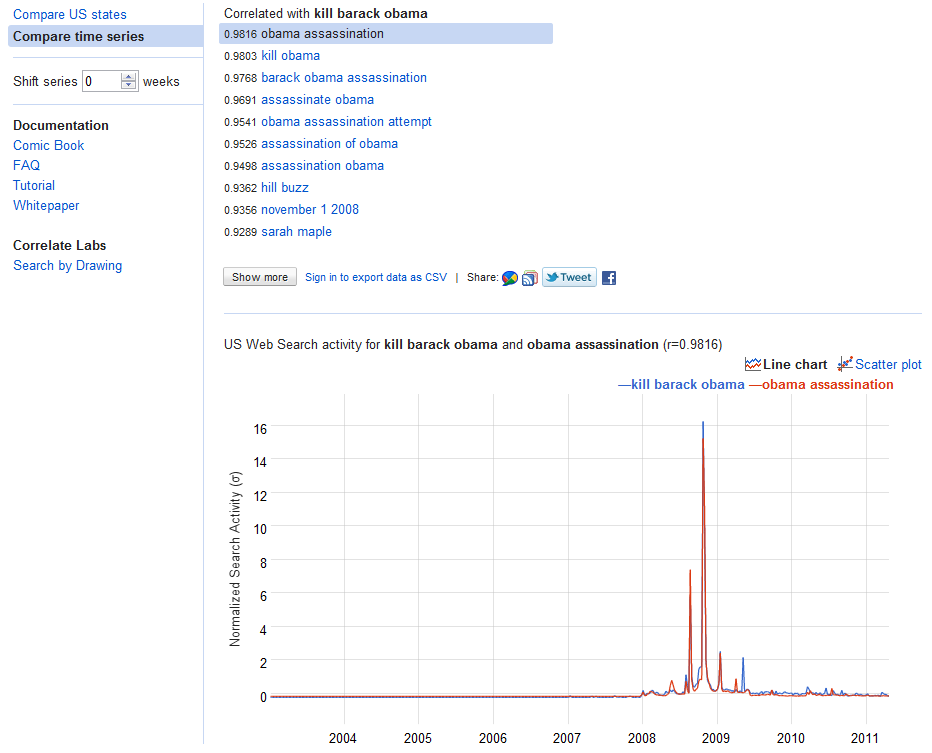
From
http://www.law.cornell.edu/uscode/718/usc_sec_18_00000871—-000-.html
§ 871. Threats against President and successors to the Presidency
From
http://www.law.cornell.edu/uscode/718/usc_sec_18_00000871—-000-.html
Here is a very amusing site where bunch of hackers discuss black hat techniques to game social media- they meet in the MJ website. LOL
Thats actually the official MJ website. (also see my Poem on MJ at
https://decisionstats.com/2011/04/29/tribute-to-michael-jackson/
and https://decisionstats.com/2009/12/01/obama-and-mj-on-history/)
But back to the funny twitter gamers
http://www.michaeljackson.com/us/node/703109
Email from people at FlattR. What is FlattR- social micropayments. like small Paypal button that gives a fraction of your monthly budget (say 2 euros) to people you retweet/like (called Flattered in this social media service).
Some angels are smiling over some bays , it seems. congrats FlattR and their team (which includes tech team of largest bit torrent search engine in the world). Apparently this was done in time for the royal wedding.
Important service announcement |
||||||||
|
||||||||
On September 28th, 2010, The Document Foundation was announced. The last six months, it feels, have just passed within a short glimpse of time. Not only did we release three LibreOffice versions within three months, have created the LibreOffice-Box DVD image, and brought LibreOffice Portable on its way. We also have announced the LibreOffice Conference for October 2011 and have taken part in lots of events worldwide, with FOSDEM and CeBIT being the most prominent ones.
People follow us at Twitter, Identi.ca, XING, LinkedIn and a Facebook group and fan page, they discuss on our mailing lists with more than 6.000 subscriptions, collaborate in our wiki, get insight on our daily work in our blog, and post and blog themselves. From the very first day, openness, transparency and meritocracy have been shaping the framework we want to work in. Our discussions and decisions take place on a public mailing list, and regularly, we hold phone conferences for the Steering Committee and for the marketing teams, where everyone is invited to join. Our ideas and visions have made their way into our Next Decade Manifesto.
We have joined the Open Invention Network as well as the OpenDoc Society, and just last week have become an SPI-associated project, and we see a wide range of support from all over the world. Not only do Novell and Red Hat support our efforts with developers, but just recently, Canonical, creators of Ubuntu, joined as well. All major Linux distributions deliver LibreOffice with their operating systems, and more follow every day.
One of the most stunning contributions, that still leaves us speechless, is the support that we receive from the community. When we asked for 50,000 € capital stock for a German-based foundation, the community showed their support, appreciation and their power, and not only donated it in just eight days, but up to now has supported us with close to 100,000 €! Another one is that driven by our open, vendor neutral approach, combined with our easy hacks, we have included code contributions from over 150 entirely new developers to the project, alongside localisations from over 50 localizers. The community has developed itself better than we could ever dream of, and first meetings like the project’s weekend or the QA meeting of the Germanophone group are already being organized.
What we have seen now is just the beginning of something very big. The Document Foundation has a vision, and the creation of the foundation in Germany is about to happen soon. LibreOffice has been downloaded over 350,000 times within the first week, and we just counted more than 1,3 million downloads just from our download system — not counting packages directly delivered by Linux distributors, other download sites or DVDs included in magazines and newspapers — supported by 65 mirrors from all over the world, and millions already use and contribute to it worldwide. With our participation in the Google Summer of Code, we will engage more students and young developers to be part of our community. Our improved release schedule will ensure that new features and improvements will make their way to end-users soon, and for testers, we even provide daily builds.
We are so excited by what has been achieved over the last six months, and we are immensely grateful to all those who have supported the project in whatever ways they can. It is an honour to be working with you, to be part of one united community! The future as we are shaping it has just begun, and it will be bright and excellent.
from-
List archive: http://listarchives.documentfoundation.org/www/announce/
A highly optimized blog post or web content can get you a lot of attention just like Rebecca Black’s video (provided it passes through the new quality metrics \change*/ in the Search Engine)
But if the underlying content is weak, or based on a shoddy understanding of the content-it can drive lots of horrid comments as well as ensuring that bad word of mouth is spread about the content or you/despite your hard work.
An example of this is copy and paste journalism especially in technology circles, where even a bigger Page Ranked website /blog can get away with scraping or stealing content from a lower page ranked website (or many websites) after adding a cursory “expert comment”. This is also true when someone who is basically a corporate communication specialist (or PR -public relations) person is given a techinical text and encourage to write about it without completely understanding it.
A mild technical defect in the search engine algorithm is that it does not seem to pay attention to when the content was published, so the copying website or blog actually can get by as fresher content even if it is practically has 90% of the same words). The second flaw is over punishment or manual punishment of excessive linking – this can encourage search optimization minded people to hoard links or discourage trackbacks.
A free internet is one which promotes free sharing of content and does not encourage stealing or un-authorized scraping or content copying. Unfortunately current search engine optimization can encourage scraping and content copying without paying too much attention to origin of the words.
In addition the analytical rigor by which search algorithms search your inboxes (as in search all emails for a keyword) or media rich sites (like Youtube) are quite on a different level of quality altogether. The chances of garbage results are much more while searching for media content and/or emails.
The following is an auto generated post thanks to WordPress.com stats team- clearly they have got some stuff wrong
1) Defining the speedometer quantitatively
2) The busiest day numbers are plain wrong ( 2 views ??)
3) There is still no geographic data in WordPress -com stats (unlike Google Analytics) and I cant enable Google Analytics on a wordpress.com hosted site.
The stats helper monkeys at WordPress.com mulled over how this blog did in 2010, and here’s a high level summary of its overall blog health:

The Blog-Health-o-Meter™ reads Wow.
The Louvre Museum has 8.5 million visitors per year. This blog was viewed about 97,000 times in 2010. If it were an exhibit at The Louvre Museum, it would take 4 days for that many people to see it.
In 2010, there were 367 new posts, growing the total archive of this blog to 1191 posts. There were 411 pictures uploaded, taking up a total of 121mb. That’s about 1 pictures per day.
The busiest day of the year was September 22nd with 2 views. The most popular post that day was Top 10 Graphical User Interfaces in Statistical Software.
The top referring sites in 2010 were r-bloggers.com, reddit.com, rattle.togaware.com, twitter.com, and Google Reader.
Some visitors came searching, mostly for libre office, facebook analytics, test drive a chrome notebook, test drive a chrome notebook., and wps sas lawsuit.
These are the posts and pages that got the most views in 2010.
Top 10 Graphical User Interfaces in Statistical Software April 2010
8 comments and 1 Like on WordPress.com,
Wealth = function (numeracy, memory recall) December 2009
1 Like on WordPress.com,
Matlab-Mathematica-R and GPU Computing September 2010
1 Like on WordPress.com,
About DecisionStats July 2008
The Top Statistical Softwares (GUI) May 2010
1 comment and 1 Like on WordPress.com,
A new challenge for R , SAS and all techie bloggers-
http://en.blog.wordpress.com/2010/12/30/challenge-for-2011-want-to-blog-more-often/
As part of the DailyPost, we’re launching two campaigns:
- Post a Day 2011: Post something to your blog every single day through 2011
- Post a Week 2011: Post to your blog at least once a week through 2011
Signing up is simple – do the following:
- Post on your blog, right now, that you’re participating
- (You can grab a sample post from dailypost.wordpress.com)
- Use the tag postaday2011 or postaweek2011 in your posts (tips on tagging here)
- Go to dailypost.wordpress.com
- Subscribe to dailypost.wordpress.com– you’ll get reminders and inspirations every day to help you bring your full potential to your WordPress blog!
Do you write a blog or own a website?
Well how about taking up this challenge?
Who Dares- Wins
Game On!!!