MapReduce Analytics Apps- AsterData's Developer Express Plugin

AsterData continues to wow with it’s efforts on bridging MapReduce and Analytics, with it’s new Developer Express plug-in for Eclipse. As any Eclipse user knows, that greatly improves ability to write code or develop ( similar to creating Android apps if you have tried to). I did my winter internship at AsterData last December last year in San Carlos, and its an amazing place with giga-level bright people.

Here are some details ( Note I plan to play a bit more on the plugin on my currently downUbuntu on this and let you know)

http://marketplace.eclipse.org/content/aster-data-developer-express-plug-eclipse

Aster Data Developer Express provides an integrated set of tools for development of SQL and MapReduce analytics for Aster Data nCluster, a massively parallel database with an integrated analytics engine.

The Aster Data Developer Express plug-in for Eclipse enables developers to easily create new analytic application projects with the help of an intuitive set of wizards, immediately test their applications on their desktop, and push down their applications into the nCluster database with a single click.

Using Developer Express, analysts can significantly reduce the complexity and time needed to create advanced analytic applications so that they can more rapidly deliver deeper and richer analytic insights from their data.

and from the Press Release

Now, any developer or analyst that is familiar with the Java programming language can complete a rich analytic application in under an hour using the simple yet powerful Aster Data Developer Express environment in Eclipse. Aster Data Developer Express delivers both rapid development and local testing of advanced analytic applications for any project, regardless of size.

The free, downloadable Aster Data Developer Express IDE now brings the power of SQL-MapReduce to any organization that is looking to build richer analytic applications that can leverage massive data volumes. Much of the MapReduce coding, including programming concepts like parallelization and distributed data analysis, is addressed by the IDE without the developer or analyst needing to have expertise in these areas. This simplification makes it much easier for developers to be successful quickly and eliminates the need for them to have any deep knowledge of the MapReduce parallel processing framework. Google first published MapReduce in 2004 for parallel processing of big data sets. Aster Data has coupled SQL with MapReduce and brought SQL-MapReduce to market, making it significantly easier for any organization to leverage the power of MapReduce. The Aster Developer Express IDE simplifies application development even further with an intuitive point-and-click development environment that speeds development of rich analytic applications. Applications can be validated locally on the desktop or ultimately within Aster Data nCluster, a massive parallel processing (MPP) database with a fully integrated analytics engine that is powered by MapReduce—known as a data-analytics server.

Rich analytic applications that can be easily built with Aster Data’s downloadable IDE include:

Iterative Analytics: Uncovering critical business patterns in your data requires hypothesis-driven, iterative analysis.  This class of applications is defined by the exploratory navigation of massive volumes of data in a top-down, deductive manner.  Aster Data’s IDE makes this easy to develop and to validate the algorithms and functions required to deliver these advanced analytic applications.

Prediction and Optimization: For this class of applications, the process is inductive. Rather than starting with a hypothesis, developers and analysts can easily build analytic applications that discover the trends, patterns, and outliers in data sets.  Examples include propensity to churn in telecommunications, proactive product and service recommendations in retail, and pricing and retention strategies in financial services.

Ad Hoc Analysis: Examples of ad hoc analysis that can be performed includes social network analysis, advanced click stream analysis, graph analysis, cluster analysis, and a wide variety of mathematical, trigonometry, and statistical functions.

“Aster Data’s IDE and SQL-MapReduce significantly eases development of advanced analytic applications on big data. We have now built over 350 analytic functions in SQL-MapReduce on Aster Data nCluster that are available for customers to purchase,” said Partha Sen, CEO and Founder of Fuzzy Logix. “Aster Data’s implementation of MapReduce with SQL-MapReduce goes beyond the capabilities of general analytic development APIs and provides us with the excellent control and flexibility needed to implement even the most complex analytic algorithms.”

Richer analytics on big data volumes is the new competitive frontier. Organizations have always generated reports to guide their decision-making. Although reports are important, they are historical sets of information generally arranged around predefined metrics and generated on a periodic basis.

Advanced analytics begins where reporting leaves off. Reporting often answers historical questions such as “what happened?” However, analytics addresses “why it happened” and, increasingly, “what will happen next?” To that end, solutions like Aster Data Developer Express ease the development of powerful ad hoc, predictive analytics and enables analysts to quickly and deeply explore terabytes to petabytes of data.
“We are in the midst of a new age in analytics. Organizations today can harness the power of big data regardless of scale or complexity”, said Don Watters, Chief Data Architect for MySpace. “Solutions like the Aster Data Developer Express visual development environment make it even easier by enabling us to automate aspects of development that currently take days, allowing us to build rich analytic applications significantly faster. Making Developer Express openly available for download opens the power of MapReduce to a broader audience, making big data analytics much faster and easier than ever before.”

“Our delivery of SQL coupled with MapReduce has clearly made it easier for customers to build highly advanced analytic applications that leverage the power of MapReduce. The visual IDE, Aster Data Developer Express, introduced earlier this year, made application development even easier and the great response we have had to it has driven us to make this open and freely available to any organization looking to build rich analytic applications,” said Tasso Argyros, Founder and CTO, Aster Data. “We are excited about today’s announcement as it allows companies of all sizes who need richer analytics to easily build powerful analytic applications and experience the power of MapReduce without having to learn any new skills.”

You can have a look here at http://www.asterdata.com/download_developer_express/

Software Lawsuits :Ergo

The latest round of software lawsuits makes things more interesting especially for Google. There are two notable developments

1) Google’s pact with Verizon for Even more Open Internet -From

http://googlepublicpolicy.blogspot.com/2010/08/joint-policy-proposal-for-open-internet.html

A provider that offers a broadband Internet access service
complying with the above principles could offer any other additional or differentiated services. Such other services would have to be distinguishable in scope and purpose from broadband . Internet access service, but could make use of or access Internet content, applications or services
and could include traffic prioritization.

2) Oracle’s lawsuit against Google for Intellectual Property enforcement of Java for Android. ( read here http://news.cnet.com/8301-30685_3-20013549-264.html

I once joked about nothing remains cool forever not even Google (see https://decisionstats.wordpress.com/2008/08/05/11-ways-to-beat-up-google/ ) and I did not foresee the big G beating itself into knots on its own.

It is hard to sympathize with Google (or Oracle or Verizon) but this is a mess that is created when lawyers (with a briefcase) steal value rather than a thousand engineers can create value.

Interestingly Google owns the IP for Map Reduce – so could it itself sue the Hadoop community over terms of royalty someday-like Oracle did with Java- hmmmmm interesting revenue stream

All in all I would be happy to see zero tiers on an internet (wireless or wired) and even Java developers to make some money on writing code. Open source is not free source.

Mapreduce Book

Here is a new book on learning MapReduce and it has a free downloadable version as well.

Data-Intensive Text Processing with MapReduce

Jimmy Lin and Chris Dyer

ABSTRACT

Our world is being revolutionized by data-driven methods: access to large amounts of data has generated new insights and opened exciting new opportunities in commerce, science, and computing applications. Processing the enormous quantities of data necessary for these advances requires large clusters, making distributed computing paradigms more crucial than ever. MapReduce is a programming model for expressing distributed computations on massive datasets and an execution framework for large-scale data processing on clusters of commodity servers. The programming model provides an easy-to-understand abstraction for designing scalable algorithms, while the execution framework transparently handles many system-level details, ranging from scheduling to synchronization to fault tolerance. This book focuses on MapReduce algorithm design, with an emphasis on text processing algorithms common in natural language processing, information retrieval, and machine learning. We introduce the notion of MapReduce design patterns, which represent general reusable solutions to commonly occurring problems across a variety of problem domains. This book not only intends to help the reader “think in MapReduce”, but also discusses limitations of the programming model as well.

You can download the book here

This book is part of the Morgan & Claypool Synthesis Lectures on Human Language Technologies. If you’re at a university, your institution may already subscribe to the series, in which case you can access the electronic version directly without cost (see this page for a list of institutional subscribers). Otherwise, to purchase:

Quite explicitly, this book focuses on MapReduce algorithm design, not Hadoop programming. Tom White’s Hadoop: The Definitive Guide is a great resource for learning Hadoop.

Want to be notified of updates? Interested in MapReduce algorithm design? Follow @lintool on Twitter here!

Q&A with David Smith, Revolution Analytics.

Here’s a group of questions and answers that David Smith of Revolution Analytics was kind enough to answer post the launch of the new R Package which integrates Hadoop and R-                         RevoScaleR

Ajay- How does RevoScaleR work from a technical viewpoint in terms of Hadoop integration?

David-The point isn’t that there’s a deep technical integration between Revolution R and Hadoop, rather that we see them as complementary (not competing) technologies. Hadoop is amazing at reliably (if slowly) processing huge volumes of distributed data; the RevoScaleR package complements Hadoop by providing statistical algorithms to analyze the data processed by Hadoop. The analogy I use is to compare a freight train with a race car: use Hadoop to slog through a distributed data set and use Map/Reduce to output an aggregated, rectangular data file; then use RevoScaleR to perform statistical analysis on the processed data (and use the speed of RevolScaleR to iterate through many model options to find the best one).

Ajay- How is it different from MapReduce and R Hipe– existing R Hadoop packages?
David- They’re complementary. In fact, we’ll be publishing a white paper soon by Saptarshi Guha, author of the Rhipe R/Hadoop integration, showing how he uses Hadoop to process vast volumes of packet-level VOIP data to identify call time/duration from the packets, and then do a regression on the table of calls using RevoScaleR. There’s a little more detail in this blog post: http://blog.revolutionanalytics.com/2010/08/announcing-big-data-for-revolution-r.html
Ajay- Is it going to be proprietary, free or licensable (open source)?
David- RevoScaleR is a proprietary package, available to paid subscribers (or free to academics) with Revolution R Enterprise. (If you haven’t seen it, you might be interested in this Q&A I did with Matt Shotwell: http://biostatmatt.com/archives/533 )
Ajay- Any existing client case studies for Terabyte level analysis using R.
David- The VOIP example above gets close, but most of the case studies we’ve seen in beta testing have been in the 10’s to 100’s of Gb range. We’ve tested RevoScaleR on larger data sets internally, but we’re eager to hear about real-life use cases in the terabyte range.
Ajay- How can I use RevoScaleR on my dual chip Win Intel laptop for say 5 gb of data.
David- One of the great things about RevoScaleR is that it’s designed to work on commodity hardware like a dual-core laptop. You won’t be constrained by the limited RAM available, and the parallel processing algorithms will make use of all cores available to speed up the analysis even further. There’s an example in this white paper (http://info.revolutionanalytics.com/bigdata.html) of doing linear regression on 13Gb of data on a simple dual-core laptop in less than 5 seconds.
AJ-Thanks to David Smith, for this fast response and wishing him, Saptarshi Guha Dr Norman Nie and the rest of guys at Revolution Analytics a congratulations for this new product launch.

Open Source and Software Strategy

Curt Monash at Monash Research pointed out some ongoing open source GPL issues for WordPress and the Thesis issue (Also see http://ma.tt/2009/04/oracle-and-open-source/ and  http://www.mattcutts.com/blog/switching-things-around/).

As a user of both going upwards of 2 years- I believe open source and GPL license enforcement are general parts of software strategy of most software companies nowadays. Some thoughts on  open source and software strategy-Thesis remains a very very popular theme and has earned upwards of 100,000 $ for its creator (estimate based on 20k plus installs and 60$ avg price)

  • Little guys like to give away code to get some satisfaction/ recognition, big guys give away free code only when its necessary or when they are not making money in that product segment anyway.
  • As Ethan Hunt said, ” Every Hero needs a Villian”. Every software (market share) war between players needs One Big Company Holding more market share and Open Source Strategy between other player who is not able to create in house code, so effectively out sources by creating open source project. But same open source propent rarely gives away the secret to its own money making project.
    • Examples- Google creates open source Android, but wont reveal its secret algorithm for search which drives its main profits,
    • Google again puts a paper for MapReduce but it’s Yahoo that champions Hadoop,
    • Apple creates open source projects (http://www.apple.com/opensource/) but wont give away its Operating Source codes (why?) which help people buys its more expensive hardware,
    • IBM who helped kickstart the whole proprietary code thing (remember MS DOS) is the new champion of open source (http://www.ibm.com/developerworks/opensource/) and
    • Microsoft continues to spark open source debate but read http://blogs.technet.com/b/microsoft_blog/archive/2010/07/02/a-perspective-on-openness.aspx and  also http://www.microsoft.com/opensource/
    • SAS gives away a lot of open source code (Read Jim Davis , CMO SAS here , but will stick to Base SAS code (even though it seems to be making more money by verticals focus and data mining).
    • SPSS was the first big analytics company that helps supports R (open source stats software) but will cling to its own code on its softwares.
    • WordPress.org gives away its software (and I like Akismet just as well as blogging) for open source, but hey as anyone who is on WordPress.com knows how locked in you can get by its (pricy) platform.
    • Vendor Lock-in (wink wink price escalation) is the elephant in the room for Big Software Proprietary Companies.
    • SLA Quality, Maintenance and IP safety is the uh-oh for going in for open source software mostly.
  • Lack of IP protection for revenue models for open source code is the big bottleneck  for a lot of companies- as very few software users know what to do with source code if you give it to them anyways.
    • If companies were confident that they would still be earning same revenue and there would be less leakage or theft, they would gladly give away the source code.
    • Derivative softwares or extensions help popularize the original softwares.
      • Half Way Steps like Facebook Applications  the original big company to create a platform for third party creators),
      • IPhone Apps and Android Applications show success of creating APIs to help protect IP and software control while still giving some freedom to developers or alternate
      • User Interfaces to R in both SAS/IML and JMP is a similar example
  • Basically open source is mostly done by under dog while top dog mostly rakes in money ( and envy)
  • There is yet to a big commercial success in open source software, though they are very good open source softwares. Just as Google’s success helped establish advertising as an alternate ( and now dominant) revenue source for online companies , Open Source needs a big example of a company that made billions while giving source code away and still retaining control and direction of software strategy.
  • Open source people love to hate proprietary packages, yet there are more shades of grey (than black and white) and hypocrisy (read lies) within  the open source software movement than the regulated world of big software. People will be still people. Software is just a piece of code.  😉

(Art citation-http://gapingvoid.com/about/ and http://gapingvoidgallery.com/

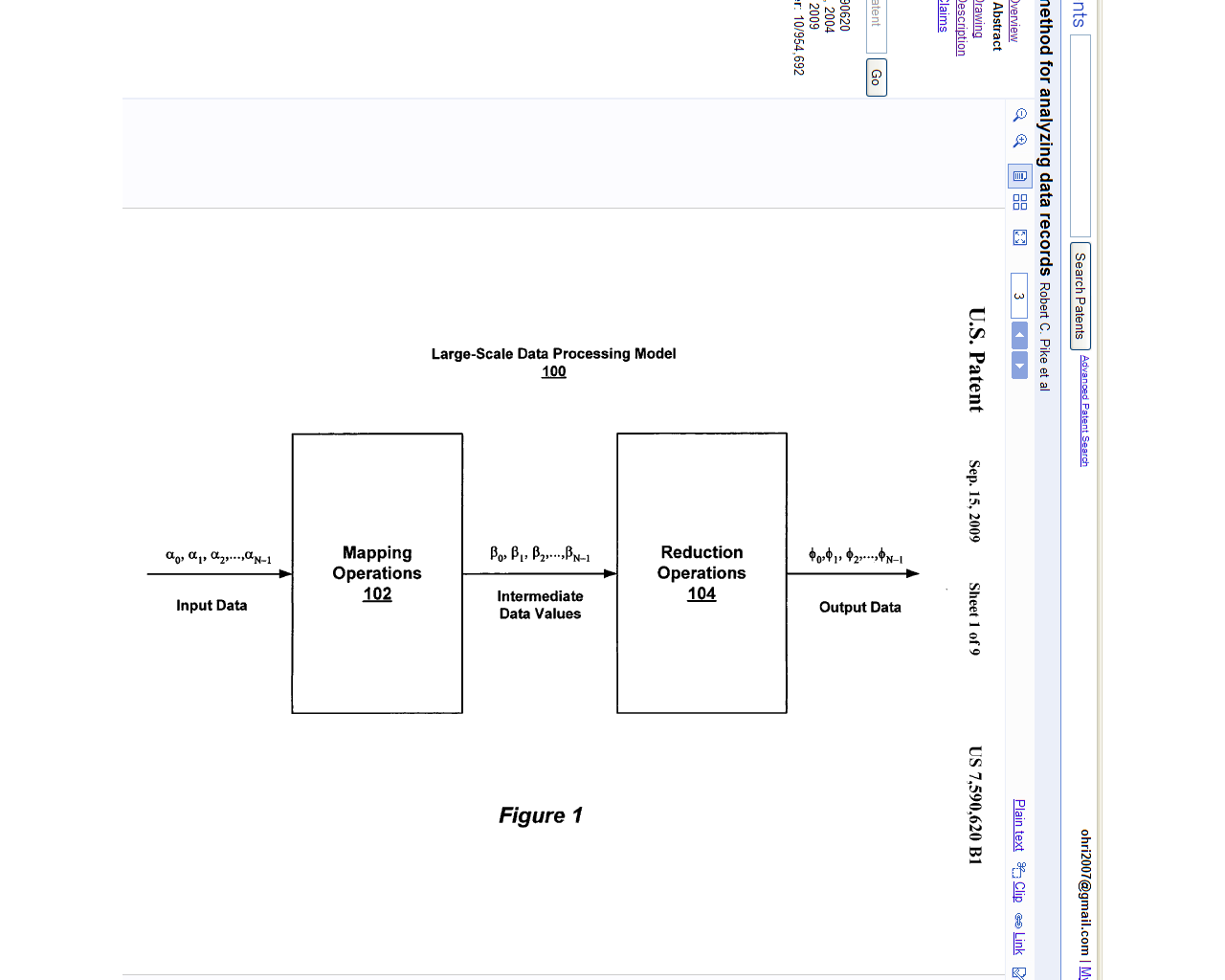
MapReduce Patent Granted

After 5 years of third party validation and almost 10 years of Google Internal Validation, the fastest way to crunch data belongs to the people who created it first, Google Inc

From

http://www.google.com/patents/about?id=XLfIAAAAEBAJ

Citations

Patent Number Title Issue date
4876643 Parallel searching system having a master processor for controlling plural slave processors for independently processing respective search requests Oct 24, 1989
5345584 System for managing data storage based on vector-summed size-frequency vectors for data sets, devices, and residual storage on devices Sep 6, 1994
5414849 Evaluating method of data division patterns and a program execution time for a distributed memory parallel computer system, and parallel program producing method using such an evaluating method May 9, 1995
5414899 Pivot structure from a lock handle May 16, 1995
5471622 Run-time system having nodes for identifying parallel tasks in a logic program and searching for available nodes to execute the parallel tasks Nov 28, 1995
5590319 Query processor for parallel processing in homogenous and heterogenous databases Dec 31, 1996
5806059 Database management system and method for query process for the same Sep 8, 1998
5819251 System and apparatus for storage retrieval and analysis of relational and non-relational data Oct 6, 1998
5870743 Method and apparatus for parallelizing operations that create a table Feb 9, 1999
5884299 Optimization of SQL queries involving aggregate expressions using a plurality of local and global aggregation operations Mar 16, 1999
5884303 Parallel searching technique Mar 16, 1999
5920854 Real-time document collection search engine with phrase indexing Jul 6, 1999
5956704 Method and apparatus for parallelizing operations that insert data into an existing data container Sep 21, 1999
5963954 Method for mapping an index of a database into an array of files Oct 5, 1999
6006224 Crucible query system Dec 21, 1999
6026394 System and method for implementing parallel operations in a database management system Feb 15, 2000
6182061 Method for executing aggregate queries, and computer system Jan 30, 2001
6226635 Layered query management May 1, 2001
6256621 Database management system and query operation therefor, including processing plural database operation requests based on key range of hash code Jul 3, 2001
6301574 System for providing business information Oct 9, 2001
6366904 Machine-implementable method and apparatus for iteratively extending the results obtained from an initial query in a database Apr 2, 2002
6408292 Method of and system for managing multi-dimensional databases using modular-arithmetic based address data mapping processes on integer-encoded business dimensions Jun 18, 2002
6556988 Database management apparatus and query operation therefor, including processing plural database operation requests based on key range of hash code Apr 29, 2003
6567806 System and method for implementing hash-based load-balancing query processing in a multiprocessor database system May 20, 2003
6741992 Flexible rule-based communication system and method for controlling the flow of and access to information between computer users May 25, 2004
6910070 Methods and systems for asynchronous notification of database events Jun 21, 2005
6961723 System and method for determining relevancy of query responses in a distributed network search mechanism Nov 1, 2005
6983322 System for discrete parallel processing of queries and updates Jan 3, 2006
7099871 System and method for distributed real-time search Aug 29, 2006
7103590 Method and system for pipelined database table functions Sep 5, 2006
7146365 Method, system, and program for optimizing database query execution Dec 5, 2006
7430549 Optimized SQL code generation Sep 30, 2008
7433863 SQL code generation for heterogeneous environment Oct 7, 2008

Claims

What is claimed is:1. A computer-implemented method of analyzing data records, comprising:

storing the data records in one or more data centers;
allocating groups of the stored data records to respective processes of a first plurality of processes executing in parallel;
after allocating the groups of the stored data records to the respective processes of the first plurality of processes executing in parallel, in each respective process of the first plurality of processes:
for each data record in at least a subset of the group of the stored data records allocated to the respective process:
creating a parsed representation of the data record;
applying a procedural language query to the parsed representation of the data record to extract one or more values, wherein the procedural language query is applied independently to each parsed representation; and
applying a respective emit operator to at least one of the extracted one or more values to add corresponding information to a respective intermediate data structure, wherein the respective emit operator implements one of a predefined set of application-independent statistical information processing functions;
in each process of a second plurality of processes, aggregating information from a subset of the intermediate data structures to produce aggregated data; and
combining the produced aggregated data to produce output data.

2. The method of claim 1, wherein the respective emit operator implements one of a predefined set of application-independent statistical information processing functions.

3. The method of claim 2, wherein the application-independent statistical information processing functions comprise one or more of the following: a function for counting occurrences of distinct values, a maximum value function, a minimum value function, a statistical sampling function, a function for identifying values that occur most frequently, and a function for estimating a total number of unique values.

4. The method of claim 1, wherein the applying the procedural language query to the parsed representation of the data record to extract the one or more values and the applying the respective emit operator to at least one of the one or more values to add the corresponding information to the respective intermediate data structure are performed independently for each data record.

5. The method of claim 1, wherein the parsed representation of the data record comprises a key-value pair.

6. The method of claim 1, wherein the intermediate data structure comprises a table having at least one index whose index values comprise unique values of the extracted one or more values.

7. The method of claim 6, wherein the aggregating information from the subset of the intermediate data structures to produce the aggregated data combines the extracted one or more values having the same index values.

8. The method of claim 1, wherein

when applying the procedural language query to the parsed representation produces a plurality of values, applying the respective emit operator to each of the produced plurality of values to add corresponding information to the respective intermediate data structure.

9. The method of claim 1, wherein the second plurality of processes are executing in parallel.

10. The method of claim 1, wherein the allocating the groups of the stored data records to the respective processes of the first plurality of processes executing in Parallel is application independent, and the procedural language query is application dependent.

11. The method of claim 1, wherein the data records comprise one or more of the following types of data records: log files, transaction records, and documents.

12. The method of claim 1, wherein the intermediate data structure is a table having a plurality of indices, wherein each of the plurality of indices is dynamically generated in accordance with the extracted one or more values.

13. A computer-implemented method of analyzing data records, comprising:

storing the data records in one or more data centers;
allocating groups of the stored data records to respective processes of a first plurality of processes executing in parallel;
after allocating the groups of the stored data records to the respective processes of the first plurality of processes executing in parallel, in each respective process of the first plurality of processes:
for each data record in at least a subset of the group of stored data records allocated to the respective process:
creating a parsed representation of the data record;
applying a procedural language query to the parsed representation of the data record to extract one or more values; and
applying a respective operator to at least one of the extracted one or more values to add corresponding information to a respective intermediate data structure;
in each process of a second plurality of processes, aggregating information from a subset of the intermediate data structures to produce aggregated data; and
combining the produced aggregated data to produce output data.

14. A computer system with one or more processors and memory for analyzing data records, wherein the data records are stored in one or more data centers, the computer system comprising:

a first plurality of processes operating in parallel, each of which is allocated a group of stored data records to process;
each respective process of the first plurality of processes including instructions for:
creating a parsed representation of each data record in at least a subset of the group of stored data records allocated to the respective process after the group of stored data records is allocated to the respective process;
applying a procedural language query to the parsed representation of each stored data record in at least the subset of the group of stored data records allocated to the respective process to produce one or more values; and
applying one or more emit operators to each of the one or more produced values to add corresponding information to an intermediate data structure; and
at least one aggregating process for aggregating information from a plurality of the intermediate data structures to produce output data.

15. The system of claim 14, wherein the at least one aggregating process for aggregating information comprises a second plurality of processes operating in parallel, wherein each respective process of the second plurality of processes operating in parallel includes instructions for aggregating information from the plurality of the intermediate data structures to produce the output data.

16. The system of claim 14, wherein the intermediate data structure comprises a table.

17. The system of claim 15, wherein at least one process of the second plurality of processes operating in parallel includes instructions for combining the output data to produce aggregated output data.

18. The system of claim 14, wherein each of the one or more emit operators implements one of a predefined set of application-independent statistical information processing functions.

19. The system of claim 18, wherein the application-independent statistical information processing functions comprise one or more of the following: a function for counting occurrences of distinct values, a maximum value function, a minimum value function, a statistical sampling function, a function for identifying values that occur most frequently, and a function for estimating a total number of unique values.

20. The system of claim 14, wherein the instructions for applying the procedural language query to the parsed representation of each data record in at least the subset of the group of stored data records allocated to the respective process to produce the one or more values include instructions for applying the procedural language query independently to each data record.

21. The system of claim 14, wherein the instructions for applying the procedural language query to the parsed representation of each data record in at least the subset of the group of stored data records allocated to the respective process to produce the one or more values and instructions for applying the one or more emit operators to each of the one or more produced values to add the corresponding information to the intermediate data structure include instructions for applying the procedural language query and the one or more emit operators independently to each data record.

22. The system of claim 14, wherein the at least one aggregating process for aggregating information is configured to aggregate, in each respective process of a second plurality of processes, the information from the plurality of the intermediate data structures to produce the output data.

23. The system of claim 14, wherein each parsed representation of each data record comprises a key-value pair.

24. The system of claim 14, wherein the intermediate data structure comprises a table having at least one index whose index values comprise unique values of the produced values.

25. The system of claim 24, wherein the at least one aggregating process for aggregating the information from the plurality of intermediate data structures to produce the output data includes instructions for combining the one or more produced values having the same index values.

26. The system of claim 14, wherein the instructions for applying the procedural language query to the parsed representation of each stored data record include instructions for applying the one or more emit operators to each of a plurality of produced values to add corresponding information to the intermediate data structure.

27. The system of claim 14, wherein the at least one aggregating process for aggregating the information from the plurality of intermediate data structures to produce the output data comprises a second plurality of processes executing in parallel.

28. The system of claim 14, wherein the system is configured such that the allocation of stored data records to each respective process of the first plurality of processes is application independent, and wherein the procedural language query is application dependent.

29. The system of claim 14, wherein the data records comprise one or more of the following types of data records: log files, transaction records, and documents.

30. The system of claim 14, wherein the intermediate data structure is a table having a plurality of indices, wherein each of the plurality of the indices is dynamically generated in accordance with the one or more produced values.