Creating an Anonymous Bot

or Surfing the Net Anonmously and Having some Fun.

On the weekend, while browsing through http://freelancer.com I came across an intriguing offer-

http://www.freelancer.com/projects/by-job/YouTube.html

Basically projects asking for increasing Youtube Views-

Hmm.Hmm.Hmm

So this is one way I though it could be done-

1) Create an IP Address Anonymizer

Thats pretty simple- I used the Tor Project at http://www.torproject.org/easy-download.html.en

Basically it uses a peer to peer network to  connect to the internet and you can reset the connection as you want-so it hides your IP address.

Also useful for sending hatemail- limitation uses Firefox browser only.And also your webpage default keeps changing languages as the ip address changes.

Note-

The Tor Project is a 501(c)(3) non-profit based in the United States. The official address of the organization is:

The Tor Project
969 Main Street, Suite 206
Walpole, MA 02081 USA
Check your IP address at http://www.whatismyip.com/

2) Creating a Bot or an automatic clicking code ( without knowing code)

Go to https://addons.mozilla.org/en-US/firefox/addon/3863/

Remember when you could create an Excel Macro by just recording the Macro (in Excel 2003)

So while surfing if you need to do something again and again (like go the same Youtube video and clicking Like 5000 times) you can press record Macro

  • Do the action you want repeated again and again.
  • Click save Macro
  • Now run the Macro in a loop using the iMacro extension.

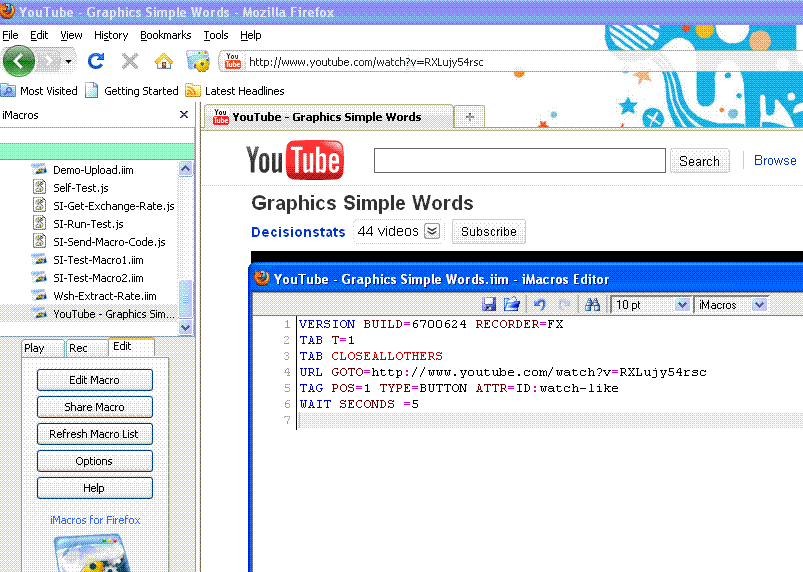
see screenshot below-

Note I have added two lines of code -WAIT SECONDS= 6

This means everytime the code runs in a loop it will wait for 6 seconds and then reload.

However I recommend you create a random number of wait seconds using Google Spreadsheet and the function RANDBETWEEN(5,400) (to limit between 5 and 400 seconds) and also use CONCATENATE with click and drag to create RANDOM wait times (instead of typing it say 500 times yourself)

see https://spreadsheets.google.com/ccc?key=tr18JVEE2TmAuH5V8fzJLRA#gid=0

That’s it – Your Anonymous Bot is ready.

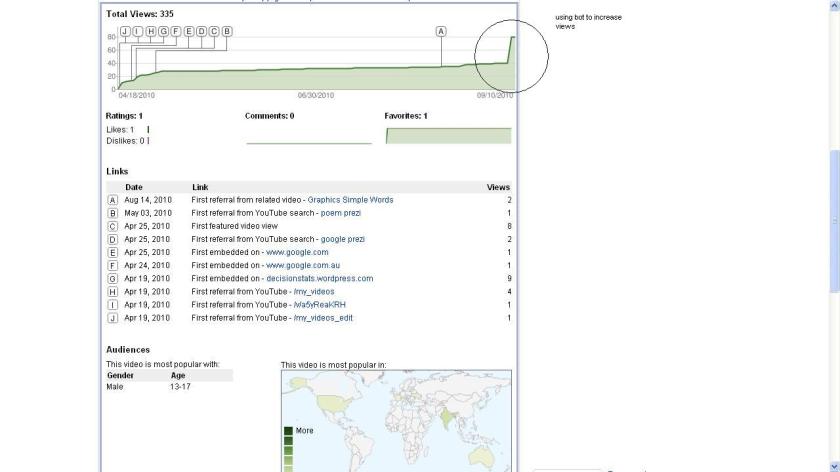
See the  analytical results for my personal favourite Streaming Poetry video http://www.youtube.com/watch?v=a5yReaKRHOM

Easy isn’t it. Lines of code written= 0 , Number of Views =335 (before I grew bored)

Note- Officially it is against Youtube Terms http://www.youtube.com/t/terms to  use scripts or Bots so I did it for Research Purposes only. And the http://Freelancer.com needs to look into the activities underway at http://www.freelancer.com/projects/by-job/YouTube.html and also http://www.freelancer.com/projects/by-job/Facebook.html and http://www.freelancer.com/projects/by-job/Social-Networking.html

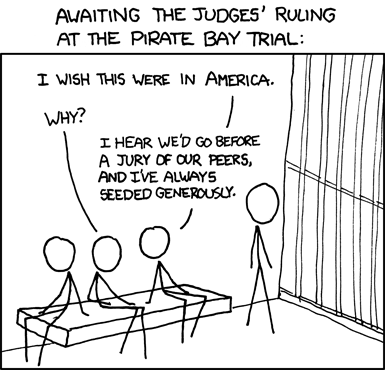
The final word on these activities is by http://xkcd.com or

Funny Images from India

So I was surfing the internet on the weekend (Note some Hindi would help)

(or chilled beer)

( tatti= *rap in Hindi which is not spoken in Tamil Nadu/South India)

and some cold grizzlies / bear again

(Image 3 citation :http://engrishfunny.com/ )

But seriously…………..

Dryad- Microsoft's answer to MR

While reading across the internet I came across Microsoft’s version to MapReduce called Dryad- which has been around for some time, but has not generated quite the buzz that Hadoop or MapReduce are doing.

http://research.microsoft.com/en-us/projects/dryadlinq/

DryadLINQ

DryadLINQ is a simple, powerful, and elegant programming environment for writing large-scale data parallel applications running on large PC clusters.

Overview

New! An academic release of Dryad/DryadLINQ is now available for public download.

The goal of DryadLINQ is to make distributed computing on large compute cluster simple enough for every programmers. DryadLINQ combines two important pieces of Microsoft technology: the Dryad distributed execution engine and the .NET Language Integrated Query (LINQ).

Dryad provides reliable, distributed computing on thousands of servers for large-scale data parallel applications. LINQ enables developers to write and debug their applications in a SQL-like query language, relying on the entire .NET library and using Visual Studio.

DryadLINQ translates LINQ programs into distributed Dryad computations:

  • C# and LINQ data objects become distributed partitioned files.
  • LINQ queries become distributed Dryad jobs.
  • C# methods become code running on the vertices of a Dryad job.

DryadLINQ has the following features:

  • Declarative programming: computations are expressed in a high-level language similar to SQL
  • Automatic parallelization: from sequential declarative code the DryadLINQ compiler generates highly parallel query plans spanning large computer clusters. For exploiting multi-core parallelism on each machine DryadLINQ relies on the PLINQ parallelization framework.
  • Integration with Visual Studio: programmers in DryadLINQ take advantage of the comprehensive VS set of tools: Intellisense, code refactoring, integrated debugging, build, source code management.
  • Integration with .Net: all .Net libraries, including Visual Basic, and dynamic languages are available.
  • and
  • Conciseness: the following line of code is a complete implementation of the Map-Reduce computation framework in DryadLINQ:
    • public static IQueryable<R>
      MapReduce<S,M,K,R>(this IQueryable<S> source,
      Expression<Func<S,IEnumerable<M>>> mapper,
      Expression<Func<M,K>> keySelector,
      Expression<Func<K,IEnumerable<M>,R>> reducer)
      {
      return source.SelectMany(mapper).GroupBy(keySelector, reducer);
      }

    and http://research.microsoft.com/en-us/projects/dryad/

    Dryad

    The Dryad Project is investigating programming models for writing parallel and distributed programs to scale from a small cluster to a large data-center.

    Overview

    New! An academic release of DryadLINQ is now available for public download.

    Dryad is an infrastructure which allows a programmer to use the resources of a computer cluster or a data center for running data-parallel programs. A Dryad programmer can use thousands of machines, each of them with multiple processors or cores, without knowing anything about concurrent programming.

    The Structure of Dryad Jobs

    A Dryad programmer writes several sequential programs and connects them using one-way channels. The computation is structured as a directed graph: programs are graph vertices, while the channels are graph edges. A Dryad job is a graph generator which can synthesize any directed acyclic graph. These graphs can even change during execution, in response to important events in the computation.

    Dryad is quite expressive. It completely subsumes other computation frameworks, such as Google’s map-reduce, or the relational algebra. Moreover, Dryad handles job creation and management, resource management, job monitoring and visualization, fault tolerance, re-execution, scheduling, and accounting.

    The Dryad Software Stack

    As a proof of Dryad’s versatility, a rich software ecosystem has been built on top Dryad:

    • SSIS on Dryad executes many instances of SQL server, each in a separate Dryad vertex, taking advantage of Dryad’s fault tolerance and scheduling. This system is currently deployed in a live production system as part of one of Microsoft’s AdCenter log processing pipelines.
    • DryadLINQ generates Dryad computations from the LINQ Language-Integrated Query extensions to C#.
    • The distributed shell is a generalization of the pipe concept from the Unix shell in three ways. If Unix pipes allow the construction of one-dimensional (1-D) process structures, the distributed shell allows the programmer to build 2-D structures in a scripting language. The distributed shell generalizes Unix pipes in three ways:
      1. It allows processes to easily connect multiple file descriptors of each process — hence the 2-D aspect.
      2. It allows the construction of pipes spanning multiple machines, across a cluster.
      3. It virtualizes the pipelines, allowing the execution of pipelines with many more processes than available machines, by time-multiplexing processors and buffering results.
    • Several languages are compiled to distributed shell processes. PSQL is an early version, recently replaced with Scope.

    Publications

    Dryad: Distributed Data-Parallel Programs from Sequential Building Blocks
    Michael Isard, Mihai Budiu, Yuan Yu, Andrew Birrell, and Dennis Fetterly
    European Conference on Computer Systems (EuroSys), Lisbon, Portugal, March 21-23, 2007

    Video of a presentation on Dryad at the Google Campus, given by Michael Isard, Nov 1, 2007.

    Also interesting to read-

    Why does Dryad use a DAG?

    he basic computational model we decided to adopt for Dryad is the directed-acyclic graph (DAG). Each node in the graph is a computation, and each edge in the graph is a stream of data traveling in the direction of the edge. The amount of data on any given edge is assumed to be finite, the computations are assumed to be deterministic, and the inputs are assumed to be immutable. This isn’t by any means a new way of structuring a distributed computation (for example Condor had DAGMan long before Dryad came along), but it seemed like a sweet spot in the design space given our other constraints.

    So, why is this a sweet spot? A DAG is very convenient because it induces an ordering on the nodes in the graph. That makes it easy to design scheduling policies, since you can define a node to be ready when its inputs are available, and at any time you can choose to schedule as many ready nodes as you like in whatever order you like, and as long as you always have at least one scheduled you will continue to make progress and never deadlock. It also makes fault-tolerance easy, since given our determinism and immutability assumptions you can backtrack as far as you want in the DAG and re-execute as many nodes as you like to regenerate intermediate data that has been lost or is unavailable due to cluster failures.

    from

    http://blogs.msdn.com/b/dryad/archive/2010/07/23/why-does-dryad-use-a-dag.aspx

      Software Lawsuits :Ergo

      The latest round of software lawsuits makes things more interesting especially for Google. There are two notable developments

      1) Google’s pact with Verizon for Even more Open Internet -From

      http://googlepublicpolicy.blogspot.com/2010/08/joint-policy-proposal-for-open-internet.html

      A provider that offers a broadband Internet access service
      complying with the above principles could offer any other additional or differentiated services. Such other services would have to be distinguishable in scope and purpose from broadband . Internet access service, but could make use of or access Internet content, applications or services
      and could include traffic prioritization.

      2) Oracle’s lawsuit against Google for Intellectual Property enforcement of Java for Android. ( read here http://news.cnet.com/8301-30685_3-20013549-264.html

      I once joked about nothing remains cool forever not even Google (see https://decisionstats.wordpress.com/2008/08/05/11-ways-to-beat-up-google/ ) and I did not foresee the big G beating itself into knots on its own.

      It is hard to sympathize with Google (or Oracle or Verizon) but this is a mess that is created when lawyers (with a briefcase) steal value rather than a thousand engineers can create value.

      Interestingly Google owns the IP for Map Reduce – so could it itself sue the Hadoop community over terms of royalty someday-like Oracle did with Java- hmmmmm interesting revenue stream

      All in all I would be happy to see zero tiers on an internet (wireless or wired) and even Java developers to make some money on writing code. Open source is not free source.

      R Excel :Updated

      It was really nice to see the latest version of R Excel at http://rcom.univie.ac.at/ and bundled together in an aptly named package called R and Friends.

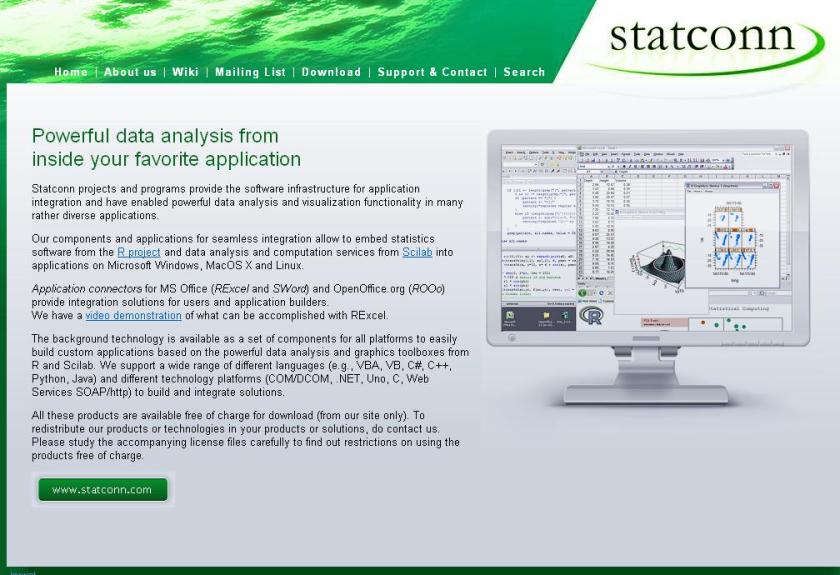
      The look and feel of the package as well as ease of installing are really professional. I also liked the commercial equivalent at http://www.statconn.com/

      However much older-guardians and  die- hards of command line,  feel that GUI is like putting lipstick on a pig, but we respectfully demur.

      What does R Excel do? Well for one it can put the R Commander Interface INSIDE your Excel Spreadsheet. That makes it easy to use and a familiar interface even if you are newbie to R- (assuming you have done some Excel)

      Download the latest version here

      RAndFriends

      This package will automatically install and configure

      • R 2.11.1
      • rscproxy 1.3-1
      • rcom 2.2-1

      It will also download and install a suitable version of the statconnDCOM server and of RExcel during installation. Therefore you will need a working Internet connection during the installation process.
      This version of RAndFriends was created 20100516.

      Download RAndFriendsSetup2111V3.1-5-1

      We also give you information how to download all sources for R and the R packages included in RAndFriends.

      Also read a paper on R and SAS interoperability (using HMisc package from Dr Harrell) at Holland Numerics

      http://www.hollandnumerics.co.uk/pdf/SAS2R2SAS_paper.pdf

      Protected: Analyzing SAS Institute-WPS Lawsuit

      This content is password-protected. To view it, please enter the password below.