Revolution releases R Windows for Academics for free

Logo for R
Image via Wikipedia

Based on the official email from them, God bless the merry coders at Revo-

Revolution Analytics has just released Revolution R Enterprise 4.3 for 32-bit and 64-bit Windows, a significant step forward in enterprise data analytics.  It features an updated RevoScaleR package for scalable, fast (multicore), and extensible data analysis with R. Revolution R Enterprise 4.3 for Windows also provides R 2.12.2, and includes an enhanced R Productivity Environment (RPE), a full-featured integrated development environment with visual debugging capabilities. Also available is an updated Windows release of our deployment server solution, RevoDeployR 1.2, designed to help you deliver R analytics via the Web.

As a registered user of the Academic version of Revolution R Enterprise for Windows, you can take advantage of these improvements by downloading and installing Revolution R Enterprise 4.3 today. You can install Revolution R Enterprise 4.3 side-by-side with your existing Revolution R Enterprise installations; there is no need to uninstall previous versions.


Try JMP for free in steps 1-2-3

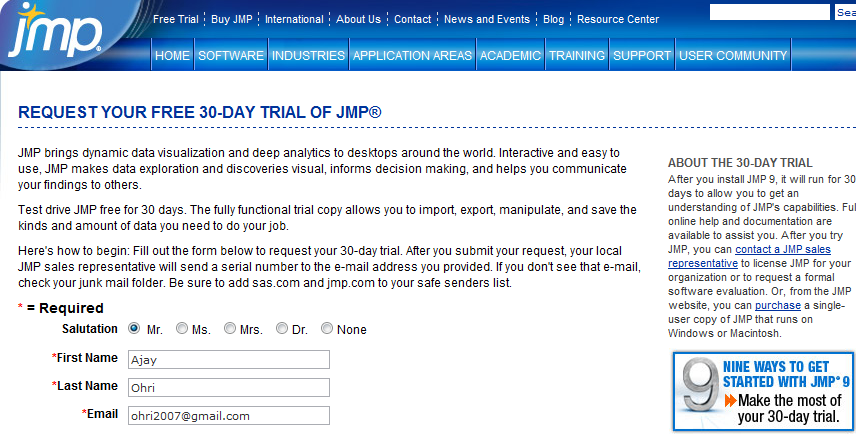
Test a 30 day free trial of JMP, the beautiful software with the ugliest website.

In case you have never used JMP, but know the difference between a mean and a mode- take a look.

Step 1 Fill long and badly designed outdated form (note the blue lightening graphics design and font)


Step 2 See uselessly long message, as the website does require registration but it has not done  any oAuth/SM easy registration even though they help sell software in the same campus on social media

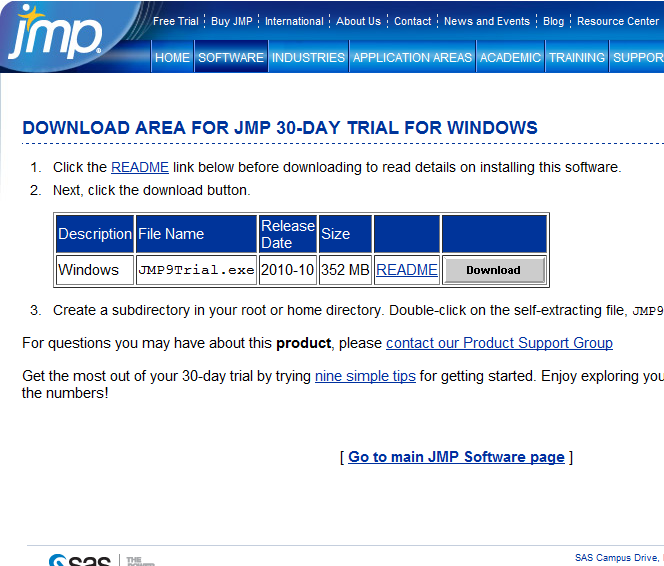
Step 3 Wait for 352 mb TO DOWNLOAD without a bit torrent or mirror servers, or even a link for scheduling Download Accelerator-

Note internet connections can be lousy (globally not just in India) to categorize 352 mb of downloads as painful.


And after all the violence and double talk
There’s just a song in all the trouble and the strife

JMP is still the best easiest to use powerful Big Data software with extensions into R and SAS.

Tips to Play Farmville Really Well

Here are some tips to play Farmville really well-

1) Keep your Farmville friends in a seperate friend list  by creating a list at http://www.facebook.com/friends/edit/

This ensures friendship , work and Farmville dont mess around with each other. You also dont need a lot of friends in Farmville (max 40 actives) unlike Mafia Wars

2) Register at http://rewards.zynga.com/ to get free or double rewards by doing the same work. These rewards can be redeemed in-game

3) Set a time as well as money budget. Like $10 per month and 1 hour on weekends with 15 minutes on weekdays with max 3-4 logins. Continue reading “Tips to Play Farmville Really Well”

Free and Open Source cannot get basic economics correct

Nutch robots
Image via Wikipedia

Before you rev up those keyboards, and shoot off a snarky comment- consider this statement- there are many ways to run (and ruin economies). But they still have not found a replacement for money. Yes Happiness is important. Search Engine is good.

So unless they start a new branch of economics with lots more motivational theory and psychology and lot less quant especially for open source projects, money ,revenue, sales is the only true measure of success in enterprise software. Particularly if you have competitors who are making more money selling the same class of software.

Popularity contests are for high school quarterbacks —so even if your open source software is popular in downloads, email discussions, stack overflow or Continue reading “Free and Open Source cannot get basic economics correct”

High Performance Analytics

Marry Big Data Analytics to High Performance Computing, and you get the buzzword of this season- High Performance Analytics.

It basically consists of Parallelized code to run in parallel on custom hardware, in -database analytics for speed, and cloud computing /high performance computing environments. On an operational level, it consists of software (as in analytics) partnering with software (as in databases, Map reduce, Hadoop) plus some hardware (HP or IBM mostly). It is considered a high margin , highly profitable, business with small number of deals compared to say desktop licenses.

As per HPC Wire- which is a great tool/newsletter to keep updated on HPC , SAS Institute has been busy on this front partnering with EMC Greenplum and TeraData (who also acquired  SAS Partner AsterData to gain a much needed foot in the MR/SQL space) Continue reading “High Performance Analytics”

Microsoft works on ad supported desktop programs

3 years ago, in a mock article I speculated what happened if Microsoft followed Google, and gave away Windows/Office for free while showing you ads. Basically whats the value of a single customer for 3-4 years worth of ads.

https://decisionstats.com/2008/02/02/ballmer-yahoo-googles-boo-hoo-2/

Well it seems like Windows 7, and Microsoft Word have  made a quiet move to showing ads OUT of the browser and into the desktop program.

See screnshot on Windows 7, when even a simple Rich text document shows an ad for slidefest/powerpoint. Continue reading “Microsoft works on ad supported desktop programs”

Oracle launches XBRL extension for financial domains

What is XBRL and how does it work?

http://www.xbrl.org/HowXBRLWorks/

How XBRL Works
XBRL is a member of the family of languages based on XML, or Extensible Markup Language, which is a standard for the electronic exchange of data between businesses and on the internet.  Under XML, identifying tags are applied to items of data so that they can be processed efficiently by computer software.

XBRL is a powerful and flexible version of XML which has been defined specifically to meet the requirements of business and financial information.  It enables unique identifying tags to be applied to items of financial data, such as ‘net profit’.  However, these are more than simple identifiers.  They provide a range of information about the item, such as whether it is a monetary item, percentage or fraction.  XBRL allows labels in any language to be applied to items, as well as accounting references or other subsidiary information.

XBRL can show how items are related to one another.  It can thus represent how they are calculated.  It can also identify whether they fall into particular groupings for organisational or presentational purposes.  Most importantly, XBRL is easily extensible, so companies and other organisations can adapt it to meet a variety of special requirements.

The rich and powerful structure of XBRL allows very efficient handling of business data by computer software.  It supports all the standard tasks involved in compiling, storing and using business data.  Such information can be converted into XBRL by suitable mapping processes or generated in XBRL by software.  It can then be searched, selected, exchanged or analysed by computer, or published for ordinary viewing.

also see

http://www.xbrl.org/Example1/


and from-

http://www.oracle.com/us/dm/xbrlextension-354972.html?msgid=3-3856862107

With more than 7,000 new U.S. companies facing extensible business reporting language (XBRL) filing mandates in 2011, Oracle has released a free XBRL extension on top of the latest release of Oracle Database.

Oracle’s XBRL extension leverages Oracle Database 11g Release 2 XML to manage the collection, validation, storage, and analysis of XBRL data. It enables organizations to create one or more back-end XBRL repositories based on Oracle Database, providing secure XBRL storage and query-ability with a set of XBRL-specific services.

In addition, the extension integrates easily with Oracle Business Intelligence Suite Enterprise Edition to provide analytics, plus interactive development environments (IDEs) and design tools for creating and editing XBRL taxonomies.

The Other Side of XBRL
“While the XBRL mandate continues to grow, the feedback we keep hearing from the ‘other side’ of XRBL—regulators, academics, financial analysts, and investors—is that they lack sufficient tools and historic data to leverage the full potential of XBRL,” says John O’Rourke, vice president of product marketing, Oracle.

However, O’Rourke says this is quickly changing as XBRL mandates enter their third year—and more and more companies have to comply. While the new extension should be attractive to organizations that produce XBRL filings, O’Rourke expects it will prove particularly valuable to regulators, stock exchanges, universities, and other organizations that need to collect, analyze, and disseminate XBRL-based filings.

Outsourcing, a Bolt-on Solution, or Integrated XBRL Tagging
Until recently, reporting organizations had to choose between expensive third-party outsourcing or manual, in-house tagging with bolt-on solutions— both of which introduce the possibility of error.

In response, Oracle launched Oracle Hyperion Disclosure Management, which provides an XBRL tagging solution that is integrated with the financial close and reporting process for fast and reliable XBRL report submission—without relying on third-party providers. The solution enables organizations to

  • Author regulatory filings in Microsoft Office and “hot link” them directly to financial reporting systems so they can be easily updated
  • Graphically perform XBRL tagging at several levels—within Microsoft Office, within EPM system reports, or in the data source metadata
  • Modify or extend XBRL taxonomies before the mapping process, as well as set up multiple taxonomies
  • Create and validate final XBRL instance documents before submission