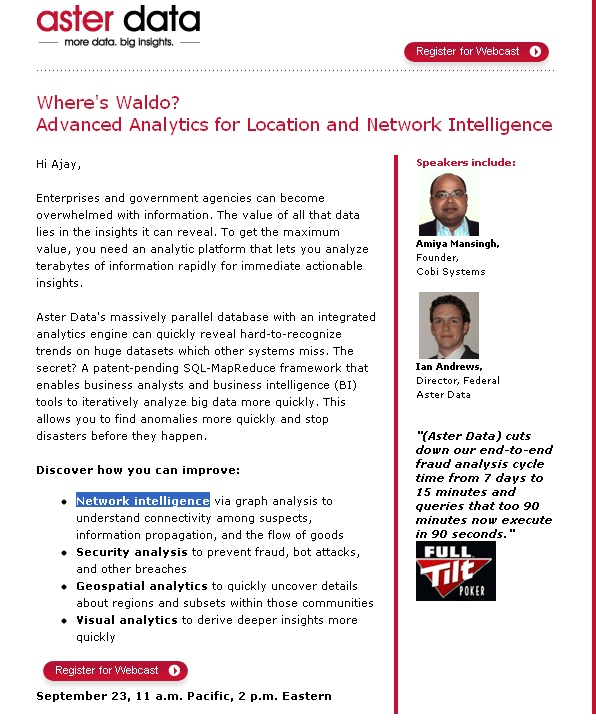
Where is Waldo? Webcast on Network Intelligence

From the good folks at AsterData, a webcast on a slightly interesting analytics topic

Enterprises and government agencies can become overwhelmed with information. The value of all that data lies in the insights it can reveal. To get the maximum value, you need an analytic platform that lets you analyze terabytes of information rapidly for immediate actionable insights.

Aster Data’s massively parallel database with an integrated analytics engine can quickly reveal hard-to-recognize trends on huge datasets which other systems miss. The secret? A patent-pending SQL-MapReduce framework that enables business analysts and business intelligence (BI) tools to iteratively analyze big data more quickly. This allows you to find anomalies more quickly and stop disasters before they happen.

Discover how you can improve:

  • Network intelligence via graph analysis to understand connectivity among suspects, information propagation, and the flow of goods
  • Security analysis to prevent fraud, bot attacks, and other breaches
  • Geospatial analytics to quickly uncover details about regions and subsets within those communities
  • Visual analytics to derive deeper insights more quickly

Analytics and Journals

Some good journals for reading on analytics-

1) JSS

http://www.jstatsoft.org/

present research that demonstrates the joint evolution of computational and statistical methods and techniques.  Implementations can use languages such as C, C++, S, Fortran, Java, PHP, Python and Ruby or environments such as Mathematica, MATLAB, R, S-PLUS, SAS, Stata, and XLISP-STAT.

There are currently 370 articles, 23 code snippets, 86 book reviews, 4 software reviews, and 7 special volumes in archives

2) R Journal

http://journal.r-project.org/

The  Journal

3) Pharma Programming

http://maney.co.uk/index.php/journals/pha/

Pharmaceutical Programming is the official journal of the Pharmaceutical Users Software Exchange (PhUSE), a non-profit membership society with the objective of educating programmers and their managers working in the pharmaceutical industry. Available both in print and online, Pharmaceutical Programming is an international journal with focus on programming in the regulated environment of the pharmaceutical and life sciences industry.

4) SAS Papers – User Groups

http://www.lexjansen.com/

4569 SAS papers presented
at SGF/SUGI 1996-2010.
1343 SAS papers presented
at PharmaSUG 2000-2010.
1810 SAS papers presented
at NESUG 1997-2009.
1191 SAS papers presented
at SESUG 1999-2009.
463 SAS papers presented
at PhUSE 2005-2009.
787 SAS papers presented
at WUSS 2003-2009.
337 SAS papers presented
at MWSUG 2001, 2004-2009.
188 SAS papers presented
at PNWSUG 2004-2009.
246 SAS papers presented
at SCSUG 2003-2007, 2009.
221 SAS papers related to CDISC.
Easy access to the CDISC Forum.

5) http://analyticsmagazine.com/

Magazine by http://www.informs.org/

6) Data Mining Journals

Academic Journals

Journals relevant to Data Mining

Oracle Open World/ RODM package

From the press release, here comes Oracle Open World. They really have an excellent rock concert in that as well.

.NET and Windows @ Oracle Develop and Oracle OpenWorld 2010

Oracle Develop will again feature a .NET track for Oracle developers. Oracle Develop is suited for all levels of .NET developers, from beginner to advanced. It covers introductory Oracle .NET material, new features, deep dive application tuning, and includes three hours of hands-on labs apply what you learned from the sessions.

To register, go to Oracle Develop registration site.

Oracle OpenWorld will include several sessions on using the Oracle Database on Windows and .NET.

Session schedules and locations for Windows and .NET sessions at Oracle Develop and OpenWorld are now available.

Download: 32-bit ODAC 11.2.0.1.2 for Visual Studio 2010 and .NET Framework 4

With ODAC 11.2.0.1.2, developers can connect to Oracle Database versions 9.2 and higher from Visual Studio 2010 and .NET Framework 4. ODAC components support the full framework, as well as the new .NET Framework Client Profile.

Statement of Direction: Oracle Database and Microsoft Entity Framework

Learn about Oracle’s beta and production plans to support Microsoft Entity Framework with Oracle Database.

Also see http://www.oracle.com/technetwork/articles/datawarehouse/saternos-r-161569.html

for

Data Mining Using the RDOM Package

By Casimir Saternos

Some excerpts-

Open R and enter the following command.

> library(RODM)

This command loads the RODM library and as well the dependent RODBC package. The next step is to make a database connection.

> DB <- RODM_open_dbms_connection(dsn="orcl", uid="dm", pwd="dm")

Subsequent commands use the DB object (an instance of the RODBC class) to connect to the database. The DNS specified in the command is the name you used earlier for the Data Source Name during the ODBC connection configuration. You can view the actual R code being executed by the command by simply typing the function name (without parentheses).

> RODM_open_dbms_connection

And say making a Model in Oracle and R-

> numrows <- length(orange_data[,1])
> orange_data.rows <- length(orange_data[,1])
> orange_data.id <- matrix(seq(1, orange_data.rows),  nrow=orange_data.rows, ncol=1, dimnames= list(NULL, c(“CASE_ID”)))
> orange_data <- cbind(orange_data.id, orange_data)

This adjustment to the data frame then needs to be propagated to the database. You can confirm the change using the sqlColumns function, as listed earlier.

> RODM_create_dbms_table(DB, "orange_data")
> sqlColumns(DB, 'orange_data')$COLUMN_NAME

> glm <- RODM_create_glm_model(
database = DB,
data_table_name = “orange_data”,
case_id_column_name = “CASE_ID”,
target_column_name = “circumference”,
model_name = “GLM_MODEL”,
mining_function = “regression”)

Information about this model can then be obtained by analyzing value returned from the model and stored in the variable named glm.

> glm$model.model_settings
> glm$glm.globals
> $glm.coefficients

Once you have a model, you can apply the model to a new set of data. To begin, create or retrieve sample data in the same format as the training data.

> query<-('select 999 case_id, 1 tree, 120 age, 
32 circumference from dual')

> orange_test<-sqlQuery(DB, query)
> RODM_create_dbms_table(DB, "orange_test")
and 
Finally, the model can be applied to the new data set and the results analyzed.

results <- RODM_apply_model(database = DB, 
data_table_name = "orange_test",
model_name = "GLM_MODEL",
supplemental_cols = "circumference")

When your session is complete, you can clean up objects that were created (if you like) and you should close the database connection:

> RODM_drop_model(database=DB,'GLM_MODEL')
> RODM_drop_dbms_table(DB, "orange_test")
> RODM_drop_dbms_table(DB, "orange_data")
> RODM_close_dbms_connection(DB)

See the full article at http://www.oracle.com/technetwork/articles/datawarehouse/saternos-r-161569.html

AsterData releases nCluster 4.6

From the press release

Aster Data nCluster 4.6, which includes a column data store, making Aster Data nCluster 4.6 the first platform with a unified SQL-MapReduce analytic framework on a hybrid row and column massively parallel processing (MPP) database management system (DBMS). The unified SQL-MapReduce analytic framework and Aster Data’s suite of 1000+ MapReduce-ready analytic functions, delivers a substantial breakthrough in richer, high performance analytics on large data volumes where data can be stored in either a row or column format.

With Aster Data nCluster 4.6, customers can choose the data format best suited to their needs and benefit from the power of Aster Data’s SQL-MapReduce analytic capabilities, providing maximum query performance by leveraging row-only, column-only, or hybrid storage strategies. Aster Data makes selection of the appropriate storage strategy easy with the new Data Model Express tool that determines the optimal data model based on a customer’s query workloads.  Both row and column stores in Aster Data nCluster 4.6 benefit from platform-level services including Online Precision Scaling™ on commodity hardware, dynamic workload management, and always-on availability, all of which now operate on both row and column stores. All 1000+ MapReduce-ready analytic functions released previously through Aster Data Analytic Foundation — a powerful suite of pre-built MapReduce analytic software building blocks — now run on a hybrid row and column architecture.  Aster Data nCluster 4.6 also includes new pre-built analytic functions, including decision trees and histograms. For custom analytic application development, the Aster Data IDE, Aster Data Developer Express, also fully and seamlessly supports the hybrid row and column store in Aster DatanCluster 4.6.

More advanced analytics infrastructure.

KXEN Update

Update from a very good data mining software company, KXEN –

  1. Longtime Chairman and founder Roger Haddad is retiring but would be a Board Member. See his interview with Decisionstats here https://decisionstats.wordpress.com/2009/01/05/interview-roger-haddad-founder-of-kxen-automated-modeling-software/ (note images were hidden due to migration from .com to .wordpress.com )
  2. New Members of Leadership are as-
John Ball, CEOJohn Ball
Chief Executive Officer

John Ball brings 20 years of experience in enterprise software, deep expertise in business intelligence and CRM applications, and a proven track record of success driving rapid growth at highly innovative companies.

Prior to joining KXEN, Mr. Ball served in several executive roles at salesforce.com, the leading provider of SaaS applications. Most recently, John served as VP & General Manager, Analytics and Reporting Products, where he spearheaded salesforce.com’s foray into CRM analytics and business intelligence. John also served as VP & General Manager, Service and Support Applications at salesforce.com, where he successfully grew the business to become the second largest and fastest growing product line at salesforce.com. Before salesforce.com, Ball was founder and CEO of Netonomy, the leading provider of customer self-service solutions for the telecommunications industry. Ball also held a number of executive roles at Business Objects, including General Manager, Web Products, where delivered to market the first 3 versions of WebIntelligence. Ball has a master’s degree in electrical engineering from Georgia Tech and a master’s degree in electric

I hope John atleast helps build a KXEN Force.com application- there are only 2 data mining apps there on App Exchange. Also on the wish list  more social media presence, a Web SaaS/Amazon API for KXEN, greater presence in American/Asian conferences, and a solution for SME’s (which cannot afford the premium pricing of the flagship solution. An alliance with bigger BI vendors like Oracle, SAP or IBM  for selling the great social network analysis.

Bill Russell as Non Executive Chairman-

Bill Russell as Non-executive Chairman of the Board, effective July 16 2010. Russell has 30 years of operational experience in enterprise software, with a special focus on business intelligence, analytics, and databases.Russell held a number of senior-level positions in his more than 20 years at Hewlett-Packard, including Vice President and General Manager of the multi-billion dollar Enterprise Systems Group. He has served as Non-executive Chairman of the Board for Sylantro Systems Corporation, webMethods Inc., and Network Physics, Inc. and has served as a board director for Cognos Inc. In addition to KXEN, Russell currently serves on the boards of Saba, PROS Holdings Inc., Global 360, ParAccel Inc., and B.T. Mancini Company.

Xavier Haffreingue as senior vice president, worldwide professional services and solutions.
He has almost 20 years of international enterprise software experience gained in the CRM, BI, Web and database sectors. Haffreingue joins KXEN from software provider Axway where he was VP global support operations. Prior to Axway, he held various leadership roles in the software industry, including VP self service solutions at Comverse Technologies and VP professional services and support at Netonomy, where he successfully delivered multi-million dollar projects across Europe, Asia-Pacific and Africa. Before that he was with Business Objects and Sybase, where he ran support and services in southern Europe managing over 2,500 customers in more than 20 countries.

David Guercio  as senior vice president, Americas field operations. Guercio brings to the role more than 25 years experience of building and managing high-achieving sales teams in the data mining, business intelligence and CRM markets. Guercio comes to KXEN from product lifecycle management vendor Centric Software, where he was EVP sales and client services. Prior to Centric, he was SVP worldwide sales and client services at Inxight Software, where he was also Chairman and CEO of the company’s Federal Systems Group, a subsidiary of Inxight that saw success in the US Federal Government intelligence market. The success in sales growth and penetration into the federal government led to the acquisition of Inxight by Business Objects in 2007, where Guercio then led the Inxight sales organization until Business Objects was acquired by SAP. Guercio was also a key member of the management team and a co-founder at Neovista, an early pioneer in data mining and predictive analytics. Additionally, he held the positions of director of sales and VP of professional services at Metaphor Computer Systems, one of the first data extraction solutions companies, which was acquired by IBM. During his career, Guercio also held executive positions at Resonate and SiGen.

3) Venture Capital funding to fund expansion-

It has closed $8 million in series D funding to further accelerate its growth and international expansion. The round was led by NextStage and included participation from existing investors XAnge Capital, Sofinnova Ventures, Saints Capital and Motorola Ventures.

This was done after John Ball had joined as CEO.

4) Continued kudos from analysts and customers for it’s technical excellence.

KXEN was named a leader in predictive analytics and data mining by Forrester Research (1) and was rated highest for commercial deployments of social network analytics by Frost & Sullivan (2)

Also it became an alliance partner of Accenture- which is also a prominent SAS partner as well.

In Database Optimization-

In KXEN V5.1, a new data manipulation module (ADM) is provided in conjunction with scoring to optimize database workloads and provide full in-database model deployment. Some leading data mining vendors are only now beginning to offer this kind of functionality, and then with only one or two selected databases, giving KXEN a more than five-year head start. Some other vendors are only offering generic SQL generation, not optimized for each database, and do not provide the wealth of possible outputs for their scoring equations: For example, real operational applications require not only to generate scores, but decision probabilities, error bars, individual input contributions – used to derive reasons of decision and more, which are available in KXEN in-database scoring modules.

Since 2005, KXEN has leveraged databases as the data manipulation engine for analytical dataset generation. In 2008, the ADM (Analytical Data Management) module delivered a major enhancement by providing a very easy to use data manipulation environment with unmatched productivity and efficiency. ADM works as a generator of optimized database-specific SQL code and comes with an integrated layer for the management of meta-data for analytics.

KXEN Modeling Factory- (similar to SAS’s recent product Rapid Predictive Modeler http://www.sas.com/resources/product-brief/rapid-predictive-modeler-brief.pdf and http://jtonedm.com/2010/09/02/first-look-rapid-predictive-modeler/)

KXEN Modeling Factory (KMF) has been designed to automate the development and maintenance of predictive analytics-intensive systems, especially systems that include large numbers of models, vast amounts of data or require frequent model refreshes. Information about each project and model is monitored and disseminated to ensure complete management and oversight and to facilitate continual improvement in business performance.

Main Functions

Schedule: creation of the Analytic Data Set (ADS), setup of how and when to score, setup of when and how to perform model retraining and refreshes …

Report
: Monitormodel execution over time, Track changes in model quality over time, see how useful one variable is by considering its multiple instance in models …

Notification
: Rather than having to wade through pages of event logs, KMF Department allows users to manage by exception through notifications.

Other products from KXEN have been covered here before https://decisionstats.wordpress.com/tag/kxen/ , including Structural Risk Minimization- https://decisionstats.wordpress.com/2009/04/27/kxen-automated-regression-modeling/

Thats all for the KXEN update- all the best to the new management team and a splendid job done by Roger Haddad in creating what is France and Europe’s best known data mining company.

Note- Source – http://www.kxen.com


Google moving on from MapReduce: rest of world still catching up

Apparently it is true as per the Register, but details in a paper next month- It is called Google Caffeine.

http://www.theregister.co.uk/2010/09/09/google_caffeine_explained/

Caffeine expands on BigTable to create a kind of database programming model that lets the company make changes to its web index without rebuilding the entire index from scratch. “[Caffeine] is a database-driven, Big Table–variety indexing system,” Lipkovitz tells The Reg, saying that Google will soon publish a paper discussing the system. The paper, he says, will be delivered next month at the USENIX Symposium on Operating Systems Design and Implementation (OSDI).

and interestingly

MapReduce, he says, isn’t suited to calculations that need to occur in near real-time.

MapReduce is a sequence of batch operations, and generally, Lipkovits explains, you can’t start your next phase of operations until you finish the first. It suffers from “stragglers,” he says. If you want to build a system that’s based on series of map-reduces, there’s a certain probability that something will go wrong, and this gets larger as you increase the number of operations. “You can’t do anything that takes a relatively short amount of time,” Lipkovitz says, “so we got rid of it.”

With Caffeine, Google can update its index by making direct changes to the web map already stored in BigTable. This includes a kind of framework that sits atop BigTable, and Lipkovitz compares it to old-school database programming and the use of “database triggers.”

but most importantly

In 2004, Google published research papers on GFS and MapReduce that became the basis for the open source Hadoop platform now used by Yahoo!, Facebook, and — yes — Microsoft. But as Google moves beyond GFS and MapReduce, Lipokovitz stresses that he is “not claiming that the rest of the world is behind us.”

But oh no!

“We’re in business of making searches useful,” he says. “We’re not in the business of selling infrastructure

But I say why not- Search is good and advertising is okay

There is more (not evil) money in infrastructure (of big data) as there is in advertising. But the advertising guys disagree

Big Data Management and Advanced Analytics

Here is a new list for the top 10 considerations for Big Data Management and using Advanced Analytics -courtesy AsterData.

Source-

http://www.asterdata.com/wp_10_considerations/index.php?ref=decisionstats

“There are ten strong reasons why competitive organizations are turning to new data management solutions to handle their growing data volumes and evolving analytic needs. This new platform – a ‘data-analytics server’ – merges data storage and data analytics into one single system to conquer the big data challenge.

Big data storage is handled by a massively parallel database architecture; big data analytics is handled by an integrated analytics engine, so that analytics run fully in-database yielding ultra high performance on large data sets. The analytics engine leverages the powerful analytics framework MapReduce. The results are cost-effective, scalable data storage, ultra high performance and richer data analysis.”

Major considerations include:
Cost-effective, scalable data management – what are the requirements?
Advanced analytic queries – what’s meant by advanced analytics & how easy is it?
Running rich, diverse workloads – key factors for high concurrency & performance