
Intel® Threading Challenge 2011 Software Contest

Please use the following code to get a 15% discount on the 2 Day Conference Pass: AJAYNY11.
Predictive Analytics World Conference –New York City and London, UK

October 17-21, 2011 – New York City, NY (pawcon.com/nyc)
Nov 30 – Dec 1, 2011 – London, UK (pawcon.com/london)
Predictive Analytics World (pawcon.com) is the business-focused event for predictive analytics
professionals, managers and commercial practitioners, covering today’s commercial deployment of
predictive analytics, across industries and across software vendors. The conference delivers case
studies, expertise, and resources to achieve two objectives:
1) Bigger wins: Strengthen the business impact delivered by predictive analytics
2) Broader capabilities: Establish new opportunities with predictive analytics
Case Studies: How the Leading Enterprises Do It
Predictive Analytics World focuses on concrete examples of deployed predictive analytics. The leading
enterprises have signed up to tell their stories, so you can hear from the horse’s mouth precisely how
Fortune 500 analytics competitors and other top practitioners deploy predictive modeling, and what
kind of business impact it delivers.
PAW NEW YORK CITY 2011
PAW’s NYC program is the richest and most diverse yet, featuring over 40 sessions across three tracks
– including both X and Y tracks, and an “Expert/Practitioner” track — so you can witness how predictive
analytics is applied at major companies.
PAW NYC’s agenda covers hot topics and advanced methods such as ensemble models, social data,
search marketing, crowdsourcing, blackbox trading, fraud detection, risk management, survey analysis,
and other innovative applications that benefit organizations in new and creative ways.
WORKSHOPS: PAW NYC also features five full-day pre- and post-conference workshops that
complement the core conference program. Workshop agendas include advanced predictive modeling
methods, hands-on training, an intro to R (the open source analytics system), and enterprise decision
management.
For more see http://www.predictiveanalyticsworld.com/newyork/2011/
PAW LONDON 2011
PAW London’s agenda covers hot topics and advanced methods such as risk management, uplift
(incremental lift) modeling, open source analytics, and crowdsourcing data mining. Case study
presentations cover campaign targeting, churn modeling, next-best-offer, selecting marketing channels,
global analytics deployment, email marketing, HR candidate search, and other innovative applications
that benefit organizations in new and creative ways.
Join PAW and access the best keynotes, sessions, workshops, exposition, expert panel, live demos,
networking coffee breaks, reception, birds-of-a-feather lunches, brand-name enterprise leaders, and
industry heavyweights in the business.
For more see http://www.predictiveanalyticsworld.com/london
CROSS-INDUSTRY APPLICATIONS
Predictive Analytics World is the only conference of its kind, delivering vendor-neutral sessions across
verticals such as banking, financial services, e-commerce, education, government, healthcare, high
technology, insurance, non-profits, publishing, social gaming, retail and telecommunications
And PAW covers the gamut of commercial applications of predictive analytics, including response
modeling, customer retention with churn modeling, product recommendations, fraud detection, online
marketing optimization, human resource decision-making, law enforcement, sales forecasting, and
credit scoring.
Why bring together such a wide range of endeavors? No matter how you use predictive analytics, the
story is the same: Predicatively scoring customers optimizes business performance. Predictive analytics
initiatives across industries leverage the same core predictive modeling technology, share similar project
overhead and data requirements, and face common process challenges and analytical hurdles.
RAVE REVIEWS:
“Hands down, best applied, analytics conference I have ever attended. Great exposure to cutting-edge
predictive techniques and I was able to turn around and apply some of those learnings to my work
immediately. I’ve never been able to say that after any conference I’ve attended before!”
Jon Francis
Senior Statistician
T-Mobile
Read more: Articles and blog entries about PAW can be found at http://www.predictiveanalyticsworld.com/
pressroom.php
VENDORS. Meet the vendors and learn about their solutions, software and service. Discover the best
predictive analytics vendors available to serve your needs – learn what they do and see how they
compare
COLLEAGUES. Mingle, network and hang out with your best and brightest colleagues. Exchange
experiences over lunch, coffee breaks and the conference reception connecting with those professionals
who face the same challenges as you.
GET STARTED. If you’re new to predictive analytics, kicking off a new initiative, or exploring new ways
to position it at your organization, there’s no better place to get your bearings than Predictive Analytics
World. See what other companies are doing, witness vendor demos, participate in discussions with the
experts, network with your colleagues and weigh your options!
For more information:
http://www.predictiveanalyticsworld.com
View videos of PAW Washington DC, Oct 2010 — now available on-demand:
http://www.predictiveanalyticsworld.com/online-video.php
What is predictive analytics? See the Predictive Analytics Guide:
http://www.predictiveanalyticsworld.com/predictive_analytics.php
If you’d like our informative event updates, sign up at:
http://www.predictiveanalyticsworld.com/signup-us.php
To sign up for the PAW group on LinkedIn, see:
http://www.linkedin.com/e/gis/1005097
For inquiries e-mail regsupport@risingmedia.com or call (717) 798-3495.
Heres a new contest for SAS users. The prizes are books, so students should be interested as well.
From http://www.sascommunity.org/mwiki/images/b/bc/PointsforprizesRules.pdf
HOW TO ENTER: To qualify for entry, go to the sasCommunity.org web site located at http://www.sascommunity.org/wiki/Main_Page between April 11, 2011 and May 9, 2011 and either add or edit valid content as described herein to earn award points. Creation of a first time profile on www.sascommunity.org will earn 1,000 points. For each valid article creation or edit, 100 points will be earned. Articles and subsequent edits should adhere to the sasCommunity.org terms of use as outlined on http://www.sascommunity.org/wiki/sasCommunity:Terms_of_Use. All points’ accumulation will end at 5:00 PM GMT on May 9, 2011 and only those points earned between 8:00 AM GMT on April 11, 2011 and 5:00 PM GMT on May 9, 2011 will be counted in this contest. Contest entries made through the Internet will be declared made by the registered user of the sasCommunity.org profile account. Sponsor is not responsible for phone, technical, network, electronic, computer hardware or software failures of any kind, misdirected, incomplete, garbled or delayed transmissions. Sponsor will not be responsible for incorrect or inaccurate entry information, whether caused by entrants or by any of the equipment or programming associated with or utilized in the contest. ELIGIBILITY: The contest is open to all sasCommunity.org members 18 year of age or older on the start date of the contest. Void where prohibited by law. Employees (including immediate family members and/or those living in the same household of each), the Sponsor, members of the sasCommunity.org Advisory Board, SAS Global Users Group Executive Board, their advertising, promotion and production agencies, the affiliated companies of each, and the immediate family members of each are not eligible. PRIZE: Three (3) prizes will be awarded based on total points accumulated during the contest as follows: 1stPlace: 3 SAS®Press books - not to exceed $250 in combined retail value; 2ndPlace: 2 SAS®Press books - not to exceed $150 in combined retail value; and 3rdPlace: 1 SAS®Press book - not to exceed $100 in retail value.
http://www.sascommunity.org/wiki/Main_Page
| New Points for Prizes Contest | ||
 Win SAS books! |
Contribute content or SAS code to sasCommunity.org for your chance to WIN! To qualify, simply add or edit articles between April 11, 2011 and May 9, 2011 (GMT). Creation of a first-time profile on sasCommunity.org gives you 1,000 points. For each valid article creation or edit, 100 points will be earned. The user with the most points collected during this time wins SAS Press Books!
|
|
| Become a sasCommunity Guru | ||
  |
The sasCommunity support team has been hard at work adding new features and is pleased to announce a points system that recognizes each user’s contributions to the site. Every time you contribute by creating a page, updating it, or just doing a little wiki gardening, you earn points.Earning points is automatic and simple – all you have to do is contribute! Creating your account starts you with 1000 points and all the current users have been credited with points dating back to the site coming online in April 2007.
|
|
The newest version of R is now available for download. R 2.13 is ready !!

http://cran.at.r-project.org/bin/windows/base/CHANGES.R-2.13.0.html
win_iconv has been updated: this version has a change in the behaviour with BOMs on UTF-16 and UTF-32 files – it removes BOMs when reading and adds them when writing. (This is consistent with Microsoft applications, but Unix versions of iconv usually ignore them.)
options("browser") and options("pdfviewer") are now set from environment variables R_BROWSER and R_PDFVIEWER respectively (as on a Unix-alike). A value of "false" suppresses display (even if there is no false.exe present on the path).
options("install.lock") is set to TRUE, binary package installs are protected against failure similar to the way source package installs are protected.
file.exists() and unlink() have more support for files > 2GB.
R.exe in ‘R_HOME/bin/i386,x64/bin’ now support options such as R --vanilla CMD: there is no comparable interface for ‘Rcmd.exe’.
Rcmd.exe).
Rgui has a new menu item for the PDF ‘Sweave User Manual’.
unzip().
JPEGDIR to that value in ‘MkRules.local’.
Support for jpeg-6b has been removed.
casinh function on the branch cuts.windows(). The symptom was the occasional raster image not being drawn, especially when drawing multiple raster images in a single expression. Thanks to Michael Sumner for report and testing.Tonnes of changes!!
http://cran.at.r-project.org/src/base/NEWS
CHANGES IN R VERSION 2.13.0:
SIGNIFICANT USER-VISIBLE CHANGES:
• replicate() (by default) and vapply() (always) now return a
higher-dimensional array instead of a matrix in the case where
the inner function value is an array of dimension >= 2.
• Printing and formatting of floating point numbers is now using
the correct number of digits, where it previously rarely differed
by a few digits. (See “scientific†entry below.) This affects
_many_ *.Rout.save checks in packages.
NEW FEATURES:
• normalizePath() has been moved to the base package (from utils):
this is so it can be used by library() and friends.
It now does tilde expansion.
It gains new arguments winslash (to select the separator on
Windows) and mustWork to control the action if a canonical path
cannot be found.
• The previously barely documented limit of 256 bytes on a symbol
name has been raised to 10,000 bytes (a sanity check). Long
symbol names can sometimes occur when deparsing expressions (for
example, in model.frame).
• reformulate() gains a intercept argument.
• cmdscale(add = FALSE) now uses the more common definition that
there is a representation in n-1 or less dimensions, and only
dimensions corresponding to positive eigenvalues are used.
(Avoids confusion such as PR#14397.)
• Names used by c(), unlist(), cbind() and rbind() are marked with
an encoding when this can be ascertained.
• R colours are now defined to refer to the sRGB color space.
The PDF, PostScript, and Quartz graphics devices record this
fact. X11 (and Cairo) and Windows just assume that your screen
conforms.
• system.file() gains a mustWork argument (suggestion of Bill
Dunlap).
• new.env(hash = TRUE) is now the default.
• list2env(envir = NULL) defaults to hashing (with a suitably sized
environment) for lists of more than 100 elements.
• text() gains a formula method.
• IQR() now has a type argument which is passed to quantile().
• as.vector(), as.double() etc duplicate less when they leave the
mode unchanged but remove attributes.
as.vector(mode = "any") no longer duplicates when it does not
remove attributes. This helps memory usage in matrix() and
array().
matrix() duplicates less if data is an atomic vector with
attributes such as names (but no class).
dim(x) <- NULL duplicates less if x has neither dimensions nor
names (since this operation removes names and dimnames).
• setRepositories() gains an addURLs argument.
• chisq.test() now also returns a stdres component, for
standardized residuals (which have unit variance, unlike the
Pearson residuals).
• write.table() and friends gain a fileEncoding argument, to
simplify writing files for use on other OSes (e.g. a spreadsheet
intended for Windows or Mac OS X Excel).
• Assignment expressions of the form foo::bar(x) <- y and
foo:::bar(x) <- y now work; the replacement functions used are
foo::`bar<-` and foo:::`bar<-`.
• Sys.getenv() gains a names argument so Sys.getenv(x, names =
FALSE) can replace the common idiom of as.vector(Sys.getenv()).
The default has been changed to not name a length-one result.
• Lazy loading of environments now preserves attributes and locked
status. (The locked status of bindings and active bindings are
still not preserved; this may be addressed in the future).
• options("install.lock") may be set to FALSE so that
install.packages() defaults to --no-lock installs, or (on
Windows) to TRUE so that binary installs implement locking.
• sort(partial = p) for large p now tries Shellsort if quicksort is
not appropriate and so works for non-numeric atomic vectors.
• sapply() gets a new option simplify = "array" which returns a
“higher rank†array instead of just a matrix when FUN() returns a
dim() length of two or more.
replicate() has this option set by default, and vapply() now
behaves that way internally.
• aperm() becomes S3 generic and gets a table method which
preserves the class.
• merge() and as.hclust() methods for objects of class "dendrogram"
are now provided.
• as.POSIXlt.factor() now passes ... to the character method
(suggestion of Joshua Ulrich).
• The character method of as.POSIXlt() now tries to find a format
that works for all non-NA inputs, not just the first one.
• str() now has a method for class "Date" analogous to that for
class "POSIXt".
• New function file.link() to create hard links on those file
systems (POSIX, NTFS but not FAT) that support them.
• New Summary() group method for class "ordered" implements min(),
max() and range() for ordered factors.
• mostattributes<-() now consults the "dim" attribute and not the
dim() function, making it more useful for objects (such as data
frames) from classes with methods for dim(). It also uses
attr<-() in preference to the generics name<-(), dim<-() and
dimnames<-(). (Related to PR#14469.)
• There is a new option "browserNLdisabled" to disable the use of
an empty (e.g. via the ‘Return’ key) as a synonym for c in
browser() or n under debug(). (Wish of PR#14472.)
• example() gains optional new arguments character.only and
give.lines enabling programmatic exploration.
• serialize() and unserialize() are no longer described as
‘experimental’. The interface is now regarded as stable,
although the serialization format may well change in future
releases. (serialize() has a new argument version which would
allow the current format to be written if that happens.)
New functions saveRDS() and readRDS() are public versions of the
‘internal’ functions .saveRDS() and .readRDS() made available for
general use. The dot-name versions remain available as several
package authors have made use of them, despite the documentation.
saveRDS() supports compress = "xz".
• Many functions when called with a not-open connection will now
ensure that the connection is left not-open in the event of
error. These include read.dcf(), dput(), dump(), load(),
parse(), readBin(), readChar(), readLines(), save(), writeBin(),
writeChar(), writeLines(), .readRDS(), .saveRDS() and
tools::parse_Rd(), as well as functions calling these.
• Public functions find.package() and path.package() replace the
internal dot-name versions.
• The default method for terms() now looks for a "terms" attribute
if it does not find a "terms" component, and so works for model
frames.
• httpd() handlers receive an additional argument containing the
full request headers as a raw vector (this can be used to parse
cookies, multi-part forms etc.). The recommended full signature
for handlers is therefore function(url, query, body, headers,
...).
• file.edit() gains a fileEncoding argument to specify the encoding
of the file(s).
• The format of the HTML package listings has changed. If there is
more than one library tree , a table of links to libraries is
provided at the top and bottom of the page. Where a library
contains more than 100 packages, an alphabetic index is given at
the top of the section for that library. (As a consequence,
package names are now sorted case-insensitively whatever the
locale.)
• isSeekable() now returns FALSE on connections which have
non-default encoding. Although documented to record if ‘in
principle’ the connection supports seeking, it seems safer to
report FALSE when it may not work.
• R CMD REMOVE and remove.packages() now remove file R.css when
removing all remaining packages in a library tree. (Related to
the wish of PR#14475: note that this file is no longer
installed.)
• unzip() now has a unzip argument like zip.file.extract(). This
allows an external unzip program to be used, which can be useful
to access features supported by Info-ZIP's unzip version 6 which
is now becoming more widely available.
• There is a simple zip() function, as wrapper for an external zip
command.
• bzfile() connections can now read from concatenated bzip2 files
(including files written with bzfile(open = "a")) and files
created by some other compressors (such as the example of
PR#14479).
• The primitive function c() is now of type BUILTIN.
• plot(<dendrogram>, .., nodePar=*) now obeys an optional xpd
specification (allowing clipping to be turned off completely).
• nls(algorithm="port") now shares more code with nlminb(), and is
more consistent with the other nls() algorithms in its return
value.
• xz has been updated to 5.0.1 (very minor bugfix release).
• image() has gained a logical useRaster argument allowing it to
use a bitmap raster for plotting a regular grid instead of
polygons. This can be more efficient, but may not be supported by
all devices. The default is FALSE.
• list.files()/dir() gains a new argument include.dirs() to include
directories in the listing when recursive = TRUE.
• New function list.dirs() lists all directories, (even empty
ones).
• file.copy() now (by default) copies read/write/execute
permissions on files, moderated by the current setting of
Sys.umask().
• Sys.umask() now accepts mode = NA and returns the current umask
value (visibly) without changing it.
• There is a ! method for classes "octmode" and "hexmode": this
allows xor(a, b) to work if both a and b are from one of those
classes.
• as.raster() no longer fails for vectors or matrices containing
NAs.
• New hook "before.new.plot" allows functions to be run just before
advancing the frame in plot.new, which is potentially useful for
custom figure layout implementations.
• Package tools has a new function compactPDF() to try to reduce
the size of PDF files _via_ qpdf or gs.
• tar() has a new argument extra_flags.
• dotchart() accepts more general objects x such as 1D tables which
can be coerced by as.numeric() to a numeric vector, with a
warning since that might not be appropriate.
• The previously internal function create.post() is now exported
from utils, and the documentation for bug.report() and
help.request() now refer to that for create.post().
It has a new method = "mailto" on Unix-alikes similar to that on
Windows: it invokes a default mailer via open (Mac OS X) or
xdg-open or the default browser (elsewhere).
The default for ccaddress is now getOption("ccaddress") which is
by default unset: using the username as a mailing address
nowadays rarely works as expected.
• The default for options("mailer") is now "mailto" on all
platforms.
• unlink() now does tilde-expansion (like most other file
functions).
• file.rename() now allows vector arguments (of the same length).
• The "glm" method for logLik() now returns an "nobs" attribute
(which stats4::BIC() assumed it did).
The "nls" method for logLik() gave incorrect results for zero
weights.
• There is a new generic function nobs() in package stats, to
extract from model objects a suitable value for use in BIC
calculations. An S4 generic derived from it is defined in
package stats4.
• Code for S4 reference-class methods is now examined for possible
errors in non-local assignments.
• findClasses, getGeneric, findMethods and hasMethods are revised
to deal consistently with the package= argument and be consistent
with soft namespace policy for finding objects.
• tools::Rdiff() now has the option to return not only the status
but a character vector of observed differences (which are still
by default sent to stdout).
• The startup environment variables R_ENVIRON_USER, R_ENVIRON,
R_PROFILE_USER and R_PROFILE are now treated more consistently.
In all cases an empty value is considered to be set and will stop
the default being used, and for the last two tilde expansion is
performed on the file name. (Note that setting an empty value is
probably impossible on Windows.)
• Using R --no-environ CMD, R --no-site-file CMD or R
--no-init-file CMD sets environment variables so these settings
are passed on to child R processes, notably those run by INSTALL,
check and build. R --vanilla CMD sets these three options (but
not --no-restore).
• smooth.spline() is somewhat faster. With cv=NA it allows some
leverage computations to be skipped,
• The internal (C) function scientific(), at the heart of R's
format.info(x), format(x), print(x), etc, for numeric x, has been
re-written in order to provide slightly more correct results,
fixing PR#14491, notably in border cases including when digits >=
16, thanks to substantial contributions (code and experiments)
from Petr Savicky. This affects a noticable amount of numeric
output from R.
• A new function grepRaw() has been introduced for finding subsets
of raw vectors. It supports both literal searches and regular
expressions.
• Package compiler is now provided as a standard package. See
?compiler::compile for information on how to use the compiler.
This package implements a byte code compiler for R: by default
the compiler is not used in this release. See the ‘R
Installation and Administration Manual’ for how to compile the
base and recommended packages.
• Providing an exportPattern directive in a NAMESPACE file now
causes classes to be exported according to the same pattern, for
example the default from package.skeleton() to specify all names
starting with a letter. An explicit directive to
exportClassPattern will still over-ride.
• There is an additional marked encoding "bytes" for character
strings. This is intended to be used for non-ASCII strings which
should be treated as a set of bytes, and never re-encoded as if
they were in the encoding of the currrent locale: useBytes = TRUE
is autmatically selected in functions such as writeBin(),
writeLines(), grep() and strsplit().
Only a few character operations are supported (such as substr()).
Printing, format() and cat() will represent non-ASCII bytes in
such strings by a \xab escape.
• The new function removeSource() removes the internally stored
source from a function.
• "srcref" attributes now include two additional line number
values, recording the line numbers in the order they were parsed.
• New functions have been added for source reference access:
getSrcFilename(), getSrcDirectory(), getSrcLocation() and
getSrcref().
• Sys.chmod() has an extra argument use_umask which defaults to
true and restricts the file mode by the current setting of umask.
This means that all the R functions which manipulate
file/directory permissions by default respect umask, notably R
CMD INSTALL.
• tempfile() has an extra argument fileext to create a temporary
filename with a specified extension. (Suggestion and initial
implementation by Dirk Eddelbuettel.)
There are improvements in the way Sweave() and Stangle() handle
non-ASCII vignette sources, especially in a UTF-8 locale: see
‘Writing R Extensions’ which now has a subsection on this topic.
• factanal() now returns the rotation matrix if a rotation such as
"promax" is used, and hence factor correlations are displayed.
(Wish of PR#12754.)
• The gctorture2() function provides a more refined interface to
the GC torture process. Environment variables R_GCTORTURE,
R_GCTORTURE_WAIT, and R_GCTORTURE_INHIBIT_RELEASE can also be
used to control the GC torture process.
• file.copy(from, to) no longer regards it as an error to supply a
zero-length from: it now simply does nothing.
• rstandard.glm gains a type argument which can be used to request
standardized Pearson residuals.
• A start on a Turkish translation, thanks to Murat Alkan.
• .libPaths() calls normalizePath(winslash = "/") on the paths:
this helps (usually) present them in a user-friendly form and
should detect duplicate paths accessed via different symbolic
links.
SWEAVE CHANGES:
• Sweave() has options to produce PNG and JPEG figures, and to use
a custom function to open a graphics device (see ?RweaveLatex).
(Based in part on the contribution of PR#14418.)
• The default for Sweave() is to produce only PDF figures (rather
than both EPS and PDF).
• Environment variable SWEAVE_OPTIONS can be used to supply
defaults for existing or new options to be applied after the
Sweave driver setup has been run.
• The Sweave manual is now included as a vignette in the utils
package.
• Sweave() handles keep.source=TRUE much better: it could duplicate
some lines and omit comments. (Reported by John Maindonald and
others.)
C-LEVEL FACILITIES:
• Because they use a C99 interface which a C++ compiler is not
required to support, Rvprintf and REvprintf are only defined by
R_ext/Print.h in C++ code if the macro R_USE_C99_IN_CXX is
defined when it is included.
• pythag duplicated the C99 function hypot. It is no longer
provided, but is used as a substitute for hypot in the very
unlikely event that the latter is not available.
• R_inspect(obj) and R_inspect3(obj, deep, pvec) are (hidden)
C-level entry points to the internal inspect function and can be
used for C-level debugging (e.g., in conjunction with the p
command in gdb).
• Compiling R with --enable-strict-barrier now also enables
additional checking for use of unprotected objects. In
combination with gctorture() or gctorture2() and a C-level
debugger this can be useful for tracking down memory protection
issues.
UTILITIES:
• R CMD Rdiff is now implemented in R on Unix-alikes (as it has
been on Windows since R 2.12.0).
• R CMD build no longer does any cleaning in the supplied package
directory: all the cleaning is done in the copy.
It has a new option --install-args to pass arguments to R CMD
INSTALL for --build (but not when installing to rebuild
vignettes).
There is new option, --resave-data, to call
tools::resaveRdaFiles() on the data directory, to compress
tabular files (.tab, .csv etc) and to convert .R files to .rda
files. The default, --resave-data=gzip, is to do so in a way
compatible even with years-old versions of R, but better
compression is given by --resave-data=best, requiring R >=
2.10.0.
It now adds a datalist file for data directories of more than
1Mb.
Patterns in .Rbuildignore are now also matched against all
directory names (including those of empty directories).
There is a new option, --compact-vignettes, to try reducing the
size of PDF files in the inst/doc directory. Currently this
tries qpdf: other options may be used in future.
When re-building vignettes and a inst/doc/Makefile file is found,
make clean is run if the makefile has a clean: target.
After re-building vignettes the default clean-up operation will
remove any directories (and not just files) created during the
process: e.g. one package created a .R_cache directory.
Empty directories are now removed unless the option
--keep-empty-dirs is given (and a few packages do deliberately
include empty directories).
If there is a field BuildVignettes in the package DESCRIPTION
file with a false value, re-building the vignettes is skipped.
• R CMD check now also checks for filenames that are
case-insensitive matches to Windows' reserved file names with
extensions, such as nul.Rd, as these have caused problems on some
Windows systems.
It checks for inefficiently saved data/*.rda and data/*.RData
files, and reports on those large than 100Kb. A more complete
check (including of the type of compression, but potentially much
slower) can be switched on by setting environment variable
_R_CHECK_COMPACT_DATA2_ to TRUE.
The types of files in the data directory are now checked, as
packages are _still_ misusing it for non-R data files.
It now extracts and runs the R code for each vignette in a
separate directory and R process: this is done in the package's
declared encoding. Rather than call tools::checkVignettes(), it
calls tool::buildVignettes() to see if the vignettes can be
re-built as they would be by R CMD build. Option --use-valgrind
now applies only to these runs, and not when running code to
rebuild the vignettes. This version does a much better job of
suppressing output from successful vignette tests.
The 00check.log file is a more complete record of what is output
to stdout: in particular contains more details of the tests.
It now check all syntactically valid Rd usage entries, and warns
about assignments (unless these give the usage of replacement
functions).
.tar.xz compressed tarballs are now allowed, if tar supports them
(and setting environment variable TAR to internal ensures so on
all platforms).
• R CMD check now warns if it finds inst/doc/makefile, and R CMD
build renames such a file to inst/doc/Makefile.
INSTALLATION:
• Installing R no longer tries to find perl, and R CMD no longer
tries to substitute a full path for awk nor perl - this was a
legacy from the days when they were used by R itself. Because a
couple of packages do use awk, it is set as the make (rather than
environment) variable AWK.
• make check will now fail if there are differences from the
reference output when testing package examples and if environment
variable R_STRICT_PACKAGE_CHECK is set to a true value.
• The C99 double complex type is now required.
The C99 complex trigonometric functions (such as csin) are not
currently required (FreeBSD lacks most of them): substitutes are
used if they are missing.
• The C99 system call va_copy is now required.
• If environment variable R_LD_LIBRARY_PATH is set during
configuration (for example in config.site) it is used unchanged
in file etc/ldpaths rather than being appended to.
• configure looks for support for OpenMP and if found compiles R
with appropriate flags and also makes them available for use in
packages: see ‘Writing R Extensions’.
This is currently experimental, and is only used in R with a
single thread for colSums() and colMeans(). Expect it to be more
widely used in later versions of R.
This can be disabled by the --disable-openmp flag.
PACKAGE INSTALLATION:
• R CMD INSTALL --clean now removes copies of a src directory which
are created when multiple sub-architectures are in use.
(Following a comment from Berwin Turlach.)
• File R.css is now installed on a per-package basis (in the
package's html directory) rather than in each library tree, and
this is used for all the HTML pages in the package. This helps
when installing packages with static HTML pages for use on a
webserver. It will also allow future versions of R to use
different stylesheets for the packages they install.
• A top-level file .Rinstignore in the package sources can list (in
the same way as .Rbuildignore) files under inst that should not
be installed. (Why should there be any such files? Because all
the files needed to re-build vignettes need to be under inst/doc,
but they may not need to be installed.)
• R CMD INSTALL has a new option --compact-docs to compact any PDFs
under the inst/doc directory. Currently this uses qpdf, which
must be installed (see ‘Writing R Extensions’).
• There is a new option --lock which can be used to cancel the
effect of --no-lock or --pkglock earlier on the command line.
• Option --pkglock can now be used with more than one package, and
is now the default if only one package is specified.
• Argument lock of install.packages() can now be use for Mac binary
installs as well as for Windows ones. The value "pkglock" is now
accepted, as well as TRUE and FALSE (the default).
• There is a new option --no-clean-on-error for R CMD INSTALL to
retain a partially installed package for forensic analysis.
• Packages with names ending in . are not portable since Windows
does not work correctly with such directory names. This is now
warned about in R CMD check, and will not be allowed in R 2.14.x.
• The vignette indices are more comprehensive (in the style of
browseVignetttes()).
DEPRECATED & DEFUNCT:
• require(save = TRUE) is defunct, and use of the save argument is
deprecated.
• R CMD check --no-latex is defunct: use --no-manual instead.
• R CMD Sd2Rd is defunct.
• The gamma argument to hsv(), rainbow(), and rgb2hsv() is
deprecated and no longer has any effect.
• The previous options for R CMD build --binary (--auto-zip,
--use-zip-data and --no-docs) are deprecated (or defunct): use
the new option --install-args instead.
• When a character value is used for the EXPR argument in switch(),
only a single unnamed alternative value is now allowed.
• The wrapper utils::link.html.help() is no longer available.
• Zip-ing data sets in packages (and hence R CMD INSTALL options
--use-zip-data and --auto-zip, as well as the ZipData: yes field
in a DESCRIPTION file) is defunct.
Installed packages with zip-ed data sets can still be used, but a
warning that they should be re-installed will be given.
• The ‘experimental’ alternative specification of a name space via
.Export() etc is now defunct.
• The option --unsafe to R CMD INSTALL is deprecated: use the
identical option --no-lock instead.
• The entry point pythag in Rmath.h is deprecated in favour of the
C99 function hypot. A wrapper for hypot is provided for R 2.13.x
only.
• Direct access to the "source" attribute of functions is
deprecated; use deparse(fn, control="useSource") to access it,
and removeSource(fn) to remove it.
• R CMD build --binary is now formally deprecated: R CMD INSTALL
--build has long been the preferred alternative.
• Single-character package names are deprecated (and R is already
disallowed to avoid confusion in Depends: fields).
BUG FIXES:
• drop.terms and the [ method for class "terms" no longer add back
an intercept. (Reported by Niels Hansen.)
• aggregate preserves the class of a column (e.g. a date) under
some circumstances where it discarded the class previously.
• p.adjust() now always returns a vector result, as documented. In
previous versions it copied attributes (such as dimensions) from
the p argument: now it only copies names.
• On PDF and PostScript devices, a line width of zero was recorded
verbatim and this caused problems for some viewers (a very thin
line combined with a non-solid line dash pattern could also cause
a problem). On these devices, the line width is now limited at
0.01 and for very thin lines with complex dash patterns the
device may force the line dash pattern to be solid. (Reported by
Jari Oksanen.)
• The str() method for class "POSIXt" now gives sensible output for
0-length input.
• The one- and two-argument complex maths functions failed to warn
if NAs were generated (as their numeric analogues do).
• Added .requireCachedGenerics to the dont.mind list for library()
to avoid warnings about duplicates.
• $<-.data.frame messed with the class attribute, breaking any S4
subclass. The S4 data.frame class now has its own $<- method,
and turns dispatch on for this primitive.
• Map() did not look up a character argument f in the correct
frame, thanks to lazy evaluation. (PR#14495)
• file.copy() did not tilde-expand from and to when to was a
directory. (PR#14507)
• It was possible (but very rare) for the loading test in R CMD
INSTALL to crash a child R process and so leave around a lock
directory and a partially installed package. That test is now
done in a separate process.
• plot(<formula>, data=<matrix>,..) now works in more cases;
similarly for points(), lines() and text().
• edit.default() contained a manual dispatch for matrices (the
"matrix" class didn't really exist when it was written). This
caused an infinite recursion in the no-GUI case and has now been
removed.
• data.frame(check.rows = TRUE) sometimes worked when it should
have detected an error. (PR#14530)
• scan(sep= , strip.white=TRUE) sometimes stripped trailing spaces
from within quoted strings. (The real bug in PR#14522.)
• The rank-correlation methods for cor() and cov() with use =
"complete.obs" computed the ranks before removing missing values,
whereas the documentation implied incomplete cases were removed
first. (PR#14488)
They also failed for 1-row matrices.
• The perpendicular adjustment used in placing text and expressions
in the margins of plots was not scaled by par("mex"). (Part of
PR#14532.)
• Quartz Cocoa device now catches any Cocoa exceptions that occur
during the creation of the device window to prevent crashes. It
also imposes a limit of 144 ft^2 on the area used by a window to
catch user errors (unit misinterpretation) early.
• The browser (invoked by debug(), browser() or otherwise) would
display attributes such as "wholeSrcref" that were intended for
internal use only.
• R's internal filename completion now properly handles filenames
with spaces in them even when the readline library is used. This
resolves PR#14452 provided the internal filename completion is
used (e.g., by setting rc.settings(files = TRUE)).
• Inside uniroot(f, ...), -Inf function values are now replaced by
a maximally *negative* value.
• rowsum() could silently over/underflow on integer inputs
(reported by Bill Dunlap).
• as.matrix() did not handle "dist" objects with zero rows.
CHANGES IN R VERSION 2.12.2 patched:
NEW FEATURES:
• max() and min() work harder to ensure that NA has precedence over
NaN, so e.g. min(NaN, NA) is NA. (This was not previously
documented except for within a single numeric vector, where
compiler optimizations often defeated the code.)
BUG FIXES:
• A change to the C function R_tryEval had broken error messages in
S4 method selection; the error message is now printed.
• PDF output with a non-RGB color model used RGB for the line
stroke color. (PR#14511)
• stats4::BIC() assumed without checking that an object of class
"logLik" has an "nobs" attribute: glm() fits did not and so BIC()
failed for them.
• In some circumstances a one-sided mantelhaen.test() reported the
p-value for the wrong tail. (PR#14514)
• Passing the invalid value lty = NULL to axis() sent an invalid
value to the graphics device, and might cause the device to
segfault.
• Sweave() with concordance=TRUE could lead to invalid PDF files;
Sweave.sty has been updated to avoid this.
• Non-ASCII characters in the titles of help pages were not
rendered properly in some locales, and could cause errors or
warnings. • checkRd() gave a spurious error if the \href macro was used.
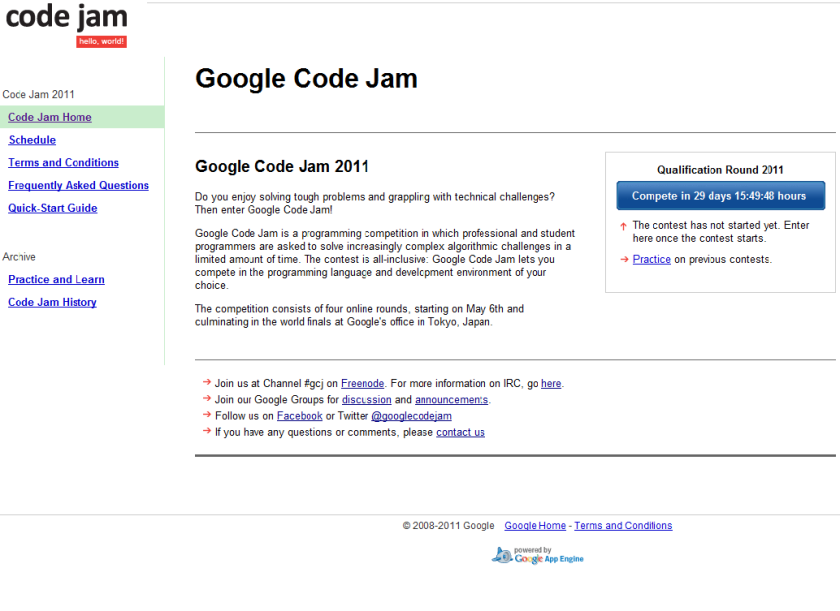
So you think you can code- here is a contest for All – programmers AND students AND professionals
Check the enthralling competition yourself at https://code.google.com/codejam
On September 28th, 2010, The Document Foundation was announced. The last six months, it feels, have just passed within a short glimpse of time. Not only did we release three LibreOffice versions within three months, have created the LibreOffice-Box DVD image, and brought LibreOffice Portable on its way. We also have announced the LibreOffice Conference for October 2011 and have taken part in lots of events worldwide, with FOSDEM and CeBIT being the most prominent ones.
People follow us at Twitter, Identi.ca, XING, LinkedIn and a Facebook group and fan page, they discuss on our mailing lists with more than 6.000 subscriptions, collaborate in our wiki, get insight on our daily work in our blog, and post and blog themselves. From the very first day, openness, transparency and meritocracy have been shaping the framework we want to work in. Our discussions and decisions take place on a public mailing list, and regularly, we hold phone conferences for the Steering Committee and for the marketing teams, where everyone is invited to join. Our ideas and visions have made their way into our Next Decade Manifesto.
We have joined the Open Invention Network as well as the OpenDoc Society, and just last week have become an SPI-associated project, and we see a wide range of support from all over the world. Not only do Novell and Red Hat support our efforts with developers, but just recently, Canonical, creators of Ubuntu, joined as well. All major Linux distributions deliver LibreOffice with their operating systems, and more follow every day.
One of the most stunning contributions, that still leaves us speechless, is the support that we receive from the community. When we asked for 50,000 € capital stock for a German-based foundation, the community showed their support, appreciation and their power, and not only donated it in just eight days, but up to now has supported us with close to 100,000 €! Another one is that driven by our open, vendor neutral approach, combined with our easy hacks, we have included code contributions from over 150 entirely new developers to the project, alongside localisations from over 50 localizers. The community has developed itself better than we could ever dream of, and first meetings like the project’s weekend or the QA meeting of the Germanophone group are already being organized.
What we have seen now is just the beginning of something very big. The Document Foundation has a vision, and the creation of the foundation in Germany is about to happen soon. LibreOffice has been downloaded over 350,000 times within the first week, and we just counted more than 1,3 million downloads just from our download system — not counting packages directly delivered by Linux distributors, other download sites or DVDs included in magazines and newspapers — supported by 65 mirrors from all over the world, and millions already use and contribute to it worldwide. With our participation in the Google Summer of Code, we will engage more students and young developers to be part of our community. Our improved release schedule will ensure that new features and improvements will make their way to end-users soon, and for testers, we even provide daily builds.
We are so excited by what has been achieved over the last six months, and we are immensely grateful to all those who have supported the project in whatever ways they can. It is an honour to be working with you, to be part of one united community! The future as we are shaping it has just begun, and it will be bright and excellent.
from-
List archive: http://listarchives.documentfoundation.org/www/announce/
I have not been really posting or writing worthwhile on the website for some time, as I am still busy writing ” R for Business Analytics” which I hope to get out before year end. However while doing research for that, I came across many types of graphs and what struck me is the actual usage of some kinds of graphs is very different in business analytics as compared to statistical computing.
The criterion of top ten graphs is as follows-
1) Usage-The order in which they appear is not strictly in terms of desirability but actual frequency of usage. So a frequently used graph like box plot would be recommended above say a violin plot.
2) Adequacy- Data Visualization paradigms change over time- but the need for accurate conveying of maximum information in a minium space without overwhelming reader or misleading data perceptions.
3) Ease of creation- A simpler graph created by a single function is more preferrable to writing 4-5 lines of code to create an elaborate graph.
4) Aesthetics– Aesthetics is relative and in addition studies have shown visual perception varies across cultures and geographies. However , beauty is universally appreciated and a pretty graph is sometimes and often preferred over a not so pretty graph. Here being pretty is in both visual appeal without compromising perceptual inference from graphical analysis.
so When do we use a bar chart versus a line graph versus a pie chart? When is a mosaic plot more handy and when should histograms be used with density plots? The list tries to capture most of these practicalities.
Let me elaborate on some specific graphs-
1) Pie Chart- While Pie Chart is not really used much in stats computing, and indeed it is considered a misleading example of data visualization especially the skewed or two dimensional charts. However when it comes to evaluating market share at a particular instance, a pie chart is simple to understand. At the most two pie charts are needed for comparing two different snapshots, but three or more pie charts on same data at different points of time is definitely a bad case.
In R you can create piechart, by just using pie(dataset$variable)
As per official documentation, pie charts are not recommended at all.
http://stat.ethz.ch/R-manual/R-patched/library/graphics/html/pie.html
Pie charts are a very bad way of displaying information. The eye is good at judging linear measures and bad at judging relative areas. A bar chart or dot chart is a preferable way of displaying this type of data.
Cleveland (1985), page 264: “Data that can be shown by pie charts always can be shown by a dot chart. This means that judgements of position along a common scale can be made instead of the less accurate angle judgements.” This statement is based on the empirical investigations of Cleveland and McGill as well as investigations by perceptual psychologists.
—-
Despite this, pie charts are frequently used as an important metric they inevitably convey is market share. Market share remains an important analytical metric for business.
The pie3D( ) function in the plotrix package provides 3D exploded pie charts.An exploded pie chart remains a very commonly used (or misused) chart.
From http://lilt.ilstu.edu/jpda/charts/chart%20tips/Chartstip%202.htm#Rules
we see some rules for using Pie charts.
|
From the R Graph Gallery (a slightly outdated but still very comprehensive graphical repository)
http://addictedtor.free.fr/graphiques/RGraphGallery.php?graph=4
par(bg="gray")
pie(rep(1,24), col=rainbow(24), radius=0.9)
title(main="Color Wheel", cex.main=1.4, font.main=3)
title(xlab="(test)", cex.lab=0.8, font.lab=3)
(Note adding a grey background is quite easy in the basic graphics device as well without using an advanced graphical package)


