Ubuntu one goes musical

Heavenly choirs singing? Not quite, but music streaming on a cloudy platform seems like a pretty cool thing.-

readhttp://voices.canonical.com/ubuntuone/?p=617

:

Ubuntu One Basic – available now
This is the same as the current free 2 GB option but with a new name. Users can continue to sync files, contacts, bookmarks and notes for free as part of our basic service and access the integrated Ubuntu One Music Store. We are also extending our platform support to include a Windows client, which will be available in Beta very soon.

Ubuntu One Mobile – available October 7th
Ubuntu One Mobile is our first example of a service that helps you do more with the content stored in your personal cloud. With Ubuntu One Mobile’s main feature – mobile music streaming – users can listen to any MP3 songs in their personal cloud (any owned MP3s, not just those purchased from the Ubuntu One Music Store) using our custom developed apps for iPhone and Android (coming soon to their respective marketplaces). These will be open source and available from Launchpad. Ubuntu One Mobile will also include the mobile contacts sync feature that was launched in Beta for the 10.04 release.

Ubuntu One Mobile is available for $3.99 (USD) per month or $39.99 (USD) per year. Users interested in this add-on can try the service free for 30 days. Ubuntu One Mobile will be the perfect companion to your morning exercise, daily commute, and weekend at the beach – we’re really excited to bring you this service!

Ubuntu One 20-Packs – available now
A 20-Pack is 20 GB of storage for files, contacts, notes, and bookmarks. Users will be able to add multiple 20-Packs at $2.99 (USD) per month or $29.99 (USD) per year each. If you start with Ubuntu One Basic (2 GB) and add 1 20-Pack (20 GB), you will have 22 GB of storage.

All add-ons are available for purchase in multiple currencies – USD, EUR and, recently added, GBP.

Users currently paying for the old 50 GB plan (including mobile contacts sync) can either keep their existing service or switch to the new plans structure to get more value from Ubuntu One at a lower price.

Sector/ Sphere – Faster than Hadoop/Mapreduce at Terasort

Here is a preview of a relatively young software Sector and Sphere- which are claimed to be better than Hadoop /MapReduce at TeraSort Benchmark among others.

http://sector.sourceforge.net/tech.html

System Overview

The Sector/Sphere stack consists of the Sector distributed file system and the Sphere parallel data processing framework. The objective is to support highly effective and efficient large data storage and processing over commodity computer clusters.

Sector/Sphere Architecture

Sector consists of 4 parts, as shown in the above diagram. The Security server maintains the system security configurations such as user accounts, data IO permissions, and IP access control lists. The master servers maintain file system metadata, schedule jobs, and respond users’ requests. Sector supports multiple active masters that can join and leave at run time and they all actively respond users’ requests. The slave nodes are racks of computers that store and process data. The slaves nodes can be located within a single data center to across multiple data centers with high speed network connections. Finally, the client includes tools and programming APIs to access and process Sector data.

Sphere: Parallel Data Processing Framework

Sphere allows developers to write parallel data processing applications with a very simple set of API. It applies user-defined functions (UDF) on all input data segments in parallel. In a Sphere application, both inputs and outputs are Sector files. Multiple Sphere processing can be combined to support more complicated applications, with inputs/outputs exchanged/shared via the Sector file system.

Data segments are processed at their storage locations whenever possible (data locality). Failed data segments may be restarted on other nodes to achieve fault tolerance.

The Sphere framework can be compared to MapReduce as they both enforce data locality and provide simplified programming interfaces. In fact, Sphere can simulate any MapReduce operations, but Sphere is more efficient and flexible. Sphere can provide better data locality for applications that process files or multiple files as minimum input units and for applications that involve with iterative/combinative processing, which requires coordination of multiple UDFs to obtain the final result.

A Sphere application includes two parts: the client program that organizes inputs (including certain parameters), outputs, and UDFs; and the UDFs that process data segments. Data segmentation, load balancing, and fault tolerance are transparent to developers.

Space: Column-based Distbuted Data Table

Space stores data tables in Sector and uses Sphere for parallel query processing. Space is similar to BigTable. Table is stored by columns and is segmented on to multiple slave nodes. Tables are independent and no relationship between tables are supported. A reduced set of SQL operations is supported, including but not limited to table creation and modification, key-value update and lookup, and select operations based on UDF.

Supported by the Sector data placement mechanism and the Sphere parallel processing framework, Space can support efficient key-value lookup and certain SQL queries on very large data tables.

Space is currently still in development.

and just when you thought Hadoop was the only way to be on the cloud.

http://sector.sourceforge.net/benchmark.html

The Terasort Benchmark

The table below lists the performance (total processing time in seconds) of the Terasort benchmark of both Sphere and Hadoop. (Terasort benchmark: suppose there are N nodes in the system, the benchmark generates a 10GB file on each node and sorts the total N*10GB data. Data generation time is excluded.) Note that it is normal to see a longer processing time for more nodes because the total amount of data also increases proportionally.

The performance value listed in this page was achieved using the Open Cloud Testbed. Currently the testbed consists of 4 racks. Each rack has 32 nodes, including 1 NFS server, 1 head node, and 30 compute/slave nodes. The head node is a Dell 1950, dual dual-core Xeon 3.0GHz, 16GB RAM. The compute nodes are Dell 1435s, single dual core AMD Opteron 2.0GHz, 4GB RAM, and 1TB single disk. The 4 racks are located in JHU (Baltimore), StarLight (Chicago), UIC (Chicago), and Calit2(San Diego). The inter-rack bandwidth is 10GE, supported by CiscoWave deployed over National Lambda Rail.

Sphere
Hadoop (3 replicas)
Hadoop (1 replica)
UIC
1265 2889 2252
UIC + StarLight
1361 2896 2617
UIC + StarLight + Calit2
1430 4341 3069
UIC + StarLight + Calit2 + JHU
1526 6675 3702

The benchmark uses the testfs/testdc examples of Sphere and randomwriter/sort examples of Hadoop. Hadoop parameters were tuned to reach good results.

Updated on Sep. 22, 2009: We have benchmarked the most recent versions of Sector/Sphere (1.24a) and Hadoop (0.20.1) on a new set of servers. Each server node costs $2,200 and consits of a single Intel Xeon E5410 2.4GHz CPU, 16GB RAM, 4*1TB RAID0 disk, and 1Gb/s NIC. The 120 nodes are hosted on 4 racks within the same data center and the inter-rack bandwidth is 20Gb/s.

The table below lists the performance of sorting 1TB data using Sector/Sphere version 1.24a and Hadoop 0.20.1. Related Hadoop parameters have been tuned for better performance (e.g., big block size), while Sector/Sphere does not require tuning. In addition, to achieve the highest performance, replication is disabled in both systems (note that replication does not afftect the performance of Sphere but will significantly decrease the performance of Hadoop).

Number of Racks
Sphere
Hadoop
1
28m 25s 85m 49s
2
15m 20s 37m 0s
3
10m 19s 25m 14s
4
7m 56s 17m 45s

Windows Azure vs Amazon EC2 (and Google Storage)

Here is a comparison of Windows Azure instances vs Amazon compute instances

Compute Instance Sizes:

Developers have the ability to choose the size of VMs to run their application based on the applications resource requirements. Windows Azure compute instances come in four unique sizes to enable complex applications and workloads.

Compute Instance Size CPU Memory Instance Storage I/O Performance
Small 1.6 GHz 1.75 GB 225 GB Moderate
Medium 2 x 1.6 GHz 3.5 GB 490 GB High
Large 4 x 1.6 GHz 7 GB 1,000 GB High
Extra large 8 x 1.6 GHz 14 GB 2,040 GB High

Standard Rates:

Windows Azure

  • Compute
    • Small instance (default): $0.12 per hour
    • Medium instance: $0.24 per hour
    • Large instance: $0.48 per hour
    • Extra large instance: $0.96 per hour
  • Storage
    • $0.15 per GB stored per month
    • $0.01 per 10,000 storage transactions
  • Content Delivery Network (CDN)
    • $0.15 per GB for data transfers from European and North American locations*
    • $0.20 per GB for data transfers from other locations*
    • $0.01 per 10,000 transactions*

Source –

http://www.microsoft.com/windowsazure/offers/popup/popup.aspx?lang=en&locale=en-US&offer=MS-AZR-0001P

and

http://www.microsoft.com/windowsazure/windowsazure/

Amazon EC2 has more options though——————————-

http://aws.amazon.com/ec2/pricing/

Standard On-Demand Instances Linux/UNIX Usage Windows Usage
Small (Default) $0.085 per hour $0.12 per hour
Large $0.34 per hour $0.48 per hour
Extra Large $0.68 per hour $0.96 per hour
Micro On-Demand Instances Linux/UNIX Usage Windows Usage
Micro $0.02 per hour $0.03 per hour
High-Memory On-Demand Instances
Extra Large $0.50 per hour $0.62 per hour
Double Extra Large $1.00 per hour $1.24 per hour
Quadruple Extra Large $2.00 per hour $2.48 per hour
High-CPU On-Demand Instances
Medium $0.17 per hour $0.29 per hour
Extra Large $0.68 per hour $1.16 per hour
Cluster Compute Instances
Quadruple Extra Large $1.60 per hour N/A*
* Windows is not currently available for Cluster Compute Instances.

http://aws.amazon.com/ec2/instance-types/

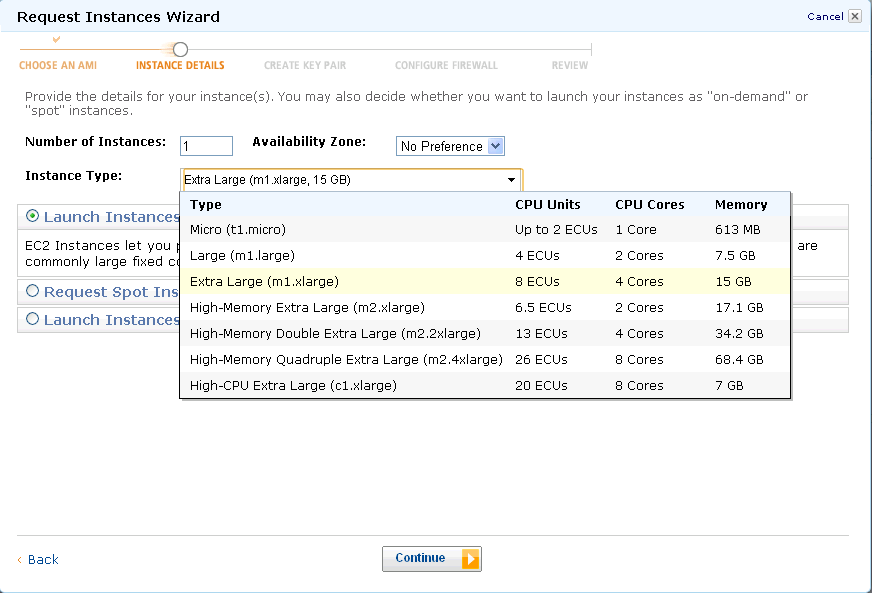
Standard Instances

Instances of this family are well suited for most applications.

Small Instance – default*

1.7 GB memory
1 EC2 Compute Unit (1 virtual core with 1 EC2 Compute Unit)
160 GB instance storage (150 GB plus 10 GB root partition)
32-bit platform
I/O Performance: Moderate
API name: m1.small

Large Instance

7.5 GB memory
4 EC2 Compute Units (2 virtual cores with 2 EC2 Compute Units each)
850 GB instance storage (2×420 GB plus 10 GB root partition)
64-bit platform
I/O Performance: High
API name: m1.large

Extra Large Instance

15 GB memory
8 EC2 Compute Units (4 virtual cores with 2 EC2 Compute Units each)
1,690 GB instance storage (4×420 GB plus 10 GB root partition)
64-bit platform
I/O Performance: High
API name: m1.xlarge

Micro Instances

Instances of this family provide a small amount of consistent CPU resources and allow you to burst CPUcapacity when additional cycles are available. They are well suited for lower throughput applications and web sites that consume significant compute cycles periodically.

Micro Instance

613 MB memory
Up to 2 EC2 Compute Units (for short periodic bursts)
EBS storage only
32-bit or 64-bit platform
I/O Performance: Low
API name: t1.micro

High-Memory Instances

Instances of this family offer large memory sizes for high throughput applications, including database and memory caching applications.

High-Memory Extra Large Instance

17.1 GB of memory
6.5 EC2 Compute Units (2 virtual cores with 3.25 EC2 Compute Units each)
420 GB of instance storage
64-bit platform
I/O Performance: Moderate
API name: m2.xlarge

High-Memory Double Extra Large Instance

34.2 GB of memory
13 EC2 Compute Units (4 virtual cores with 3.25 EC2 Compute Units each)
850 GB of instance storage
64-bit platform
I/O Performance: High
API name: m2.2xlarge

High-Memory Quadruple Extra Large Instance

68.4 GB of memory
26 EC2 Compute Units (8 virtual cores with 3.25 EC2 Compute Units each)
1690 GB of instance storage
64-bit platform
I/O Performance: High
API name: m2.4xlarge

High-CPU Instances

Instances of this family have proportionally more CPU resources than memory (RAM) and are well suited for compute-intensive applications.

High-CPU Medium Instance

1.7 GB of memory
5 EC2 Compute Units (2 virtual cores with 2.5 EC2 Compute Units each)
350 GB of instance storage
32-bit platform
I/O Performance: Moderate
API name: c1.medium

High-CPU Extra Large Instance

7 GB of memory
20 EC2 Compute Units (8 virtual cores with 2.5 EC2 Compute Units each)
1690 GB of instance storage
64-bit platform
I/O Performance: High
API name: c1.xlarge

Cluster Compute Instances

Instances of this family provide proportionally high CPU resources with increased network performance and are well suited for High Performance Compute (HPC) applications and other demanding network-bound applications. Learn more about use of this instance type for HPC applications.

Cluster Compute Quadruple Extra Large Instance

23 GB of memory
33.5 EC2 Compute Units (2 x Intel Xeon X5570, quad-core “Nehalem” architecture)
1690 GB of instance storage
64-bit platform
I/O Performance: Very High (10 Gigabit Ethernet)
API name: cc1.4xlarge

Also http://www.microsoft.com/en-us/sqlazure/default.aspx

offers SQL Databases as a service with a free trial offer

If you are into .Net /SQL big time or too dependent on MS, Azure is a nice option to EC2 http://www.microsoft.com/windowsazure/offers/popup/popup.aspx?lang=en&locale=en-US&offer=COMPARE_PUBLIC

Updated- I just got approved for Google Storage so am adding their info- though they are in Preview (and its free right now) 🙂

https://code.google.com/apis/storage/docs/overview.html

Functionality

Google Storage for Developers offers a rich set of features and capabilities:

Basic Operations

  • Store and access data from anywhere on the Internet.
  • Range-gets for large objects.
  • Manage metadata.

Security and Sharing

  • User authentication using secret keys or Google account.
  • Authenticated downloads from a web browser for Google account holders.
  • Secure access using SSL.
  • Easy, powerful sharing and collaboration via ACLs for individuals and groups.

Performance and scalability

  • Up to 100 gigabytes per object and 1,000 buckets per account during the preview.
  • Strong data consistency—read-after-write consistency for all upload and delete operations.
  • Namespace for your domain—only you can create bucket URIs containing your domain name.
  • Data replicated in multiple data centers across the U.S. and within the same data center.

Tools

  • Web-based storage manager.
  • GSUtil, an open source command line tool.
  • Compatible with many existing cloud storage tools and libraries.

Read the Getting Started Guide to learn more about the service.

Note: Google Storage for Developers does not support Google Apps accounts that use your company domain name at this time.

Back to top

Pricing

Google Storage for Developers pricing is based on usage.

  • Storage—$0.17/gigabyte/month
  • Network
    • Upload data to Google
      • $0.10/gigabyte
    • Download data from Google
      • $0.15/gigabyte for Americas and EMEA
      • $0.30/gigabyte for Asia-Pacific
  • Requests
    • PUT, POST, LIST—$0.01 per 1,000 requests
    • GET, HEAD—$0.01 per 10,000 requests

AsterData releases nCluster 4.6

From the press release

Aster Data nCluster 4.6, which includes a column data store, making Aster Data nCluster 4.6 the first platform with a unified SQL-MapReduce analytic framework on a hybrid row and column massively parallel processing (MPP) database management system (DBMS). The unified SQL-MapReduce analytic framework and Aster Data’s suite of 1000+ MapReduce-ready analytic functions, delivers a substantial breakthrough in richer, high performance analytics on large data volumes where data can be stored in either a row or column format.

With Aster Data nCluster 4.6, customers can choose the data format best suited to their needs and benefit from the power of Aster Data’s SQL-MapReduce analytic capabilities, providing maximum query performance by leveraging row-only, column-only, or hybrid storage strategies. Aster Data makes selection of the appropriate storage strategy easy with the new Data Model Express tool that determines the optimal data model based on a customer’s query workloads.  Both row and column stores in Aster Data nCluster 4.6 benefit from platform-level services including Online Precision Scaling™ on commodity hardware, dynamic workload management, and always-on availability, all of which now operate on both row and column stores. All 1000+ MapReduce-ready analytic functions released previously through Aster Data Analytic Foundation — a powerful suite of pre-built MapReduce analytic software building blocks — now run on a hybrid row and column architecture.  Aster Data nCluster 4.6 also includes new pre-built analytic functions, including decision trees and histograms. For custom analytic application development, the Aster Data IDE, Aster Data Developer Express, also fully and seamlessly supports the hybrid row and column store in Aster DatanCluster 4.6.

More advanced analytics infrastructure.

Big Data Management and Advanced Analytics

Here is a new list for the top 10 considerations for Big Data Management and using Advanced Analytics -courtesy AsterData.

Source-

http://www.asterdata.com/wp_10_considerations/index.php?ref=decisionstats

“There are ten strong reasons why competitive organizations are turning to new data management solutions to handle their growing data volumes and evolving analytic needs. This new platform – a ‘data-analytics server’ – merges data storage and data analytics into one single system to conquer the big data challenge.

Big data storage is handled by a massively parallel database architecture; big data analytics is handled by an integrated analytics engine, so that analytics run fully in-database yielding ultra high performance on large data sets. The analytics engine leverages the powerful analytics framework MapReduce. The results are cost-effective, scalable data storage, ultra high performance and richer data analysis.”

Major considerations include:
Cost-effective, scalable data management – what are the requirements?
Advanced analytic queries – what’s meant by advanced analytics & how easy is it?
Running rich, diverse workloads – key factors for high concurrency & performance

Aster Data hires Quentin Gallivan as CEO

AsterData formally marked phase 2 of it’s rapid growth story by getting as new CEO Quentin Gallivan (of Postini before it was sold to Google and also Pivotlink).

Founders (and Stanfordians) Mayan Bawa stays as Chief Customer Officer and Tasso Argyros as CTO. It has a very deja vu feel -like Eric Schmidt coming in CEO of Google in the glory days past.  Indeed the investment team in Google and AsterData is quite similar and so are the backgrounds of the founders.

AsterData of course creates the leading MapReduce (also created by Google) solution for providing BI infrastructure for big data and has been rapidly been expanding into new frontiers for Big Data.

Aster Data Appoints New Chief Executive Officer

Quentin Gallivan Joins Aster Data as CEO to Lead Company to Next Level of Growth

San Carlos, CA – September 9, 2010– Aster Data, a proven leader dedicated to providing the best data management and data processing platform for big data management and analytics, today announced the appointment of Quentin Gallivan as President and CEO. Gallivan brings more than 20 years of senior executive experience to the leading analytics and database company. With Aster Data achieving tremendous growth in the past year, Gallivan will take Aster Data to the next level, further accelerating its market leadership, sales, channel partnerships and international expansion.  Founding CEO Mayank Bawa, who grew the company from its inception based on the founders’ research at Stanford University, and whose passion for helping customers uniquely unlock the value of their data, will take on the role of Chief Customer Officer.  Bawa, in his new role, will lead the Company’s organization devoted to ensuring the success, longevity and innovation of its fast-growing customer base. Together, Gallivan and Bawa, along with co-founder and Chief Technology Officer, Tasso Argyros, will deliver on the the Company’s mission to help customers discover more value from their data, achieve deep insights through rich analytics and do more with their massive data volumes than has ever been possible.

Gallivan joins Aster Data with over 20 years of leadership experience in the high-tech industry and has held a variety of CEO and senior executive positions with leading technology companies. Before joining Aster Data, Gallivan served as CEO at PivotLink, the leading provider of business intelligence (BI) solutions delivered via Software as a Service (SaaS), where he rapidly grew the company to over 15,000 business users, from mid-sized companies to Fortune 1000 companies, across key industries including financial services, retail, CPG manufacturing and high technology. Prior to Pivotlink, Gallivan served as CEO of Postini where he scaled the company to 35,000 customers and over 10 million users until its eventual acquisition by Google in 2007.  Gallivan also served as executive vice president of worldwide sales and services at VeriSign where he was instrumental in growing the business from $20 million to $1.2 billion and was responsible for the design and execution of the global distribution strategy for the company’s security and services business. Gallivan also held a number of key executive and leadership positions at Netscape Communications and GE Information Services.

“We are delighted to have someone of Quentin’s caliber, who is a veteran of both emerging and established technology companies, lead Aster Data through our next stage of growth,” said Mayank Bawa, Chief Customer Officer and co-founder, Aster Data. “His significant experience around growing organizations and driving operational excellence will be invaluable as he takes Aster Data forward. I’m excited to shift my focus to customers and their success; to bring our innovations to our customers worldwide to help them unlock deep value from their growing data volumes.”

“I am very excited to be joining Aster Data and taking on the challenge of augmenting its already impressive level of growth and success.  Aster Data is very well respected and established in the marketplace, has an enviable solution for big data management that uniquely addresses both big data storage and data processing, an impressive client list and a very talented team,” said Quentin Gallivan, President and CEO, Aster Data. “My task will be to leverage these assets, help shape a new market and provide operational guidance and strategic direction to drive even greater value for shareholders, customers and employees alike.”