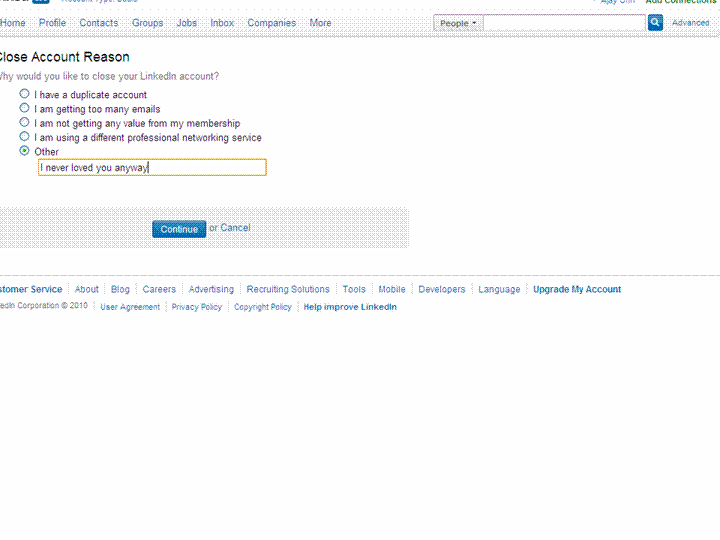
Why social media is an one way street- cant close accounts

Update to https://decisionstats.com/2010/11/24/deleting-twitter-facebooklinkedin-accepting-life/

You cant DELETE a Facebook Account- it gets deactivated NOT DELETED.

You have to delete photo albums one by one, but if you have a folder like profile photos or wall photos or mobile uploads  (you cant delete these folders you have to delete those photos one by one)

So I had to delete 1100 friends, delete all Facebook Pages I created, and then download the account- (photos) which were now a more easy to download zip file of 92 mb. And I deleted all the 250+ Likes I had given to things I had flippantly liked- it was horrifying because if you accumulate all that info- it basically gives you a big lead in estimating my psychological profile- and thats not stuff I want to be used for selling.

Then I deactivated it- no like Lord Voldermort’s horcruxes you cant delete it all.

and Facebook shows you ads even if you clean your profile and your friends and can longer see any preference for any product.

Facebook treats data like prisoners – even if you are released they WILL maintain your record.

20 years later they would be able to blackmail all the people  of all countries in the WORLD- by that much info.

And Linkedin is still getting deleted- I got this email from them-

basically if you have an active group for whom you are the only owner you cant delete yourself- you have to delete the group or find another owner.

Sigh!

If it took me 2 days to download all my info, and wipe my social media for just 3 yrs of using it (albiet at an expert enough level to act as a social media consultant to some companies)- I am not sure what today’s generation of young people who jump to twitter and Facebook at early ages would face after say 5-10 years of data is collected on them. Lots of Ads I guess!

Brief Interview with James G Kobielus

Here is a brief one question interview with James Kobielus, Senior Analyst, Forrester.

Ajay-Describe the five most important events in Predictive Analytics you saw in 2010 and the top three trends in 2011 as per you.

Jim-

Five most important developments in 2010:

  • Continued emergence of enterprise-grade Hadoop solutions as the core of the future cloud-based platforms for advanced analytics
  • Development of the market for analytic solution appliances that incorporate several key features for advanced analytics: massively parallel EDW appliance, in-database analytics and data management function processing, embedded statistical libraries, prebuilt logical domain models, and integrated modeling and mining tools
  • Integration of advanced analytics into core BI platforms with user-friendly, visual, wizard-driven, tools for quick, exploratory predictive modeling, forecasting, and what-if analysis by nontechnical business users
  • Convergence of predictive analytics, data mining, content analytics, and CEP in integrated tools geared  to real-time social media analytics
  • Emergence of CRM and other line-of-business applications that support continuously optimized “next-best action” business processes through embedding of predictive models, orchestration engines, business rules engines, and CEP agility

Three top trends I see in the coming year, above and beyond deepening and adoption of the above-bulleted developments:

  • All-in-memory, massively parallel analytic architectures will begin to gain a foothold in complex EDW environments in support of real-time elastic analytics
  • Further crystallization of a market for general-purpose “recommendation engines” that, operating inline to EDWs, CEP environments, and BPM platforms, enable “next-best action” approaches to emerge from today’s application siloes
  • Incorporation of social network analysis functionality into a wider range of front-office business processes to enable fine-tuned behavioral-based customer segmentation to drive CRM optimization

About –http://www.forrester.com/rb/analyst/james_kobielus

James G. Kobielus
Senior Analyst, Forrester Research

RESEARCH FOCUS

James serves Business Process & Applications professionals. He is a leading expert on data warehousing, predictive analytics, data mining, and complex event processing. In addition to his core coverage areas, James contributes to Forrester’s research in business intelligence, data integration, data quality, and master data management.

PREVIOUS WORK EXPERIENCE

James has a long history in IT research and consulting and has worked for both vendors and research firms. Most recently, he was at Current Analysis, an IT research firm, where he was a principal analyst covering topics ranging from data warehousing to data integration and the Semantic Web. Prior to that position, James was a senior technical systems analyst at Exostar (a hosted supply chain management and eBusiness hub for the aerospace and defense industry). In this capacity, James was responsible for identifying and specifying product/service requirements for federated identity, PKI, and other products. He also worked as an analyst for the Burton Group and was previously employed by LCC International, DynCorp, ADEENA, International Center for Information Technologies, and the North American Telecommunications Association. He is both well versed and experienced in product and market assessments. James is a widely published business/technology author and has spoken at many industry events

Interview Jamie Nunnelly NISS

An interview with Jamie Nunnelly, Communications Director of National Institute of Statistical Sciences
Ajay– What does NISS do? And What does SAMSI do?

Jamie– The National Institute of Statistical Sciences (NISS) was established in 1990 by the national statistics societies and the Research Triangle universities and organizations, with the mission to identify, catalyze and foster high-impact, cross-disciplinary and cross-sector research involving the statistical sciences.

NISS is dedicated to strengthening and serving the national statistics community, most notably by catalyzing community members’ participation in applied research driven by challenges facing government and industry. NISS also provides career development opportunities for statisticians and scientists, especially those in the formative stages of their careers.

The Institute identifies emerging issues to which members of the statistics community can make key contributions, and then catalyzes the right combinations of researchers from multiple disciplines and sectors to tackle each problem. More than 300 researchers from over 100 institutions have worked on our projects.

The Statistical and Applied Mathematical Sciences Institute (SAMSI) is a partnership of Duke University,  North Carolina State University, The University of North Carolina at Chapel Hill, and NISS in collaboration with the William Kenan Jr. Institute for Engineering, Technology and Science and is part of the Mathematical Sciences Institutes of the NSF.

SAMSI focuses on 1-2 programs of research interest in the statistical and/or applied mathematical area and visitors from around the world are involved with the programs and come from a variety of disciplines in addition to mathematics and statistics.

Many come to SAMSI to attend workshops, and also participate in working groups throughout the academic year. Many of the working groups communicate via WebEx so people can be involved with the research remotely. SAMSI also has a robust education and outreach program to help undergraduate and graduate students learn about cutting edge research in applied mathematics and statistics.

Ajay– What successes have you had in 2010- and what do you need to succeed in 2011. Whats planned for 2011 anyway

Jamie– NISS has had a very successful collaboration with the National Agricultural Statistical Service (NASS) over the past two years that was just renewed for the next two years. NISS & NASS had three teams consisting of a faculty researcher in statistics, a NASS researcher, a NISS mentor, a postdoctoral fellow and a graduate student working on statistical modeling and other areas of research for NASS.

NISS is also working on a syndromic surveillance project with Clemson University, Duke University, The University of Georgia, The University of South Carolina. The group is currently working with some hospitals to test out a model they have been developing to help predict disease outbreak.

SAMSI had a very successful year with two programs ending this past summer, which were the Stochastic Dynamics program and the Space-time Analysis for Environmental Mapping, Epidemiology and Climate Change. Several papers were written and published and many presentations have been made at various conferences around the world regarding the work that was conducted as SAMSI last year.

Next year’s program is so big that the institute has decided to devote all it’s time and energy around it, which is uncertainty quantification. The opening workshop, in addition to the main methodological theme, will be broken down into three areas of interest under this broad umbrella of research: climate change, engineering and renewable energy, and geosciences.

Ajay– Describe your career in science and communication.

Jamie– I have been in communications since 1985, working for large Fortune 500 companies such as General Motors and Tropicana Products. I moved to the Research Triangle region of North Carolina after graduate school and got into economic development and science communications first working for the Research Triangle Regional Partnership in 1994.

From 1996-2005 I was the communications director for the Research Triangle Park, working for the Research Triangle Foundation of NC. I published a quarterly magazine called The Park Guide for awhile, then came to work for NISS and SAMSI in 2008.

I really enjoy working with the mathematicians and statisticians. I always joke that I am the least educated person working here and that is not far from the truth! I am honored to help get the message out about all of the important research that is conducted here each day that is helping to improve the lives of so many people out there.

Ajay– Research Triangle or Silicon Valley– Which is better for tech people and why? Your opinion

Jamie– Both the Silicon Valley and Research Triangle are great regions for tech people to locate, but of course, I have to be biased and choose Research Triangle!

Really any place in the world that you find many universities working together with businesses and government, you have an area that will grow and thrive, because the collaborations help all of us generate new ideas, many of which blossom into new businesses, or new endeavors of research.

The quality of life in places such as the Research Triangle is great because you have people from around the world moving to a place, each bringing his/her culture, food, and uniqueness to this place, and enriching everyone else as a result.

Two advantages the Research Triangle has over Silicon Valley are that the Research Triangle has a bigger diversity of industries, so when the telecommunications industry busted back in 2001-02, the region took a hit, but the biotechnology industry was still growing, so unemployment rose, but not to the extent that other areas might have experienced.

The latest recession has hit us all very hard, so even this strategy has not made us immune to having high unemployment, but the Research Triangle region has been pegged by experts to be one of the first regions to emerge out of the Great Recession.

The other advantage I think we have is that our cost of living is still much more reasonable than Silicon Valley. It’s still possible to get a nice sized home, some land and not break the bank!

Ajay– How do you manage an active online social media presence, your job and your family. How important is balance in professional life and when young professional should realize this?

Jamie– Balance is everything, isn’t it? When I leave the office, I turn off my iPhone and disconnect from Twitter/Facebook etc.

I know that is not recommended by some folks, but I am a one person communications department and I love my family and friends and feel its important to devote time to them as well as to my career.

I think it is very important for young people to establish this early in their careers because if they don’t they will fall victim to working way too many hours and really, who loves you at the end of the day?

Your company may appreciate all you do for them, but if you leave, or you get sick and cannot work for them, you will be replaced

. Lee Iacocca, former CEO of Chrystler, said, “No matter what you’ve done for yourself or for humanity, if you can’t look back on having given love and attention to your own family, what have you really accomplished?” I think that is what is really most important in life.

About-

Jamie Nunnelly has been in communications for 25 years. She is currently on the board of directors for Chatham County Economic Development Corporation and Leadership Triangle & is a member of the International Association of Business Communicators and the Public Relations Society of America. She earned a bachelor’s degree in interpersonal and public communications at Bowling Green State University and a master’s degree in mass communications at the University of South Florida.

You can contact Jamie at http://niss.org/content/jamie-nunnelly or on twitter at

STEM is cool

Lady Gaga holding a speech at National Equalit...
Image via Wikipedia

A good video created by my favorite social media people from a company in North Carolina.

STEM is cool (Science Technology Engineering Maths?)

No, Science is not kool aid- it is just COOL. and better paying than watching Justin Bieber or Lady Gaga videos. Get those lazy teenagers out of Glee clubs and back into Science clubs.

The video itself-

Disclaimer- I have no direct or indirect  financial relationship with the creators of this video. I think it is cool people express creativity in positive ways to help their favorite software,company, and even the world. Blah Blah Blah 🙂

Yeah, STEM is cool again.


Quantifying Analytics ROI

Japanese House Crest “Go-Shichi no Kiri”
Image via Wikipedia

I had a brief twitter exchange with Jim Davis, Chief Marketing Officer, SAS Institute on Return of Investment on Business Analytics Projects for customers. I have interviewed Jim Davis before last year https://decisionstats.com/2009/06/05/interview-jim-davis-sas-institute/

Now Jim Davis is a big guy, and he is rushing from the launch of SAS Institute’s Social Media Analytics in Japan- to some arguably difficult flying conditions in time to be home in America for Thanksgiving. That and and I have not been much of a good Blog Boy recently, more swayed by love of open source, than love of software per se. I love equally, given I am bad at both equally.

Anyways, Jim’s contention  ( http://twitter.com/Davis_Jim ) was customers should go in business analytics only if there is Positive Return on Investment.  I am quoting him here-

What is important is that there be a positive ROI on each and every BA project. Otherwise don’t do it.

That’s not the marketing I was taught in my business school- basically it was sell, sell, sell.

However I see most BI sales vendors also go through -let me meet my sales quota for this quarter- and quantifying customer ROI is simple maths than predictive analytics but there seems to be some information assymetry in it.

Here is a paper from North Western University on ROI in IT projects-.

but overall it would be in the interest of customers and Business Analytics Vendors to publish aggregated ROI.

The opponents to this transparency in ROI would be market leaders in market share, who have trapped their customers by high migration costs (due to complexity) or contractually.

A recent study listed Oracle having a large percentage of unhappy customers who would still renew!, SAP had problems when it raised prices for licensing arbitrarily (that CEO is now CEO of HP and dodging legal notices from Oracle).

Indeed Jim Davis’s famous unsettling call for focusing on Business Analytics,as Business Intelligence is dead- that call has been implemented more aggressively by IBM in analytical acquisitions than even SAS itself which has been conservative about inorganic growth. Quantifying ROI, should theoretically aid open source software the most (since they are cheapest in up front licensing) or newer technologies like MapReduce /Hadoop (since they are quite so fast)- but I think that market has a way of factoring in these things- and customers are not as foolish neither as unaware of costs versus benefits of migration.

The contrary to this is Business Analytics and Business Intelligence are imperfect markets with duo-poly  or big players thriving in absence of customer regulation.

You get more protection as a customer of $20 bag of potato chips, than as a customer of a $200,000 software. Regulators are wary to step in to ensure ROI fairness (since most bright techies are qither working for private sector, have their own startup or invested in startups)- who in Govt understands Analytics and Intelligence strong enough to ensure vendor lock-ins are not done, and market flexibility is done. It is also a lower choice for embattled regulators to ensure ROI on enterprise software unlike the aggressiveness they have showed in retail or online software.

Who will Analyze the Analysts and who can quantify the value of quants (or penalize them for shoddy quantitative analytics)- is an interesting phenomenon we expect to see more of.


Business Intelligence and Stat Computing: The White Man's Last Stand

Unknown White Male
Image via Wikipedia

Name an industry in which top level executives are mostly white males, new recruits are mostly male (white or Indian/Chinese), women are primarily shunted into publicity relationships, social media or marketing.

Statistical Computing And Business Intelligence are the white man’s last stand to preserve an exclusive club of hail fellow well met and lets catch up after drinks culture. Newer startups are the exception in the business intelligence world , but  a whiter face helps (so do an Indian or Chinese male) to attract a mostly male white venture capital industry.

I have earlier talked about technology being totally dominated by Asian males at grad student level and ASA membership almost not representing minorities like blacks and yes women- but this is about corporate culture in the traditional BI world.

If you are connected to the BI or Stat Computing world, who would you rather hire AND who have you actually hired- with identical resumes

White Male or White Female or Brown Indian Male/Female or Yellow Male/Female or Black Male or Black Female

How many Black Grad Assistants do you see in tech corridors- (Nah- it is easier to get a  hard working Chinese /Indian- who smiles and does a great job at $12/hour)

How many non- Asian non white Authors do you see in technology and does that compare to pie chart below


racist image Pictures, Images and Photos

Note_ 2010 Census numbers arent available for STEM, and I was unable to find ethnic background for various technology companies, because though these numbers are collected for legal purposes, they are not publicly shared.

Any technology company which has more than 40% women , or more than 10% blacks would be fairly representative to the US population. Anecdotal evidence suggests European employment for minorities is worse (especially for Asians) but better for women.

Any data sources to support/ refute these hypothesis are welcome for purposes of scientific inquiry.

racist math image Pictures, Images and Photos