Web Analytics using R , Google Analytics and TS Forecasting

This is a continuation of the previous post on using Google Analytics .

Now that we have downloaded and plotted the data- we try and fit time series to the website data to forecast future traffic.

Some observations-

1) Google Analytics has 0 predictive analytics, it is just descriptive analytics and data visualization models (including the recent social analytics). However you can very well add in basic TS function using R to the GA API.

Why do people look at Website Analytics? To know today’s traffic and derive insights for the Future

2) Web Data clearly follows a 7 day peak and trough for weekly effects (weekdays and weekends), this is also true for hourly data …and this can be used for smoothing historic web data for future forecast.

3) On an advanced level, any hugely popular viral posts can be called a level shift (not drift) and accoringly dampened.

Test and Control!

Similarly using ARIMAX, we can factor in quantity and tag of posts as X regressor variables.

and now the code-( dont laugh at the simplicity please, I am just tinkering and playing with data here!)

You need to copy and paste the code at the bottom of   this post  http://www.decisionstats.com/using-google-analytics-with-r/ if you want to download your GA data down first.

Note I am using lubridate ,forecast and timeSeries packages in this section.

#Plotting the Traffic  plot(ga.data$data[,2],type="l") 

library(timeSeries)
library(forecast)

#Using package lubridate to convert character dates into time
library(lubridate)
ga.data$data[,1]=ymd(ga.data$data[,1])
ls()
dataset1=ga.data$data
names(dataset1) <- make.names(names(dataset1))
str(dataset1)
head(dataset1)
dataset2 <- ts(dataset1$ga.visitors,start=0,frequency = frequency(dataset1$ga.visitors), names=dataset1$ga.date)
str(dataset2)
head(dataset2)
ts.test=dataset2[1:200]
ts.control=dataset2[201:275]

 #Note I am splitting the data into test and control here

fitets=ets(ts.test)
plot(fitets)
testets=ets(ts.control,model=fitets)
accuracy(testets)
plot(testets)
spectrum(ts.test,method='ar')
decompose(ts.test)

library("TTR")
bb=SMA(dataset2,n=7)#We are doing a simple moving average for every 7 days. Note this can be 24 hrs for hourly data, or 30 days for daily data for month # 

to month comparison or 12 months for annual
#We notice that Web Analytics needs sommethening for every 7 thday as there is some relation to traffic on weekedays /weekends /same time last week
head(dataset2,40)
head(bb,40)

par(mfrow=c(2,1))
plot(bb,type="l",main="Using Seven Day Moving Average for Web Visitors")
plot(dataset2,main="Original Data")

Created by Pretty R at inside-R.org

Though I still wonder why the R query, gA R code /package could not be on the cloud (why it  needs to be downloaded)– cloud computing Gs?

Also how about adding some MORE predictive analytics to Google Analytics, chaps!

To be continued-

auto.arima() and forecasts!!!

cross validations!!!

and adapting the idiosyncratic periods and cycles  of web analytics to time series !!

Text Mining Barack Obama using R #rstats

  • We copy and paste President Barack Obama’s “Yes We Can” speech in a text document and read it in. For a word cloud we need a dataframe with two columns, one with words and the the other with frequency.We read in the transcript from http://www.nytimes.com/2008/01/08/us/politics/08text-obama.html?pagewanted=all&_r=0  and paste in the file located in the local directory- /home/ajay/Desktop/new. Note tm is a powerful package and will read ALL the text documents within the particular folder

library(tm)

library(wordcloud)

txt2=”/home/ajay/Desktop/new”

b=Corpus(DirSource(txt2), readerControl = list(language = “eng”))

> b b b tdm m1 v1 d1 wordcloud(d1$word,d1$freq)

Now it seems we need to remove some of the very commonly occuring words like “the” and “and”. We are not using the standard stopwords in english (the tm package provides that see Chapter 13 Text Mining case studies), as the words “we” and “can” are also included .

> b tdm m1 v1 d1 wordcloud(d1$word,d1$freq)

But let’s see how the wordcloud changes if we remove all English Stopwords.

> b tdm m1 v1 d1 wordcloud(d1$word,d1$freq)

and you can draw your own conclusions from the content of this famous speech based on your political preferences.

Politicians can give interesting speeches but they may be full of simple sounding words…..

Citation-

1. Ingo Feinerer (2012). tm: Text Mining Package. R package version0.5-7.1.

Ingo Feinerer, Kurt Hornik, and David Meyer (2008). Text Mining
Infrastructure in R. Journal of Statistical Software 25/5. URL:
http://www.jstatsoft.org/v25/i05/

2. Ian Fellows (2012). wordcloud: Word Clouds. R package version 2.0.

http://CRAN.R-project.org/package=wordcloud

3. You can see more than 100 of Obama’s speeches at http://obamaspeeches.com/

Quote- numbers dont lie, people do.

.

Facebook and R

Part 1 How do people at Facebook use R?

tamar Rosenn, Facebook

Itamar conveyed how Facebook’s Data Team used R in 2007 to answer two questions about new users: (i) which data points predict whether a user will stay? and (ii) if they stay, which data points predict how active they’ll be after three months?

For the first question, Itamar’s team used recursive partitioning (via the rpartpackage) to infer that just two data points are significantly predictive of whether a user remains on Facebook: (i) having more than one session as a new user, and (ii) entering basic profile information.

For the second question, they fit the data to a logistic model using a least angle regression approach (via the lars package), and found that activity at three months was predicted by variables related to three classes of behavior: (i) how often a user was reached out to by others, (ii) frequency of third party application use, and (iii) what Itamar termed “receptiveness” — related to how forthcoming a user was on the site.

source-http://www.dataspora.com/2009/02/predictive-analytics-using-r/

and cute graphs like the famous

https://www.facebook.com/notes/facebook-engineering/visualizing-friendships/469716398919


and

studying baseball on facebook

https://www.facebook.com/notes/facebook-data-team/baseball-on-facebook/10150142265858859

by counting the number of posts that occurred the day after a team lost divided by the total number of wins, since losses for great teams are remarkable and since winning teams’ fans just post more.


But mostly at

https://www.facebook.com/data?sk=notes and https://www.facebook.com/data?v=app_4949752878


and creating new packages

1. jjplot (not much action here!)

https://r-forge.r-project.org/scm/viewvc.php/?root=jjplot

though

I liked the promise of JJplot at

http://pleasescoopme.com/2010/03/31/using-jjplot-to-explore-tipping-behavior/

2. ising models

https://github.com/slycoder/Rflim

https://www.facebook.com/note.php?note_id=10150359708746212

3. R pipe

https://github.com/slycoder/Rpipe


even the FB interns are cool

http://brenocon.com/blog/2009/02/comparison-of-data-analysis-packages-r-matlab-scipy-excel-sas-spss-stata/


Part 2 How do people with R use Facebook?

Using the API at https://developers.facebook.com/tools/explorer

and code mashes from


http://romainfrancois.blog.free.fr/index.php?post/2012/01/15/Crawling-facebook-with-R

http://applyr.blogspot.in/2012/01/mining-facebook-data-most-liked-status.html

but the wonderful troubleshooting code from http://www.brocktibert.com/blog/2012/01/19/358/

which needs to be added to the code first


and using network package

>access_token=”XXXXXXXXXXXX”

Annoyingly the Facebook token can expire after some time, this can lead to huge wait and NULL results with Oauth errors

If that happens you need to regenerate the token

What we need
> require(RCurl)
> require(rjson)
> download.file(url=”http://curl.haxx.se/ca/cacert.pem&#8221;, destfile=”cacert.pem”)

Roman’s Famous Facebook Function (altered)

> facebook <- function( path = “me”, access_token , options){
+ if( !missing(options) ){
+ options <- sprintf( “?%s”, paste( names(options), “=”, unlist(options), collapse = “&”, sep = “” ) )
+ } else {
+ options <- “”
+ }
+ data <- getURL( sprintf( “https://graph.facebook.com/%s%s&access_token=%s&#8221;, path, options, access_token ), cainfo=”cacert.pem” )
+ fromJSON( data )
+ }


Now getting the friends list
> friends <- facebook( path=”me/friends” , access_token=access_token)
> # extract Facebook IDs
> friends.id <- sapply(friends$data, function(x) x$id)
> # extract names
> friends.name <- sapply(friends$data, function(x) iconv(x$name,”UTF-8″,”ASCII//TRANSLIT”))
> # short names to initials
> initials <- function(x) paste(substr(x,1,1), collapse=””)
> friends.initial <- sapply(strsplit(friends.name,” “), initials)

This matrix can take a long time to build, so you can change the value of N to say 40 to test your network. I needed to press the escape button to cut short the plotting of all 400 friends of mine.
> # friendship relation matrix
> N <- length(friends.id)
> friendship.matrix <- matrix(0,N,N)
> for (i in 1:N) {
+ tmp <- facebook( path=paste(“me/mutualfriends”, friends.id[i], sep=”/”) , access_token=access_token)
+ mutualfriends <- sapply(tmp$data, function(x) x$id)
+ friendship.matrix[i,friends.id %in% mutualfriends] <- 1
+ }


Plotting using Network package in R (with help from the  comments at http://applyr.blogspot.in/2012/01/mining-facebook-data-most-liked-status.html)

> require(network)

>net1<- as.network(friendship.matrix)

> plot(net1, label=friends.initial, arrowhead.cex=0)

(Rgraphviz is tough if you are on Windows 7 like me)

but there is an alternative igraph solution at https://github.com/sciruela/facebookFriends/blob/master/facebook.r


After all that-..talk.. a graph..of my Facebook Network with friends initials as labels..


Opinion piece-

I hope plans to make the Facebook R package get fulfilled (just as the twitteR  package led to many interesting analysis)

and also Linkedin has an API at http://developer.linkedin.com/apis

I think it would be interesting to plot professional relationships across social networks as well. But I hope to see a LinkedIn package (or blog code) soon.

As for jjplot, I had hoped ggplot and jjplot merged or atleast had some kind of inclusion in the Deducer GUI. Maybe a Google Summer of Code project if people are busy!!

Also the geeks at Facebook.com can think of giving something back to the R community, as Google generously does with funding packages like RUnit, Deducer and Summer of Code, besides sponsoring meet ups etc.


(note – this is part of the research for the upcoming book ” R for Business Analytics”)


ps-

but didnt get time to download all my posts using R code at

https://gist.github.com/1634662#

or do specific Facebook Page analysis using R at

http://tonybreyal.wordpress.com/2012/01/06/r-web-scraping-r-bloggers-facebook-page-to-gain-further-information-about-an-authors-r-blog-posts-e-g-number-of-likes-comments-shares-etc/

Updated-

 #access token from https://developers.facebook.com/tools/explorer
access_token="AAuFgaOcVaUZAssCvL9dPbZCjghTEwwhNxZAwpLdZCbw6xw7gARYoWnPHxihO1DcJgSSahd67LgZDZD"
require(RCurl)
 require(rjson)
# download the file needed for authentication http://www.brocktibert.com/blog/2012/01/19/358/
download.file(url="http://curl.haxx.se/ca/cacert.pem", destfile="cacert.pem")
# http://romainfrancois.blog.free.fr/index.php?post/2012/01/15/Crawling-facebook-with-R
facebook <- function( path = "me", access_token = token, options){
if( !missing(options) ){
options <- sprintf( "?%s", paste( names(options), "=", unlist(options), collapse = "&", sep = "" ) )
} else {
options <- ""
}
data <- getURL( sprintf( "https://graph.facebook.com/%s%s&access_token=%s", path, options, access_token ), cainfo="cacert.pem" )
fromJSON( data )
}

 # see http://applyr.blogspot.in/2012/01/mining-facebook-data-most-liked-status.html

# scrape the list of friends
friends <- facebook( path="me/friends" , access_token=access_token)
# extract Facebook IDs
friends.id <- sapply(friends$data, function(x) x$id)
# extract names 
friends.name <- sapply(friends$data, function(x)  iconv(x$name,"UTF-8","ASCII//TRANSLIT"))
# short names to initials 
initials <- function(x) paste(substr(x,1,1), collapse="")
friends.initial <- sapply(strsplit(friends.name," "), initials)

# friendship relation matrix
#N <- length(friends.id)
N <- 200
friendship.matrix <- matrix(0,N,N)
for (i in 1:N) {
  tmp <- facebook( path=paste("me/mutualfriends", friends.id[i], sep="/") , access_token=access_token)
  mutualfriends <- sapply(tmp$data, function(x) x$id)
  friendship.matrix[i,friends.id %in% mutualfriends] <- 1
}
require(network)
net1<- as.network(friendship.matrix)
plot(net1, label=friends.initial, arrowhead.cex=0)

Created by Pretty R at inside-R.org

Interview: Hjálmar Gíslason, CEO of DataMarket.com

Here is an interview with Hjálmar Gíslason, CEO of Datamarket.com  . DataMarket is an active marketplace for structured data and statistics. Through powerful search and visual data exploration, DataMarket connects data seekers with data providers.


Ajay-  Describe your journey as an entrepreneur and techie in Iceland. What are the 10 things that surprised you most as a tech entrepreneur.

HG- DataMarket is my fourth tech start-up since at age 20 in 1996. The previous ones have been in gaming, mobile and web search. I come from a technical background but have been moving more and more to the business side over the years. I can still prototype, but I hope there isn’t a single line of my code in production!

Funny you should ask about the 10 things that have surprised me the most on this journey, as I gave a presentation – literally yesterday – titled: “9 things nobody told me about the start-up business”

They are:
* Do NOT generalize – especially not to begin with
* Prioritize – and find a work-flow that works for you
* Meet people – face to face
* You are a sales person – whether you like it or not
* Technology is not a product – it’s the entire experience
* Sell the current version – no matter how amazing the next one is
* Learn from mistakes – preferably others’
* Pick the right people – good people is not enough
* Tell a good story – but don’t make them up

I obviously elaborate on each of these points in the talk, but the points illustrate roughly some of the things I believe I’ve learned … so far 😉

9 things nobody told me about the start-up business

Ajay-

Both Amazon  and Google  have entered the public datasets space. Infochimps  has 14,000+ public datasets. The US has http://www.data.gov/

So clearly the space is both competitive and yet the demand for public data repositories is clearly under served still. 

How does DataMarket intend to address this market in a unique way to differentiate itself from others.

HG- DataMarket is about delivering business data to decision makers. We help data seekers find the data they need for planning and informed decision making, and data publishers reaching this audience. DataMarket.com is the meeting point, where data seekers can come to find the best available data, and data publishers can make their data available whether for free or for a fee. We’ve populated the site with a wealth of data from public sources such as the UN, Eurostat, World Bank, IMF and others, but there is also premium data that is only available to those that subscribe to and pay for the access. For example we resell the entire data offering from the EIU (Economist Intelligence Unit) (link: http://datamarket.com/data/list/?q=provider:eiu)

DataMarket.com allows all this data to be searched, visualized, compared and downloaded in a single place in a standard, unified manner.

We see many of these efforts not as competition, but as valuable potential sources of data for our offering, while others may be competing with parts of our proposition, such as easy access to the public data sets.


Ajay- What are your views on data confidentiality and access to data owned by Governments funded by tax payer money.

HG- My views are very simple: Any data that is gathered or created for taxpayers’ money should be open and free of charge unless higher priorities such as privacy or national security indicate otherwise.

Reflecting that, any data that is originally open and free of charge is still open and free of charge on DataMarket.com, just easier to find and work with.

Ajay-  How is the technology entrepreneurship and venture capital scene in Iceland. What things work and what things can be improved?

HG- The scene is quite vibrant, given the small community. Good teams with promising concepts have been able to get the funding they need to get started and test their footing internationally. When the rapid growth phase is reached outside funding may still be needed.

There are positive and negative things about any location. Among the good things about Iceland from the stand point of a technology start-up are highly skilled tech people and a relatively simple corporate environment. Among the bad things are a tiny local market, lack of skills in international sales and marketing and capital controls that were put in place after the crash of the Icelandic economy in 2008.

I’ve jokingly said that if a company is hot in the eyes of VCs it would get funding even if it was located in the jungles of Congo, while if they’re only lukewarm towards you, they will be looking for any excuse not to invest. Location can certainly be one of them, and in that case being close to the investor communities – physically – can be very important.

We’re opening up our sales and marketing offices in Boston as we speak. Not to be close to investors though, but to be close to our market and current customers.

Ajay- Describe your hobbies when you are not founding amazing tech startups.

HG- Most of my time is spent working – which happens to by my number one hobby.

It is still important to step away from it all every now and then to see things in perspective and come back with a clear mind.

I *love* traveling to exotic places. Me and my wife have done quite a lot of traveling in Africa and S-America: safari, scuba diving, skiing, enjoying nature. When at home I try to do some sports activities 3-4 times a week at least, and – recently – play with my now 8 month old son as much as I can.

About-

http://datamarket.com/p/about/team/

Management

Hjalmar GislasonHjálmar Gíslason, Founder and CEO: Hjalmar is a successful entrepreneur, founder of three startups in the gaming, mobile and web sectors since 1996. Prior to launching DataMarket, Hjalmar worked on new media and business development for companies in the Skipti Group (owners of Iceland Telecom) after their acquisition of his search startup – Spurl. Hjalmar offers a mix of business, strategy and technical expertise. DataMarket is based largely on his vision of the need for a global exchange for structured data.

hjalmar.gislason@datamarket.com

To know more, have a quick  look at  http://datamarket.com/

Using Google Adwords to target Vic Gundotra and Matt Cutts stochastically

Over the Christmas break, I created a Google Adwords campaign using the $100 credit generously given by Google. I did it using my alumni id, even though I have a perfectly normal gmail id. I guess if Google allows me to use the credit on any account- well I will take it. and so a free experiment was borne.

But whom to target -with Google- but Google itself. It seemed logical

So I created a campaign for the names of prominent Googlers  (from a list of Google + at https://plus.google.com/103399926392582289066/posts/LX4g7577DqD ) and limited the ad location to Mountain View, California.

NULL HYPOTHESIS- People who are googled a lot from within the office are either popular or just checking themselves.

Since Google’s privacy policy is great, has been now shown billions of times, well I guess what’s a little ad targetting between brother geeks. Right?

My ad was-

Hire Ajay Ohri
He is
Awesome
linkedin.com/in/ajayohri 

or see screenshot below.

Here are the results-88 clicks and 43000 impressions (and 83$ of Google’s own money)

clearly Vic Gundotra is googled a lot within Mountain View, California. Does He Google himself.

so is Matt Cutts. Does HE Google himself or does he get elves to help him.

to my disappointment not many people clicked my LI offer, I am still blogging

and there were few clicks on Marissa Myers. Why Google her when she is right down the corridor.

The null hypothesis is thus rejected. Also most clicks were from display and not from search.

I need to do something better to do with Christmas break this year. I still got a credit of 16$ left.


Why the West needs China to start moving towards cyber conflict

Hypothesis-

Western countries are running out of people to fight their wars. This is even more acute given the traditional and current demographic trends in both armed forces and general populations.

A shift to cyber conflict can help the West maintain parity over Eastern methods of assymetrical warfare (by human attrition /cyber conflict).

Declining resources will lead to converging conflicts of interest and dynamics in balance of power in the 21 st century.

Assumed Facts

The launch of Sputnik by USSR led to the moon shot rush by the US.1960s

The proposed announcement of StarWars by USA led to unsustainable defence expenditure by USSR.1980s

The threat of cyber conflict and espionage by China (and Russian cyber actions in war with Georgia) has led to increasing budgets for cyber conflict research and defense in USA. -2010s

Assumptions

If we do not learn from history, we are condemned to repeat it.

Declining Populations in the West and Rising Populations in the East in the 21 st century. The difference in military age personnel would be even more severe, due to more rapid aging in the west.

Economic output will be proportional to number of people employed as economies reach similar stages of maturity (Factor-Manufacturing-Services-Innovation)

Data-

http://esa.un.org/unpd/wpp/unpp/panel_population.htm

http://www.census.gov/population/international/

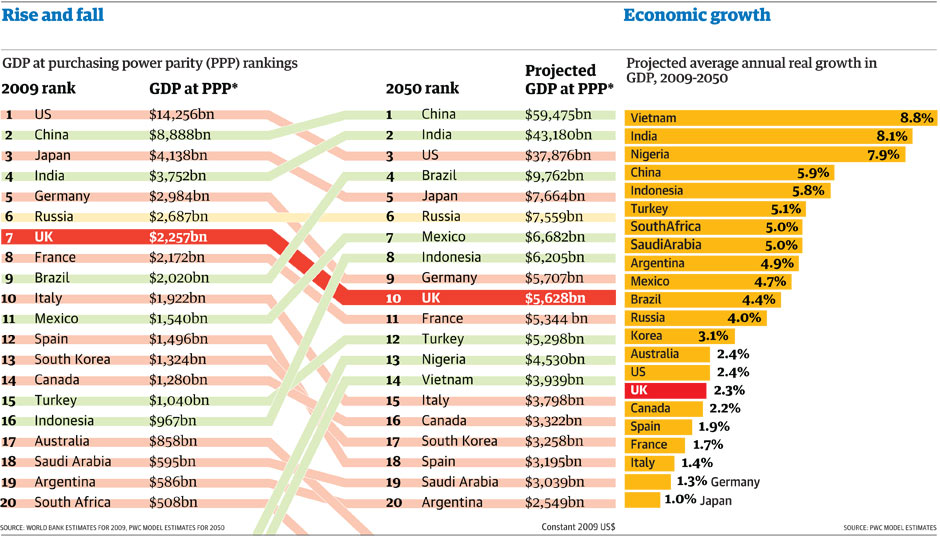
GDP projections to 2050 graphicView larger picture

GDP projections to 2050:
Summary-
Western defence forces would not be able to afford a human attrition intensive war by 2030 given current demographic trends  (both growth and aging). Existing balance of power could be maintained if resources are either shared or warfare is moved to cyber space. Technological advances can help augment resources reducing case for conflict scenarios.
Will the Internet be used by US against China in the 21 st century as Opium was used by GB in the 19th? Time will tell 🙂

On Software

1) All software has bugs. Sometimes this is because people have been told to code in a hurry to meet shipping deadlines. Sometimes it is due to the way metal and other software interact with it. Mostly it is karma.

2) In the 21 st Century,It is okay to insult someone over his software , but not over most other things. Sometimes I think people are passionate not just for their own software but to just diss the other guys. It is a politically convenient release.

3) Bloggers writing about software are full of bull-by products. If they were any good in writing code, they would not have time to write a blog. Mostly bloggers on code are people whose coding enthusiasm is more than their coding competence.

4) Software is easier than it looks to people who know it. To those who dont know how to code, it will always be a bit of magic.

5) Despite immense progress, initiatives and encouragement- the number of females writing code is too low . Comparatively, figuratively and literally. If you are a male and want a social life- get into marketing while the hair is still black.

Man walks into Bar. Says to Women at Bar. ” Hey,What do you do, Me- I write code”

See!

6) People who write software end up making more money not just because they create useful stuff that helps get work done faster or helps reduce boredom for people. They make more money because they are mostly passionate, logical problem thinkers, focused, hard working and better read on a variety of subjects than others. That’s your cue to how to make money even if you cannot code.

7) I would rather write much more code rather than write poetry. But I sometimes think they are related. Just manipulating words in different languages to manipulate output in different machines or people.

8) Kids should be taught software at early age , as that is a skill that helps in their education and thinking. More education for the kids!

9) Laying off talented software people because you found a cheaper , younger alternative half across the globe is sometimes evil. It is also inevitable. Learn more software as you grow older.

10) The best software is the one in your head. It was written by a better programmer too.