Top 10 Games on Linux -sudo update

The phrase "Doom clone" was initiall...
Image via Wikipedia

Here are some cool games I like to play on my Ubuntu 10.10 – I think they run on most other versions of Linux as well. 1) Open ArenaFirst person Shooter– This is like Quake Arena- very very nice graphics and good for playing for a couple of hours while taking a break. It is available here- http://openarena.ws/smfnews.php ideally if you have a bunch of gaming friends, playing on a local network or internet is quite mind blowing entertaining. And it’s free! 2) Armagetron– This is based on the TRON game of light cycles-It is available here at http://www.armagetronad.net/ or you can use Synaptic packages manager for all the games mentioned here

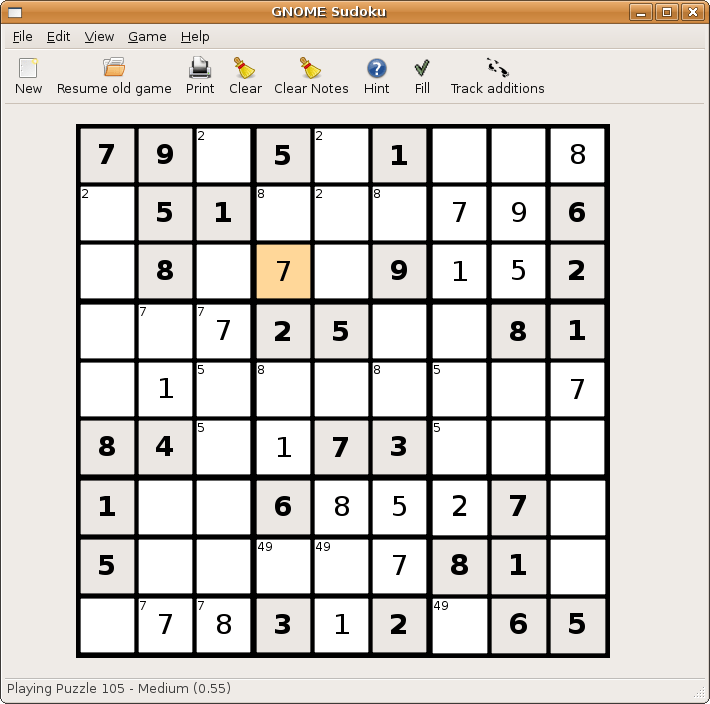
If violence or cars is not your stuff and you like puzzles like Sudoko, well just install the application Sudoko from http://gnome-sudoku.sourceforge.net/ Also recommended for people of various ages as it has multiple levels.
If you ever liked Pinball play the open source version from download at http://pinball.sourceforge.net/ Alternatively you can go to Ubuntu Software Centre>Games>Arcade>Emilio>Pinball and you can also build your own pinball if you like the game well enough. 5) Pacman/Njam- Clone of the original classic game.  Downloadable from http://www.linuxcompatible.org/news/story/pacman_for_linux.html 6) Gweled– This is free clone version of Bejeweled. It now has a new website at http://gweled.org/ http://linux.softpedia.com/progDownload/Gweled-Download-3449.html

Gweled is a GNOME version of a popular PalmOS/Windows/Java game called “Bejeweled” or “Diamond Mine”. The aim of the game is to make alignment of 3 or more gems, both vertically or horizontally by swapping adjacent gems. The game ends when there are no possible moves left. Here are some key features of “Gweled”: · exact same gameplay as the commercial versions · SVG original graphics

7) Hearts – For this card game classis you can use Ubuntu software to install the package or go to http://linuxappfinder.com/package/gnome-hearts 8) Card Games- KPatience has almost 14 card games including solitaire, and free cell. 9) Sauerbraten -First person shooter with good network play, edit maps capabilities. You can read more here- http://sauerbraten.org/ 10) Tetris-KBlocks Tetris is the classic game. If you like classic slow games- Tetris is the best. and I like the toughest Tetris game -Bastet http://fph.altervista.org/prog/bastet.html Even an xkcd toon for it

Is Random Poetry Click Fraud

Meta-search-vi
Image via Wikipedia

Is poetry when randomized

Tweaked, meta tagged , search engine optimized

Violative of unseen terms and conditional clauses

Is random poetry or aggregated prose farmed for click fraud uses


I dont know, you tell me, says the blog boy,

Tapping away at the keyboard like a shiny new toy,

Geeks unfortunately too often are men too many,

Forgive the generalization, but the tech world is yet to be equalized.


If a New York Hot Dog  is a slice of heaven at four bucks a piece

Then why is prose and poetry at five bucks an hour considered waste

Ah I see, you have grown old and cynical,

Of the numerous stupid internet capers and cyber ways


The clicking finger clicks on

swiftly but mostly delightfully virally moves on

While people collect its trails and

ponder its aggregated merry ways


All people are equal but all links are not,

Thus overturning two centuries of psychology had you been better taught,

But you chose to drop out of school, and create that search engine so big

It is now a fraud catchers head ache that millions try to search engine optimize and rig


Once again, people are different, in so many ways so prettier

Links are the same hyper linked code number five or earlier

People think like artificial artificial (thus natural) neural nets

Biochemically enhanced Harmonically possessed.


rather than  analyze forensically and quite creepily

where people have been

Gentic Algorithms need some chaos

To see what till now hasnt been seen.


Again this was a random poem,

inspired by a random link that someone clicked

To get here, on a carbon burning cyber machine,

Having digested poem, moves on, unheard , unseen.

(Inspired by the Hyper Link at http://goo.gl/a8ijW )

Also-

Ohri's Johari Window

Astronaut Buzz Aldrin during the first human l...
Image via Wikipedia


An empty Johari window, with the “Rooms” arranged clockwise, starting with Room 1 at the top left


Johari window is a cognitive psychological tool created by Joseph Luft and Harry Ingham in 1955[1] in the United States, used to help people better understand their interpersonal communication and relationships. It is used primarily in self-help groups and corporate settings as a heuristic exercise.

When performing the exercise, subjects are given a list of 56 adjectives and picks five or six that they feel describe their own personality. Peers of the subject are then given the same list, and each picks five or six adjectives that describe the subject. These adjectives are then mapped onto a grid

A Johari window consists of the following 56 adjectives used as possible descriptions of the participant. In alphabetical order they are:

  • able
  • accepting
  • adaptable
  • bold
  • brave
  • calm
  • caring
  • cheerful
  • clever
  • complex
  • confident
  • dependable
  • dignified
  • energetic
  • extroverted
  • friendly
  • giving
  • happy
  • helpful
  • idealistic
  • independent
  • ingenious
  • intelligent
  • introverted
  • kind
  • knowledgeable
  • logical
  • loving
  • mature
  • modest
  • nervous
  • observant
  • organized
  • patient
  • powerful
  • proud
  • quiet
  • reflective
  • relaxed
  • religious
  • responsive
  • searching
  • self-assertive
  • self-conscious
  • sensible
  • sentimental
  • shy
  • silly
  • smart
  • spontaneous
  • sympathetic
  • tense
  • trustworthy
  • warm
  • wise
  • witty


Continue reading “Ohri's Johari Window”

Interview Anne Milley JMP

Here is an interview with Anne Milley, a notable thought leader in the world of analytics. Anne is now Senior Director, Analytical Strategy in Product Marketing for JMP , the leading data visualization software from the SAS Institute.

Ajay-What do you think are the top 5 unique selling points of JMP compared to other statistical software in its category?

Anne-

JMP combines incredible analytic depth and breadth with interactive data visualization, creating a unique environment optimized for discovery and data-driven innovation.

With an extensible framework using JSL (JMP Scripting Language), and integration with SAS, R, and Excel, JMP becomes your analytic hub.

JMP is accessible to all kinds of users. A novice analyst can dig into an interactive report delivered by a custom JMP application. An engineer looking at his own data can use built-in JMP capabilities to discover patterns, and a developer can write code to extend JMP for herself or others.

State-of-the-art DOE capabilities make it easy for anyone to design and analyze efficient experiments to determine which adjustments will yield the greatest gains in quality or process improvement – before costly changes are made.

Not to mention, JMP products are exceptionally well designed and easy to use. See for yourself and check out the free trial at www.jmp.com.

Download a free 30-day trial of JMP.

Ajay- What are the challenges and opportunities of expanding JMP’s market share? Do you see JMP expanding its conferences globally to engage global audiences?

Anne-

We realized solid global growth in 2010. The release of JMP Pro and JMP Clinical last year along with continuing enhancements to the rest of the JMP family of products (JMP and JMP Genomics) should position us well for another good year.

With the growing interest in analytics as a means to sustained value creation, we have the opportunity to help people along their analytic journey – to get started, take the next step, or adopt new paradigms speeding their time to value. The challenge is doing that as fast as we would like.

We are hiring internationally to offer even more events, training and academic programs globally.

Ajay- What are the current and proposed educational and global academic initiatives of JMP? How can we see more JMP in universities across the world (say India- China etc)?

Anne-

We view colleges and universities both as critical incubators of future JMP users and as places where attitudes about data analysis and statistics are formed. We believe that a positive experience in learning statistics makes a person more likely to eventually want and need a product like JMP.

For most students – and particularly for those in applied disciplines of business, engineering and the sciences – the ability to make a statistics course relevant to their primary area of study fosters a positive experience. Fortunately, there is a trend in statistical education toward a more applied, data-driven approach, and JMP provides a very natural environment for both students and researchers.

Its user-friendly navigation, emphasis on data visualization and easy access to the analytics behind the graphics make JMP a compelling alternative to some of our more traditional competitors.

We’ve seen strong growth in the education markets in the last few years, and JMP is now used in nearly half of the top 200 universities in the US.

Internationally, we are at an earlier stage of market development, but we are currently working with both JMP and SAS country offices and their local academic programs to promote JMP. For example, we are working with members of the JMP China office and faculty at several universities in China to support the use of JMP in the development of a master’s curriculum in Applied Statistics there, touched on in this AMSTAT News article.

Ajay- What future trends do you see for 2011 in this market (say top 5)?

Anne-

Growing complexity of data (text, image, audio…) drives the need for more and better visualization and analysis capabilities to make sense of it all.

More “chief analytics officers” are making better use of analytic talent – people are the most important ingredient for success!

JMP has been on the vanguard of 64-bit development, and users are now catching up with us as 64-bit machines become more common.

Users should demand easy-to-use, exploratory and predictive modeling tools as well as robust tools to experiment and learn to help them make the best decisions on an ongoing basis.

All these factors and more fuel the need for the integration of flexible, extensible tools with popular analytic platforms.

Ajay-You enjoy organic gardening as a hobby. How do you think hobbies and unwind time help people be better professionals?

Anne-

I am lucky to work with so many people who view their work as a hobby. They have other interests too, though, some of which are work-related (statistics is relevant everywhere!). Organic gardening helps me put things in perspective and be present in the moment. More than work defines who you are. You can be passionate about your work as well as passionate about other things. I think it’s important to spend some leisure time in ways that bring you joy and contribute to your overall wellbeing and outlook.

Btw, nice interviews over the past several months—I hadn’t kept up, but will check it out more often!

Biography–  Source- http://www.sas.com/knowledge-exchange/business-analytics/biographies.html

  • Anne Milley

    Anne Milley

    Anne Milley is Senior Director of Analytics Strategy at JMP Product Marketing at SAS. Her ties to SAS began with bank failure prediction at Federal Home Loan Bank Dallas and continued at 7-Eleven Inc. She has authored papers and served on committees for F2006, KDD, SIAM, A2010 and several years of SAS’ annual data mining conference. Milley is a contributing faculty member for the International Institute of Analytics. anne.milley@jmp.com

Google Realtime Live Updates on Egypt Yemen Tunisia Jordan..

Using Google RealTime, a small icon on the left margin, you can monitor the latest uprisings. Apparently you can still get shot in most of the world to ask for freedom. What a trillion dollars of industrial arms complex could not do in Iraq or Afghanistan, hackers at Wikileaks, Bloggers in Middle East and Media people at Al Jazzera are doing right now. I am probably too young in 1989 when communists fell, but watching dictators fall by people power than external arms is good, no.

Now if only a few more people could listen to some Chinese Democracy

Computer Education grants from Google

Image representing Google as depicted in Crunc...
Image via CrunchBase

message from the official google blog-

http://googleblog.blogspot.com/2011/01/supporting-computer-science-education.html

With programs like Computer Science for High School (CS4HS), we hope to increase the number of CS majors —and therefore the number of people entering into careers in CS—by promoting computer science curriculum at the high school level.

For the fourth consecutive year, we’re funding CS4HS to invest in the next generation of computer scientists and engineers. CS4HS is a workshop for high school and middle school computer science teachers that introduces new and emerging concepts in computing and provides tips, tools and guidance on how to teach them. The ultimate goals are to “train the trainer,” develop a thriving community of high school CS teachers and spread the word about the awe and beauty of computing.

If you’re a university, community college, or technical School in the U.S., Canada, Europe, Middle East or Africa and are interested in hosting a workshop at your institution, please visit www.cs4hs.com to submit an application for grant funding.Applications will be accepted between January 18, 2011 and February 18, 2011.

In addition to submitting your application, on the CS4HS website you’ll find info on how to organize a workshop, as well as websites and agendas from last year’s participants to give you an idea of how the workshops were structured in the past. There’s also a collection ofCS4HS curriculum modules that previous participating schools have shared for future organizers to use in their own program.

Mapping Health Statistics at CDC.gov

Astronaut Buzz Aldrin during the first human l...
Image via Wikipedia

CDC.gov has a great tool for showing United States statistics on death and injury, drillable by various details.

The tool is hosted at http://wisqars.cdc.gov:8080/cdcMapFramework/

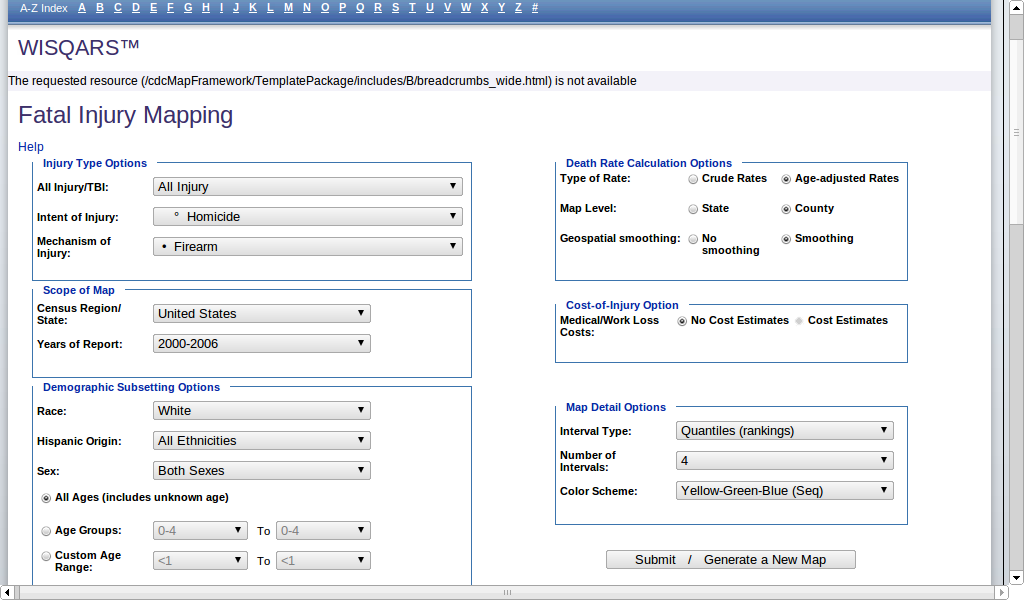
As a test I decided to map out injuries due to fire arms , and compare firearm deaths of white people versus the whole population.(see firearm deaths file)

See white people are more likely than black people to own guns (also read http://www.ncbi.nlm.nih.gov/pubmed/9572612 ), but it seems statistically they are less likely to be injured by firearms- so it could affect support for gun control laws on a racial ground- that was my null hypothesis. No politics, just plain statistics. I dont know- why dont you look at the data and decide-