Interesting Interview with Quentin G,AsterData

Here is an interesting interview with Quentin G, CEO AsterData, Marketing trumpeting aside apart-the insights on the whats next vision thing are quite good.

Sourcehttp://www.arnoldit.com/search-wizards-speak/aster-data.html

As you look down the road, what are the three major challenges you see for vendors who keep trying to solve big data and other “now” problems with old tools?

Old tools and traditional architectures cannot scale effectively to handle massive data volumes that reach 100’s of terabytes nor can they effectively process large data volumes in a high performance manner. Further, they are restricted to what SQL querying allows. The three challenges I have noted are:

First, performance, specifically, poor performance on large data volumes and heavy workloads: The pre-existing systems rely on storing data in a traditional DBMS or data warehouse and then extracting a sample of data to a separate processing tier. This greatly restricts data insights and analytics as only a sample of data is analyzed and understood.  As more data is stored in these systems they suffer from performance degradation as more users try to access the system concurrently. Additionally moving masses of data out of the traditional DBMS to a separate processing tier adds latency and slows down analytics and response times. This pre-existing architecture greatly limits performance especially as data sizes grow.

Second, limited analytics: Pre-existing systems rely mostly on SQL for data querying and analysis. SQL poses several limitations and is not suited for ad hoc querying, deep data exploration and a range of other analytics. MapReduce overcomes the limitations of SQL and SQL-MapReduce in particular opens up a new class of analytics that cannot be achieved with SQL alone.

And, third, limitations of types of data that can be stored and analyzed: Traditional systems are not designed for non-relational or unstructured data. New solutions such as Aster Data’s are designed from the ground up to handle both relational and non-relational data. Organizations want to store and process a range of data types and do this in a single platform. New solutions allow for different data types to be handled in a single platform whereas pre-existing architectures and solutions are specialized around a single data type or format – this restricts the diversity of analytics that can be performed on these systems.

Read the whole interview at –http://www.arnoldit.com/search-wizards-speak/aster-data.html

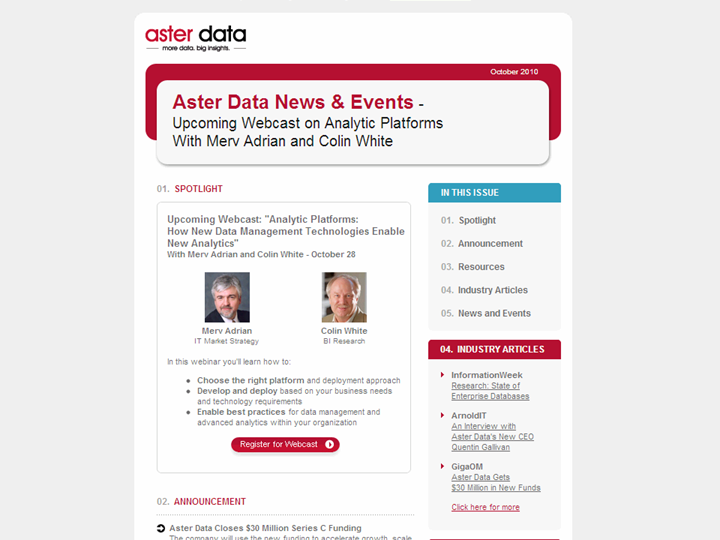
Speaking of which- there is a new webinar by Merv Adrian (interview on Decisionstats) and Colin White-


http://now.eloqua.com/es.asp?s=1015&e=1862&elq=9ec9b73872e849b88d2943cca920acda

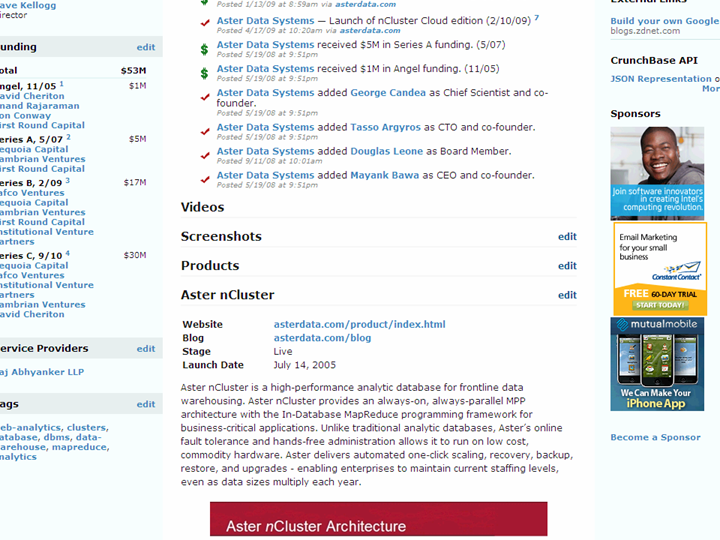
and from the famous AOL website- a profile of AsterData’s money flow which kind of hints at an IPO two years onwards-

http://www.crunchbase.com/company/aster-data-systems

Learning Hadoop

Curious on learning hadoop- a hot resume skill

Try

http://www.cloudera.com/hadoop-training/#certification

Cloudera Certification for Hadoop

Cloudera Certification establishes you as a trusted and valuable resource for those working with Hadoop. Whether your company is just looking into the technology or your customers are asking for help, Cloudera Certification demonstrates your ability to solve problems using Hadoop.

  • Consultants, developers and technical leaders can use Cloudera Certification to demonstrate their experience with Hadoop.
  • Employers can use Cloudera Certification to identify candidates for new jobs or internal promotions, as well as ensure team members share a common knowledge base.
  • Customers can reduce risk by relying on contractors and suppliers who retain current Cloudera Certification for their personnel.

If you’d like to obtain Cloudera Certification for Developers or Administrators

http://www.cloudera.com/hadoop-training/#certification

Interview Michael J. A. Berry Data Miners, Inc

Here is an interview with noted Data Mining practitioner Michael Berry, author of seminal books in data mining, noted trainer and consultantmjab picture

Ajay- Your famous book “Data Mining Techniques: For Marketing, Sales, and Customer Relationship Management” came out in 2004, and an update is being planned for 2011. What are the various new data mining techniques and their application that you intend to talk about in that book.

Michael- Each time we do a revision, it feels like writing a whole new book. The first edition came out in 1997 and it is hard to believe how much the world has changed since then. I’m currently spending most of my time in the on-line retailing world. The things I worry about today–improving recommendations for cross-sell and up-sell,and search engine optimization–wouldn’t have even made sense to me back then. And the data sizes that are routine today were beyond the capacity of the most powerful super computers of the nineties. But, if possible, Gordon and I have changed even more than the data mining landscape. What has changed us is experience. We learned an awful lot between the first and second editions, and I think we’ve learned even more between the second and third.

One consequence is that we now have to discipline ourselves to avoid making the book too heavy to lift. For the first edition, we could write everything we knew (and arguably, a bit more!); now we have to remind ourselves that our intended audience is still the same–intelligent laymen with a practical interest in getting more information out of data. Not statisticians. Not computer scientists. Not academic researchers. Although we welcome all readers, we are primarily writing for someone who works in a marketing department and has a title with the word “analyst” or “analytics” in it. We have relaxed our “no equations” rule slightly for cases when the equations really do make things easier to explain, but the core explanations are still in words and pictures.

The third edition completes a transition that was already happening in the second edition. We have fully embraced standard statistical modeling techniques as full-fledged components of the data miner’s toolkit. In the first edition, it seemed important to make a distinction between old, dull, statistics, and new, cool, data mining. By the second edition, we realized that didn’t really make sense, but remnants of that attitude persisted. The third edition rectifies this. There is a chapter on statistical modeling techniques that explains linear and logistic regression, naive Bayes models, and more. There is also a brand new chapter on text mining, a curious omission from previous editions.

There is also a lot more material on data preparation. Three whole chapters are devoted to various aspects of data preparation. The first focuses on creating customer signatures. The second is focused on using derived variables to bring information to the surface, and the third deals with data reduction techniques such as principal components. Since this is where we spend the greatest part of our time in our work, it seemed important to spend more time on these subjects in the book as well.

Some of the chapters have been beefed up a bit. The neural network chapter now includes radial basis functions in addition to multi-layer perceptrons. The clustering chapter has been split into two chapters to accommodate new material on soft clustering, self-organizing maps, and more. The survival analysis chapter is much improved and includes material on some of our recent application of survival analysis methods to forecasting. The genetic algorithms chapter now includes a discussion of swarm intelligence.

Ajay- Describe your early career and how you came into Data Mining as a profession. What do you think of various universities now offering MS in Analytics. How do you balance your own teaching experience with your consulting projects at The Data Miners.

Michael- I fell into data mining quite by accident. I guess I always had a latent interest in the topic. As a high school and college student, I was a fan of Martin Gardner‘s mathematical games in in Scientific American. One of my favorite things he wrote about was a game called New Eleusis in which one players, God, makes up a rule to govern how cards can be played (“an even card must be followed by a red card”, say) and the other players have to figure out the rule by watching what plays are allowed by God and which ones are rejected. Just for my own amusement, I wrote a computer program to play the game and presented it at the IJCAI conference in, I think, 1981.

That paper became a chapter in a book on computer game playing–so my first book was about finding patterns in data. Aside from that, my interest in finding patterns in data lay dormant for years. At Thinking Machines, I was in the compiler group. In particular, I was responsible for the run-time system of the first Fortran Compiler for the CM-2 and I represented Thinking Machines at the Fortran 8X (later Fortran-90) standards meetings.

What changed my direction was that Thinking Machines got an export license to sell our first machine overseas. The machine went to a research lab just outside of Paris. The connection machine was so hard to program, that if you bought one, you got an applications engineer to go along with it. None of the applications engineers wanted to go live in Paris for a few months, but I did.

Paris was a lot of fun, and so, I discovered, was actually working on applications. When I came back to the states, I stuck with that applied focus and my next assignment was to spend a couple of years at Epsilon, (then a subsidiary of American Express) working on a database marketing system that stored all the “records of charge” for American Express card members. The purpose of the system was to pick ads to go in the billing envelope. I also worked on some more general purpose data mining software for the CM-5.

When Thinking Machines folded, I had the opportunity to open a Cambridge office for a Virginia-based consulting company called MRJ that had been a major channel for placing Connection Machines in various government agencies. The new group at MRJ was focused on data mining applications in the commercial market. At least, that was the idea. It turned out that they were more interested in data warehousing projects, so after a while we parted company.

That led to the formation of Data Miners. My two partners in Data Miners, Gordon Linoff and Brij Masand, share the Thinking Machines background.

To tell the truth, I really don’t know much about the university programs in data mining that have started to crop up. I’ve visited the one at NC State, but not any of the others.

I myself teach a class in “Marketing Analytics” at the Carroll School of Management at Boston College. It is an elective part of the MBA program there. I also teach short classes for corporations on their sites and at various conferences.

Ajay- At the previous Predictive Analytics World, you took a session on Forecasting and Predicting Subsciber levels (http://www.predictiveanalyticsworld.com/dc/2009/agenda.php#day2-6) .

It seems inability to forecast is a problem many many companies face today. What do you think are the top 5 principles of business forecasting which companies need to follow.

Michael- I don’t think I can come up with five. Our approach to forecasting is essentially simulation. We try to model the underlying processes and then turn the crank to see what happens. If there is a principal behind that, I guess it is to approach a forecast from the bottom up rather than treating aggregate numbers as a time series.

Ajay- You often partner your talks with SAS Institute, and your blog at http://blog.data-miners.com/ sometimes contain SAS code as well. What particular features of the SAS software do you like. Do you use just the Enterprise Miner or other modules as well for Survival Analysis or Forecasting.

Michael- Our first data mining class used SGI’s Mineset for the hands-on examples. Later we developed versions using Clementine, Quadstone, and SAS Enterprise Miner. Then, market forces took hold. We don’t market our classes ourselves, we depend on others to market them and then share in the revenue.

SAS turned out to be much better at marketing our classes than the other companies, so over time we stopped updating the other versions. An odd thing about our relationship with SAS is that it is only with the education group. They let us use Enterprise Miner to develop course materials, but we are explicitly forbidden to use it in our consulting work. As a consequence, we don’t use it much outside of the classroom.

Ajay- Also any other software you use (apart from SQL and J)

Michael- We try to fit in with whatever environment our client has set up. That almost always is SQL-based (Teradata, Oracle, SQL Server, . . .). Often SAS Stat is also available and sometimes Enterprise Miner.

We run into SPSS, Statistica, Angoss, and other tools as well. We tend to work in big data environments so we’ve also had occasion to use Ab Initio and, more recently, Hadoop. I expect to be seeing more of that.

Biography-

Together with his colleague, Gordon Linoff, Michael Berry is author of some of the most widely read and respected books on data mining. These best sellers in the field have been translated into many languages. Michael is an active practitioner of data mining. His books reflect many years of practical, hands-on experience down in the data mines.

Data Mining Techniques cover

Data Mining Techniques for Marketing, Sales and Customer Relationship Management

by Michael J. A. Berry and Gordon S. Linoff
copyright 2004 by John Wiley & Sons
ISB

Mining the Web cover

Mining the Web

by Michael J.A. Berry and Gordon S. Linoff
copyright 2002 by John Wiley & Sons
ISBN 0-471-41609-6

Non-English editions available in Traditional Chinese and Simplified Chinese

This book looks at the new opportunities and challenges for data mining that have been created by the web. The book demonstrates how to apply data mining to specific types of online businesses, such as auction sites, B2B trading exchanges, click-and-mortar retailers, subscription sites, and online retailers of digital content.

Mastering Data Mining

by Michael J.A. Berry and Gordon S. Linoff
copyright 2000 by John Wiley & Sons
ISBN 0-471-33123-6

Non-English editions available in JapaneseItalianTraditional Chinese , and Simplified Chinese

A case study-based guide to applying data mining techniques for solving practical business problems. These “warts and all” case studies are drawn directly from consulting engagements performed by the authors.

A data mining educator as well as a consultant, Michael is in demand as a keynote speaker and seminar leader in the area of data mining generally and the application of data mining to customer relationship management in particular.

Prior to founding Data Miners in December, 1997, Michael spent 8 years at Thinking Machines Corporation. There he specialized in the application of massively parallel supercomputing techniques to business and marketing applications, including one of the largest database marketing systems of the time.

Interview Dean Abbott Abbott Analytics

Here is an interview with noted Analytics Consultant and trainer Dean Abbott. Dean is scheduled to take a workshop on Predictive Analytics at PAW (Predictive Analytics World Conference)  Oct 18 , 2010 in Washington D.C

Ajay-  Describe your upcoming hands on workshop at Predictive Analytics World and how it can help people learn more predictive modeling.

Refer- http://www.predictiveanalyticsworld.com/dc/2010/handson_predictive_analytics.php

Dean- The hands-on workshop is geared toward individuals who know something about predictive analytics but would like to experience the process. It will help people in two regards. First, by going through the data assessment, preparation, modeling and model assessment stages in one day, the attendees will see how predictive analytics works in reality, including some of the pain associated with false starts and mistakes. At the same time, they will experience success with building reasonable models to solve a problem in a single day. I have found that for many, having to actually build the predictive analytics solution if an eye-opener. Seeing demonstrations show the capabilities of a tool, but greater value for an end-user is the development of intuition of what to do at each each stage of the process that makes the theory of predictive analytics real.

Second, they will gain experience using a top-tier predictive analytics software tool, Enterprise Miner (EM). This is especially helpful for those who are considering purchasing EM, but also for those who have used open source tools and have never experienced the additional power and efficiencies that come with a tool that is well thought out from a business solutions standpoint (as opposed to an algorithm workbench).

Ajay-  You are an instructor with software ranging from SPSS, S Plus, SAS Enterprise Miner, Statistica and CART. What features of each software do you like best and are more suited for application in data cases.

Dean- I’ll add Tibco Spotfire Miner, Polyanalyst and Unica’s Predictive Insight to the list of tools I’ve taught “hands-on” courses around, and there are at least a half dozen more I demonstrate in lecture courses (JMP, Matlab, Wizwhy, R, Ggobi, RapidMiner, Orange, Weka, RandomForests and TreeNet to name a few). The development of software is a fascinating undertaking, and each tools has its own strengths and weaknesses.

I personally gravitate toward tools with data flow / icon interface because I think more that way, and I’ve tired of learning more programming languages.

Since the predictive analytics algorithms are roughly the same (backdrop is backdrop no matter which tool you use), the key differentiators are

(1) how data can be loaded in and how tightly integrated can the tool be with the database,

(2) how well big data can be handled,

(3) how extensive are the data manipulation options,

(4) how flexible are the model reporting options, and

(5) how can you get the models and/or predictions out.

There are vast differences in the tools on these matters, so when I recommend tools for customers, I usually interview them quite extensively to understand better how they use data and how the models will be integrated into their business practice.

A final consideration is related to the efficiency of using the tool: how much automation can one introduce so that user-interaction is minimized once the analytics process has been defined. While I don’t like new programming languages, scripting and programming often helps here, though some tools have a way to run the visual programming data diagram itself without converting it to code.

Ajay- What are your views on the increasing trend of consolidation and mergers and acquisitions in the predictive analytics space. Does this increase the need for vendor neutral analysts and consultants as well as conferences.

Dean- When companies buy a predictive analytics software package, it’s a mixed bag. SPSS purchasing of Clementine was ultimately good for the predictive analytics, though it took several years for SPSS to figure out what they wanted to do with it. Darwin ultimately disappeared after being purchased by Oracle, but the newer Oracle data mining tool, ODM, integrates better with the database than Darwin did or even would have been able to.

The biggest trend and pressure for the commercial vendors is the improvements in the Open Source and GNU tools. These are becoming more viable for enterprise-level customers with big data, though from what I’ve seen, they haven’t caught up with the big commercial players yet. There is great value in bringing both commercial and open source tools to the attention of end-users in the context of solutions (rather than sales) in a conference setting, which is I think an advantage that Predictive Analytics World has.

As a vendor-neutral consultant, flux is always a good thing because I have to be proficient in a variety of tools, and it is the breadth that brings value for customers entering into the predictive analytics space. But it is very difficult to keep up with the rapidly-changing market and that is something I am weighing myself: how many tools should I keep in my active toolbox.

Ajay-  Describe your career and how you came into the Predictive Analytics space. What are your views on various MS Analytics offered by Universities.

Dean- After getting a masters degree in Applied Mathematics, my first job was at a small aerospace engineering company in Charlottesville, VA called Barron Associates, Inc. (BAI); it is still in existence and doing quite well! I was working on optimal guidance algorithms for some developmental missile systems, and statistical learning was a key part of the process, so I but my teeth on pattern recognition techniques there, and frankly, that was the most interesting part of the job. In fact, most of us agreed that this was the most interesting part: John Elder (Elder Research) was the first employee at BAI, and was there at that time. Gerry Montgomery and Paul Hess were there as well and left to form a data mining company called AbTech and are still in analytics space.

After working at BAI, I had short stints at Martin Marietta Corp. and PAR Government Systems were I worked on analytics solutions in DoD, primarily radar and sonar applications. It was while at Elder Research in the 90s that began working in the commercial space more in financial and risk modeling, and then in 1999 I began working as an independent consultant.

One thing I love about this field is that the same techniques can be applied broadly, and therefore I can work on CRM, web analytics, tax and financial risk, credit scoring, survey analysis, and many more application, and cross-fertilize ideas from one domain into other domains.

Regarding MS degrees, let me first write that I am very encouraged that data mining and predictive analytics are being taught in specific class and programs rather than as just an add-on to an advanced statistics or business class. That stated, I have mixed feelings about analytics offerings at Universities.

I find that most provide a good theoretical foundation in the algorithms, but are weak in describing the entire process in a business context. For those building predictive models, the model-building stage nearly always takes much less time than getting the data ready for modeling and reporting results. These are cross-discipline tasks, requiring some understanding of the database world and the business world for us to define the target variable(s) properly and clean up the data so that the predictive analytics algorithms to work well.

The programs that have a practicum of some kind are the most useful, in my opinion. There are some certificate programs out there that have more of a business-oriented framework, and the NC State program builds an internship into the degree itself. These are positive steps in the field that I’m sure will continue as predictive analytics graduates become more in demand.

Biography-

DEAN ABBOTT is President of Abbott Analytics in San Diego, California. Mr. Abbott has over 21 years of experience applying advanced data mining, data preparation, and data visualization methods in real-world data intensive problems, including fraud detection, response modeling, survey analysis, planned giving, predictive toxicology, signal process, and missile guidance. In addition, he has developed and evaluated algorithms for use in commercial data mining and pattern recognition products, including polynomial networks, neural networks, radial basis functions, and clustering algorithms, and has consulted with data mining software companies to provide critiques and assessments of their current features and future enhancements.

Mr. Abbott is a seasoned instructor, having taught a wide range of data mining tutorials and seminars for a decade to audiences of up to 400, including DAMA, KDD, AAAI, and IEEE conferences. He is the instructor of well-regarded data mining courses, explaining concepts in language readily understood by a wide range of audiences, including analytics novices, data analysts, statisticians, and business professionals. Mr. Abbott also has taught both applied and hands-on data mining courses for major software vendors, including Clementine (SPSS, an IBM Company), Affinium Model (Unica Corporation), Statistica (StatSoft, Inc.), S-Plus and Insightful Miner (Insightful Corporation), Enterprise Miner (SAS), Tibco Spitfire Miner (Tibco), and CART (Salford Systems).

R on Windows HPC Server

From HPC Wire, the newsletter/site for all HPC news-

Source- Link

PALO ALTO, Calif., Sept. 20 — Revolution Analytics, the leading commercial provider of software and support for the popular open source R statistics language, today announced it will deliver Revolution R Enterprise for Microsoft Windows HPC Server 2008 R2, released today, enabling users to analyze very large data sets in high-performance computing environments.

R is a powerful open source statistics language and the modern system for predictive analytics. Revolution Analytics recently introduced RevoScaleR, new “Big Data” analysis capabilities, to its R distribution, Revolution R Enterprise. RevoScaleR solves the performance and capacity limitations of the R language by with parallelized algorithms that stream data across multiple cores on a laptop, workstation or server. Users can now process, visualize and model terabyte-class data sets at top speeds — without the need for specialized hardware.

“Revolution Analytics is pleased to support Microsoft’s Technical Computing initiative, whose efforts will benefit scientists, engineers and data analysts,” said David Champagne, CTO at Revolution. “We believe the engineering we have done for Revolution R Enterprise, in particular our work on big-data statistics and multicore computing, along with Microsoft’s HPC platform for technical computing, makes an ideal combination for high-performance large scale statistical computing.”

“Processing and analyzing this ‘big data’ is essential to better prediction and decision making,” said Bill Hamilton, director of technical computing at Microsoft Corp. “Revolution R Enterprise for Windows HPC Server 2008 R2 gives customers an extremely powerful tool that handles analysis of very large data and high workloads.”

To learn more about Revolution R Enterprise and its Big Data capabilities, download thewhite paper. Revolution Analytics also has an on-demand webcast, “High-performance analytics with Revolution R and Windows HPC Server,” available online.

AND from Microsoft’s website

http://www.microsoft.com/hpc/en/us/solutions/hpc-for-life-sciences.aspx

REvolution R Enterprise »

REvolution Computing

REvolution R Enterprise is designed for both novice and experienced R users looking for a production-grade R distribution to perform mission critical predictive analytics tasks right from the desktop and scale across multiprocessor environments. Featuring RPE™ REvolution’s R Productivity Environment for Windows.

Of course R Enterprise is available on Linux but on Red Hat Enterprise Linux- it would be nice to see Amazom Machine Images as well as Ubuntu versions as well.

An Amazon Machine Image (AMI) is a special type of virtual appliance which is used to instantiate (create) a virtual machine within the Amazon Elastic Compute Cloud. It serves as the basic unit of deployment for services delivered using EC2.[1]

Like all virtual appliances, the main component of an AMI is a read-only filesystem image which includes an operating system (e.g., Linux, UNIX, or Windows) and any additional software required to deliver a service or a portion of it.[2]

The AMI filesystem is compressed, encrypted, signed, split into a series of 10MB chunks and uploaded into Amazon S3 for storage. An XML manifest file stores information about the AMI, including name, version, architecture, default kernel id, decryption key and digests for all of the filesystem chunks.

An AMI does not include a kernel image, only a pointer to the default kernel id, which can be chosen from an approved list of safe kernels maintained by Amazon and its partners (e.g., RedHat, Canonical, Microsoft). Users may choose kernels other than the default when booting an AMI.[3]

[edit]Types of images

  • Public: an AMI image that can be used by any one.
  • Paid: a for-pay AMI image that is registered with Amazon DevPay and can be used by any one who subscribes for it. DevPay allows developers to mark-up Amazon’s usage fees and optionally add monthly subscription fees.

AsterData gets $30 mill in funding

From the press release, the maker of Map Reduce based BI software gets 30 mill $ as Series C funding. Given the valuation recently by IBM to Netezza, AsterData seems set to cross the Billion Dollar valuation within the next 18-24 months IMO

Aster Data Closes $30 Million Series C Financing

Explosive Growth and Market Leadership Attracts New and Existing Investors

San Carlos, CA – September 22, 2010 – Aster Data, a market leader in big data management and advanced analytics, today announced that it has closed a $30 million Series C round of financing led by both new and existing investors. The company will use the new funding to accelerate growth, scale operations, and expand its global market share in the $20 billion database market – a market that is experiencing rapid growth as a result of both the explosion in data volumes across organizations and the urgent need to deliver a new class of analytics and data-driven applications. The Series C round of funding includes previous investors Sequoia Capital, JAFCO Ventures, Institutional Venture Partners, Cambrian Ventures, as well as an additional new strategic investor.  Also investing in this round is early investor David Cheriton, who previously backed high-growth companies including Google and VMware, and co-founded several successful technology companies.

Today’s Series C funding announcement underscores a year of strong innovation, execution, and overall momentum for the analytic database company. Key milestones include:

Strong sales growth: Since 2008, Aster Data has doubled revenue year-over-year and secured key customers that leverage Aster Data’s platform to address the big data management problem including MySpace, comScore, Barnes & Noble, and Akamai. Like so many organizations today,
Aster Data’s customers are experiencing explosive data growth across their organizations and recognize the need for rich, advanced analytics that give them deeper insights from their data.

Key executive hires: Quentin Gallivan, former CEO of both PivotLink and Postini and EVP of worldwide sales at Verisign, recently joined the company as Chief Executive Officer. In addition, earlier this year, John Calonico, previously at Interwoven, BEA, and Autodesk, joined as Chief Financial Officer; and Nitin Donde, formerly an executive at EMC and 3PAR, joined as Executive Vice President Engineering.  The strength and experience of Aster Data’s management team helps further establish a strong operational foundation for growth in 2010 and beyond.

Industry recognition: Aster Data was positioned in the “Visionaries” Quadrant of Gartner, Inc.’s

Data Warehouse Database Management Systems Magic Quadrant, published 2010 *; was recently named 2011 Tech Pioneer by the World Economic Forum; was named “Company to Watch” in the Information Management category of TechWeb’s Intelligent Enterprise 2010 Editors’ Choice Awards; and was awarded the 2010 San Francisco Business Times Technology and Innovation Award in the Best Product and Services Category.

Product Innovation: Aster Data continues to deliver ground-breaking capabilities to address the big data management and advanced analytics market need. Its recent announcement of
Aster Data nCluster 4.6 includes a column data store, making it the first hybrid row and column MPP DBMS with a unified SQL and MapReduce analytic framework for advanced analytics on large data sets. This year, Aster Data also delivered the most extensive library of pre-packaged MapReduce analytics totaling over 1000 functions, to ease and accelerate delivery of highly advanced analytic applications.

Aster Data’s analytic database, also called a ‘Data-Analytics Server’ is specifically designed to enable organizations to cost effectively store and analyze massive volumes of data. Aster Data leverages the power of commodity, general-purpose hardware, to reduce the cost to scale to support large data volumes and uniquely allows analysis of all data ‘in-database’ enabling richer and faster processing of large data sets. Aster Data’s in-database analytics engine uses the power of MapReduce, a parallel processing framework created by Google.

”The funding we received in our Series C round is a strong endorsement of Aster Data’s market leadership position and the high growth potential of the big data market,” said Quentin Gallivan, Chief Executive Officer, Aster Data. “The Aster Data team has executed exceptionally well to-date and I am excited to have the resources to accelerate the growth of the company as we expand our operations and execute aggressively across all fronts.”

Where is Waldo? Webcast on Network Intelligence

From the good folks at AsterData, a webcast on a slightly interesting analytics topic

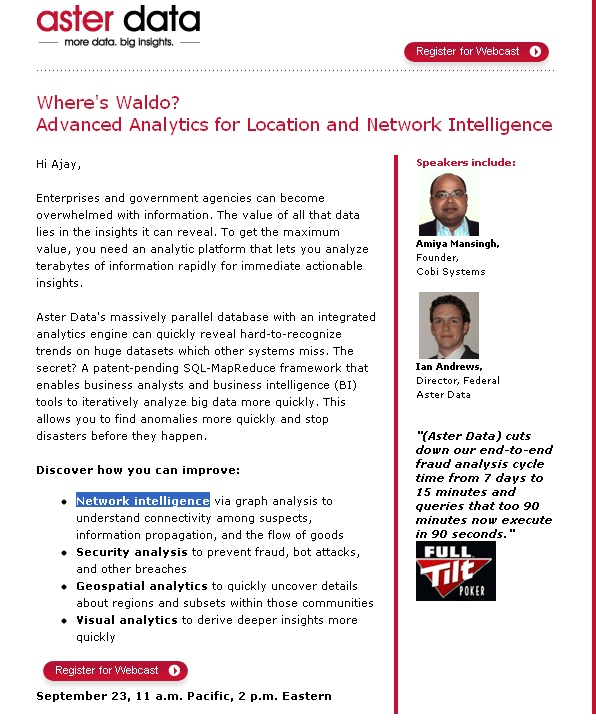
Enterprises and government agencies can become overwhelmed with information. The value of all that data lies in the insights it can reveal. To get the maximum value, you need an analytic platform that lets you analyze terabytes of information rapidly for immediate actionable insights.

Aster Data’s massively parallel database with an integrated analytics engine can quickly reveal hard-to-recognize trends on huge datasets which other systems miss. The secret? A patent-pending SQL-MapReduce framework that enables business analysts and business intelligence (BI) tools to iteratively analyze big data more quickly. This allows you to find anomalies more quickly and stop disasters before they happen.

Discover how you can improve:

  • Network intelligence via graph analysis to understand connectivity among suspects, information propagation, and the flow of goods
  • Security analysis to prevent fraud, bot attacks, and other breaches
  • Geospatial analytics to quickly uncover details about regions and subsets within those communities
  • Visual analytics to derive deeper insights more quickly