Try JMP for free in steps 1-2-3

Test a 30 day free trial of JMP, the beautiful software with the ugliest website.

In case you have never used JMP, but know the difference between a mean and a mode- take a look.

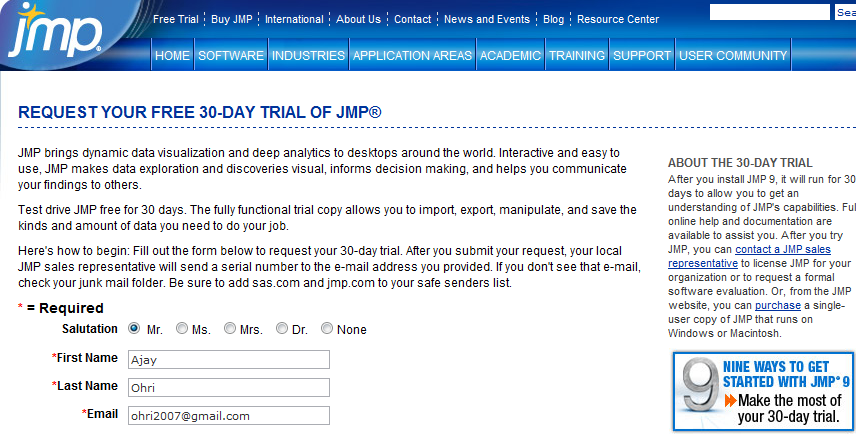
Step 1 Fill long and badly designed outdated form (note the blue lightening graphics design and font)


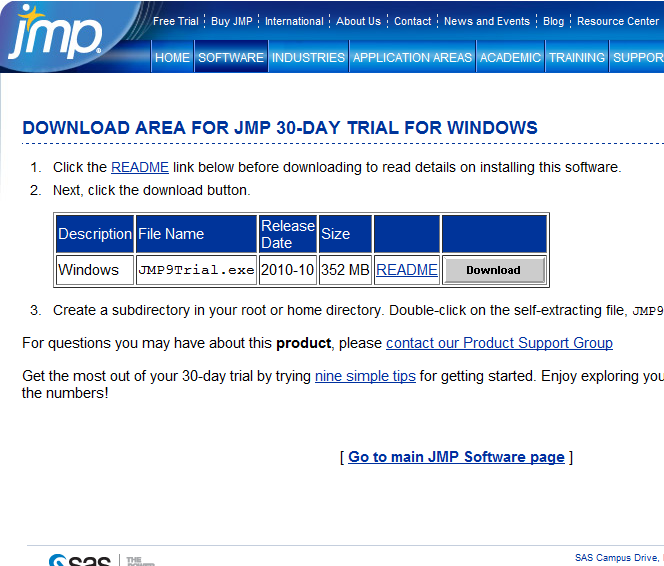
Step 2 See uselessly long message, as the website does require registration but it has not done  any oAuth/SM easy registration even though they help sell software in the same campus on social media

Step 3 Wait for 352 mb TO DOWNLOAD without a bit torrent or mirror servers, or even a link for scheduling Download Accelerator-

Note internet connections can be lousy (globally not just in India) to categorize 352 mb of downloads as painful.


And after all the violence and double talk
There’s just a song in all the trouble and the strife

JMP is still the best easiest to use powerful Big Data software with extensions into R and SAS.

Tips to Play Farmville Really Well

Here are some tips to play Farmville really well-

1) Keep your Farmville friends in a seperate friend list  by creating a list at http://www.facebook.com/friends/edit/

This ensures friendship , work and Farmville dont mess around with each other. You also dont need a lot of friends in Farmville (max 40 actives) unlike Mafia Wars

2) Register at http://rewards.zynga.com/ to get free or double rewards by doing the same work. These rewards can be redeemed in-game

3) Set a time as well as money budget. Like $10 per month and 1 hour on weekends with 15 minutes on weekdays with max 3-4 logins. Continue reading “Tips to Play Farmville Really Well”

Broad Guidelines for Graphs

Here are some broad guidelines for Graphs from EIA.gov , so you can say these are the official graphical guidelines of USA Gov

They can be really useful for sites planning to get into the Tableau Software/NYT /Guardian Infographic mode- or even for communities of blogs that have recurrent needs to display graphical plots- particularly since communication, statistical and design specialists are different areas/expertise/people.

Energy Information Administration Standard

Broad Guidelines for Graphs-I am reproducing an example from EIA ‘s guidelines for graphs-
http://www.eia.gov/about/eia_standards.cfm#Standard25

Energy Information Administration Standard 2009-25

Title: Statistical Graphs
Superseded Version: Standard 2002-25
Purpose: To ensure the utility (usefulness to intended users) and objectivity (accuracy, clarity, completeness, and lack of bias) of energy information presented in statistical graphs.
Applicability: All EIA information products.
Required Actions:

  1. Graphs should be used to show and compare changes, trends and/or relationships, and to assist users in visualizing the conclusions drawn from the data represented.
  2. A graph should contain sufficient Continue reading “Broad Guidelines for Graphs”

Using Color Palettes in R

If you like me, are unable to decide whether blue or brown is a better color for graph- color palettes in R are a big help for aesthetically acceptable alternatives.

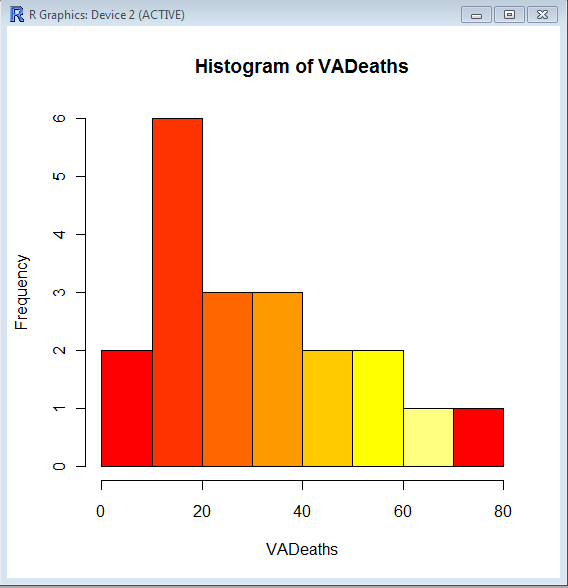
Using the same graphs, I choose the 5 main kinds of color palettes, using them is as easy as specifying the col= parameter in graphical display in Base Graphs. And I modified the n parameter for number of colors to be used- you can specify more or less depending how much you want the gradient or difference in colors to be.

> hist(VADeaths,col=heat.colors(7))

> hist(VADeaths,col=terrain.colors(7))

Continue reading “Using Color Palettes in R”

Top ten business analytics graphs Bar Charts (3/10)

Bar Charts and Histograms-Bar Charts are one of the most widely used types of Business Charts. Even the ever popular histograms are  special cases of bar charts (but showing frequencies). Histograms are the not the same as bar charts, they are simply bar charts of frequencies.

Basically a bar chart shows rectangular bars with length proportional to the quantities being described. It helps to see relative quantities between various category types.

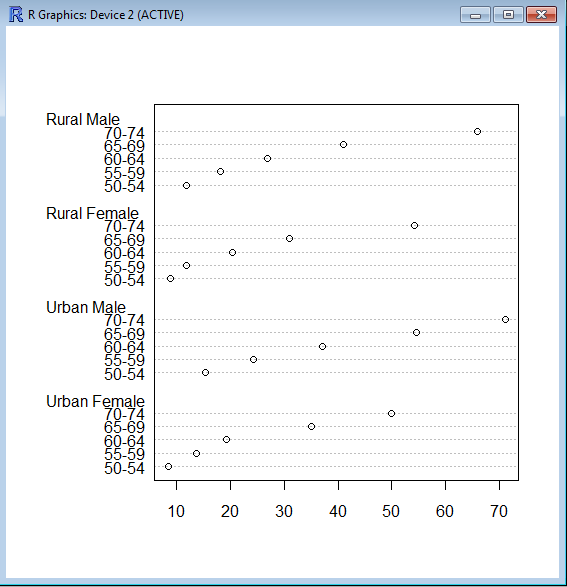
The barplot() command is used for making Bar Plots, while hist() is used for histograms. You can also use the plot() command with type=h to create histograms-The official R manual also suggests that Dot plots using dotchart () are a reasonable substitute for bar plots.
A very simple easy to understand tutorial for basic bar plots is at http://msenux.redwoods.edu/math/R/barplot.php

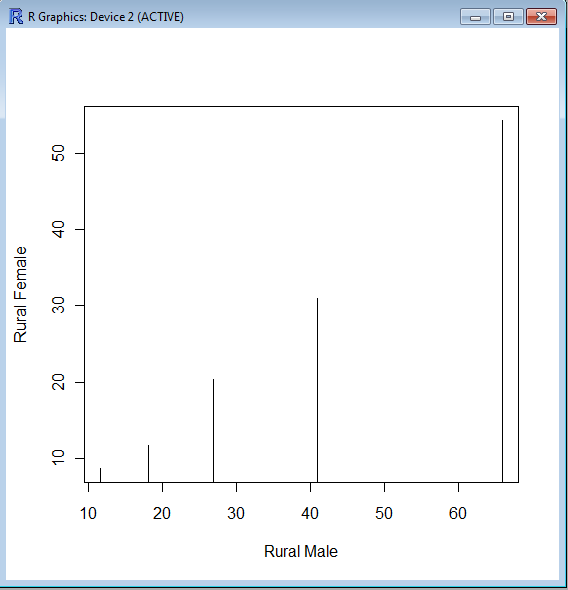
The difference between the three main functions that can be used for these charts are shown below-

> VADeaths
Rural Male Rural Female Urban Male Urban Female
50-54       11.7          8.7       15.4          8.4
55-59       18.1         11.7       24.3         13.6
60-64       26.9         20.3       37.0         19.3
65-69       41.0         30.9       54.6         35.1
70-74       66.0         54.3       71.1         50.0

> plot(VADeaths,type=”h”)


> dotchart(VADeaths)

Intel® Threading Challenge 2011 Software Contest

Logo of Intel, Jul 1968 - Dec 2005
Image via Wikipedia

One more software contests for you, but in the sub million dollar prize range

http://software.intel.com/en-us/contests/intel-threading-challenge-2011/contests.php

Intel® Threading Challenge 2011 – Win a Trip to Intel Developer Forum in San Francisco

Intel® Threading Challenge 2011 is going BIG this year! After three exciting threading competitions, our fourth Threading Challenge is stepping up the excitement with a BIG Grand Prize, a trip to the Intel Developer Forum (IDF) in San Francisco (September 13-15, 2011).

Since 2008, the Intel® Threading Challenge has attracted developers of varying experience from around the world. The active participation from the community has made the Threading Challenge not only a great programming competition, but a great way for community members to engage with each other, trade threading tips, and discover new parallel programming resources.

Last year’s format of two competition levels, Master and Apprentice, generated great excitement and opened the Threading Challenge to a new group of participants. So, we are going to continue the competition with a Master level and Apprentice level, each competing for the Grand Prize for their level, as well as individual problem awards. We know you love a great challenge and great prizes, so our Threading Challenge Team is putting together some exciting threading problems for you.

Monday, April 18, 2011 – Threading Challenge 2011 (Phase 1) Launches (both levels) at 12:00 PM (noon PDT)– The competition for 2011 is very similar to last year’s, but read on whether you’re a previous participant or new to the Threading Challenge, so you will be aware of all elements of the competition and how to compete. Then, you can start threading your way to prizes today!

Choose the right level for you!


Threading Challenge 2011:

• Two levels available for entry: Apprentice & Master
• Phase 1: 3 problems in each level
• Phase 2: Stay tuned for details, coming in Autumn 2011
• We will award 1st, 2nd & 3rd place prizes for each problem in each level
• No overlap of problems and each level’s problems will be offered consecutively
• Participants have the option to use the Intel® Manycore Testing Lab (MTL), consisting of 40 cores, 80 threads
• To enter the Threading Challenge 2011, please read the Official Rules and register for the competition with link in the “To Enter” Section.

The Threading Challenge will be implemented in two phases, with the 1st Phase consisting of 3 problems in each level. The details of the 2nd Phase will be announced in September 2011. For Phase 1, a new problem in each level will be launched on the days listed below at 12:00 noon (PDT) and will be open for entry for 22 days (inclusive of the problem starting day), until closing on the final problem day at 12:00 noon (PDT).

Problem Start and Closing Dates (both Master and Apprentice levels):

Problem 1:
Starts: Monday, April 18, 2011 at 12:00pm (PDT)
Ends. Monday, May 9, 2011 at 12:00pm (PDT)

Problem 2:
Starts: Monday, May 9, 2011 at 12:00pm (PDT)
Ends: Monday, May 30, 2011 at 12:00pm (PDT)

Problem 3: (Due to U.S. Memorial Day Holiday, Problem 2 will start on Tuesday, May 31, 2011)
Starts: Tuesday, May 31, 2011 at 12:00pm (PDT)
Ends: Tuesday, June 21, 2011 at 12:00pm (PDT)

*All problems start and end at 12:00 noon (Pacific Daylight Time)

Contestants will have 22 days to complete their entry submission (solution only for Apprentice OR solution and write-up for Master) for each problem. You may enter ONLY 1 problem at a time and will need to choose which level (Apprentice or Master) you wish to participate in during each problem cycle. You will be awarded points based on your solution submitted. Be sure to take advantage of our threading resources and tools, and you may validate your solution (optional) using the Intel® Manycore Testing Lab to solve your problems and get involved in the dedicated forums to earn extra points.

Each problems winners will be announced on the site after the problem is closed, and Prizes will be awarded to those problem winners (see official rules for prize distribution information). The Grand Prize, a Trip to Intel® Developer Forum (IDF) in San Francisco, will be awarded for each level to the participant that has the highest total points earned for the three problems in each level (i.e., highest total points for Master level problems and Apprentice level problems).

The Intel® Threading Challenge attracts some of the most talented developers in the world to solve parallelism code challenges. Now is your chance to take multithreading to the next level and possibly win great prizes. Demonstrate your threading expertise today!

More Details:

Intel® Threading Challenge 2011 is organized so any level of developer can have the opportunity to participate. Two levels of participation are available. The Apprentice level gives those just getting started in multithreading development a chance to try out and improve their threading skills. The Master level will be executed similarly to previous threading challenges, providing those with more experience a chance to test their skills and compete against other experienced developers.

Intel® Manycore Testing Lab – Available as Option for Threading Challenge 2011 Participants

This year competitors will have the optional opportunity to develop and validate their code using the Intel® Manycore Testing Lab. This 40-core, 80-thread development environment has the latest hardware and software available and will be used by this year’s judges to test the winning entries in Threading Challenge 2011 Phase 1.

The Intel® Manycore Testing Lab (MTL) will be made available to Threading Challenge 2011 contestants. Use of the MTL will give participants the opportunity to write and test their code on systems exactly configured to what the judges will be using to score submitted entries. No more guessing about if your code will build or how it will run. (There is no requirement to use the MTL for any part of the contest. It is strictly an optional alternative being made available to those that wish to use it.)

Predictive Analytics World Conference –New York City and London, UK

Please use the following code  to get a 15% discount on the 2 Day Conference Pass:  AJAYNY11.

Predictive Analytics World Conference –New York City and London, UK
October 17-21, 2011 – New York City, NY (pawcon.com/nyc)
Nov 30 – Dec 1, 2011 – London, UK (pawcon.com/london)

Predictive Analytics World (pawcon.com) is the business-focused event for predictive analytics
professionals, managers and commercial practitioners, covering today’s commercial deployment of
predictive analytics, across industries and across software vendors. The conference delivers case
studies, expertise, and resources to achieve two objectives:

1) Bigger wins: Strengthen the business impact delivered by predictive analytics

2) Broader capabilities: Establish new opportunities with predictive analytics

Case Studies: How the Leading Enterprises Do It

Predictive Analytics World focuses on concrete examples of deployed predictive analytics. The leading
enterprises have signed up to tell their stories, so you can hear from the horse’s mouth precisely how
Fortune 500 analytics competitors and other top practitioners deploy predictive modeling, and what
kind of business impact it delivers.

PAW NEW YORK CITY 2011

PAW’s NYC program is the richest and most diverse yet, featuring over 40 sessions across three tracks
– including both X and Y tracks, and an “Expert/Practitioner” track — so you can witness how predictive
analytics is applied at major companies.

PAW NYC’s agenda covers hot topics and advanced methods such as ensemble models, social data,
search marketing, crowdsourcing, blackbox trading, fraud detection, risk management, survey analysis,
and other innovative applications that benefit organizations in new and creative ways.

WORKSHOPS: PAW NYC also features five full-day pre- and post-conference workshops that
complement the core conference program. Workshop agendas include advanced predictive modeling
methods, hands-on training, an intro to R (the open source analytics system), and enterprise decision
management.

For more see http://www.predictiveanalyticsworld.com/newyork/2011/

PAW LONDON 2011

PAW London’s agenda covers hot topics and advanced methods such as risk management, uplift
(incremental lift) modeling, open source analytics, and crowdsourcing data mining. Case study
presentations cover campaign targeting, churn modeling, next-best-offer, selecting marketing channels,
global analytics deployment, email marketing, HR candidate search, and other innovative applications
that benefit organizations in new and creative ways.

Join PAW and access the best keynotes, sessions, workshops, exposition, expert panel, live demos,
networking coffee breaks, reception, birds-of-a-feather lunches, brand-name enterprise leaders, and

industry heavyweights in the business.

For more see http://www.predictiveanalyticsworld.com/london

CROSS-INDUSTRY APPLICATIONS

Predictive Analytics World is the only conference of its kind, delivering vendor-neutral sessions across
verticals such as banking, financial services, e-commerce, education, government, healthcare, high
technology, insurance, non-profits, publishing, social gaming, retail and telecommunications

And PAW covers the gamut of commercial applications of predictive analytics, including response
modeling, customer retention with churn modeling, product recommendations, fraud detection, online
marketing optimization, human resource decision-making, law enforcement, sales forecasting, and
credit scoring.

Why bring together such a wide range of endeavors? No matter how you use predictive analytics, the
story is the same: Predicatively scoring customers optimizes business performance. Predictive analytics
initiatives across industries leverage the same core predictive modeling technology, share similar project
overhead and data requirements, and face common process challenges and analytical hurdles.

RAVE REVIEWS:

“Hands down, best applied, analytics conference I have ever attended. Great exposure to cutting-edge
predictive techniques and I was able to turn around and apply some of those learnings to my work
immediately. I’ve never been able to say that after any conference I’ve attended before!”

Jon Francis
Senior Statistician
T-Mobile

Read more: Articles and blog entries about PAW can be found at http://www.predictiveanalyticsworld.com/
pressroom.php

VENDORS. Meet the vendors and learn about their solutions, software and service. Discover the best
predictive analytics vendors available to serve your needs – learn what they do and see how they
compare

COLLEAGUES. Mingle, network and hang out with your best and brightest colleagues. Exchange
experiences over lunch, coffee breaks and the conference reception connecting with those professionals
who face the same challenges as you.

GET STARTED. If you’re new to predictive analytics, kicking off a new initiative, or exploring new ways
to position it at your organization, there’s no better place to get your bearings than Predictive Analytics
World. See what other companies are doing, witness vendor demos, participate in discussions with the
experts, network with your colleagues and weigh your options!

For more information:
http://www.predictiveanalyticsworld.com

View videos of PAW Washington DC, Oct 2010 — now available on-demand:
http://www.predictiveanalyticsworld.com/online-video.php

What is predictive analytics? See the Predictive Analytics Guide:
http://www.predictiveanalyticsworld.com/predictive_analytics.php

If you’d like our informative event updates, sign up at:
http://www.predictiveanalyticsworld.com/signup-us.php

To sign up for the PAW group on LinkedIn, see:
http://www.linkedin.com/e/gis/1005097

For inquiries e-mail regsupport@risingmedia.com or call (717) 798-3495.