It's a code code summer

East-German pupils ("Junge Pioniere"...
Image via Wikipedia

and soc is back!

also expecting some #Rstats entries (open source!)

from https://code.google.com/soc/

Google Summer of Code 2011

Visit the Google Summer of Code 2011 site for more details about the program this year.

For a detailed timeline and further information about the program, review our Frequently Asked Questions.

About Google Summer of Code

Google Summer of Code is a global program that offers student developers stipends to write code for various open source software projects. We have worked with several open source, free software, and technology-related groups to identify and fund several projects over a three month period. Since its inception in 2005, the program has brought together over 4500 successful student participants and over 3000 mentors from over 100 countries worldwide, all for the love of code. Through Google Summer of Code, accepted student applicants are paired with a mentor or mentors from the participating projects, thus gaining exposure to real-world software development scenarios and the opportunity for employment in areas related to their academic pursuits. In turn, the participating projects are able to more easily identify and bring in new developers. Best of all, more source code is created and released for the use and benefit of all.

To learn more about the program, peruse our 2011 Frequently Asked Questions page. You can also subscribe to the Google Open Source Blog or the Google Summer of Code Discussion Group to keep abreast of the latest announcements.

Participating in Google Summer of Code

For those of you who would like to participate in the program, there are many resources available for you to learn more. Check out the information pages from the 20052006200720082009, and 2010 instances of the program to get a better sense of which projects have participated as mentoring organizations in Google Summer of Code each year. If you are interested in a particular mentoring organization, just click on its name and you’ll find more information about the project, a summary of their students’ work and actual source code produced by student participants. You may also find the program Frequently Asked Questions (FAQs) pages for each year to be useful. Finally, check out all the great content and advice on participation produced by the community, for the community, on our program wiki.

If you don’t find what you need in the documentation, you can always ask questions on our program discussion list or the program IRC channel, #gsoc on Freenode.


What to do if you see a possible GPL violation

GNU Lesser General Public License
Image via Wikipedia

Well I have played with software (mostly but not exclusively) analytical, and I admire the zeal and energy of both open source and closed source practioners- all having relatively decent people executing strategies their investors or owners tell them to do (closed source) or motivated by their own self sense of cool-change the world-openness (open source)

What I dont get is people stealing open source code- repackaging without adding major contributions- claiming patent pending stuff- and basically making money by creating CLOSED source from the open source software-(as open source is yet to break the enterprise glass cieling)

you are either open source or you arent.

bi- sexuality is okay. bi-codability is not.

Next time you see someone stealing some community’s open source code- refer to this excellent link.


But, we cannot act on our own if we do not hold copyright. Thus, be sure to find out who the copyright holders of the software are before reporting a violation.

http://www.gnu.org/licenses/gpl-violation.html

Violations of the GNU Licenses

If you think you see a violation of the GNU GPLLGPLAGPL, or FDL, the first thing you should do is double-check the facts:

  • Does the distribution contain a copy of the License?
  • Does it clearly state which software is covered by the License? Does it say anything misleading, perhaps giving the impression that something is covered by the License when in fact it is not?
  • Is source code included in the distribution?
  • Is a written offer for source code included with a distribution of just binaries?
  • Is the available source code complete, or is it designed for linking in other non-free modules?

If there seems to be a real violation, the next thing you need to do is record the details carefully:

  • the precise name of the product
  • the name of the person or organization distributing it
  • email addresses, postal addresses and phone numbers for how to contact the distributor(s)
  • the exact name of the package whose license is violated
  • how the license was violated:
    • Is the copyright notice of the copyright holder included?
    • Is the source code completely missing?
    • Is there a written offer for source that’s incomplete in some way? This could happen if it provides a contact address or network URL that’s somehow incorrect.
    • Is there a copy of the license included in the distribution?
    • Is some of the source available, but not all? If so, what parts are missing?

The more of these details that you have, the easier it is for the copyright holder to pursue the matter.

Once you have collected the details, you should send a precise report to the copyright holder of the packages that are being misused. The copyright holder is the one who is legally authorized to take action to enforce the license.

If the copyright holder is the Free Software Foundation, please send the report to <license-violation@gnu.org>. It’s important that we be able to write back to you to get more information about the violation or product. So, if you use an anonymous remailer, please provide a return path of some sort. If you’d like to encrypt your correspondence, just send a brief mail saying so, and we’ll make appropriate arrangements.

Note that the GPL, and other copyleft licenses, are copyright licenses. This means that only the copyright holders are empowered to act against violations. The FSF acts on all GPL violations reported on FSF copyrighted code, and we offer assistance to any other copyright holder who wishes to do the same.

But, we cannot act on our own if we do not hold copyright. Thus, be sure to find out who the copyright holders of the software are before reporting a violation.


Top 10 Games on Linux -sudo update

The phrase "Doom clone" was initiall...
Image via Wikipedia

Here are some cool games I like to play on my Ubuntu 10.10 – I think they run on most other versions of Linux as well. 1) Open ArenaFirst person Shooter– This is like Quake Arena- very very nice graphics and good for playing for a couple of hours while taking a break. It is available here- http://openarena.ws/smfnews.php ideally if you have a bunch of gaming friends, playing on a local network or internet is quite mind blowing entertaining. And it’s free! 2) Armagetron– This is based on the TRON game of light cycles-It is available here at http://www.armagetronad.net/ or you can use Synaptic packages manager for all the games mentioned here

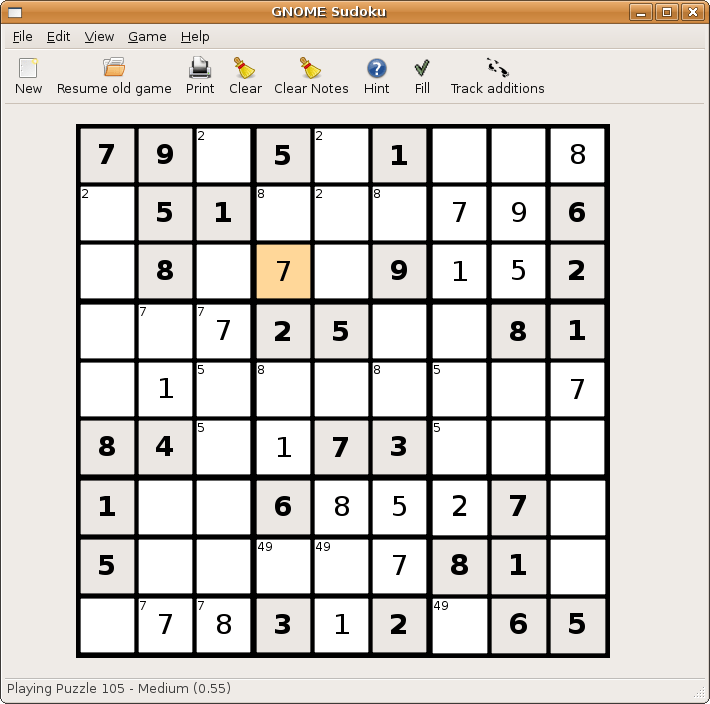
If violence or cars is not your stuff and you like puzzles like Sudoko, well just install the application Sudoko from http://gnome-sudoku.sourceforge.net/ Also recommended for people of various ages as it has multiple levels.

If you ever liked Pinball play the open source version from download at http://pinball.sourceforge.net/ Alternatively you can go to Ubuntu Software Centre>Games>Arcade>Emilio>Pinball and you can also build your own pinball if you like the game well enough. 5) Pacman/Njam- Clone of the original classic game.  Downloadable from http://www.linuxcompatible.org/news/story/pacman_for_linux.html 6) Gweled– This is free clone version of Bejeweled. It now has a new website at http://gweled.org/ http://linux.softpedia.com/progDownload/Gweled-Download-3449.html

Gweled is a GNOME version of a popular PalmOS/Windows/Java game called “Bejeweled” or “Diamond Mine”. The aim of the game is to make alignment of 3 or more gems, both vertically or horizontally by swapping adjacent gems. The game ends when there are no possible moves left. Here are some key features of “Gweled”: · exact same gameplay as the commercial versions · SVG original graphics

7) Hearts – For this card game classis you can use Ubuntu software to install the package or go to http://linuxappfinder.com/package/gnome-hearts 8) Card Games- KPatience has almost 14 card games including solitaire, and free cell. 9) Sauerbraten -First person shooter with good network play, edit maps capabilities. You can read more here- http://sauerbraten.org/ 10) Tetris-KBlocks Tetris is the classic game. If you like classic slow games- Tetris is the best. and I like the toughest Tetris game -Bastet http://fph.altervista.org/prog/bastet.html Even an xkcd toon for it

LibreOffice 3.3.2

Graph of internet users per 100 inhabitants be...
Image via Wikipedia

the latest freest office productivity software in the world.

The Document Foundation maintains its release schedule thanks to a growing and vibrant community of developers

The Internet, March 22, 2011 – The Document Foundation announces LibreOffice 3.3.2, the second micro release of the free office suite for personal productivity, which further improves the stability of the software and sets the platform for the next release 3.4, due in mid May. The community of developers has been able to maintain the tight schedule thanks to the increase in the number of contributors, and to the fact that those that have started with easy hacks in September 2010 are now working at substantial features. In addition, they have almost completed the code cleaning process, getting rid of German comments and obsolete functionalities.

“I have started hacking LibreOffice code on September 28, 2010, just a few hours after the announcement of the project, and I found a very welcoming community, where senior developers went out of their way to help newbies like me to become productive. After a few hours I submitted a small patch removing 5 or 6 lines of dead code… enough to get my feet wet and learn the workflow”, says Norbert, a French developer living in the United States. “In a short time, I ended up removing the VOS library – deprecated for a decade – from LibreOffice, and finding and fixing various threading issues in the process”.

LibreOffice 3.3.2 is being released just one day after the closing of the first funding round launched by The Document Foundation to collect donations towards the 50,000-euro capital needed to establish a Stiftung in Germany. In five weeks, the community has donated twice as much, i.e. around 100,000 euros. All additional funds will be used for operating expenses such as infrastructure costs and registration of domain names and trademarks, as well as for community development expenses such as travel funding for TDF representatives speaking at conferences, booth fees for trade shows, and initial financing of merchandising items, DVDs and printed material.

Italo Vignoli, a founder and a steering committee member of The Document Foundation, will be keynoting at Flourish 2011 in Chicago on Sunday, April 3, at 10:30AM, about getting independent from OpenOffice and Oracle, starting The Document Foundation, raising the capital and the first community budget, organizing developers and other work, and outlining a roadmap for future releases and features.

The Document Foundation is at http://documentfoundation.org, while LibreOffice is at http://www.libreoffice.org. LibreOffice 3.3.2 is immediately available from the download page.

*** About The Document Foundation

The Document Foundation has the mission of facilitating the evolution of the LibreOffice Community into a new, open, independent, and meritocratic organization within the next few months. An independent foundation is a better reflection of the values of our contributors, users and supporters, and will enable a more effective, efficient and transparent community. TDF will protect past investments by building on the achievements of the first decade, will encourage wide participation within the community, and will co-ordinate activity across the community.

*** Media contacts for TDF

Florian Effenberger (Germany)
Mobile: +49 151 14424108 – E-mail: floeff@documentfoundation.org
Olivier Hallot (Brazil)
Mobile: +55 21 88228812 – E-mail: olivier.hallot@documentfoundation.org
Charles H. Schulz (France)
Mobile: +33 6 98655424 – E-mail: charles.schulz@documentfoundation.org
Italo Vignoli (Italy)
Mobile: +39 348 5653829 – E-mail: italo.vignoli@documentfoundation.org


Italo Vignoli – The Document Foundation
email italo.vignoli@documentfoundation.org
phone +39.348.5653829 – VoIP +39.02.320621813
skype italovignoli – italo.vignoli@gmail.com

IBM and Revolution team to create new in-database R

From the Press Release at http://www.revolutionanalytics.com/news-events/news-room/2011/revolution-analytics-netezza-partnership.php

Under the terms of the agreement, the companies will work together to create a version of Revolution’s software that takes advantage of IBM Netezza’s i-class technology so that Revolution R Enterprise can run in-database in an optimal fashion.

About IBM

For information about IBM Netezza, please visit: http://www.netezza.com.
For Information on IBM Information Management, please visit: http://www.ibm.com/software/data/information-on-demand/
For information on IBM Business Analytics, please visit the online press kit: http://www.ibm.com/press/us/en/presskit/27163.wss
Follow IBM and Analytics on Twitter: http://twitter.com/ibmbizanalytics
Follow IBM analytics on Tumblr: http://smarterplanet.tumblr.com/tagged/new_intelligence
IBM YouTube Analytics Channel: http://www.youtube.com/user/ibmbusinessanalytics
For information on IBM Smarter Systems: http://www-03.ibm.com/systems/smarter/

About Revolution Analytics

Revolution Analytics is the leading commercial provider of software and services based on the open source R project for statistical computing.  Led by predictive analytics pioneer Norman Nie, the company brings high performance, productivity and enterprise readiness to R, the most powerful statistics language in the world. The company’s flagship Revolution R product is designed to meet the production needs of large organizations in industries such as finance, life sciences, retail, manufacturing and media.  Used by over 2 million analysts in academia and at cutting-edge companies such as Google, Bank of America and Acxiom, R has emerged as the standard of innovation in statistical analysis. Revolution Analytics is committed to fostering the continued growth of the R community through sponsorship of the Inside-R.org community site, funding worldwide R user groups and offers free licenses of Revolution R Enterprise to everyone in academia.


Netezza, an IBM Company, is the global leader in data warehouse, analytic and monitoring appliances that dramatically simplify high-performance analytics across an extended enterprise. IBM Netezza’s technology enables organizations to process enormous amounts of captured data at exceptional speed, providing a significant competitive and operational advantage in today’s data-intensive industries, including digital media, energy, financial services, government, health and life sciences, retail and telecommunications.

The IBM Netezza TwinFin® appliance is built specifically to analyze petabytes of detailed data significantly faster than existing data warehouse options, and at a much lower total cost of ownership. It stores, filters and processes terabytes of records within a single unit, analyzing only the relevant information for each query.

Using Revolution R Enterprise & Netezza Together

Revolution Analytics and IBM Netezza have announced a partnership to integrate Revolution R Enterprise and the IBM Netezza TwinFin  Data Warehouse Appliance. For the first time, customers seeking to run high performance and full-scale predictive analytics from within a data warehouse platform will be able to directly leverage the power of the open source R statistics language. The companies are working together to create a version of Revolution’s software that takes advantage of IBM Netezza’s i-class technology so that Revolution R Enterprise can run in-database in an optimal fashion.

This partnership integrates Revolution R Enterprise with IBM Netezza’s high performance data warehouse and advanced analytics platform to help organizations combat the challenges that arise as complexity and the scale of data grow.  By moving the analytics processing next to the data, this integration will minimize data movement – a significant bottleneck, especially when dealing with “Big Data”.  It will deliver high performance on large scale data, while leveraging the latest innovations in analytics.

With Revolution R Enterprise for IBM Netezza, advanced R computations are available for rapid analysis of hundreds of terabyte-class data volumes — and can deliver 10-100x performance improvements at a fraction of the cost compared to traditional analytics vendors.

Additional Resources


HIGHLIGHTS from REXER Survey :R gives best satisfaction

Simple graph showing hierarchical clustering. ...
Image via Wikipedia

A Summary report from Rexer Analytics Annual Survey


HIGHLIGHTS from the 4th Annual Data Miner Survey (2010):


•   FIELDS & GOALS: Data miners work in a diverse set of fields.  CRM / Marketing has been the #1 field in each of the past four years.  Fittingly, “improving the understanding of customers”, “retaining customers” and other CRM goals are also the goals identified by the most data miners surveyed.


•   ALGORITHMS: Decision trees, regression, and cluster analysis continue to form a triad of core algorithms for most data miners.  However, a wide variety of algorithms are being used.  This year, for the first time, the survey asked about Ensemble Models, and 22% of data miners report using them.
A third of data miners currently use text mining and another third plan to in the future.


•   MODELS: About one-third of data miners typically build final models with 10 or fewer variables, while about 28% generally construct models with more than 45 variables.


•   TOOLS: After a steady rise across the past few years, the open source data mining software R overtook other tools to become the tool used by more data miners (43%) than any other.  STATISTICA, which has also been climbing in the rankings, is selected as the primary data mining tool by the most data miners (18%).  Data miners report using an average of 4.6 software tools overall.  STATISTICA, IBM SPSS Modeler, and R received the strongest satisfaction ratings in both 2010 and 2009.


•   TECHNOLOGY: Data Mining most often occurs on a desktop or laptop computer, and frequently the data is stored locally.  Model scoring typically happens using the same software used to develop models.  STATISTICA users are more likely than other tool users to deploy models using PMML.


•   CHALLENGES: As in previous years, dirty data, explaining data mining to others, and difficult access to data are the top challenges data miners face.  This year data miners also shared best practices for overcoming these challenges.  The best practices are available online.


•   FUTURE: Data miners are optimistic about continued growth in the number of projects they will be conducting, and growth in data mining adoption is the number one “future trend” identified.  There is room to improve:  only 13% of data miners rate their company’s analytic capabilities as “excellent” and only 8% rate their data quality as “very strong”.


Please contact us if you have any questions about the attached report or this annual research program.  The 5th Annual Data Miner Survey will be launching next month.  We will email you an invitation to participate.


Information about Rexer Analytics is available at www.RexerAnalytics.com. Rexer Analytics continues their impressive journey see http://www.rexeranalytics.com/Clients.html

|My only thought- since most data miners are using multiple tools including free tools as well as paid software, Perhaps a pie chart of market share by revenue and volume would be handy.

Also some ideas on comparing diverse data mining projects by data size, or complexity.