What is a White Paper?

Christine and Jimmy Wales
Image via Wikipedia

As per Jimmy Wales and his merry band at Wiki (pedia not leaky-ah)- The emphasis is mine

What is the best white paper you have read in the past 15 years.

Categories are-

  • Business benefits: Makes a business case for a certain technology or methodology.
  • Technical: Describes how a certain technology works.
  • Hybrid: Combines business benefits with technical details in a single document.
  • Policy: Makes a case for a certain political solution to a societal or economic challenge.
——————————————————————————————————————————————————


white paper is an authoritative report or guide that helps solve a problem. White papers are used to educate readers and help people make decisions, and are often requested and used in politics, policy, business, and technical fields. In commercial use, the term has also come to refer to documents used by businesses as a marketing or sales tool. Policy makers frequently request white papers from universities or academic personnel to inform policy developments with expert opinions or relevant research.

Government white papers

In the Commonwealth of Nations, “white paper” is an informal name for a parliamentary paper enunciating government policy; in the United Kingdom these are mostly issued as “Command papers“. White papers are issued by the government and lay out policy, or proposed action, on a topic of current concern. Although a white paper may on occasion be a consultation as to the details of new legislation, it does signify a clear intention on the part of a government to pass new law. White Papers are a “…. tool of participatory democracy … not [an] unalterable policy commitment.[1] “White Papers have tried to perform the dual role of presenting firm government policies while at the same time inviting opinions upon them.” [2]

In Canada, a white paper “is considered to be a policy document, approved by Cabinet, tabled in the House of Commons and made available to the general public.”[3] A Canadian author notes that the “provision of policy information through the use of white and green papers can help to create an awareness of policy issues among parliamentarians and the public and to encourage an exchange of information and analysis. They can also serve as educational techniques”.[4]

“White Papers are used as a means of presenting government policy preferences prior to the introduction of legislation”; as such, the “publication of a White Paper serves to test the climate of public opinion regarding a controversial policy issue and enables the government to gauge its probable impact”.[5]

By contrast, green papers, which are issued much more frequently, are more open ended. These green papers, also known as consultation documents, may merely propose a strategy to be implemented in the details of other legislation or they may set out proposals on which the government wishes to obtain public views and opinion.

White papers published by the European Commission are documents containing proposals for European Union action in a specific area. They sometimes follow a green paper released to launch a public consultation process.

For examples see the following:

 Commercial white papers

Since the early 1990s, the term white paper has also come to refer to documents used by businesses and so-called think tanks as marketing or sales tools. White papers of this sort argue that the benefits of a particular technologyproduct or policy are superior for solving a specific problem.

These types of white papers are almost always marketing communications documents designed to promote a specific company’s or group’s solutions or products. As a marketing tool, these papers will highlight information favorable to the company authorizing or sponsoring the paper. Such white papers are often used to generate sales leads, establish thought leadership, make a business case, or to educate customers or voters.

There are four main types of commercial white papers:

  • Business benefits: Makes a business case for a certain technology or methodology.
  • Technical: Describes how a certain technology works.
  • Hybrid: Combines business benefits with technical details in a single document.
  • Policy: Makes a case for a certain political solution to a societal or economic challenge.

Resources

  • Stelzner, Michael (2007). Writing White Papers: How to capture readers and keep them engaged. Poway, California: WhitePaperSource Publishing. pp. 214. ISBN 9780977716937.
  • Bly, Robert W. (2006). The White Paper Marketing Handbook. Florence, Kentucky: South-Western Educational Publishing. pp. 256. ISBN 9780324300826.
  • Kantor, Jonathan (2009). Crafting White Paper 2.0: Designing Information for Today’s Time and Attention Challenged Business Reader. Denver,Colorado: Lulu Publishing. pp. 167.ISBN 9780557163243.

Cognitive Biases exploited by Spammers and Phishers

"Keep Walking"

Since they day you arrive on this planet, you are programmed into accepting reality as good and bad.

Beautiful people good. Ugly people not good.

Fellow countrymen good. Fellow earthling not so good.

Same religion is good. Different religion is awkward.

These cognitive biases are exploited in social media in the following manner-

1) Same Name Bias- You like people of the same name as you. or people who remind you of your brothers name. or uncles name.

All that information is already known. Esp true on Linkedin.

2) Same Orientation Bias- People tend to react better to photos considered attractive of opposite sex / opposite preference. Especially true on Twitter and Facebook.

3) Nationality Bias- Israeli Americans tend to respond better to Jewish looking phishers who claim to be from Israel but are not. Ditto for Indians- Arabs etc. E|sp true on Linkedin and Facebook.

You are positively biased to people of same country or of friendly nation states and will likely accept invites/friend/poke

4) Same organization/ alumni bias- People at end of phishing attack will have higher response rate if proxy identity claims familiarity with organizations or schools attended. Especially true on Facebook and Linkedin.

5) Same interests/movies/books bias- Your likely response rate is higher to someone who has seen your profile page on Facebook for interests, and checked the RSS stream of your tweets for stuff you like.

Bias is just maths. Period.

Forecasting World Events Team

a large and diverse panel of forecasters, including substantial representation from government, academia, “think tanks,” and industry. Here are a few other details concerning your fellow participants:
  • At this time, over 600 people are being invited to participate. Please note that we expect that new participants will be joining the panel on a rolling basis for years to come.
  • Around 85% of these 600+ participants have at least a Bachelor’s degree, and over 60% of them have advanced degrees.
  • In terms of background training, participants represent a range of academic fields. Around 40% report a Social-Behavioral Science background, but there is also significant representation from those with backgrounds in Business (15%), the Humanities (13%), Engineering (12%), and the Natural Sciences (10%), among others.
  • The average participant age is 43 years-old, with a standard deviation of 15 years.
  • The panel’s gender composition is 75% men / 25% women, and this closely mirrors the gender ratio for all FWE registrants.
  • In addition to participation from individuals overseas, we are pleased to have eligible participants representing 44 of the 50 United States.
We are currently scheduled to begin the core forecasting study in late summer, a few months later than we initially anticipated. In the meantime, we will be readying our web-based forecasting environment and assembling our initial set of forecasting questions. As our formal launch date approaches, we will be contacting you with a link to the forecasting website and any other information you’ll need to get started. Between now and then we may reach out to you with other related announcements.
Finally, registration remains open, and we encourage you to “spread the word” by sharing our registration homepage link with your friends and colleagues.
Thanks once again for your interest in Forecasting World Events. We look forward to you joining us this summer.
Sincerely,
The Forecasting World Events Team
E-mail is not a secure form of communication.

The confidentiality of this message cannot be guaranteed.

ps- above message was from this new contest. Enter at your initiative. Buyer Beware!.

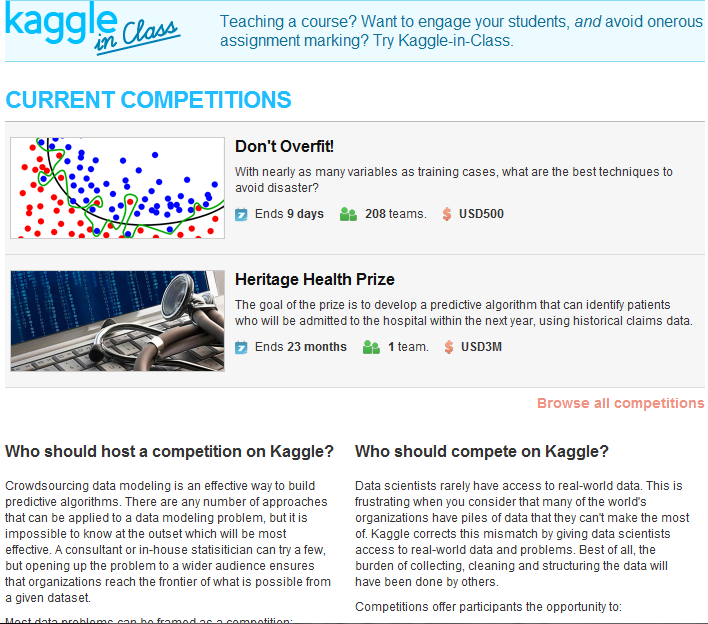
Heritage prize= 3mill now open

I am still angry with THE netflix for 1 mill I lost out. No sweat! this time the money is 3 times as much, it is legit, and yes baby you can change the world, make it a better place and get rich.! see details below-http://www.heritagehealthprize.com/c/hhp/Data

HERITAGE HEALTH PRIZE DATA FILES

You must accept this competition’s rules before you’ll be able to download data files.

IMPORTANT NOTE: The information provided below is intended only to provide general guidance to participants in the Heritage Health Prize Competition and is subject to the Competition Official Rules. Any capitalized term not defined below is defined in the Competition Official Rules. Please consult the Competition Official Rules for complete details.

Heritage Provider Network is providing Competition Entrants with deidentified member data collected during a forty-eight month period that is allocated among three data sets (the “Data Sets”). Competition Entrants will use the Data Sets to develop and test their algorithms for accurately predicting the number of days that the members will spend in a hospital (inpatient or emergency room visit) during the 12-month period following the Data Set cut-off date.

HHP_release2.zip contains the latest files, so you can ignore HHP_release1.zip. SampleEntry.CSV shows you how an entry should look.

Data Sets will be released to Entrants after registration on the Website according to the following schedule:

April 4, 2011 Claims Table – Y1 and DaysInHospital Table – Y2

May 4, 2011

All other Data Sets except Labs Table and Rx Table

From https://www.kaggle.com/

The $3 million Heritage Health Prize opens to entries

It’s been one month since the launch of the Heritage Health Prize. The prize has attracted some great publicity, receiving coverage from the Wall Street JournalThe EconomistSlate andForbes.

By now, people have had a good chance to poke around the first portion of the data. Now the fun starts! HPN have released two more years’-worth of data, set the accuracy threshold and are opening up the competition to entries. The data are available from the Heritage Health Prize page. Good luck to all participants!

The Deloitte/FIDE Chess Ratings Competition results

The Deloitte/FIDE Chess Ratings Competition attracted one of the strongest fields ever seen in a Kaggle Competition. The competition attracted 189 teams, ranging from chess ratings  experts to Netflix Prize winners. As Jeff Sonas wrote on the Kaggle blog last week, the  competition has far exceeded his expectations. A big congratulations the provisional winner, Tim Salimans, an econometrician at Erasmus University in Rotterdam. We look forward to reading about the approaches used by top performers on the Kaggle blog. We also look forward to the results of the FIDE prize, which could see the introduction of a new chess ratings system.

ICDAR 2011 Competition Results

The ICDAR 2011 competition also finished recently. The competiiton required participants to develop an algorithm that correctly matched handwriting samples. The winners were Lewis Griffin and Andrew Newell from the University College London who achieved Kaggle’s first ever perfect score by managing to match every sample correctly! Andrew and Lewis have posted a description of their winning method on the Kaggle blog.

Revolution R Enterprise

Since R is the most popular language used by Kaggle members, the Revolution Analytics team is making Revolution R Enterprise (the pre-eminent commercial version of R) available free of charge to Kaggle members. Revolution R Enterprise has several advantages over standard R, including the ability to seemlessly handle larger datasets. To get your free copy, visit http://info.revolutionanalytics.com/Kaggle.html.
Kaggle-in-Class

As many of you know, Kaggle offers a free platform, Kaggle-in-Class, for instructors who want to host competitions for their students. For those interested in hearing more about the use of Kaggle-in-Class as a teaching tool, Susan Holmes and Nelson Ray from Stanford University share their experience in a webinar organized by the Consortium for the Advancement of Undergraduate Statistics Education.

Why does Matt (of WordPress) hate Matt (of Google)

Biz Stone, co-founder of Twitter
Image via Wikipedia

I want to show some bad ads of Google Ad sense. I pay through my nose for video upgrades and extra space to keep people happy.

120,000 views in 2010

Money earned By Matt (of WordPress)= $$$$$ from me

Money earned by Mutt -(thats me)= 000,000,000

Please allow me to run ads on wordpress.com

or create your own fucking ad networks

but do it PHAST.

ESLE blog trsnfer using Blog Export, divide Xml file into 13 files  using Notepad copy and paste

go to Appspot

Convert files to Blogger files\

Thats the company BIZ stone OF tWITTER  made

before these Two matts got into dog fights.

https://wordpress2blogger.appspot.com/

Ever wanted to move your WordPress blogs over to Blogger? This site can aid in the process!

Instructions

  1. Login to your WordPress account and navigate to the Dashboard for the blog that you’d like to transfer to Blogger.
  2. Click on the Manage tab below the Blog name.
  3. Click on the Export link below the Manage tab.
  4. Download the WordPress WXR export file by clicking on Download Export File.
  5. Save this file to your local machine.
  6. Browse to that saved document with the form below and click Convert.
     
  7. Save this file to your local machine. This file will be the contents of your posts/comments from WordPress in a Blogger export file.
  8. Login to your Blogger or create a new user.
  9. Once logged in, click on the Create a Blog link from the user dashboard, and then click on the Import Blog Tool
  10. Follow the instructions and upload your Blogger export file when prompted.
  11. After completing the import wizard, you should have a set of imported posts from WordPress that you can now publish to Blogger. Have fun!

NOTE: This hosted application will only allow downloads smaller than 1MB.

For information on how to run this conversion on your own, visit the open source project hosted at code.google.com

Powered by Google App Engine

Lovely forecasting blog

Eight different random walks.
Image via Wikipedia

I really loved this simple, smart and yet elegant explanation of forecasting. even a high school quarterback could understand it, and maybe get a internship job building and running and re running code for Mars shot.

Despite my plea that you remain svelte in real life, I implore you to be naïve in business forecasting – and use a naïve forecasting model early and often. A naïve forecasting model is the most important model you will ever use in business forecasting.

and now the killer line

Purists may argue that the only true naïve forecast is the “no-change” forecast, meaning either a random walk (forecast = last known actual) or a seasonal random walk (e.g. forecast = actual from corresponding period last year). These are referred to as NF1 and NF2 in the Makridakis text (where NF = Naïve Forecast). In our 2006 SAS webseries Finding Flaws in Forecasting, an attendee asked “What about using a simple time series forecast with no intervention as the naïve forecast?” Is that allowed?

i did write a blog article on forecasting some time back, but back then I was a little blogger, with the website name being http://iwannacrib.com

great work in helping make forecasting easier to understand for people who have flower shops and dont have a bee, to help them with the forecasts, nor an geeky email list, not 4000$.

make it easier for the little guy to forecast his sales, so he cuts down on his supply chain inventory, lowering his carbon footprint.

Blog.sas.com take a bow, on labour day, helping workers with easy to understand models.

http://blogs.sas.com/forecasting/index.php?/archives/68-Which-Naive-Model-to-Use.html