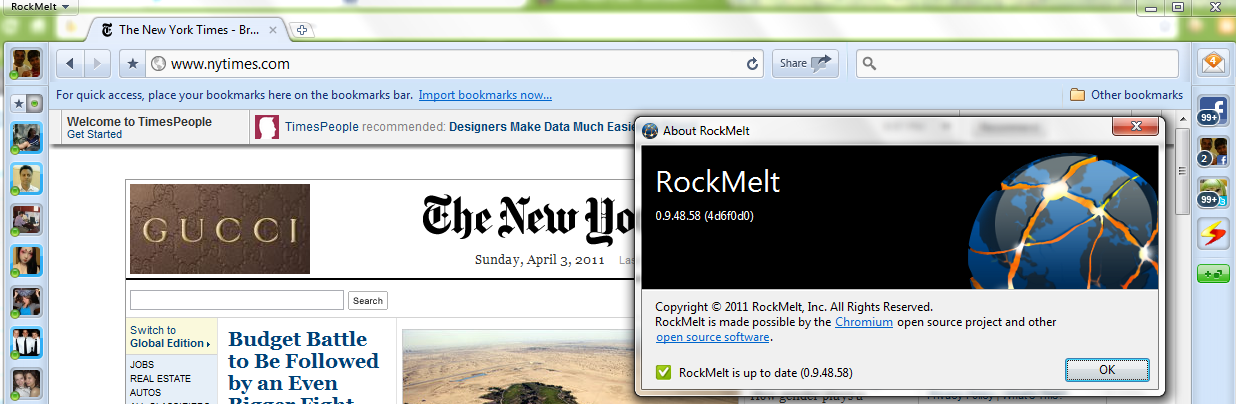
Rockmelt: A chromium based browser with a social layer

I kind of liked the latest browser on the block: Rockmelt.

It is based on Chromium open source project, that is primarily lead by Google. In case Facebook wants to buy a browser it can use Rockmelt–provided the mutual powers and angels agree.

I really liked the idea of a social layer- though I am not sure how the analytics embedded within a browser/report should be used.

Basically it re-designs the interface to put your social networks to the margin, thus quite a boon in you have active social media presence on multiple sites or a power reader/surfer. Timely alerts ping you to status/new messages without cluttering your screen and internet experience. Worth atleast a try or first look for the innovator kind of internet customer.

I still prefer the speed of Chrome– because Rockwell interface is still not easy to transition to – it almost adds in 3 dimensions in terms of where your eyeball should be while surfing (to left/right/margin).


and thats despite the funny fine print in Chrome’s user agreement of “continuing innovation”

type about:terms in your chrome bar to see-

4.3 As part of this continuing innovation, you acknowledge and agree that Google may stop (permanently or temporarily) providing the Services (or any features within the Services) to you or to users generally at Google’s sole discretion, without prior notice to you. You may stop using the Services at any time. You do not need to specifically inform Google when you stop using the Services.

Why search optimization can make you like Rebecca Black

Felicia Day, actress and web content producer.
Image via Wikipedia

A highly optimized blog post or web content can get you a lot of attention just like Rebecca Black’s video (provided it passes through the new quality metrics \change*/ in the Search Engine)

But if the underlying content is weak, or based on a shoddy understanding of the content-it can drive lots of horrid comments as well as ensuring that bad word of mouth is spread about the content or you/despite your hard work.

An example of this is copy and paste journalism especially in technology circles, where even a bigger Page Ranked website /blog can get away with scraping or stealing content from a lower page ranked website (or many websites)  after adding a cursory “expert comment”. This is also true when someone who is basically a corporate communication specialist (or PR -public relations) person is given a techinical text and encourage to write about it without completely understanding it.

A mild technical defect in the search engine algorithm is that it does not seem to pay attention to when the content was published, so the copying website or blog actually can get by as fresher content even if it is practically has 90% of the same words). The second flaw is over punishment or manual punishment of excessive linking – this can encourage search optimization minded people to hoard links or discourage trackbacks.

A free internet is one which promotes free sharing of content and does not encourage stealing or un-authorized scraping or content copying. Unfortunately current search engine optimization can encourage scraping and content copying without paying too much attention to origin of the words.

In addition the analytical rigor by which search algorithms search your inboxes (as in search all emails for a keyword) or media rich sites (like Youtube) are quite on a different level of quality altogether. The chances of garbage results are much more while searching for media content and/or emails.

The impact of currency fluctuations on outsourcing businesses globally


The impact of currency fluctuations on outsourcing businesses globally.

If you have a current offshore team in a different country/currency zone then you may find that the significant cost savings from outsourcing have vanished due to currency fluctuations that occur for reasons like earthquakes, war or oil- something which is outside the core competency of your business corporation. As off shoring companies incur cost in local currencies but gain revenue in American Dollars and Euro (mostly), they pass on these fluctuating costs to their customers but rarely pass along discounts on existing contracts. Sometimes the offshoring contract actually gains from currency fluctuations.The Indian rupee has fluctuated from  43.62 Rupees per USD (04-01-2005) to 48.58 (12-31-2008) to the current value of 44.65.This makes for a volatility component of almost 10 percentage points to the revenue and profit margins of an off shoring vendor. Inflation in India has been growing at 8.5 % and the annual increase in salaries has been around 10-15 % for the past few years. Offshoring vendors have been known to cut back on quality in recruitment when costs have risen historically, and the current attrition rate in Indian ITES is almost 17%.
This raises important questions for companies going for global bids for the offshoring contracts. Should macroeconomic indicators like currency fluctuations, wage-inflation be part of the request for proposal process (RFP). Would vendors be comfortable in disclosing the ratio of salary costs to billing revenue. Should dips in service quality be penalized by customer. Most importantly, while going in for a multi year contract, the projection of fore-casted savings may vary greatly due to extraneous factors.
(this article was originally written for and published by http://www.indiasoftwarebrief.com/ in their daily newsletter and their socail media channel- see http://www.linkedin.com/groups/impact-currency-fluctuations-on-outsourcing-3825591.S.48411960)


Youtube's variance in interface/s for sharing

Youtube seems to have a different  interface for sharing a channel, a playlist or an individual song. Also it seems to be missing out on revenue from Itunes (or maybe it isnt). and it seems to promoting Facebook and Twitter to the expense of other social media sharing buttons which can be only seen when you click share more (or maybe the buttons/social media channels change based on sharing activity analytics 🙂 )

on a slightly different note read my techie tutorial on boosting your youtube channel views

https://decisionstats.com/2010/09/10/creating-an-anonymous-bot/

Creating an Anonymous Bot


See the following interface snapshots/views-

youtube song share expanded


youtube song share
youtube song share default
youtube playlist share
utube channel share
youtube channel share

LibreOffice 3.3.2

Graph of internet users per 100 inhabitants be...
Image via Wikipedia

the latest freest office productivity software in the world.

The Document Foundation maintains its release schedule thanks to a growing and vibrant community of developers

The Internet, March 22, 2011 – The Document Foundation announces LibreOffice 3.3.2, the second micro release of the free office suite for personal productivity, which further improves the stability of the software and sets the platform for the next release 3.4, due in mid May. The community of developers has been able to maintain the tight schedule thanks to the increase in the number of contributors, and to the fact that those that have started with easy hacks in September 2010 are now working at substantial features. In addition, they have almost completed the code cleaning process, getting rid of German comments and obsolete functionalities.

“I have started hacking LibreOffice code on September 28, 2010, just a few hours after the announcement of the project, and I found a very welcoming community, where senior developers went out of their way to help newbies like me to become productive. After a few hours I submitted a small patch removing 5 or 6 lines of dead code… enough to get my feet wet and learn the workflow”, says Norbert, a French developer living in the United States. “In a short time, I ended up removing the VOS library – deprecated for a decade – from LibreOffice, and finding and fixing various threading issues in the process”.

LibreOffice 3.3.2 is being released just one day after the closing of the first funding round launched by The Document Foundation to collect donations towards the 50,000-euro capital needed to establish a Stiftung in Germany. In five weeks, the community has donated twice as much, i.e. around 100,000 euros. All additional funds will be used for operating expenses such as infrastructure costs and registration of domain names and trademarks, as well as for community development expenses such as travel funding for TDF representatives speaking at conferences, booth fees for trade shows, and initial financing of merchandising items, DVDs and printed material.

Italo Vignoli, a founder and a steering committee member of The Document Foundation, will be keynoting at Flourish 2011 in Chicago on Sunday, April 3, at 10:30AM, about getting independent from OpenOffice and Oracle, starting The Document Foundation, raising the capital and the first community budget, organizing developers and other work, and outlining a roadmap for future releases and features.

The Document Foundation is at http://documentfoundation.org, while LibreOffice is at http://www.libreoffice.org. LibreOffice 3.3.2 is immediately available from the download page.

*** About The Document Foundation

The Document Foundation has the mission of facilitating the evolution of the LibreOffice Community into a new, open, independent, and meritocratic organization within the next few months. An independent foundation is a better reflection of the values of our contributors, users and supporters, and will enable a more effective, efficient and transparent community. TDF will protect past investments by building on the achievements of the first decade, will encourage wide participation within the community, and will co-ordinate activity across the community.

*** Media contacts for TDF

Florian Effenberger (Germany)
Mobile: +49 151 14424108 – E-mail: floeff@documentfoundation.org
Olivier Hallot (Brazil)
Mobile: +55 21 88228812 – E-mail: olivier.hallot@documentfoundation.org
Charles H. Schulz (France)
Mobile: +33 6 98655424 – E-mail: charles.schulz@documentfoundation.org
Italo Vignoli (Italy)
Mobile: +39 348 5653829 – E-mail: italo.vignoli@documentfoundation.org


Italo Vignoli – The Document Foundation
email italo.vignoli@documentfoundation.org
phone +39.348.5653829 – VoIP +39.02.320621813
skype italovignoli – italo.vignoli@gmail.com

Google Realtime Live Updates on Egypt Yemen Tunisia Jordan..

Using Google RealTime, a small icon on the left margin, you can monitor the latest uprisings. Apparently you can still get shot in most of the world to ask for freedom. What a trillion dollars of industrial arms complex could not do in Iraq or Afghanistan, hackers at Wikileaks, Bloggers in Middle East and Media people at Al Jazzera are doing right now. I am probably too young in 1989 when communists fell, but watching dictators fall by people power than external arms is good, no.

Now if only a few more people could listen to some Chinese Democracy

LibreOffice Stable Release launched

Non Oracle Open Office completes important milestone- from the press release

The Document Foundation launches LibreOffice 3.3

The first stable release of the free office suite is available for download

The Internet, January 25, 2011 – The Document Foundation launches LibreOffice 3.3, the first stable release of the free office suite developed by the community. In less than four months, the number of developers hacking LibreOffice has grown from less than twenty in late September 2010, to well over one hundred today. This has allowed us to release ahead of the aggressive schedule set by the project.

Not only does it ship a number of new and original features, LibreOffice 3.3 is also a significant achievement for a number of reasons:

– the developer community has been able to build their own and independent process, and get up and running in a very short time (with respect to the size of the code base and the project’s strong ambitions);

– thanks to the high number of new contributors having been attracted into the project, the source code is quickly undergoing a major clean-up to provide a better foundation for future development of LibreOffice;

– the Windows installer, which is going to impact the largest and most diverse user base, has been integrated into a single build containing all language versions, thus reducing the size for download sites from 75 to 11GB, making it easier for us to deploy new versions more rapidly and lowering the carbon footprint of the entire infrastructure.

Caolán McNamara from RedHat, one of the developer community leaders, comments, “We are excited: this is our very first stable release, and therefore we are eager to get user feedback, which will be integrated as soon as possible into the code, with the first enhancements being released in February. Starting from March, we will be moving to a real time-based, predictable, transparent and public release schedule, in accordance with Engineering Steering Committee’s goals and users’ requests”. The LibreOffice development roadmap is available at http://wiki.documentfoundation.org/ReleasePlan

LibreOffice 3.3 brings several unique new features. The 10 most-popular among community members are, in no particular order:

  1. the ability to import and work with SVG files;
  2. an easy way to format title pages and their numbering in Writer;
  3. a more-helpful Navigator Tool for Writer;
  4. improved ergonomics in Calc for sheet and cell management;
  5. and Microsoft Works and Lotus Word Pro document import filters.

In addition, many great extensions are now bundled, providing

PDF import,

a slide-show presenter console,

a much improved report builder, and more besides.

A more-complete and detailed list of all the new features offered by LibreOffice 3.3 is viewable on the following web page: http://www.libreoffice.org/download/new-features-and-fixes/

LibreOffice 3.3 also provides all the new features of OpenOffice.org 3.3, such as new custom properties handling; embedding of standard PDF fonts in PDF documents; new Liberation Narrow font; increased document protection in Writer and Calc; auto decimal digits for “General” format in Calc; 1 million rows in a spreadsheet; new options for CSV import in Calc; insert drawing objects in Charts; hierarchical axis labels for Charts; improved slide layout handling in Impress; a new easier-to-use print interface; more options for changing case; and colored sheet tabs in Calc. Several of these new features were contributed by members of the LibreOffice team prior to the formation of The Document Foundation.

LibreOffice hackers will be meeting at FOSDEM in Brussels on February 5 and 6, and will be presenting their work during a one-day workshop on February 6, with speeches and hacking sessions coordinated by several members of the project.

The home of The Document Foundation is at http://www.documentfoundation.org

The home of LibreOffice is at http://www.libreoffice.org where the download page has been redesigned by the community to be more user-friendly.

*** About The Document Foundation

The Document Foundation has the mission of facilitating the evolution of the OOo Community into a new, open, independent, and meritocratic organization within the next few months. An independent Foundation is a better reflection of the values of our contributors, users and supporters, and will enable a more effective, efficient and transparent community. TDF will protect past investments by building on the achievements of the first decade, will encourage wide participation within the community, and will co-ordinate activity across the community.

*** Media Contacts for TDF

Florian Effenberger (Germany)

Mobile: +49 151 14424108 – E-mail: floeff@documentfoundation.org

Olivier Hallot (Brazil)

Mobile: +55 21 88228812 – E-mail: olivier.hallot@documentfoundation.org

Charles H. Schulz (France)

Mobile: +33 6 98655424 – E-mail: charles.schulz@documentfoundation.org

Italo Vignoli (Italy)

Mobile: +39 348 5653829 – E-mail: italo.vignoli@documentfoundation.org