R on Windows HPC Server

From HPC Wire, the newsletter/site for all HPC news-

Source- Link

PALO ALTO, Calif., Sept. 20 — Revolution Analytics, the leading commercial provider of software and support for the popular open source R statistics language, today announced it will deliver Revolution R Enterprise for Microsoft Windows HPC Server 2008 R2, released today, enabling users to analyze very large data sets in high-performance computing environments.

R is a powerful open source statistics language and the modern system for predictive analytics. Revolution Analytics recently introduced RevoScaleR, new “Big Data” analysis capabilities, to its R distribution, Revolution R Enterprise. RevoScaleR solves the performance and capacity limitations of the R language by with parallelized algorithms that stream data across multiple cores on a laptop, workstation or server. Users can now process, visualize and model terabyte-class data sets at top speeds — without the need for specialized hardware.

“Revolution Analytics is pleased to support Microsoft’s Technical Computing initiative, whose efforts will benefit scientists, engineers and data analysts,” said David Champagne, CTO at Revolution. “We believe the engineering we have done for Revolution R Enterprise, in particular our work on big-data statistics and multicore computing, along with Microsoft’s HPC platform for technical computing, makes an ideal combination for high-performance large scale statistical computing.”

“Processing and analyzing this ‘big data’ is essential to better prediction and decision making,” said Bill Hamilton, director of technical computing at Microsoft Corp. “Revolution R Enterprise for Windows HPC Server 2008 R2 gives customers an extremely powerful tool that handles analysis of very large data and high workloads.”

To learn more about Revolution R Enterprise and its Big Data capabilities, download thewhite paper. Revolution Analytics also has an on-demand webcast, “High-performance analytics with Revolution R and Windows HPC Server,” available online.

AND from Microsoft’s website

http://www.microsoft.com/hpc/en/us/solutions/hpc-for-life-sciences.aspx

REvolution R Enterprise »

REvolution Computing

REvolution R Enterprise is designed for both novice and experienced R users looking for a production-grade R distribution to perform mission critical predictive analytics tasks right from the desktop and scale across multiprocessor environments. Featuring RPE™ REvolution’s R Productivity Environment for Windows.

Of course R Enterprise is available on Linux but on Red Hat Enterprise Linux- it would be nice to see Amazom Machine Images as well as Ubuntu versions as well.

An Amazon Machine Image (AMI) is a special type of virtual appliance which is used to instantiate (create) a virtual machine within the Amazon Elastic Compute Cloud. It serves as the basic unit of deployment for services delivered using EC2.[1]

Like all virtual appliances, the main component of an AMI is a read-only filesystem image which includes an operating system (e.g., Linux, UNIX, or Windows) and any additional software required to deliver a service or a portion of it.[2]

The AMI filesystem is compressed, encrypted, signed, split into a series of 10MB chunks and uploaded into Amazon S3 for storage. An XML manifest file stores information about the AMI, including name, version, architecture, default kernel id, decryption key and digests for all of the filesystem chunks.

An AMI does not include a kernel image, only a pointer to the default kernel id, which can be chosen from an approved list of safe kernels maintained by Amazon and its partners (e.g., RedHat, Canonical, Microsoft). Users may choose kernels other than the default when booting an AMI.[3]

[edit]Types of images

  • Public: an AMI image that can be used by any one.
  • Paid: a for-pay AMI image that is registered with Amazon DevPay and can be used by any one who subscribes for it. DevPay allows developers to mark-up Amazon’s usage fees and optionally add monthly subscription fees.

SAS/Blades/Servers/ GPU Benchmarks

Just checked out cool new series from NVidia servers.

Now though SAS Inc/ Jim Goodnight thinks HP Blade Servers are the cool thing- the GPU takes hardware high performance computing to another level. It would be interesting to see GPU based cloud computers as well – say for the on Demand SAS (free for academics and students) but which has had some complaints of being slow.

See this for SAS and Blade Servers-

http://www.sas.com/success/ncsu_analytics.html

To give users hands-on experience, the program is underpinned by a virtual computing lab (VCL), a remote access service that allows users to reserve a computer configured with a desired set of applications and operating system and then access that computer over the Internet. The lab is powered by an IBM BladeCenter infrastructure, which includes more than 500 blade servers, distributed between two locations. The assignment of the blade servers can be changed to meet shifts in the balance of demand among the various groups of users. Laura Ladrie, MSA Classroom Coordinator and Technical Support Specialist, says, “The virtual computing lab chose IBM hardware because of its quality, reliability and performance. IBM hardware is also energy efficient and lends itself well to high performance/low overhead computing.

Thats interesting since IBM now competes (as owner of SPSS) and also cooperates with SAS Institute

And

http://www.theaustralian.com.au/australian-it/the-world-according-to-jim-goodnight-blade-switch-slashes-job-times/story-e6frgakx-1225888236107

You’re effectively turbo-charging through deployment of many processors within the blade servers?

Yes. We’ve got machines with 192 blades on them. One of them has 202 or 203 blades. We’re using Hewlett-Packard blades with 12 CP cores on each, so it’s a total 2300 CPU cores doing the computation.

Our idea was to give every one of those cores a little piece of work to do, and we came up with a solution. It involved a very small change to the algorithm we were using, and it’s just incredible how fast we can do things now.

I don’t think of it as a grid, I think of it as essentially one computer. Most people will take a blade and make a grid out of it, where everything’s a separate computer running separate jobs.

We just look at it as one big machine that has memory and processors all over the place, so it’s a totally different concept.

GPU servers can be faster than CPU servers, though , Professor G.


Source-

http://www.nvidia.com/object/preconfigured_clusters.html

TESLA GPU COMPUTING SOLUTIONS FOR DATA CENTERS
Supercharge your cluster with the Tesla family of GPU computing solutions. Deploy 1U systems from NVIDIA or hybrid CPU-GPU servers from OEMs that integrate NVIDIA® Tesla™ GPU computing processors.

When compared to the latest quad-core CPU, Tesla 20-series GPU computing processors deliver equivalent performance at 1/20th the power consumption and 1/10th the cost. Each Tesla GPU features hundreds of parallel CUDA cores and is based on the revolutionary NVIDIA® CUDA™ parallel computing architecture with a rich set of developer tools (compilers, profilers, debuggers) for popular programming languages APIs like C, C++, Fortran, and driver APIs like OpenCL and DirectCompute.

NVIDIA’s partners provide turnkey easy-to-deploy Preconfigured Tesla GPU clusters that are customizable to your needs. For 3D cloud computing applications, our partners offer the Tesla RS clusters that are optimized for running RealityServer with iray.

Available Tesla Products for Data Centers:
– Tesla S2050
– Tesla M2050/M2070
– Tesla S1070
– Tesla M1060

Also I liked the hybrid GPU and CPU

And from a paper on comparing GPU and CPU using Benchmark tests on BLAS from a Debian- Dirk E’s excellent blog

http://dirk.eddelbuettel.com/blog/

Usage of accelerated BLAS libraries seems to shrouded in some mystery, judging from somewhat regularly recurring requests for help on lists such as r-sig-hpc(gmane version), the R list dedicated to High-Performance Computing. Yet it doesn’t have to be; installation can be really simple (on appropriate systems).

Another issue that I felt needed addressing was a comparison between the different alternatives available, quite possibly including GPU computing. So a few weeks ago I sat down and wrote a small package to run, collect, analyse and visualize some benchmarks. That package, called gcbd (more about the name below) is now onCRAN as of this morning. The package both facilitates the data collection for the paper it also contains (in the vignette form common among R packages) and provides code to analyse the data—which is also included as a SQLite database. All this is done in the Debian and Ubuntu context by transparently installing and removing suitable packages providing BLAS implementations: that we can fully automate data collection over several competing implementations via a single script (which is also included). Contributions of benchmark results is encouraged—that is the idea of the package.

And from his paper on the same-

Analysts are often eager to reap the maximum performance from their computing platforms.

A popular suggestion in recent years has been to consider optimised basic linear algebra subprograms (BLAS). Optimised BLAS libraries have been included with some (commercial) analysis platforms for a decade (Moler 2000), and have also been available for (at least some) Linux distributions for an equally long time (Maguire 1999). Setting BLAS up can be daunting: the R language and environment devotes a detailed discussion to the topic in its Installation and Administration manual (R Development Core Team 2010b, appendix A.3.1). Among the available BLAS implementations, several popular choices have emerged. Atlas (an acronym for Automatically Tuned Linear Algebra System) is popular as it has shown very good performance due to its automated and CPU-speci c tuning (Whaley and Dongarra 1999; Whaley and Petitet 2005). It is also licensed in such a way that it permits redistribution leading to fairly wide availability of Atlas.1 We deploy Atlas in both a single-threaded and a multi-threaded con guration. Another popular BLAS implementation is Goto BLAS which is named after its main developer, Kazushige Goto (Goto and Van De Geijn 2008). While `free to use’, its license does not permit redistribution putting the onus of con guration, compilation and installation on the end-user. Lastly, the Intel Math Kernel Library (MKL), a commercial product, also includes an optimised BLAS library. A recent addition to the tool chain of high-performance computing are graphical processing units (GPUs). Originally designed for optimised single-precision arithmetic to accelerate computing as performed by graphics cards, these devices are increasingly used in numerical analysis. Earlier criticism of insucient floating-point precision or severe performance penalties for double-precision calculation are being addressed by the newest models. Dependence on particular vendors remains a concern with NVidia’s CUDA toolkit (NVidia 2010) currently still the preferred development choice whereas the newer OpenCL standard (Khronos Group 2008) may become a more generic alternative that is independent of hardware vendors. Brodtkorb et al. (2010) provide an excellent recent survey. But what has been lacking is a comparison of the e ective performance of these alternatives. This paper works towards answering this question. By analysing performance across ve di erent BLAS implementations|as well as a GPU-based solution|we are able to provide a reasonably broad comparison.

Performance is measured as an end-user would experience it: we record computing times from launching commands in the interactive R environment (R Development Core Team 2010a) to their completion.

And

Basic Linear Algebra Subprograms (BLAS) provide an Application Programming Interface
(API) for linear algebra. For a given task such as, say, a multiplication of two conformant
matrices, an interface is described via a function declaration, in this case sgemm for single
precision and dgemm for double precision. The actual implementation becomes interchangeable
thanks to the API de nition and can be supplied by di erent approaches or algorithms. This
is one of the fundamental code design features we are using here to benchmark the di erence
in performance from di erent implementations.
A second key aspect is the di erence between static and shared linking. In static linking,
object code is taken from the underlying library and copied into the resulting executable.
This has several key implications. First, the executable becomes larger due to the copy of
the binary code. Second, it makes it marginally faster as the library code is present and
no additional look-up and subsequent redirection has to be performed. The actual amount
of this performance penalty is the subject of near-endless debate. We should also note that
this usually amounts to only a small load-time penalty combined with a function pointer
redirection|the actual computation e ort is unchanged as the actual object code is identi-
cal. Third, it makes the program more robust as fewer external dependencies are required.
However, this last point also has a downside: no changes in the underlying library will be
reected in the binary unless a new build is executed. Shared library builds, on the other
hand, result in smaller binaries that may run marginally slower|but which can make use of
di erent libraries without a rebuild.

Basic Linear Algebra Subprograms (BLAS) provide an Application Programming Interface(API) for linear algebra. For a given task such as, say, a multiplication of two conformantmatrices, an interface is described via a function declaration, in this case sgemm for singleprecision and dgemm for double precision. The actual implementation becomes interchangeablethanks to the API de nition and can be supplied by di erent approaches or algorithms. Thisis one of the fundamental code design features we are using here to benchmark the di erencein performance from di erent implementations.A second key aspect is the di erence between static and shared linking. In static linking,object code is taken from the underlying library and copied into the resulting executable.This has several key implications. First, the executable becomes larger due to the copy ofthe binary code. Second, it makes it marginally faster as the library code is present andno additional look-up and subsequent redirection has to be performed. The actual amountof this performance penalty is the subject of near-endless debate. We should also note thatthis usually amounts to only a small load-time penalty combined with a function pointerredirection|the actual computation e ort is unchanged as the actual object code is identi-cal. Third, it makes the program more robust as fewer external dependencies are required.However, this last point also has a downside: no changes in the underlying library will bereected in the binary unless a new build is executed. Shared library builds, on the otherhand, result in smaller binaries that may run marginally slower|but which can make use ofdi erent libraries without a rebuild.

And summing up,

reference BLAS to be dominated in all cases. Single-threaded Atlas BLAS improves on the reference BLAS but loses to multi-threaded BLAS. For multi-threaded BLAS we nd the Goto BLAS dominate the Intel MKL, with a single exception of the QR decomposition on the xeon-based system which may reveal an error. The development version of Atlas, when compiled in multi-threaded mode is competitive with both Goto BLAS and the MKL. GPU computing is found to be compelling only for very large matrix sizes. Our benchmarking framework in the gcbd package can be employed by others through the R packaging system which could lead to a wider set of benchmark results. These results could be helpful for next-generation systems which may need to make heuristic choices about when to compute on the CPU and when to compute on the GPU.

Source – DirkE’paper and blog http://dirk.eddelbuettel.com/papers/gcbd.pdf

Quite appropriately-,

Hardware solutions or atleast need to be a part of Revolution Analytic’s thinking as well. SPSS does not have any choice anymore though 😉

It would be interesting to see how the new SAS Cloud Computing/ Server Farm/ Time Sharing facility is benchmarking CPU and GPU for SAS analytics performance – if being done already it would be nice to see a SUGI paper on the same at http://sascommunity.org.

Multi threading needs to be taken care automatically by statistical software to optimize current local computing (including for New R)

Acceptable benchmarks for testing hardware as well as software need to be reinforced and published across vendors, academics  and companies.

What do you think?


Linux= Who did what and how much?

A report distributed under Creative Commons 3 and available at

That shows Canonical — the commercial arm of Ubuntu — has contributed only about one percent of the code to the GNOME desktop for Linux. while Red Hat accounts for 17 percent of the code and Novell developers are responsible for about 11 percent. That prompted some heartburn from Mark, creator- founder Cannonical/ Ubuntu at http://www.markshuttleworth.com/archives/517

And it would be a very different story if it weren’t for the Mozilla folks and Netscape before them, and GNOME and KDE, and Google and everyone else who have exercised that stack in so many different ways, making it better along the way. There are tens of thousands of people who are not in any way shape or form associated with Ubuntu, who make this story real. Many of them have been working at it for more than a decade – it takes a long time to make an overnight success :) while Ubuntu has only been on the scene six years. So Ubuntu cannot be credited solely for the delight of its users.

Nevertheless, the Ubuntu Project does bring something unique, special and important to free software: a total commitment to everyday users and use cases, the idea that free software should be “for everyone” both economically and in ease of use, and a willingness to chase down the problems that stand between here and there. I feel that commitment is a gift back to the people who built every one of those packages. If we can bring free software to ten times the audience, we have amplified the value of your generosity by a factor of ten, we have made every hour spent fixing an issue or making something amazing, ten times as valuable. I’m very proud to be spending the time and energy on Ubuntu that I do. Yes, I could do many other things, but I can’t think of another course which would have the same impact on the world.

I recognize that not everybody will feel the same way. Bringing their work to ten times the audience without contributing features might just feel like leeching, or increasing the flow of bug reports 10x. I suppose you could say that no matter how generous we are to downstream users, if upstream is only measuring code, then any generosity other than code won’t be registered. I don’t really know what to do about that – I didn’t found Ubuntu as a vehicle for getting lots of code written, that didn’t seem to me to be what the world needed.

Open source communities work like democracies with all noise whereas R and D within corporates have a stricter hierarchy. Still for all that – Ubuntu and Android have made Linux mainstream just as R has made statistical software available to all.

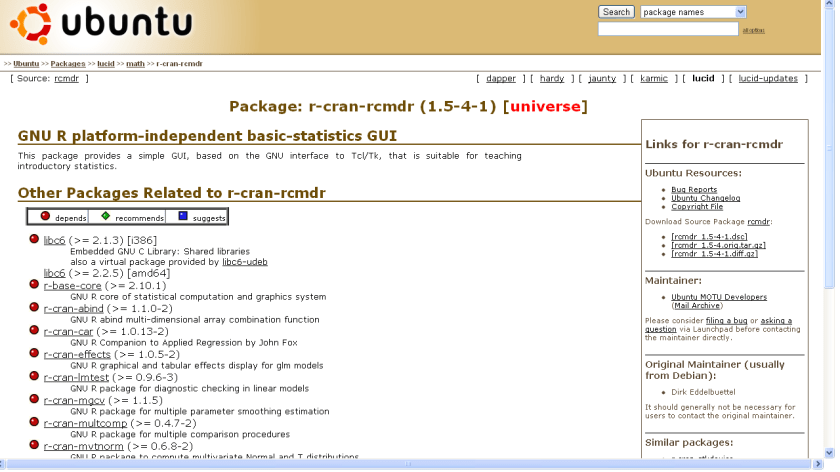
And Ubuntu also has great support for R (particularly the single click R Commander Install and Icon) available at http://packages.ubuntu.com/lucid/math/r-cran-rcmdr

Kill R? Wait a sec

1) Is R efficient? (scripting wise, and performance wise) _ Depends on how you code it- some Packages like foreach can help but basic efficiency come from programmer. XDF formats from Revoscalar -the non open R package further improve programming efficiency

2) Should R be written from scratch?

You got to be kidding- It depends on how you define scratch after 2 million users

This has been done with S, then S Plus and now R.

3) What should be the license of R (if it was made a new)?

GPL license is fine. You need to do a better job of executing the license. Currently interfaces to R exist from SPSS, SAS, KXEN , other companies as well. To my knowledge royalty payments as well as formal code sharing does not agree.

R core needs to do a better job of protecting the work of 2500 package-creators rather than settling for a few snacks at events, sponsorships, Corporate Board Membership for Prof Gentleman, and 4-5 packages donated to it. The only way R developers can currently support their research is write a book (ny Springer mostly)

Eg GGplot and Hmisc are likely to be used more by average corporate user. Do their creators deserve royalty if creators of RevoScalar are getting it?

If some of 2 million users gave 1 $ to R core (compared to 9 million in last round of funding in Revolution Analytics)- you would have enough money to create a 64 bit optimized R for Linux (missing in Enterprise R), Amazon R APIs (like Karim Chine’s efforts), R GUIs (like Rattle’s commercial version) etc etc

The developments are not surprising given that Microsoft and Intel are funding Revolution Analytics http://www.dudeofdata.com/?p=1967

R controversies come and go (this has happened before including the NYT article and shakeup at Revo)

An interesting debate on whether R should be killed to make an upgrade to a more efficient language.

From Tal (creator R Bloggers) and on R help list-

There is currently a (very !) lively discussions happening around the web, surrounding the following topics:
1) Is R efficient? (scripting wise, and performance wise)
2) Should R be written from scratch?
3) What should be the license of R (if it was made a new)?

Very serious people have taken part in the debates so far.  I hope to let you know of the places I came by, so you might be able to follow/participate
in these (IMHO) important discussions.

The discussions started in the response for the following blog post on
Xi’An’s blog:
http://xianblog.wordpress.com/2010/09/06/insane/


Followed by the (short) response post by Ross Ihaka:
http://xianblog.wordpress.com/2010/09/13/simply-start-over-and-build-something-better/


Other discussions started to appear on Andrew Gelman’s blog:
http://www.stat.columbia.edu/~cook/movabletype/archives/2010/09/ross_ihaka_to_r.html

And (many) more responses started to appear in the hackers news website:
http://news.ycombinator.com/item?id=1687054

I hope these discussions will have fruitful results for our community,
Tal

—————-Contact
Details:——————————————————-
Contact me: Tal.Galili@gmail.com |  972-52-7275845
Read me: www.talgalili.com (Hebrew) | www.biostatistics.co.il (Hebrew) |
www.r-statistics.com (English)

My 0 cents ( see it would 2 cents but it;s free)

Amazon announces Micro Instances for cloud computing

From Amazon http://aws.amazon.com/ec2

Micro instances provide 613 MB of memory and support 32-bit and 64-bit platforms on both Linux and Windows. Micro instance pricing for On-Demand instances starts at $0.02 per hour for Linux and $0.03 per hour for Windows.

Customers have asked us for a lower priced instance type that could satisfy the needs of their less demanding applications. Micro instances are optimized for applications that require lower throughput, but which still may consume significant compute cycles periodically. Micro instances provide a small amount of consistent CPU resources, and also allow you to burst CPU capacity when additional cycles are available.

Micro instances are available immediately in all regions, and we invite you to go and try one out for yourself today! Learn more about Amazon EC2’s new Micro instances ataws.amazon.com/ec2.

Micro Instances

Instances of this family provide a small amount of consistent CPU resources and allow you to burst CPU capacity when additional cycles are available. They are well suited for lower throughput applications and web sites that consume significant compute cycles periodically.

  • Micro Instance 613 MB of memory, up to 2 ECUs (for short periodic bursts), EBS storage only, 32-bit or 64-bit platform

So dont buy that new CPU yet- use existing hardware in tandem with these micro instances (and internet) to compute- (but  only if your corporate IP administrator wasn’t trained in Windows only certifications 😉

Big Data and R: New Product Release by Revolution Analytics

Press Release by the Guys in Revolution Analytics- this time claiming to enable terabyte level analytics with R. Interesting stuff but techie details are awaited.

Revolution Analytics Brings

Big Data Analysis to R

The world’s most powerful statistics language can now tackle terabyte-class data sets using

Revolution R Enterpriseat a fraction of the cost of legacy analytics products


JSM 2010 – VANCOUVER (August 3, 2010) — Revolution Analytics today introduced ‘Big Data’ analysis to its Revolution R Enterprise software, taking the popular R statistics language to unprecedented new levels of capacity and performance for analyzing very large data sets. For the first time, R users will be able to process, visualize and model terabyte-class data sets in a fraction of the time of legacy products—without employing expensive or specialized hardware.

The new version of Revolution R Enterprise introduces an add-on package called RevoScaleR that provides a new framework for fast and efficient multi-core processing of large data sets. It includes:

  • The XDF file format, a new binary ‘Big Data’ file format with an interface to the R language that provides high-speed access to arbitrary rows, blocks and columns of data.
  • A collection of widely-used statistical algorithms optimized for Big Data, including high-performance implementations of Summary Statistics, Linear Regression, Binomial Logistic Regressionand Crosstabs—with more to be added in the near future.
  • Data Reading & Transformation tools that allow users to interactively explore and prepare large data sets for analysis.
  • Extensibility, expert R users can develop and extend their own statistical algorithms to take advantage of Revolution R Enterprise’s new speed and scalability capabilities.

“The R language’s inherent power and extensibility has driven its explosive adoption as the modern system for predictive analytics,” said Norman H. Nie, president and CEO of Revolution Analytics. “We believe that this new Big Data scalability will help R transition from an amazing research and prototyping tool to a production-ready platform for enterprise applications such as quantitative finance and risk management, social media, bioinformatics and telecommunications data analysis.”

Sage Bionetworks is the nonprofit force behind the open-source collaborative effort, Sage Commons, a place where data and disease models can be shared by scientists to better understand disease biology. David Henderson, Director of Scientific Computing at Sage, commented: “At Sage Bionetworks, we need to analyze genomic databases hundreds of gigabytes in size with R. We’re looking forward to using the high-speed data-analysis features of RevoScaleR to dramatically reduce the times it takes us to process these data sets.”

Take Hadoop and Other Big Data Sources to the Next Level

Revolution R Enterprise fits well within the modern ‘Big Data’ architecture by leveraging popular sources such as Hadoop, NoSQL or key value databases, relational databases and data warehouses. These products can be used to store, regularize and do basic manipulation on very large datasets—while Revolution R Enterprise now provides advanced analytics at unparalleled speed and scale: producing speed on speed.

“Together, Hadoop and R can store and analyze massive, complex data,” said Saptarshi Guha, developer of the popular RHIPE R package that integrates the Hadoop framework with R in an automatically distributed computing environment. “Employing the new capabilities of Revolution R Enterprise, we will be able to go even further and compute Big Data regressions and more.”

Platforms and Availability

The new RevoScaleR package will be delivered as part of Revolution R Enterprise 4.0, which will be available for 32-and 64-bit Microsoft Windows in the next 30 days. Support for Red Hat Enterprise Linux (RHEL 5) is planned for later this year.

On its website (http://www.revolutionanalytics.com/bigdata), Revolution Analytics has published performance and scalability benchmarks for Revolution R Enterprise analyzing a 13.2 gigabyte data set of commercial airline information containing more than 123 million rows, and 29 columns.

Additionally, the company will showcase its new Big Data solution in a free webinar on August 25 at 9:00 a.m. Pacific.

Additional Resources

•      Big Data Benchmark whitepaper

•      The Revolution Analytics Roadmap whitepaper

•      Revolutions Blog

•      Download free academic copy of Revolution R Enterprise

•      Visit Inside-R.org for the most comprehensive set of information on R

•      Spread the word: Add a “Download R!” badge on your website

•      Follow @RevolutionR on Twitter

About Revolution Analytics

Revolution Analytics (http://www.revolutionanalytics.com) is the leading commercial provider of software and support for the popular open source R statistics language. Its Revolution R products help make predictive analytics accessible to every type of user and budget. The company is headquartered in Palo Alto, Calif. and backed by North Bridge Venture Partners and Intel Capital.

Media Contact

Chantal Yang
Page One PR, for Revolution Analytics
Tel: +1 415-875-7494

Email:  revolution@pageonepr.com

New Year Resolution Presentation

Here is a short clip I made using two softwares-

1) Prezi Desktop

This is an innovative single slide way of creating macromedia presentations. Recommended for offbeat new look presentations.

2) Xvidcap screencapture- For capturing and creating a video based on screen capture. This is the Linux Version of Camtasia- there is only one drawback the default rate is a bit fast- so audio and frame capture settings in a multi frame need to be tweaked.

3) I Phone- For Photography- It’s still the handiest camera around.

(Note- The Collage and Presentation are works of fiction)

WHAT I DID IN 2009 THAT I DONT WANT TO DO IN 2010

and here is a more offbeat version