Updated Interview Elissa Fink -VP Tableau Software

Here is an interview with Elissa Fink, VP Marketing of that new wonderful software called Tableau that makes data visualization so nice and easy to learn and work with.

Elissa Fink, VP, Marketing

Ajay-  Describe your career journey from high school to over 20 plus years in marketing. What are the various trends that you have seen come and go in marketing.

Elissa- I studied literature and linguistics in college and didn’t discover analytics until my first job selling advertising for the Wall Street Journal. Oddly enough, the study of linguistics is not that far from decision analytics: they both are about taking a structured view of information and trying to see and understand common patterns. At the Journal, I was completely captivated analyzing and comparing readership data. At the same time, the idea of using computers in marketing was becoming more common. I knew that the intersection of technology and marketing was going to radically change things – how we understand consumers, how we market and sell products, and how we engage with customers. So from that point on, I’ve always been focused on technology and marketing, whether it’s working as a marketer at technology companies or applying technology to marketing problems for other types of companies.  There have been so many interesting trends. Taking a long view, a key trend I’ve noticed is how marketers work to understand, influence and motivate consumer behavior. We’ve moved marketing from where it was primarily unpredictable, qualitative and aimed at talking to mass audiences, where the advertising agency was king. Now it’s a discipline that is more data-driven, quantitative and aimed at conversations with individuals, where the best analytics wins. As with any trend, the pendulum swings far too much to either side causing backlashes but overall, I think we are in a great place now. We are using data-driven analytics to understand consumer behavior. But pure analytics is not the be-all, end-all; good marketing has to rely on understanding human emotions, intuition and gut feel – consumers are far from rational so taking only a rational or analytical view of them will never explain everything we need to know.

Ajay- Do you think technology companies are still predominantly dominated by men . How have you seen diversity evolve over the years. What initiatives has Tableau taken for both hiring and retaining great talent.

Elissa- The thing I love about the technology industry is that its key success metrics – inventing new products that rapidly gain mass adoption in pursuit of making profit – are fairly objective. There’s little subjective nature to the counting of dollars collected selling a product and dollars spent building a product. So if a female can deliver a better product and bigger profits faster and better, then that female is going to get the resources, jobs, power and authority to do exactly that. That’s not to say that the technology industry is gender-blind, race-blind, etc. It isn’t – technology is far from perfect. For example, the industry doesn’t have enough diversity in positions of power. But I think overall, in comparison to a lot of other industries, it’s pretty darn good at giving people with great ideas the opportunities to realize their visions regardless of their backgrounds or characteristics.

At Tableau, we are very serious about bringing in and developing talented people – they are the key to our growth and success. Hiring is our #1 initiative so we’ve spent a lot of time and energy both on finding great candidates and on making Tableau a place that they want to work. This includes things like special recruiting events, employee referral programs, a flexible work environment, fun social events, and the rewards of working for a start-up. Probably our biggest advantage is the company itself – working with people you respect on amazing, cutting-edge products that delight customers and are changing the world is all too rare in the industry but a reality at Tableau. One of our senior software developers put it best when he wrote “The emphasis is on working smarter rather than longer: family and friends are why we work, not the other way around. Tableau is all about happy, energized employees executing at the highest level and delivering a highly usable, high quality, useful product to our customers.” People who want to be at a place like that should check out our openings at http://www.tableausoftware.com/jobs.

Ajay- What are most notable features in tableau’s latest edition. What are the principal software that competes with Tableau Software products and how would you say Tableau compares with them.

Elissa- Tableau 6.1 will be out in July and we are really excited about it for 3 reasons.

First, we’re introducing our mobile business intelligence capabilities. Our customers can have Tableau anywhere they need it. When someone creates an interactive dashboard or analytical application with Tableau and it’s viewed on a mobile device, an iPad in particular, the viewer will have a native, touch-optimized experience. No trying to get your fingertips to act like a mouse. And the author didn’t have to create anything special for the iPad; she just creates her analytics the usual way in Tableau. Tableau knows the dashboard is being viewed on an iPad and presents an optimized experience.

Second, we’ve take our in-memory analytics engine up yet another level. Speed and performance are faster and now people can update data incrementally rapidly. Introduced in 6.0, our data engine makes any data fast in just a few clicks. We don’t run out of memory like other applications. So if I build an incredible dashboard on my 8-gig RAM PC and you try to use it on your 2-gig RAM laptop, no problem.

And, third, we’re introducing more features for the international markets – including French and German versions of Tableau Desktop along with more international mapping options.  It’s because we are constantly innovating particularly around user experience that we can compete so well in the market despite our relatively small size. Gartner’s seminal research study about the Business Intelligence market reported a massive market shift earlier this year: for the first time, the ease-of-use of a business intelligence platform was more important than depth of functionality. In other words, functionality that lots of people can actually use is more important than having sophisticated functionality that only specialists can use. Since we focus so heavily on making easy-to-use products that help people rapidly see and understand their data, this is good news for our customers and for us.

Ajay-  Cloud computing is the next big thing with everyone having a cloud version of their software. So how would you run Cloud versions of Tableau Server (say deploying it on an Amazon Ec2  or a private cloud)

Elissa- In addition to the usual benefits espoused about Cloud computing, the thing I love best is that it makes data and information more easily accessible to more people. Easy accessibility and scalability are completely aligned with Tableau’s mission. Our free product Tableau Public and our product for commercial websites Tableau Digital are two Cloud-based products that deliver data and interactive analytics anywhere. People often talk about large business intelligence deployments as having thousands of users. With Tableau Public and Tableau Digital, we literally have millions of users. We’re serving up tens of thousands of visualizations simultaneously – talk about accessibility and scalability!  We have lots of customers connecting to databases in the Cloud and running Tableau Server in the Cloud. It’s actually not complex to set up. In fact, we focus a lot of resources on making installation and deployment easy and fast, whether it’s in the cloud, on premise or what have you. We don’t want people to have spend weeks or months on massive roll-out projects. We want it to be minutes, hours, maybe a day or 2. With the Cloud, we see that people can get started and get results faster and easier than ever before. And that’s what we’re about.

Ajay- Describe some of the latest awards that Tableau has been wining. Also how is Tableau helping universities help address the shortage of Business Intelligence and Big Data professionals.

Elissa-Tableau has been very fortunate. Lately, we’ve been acknowledged by both Gartner and IDC as the fastest growing business intelligence software vendor in the world. In addition, our customers and Tableau have won multiple distinctions including InfoWorld Technology Leadership awards, Inc 500, Deloitte Fast 500, SQL Server Magazine Editors’ Choice and Community Choice awards, Data Hero awards, CODiEs, American Business Awards among others. One area we’re very passionate about is academia, participating with professors, students and universities to help build a new generation of professionals who understand how to use data. Data analysis should not be exclusively for specialists. Everyone should be able to see and understand data, whatever their background. We come from academic roots, having been spun out of a Stanford research project. Consequently, we strongly believe in supporting universities worldwide and offer 2 academic programs. The first is Tableau For Teaching, where any professor can request free term-length licenses of Tableau for academic instruction during his or her courses. And, we offer a low-cost Student Edition of Tableau so that students can choose to use Tableau in any of their courses at any time.

Elissa Fink, VP Marketing,Tableau Software


Elissa Fink is Tableau Software’s Vice President of Marketing. With 20+ years helping companies improve their marketing operations through applied data analysis, Elissa has held executive positions in marketing, business strategy, product management, and product development. Prior to Tableau, Elissa was EVP Marketing at IXI Corporation, now owned by Equifax. She has also served in executive positions at Tele Atlas (acquired by TomTom), TopTier Software (acquired by SAP), and Nielsen/Claritas. Elissa also sold national advertising for the Wall Street Journal. She’s a frequent speaker and has spoken at conferences including the DMA, the NCDM, Location Intelligence, the AIR National Forum and others. Elissa is a graduate of Santa Clara University and holds an MBA in Marketing and Decision Systems from the University of Southern California.

Elissa first discovered Tableau late one afternoon at her previous company. Three hours later, she was still “at play” with her data. “After just a few minutes using the product, I was getting answers to questions that were taking my company’s programmers weeks to create. It was instantly obvious that Tableau was on a special mission with something unique to offer the world. I just had to be a part of it.”

To know more – read at http://www.tableausoftware.com/

and existing data viz at http://www.tableausoftware.com/learn/gallery

Storm seasons: measuring and tracking key indicators
What’s happening with local real estate prices?
How are sales opportunities shaping up?
Identify your best performing products
Applying user-defined parameters to provide context
Not all tech companies are rocket ships
What’s really driving the economy?
Considering factors and industry influencers
The complete orbit along the inside, or around a fixed circle
How early do you have to be at the airport?
What happens if sales grow but so does customer churn?
What are the trends for new retail locations?
How have student choices changed?
Do patients who disclose their HIV status recover better?
Closer look at where gas prices swing in areas of the U.S.
U.S. Census data shows more women of greater age
Where do students come from and how does it affect their grades?
Tracking customer service effectiveness
Comparing national and local test scores
What factors correlate with high overall satisfaction ratings?
Fund inflows largely outweighed outflows well after the bubble
Which programs are competing for federal stimulus dollars?
Oil prices and volatility
A classic candlestick chart
How do oil, gold and CPI relate to the GDP growth rate?


Amazon Ec2 goes Red Hat

message from Amazing Amazon’s cloud team- this will also help for #rstats users given that revolution Analytics full versions on RHEL.

—————————————————-

on-demand instances of Amazon EC2 running Red Hat Enterprise Linux (RHEL) for as little as $0.145 per instance hour. The offering combines the cost-effectiveness, scalability and flexibility of running in Amazon EC2 with the proven reliability of Red Hat Enterprise Linux.

Highlights of the offering include:

  • Support is included through subscription to AWS Premium Support with back-line support by Red Hat
  • Ongoing maintenance, including security patches and bug fixes, via update repositories available in all Amazon EC2 regions
  • Amazon EC2 running RHEL currently supports RHEL 5.5, RHEL 5.6, RHEL 6.0 and RHEL 6.1 in both 32 bit and 64 bit formats, and is available in all Regions.
  • Customers who already own Red Hat licenses will continue to be able to use those licenses at no additional charge.
  • Like all services offered by AWS, Amazon EC2 running Red Hat Enterprise Linux offers a low-cost, pay-as-you-go model with no long-term commitments and no minimum fees.

For more information, please visit the Amazon EC2 Red Hat Enterprise Linux page.

which is

Amazon EC2 Running Red Hat Enterprise Linux

Amazon EC2 running Red Hat Enterprise Linux provides a dependable platform to deploy a broad range of applications. By running RHEL on EC2, you can leverage the cost effectiveness, scalability and flexibility of Amazon EC2, the proven reliability of Red Hat Enterprise Linux, and AWS premium support with back-line support from Red Hat.. Red Hat Enterprise Linux on EC2 is available in versions 5.5, 5.6, 6.0, and 6.1, both in 32-bit and 64-bit architectures.

Amazon EC2 running Red Hat Enterprise Linux provides seamless integration with existing Amazon EC2 features including Amazon Elastic Block Store (EBS), Amazon CloudWatch, Elastic-Load Balancing, and Elastic IPs. Red Hat Enterprise Linux instances are available in multiple Availability Zones in all Regions.

Sign Up

Pricing

Pay only for what you use with no long-term commitments and no minimum fee.

On-Demand Instances

On-Demand Instances let you pay for compute capacity by the hour with no long-term commitments.

Region:US – N. VirginiaUS – N. CaliforniaEU – IrelandAPAC – SingaporeAPAC – Tokyo
Standard Instances Red Hat Enterprise Linux
Small (Default) $0.145 per hour
Large $0.40 per hour
Extra Large $0.74 per hour
Micro Instances Red Hat Enterprise Linux
Micro $0.08 per hour
High-Memory Instances Red Hat Enterprise Linux
Extra Large $0.56 per hour
Double Extra Large $1.06 per hour
Quadruple Extra Large $2.10 per hour
High-CPU Instances Red Hat Enterprise Linux
Medium $0.23 per hour
Extra Large $0.78 per hour
Cluster Compute Instances Red Hat Enterprise Linux
Quadruple Extra Large $1.70 per hour
Cluster GPU Instances Red Hat Enterprise Linux
Quadruple Extra Large $2.20 per hour

Pricing is per instance-hour consumed for each instance type. Partial instance-hours consumed are billed as full hours.

↑ Top

and

Available Instance Types

Standard Instances

Instances of this family are well suited for most applications.

Small Instance – default*

1.7 GB memory
1 EC2 Compute Unit (1 virtual core with 1 EC2 Compute Unit)
160 GB instance storage
32-bit platform
I/O Performance: Moderate
API name: m1.small

Large Instance

7.5 GB memory
4 EC2 Compute Units (2 virtual cores with 2 EC2 Compute Units each)
850 GB instance storage
64-bit platform
I/O Performance: High
API name: m1.large

Extra Large Instance

15 GB memory
8 EC2 Compute Units (4 virtual cores with 2 EC2 Compute Units each)
1,690 GB instance storage
64-bit platform
I/O Performance: High
API name: m1.xlarge

Micro Instances

Instances of this family provide a small amount of consistent CPU resources and allow you to burst CPU capacity when additional cycles are available. They are well suited for lower throughput applications and web sites that consume significant compute cycles periodically.

Micro Instance

613 MB memory
Up to 2 EC2 Compute Units (for short periodic bursts)
EBS storage only
32-bit or 64-bit platform
I/O Performance: Low
API name: t1.micro

High-Memory Instances

Instances of this family offer large memory sizes for high throughput applications, including database and memory caching applications.

High-Memory Extra Large Instance

17.1 GB of memory
6.5 EC2 Compute Units (2 virtual cores with 3.25 EC2 Compute Units each)
420 GB of instance storage
64-bit platform
I/O Performance: Moderate
API name: m2.xlarge

High-Memory Double Extra Large Instance

34.2 GB of memory
13 EC2 Compute Units (4 virtual cores with 3.25 EC2 Compute Units each)
850 GB of instance storage
64-bit platform
I/O Performance: High
API name: m2.2xlarge

High-Memory Quadruple Extra Large Instance

68.4 GB of memory
26 EC2 Compute Units (8 virtual cores with 3.25 EC2 Compute Units each)
1690 GB of instance storage
64-bit platform
I/O Performance: High
API name: m2.4xlarge

High-CPU Instances

Instances of this family have proportionally more CPU resources than memory (RAM) and are well suited for compute-intensive applications.

High-CPU Medium Instance

1.7 GB of memory
5 EC2 Compute Units (2 virtual cores with 2.5 EC2 Compute Units each)
350 GB of instance storage
32-bit platform
I/O Performance: Moderate
API name: c1.medium

High-CPU Extra Large Instance

7 GB of memory
20 EC2 Compute Units (8 virtual cores with 2.5 EC2 Compute Units each)
1690 GB of instance storage
64-bit platform
I/O Performance: High
API name: c1.xlarge

Cluster Compute Instances

Instances of this family provide proportionally high CPU resources with increased network performance and are well suited for High Performance Compute (HPC) applications and other demanding network-bound applications. Learn more about use of this instance type for HPC applications.

Cluster Compute Quadruple Extra Large Instance

23 GB of memory
33.5 EC2 Compute Units (2 x Intel Xeon X5570, quad-core “Nehalem” architecture)
1690 GB of instance storage
64-bit platform
I/O Performance: Very High (10 Gigabit Ethernet)
API name: cc1.4xlarge

Cluster GPU Instances

Instances of this family provide general-purpose graphics processing units (GPUs) with proportionally high CPU and increased network performance for applications benefitting from highly parallelized processing, including HPC, rendering and media processing applications. While Cluster Compute Instances provide the ability to create clusters of instances connected by a low latency, high throughput network, Cluster GPU Instances provide an additional option for applications that can benefit from the efficiency gains of the parallel computing power of GPUs over what can be achieved with traditional processors. Learn more about use of this instance type for HPC applications.

Cluster GPU Quadruple Extra Large Instance

22 GB of memory
33.5 EC2 Compute Units (2 x Intel Xeon X5570, quad-core “Nehalem” architecture)
2 x NVIDIA Tesla “Fermi” M2050 GPUs
1690 GB of instance storage
64-bit platform
I/O Performance: Very High (10 Gigabit Ethernet)
API name: cg1.4xlarge


Getting Started

To get started using Red Hat Enterprise Linux on Amazon EC2, perform the following steps:

  • Open and log into the AWS Management Console
  • Click on Launch Instance from the EC2 Dashboard
  • Select the Red Hat Enterprise Linux AMI from the QuickStart tab
  • Specify additional details of your instance and click Launch
  • Additional details can be found on each AMI’s Catalog Entry page

The AWS Management Console is an easy tool to start and manage your instances. If you are looking for more details on launching an instance, a quick video tutorial on how to use Amazon EC2 with the AWS Management Console can be found here .
A full list of Red Hat Enterprise Linux AMIs can be found in the AWS AMI Catalog.

↑ Top


Support

All customers running Red Hat Enterprise Linux on EC2 will receive access to repository updates from Red Hat. Moreover, AWS Premium support customers can contact AWS to get access to a support structure from both Amazon and Red Hat.

↑ Top


Resources

↑ Top


About Red Hat

Red Hat, the world’s leading open source solutions provider, is headquartered in Raleigh, NC with over 50 satellite offices spanning the globe. Red Hat provides high-quality, low-cost technology with its operating system platform, Red Hat Enterprise Linux, together with applications, management and Services Oriented Architecture (SOA) solutions, including the JBoss Enterprise Middleware Suite. Red Hat also offers support, training and consulting services to its customers worldwide.


also from Revolution Analytics- in case you want to #rstats in the cloud and thus kill all that talk of RAM dependency, slow R than other softwares (just increase the RAM above in the instances to keep it simple)

,or Revolution not being open enough

http://www.revolutionanalytics.com/downloads/gpl-sources.php

GPL SOURCES

Revolution Analytics uses an Open-Core Licensing model. We provide open- source R bundled with proprietary modules from Revolution Analytics that provide additional functionality for our users. Open-source R is distributed under the GNU Public License (version 2), and we make our software available under a commercial license.

Revolution Analytics respects the importance of open source licenses and has contributed code to the open source R project and will continue to do so. We have carefully reviewed our compliance with GPLv2 and have worked with Mark Radcliffe of DLA Piper, the outside General Legal Counsel of the Open Source Initiative, to ensure that we fully comply with the obligations of the GPLv2.

For our Revolution R distribution, we may make some minor modifications to the R sources (the ChangeLog file lists all changes made). You can download these modified sources of open-source R under the terms of the GPLv2, using either the links below or those in the email sent to you when you download a specific version of Revolution R.

Download GPL Sources

Product Version Platform Modified R Sources
Revolution R Community 3.2 Windows R 2.10.1
Revolution R Community 3.2 MacOS R 2.10.1
Revolution R Enterprise 3.1.1 RHEL R 2.9.2
Revolution R Enterprise 4.0 Windows R 2.11.1
Revolution R Enterprise 4.0.1 RHEL R 2.11.1
Revolution R Enterprise 4.1.0 Windows R 2.11.1
Revolution R Enterprise 4.2 Windows R 2.11.1
Revolution R Enterprise 4.2 RHEL R 2.11.1
Revolution R Enterprise 4.3 Windows & RHEL R 2.12.2


Calling #Rstats lovers and bloggers – to work together on “The R Programming wikibook”

so you think u like R, huh. Well it is time to pay it forward.

Message from a dear R blogger, Tal G from Tel Aviv (creator of R-bloggers.com and SAS-X.com)

———————————————————————————————————-
Calling R lovers and bloggers – to work together on “The R Programming wikibook”
Posted: 20 Jun 2011 07:05 AM PDT

This post is a call for both R community members and R-bloggers, to come and help make The R Programming wikibook be amazing:

Dear R community member – please consider giving a visit to The R Programming wikibook. If you wish to contribute your knowledge and editing skills to the project, then you could learn how to write in wiki-markup here, and how to edit a wikibook here (you can even use R syntax highlighting in the wikibook). You could take information into the site from the (soon to be) growing list of available R resources for harvesting.

Dear R blogger, you can help The R Programming wikibook by doing the following:

Write to your readers about the project and invite them to join.
Add your blog’s R content as an available resource for other editors to use for the wikibook. Here is how to do that:
First, make a clear indication on your blog that your content is licensed under cc-by-sa copyrights (*see what it means at the end of the post). You can do this by adding it to the footer of your blog, or by writing a post that clearly states that this is the case (what a great opportunity to write to your readers about the project…).
Next, go and add a link, to where all of your R content is located on your site, to the resource page (also with a link to the license post, if you wrote one). For example, since I write about other things besides R, I would give a link to my R category page, and will also give a link to this post. If you do not know how to add it to the wiki, just e-mail me about it (tal.galili@gmail.com).
If you are an R blogger, besides living up to the spirit of the R community, you will benefit from joining this project in that every time someone will use your content on the wikibook, they will add your post as a resource. In the long run, this is likely to help visitors of the site get to know about you and strengthen your site’s SEO ranking. Which reminds me, if you write about this, I always appreciate a link back to my blog

* Having a cc-by-sa copyrights means that you will agree that anyone may copy, distribute, display, and make derivative works based on your content, only if they give the author (you) the credits in the manner specified by you. And also that the user may distribute derivative works only under a license identical to the license that governs the original work.

———-

Three more points:

1) This post is a result of being contacted by Paul (a.k.a: PAC2), asking if I could help promote “The R Programming wikibook” among R-bloggers and their readers. Paul has made many contributions to the book so far. So thank you Paul for both reaching out and helping all of us with your work on this free open source project.

2) I should also mention that the R wiki exists and is open for contribution. And naturally, every thing that will help the R wikibook will help the R wiki as well.

3) Copyright notice: I hereby release all of the writing material content that is categoriesed in the R category page, under the cc-by-sa copyrights (date: 20.06.2011). Now it’s your turn!

———-

List of R bloggers who have joined: (This list will get updated as this “group writing” project will progress)

R-statistics blog (that’s Tal…)
Decisionstats.com (That’s me)
……………………………………………………………………………….
3) Copyright notice: I hereby release all of the writing material content of this website, under the cc-by-sa copyrights (date: 21.06.2011). Now it’s your turn!

https://decisionstats.com/privacy-3/

Content Licensing-
This website has all content licensed under
http://creativecommons.org/licenses/by-sa/3.0/
You are free:
to Share — to copy, distribute and transmit the work
to Remix — to adapt the work

Tools for Hackers:Beginners

How to disguise your IP Address from your most wonderful glorious leaders-

From


https://www.torproject.org/projects/torbrowser.html.en

Tor Browser Bundle


The Tor software protects you by bouncing your communications around a distributed network of relays run by volunteers all around the world: it prevents somebody watching your Internet connection from learning what sites you visit, it prevents the sites you visit from learning your physical location, and it lets you access sites which are blocked.

The Tor Browser Bundle lets you use Tor on Windows, Mac OS X, or Linux without needing to install any software. It can run off a USB flash drive, comes with a pre-configured web browser, and is self-contained. The Tor IM Browser Bundleadditionally allows instant messaging and chat over Tor. If you would prefer to use your existing web browser, install Tor permanently, or if you don’t use Windows, see the other ways to download Tor.

Freedom House has produced a video on how to find and use the Tor Browser Bundle. If you don’t see a video below, view it at Youtube . Know of a better video or one translated into your language? Let us know!


and if you now want to see or check your own website for a Denial of Service attack , download this

http://sourceforge.net/projects/loic/

This is the software for which 32 Turkish teenagers got arrested for bringing down their govt websites. Do NOT USE it for ILLEGAL purposes,

because 1) it is hosted on a western website that due to Patriot Act would tracking downloads as well as most likely be inserting some logging code into your computer (especially if you are still on Windows)

2) Turkey being a NATO member got rather immediate notice of this – which makes it very likely that this tool is compromised in the Western Hemisphere. You can probably use this in Eastern Hemisphere country excluding Israel, Turkey, China, India ,Korea or Japan because these countries do have sophisticated hackers working for the government as well.

3) This is just a beginners tool to understand how flooding a website with requests work.

http://sourceforge.net/projects/loic/files/

Basically download, unzip the file

Enter URL and click Lock on to know IP address.

use HTTP Method. Make say 1000 threads.

Then press the IMMA CHARGING MY LAZER big button.

Note the Failed Tab tells you how good or bad this method is.

Note – it wont work on my blogs hosted on wordpress.com- but then those blogs had a root level breach some time back. It did work on both my blogspot and my tumblr blogs, and it completely shattered my son’s self hosted wordpress blog (see below)


Why open source companies dont dance?

I have been pondering on this seemingly logical paradox for some time now-

1) Why are open source solutions considered technically better but not customer friendly.

2) Why do startups and app creators in social media or mobile get much more press coverage than

profitable startups in enterprise software.

3) How does tech journalism differ in covering open source projects in enterprise versus retail software.

4) What are the hidden rules of the game of enterprise software.

Some observations-

1) Open source companies often focus much more on technical community management and crowd sourcing code. Traditional software companies focus much more on managing the marketing community of customers and influencers. Accordingly the balance of power is skewed in favor of techies and R and D in open source companies, and in favor of marketing and analyst relations in traditional software companies.

Traditional companies also spend much more on hiring top notch press release/public relationship agencies, while open source companies are both financially and sometimes ideologically opposed to older methods of marketing software. The reverse of this is you are much more likely to see Videos and Tutorials by an open source company than a traditional company. You can compare the websites of ClouderaDataStax, Hadapt ,Appistry and Mapr and contrast that with Teradata or Oracle (which has a much bigger and much more different marketing strategy.

Social media for marketing is also more efficiently utilized by smaller companies (open source) while bigger companies continue to pay influential analysts for expensive white papers that help present the brand.

Lack of budgets is a major factor that limits access to influential marketing for open source companies particularly in enterprise software.

2 and 3) Retail software is priced at 2-100$ and sells by volume. Accordingly technology coverage of these software is based on volume.

Enterprise software is much more expensively priced and has much more discreet volume or sales points. Accordingly the technology coverage of enterprise software is more discreet, in terms of a white paper coming every quarter, a webinar every month and a press release every week. Retail software is covered non stop , but these journalists typically do not charge for “briefings”.

Journalists covering retail software generally earn money by ads or hosting conferences. So they have an interest in covering new stuff or interesting disruptive stuff. Journalists or analysts covering enterprise software generally earn money by white papers, webinars, attending than hosting conferences, writing books. They thus have a much stronger economic incentive to cover existing landscape and technologies than smaller startups.

4) What are the hidden rules of the game of enterprise software.

  • It is mostly a white man’s world. this can be proved by statistical demographic analysis
  • There is incestuous intermingling between influencers, marketers, and PR people. This can be proved by simple social network analysis of who talks to who and how much. A simple time series between sponsorship and analysts coverage also will prove this (I am working on quantifying this ).
  • There are much larger switching costs to enterprise software than retail software. This leads to legacy shoddy software getting much chances than would have been allowed in an efficient marketplace.
  • Enterprise software is a less efficient marketplace than retail software in all definitions of the term “efficient markets”
  • Cloud computing, and SaaS and Open source threatens to disrupt the jobs and careers of a large number of people. In the long term, they will create many more jobs, but in the short term, people used to comfortable living of enterprise software (making,selling,or writing) will actively and passively resist these changes to the  paradigms in the current software status quo.
  • Open source companies dont dance and dont play ball. They prefer to hire 4 more college grads than commission 2 more white papers.

and the following with slight changes from a comment I made on a fellow blog-

  • While the paradigm on how to create new software has evolved from primarily silo-driven R and D departments to a broader collaborative effort, the biggest drawback is software marketing has not evolved.
  • If you want your own version of the open source community editions to be more popular, some standardization is necessary for the corporate decision makers, and we need better marketing paradigms.
  • While code creation is crowdsourced, solution implementation cannot be crowdsourced. Customers want solutions to a problem not code.
  • Just as open source as a production and licensing paradigm threatens to disrupt enterprise software, it will lead to newer ways to marketing software given the hostility of existing status quo.


How to make a bomb

A trip-wire triggered pipe bomb mock-up used t...
Image via Wikipedia

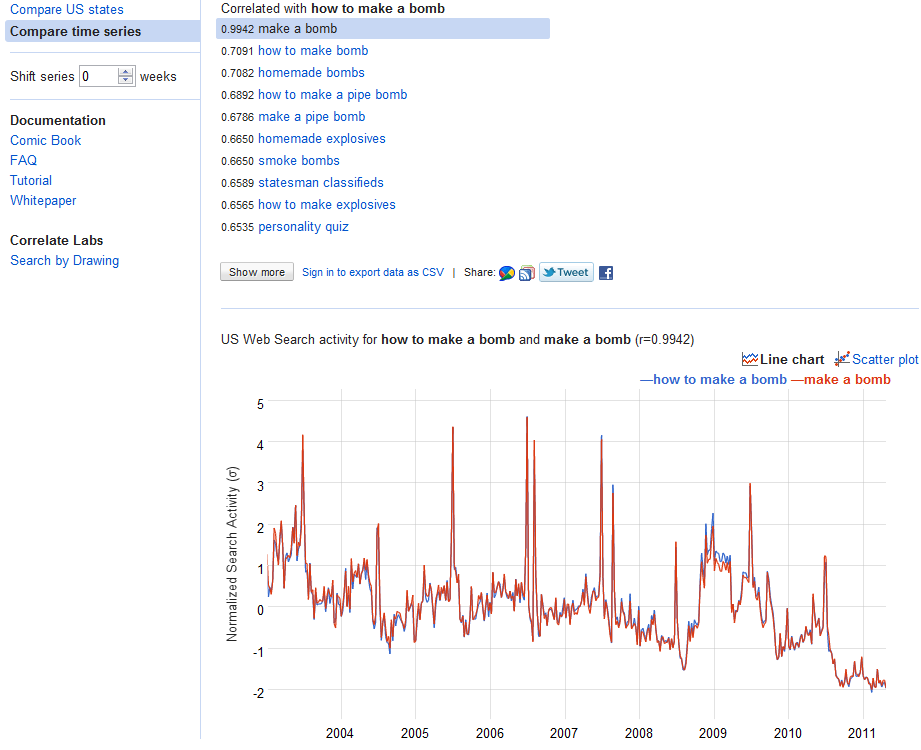
How to make a bomb search activity using Google CoRelate

First we search for how to make a bomb, it seems this has annual spikes.

http://correlate.googlelabs.com/search?e=how+to+make+a+bomb&t=weekly

Then we shift series by 6 weeks, assuming the dumbass takes 6 weeks to actually make the bomb.

http://correlate.googlelabs.com/search?e=how+to+make+a+bomb&t=weekly&shift=6

Note -corelation between making pipe bombs and tattoo art is not the same as causation. corelation is not causation unless google comes out with http://causation.google.com

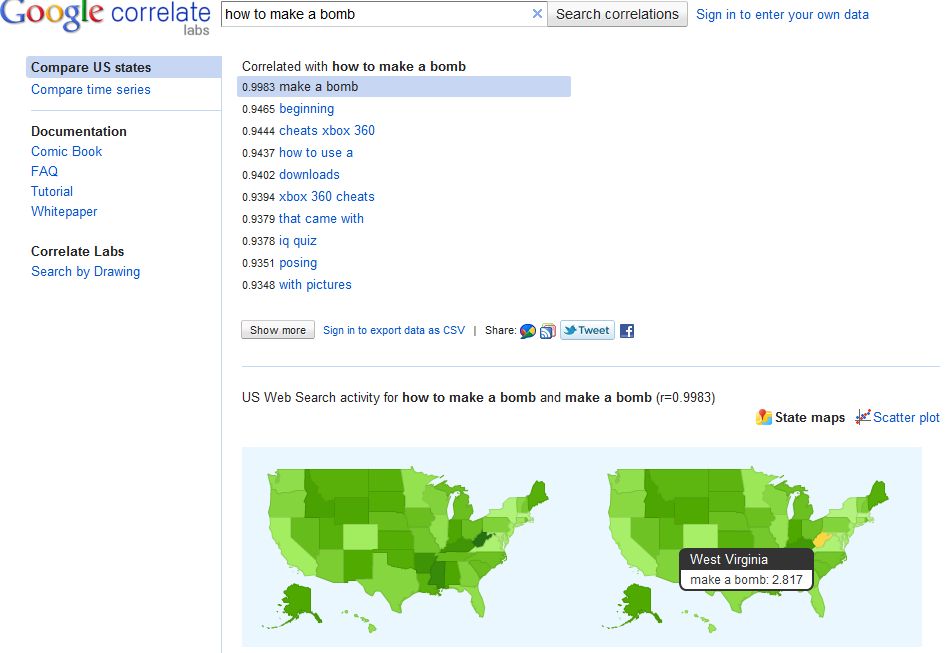
and we see West Virginia likes to search for “how to make a bomb ” 🙂 yeah, right 😉

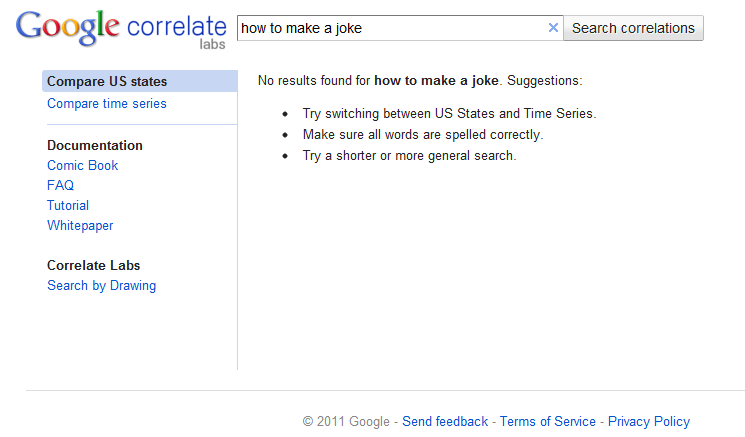
but heres the big oops.

http://correlate.googlelabs.com/search?e=how+to+make+a+joke&t=all

Related articles


Interview with Rob La Gesse Chief Disruption Officer Rackspace

Here is an interview with Rob La Gesse ,Chief Disruption Officer ,Rackspace Hosting.
Ajay- Describe your career  journey from not finishing college to writing software to your present projects?
Rob- I joined the Navy right out of High School. I had neither the money for college, or a real desire for it. I had several roles in the Navy, to include a Combat Medic station with the US Marine Corps and eventually becoming a Neonatal Respiratory Therapist.

After the Navy I worked as a Respiratory Therapist, a roofer, and I repaired print shop equipment. Basically whatever it took to make a buck or two.  Eventually I started selling computers.  That led me to running a multi-line dial-up BBS and I taught myself how to program.  Eventually that led to a job with a small engineering company where we developed WiFi.

After the WiFi project I started consulting on my own.  I used Rackspace to host my clients, and eventually they hired me.  I’ve been here almost three years and have held several roles. I currently manage Social Media, building 43 and am involved in several other projects such as the Rackspace Startup Program.

Ajay-  What is building43 all about ?

Rob- Building43 is a web site devoted to telling the stories behind technology startups. Basically, after we hired Robert Scoble and Rocky Barbanica we were figuring out how best we could work with them to both highlight Rackspace and customers.  That idea expanded beyond customers to highlighting anyone doing something incredible in the technology industry – mostly software startups.  We’ve had interviews with people like Mark Zuckerberg, CEO and Founder of FaceBook.  We’ve broken some news on the site, but it isn’t really a news site. It is a story telling site.

Rackspace has met some amazing new customers through the relationships that started with an interview.

Ajay-  How is life as Robert Scoble’s boss. Is he an easy guy to work with? Does he have super powers while he types?

Rob- Robert isn’t much different to manage than the rest of my employees. He is a person – no super powers.  But he does establish a unique perspective on things because he gets to see so much new technology early.  Often earlier than almost anyone else. It helps him to spot trends that others might not be seeing yet.
Ajay – Hosting companies are so so many. What makes Rackspace special for different kinds of customers?
Rob- I think what we do better than anyone is add that human touch – the people really care about your business.  We are a company that is focused on building one of the greatest service companies on the planet.  We sell support.  Hosting is secondary to service. Our motto is Fanatic Support®

and we actually look for people focused on delivering amazing customer experiences during our interviewing and hiring practices. People that find a personal sense of pride and reward by helping others should apply at
Rackspace.  We are hiring like crazy!

Ajay – Where do you see technology and the internet 5 years down the line? (we will visit the answers in 5 years 🙂 )?
Rob- I think the shift to Cloud computing is going to be dramatic.  I think in five years we will be much further down that path.  The scaling, cost-effectiveness, and on-demand nature of the Cloud are just too compelling for companies not to embrace. This changes business in fundamental ways – lower capital expenses, no need for in house IT staff, etc will save companies a lot of money and let them focus more on their core businesses. Computing will become another utility.  I also think mobile use of computing will be much more common than it is today.  And it is VERY common today.  Phones will replace car keys and credit cards (they already are). This too will drive use of Cloud computing  because we all want our data wherever we are – on whatever computing device we happen tobe using.
Ajay- GoDaddy CEO shoots elephants. What do you do in your  spare time, if any.
Rob- Well, I don’t hunt.  We do shoot a lot of video though! I enjoy playing poker, specifically Texas Hold ’em.  It is a very people oriented game, and people are my passion.

Brief Biography- (in his own words from http://www.lagesse.org/about/)

My technical background includes working on the development of WiFi, writing wireless applications for the Apple Newton, mentoring/managing several software-based start-ups, running software quality assurance teams and more. In 2008 I joined Rackspace as an employee – a “Racker”.  I was previously a 7 year customer and the company impressed me. My initial role was as Director of Software Development for the Rackspace Cloud.  It was soon evident that I was better suited to a customer facing role since I LOVE talking to customers. I am currently the Director of Customer Development Chief Disruption Officer.  I manage building43 and enjoy working with Robert Scoble and Rocky Barbanica to make that happen.  The org chart says they work for me.  Reality tells me the opposite :)

Go take a look – I’m proud of what we are building there (pardon the pun!).

I do a lot of other stuff at Rackspace – mostly because they let me!  I love a company that lets me try. Rackspace does that.Going further back, I have been a Mayor (in Hawaii). I have written successful shareware software. I have managed employees all over the world. I have been all over the world. I have also done roofing, repaired high end print-shop equipment, been a Neonatal Respiratory Therapist, done CPR on a boat, in a plane, and in a hardware store (and of course in hospitals).

I have treated jumpers from the Golden Gate Bridge – and helped save a few. I have lived in Illinois (Kankakee), California (San Diego, San Francisco and Novato), Texas (Corpus Christi and San Antonio), Florida (Pensacola and Palm Bay), Hawaii (Honolulu/Fort Shafter) and several other places for shorter durations.

For the last 8+ years I have been a single parent – and have done an amazing job (yes, I am a proud papa) thanks to having great kids.  They are both in College now – something I did NOT manage to accomplish. I love doing anything someone thinks I am not qualified to do.

I can be contacted at rob (at) lagesse (dot) org

you can follow Rob at http://twitter.com/kr8tr