Making NeW R

Tal G in his excellent blog piece talks of “Why R Developers  should not be paid” http://www.r-statistics.com/2010/09/open-source-and-money-why-r-developers-shouldnt-be-paid/

His argument of love is not very original though it was first made by these four guys

I am going to argue that “some” R developers should be paid, while the main focus should be volunteers code. These R developers should be paid as per usage of their packages.

Let me expand.

Imagine the following conversation between Ross Ihaka, Norman Nie and Peter Dalgaard.

Norman- Hey Guys, Can you give me some code- I got this new startup.

Ross Ihaka and Peter Dalgaard- Sure dude. Here is 100,000 lines of code, 2000 packages and 2 decades of effort.

Norman- Thanks guys.

Ross Ihaka- Hey, What you gonna do with this code.

Norman- I will better it. Sell it. Finally beat Jim Goodnight and his **** Proc GLM and **** Proc Reg.

Ross- Okay, but what will you give us? Will you give us some code back of what you improve?

Norman – Uh, let me explain this open core …

Peter D- Well how about some royalty?

Norman- Sure, we will throw parties at all conferences, snacks you know at user groups.

Ross – Hmm. That does not sound fair. (walks away in a huff muttering)-He takes our code, sells it and wont share the code

Peter D- Doesnt sound fair. I am back to reading Hamlet, the great Dane, and writing the next edition of my book. I am glad I wrote a book- Ross didnt even write that.

Norman-Uh Oh. (picks his phone)- Hey David Smith, We need to write some blog articles pronto – these open source guys ,man…

———–I think that sums what has been going on in the dynamics of R recently. If Ross Ihaka and R Gentleman had adopted an open core strategy- meaning you can create packages to R but not share the original where would we all be?

At this point if he is reading this, David Smith , long suffering veteran of open source  flameouts is rolling his eyes while Tal G is wondering if he will publish this on R Bloggers and if so when or something.

Lets bring in another R veteran-  Hadley Wickham who wrote a book on R and also created ggplot. Thats the best quality, most often used graphics package.

In terms of economic utilty to end user- the ggplot package may be as useful if not more as the foreach package developed by Revolution Computing/Analytics.

Now http://cran.r-project.org/web/packages/foreach/index.html says that foreach is licensed under http://www.apache.org/licenses/LICENSE-2.0

However lets come to open core licensing ( read it here http://alampitt.typepad.com/lampitt_or_leave_it/2008/08/open-core-licen.html ) which is where the debate is- Revolution takes code- enhances it (in my opinion) substantially with new formats XDF for better efficieny, web services API, and soon coming next year a GUI (thanks in advance , Dr Nie and guys)

and sells this advanced R code to businesses happy to pay ( they are currently paying much more to DR Goodnight and HIS guys)

Why would any sane customer buy it from Revolution- if he could download exactly the same thing from http://r-project.org

Hence the business need for Revolution Analytics to have an enhanced R- as they are using a product based software model not software as a service model.

If Revolution gives away source code of these new enhanced codes to R core team- how will R core team protect the above mentioned intelectual property- given they have 2 decades experience of giving away free code , and back and forth on just code.

Now Revolution also has a marketing budget- and thats how they sponsor some R Core events, conferences, after conference snacks.

How would people decide if they are being too generous or too stingy in their contribution (compared to the formidable generosity of SAS Institute to its employees, stakeholders and even third party analysts).

Would it not be better- IF Revolution can shift that aspect of relationship to its Research and Development budget than it’s marketing budget- come with some sort of incentive for “SOME” developers – even researchers need grants and assistantships, scholarships, make a transparent royalty formula say 17.5 % of the NEW R sales goes to R PACKAGE Developers pool, which in turn examines usage rate of packages and need/merit before allocation- that would require Revolution to evolve from a startup to a more sophisticated corporate and R Core can use this the same way as John M Chambers software award/scholarship

Dont pay all developers- it would be an insult to many of them – say Prof Harrell creator of HMisc to accept – but can Revolution expand its dev base (and prospect for future employees) by even sponsoring some R Scholarships.

And I am sure that if Revolution opens up some more code to the community- they would the rest of the world and it’s help useful. If it cant trust people like R Gentleman with some source code – well he is a board member.

——————————————————————————————–

Now to sum up some technical discussions on NeW R

1)  An accepted way of benchmarking efficiencies.

2) Code review and incorporation of efficiencies.

3) Multi threading- Multi core usage are trends to be incorporated.

4) GUIs like R Commander E Plugins for other packages, and Rattle for Data Mining to have focussed (or Deducer). This may involve hiring User Interface Designers (like from Apple 😉  who will work for love AND money ( Even the Beatles charge royalty for that song)

5) More support to cloud computing initiatives like Biocep and Elastic R – or Amazon AMI for using cloud computers- note efficiency arguements dont matter if you just use a Chrome Browser and pay 2 cents a hour for an Amazon Instance. Probably R core needs more direct involvement of Google (Cloud OS makers) and Amazon as well as even Salesforce.com (for creating Force.com Apps). Note even more corporates here need to be involved as cloud computing doesnot have any free and open source infrastructure (YET)

_______________________________________________________

Debates will come and go. This is an interesting intellectual debate and someday the liitle guys will win the Revolution-

From Hugh M of Gaping Void-

http://www.gapingvoid.com/Moveable_Type/archives/cat_microsoft_blue_monster_series.html

HOW DOES A SOFTWARE COMPANY MAKE MONEY, IF ALL

SOFTWARE IS FREE?

“If something goes wrong with Microsoft, I can phone Microsoft up and have it fixed. With Open Source, I have to rely on the community.”

And the community, as much as we may love it, is unpredictable. It might care about your problem and want to fix it, then again, it may not. Anyone who has ever witnessed something online go “viral”, good or bad, will know what I’m talking about.

and especially-

http://gapingvoid.com/2007/04/16/how-well-does-open-source-currently-meet-the-needs-of-shareholders-and-ceos/

Source-http://gapingvoidgallery.com/

Kind of sums up why the open core licensing is all about.

Web R- Elastic R and RevoDeploy R

I had a skype video chat with Karime Chine and he was kind enough to walk me through the new portal Elastic-R at http://www.elastic-r.org

Basically you can work on a collaborative basis in this with multiple users working on excel as well as R projects.

Some screenshots-in a short presentation I made on my notes during K Chine’s presentation

Also, Revolution Analytics is coming out with a Web Services product for R

RevoDeployR: Web Services for R

Both are very powerful uses of R for cloud computing- and it would be interesting if the original cloud computing champion Google gets into the R Project.

Linux= Who did what and how much?

A report distributed under Creative Commons 3 and available at

That shows Canonical — the commercial arm of Ubuntu — has contributed only about one percent of the code to the GNOME desktop for Linux. while Red Hat accounts for 17 percent of the code and Novell developers are responsible for about 11 percent. That prompted some heartburn from Mark, creator- founder Cannonical/ Ubuntu at http://www.markshuttleworth.com/archives/517

And it would be a very different story if it weren’t for the Mozilla folks and Netscape before them, and GNOME and KDE, and Google and everyone else who have exercised that stack in so many different ways, making it better along the way. There are tens of thousands of people who are not in any way shape or form associated with Ubuntu, who make this story real. Many of them have been working at it for more than a decade – it takes a long time to make an overnight success :) while Ubuntu has only been on the scene six years. So Ubuntu cannot be credited solely for the delight of its users.
Nevertheless, the Ubuntu Project does bring something unique, special and important to free software: a total commitment to everyday users and use cases, the idea that free software should be “for everyone” both economically and in ease of use, and a willingness to chase down the problems that stand between here and there. I feel that commitment is a gift back to the people who built every one of those packages. If we can bring free software to ten times the audience, we have amplified the value of your generosity by a factor of ten, we have made every hour spent fixing an issue or making something amazing, ten times as valuable. I’m very proud to be spending the time and energy on Ubuntu that I do. Yes, I could do many other things, but I can’t think of another course which would have the same impact on the world.

I recognize that not everybody will feel the same way. Bringing their work to ten times the audience without contributing features might just feel like leeching, or increasing the flow of bug reports 10x. I suppose you could say that no matter how generous we are to downstream users, if upstream is only measuring code, then any generosity other than code won’t be registered. I don’t really know what to do about that – I didn’t found Ubuntu as a vehicle for getting lots of code written, that didn’t seem to me to be what the world needed.

Open source communities work like democracies with all noise whereas R and D within corporates have a stricter hierarchy. Still for all that – Ubuntu and Android have made Linux mainstream just as R has made statistical software available to all.

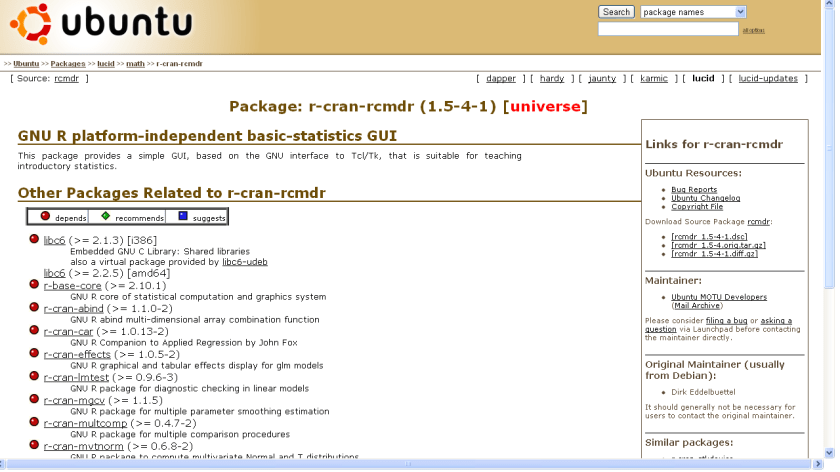
And Ubuntu also has great support for R (particularly the single click R Commander Install and Icon) available at http://packages.ubuntu.com/lucid/math/r-cran-rcmdr

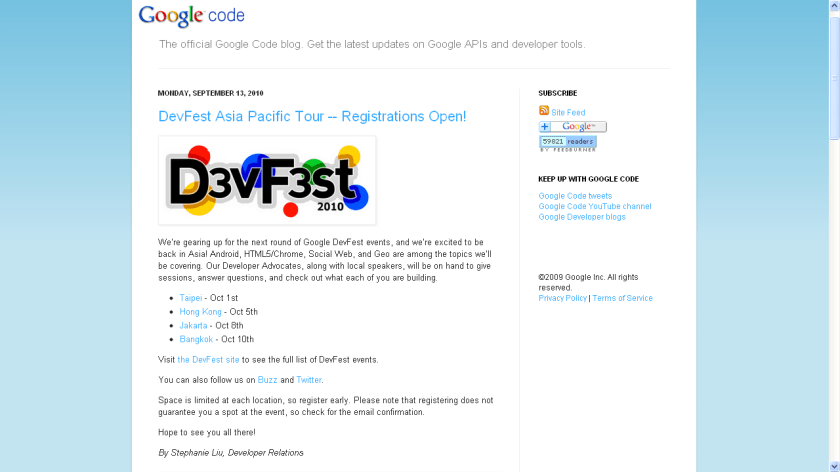
Google Code Devfest – in Asia

Interesting series of conferences in Asia courtesy Google Code-

http://googlecode.blogspot.com/2010/09/devfest-asia-pacific-tour-registrations.html

Google AppInventor -Android and Business Intelligence

Here is a great new tool for techies to start creating Android Apps right away- even if you have no knowledge of the platform. Of course there are existing great number of apps- including my favorite Android Data Mining App in R – called AnalyticDroid http://analyticdroid.togaware.com/

Basically it calls the Rattle (R Analytical Tool To Learn Easily) Data Mining GUI -enabling data mining from an Android Mobile using remote computing.

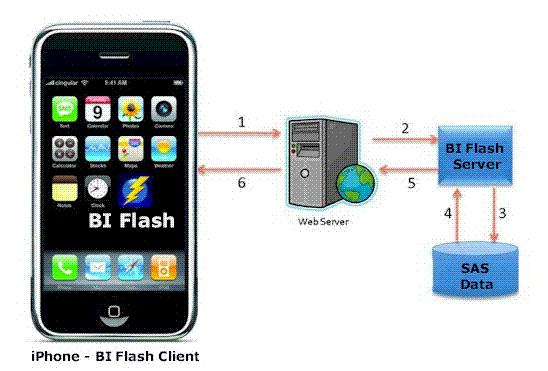
I dont know if any other statistical application is available on Android Mobiles- though SAS did have a presentation on using SAS on IPhone

http://www.wuss.org/proceedings09/09WUSSProceedings/papers/dpr/DPR-Truong.pdf


SAS Mobile -Iphone App

All you need to do is go to http://appinventor.googlelabs.com/about/index.html and request access (yes there is a 2 week approval waiting line)

Because App Inventor provides access to a GPS-location sensor, you can build apps that know where you are. You can build an app to help you remember where you parked your car, an app that shows the location of your friends or colleagues at a concert or conference, or your own custom tour app of your school, workplace, or a museum.
You can write apps that use the phone features of an Android phone. You can write an app that periodically texts “missing you” to your loved ones, or an app “No Text While Driving” that responds to all texts automatically with “sorry, I’m driving and will contact you later”. You can even have the app read the incoming texts aloud to you (though this might lure you into responding).
App Inventor provides a way for you to communicate with the web. If you know how to write web apps, you can use App Inventor to write Android apps that talk to your favorite web sites, such as Amazon and Twitter.

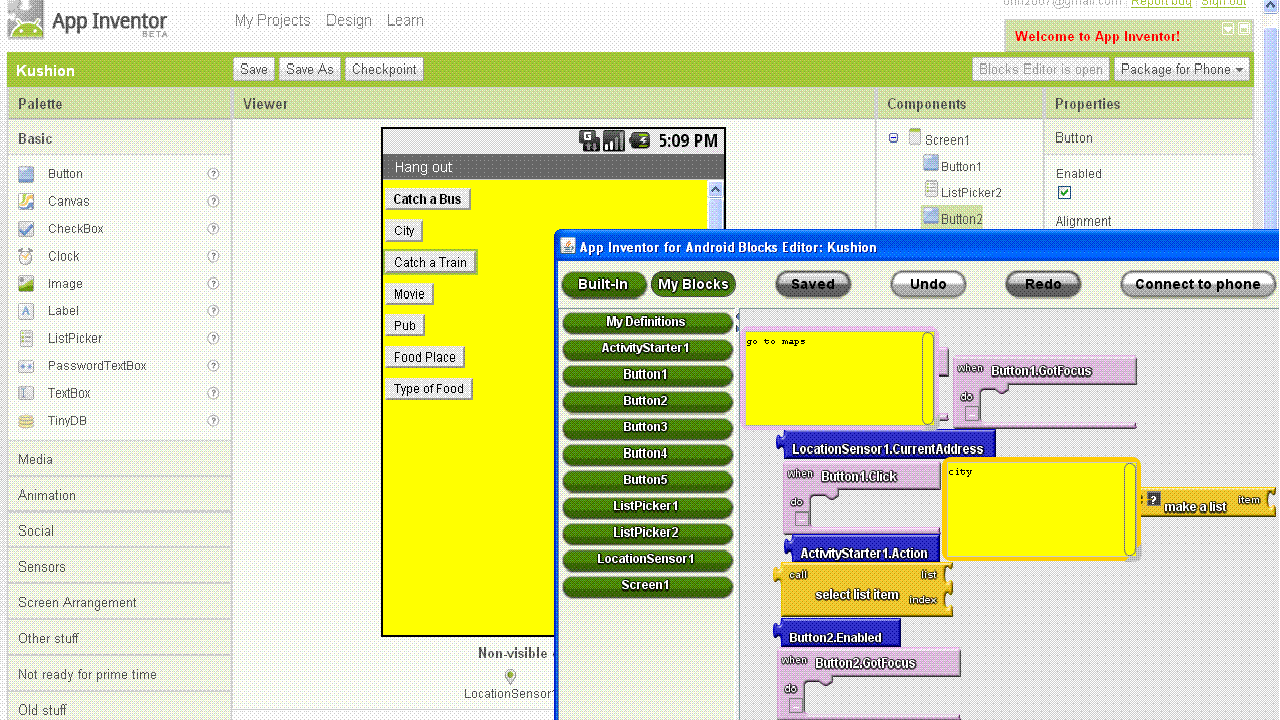
Here is a not so statistical Android App I am trying to create called Hang-Out

using the current GPS location of your phone to find nearest Pub, Movie or Diner and catch Bus- Train based on your location city, the GPS and time of request and schedule of those cities public transport- very much WIP

Google moving on from MapReduce: rest of world still catching up

Apparently it is true as per the Register, but details in a paper next month- It is called Google Caffeine.

http://www.theregister.co.uk/2010/09/09/google_caffeine_explained/

Caffeine expands on BigTable to create a kind of database programming model that lets the company make changes to its web index without rebuilding the entire index from scratch. “[Caffeine] is a database-driven, Big Table–variety indexing system,” Lipkovitz tells The Reg, saying that Google will soon publish a paper discussing the system. The paper, he says, will be delivered next month at the USENIX Symposium on Operating Systems Design and Implementation (OSDI).

and interestingly

MapReduce, he says, isn’t suited to calculations that need to occur in near real-time.

MapReduce is a sequence of batch operations, and generally, Lipkovits explains, you can’t start your next phase of operations until you finish the first. It suffers from “stragglers,” he says. If you want to build a system that’s based on series of map-reduces, there’s a certain probability that something will go wrong, and this gets larger as you increase the number of operations. “You can’t do anything that takes a relatively short amount of time,” Lipkovitz says, “so we got rid of it.”

With Caffeine, Google can update its index by making direct changes to the web map already stored in BigTable. This includes a kind of framework that sits atop BigTable, and Lipkovitz compares it to old-school database programming and the use of “database triggers.”

but most importantly

In 2004, Google published research papers on GFS and MapReduce that became the basis for the open source Hadoop platform now used by Yahoo!, Facebook, and — yes — Microsoft. But as Google moves beyond GFS and MapReduce, Lipokovitz stresses that he is “not claiming that the rest of the world is behind us.”

But oh no!

“We’re in business of making searches useful,” he says. “We’re not in the business of selling infrastructure

But I say why not- Search is good and advertising is okay

There is more (not evil) money in infrastructure (of big data) as there is in advertising. But the advertising guys disagree

Tale of Two Apps

Whom to follow on Twitter- Google Follow Finder vs Twitter’s own Twitter Suggests

http://followfinder.googlelabs.com/search?user=decisionstats

vs

http://twitter.com/invitations/twitter_suggests

(Twitter Suggests thinks I like following celebrities- Cricketers and Bollywood Stars- while Google Friend Follow (a Google Labs App- thinks I like to follow Data Techies)

Google Wins!