Why Cloud?

Here are some reasons why cloud computing is very helpful to small business owners like me- and can be very helpful to even bigger people.

1) Infrastructure Overhead becomes zero

– I need NOT invest in secure powerbackups (like a big battery for electricity power-outs-true in India), data disaster management (read raid), software licensing compliance.

All this is done for me by infrastructure providers like Google and Amazon.

For simple office productivity, I type on Google Docs that auto-saves my data,writing on cloud. I need not backup- Google does it for me.  Ditto for presentations and spreadsheets. Amazon gets me the latest Window software installed whenever I logon- I need not be  bothered by software contracts (read bug fixes and patches) any more.

2) Renting Hardware by the hour- A small business owner cannot invest too much in computing hardware (or software). The pay as you use makes sense for them. I could never afford a 8 cores desktop with 25 gb RAM- but I sure can rent and use it to bid for heavier data projects that I would have had to let go in the past.

3) Renting software by the hour- You may have bought your last PC for all time

An example- A windows micro instance costs you 3 cents per hour on Amazon. If you take a mathematical look at upgrading your PC to latest Windows, buying more and more upgraded desktops just to keep up, those costs would exceed 3 cents per hour. For Unix, it is 2 cents per hour, and those softwares (like Red Hat Linux and Ubuntu have increasingly been design friendly even for non techie users)

Some other software companies especially in enterprise software plan to and already offer paid machine images that basically adds their software layer on top of the OS and you can rent software for the hour.

It does not make sense for customers to effectively subsidize golf tournaments, rock concerts, conference networks by their own money- as they can rent software by the hour and switch to pay per use.

People especially SME consultants, academics and students and cost conscious customers – in Analytics would love to see a world where they could say run SAS Enterprise Miner for 10 dollars a hour for two hours to build a data mining model on 25 gb RAM, rather than hurt their pockets and profitability in Annual license models. Ditto for SPSS, JMP, KXEN, Revolution R, Oracle Data Mining (already available on Amazon) , SAP (??), WPS ( on cloud ???? ) . It’s the economy, stupid.

Corporates have realized that cutting down on Hardware and software expenses is more preferable to cutting down people. Would you rather fire people in your own team to buy that big HP or Dell or IBM Server (effectively subsidizing jobs in those companies). IF you had to choose between an annual license renewal for your analytics software TO renting software by the hour and using those savings for better benefits for your employees, what makes business sense for you to invest in.

Goodbye annual license fees.  Welcome brave new world.

IBM SPSS 19: Marketing Analytics and RFM

What is RFM Analysis?

Recency Frequency Monetization is basically a technique to classify your entire customer list. You may be a retail player with thousands of customers or a enterprise software seller with only two dozen customers.

RFM Analysis can help you cut through and focus on the real customer that drives your profit.

As per Wikipedia

http://en.wikipedia.org/wiki/RFM

RFM is a method used for analyzing customer behavior and defining market segments. It is commonly used in database marketing and direct marketing and has received particular attention in retail.

RFM stands for

  • Recency – How recently a customer has purchased?
  • Frequency – How often he purchases?
  • Monetary Value – How much does he spend?

To create an RFM analysis, one creates categories for each attribute. For instance, the Recency attribute might be broken into three categories: customers with purchases within the last 90 days; between 91 and 365 days; and longer than 365 days. Such categories may be arrived at by applying business rules, or using a data mining technique, such asCHAID, to find meaningful breaks.

—————————————————————————————————-

Even if you dont know what or how to do a RFM, see below for an easy to do way.

I just got myself an evaluation copy of a fully loaded IBM SPSS 19 Module and did some RFM Analysis on some data- the way SPSS recent version is it makes it very very useful even to non statistical tool- but an extremely useful one to a business or marketing user.

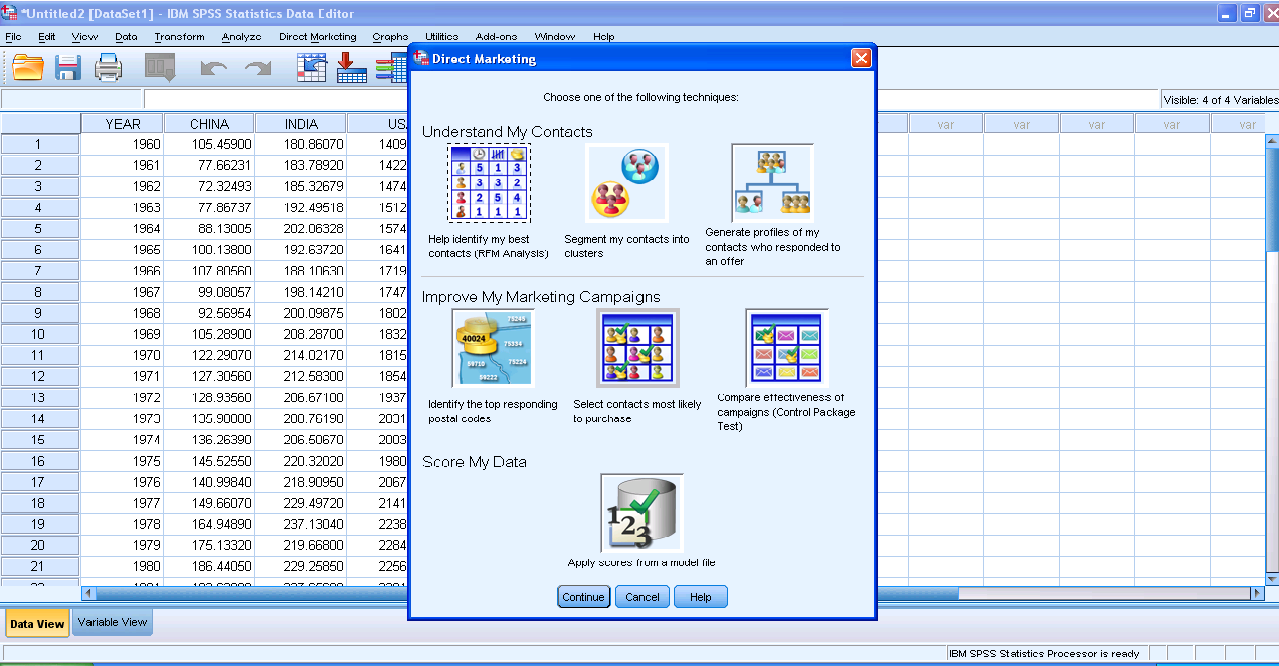
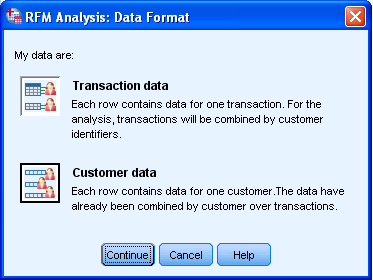
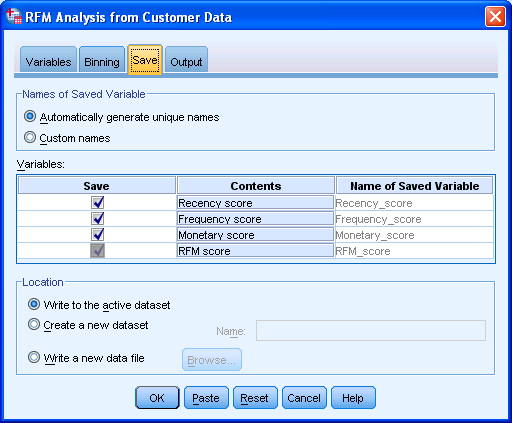
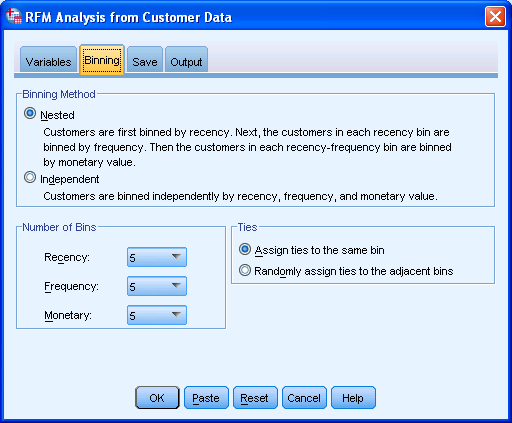
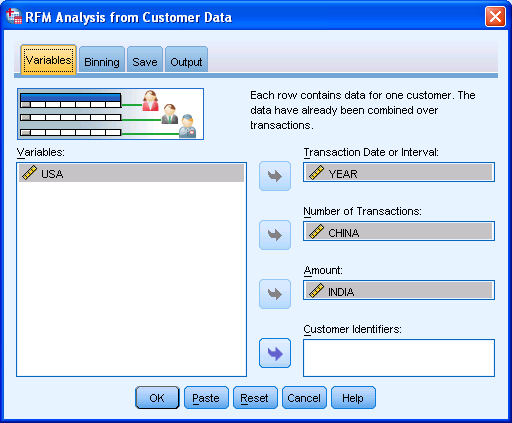
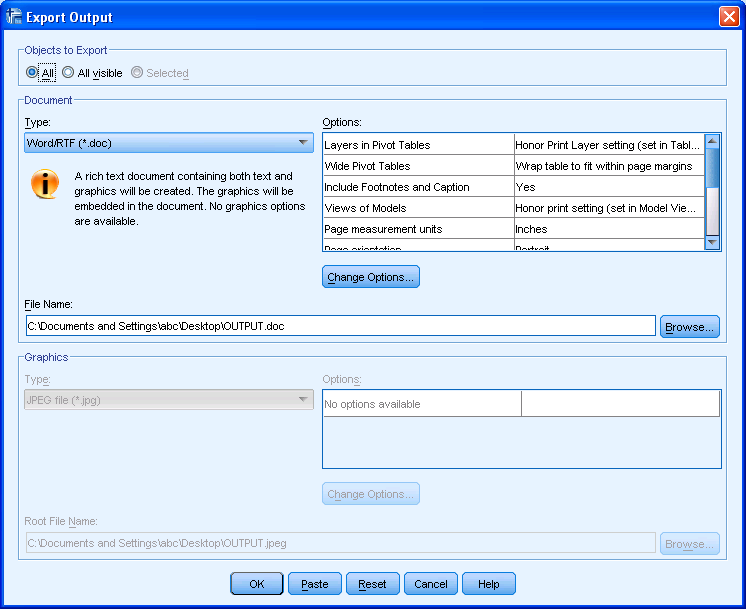
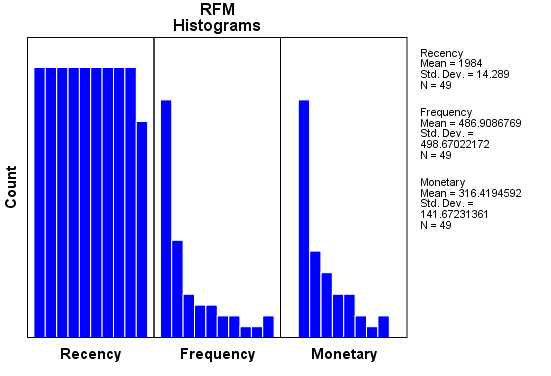
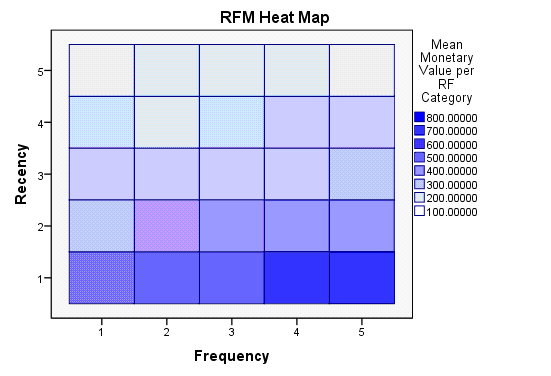
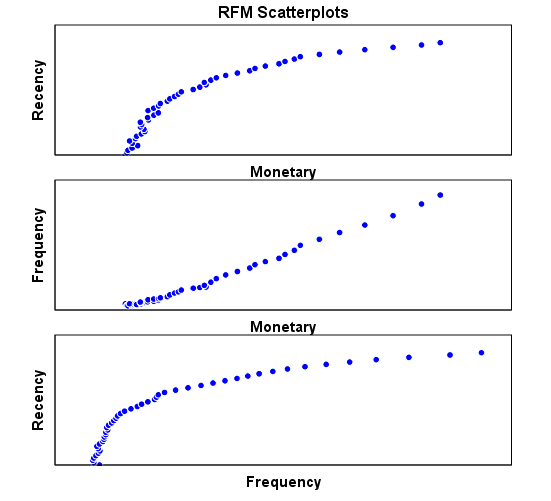
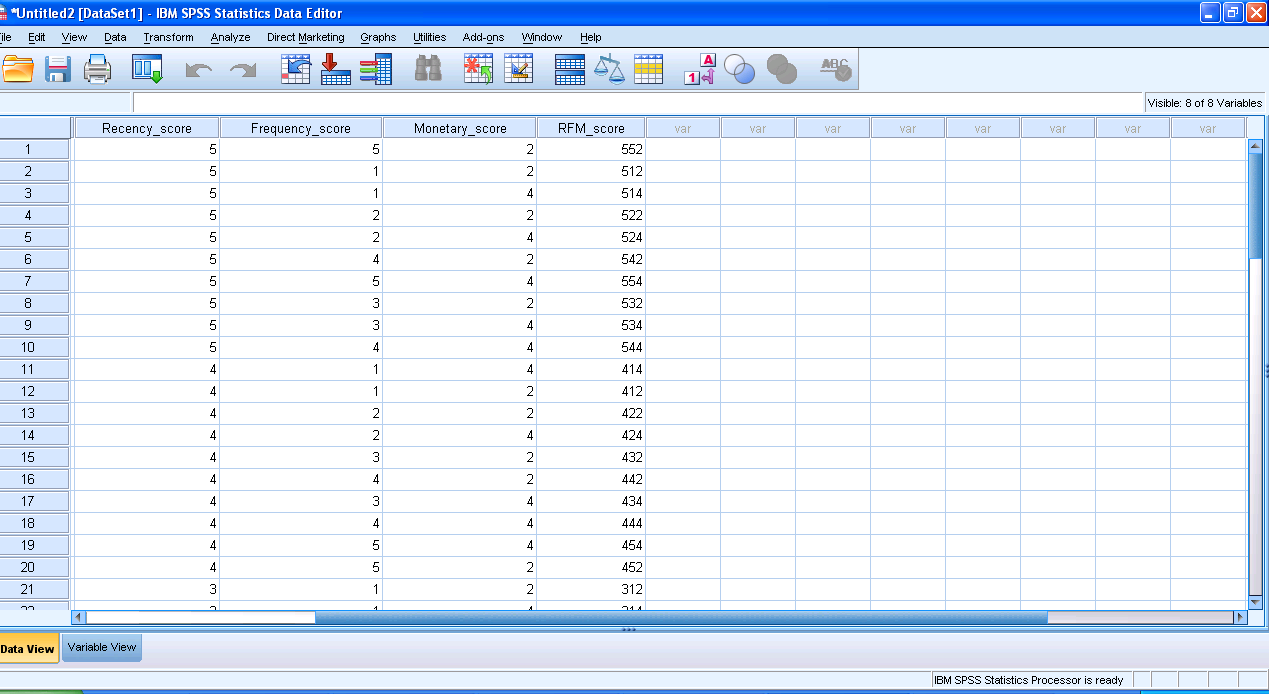
Here are some screenshots to describe the features.

1) A simple dashboard to show functionality (with room for improvement for visual appeal)

2) Simple Intuitive design to inputting data3) Some options in creating marketing scorecards4) Easy to understand features for a business audiences

rather than pseudo techie jargon5) Note the clean design of the GUI in specifying data input type6) Again multiple options to export results in a very user friendly manner with options to customize business report7) Graphical output conveniently pasted inside a word document rather than a jumble of images. Auto generated options for customized standard graphs.8) An attractive heatmap to represent monetization for customers. Note the effect that a scale of color shades have in visual representation of data.9) Comparative plots placed side by side with easy to understand explanation (in the output word doc not shown here)10) Auto generated scores attached to data table to enhance usage. 

Note here I am evaluating RFM as a marketing technique (which is well known) but also the GUI of IBM SPSS 19 Marketing Analytics. It is simple, and yet powerful into turning what used to be a purely statistical software for nerds into a beautiful easy to implement tool for business users.

So what else can you do in Marketing Analytics with SPSS 19.

IBM SPSS Direct Marketing

The Direct Marketing add-on option allows organizations to ensure their marketing programs are as effective as possible, through techniques specifically designed for direct marketing, including:

• RFM Analysis. This technique identifies existing customers who are most likely to respond to a new offer.

• Cluster Analysis. This is an exploratory tool designed to reveal natural groupings (or clusters) within your data. For example, it can identify different groups of customers based on various demographic and purchasing characteristics.

• Prospect Profiles. This technique uses results from a previous or test campaign to create descriptive profiles. You can use the profiles to target specific groups of contacts in future campaigns.

• Postal Code Response Rates. This technique uses results from a previous campaign to calculate postal code response rates. Those rates can be used to target specific postal codes in future campaigns.

• Propensity to Purchase. This technique uses results from a test mailing or previous campaign to generate propensity scores. The scores indicate which contacts are most likely to respond.

• Control Package Test. This technique compares marketing campaigns to see if there is a significant difference in effectiveness for different packages or offers.

Click here to find out more about Direct Marketing.

Graphics Presentations

Here are some Wow Presentations on Design and User Interfaces and  Graphics (including R)- you may have seen some before.

From Dataspora-

A Survey of R Graphics

R Graphics using GGPlot

King of all R graphics-Hadley Wickham

and a rather clever Graphics User Interface presentation

Dark Patterns to Trick People

More on Design Anti Patterns

Back to designing well

Back to Polishing your Graphics with Hadley –

SAS/Blades/Servers/ GPU Benchmarks

Just checked out cool new series from NVidia servers.

Now though SAS Inc/ Jim Goodnight thinks HP Blade Servers are the cool thing- the GPU takes hardware high performance computing to another level. It would be interesting to see GPU based cloud computers as well – say for the on Demand SAS (free for academics and students) but which has had some complaints of being slow.

See this for SAS and Blade Servers-

http://www.sas.com/success/ncsu_analytics.html

To give users hands-on experience, the program is underpinned by a virtual computing lab (VCL), a remote access service that allows users to reserve a computer configured with a desired set of applications and operating system and then access that computer over the Internet. The lab is powered by an IBM BladeCenter infrastructure, which includes more than 500 blade servers, distributed between two locations. The assignment of the blade servers can be changed to meet shifts in the balance of demand among the various groups of users. Laura Ladrie, MSA Classroom Coordinator and Technical Support Specialist, says, “The virtual computing lab chose IBM hardware because of its quality, reliability and performance. IBM hardware is also energy efficient and lends itself well to high performance/low overhead computing.

Thats interesting since IBM now competes (as owner of SPSS) and also cooperates with SAS Institute

And

http://www.theaustralian.com.au/australian-it/the-world-according-to-jim-goodnight-blade-switch-slashes-job-times/story-e6frgakx-1225888236107

You’re effectively turbo-charging through deployment of many processors within the blade servers?

Yes. We’ve got machines with 192 blades on them. One of them has 202 or 203 blades. We’re using Hewlett-Packard blades with 12 CP cores on each, so it’s a total 2300 CPU cores doing the computation.

Our idea was to give every one of those cores a little piece of work to do, and we came up with a solution. It involved a very small change to the algorithm we were using, and it’s just incredible how fast we can do things now.

I don’t think of it as a grid, I think of it as essentially one computer. Most people will take a blade and make a grid out of it, where everything’s a separate computer running separate jobs.

We just look at it as one big machine that has memory and processors all over the place, so it’s a totally different concept.

GPU servers can be faster than CPU servers, though , Professor G.


Source-

http://www.nvidia.com/object/preconfigured_clusters.html

TESLA GPU COMPUTING SOLUTIONS FOR DATA CENTERS
Supercharge your cluster with the Tesla family of GPU computing solutions. Deploy 1U systems from NVIDIA or hybrid CPU-GPU servers from OEMs that integrate NVIDIA® Tesla™ GPU computing processors.

When compared to the latest quad-core CPU, Tesla 20-series GPU computing processors deliver equivalent performance at 1/20th the power consumption and 1/10th the cost. Each Tesla GPU features hundreds of parallel CUDA cores and is based on the revolutionary NVIDIA® CUDA™ parallel computing architecture with a rich set of developer tools (compilers, profilers, debuggers) for popular programming languages APIs like C, C++, Fortran, and driver APIs like OpenCL and DirectCompute.

NVIDIA’s partners provide turnkey easy-to-deploy Preconfigured Tesla GPU clusters that are customizable to your needs. For 3D cloud computing applications, our partners offer the Tesla RS clusters that are optimized for running RealityServer with iray.

Available Tesla Products for Data Centers:
– Tesla S2050
– Tesla M2050/M2070
– Tesla S1070
– Tesla M1060

Also I liked the hybrid GPU and CPU

And from a paper on comparing GPU and CPU using Benchmark tests on BLAS from a Debian- Dirk E’s excellent blog

http://dirk.eddelbuettel.com/blog/

Usage of accelerated BLAS libraries seems to shrouded in some mystery, judging from somewhat regularly recurring requests for help on lists such as r-sig-hpc(gmane version), the R list dedicated to High-Performance Computing. Yet it doesn’t have to be; installation can be really simple (on appropriate systems).

Another issue that I felt needed addressing was a comparison between the different alternatives available, quite possibly including GPU computing. So a few weeks ago I sat down and wrote a small package to run, collect, analyse and visualize some benchmarks. That package, called gcbd (more about the name below) is now onCRAN as of this morning. The package both facilitates the data collection for the paper it also contains (in the vignette form common among R packages) and provides code to analyse the data—which is also included as a SQLite database. All this is done in the Debian and Ubuntu context by transparently installing and removing suitable packages providing BLAS implementations: that we can fully automate data collection over several competing implementations via a single script (which is also included). Contributions of benchmark results is encouraged—that is the idea of the package.

And from his paper on the same-

Analysts are often eager to reap the maximum performance from their computing platforms.

A popular suggestion in recent years has been to consider optimised basic linear algebra subprograms (BLAS). Optimised BLAS libraries have been included with some (commercial) analysis platforms for a decade (Moler 2000), and have also been available for (at least some) Linux distributions for an equally long time (Maguire 1999). Setting BLAS up can be daunting: the R language and environment devotes a detailed discussion to the topic in its Installation and Administration manual (R Development Core Team 2010b, appendix A.3.1). Among the available BLAS implementations, several popular choices have emerged. Atlas (an acronym for Automatically Tuned Linear Algebra System) is popular as it has shown very good performance due to its automated and CPU-speci c tuning (Whaley and Dongarra 1999; Whaley and Petitet 2005). It is also licensed in such a way that it permits redistribution leading to fairly wide availability of Atlas.1 We deploy Atlas in both a single-threaded and a multi-threaded con guration. Another popular BLAS implementation is Goto BLAS which is named after its main developer, Kazushige Goto (Goto and Van De Geijn 2008). While `free to use’, its license does not permit redistribution putting the onus of con guration, compilation and installation on the end-user. Lastly, the Intel Math Kernel Library (MKL), a commercial product, also includes an optimised BLAS library. A recent addition to the tool chain of high-performance computing are graphical processing units (GPUs). Originally designed for optimised single-precision arithmetic to accelerate computing as performed by graphics cards, these devices are increasingly used in numerical analysis. Earlier criticism of insucient floating-point precision or severe performance penalties for double-precision calculation are being addressed by the newest models. Dependence on particular vendors remains a concern with NVidia’s CUDA toolkit (NVidia 2010) currently still the preferred development choice whereas the newer OpenCL standard (Khronos Group 2008) may become a more generic alternative that is independent of hardware vendors. Brodtkorb et al. (2010) provide an excellent recent survey. But what has been lacking is a comparison of the e ective performance of these alternatives. This paper works towards answering this question. By analysing performance across ve di erent BLAS implementations|as well as a GPU-based solution|we are able to provide a reasonably broad comparison.

Performance is measured as an end-user would experience it: we record computing times from launching commands in the interactive R environment (R Development Core Team 2010a) to their completion.

And

Basic Linear Algebra Subprograms (BLAS) provide an Application Programming Interface
(API) for linear algebra. For a given task such as, say, a multiplication of two conformant
matrices, an interface is described via a function declaration, in this case sgemm for single
precision and dgemm for double precision. The actual implementation becomes interchangeable
thanks to the API de nition and can be supplied by di erent approaches or algorithms. This
is one of the fundamental code design features we are using here to benchmark the di erence
in performance from di erent implementations.
A second key aspect is the di erence between static and shared linking. In static linking,
object code is taken from the underlying library and copied into the resulting executable.
This has several key implications. First, the executable becomes larger due to the copy of
the binary code. Second, it makes it marginally faster as the library code is present and
no additional look-up and subsequent redirection has to be performed. The actual amount
of this performance penalty is the subject of near-endless debate. We should also note that
this usually amounts to only a small load-time penalty combined with a function pointer
redirection|the actual computation e ort is unchanged as the actual object code is identi-
cal. Third, it makes the program more robust as fewer external dependencies are required.
However, this last point also has a downside: no changes in the underlying library will be
reected in the binary unless a new build is executed. Shared library builds, on the other
hand, result in smaller binaries that may run marginally slower|but which can make use of
di erent libraries without a rebuild.

Basic Linear Algebra Subprograms (BLAS) provide an Application Programming Interface(API) for linear algebra. For a given task such as, say, a multiplication of two conformantmatrices, an interface is described via a function declaration, in this case sgemm for singleprecision and dgemm for double precision. The actual implementation becomes interchangeablethanks to the API de nition and can be supplied by di erent approaches or algorithms. Thisis one of the fundamental code design features we are using here to benchmark the di erencein performance from di erent implementations.A second key aspect is the di erence between static and shared linking. In static linking,object code is taken from the underlying library and copied into the resulting executable.This has several key implications. First, the executable becomes larger due to the copy ofthe binary code. Second, it makes it marginally faster as the library code is present andno additional look-up and subsequent redirection has to be performed. The actual amountof this performance penalty is the subject of near-endless debate. We should also note thatthis usually amounts to only a small load-time penalty combined with a function pointerredirection|the actual computation e ort is unchanged as the actual object code is identi-cal. Third, it makes the program more robust as fewer external dependencies are required.However, this last point also has a downside: no changes in the underlying library will bereected in the binary unless a new build is executed. Shared library builds, on the otherhand, result in smaller binaries that may run marginally slower|but which can make use ofdi erent libraries without a rebuild.

And summing up,

reference BLAS to be dominated in all cases. Single-threaded Atlas BLAS improves on the reference BLAS but loses to multi-threaded BLAS. For multi-threaded BLAS we nd the Goto BLAS dominate the Intel MKL, with a single exception of the QR decomposition on the xeon-based system which may reveal an error. The development version of Atlas, when compiled in multi-threaded mode is competitive with both Goto BLAS and the MKL. GPU computing is found to be compelling only for very large matrix sizes. Our benchmarking framework in the gcbd package can be employed by others through the R packaging system which could lead to a wider set of benchmark results. These results could be helpful for next-generation systems which may need to make heuristic choices about when to compute on the CPU and when to compute on the GPU.

Source – DirkE’paper and blog http://dirk.eddelbuettel.com/papers/gcbd.pdf

Quite appropriately-,

Hardware solutions or atleast need to be a part of Revolution Analytic’s thinking as well. SPSS does not have any choice anymore though 😉

It would be interesting to see how the new SAS Cloud Computing/ Server Farm/ Time Sharing facility is benchmarking CPU and GPU for SAS analytics performance – if being done already it would be nice to see a SUGI paper on the same at http://sascommunity.org.

Multi threading needs to be taken care automatically by statistical software to optimize current local computing (including for New R)

Acceptable benchmarks for testing hardware as well as software need to be reinforced and published across vendors, academics  and companies.

What do you think?


Professors and Patches: For a Betterrrr R

Professors sometime throw out provocative statements to ensure intellectual debate. I have had almost 1500+ hits in less than 2 days ( and I am glad I am on wordpress.com , my old beloved server would have crashed))

The remarks from Ross Ihaka, covered before and also at Xian’s blog at

Note most of his remarks are techie- and only a single line refers to Revlution Analytics.

Other senior members of community (read- professors are silent, though brobably some thought may have been ignited behind scenes)

http://xianblog.wordpress.com/2010/09/06/insane/comment-page-4/#comments

Ross Ihaka Says:
September 12, 2010 at 1:23 pm

Since (something like) my name has been taken in vain here, let me
chip in.

I’ve been worried for some time that R isn’t going to provide the base
that we’re going to need for statistical computation in the
future. (It may well be that the future is already upon us.) There
are certainly efficiency problems (speed and memory use), but there
are more fundamental issues too. Some of these were inherited from S
and some are peculiar to R.

One of the worst problems is scoping. Consider the following little
gem.

f =
function() {
if (runif(1) > .5)
x = 10
x
}

The x being returned by this function is randomly local or global.
There are other examples where variables alternate between local and
non-local throughout the body of a function. No sensible language
would allow this. It’s ugly and it makes optimisation really
difficult. This isn’t the only problem, even weirder things happen
because of interactions between scoping and lazy evaluation.

In light of this, I’ve come to the conclusion that rather than
“fixing” R, it would be much more productive to simply start over and
build something better. I think the best you could hope for by fixing
the efficiency problems in R would be to boost performance by a small
multiple, or perhaps as much as an order of magnitude. This probably
isn’t enough to justify the effort (Luke Tierney has been working on R
compilation for over a decade now).

To try to get an idea of how much speedup is possible, a number of us
have been carrying out some experiments to see how much better we
could do with something new. Based on prototyping we’ve been doing at
Auckland, it looks like it should be straightforward to get two orders
of magnitude speedup over R, at least for those computations which are
currently bottle-necked. There are a couple of ways to make this
happen.

First, scalar computations in R are very slow. This in part because
the R interpreter is very slow, but also because there are a no scalar
types. By introducing scalars and using compilation it looks like its
possible to get a speedup by a factor of several hundred for scalar
computations. This is important because it means that many ghastly
uses of array operations and the apply functions could be replaced by
simple loops. The cost of these improvements is that scope
declarations become mandatory and (optional) type declarations are
necessary to help the compiler.

As a side-effect of compilation and the use of type-hinting it should
be possible to eliminate dispatch overhead for certain (sealed)
classes (scalars and arrays in particular). This won’t bring huge
benefits across the board, but it will mean that you won’t have to do
foreign language calls to get efficiency.

A second big problem is that computations on aggregates (data frames
in particular) run at glacial rates. This is entirely down to
unnecessary copying because of the call-by-value semantics.
Preserving call-by-value semantics while eliminating the extra copying
is hard. The best we can probably do is to take a conservative
approach. R already tries to avoid copying where it can, but fails in
an epic fashion. The alternative is to abandon call-by-value and move
to reference semantics. Again, prototyping indicates that several
hundredfold speedup is possible (for data frames in particular).

The changes in semantics mentioned above mean that the new language
will not be R. However, it won’t be all that far from R and it should
be easy to port R code to the new system, perhaps using some form of
automatic translation.

If we’re smart about building the new system, it should be possible to
make use of multi-cores and parallelism. Adding this to the mix might just
make it possible to get a three order-of-magnitude performance boost
with just a fraction of the memory that R uses. I think it’s something
really worth putting some effort into.

I also think one other change is necessary. The license will need to a
better job of protecting work donated to the commons than GPL2 seems
to have done. I’m not willing to have any more of my work purloined by
the likes of Revolution Analytics, so I’ll be looking for better
protection from the license (and being a lot more careful about who I
work with).

The discussion spilled over to Stack Overflow as well

http://stackoverflow.com/questions/3706990/is-r-that-bad-that-it-should-be-rewritten-from-scratch/3710667#3710667

n the past week I’ve been following a discussion where Ross Ihaka wrote (here ):

I’ve been worried for some time that R isn’t going to provide the base that we’re going to need for statistical computation in the future. (It may well be that the future is already upon us.) There are certainly efficiency problems (speed and memory use), but there are more fundamental issues too. Some of these were inherited from S and some are peculiar to R.

He then continued explaining. This discussion started from this post, and was then followed by commentsherehereherehereherehere and maybe some more places I don’t know of.

We all know the problem now.

R can be improved substantially in terms of speed.

For some solutions, here are the patches by Radford-

http://www.cs.toronto.edu/~radford/speed-patches-doc

patch-dollar

    Speeds up access to lists, pairlists, and environments using the
    $ operator.  The speedup comes mainly from avoiding the overhead of 
    calling DispatchOrEval if there are no complexities, from passing
    on the field to extract as a symbol, or a name, or both, as available,
    and then converting only as necessary, from simplifying and inlining
    the pstrmatch procedure, and from not translating string multiple
    times.  

    Relevant timing test script:  test-dollar.r 

    This test shows about a 40% decrease in the time needed to extract
    elements of lists and environments.

    Changes unrelated to speed improvement:

    A small error-reporting bug is fixed, illustrated by the following
    output with r52822:

    > options(warnPartialMatchDollar=TRUE)
    > pl <- pairlist(abc=1,def=2)
    > pl$ab
    [1] 1
    Warning message:
    In pl$ab : partial match of 'ab' to ''

    Some code is changed at the end of R_subset3_dflt because it seems 
    to be more correct, as discussed in code comments. 

patch-evalList

    Speeds up a large number of operations by avoiding allocation of
    an extra CONS cell in the procedures for evaluating argument lists.

    Relevant timing test scripts:  all of them, but will look at test-em.r 

    On test-em.r, the speedup from this patch is about 5%.

patch-fast-base

    Speeds up lookup of symbols defined in the base environment, by
    flagging symbols that have a base environment definition recorded
    in the global cache.  This allows the definition to be retrieved
    quickly without looking in the hash table.  

    Relevant timing test scripts:  all of them, but will look at test-em.r 

    On test-em.r, the speedup from this patch is about 3%.

    Issue:  This patch uses the "spare" bit for the flag.  This bit is
    misnamed, since it is already used elsewhere (for closures).  It is
    possible that one of the "gp" bits should be used instead.  The
    "gp" bits should really be divided up for faster access, and so that
    their present use is apparent in the code.

    In case this use of the "spare" bit proves unwise, the patch code is 
    conditional on FAST_BASE_CACHE_LOOKUP being defined at the start of
    envir.r.

patch-fast-spec

    Speeds up lookup of function symbols that begin with a character
    other than a letter or ".", by allowing fast bypass of non-global
    environments that do not contain (and have never contained) symbols 
    of this sort.  Since it is expected that only functions will be
    given names of this sort, the check is done only in findFun, though
    it could also be done in findVar.

    Relevant timing test scripts:  all of them, but will look at test-em.r 

    On test-em.r, the speedup from this patch is about 8%.    

    Issue:  This patch uses the "spare" bit to flag environments known
    to not have symbols starting with a special character.  See remarks
    on patch-fast-base.

    In case this use of the "spare" bit proves unwise, the patch code is 
    conditional on FAST_SPEC_BYPASS being defined at the start of envir.r.

patch-for

    Speeds up for loops by not allocating new space for the loop
    variable every iteration, unless necessary.  

    Relevant timing test script:  test-for.r

    This test shows a speedup of about 5%.  

    Change unrelated to speed improvement:

    Fixes what I consider to be a bug, in which the loop clobbers a
    global variable, as demonstrated by the following output with r52822:

    > i <- 99
    > f <- function () for (i in 1:3) { print(i); if (i==2) rm(i); }
    > f()
    [1] 1
    [1] 2
    [1] 3
    > print(i)
    [1] 3

patch-matprod

    Speeds up matrix products, including vector dot products.  The
    speed issue here is that the R code checks for any NAs, and 
    does the multiply in the matprod procedure (in array.c) if so,
    since BLAS isn't trusted with NAs.  If this check takes about
    as long as just doing the multiply in matprod, calling a BLAS
    routine makes no sense.  

    Relevant time test script:  test-matprod.r

    With no external BLAS, this patch speeds up long vector-vector 
    products by a factor of about six, matrix-vector products by a
    factor of about three, and some matrix-matrix products by a 
    factor of about two.

    Issue:  The matrix multiply code in matprod using an LDOUBLE
    (long double) variable to accumulate sums, for improved accuracy.  
    On a SPARC system I tested on, operations on long doubles are 
    vastly slower than on doubles, so that the patch produces a 
    large slowdown rather than an improvement.  This is also an issue 
    for the "sum" function, which also uses an LDOUBLE to accumulate
    the sum.  Perhaps an ordinarly double should be used in these
    places, or perhaps the configuration script should define LDOUBLE 
    as double on architectures where long doubles are extraordinarily 
    slow.

    Due to this issue, not defining MATPROD_CAN_BE_DONE_HERE at the
    start of array.c will disable this patch.

patch-parens

    Speeds up parentheses by making "(" a special operator whose
    argument is not evaluated, thereby bypassing the overhead of
    evalList.  Also slightly speeds up curly brackets by inlining
    a function that is stylistically better inline anyway.

    Relevant test script:  test-parens.r

    In the parens part of test-parens.r, the speedup is about 9%.

patch-protect

    Speeds up numerous operations by making PROTECT, UNPROTECT, etc.
    be mostly macros in the files in src/main.  This takes effect
    only for files that include Defn.h after defining the symbol
    USE_FAST_PROTECT_MACROS.  With these macros, code of the form
    v = PROTECT(...) must be replaced by PROTECT(v = ...).  

    Relevant timing test scripts:  all of them, but will look at test-em.r 

    On test-em.r, the speedup from this patch is about 9%.

patch-save-alloc

    Speeds up some binary and unary arithmetic operations by, when
    possible, using the space holding one of the operands to hold
    the result, rather than allocating new space.  Though primarily
    a speed improvement, for very long vectors avoiding this allocation 
    could avoid running out of space.

    Relevant test script:  test-complex-expr.r

    On this test, the speedup is about 5% for scalar operands and about
    8% for vector operands.

    Issues:  There are some tricky issues with attributes, but I think
    I got them right.  This patch relies on NAMED being set correctly 
    in the rest of the code.  In case it isn't, the patch can be disabled 
    by not defining AVOID_ALLOC_IF_POSSIBLE at the top of arithmetic.c.

patch-square

    Speeds up a^2 when a is a long vector by not checking for the
    special case of an exponent of 2 over and over again for every 
    vector element.

    Relevant test script:  test-square.r

    The time for squaring a long vector is reduced in this test by a
    factor of more than five.

patch-sum-prod

    Speeds up the "sum" and "prod" functions by not checking for NA
    when na.rm=FALSE, and other detailed code improvements.

    Relevant test script:  test-sum-prod.r

    For sum, the improvement is about a factor of 2.5 when na.rm=FALSE,
    and about 10% when na.rm=TRUE.

    Issue:  See the discussion of patch-matprod regarding LDOUBLE.
    There is no change regarding this issue due to this patch, however.

patch-transpose

    Speeds up the transpose operation (the "t" function) from detailed
    code improvements.

    Relevant test script:  test-transpose.r

    The improvement for 200x60 matrices is about a factor of two.
    There is little or no improvement for long row or column vectors.

patch-vec-arith

    Speeds up arithmetic on vectors of the same length, or when on
    vector is of length one.  This is done with detailed code improvements.

    Relevant test script:  test-vec-arith.r

    On long vectors, the +, -, and * operators are sped up by about     
    20% when operands are the same length or one operand is of length one.

    Rather mysteriously, when the operands are not length one or the
    same length, there is about a 20% increase in time required, though
    this may be due to some strange C optimizer peculiarity or some 
    strange cache effect, since the C code for this is the same as before,
    with negligible additional overhead getting to it.  Regardless, this 
    case is much less common than equal lengths or length one.

    There is little change for the / operator, which is much slower than
    +, -, or *.

patch-vec-subset

    Speeds up extraction of subsets of vectors or matrices (eg, v[10:20]
    or M[1:10,101:110]).  This is done with detailed code improvements.

    Relevant test script:  test-vec-subset.r

    There are lots of tests in this script.  The most dramatic improvement
    is for extracting many rows and columns of a large array, where the 
    improvement is by about a factor of four.  Extracting many rows from
    one column of a matrix is sped up by about 30%. 

    Changes unrelated to speed improvement:

    Fixes two latent bugs where the code incorrectly refers to NA_LOGICAL
    when NA_INTEGER is appropriate and where LOGICAL and INTEGER types
    are treated as interchangeable.  These cause no problems at the moment,
    but would if representations were changed.

patch-subscript

    (Formerly part of patch-vec-subset)  This patch also speeds up
    extraction, and also replacement, of subsets of vectors or
    matrices, but focuses on the creation of the indexes rather than
    the copy operations.  Often avoids a duplication (see below) and
    eliminates a second scan of the subscript vector for zero
    subscripts, folding it into a previous scan at no additional cost.

    Relevant test script:  test-vec-subset.r

    Speeds up some operations with scalar or short vector indexes by
    about 10%.  Speeds up subscripting with a longer vector of
    positive indexes by about 20%.

    Issues:  The current code duplicates a vector of indexes when it
    seems unnecessary.  Duplication is for two reasons:  to handle
    the situation where the index vector is itself being modified in
    a replace operation, and so that any attributes can be removed, which 
    is helpful only for string subscripts, given how the routine to handle 
    them returns information via an attribute.  Duplication for the
    second reasons can easily be avoided, so I avoided it.  The first
    reason for duplication is sometimes valid, but can usually be avoided
    by first only doing it if the subscript is to be used for replacement
    rather than extraction, and second only doing it if the NAMED field
    for the subscript isn't zero.

    I also removed two layers of procedure call overhead (passing seven
    arguments, so not trivial) that seemed to be doing nothing.  Probably 
    it used to do something, but no longer does, but if instead it is 
    preparation for some future use, then removing it might be a mistake.

Software problems are best solved by writing code or patches in my opinion rather than discussing endlessly
Some other solutions to a BETTERRRR R
1) Complete Code Design Review
2) Version 3 - Tuneup
3) Better Documentation
4) Suing Revolution Analytics for the code - Hand over da code pardner

John M. Chambers Statistical Software Award – 2011

Write code, win cash, and the glory. Deep bow to Father John M Chambers, inventor of S ,for endowing this award for statistical software creation by grads and undergrads.

An effort to be matched by companies like SAS, SPSS which after all came from grad school work. Now back to the competition, I gotta get my homies from U Tenn in a team ( I was a grad student last year though taking this year off due to medico- financial reasons)

John M. Chambers Statistical Software Award – 2011
Statistical Computing Section
American Statistical Association

The Statistical Computing Section of the American Statistical
Association announces the competition for the John M.  Chambers
Statistical Software Award. In 1998 the Association for Computing
Machinery presented its Software System Award to John Chambers for the
design and development of S. Dr. Chambers generously donated his award
to the Statistical Computing Section to endow an annual prize for
statistical software written by an undergraduate or graduate student.
The prize carries with it a cash award of $1000, plus a substantial
allowance for travel to the annual Joint Statistical Meetings where
the award will be presented.

Teams of up to 3 people can participate in the competition, with the
cash award being split among team members. The travel allowance will
be given to just one individual in the team, who will be presented the
award at JSM.  To be eligible, the team must have designed and
implemented a piece of statistical software.
The individual within
the team indicated to receive the travel allowance must have begun the
development while a student, and must either currently be a student,
or have completed all requirements for her/his last degree after
January 1, 2009.  To apply for the award, teams must provide the
following materials:

Current CV’s of all team members.

A letter from a faculty mentor at the academic institution of the
individual indicated to receive the travel award.  The letter
should confirm that the individual had substantial participation in
the development of the software, certify her/his student status
when the software began to be developed (and either the current
student status or the date of degree completion), and briefly
discuss the importance of the software to statistical practice.

A brief, one to two page description of the software, summarizing
what it does, how it does it, and why it is an important
contribution.  If the team member competing for the travel
allowance has continued developing the software after finishing
her/his studies, the description should indicate what was developed
when the individual was a student and what has been added since.

An installable software package with its source code for use by the
award committee. It should be accompanied by enough information to allow
the judges to effectively use and evaluate the software (including
its design considerations.)  This information can be provided in a
variety of ways, including but not limited to a user manual (paper
or electronic), a paper, a URL, and online help to the system.

All materials must be in English.  We prefer that electronic text be
submitted in Postscript or PDF.  The entries will be judged on a
variety of dimensions, including the importance and relevance for
statistical practice of the tasks performed by the software, ease of
use, clarity of description, elegance and availability for use by the
statistical community. Preference will be given to those entries that
are grounded in software design rather than calculation.  The decision
of the award committee is final.

All application materials must be received by 5:00pm EST, Monday,
February 21, 2011 at the address below.  The winner will be announced
in May and the award will be given at the 2011 Joint Statistical
Meetings.

Information on the competition can also be accessed on the website of
the Statistical Computing Section (www.statcomputing.org or see the
ASA website, www.amstat.org for a pointer), including the names and
contributions of previous winners.  Inquiries and application
materials should be emailed or mailed to:

Chambers Software Award
c/o Fei Chen
Avaya Labs
233 Mt Airy Rd.
Basking Ridge, NJ 07920
feic@avaya.com

Google moving on from MapReduce: rest of world still catching up

Apparently it is true as per the Register, but details in a paper next month- It is called Google Caffeine.

http://www.theregister.co.uk/2010/09/09/google_caffeine_explained/

Caffeine expands on BigTable to create a kind of database programming model that lets the company make changes to its web index without rebuilding the entire index from scratch. “[Caffeine] is a database-driven, Big Table–variety indexing system,” Lipkovitz tells The Reg, saying that Google will soon publish a paper discussing the system. The paper, he says, will be delivered next month at the USENIX Symposium on Operating Systems Design and Implementation (OSDI).

and interestingly

MapReduce, he says, isn’t suited to calculations that need to occur in near real-time.

MapReduce is a sequence of batch operations, and generally, Lipkovits explains, you can’t start your next phase of operations until you finish the first. It suffers from “stragglers,” he says. If you want to build a system that’s based on series of map-reduces, there’s a certain probability that something will go wrong, and this gets larger as you increase the number of operations. “You can’t do anything that takes a relatively short amount of time,” Lipkovitz says, “so we got rid of it.”

With Caffeine, Google can update its index by making direct changes to the web map already stored in BigTable. This includes a kind of framework that sits atop BigTable, and Lipkovitz compares it to old-school database programming and the use of “database triggers.”

but most importantly

In 2004, Google published research papers on GFS and MapReduce that became the basis for the open source Hadoop platform now used by Yahoo!, Facebook, and — yes — Microsoft. But as Google moves beyond GFS and MapReduce, Lipokovitz stresses that he is “not claiming that the rest of the world is behind us.”

But oh no!

“We’re in business of making searches useful,” he says. “We’re not in the business of selling infrastructure

But I say why not- Search is good and advertising is okay

There is more (not evil) money in infrastructure (of big data) as there is in advertising. But the advertising guys disagree