Making NeW R

Tal G in his excellent blog piece talks of “Why R Developers  should not be paid” http://www.r-statistics.com/2010/09/open-source-and-money-why-r-developers-shouldnt-be-paid/

His argument of love is not very original though it was first made by these four guys

I am going to argue that “some” R developers should be paid, while the main focus should be volunteers code. These R developers should be paid as per usage of their packages.

Let me expand.

Imagine the following conversation between Ross Ihaka, Norman Nie and Peter Dalgaard.

Norman- Hey Guys, Can you give me some code- I got this new startup.

Ross Ihaka and Peter Dalgaard- Sure dude. Here is 100,000 lines of code, 2000 packages and 2 decades of effort.

Norman- Thanks guys.

Ross Ihaka- Hey, What you gonna do with this code.

Norman- I will better it. Sell it. Finally beat Jim Goodnight and his **** Proc GLM and **** Proc Reg.

Ross- Okay, but what will you give us? Will you give us some code back of what you improve?

Norman – Uh, let me explain this open core …

Peter D- Well how about some royalty?

Norman- Sure, we will throw parties at all conferences, snacks you know at user groups.

Ross – Hmm. That does not sound fair. (walks away in a huff muttering)-He takes our code, sells it and wont share the code

Peter D- Doesnt sound fair. I am back to reading Hamlet, the great Dane, and writing the next edition of my book. I am glad I wrote a book- Ross didnt even write that.

Norman-Uh Oh. (picks his phone)- Hey David Smith, We need to write some blog articles pronto – these open source guys ,man…

———–I think that sums what has been going on in the dynamics of R recently. If Ross Ihaka and R Gentleman had adopted an open core strategy- meaning you can create packages to R but not share the original where would we all be?

At this point if he is reading this, David Smith , long suffering veteran of open source  flameouts is rolling his eyes while Tal G is wondering if he will publish this on R Bloggers and if so when or something.

Lets bring in another R veteran-  Hadley Wickham who wrote a book on R and also created ggplot. Thats the best quality, most often used graphics package.

In terms of economic utilty to end user- the ggplot package may be as useful if not more as the foreach package developed by Revolution Computing/Analytics.

Now http://cran.r-project.org/web/packages/foreach/index.html says that foreach is licensed under http://www.apache.org/licenses/LICENSE-2.0

However lets come to open core licensing ( read it here http://alampitt.typepad.com/lampitt_or_leave_it/2008/08/open-core-licen.html ) which is where the debate is- Revolution takes code- enhances it (in my opinion) substantially with new formats XDF for better efficieny, web services API, and soon coming next year a GUI (thanks in advance , Dr Nie and guys)

and sells this advanced R code to businesses happy to pay ( they are currently paying much more to DR Goodnight and HIS guys)

Why would any sane customer buy it from Revolution- if he could download exactly the same thing from http://r-project.org

Hence the business need for Revolution Analytics to have an enhanced R- as they are using a product based software model not software as a service model.

If Revolution gives away source code of these new enhanced codes to R core team- how will R core team protect the above mentioned intelectual property- given they have 2 decades experience of giving away free code , and back and forth on just code.

Now Revolution also has a marketing budget- and thats how they sponsor some R Core events, conferences, after conference snacks.

How would people decide if they are being too generous or too stingy in their contribution (compared to the formidable generosity of SAS Institute to its employees, stakeholders and even third party analysts).

Would it not be better- IF Revolution can shift that aspect of relationship to its Research and Development budget than it’s marketing budget- come with some sort of incentive for “SOME” developers – even researchers need grants and assistantships, scholarships, make a transparent royalty formula say 17.5 % of the NEW R sales goes to R PACKAGE Developers pool, which in turn examines usage rate of packages and need/merit before allocation- that would require Revolution to evolve from a startup to a more sophisticated corporate and R Core can use this the same way as John M Chambers software award/scholarship

Dont pay all developers- it would be an insult to many of them – say Prof Harrell creator of HMisc to accept – but can Revolution expand its dev base (and prospect for future employees) by even sponsoring some R Scholarships.

And I am sure that if Revolution opens up some more code to the community- they would the rest of the world and it’s help useful. If it cant trust people like R Gentleman with some source code – well he is a board member.

——————————————————————————————–

Now to sum up some technical discussions on NeW R

1)  An accepted way of benchmarking efficiencies.

2) Code review and incorporation of efficiencies.

3) Multi threading- Multi core usage are trends to be incorporated.

4) GUIs like R Commander E Plugins for other packages, and Rattle for Data Mining to have focussed (or Deducer). This may involve hiring User Interface Designers (like from Apple 😉  who will work for love AND money ( Even the Beatles charge royalty for that song)

5) More support to cloud computing initiatives like Biocep and Elastic R – or Amazon AMI for using cloud computers- note efficiency arguements dont matter if you just use a Chrome Browser and pay 2 cents a hour for an Amazon Instance. Probably R core needs more direct involvement of Google (Cloud OS makers) and Amazon as well as even Salesforce.com (for creating Force.com Apps). Note even more corporates here need to be involved as cloud computing doesnot have any free and open source infrastructure (YET)

_______________________________________________________

Debates will come and go. This is an interesting intellectual debate and someday the liitle guys will win the Revolution-

From Hugh M of Gaping Void-

http://www.gapingvoid.com/Moveable_Type/archives/cat_microsoft_blue_monster_series.html

HOW DOES A SOFTWARE COMPANY MAKE MONEY, IF ALL

SOFTWARE IS FREE?

“If something goes wrong with Microsoft, I can phone Microsoft up and have it fixed. With Open Source, I have to rely on the community.”

And the community, as much as we may love it, is unpredictable. It might care about your problem and want to fix it, then again, it may not. Anyone who has ever witnessed something online go “viral”, good or bad, will know what I’m talking about.

and especially-

http://gapingvoid.com/2007/04/16/how-well-does-open-source-currently-meet-the-needs-of-shareholders-and-ceos/

Source-http://gapingvoidgallery.com/

Kind of sums up why the open core licensing is all about.

Analytics and Journals

Some good journals for reading on analytics-

1) JSS

http://www.jstatsoft.org/

present research that demonstrates the joint evolution of computational and statistical methods and techniques.  Implementations can use languages such as C, C++, S, Fortran, Java, PHP, Python and Ruby or environments such as Mathematica, MATLAB, R, S-PLUS, SAS, Stata, and XLISP-STAT.

There are currently 370 articles, 23 code snippets, 86 book reviews, 4 software reviews, and 7 special volumes in archives

2) R Journal

http://journal.r-project.org/

The  Journal

3) Pharma Programming

http://maney.co.uk/index.php/journals/pha/

Pharmaceutical Programming is the official journal of the Pharmaceutical Users Software Exchange (PhUSE), a non-profit membership society with the objective of educating programmers and their managers working in the pharmaceutical industry. Available both in print and online, Pharmaceutical Programming is an international journal with focus on programming in the regulated environment of the pharmaceutical and life sciences industry.

4) SAS Papers – User Groups

http://www.lexjansen.com/

4569 SAS papers presented
at SGF/SUGI 1996-2010.
1343 SAS papers presented
at PharmaSUG 2000-2010.
1810 SAS papers presented
at NESUG 1997-2009.
1191 SAS papers presented
at SESUG 1999-2009.
463 SAS papers presented
at PhUSE 2005-2009.
787 SAS papers presented
at WUSS 2003-2009.
337 SAS papers presented
at MWSUG 2001, 2004-2009.
188 SAS papers presented
at PNWSUG 2004-2009.
246 SAS papers presented
at SCSUG 2003-2007, 2009.
221 SAS papers related to CDISC.
Easy access to the CDISC Forum.

5) http://analyticsmagazine.com/

Magazine by http://www.informs.org/

6) Data Mining Journals

Academic Journals

Journals relevant to Data Mining

Kill R? Wait a sec

1) Is R efficient? (scripting wise, and performance wise) _ Depends on how you code it- some Packages like foreach can help but basic efficiency come from programmer. XDF formats from Revoscalar -the non open R package further improve programming efficiency

2) Should R be written from scratch?

You got to be kidding- It depends on how you define scratch after 2 million users

This has been done with S, then S Plus and now R.

3) What should be the license of R (if it was made a new)?

GPL license is fine. You need to do a better job of executing the license. Currently interfaces to R exist from SPSS, SAS, KXEN , other companies as well. To my knowledge royalty payments as well as formal code sharing does not agree.

R core needs to do a better job of protecting the work of 2500 package-creators rather than settling for a few snacks at events, sponsorships, Corporate Board Membership for Prof Gentleman, and 4-5 packages donated to it. The only way R developers can currently support their research is write a book (ny Springer mostly)

Eg GGplot and Hmisc are likely to be used more by average corporate user. Do their creators deserve royalty if creators of RevoScalar are getting it?

If some of 2 million users gave 1 $ to R core (compared to 9 million in last round of funding in Revolution Analytics)- you would have enough money to create a 64 bit optimized R for Linux (missing in Enterprise R), Amazon R APIs (like Karim Chine’s efforts), R GUIs (like Rattle’s commercial version) etc etc

The developments are not surprising given that Microsoft and Intel are funding Revolution Analytics http://www.dudeofdata.com/?p=1967

R controversies come and go (this has happened before including the NYT article and shakeup at Revo)

An interesting debate on whether R should be killed to make an upgrade to a more efficient language.

From Tal (creator R Bloggers) and on R help list-

There is currently a (very !) lively discussions happening around the web, surrounding the following topics:
1) Is R efficient? (scripting wise, and performance wise)
2) Should R be written from scratch?
3) What should be the license of R (if it was made a new)?

Very serious people have taken part in the debates so far.  I hope to let you know of the places I came by, so you might be able to follow/participate
in these (IMHO) important discussions.

The discussions started in the response for the following blog post on
Xi’An’s blog:
http://xianblog.wordpress.com/2010/09/06/insane/


Followed by the (short) response post by Ross Ihaka:
http://xianblog.wordpress.com/2010/09/13/simply-start-over-and-build-something-better/


Other discussions started to appear on Andrew Gelman’s blog:
http://www.stat.columbia.edu/~cook/movabletype/archives/2010/09/ross_ihaka_to_r.html

And (many) more responses started to appear in the hackers news website:
http://news.ycombinator.com/item?id=1687054

I hope these discussions will have fruitful results for our community,
Tal

—————-Contact
Details:——————————————————-
Contact me: Tal.Galili@gmail.com |  972-52-7275845
Read me: www.talgalili.com (Hebrew) | www.biostatistics.co.il (Hebrew) |
www.r-statistics.com (English)

My 0 cents ( see it would 2 cents but it;s free)

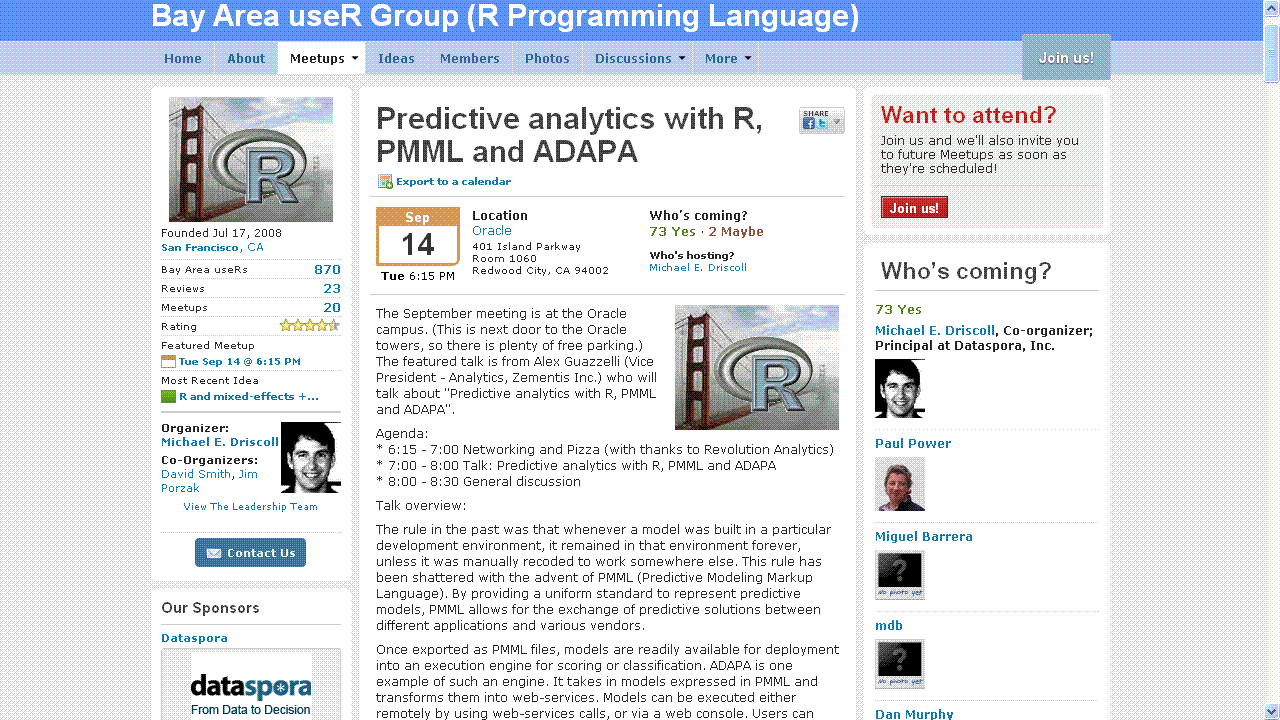
Event: Predictive analytics with R, PMML and ADAPA

From http://www.meetup.com/R-Users/calendar/14405407/

The September meeting is at the Oracle campus. (This is next door to the Oracle towers, so there is plenty of free parking.) The featured talk is from Alex Guazzelli (Vice President – Analytics, Zementis Inc.) who will talk about “Predictive analytics with R, PMML and ADAPA”.

Agenda:
* 6:15 – 7:00 Networking and Pizza (with thanks to Revolution Analytics)
* 7:00 – 8:00 Talk: Predictive analytics with R, PMML and ADAPA
* 8:00 – 8:30 General discussion

Talk overview:

The rule in the past was that whenever a model was built in a particular development environment, it remained in that environment forever, unless it was manually recoded to work somewhere else. This rule has been shattered with the advent of PMML (Predictive Modeling Markup Language). By providing a uniform standard to represent predictive models, PMML allows for the exchange of predictive solutions between different applications and various vendors.

Once exported as PMML files, models are readily available for deployment into an execution engine for scoring or classification. ADAPA is one example of such an engine. It takes in models expressed in PMML and transforms them into web-services. Models can be executed either remotely by using web-services calls, or via a web console. Users can also use an Excel add-in to score data from inside Excel using models built in R.

R models have been exported into PMML and uploaded in ADAPA for many different purposes. Use cases where clients have used the flexibility of R to develop and the PMML standard combined with ADAPA to deploy range from financial applications (e.g., risk, compliance, fraud) to energy applications for the smart grid. The ability to easily transition solutions developed in R to the operational IT production environment helps eliminate the traditional limitations of R, e.g. performance for high volume or real-time transactional systems and memory constraints associated with large data sets.

Speaker Bio:

Dr. Alex Guazzelli has co-authored the first book on PMML, the Predictive Model Markup Language which is the de facto standard used to represent predictive models. The book, entitled PMML in Action: Unleashing the Power of Open Standards for Data Mining and Predictive Analytics, is available on Amazon.com. As the Vice President of Analytics at Zementis, Inc., Dr. Guazzelli is responsible for developing core technology and analytical solutions under ADAPA, a PMML-based predictive decisioning platform that combines predictive analytics and business rules. ADAPA is the first system of its kind to be offered as a service on the cloud.
Prior to joining Zementis, Dr. Guazzelli was involved in not only building but also deploying predictive solutions for large financial and telecommunication institutions around the globe. In academia, Dr. Guazzelli worked with data mining, neural networks, expert systems and brain theory. His work in brain theory and computational neuroscience has appeared in many peer reviewed publications. At Zementis, Dr. Guazzelli and his team have been involved in a myriad of modeling projects for financial, health-care, gaming, chemical, and manufacturing industries.

Dr. Guazzelli holds a Ph.D. in Computer Science from the University of Southern California and a M.S and B.S. in Computer Science from the Federal University of Rio Grande do Sul, Brazil.

Mapreduce Book

Here is a new book on learning MapReduce and it has a free downloadable version as well.

Data-Intensive Text Processing with MapReduce

Jimmy Lin and Chris Dyer

ABSTRACT

Our world is being revolutionized by data-driven methods: access to large amounts of data has generated new insights and opened exciting new opportunities in commerce, science, and computing applications. Processing the enormous quantities of data necessary for these advances requires large clusters, making distributed computing paradigms more crucial than ever. MapReduce is a programming model for expressing distributed computations on massive datasets and an execution framework for large-scale data processing on clusters of commodity servers. The programming model provides an easy-to-understand abstraction for designing scalable algorithms, while the execution framework transparently handles many system-level details, ranging from scheduling to synchronization to fault tolerance. This book focuses on MapReduce algorithm design, with an emphasis on text processing algorithms common in natural language processing, information retrieval, and machine learning. We introduce the notion of MapReduce design patterns, which represent general reusable solutions to commonly occurring problems across a variety of problem domains. This book not only intends to help the reader “think in MapReduce”, but also discusses limitations of the programming model as well.

You can download the book here

This book is part of the Morgan & Claypool Synthesis Lectures on Human Language Technologies. If you’re at a university, your institution may already subscribe to the series, in which case you can access the electronic version directly without cost (see this page for a list of institutional subscribers). Otherwise, to purchase:

Quite explicitly, this book focuses on MapReduce algorithm design, not Hadoop programming. Tom White’s Hadoop: The Definitive Guide is a great resource for learning Hadoop.

Want to be notified of updates? Interested in MapReduce algorithm design? Follow @lintool on Twitter here!

IPSUR – A Free R Textbook

Here is a free R textbook called IPSUR-

http://ipsur.r-forge.r-project.org/book/index.php

IPSUR stands for Introduction to Probability and Statistics Using R, ISBN: 978-0-557-24979-4, which is a textbook written for an undergraduate course in probability and statistics. The approximate prerequisites are two or three semesters of calculus and some linear algebra in a few places. Attendees of the class include mathematics, engineering, and computer science majors.

IPSUR is FREE, in the GNU sense of the word. Hard copies are available for purchase here from Lulu and will be available (coming soon) from the other standard online retailers worldwide. The price of the book is exactly the manufacturing cost plus the retailers’ markup. You may be able to get it even cheaper by downloading an electronic copy and printing it yourself, but if you elect this route then be sure to get the publisher-quality PDF from theDownloads page. And double check the price. It was cheaper for my students to buy a perfect-bound paperback from Lulu and have it shipped to their door than it was to upload the PDF to Fed-Ex Kinkos and Xerox a coil-bound copy (and on top of that go pick it up at the store).

If you are going to buy from anywhere other than Lulu then be sure to check the time-stamp on the copyright page. There is a 6 to 8 week delay from Lulu to Amazon and you may not be getting the absolute latest version available.

Refer to the Installation page for instructions to install an electronic copy of IPSUR on your personal computer. See the Feedback page for guidance about questions or comments you may have about IPSUR.

Also see http://ipsur.r-forge.r-project.org/rcmdrplugin/index.php for the R Cmdr Plugin

This plugin for the R Commander accompanies the text Introduction to Probability and Statistics Using R by G. Jay Kerns. The plugin contributes functions unique to the book as well as specific configuration and functionality to R Commander, the pioneering work by John Fox of McMaster University.

RcmdrPlugin.IPSUR’s primary goal is to provide a user-friendly graphical user interface (GUI) to the open-source and freely available R statistical computing environment. RcmdrPlugin.IPSUR is equipped to handle many of the statistical analyses and graphical displays usually encountered by upper division undergraduate mathematics, statistics, and engineering majors. Available features are comparable to many expensive commercial packages such as Minitab, SPSS, and JMP-IN.

Since the audience of RcmdrPlugin.IPSUR is slightly different than Rcmdr’s, certain functionality has been added and selected error-checks have been disabled to permit the student to explore alternative regions of the statistical landscape. The resulting benefit of increased flexibility is balanced by somewhat increased vulnerability to syntax errors and misuse; the instructor should keep this and the academic audience in mind when usingRcmdrPlugin.IPSUR in the classroom

GNU PSPP- The Open Source SPSS

If you are SPSS user (for statistics/ not data mining) you can also try 0ut GNU PSPP- which is the open source equivalent and quite eerily impressive in performance. It is available at http://www.gnu.org/software/pspp/ or http://pspp.awardspace.com/ and you can also read more at http://en.wikipedia.org/wiki/PSPP

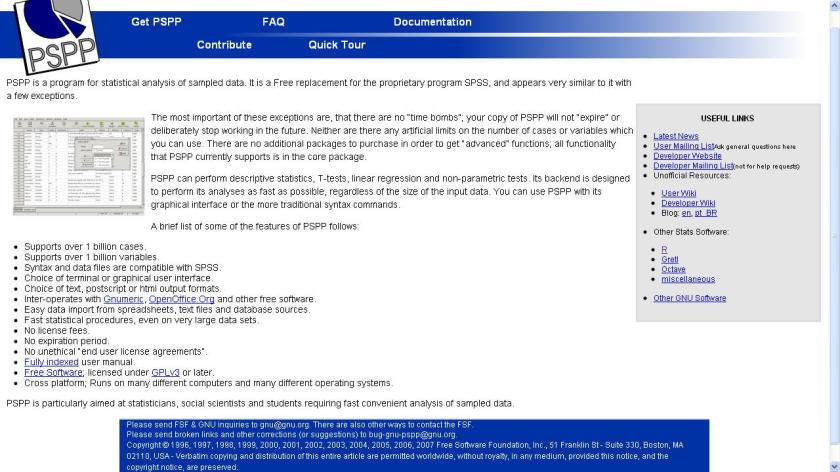
PSPP is a program for statistical analysis of sampled data. It is a Free replacement for the proprietary program SPSS, and appears very similar to it with a few exceptions.

[ Image of Variable Sheet ]The most important of these exceptions are, that there are no “time bombs”; your copy of PSPP will not “expire” or deliberately stop working in the future. Neither are there any artificial limits on the number of cases or variables which you can use. There are no additional packages to purchase in order to get “advanced” functions; all functionality that PSPP currently supports is in the core package.

PSPP can perform descriptive statistics, T-tests, linear regression and non-parametric tests. Its backend is designed to perform its analyses as fast as possible, regardless of the size of the input data. You can use PSPP with its graphical interface or the more traditional syntax commands.

A brief list of some of the features of PSPP follows:

  • Supports over 1 billion cases.
  • Supports over 1 billion variables.
  • Syntax and data files are compatible with SPSS.
  • Choice of terminal or graphical user interface.
  • Choice of text, postscript or html output formats.
  • Inter-operates with GnumericOpenOffice.Org and other free software.
  • Easy data import from spreadsheets, text files and database sources.
  • Fast statistical procedures, even on very large data sets.
  • No license fees.
  • No expiration period.
  • No unethical “end user license agreements”.
  • Fully indexed user manual.
  • Free Software; licensed under GPLv3 or later.
  • Cross platform; Runs on many different computers and many different operating systems.

PSPP is particularly aimed at statisticians, social scientists and students requiring fast convenient analysis of sampled data.

and

Features

This software provides a basic set of capabilities: frequencies, cross-tabs comparison of means (T-tests and one-way ANOVA); linear regression, reliability (Cronbach’s Alpha, not failure or Weibull), and re-ordering data, non-parametric tests, factor analysis and more.

At the user’s choice, statistical output and graphics are done in asciipdfpostscript or html formats. A limited range of statistical graphs can be produced, such as histogramspie-charts and np-charts.

PSPP can import GnumericOpenDocument and Excel spreadsheetsPostgres databasescomma-separated values– and ASCII-files. It can export files in the SPSS ‘portable’ and ‘system’ file formats and to ASCII files. Some of the libraries used by PSPP can be accessed programmatically; PSPP-Perl provides an interface to the libraries used by PSPP.

Origins

The PSPP project (originally called “Fiasco”) is a free, open-source alternative to the proprietary statistics package SPSS. SPSS is closed-source and includes a restrictive licence anddigital rights management. The author of PSPP considered this ethically unacceptable, and decided to write a program which might with time become functionally identical to SPSS, except that there would be no licence expiry, and everyone would be permitted to copy, modify and share the program.

Release history

  • 0.7.5 June 2010 http://pspp.awardspace.com/
  • 0.6.2 October 2009
  • 0.6.1 October 2008
  • 0.6.0 June 2008
  • 0.4.0.1 August 2007
  • 0.4.0 August 2005
  • 0.3.0 April 2004
  • 0.2.4 January 2000
  • 0.1.0 August 1998

Third Party Reviews

In the book “SPSS For Dummies“, the author discusses PSPP under the heading of “Ten Useful Things You Can Find on the Internet” [1]. In 2006, the South African Statistical Association presented a conference which included an analysis of how PSPP can be used as a free replacement to SPSS [2].

Citation-

Please send FSF & GNU inquiries to gnu@gnu.org. There are also other ways to contact the FSF. Please send broken links and other corrections (or suggestions) to bug-gnu-pspp@gnu.org.

Copyright © 1996, 1997, 1998, 1999, 2000, 2001, 2002, 2003, 2004, 2005, 2006, 2007 Free Software Foundation, Inc., 51 Franklin St – Suite 330, Boston, MA 02110, USA – Verbatim copying and distribution of this entire article are permitted worldwide, without royalty, in any medium, provided this notice, and the copyright notice, are preserved.