Google Dart a new programming language for web applications

From Google a new language for structured web applications-

http://www.dartlang.org/docs/technical-overview/index.html ( a rather unstructured website, if I may add)

Dart is a new class-based programming language for creating structured web applications. Developed with the goals of simplicity, efficiency, and scalability, the Dart language combines powerful new language features with familiar language constructs into a clear, readable syntax.

  • structured yet flexible programming language for the web.
  • Make Dart feel familiar and natural to programmers and thus easy to learn.
  • Ensure that all Dart language constructs allow high performance and fast application startup.
  • Make Dart appropriate for the full range of devices on the web—including phones, tablets, laptops, and servers.
  • Provide tools that make Dart run fast across all major modern browsers.

These design goals address the following problems currently facing web developers:

  • Small scripts often evolve into large web applications with no apparent structure—they’re hard to debug and difficult to maintain. In addition, these monolithic apps can’t be split up so that different teams can work on them independently. It’s difficult to be productive when a web application gets large.
  • Scripting languages are popular because their lightweight nature makes it easy to write code quickly. Generally, the contracts with other parts of an application are conveyed in comments rather than in the language structure itself. As a result, it’s difficult for someone other than the author to read and maintain a particular piece of code.
  • With existing languages, the developer is forced to make a choice between static and dynamic languages. Traditional static languages require heavyweight toolchains and a coding style that can feel inflexible and overly constrained.
  • Developers have not been able to create homogeneous systems that encompass both client and server, except for a few cases such as Node.js and Google Web Toolkit (GWT).
  • Different languages and formats entail context switches that are cumbersome and add complexity to the coding process.

Interesting announcement from PiCloud

An interesting announcement from PiCloud who is a cloud computing startup, but focused on python (as the name suggests). They basically have created a cloud library (or in R lingo – a package) that enables you to call cloud power sitting from the desktop interface itself. This announcement is for multiple IP addresses. Real parallel processing or just a quick trick in technical jargon- you decide!

  1. Prepare
  2. Run
  3. Monitor
Prepare

s1 cores are comparable in performance to c1 cores with one extra trick up their sleeve: each job running in parallel will have a different IP.

Why is this important?
Using unique IPs is necessary to minimize the automated throttling most sites will impose when seeing fast, repeated access from a single IP.

How do I use it?
If you’re already using our c1 cores, all you’ll need to do is set the _type keyword.

cloud.call(func, _type=’s1′)

How much?
$0.04/core/hour

Why don’t other cores have individual IPs?
For other core types, such as c2, multiple cores may be running on a single machine that is assigned only a single IP address. When using s1 cores, you’re guaranteed that each core sits on a different machine.


http://www.picloud.com/

Knowledge Discovery in Databases -KDD using PostgreSQL and #Rstats

Here is a small brief primer for beginners on configuring an open source database and using an open source analytics package.

All you need to know – is to read!


1. download PostgreSQL from
http://www.postgresql.org/download/windowsInstall PostgreSQL

Remember to store /memorize the password for the user postgres!

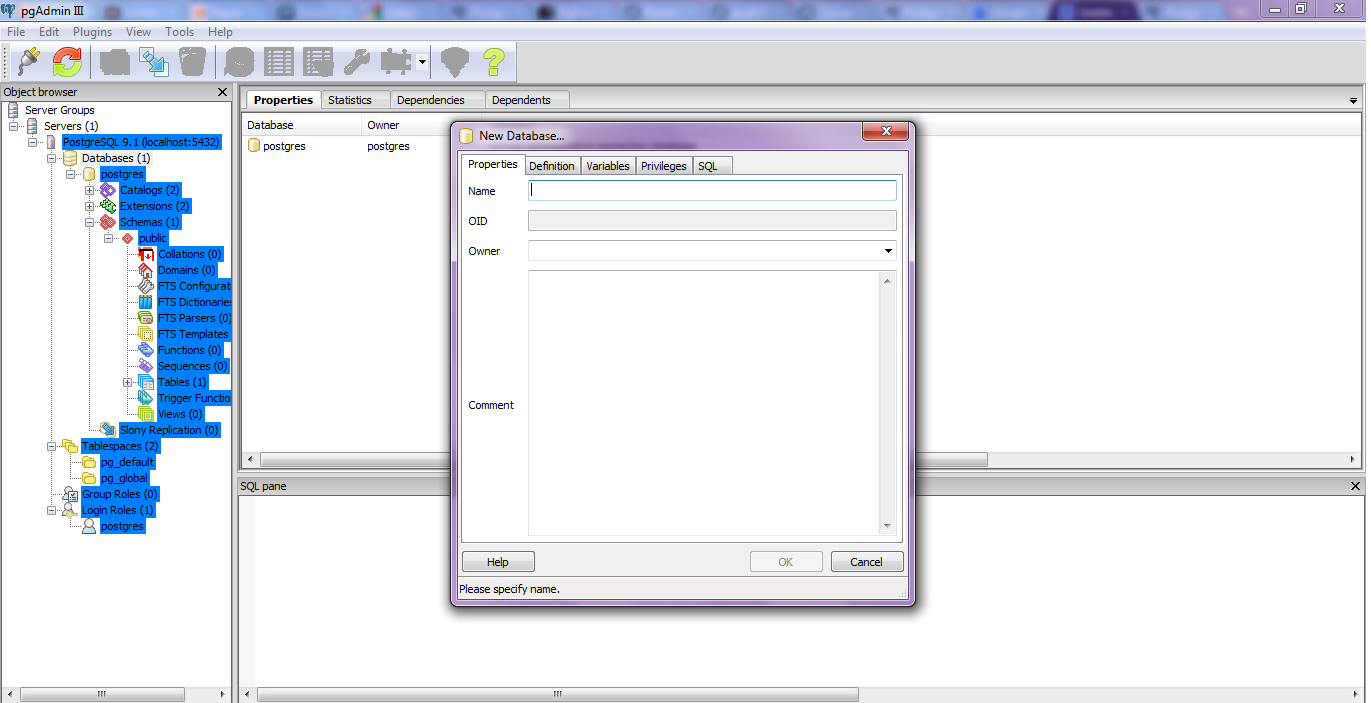
Create a connection using pgAdmin feature in Start Menu

2. download ODBC driver from
http://www.postgresql.org/ftp/odbc/versions/msi/
and the Win 64 edition from
http://wwwmaster.postgresql.org/download/mirrors-ftp/odbc/versions/msi/psqlodbc_09_00_0310-x64.zip

install ODBC driver

3. Go to

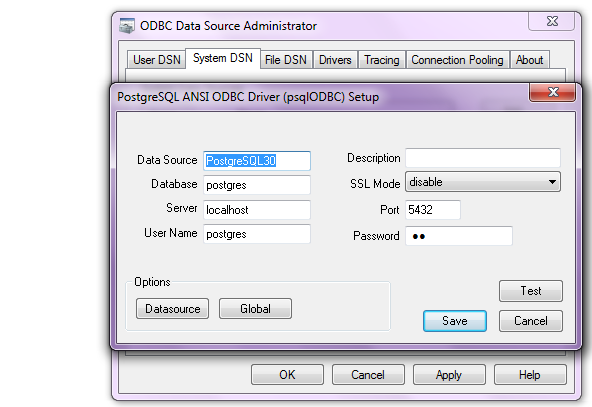
Start Menu\Control Panel\All Control Panel Items\Administrative Tools\Data Sources (ODBC)

4. Configure the following details in System DSN and  User DSN using the ADD tabs .Test connection to check if connection is working

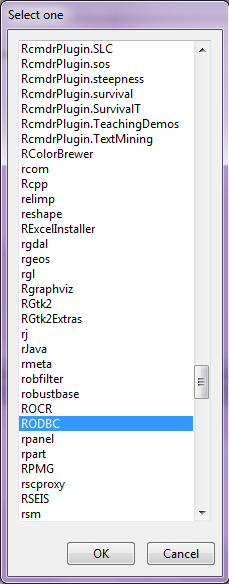
5. Start R and install and load library RODBC

6. Use following initial code for R- if you know SQL you can  do the rest
> library(RODBC)

> odbcDataSources(type = c(“all”, “user”, “system”))
SQLServer              PostgreSQL30             PostgreSQL35W
“SQL Server”    “PostgreSQL ANSI(x64)” “PostgreSQL Unicode(x64)”

> ajay=odbcConnect(“PostgreSQL30”, uid = “postgres”, pwd = “XX”)

> sqlTables(ajay)
TABLE_QUALIFIER TABLE_OWNER TABLE_NAME TABLE_TYPE REMARKS
1        postgres      public      names      TABLE

> crimedat <- sqlFetch(ajay, “names”)

How to make an analytics project?

Some of the process methodologies I have used and been exposed to while making analytics projects are-1) DMAIC/Six Sigma

While Six Sigma was initially a quality control system, it has also been very succesful in managing projects. The various stages of an analytical project can be divided using the DMAIC methodology.

DMAIC stands for

  • Define
  • Measure
  • Analyze
  • Improve
  • Control

Related to this is DMADV, ( “Design For Six Sigma”)

  • Define
  • Measure and identify CTQs
  • Analyze
  • Design
  • Verify

2) CRISP
CRISP-DM stands for Cross Industry Standard Process for Data Mining

CRISP-DM breaks the process of data mining into six major phases- and these can be used for business analytics projects as well.

  • Business Understanding
  • Data Understanding
  • Data Preparation
  • Modeling
  • Evaluation
  • Deployment

3) SEMMA
SEMMA  stands for

  • sample
  • explore
  • modify
  • model
  • assess

4) ISO 9001

ISO 9001 is a certification as well as a philosophy for making a Quality Management System to measure , reduce and eliminate error and customer complaints. Any customer complaint or followup has to be treated as an error, logged, and investigated for control.

5) LEAN
LEAN is a philosophy to eliminate Wastage in a process. Applying LEAN principles to analytics projects helps a lot in eliminating project bottlenecks, technology compatibility issues and data quality resolution. I think LEAN would be great in data quality issues, and IT infrastructure design because that is where the maximum waste is observed in analytics projects.

6) Demings Plan Do Check Act cycle.

Movie Review – Sahib Biwi aur Gangster (The Lord, The Wife and the Gangster)

This is the latest Bollywood smash, it is a inspired version of Sahib < Biwi < and Ghulam

It features a feudal lord, doing what gentlemen borne as gentlemen do, his bored schizophreniac wife, and the driver/gangster

There are lots of twists and turns, and it may be Bollywood’s steamiest romantic comedy/drama.

The songs are nice, the acting is superb by the cast of Randeep Hooda (D, Once upon a time in Mumbai), Mahi Gill and Jimmy Shergill.

Power packed and nice- but see it without your kids/family or you may end up blushing! Probably the closest to a noir sex comedy that I have seen in 3 decades of Bollywood watching!


Movie Review- Real Steel

Real Steel succeeds where Cowboys and Aliens failed. It manages to marry the odd couple-

robot movies with boxing movies, and the charming presence of Hugh Jackman, a new kid on the block,

and much better CGI than Transformers ensure this is a sweet family, buddy movie for a weekend.

It  may not rate very high on originality , as all sports movies do with the struggling underdog theme, the training, the Rocky deja Vu

—-but it does pack a very nice visual punch. See it to believe it, Robot boyz.  Real Steel is a real steal!