Google AppInventor -Android and Business Intelligence

Here is a great new tool for techies to start creating Android Apps right away- even if you have no knowledge of the platform. Of course there are existing great number of apps- including my favorite Android Data Mining App in R – called AnalyticDroid http://analyticdroid.togaware.com/

Basically it calls the Rattle (R Analytical Tool To Learn Easily) Data Mining GUI -enabling data mining from an Android Mobile using remote computing.

I dont know if any other statistical application is available on Android Mobiles- though SAS did have a presentation on using SAS on IPhone

http://www.wuss.org/proceedings09/09WUSSProceedings/papers/dpr/DPR-Truong.pdf
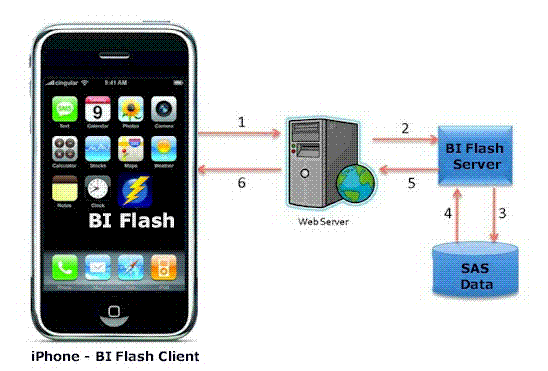


SAS Mobile -Iphone App

All you need to do is go to http://appinventor.googlelabs.com/about/index.html and request access (yes there is a 2 week approval waiting line)

Because App Inventor provides access to a GPS-location sensor, you can build apps that know where you are. You can build an app to help you remember where you parked your car, an app that shows the location of your friends or colleagues at a concert or conference, or your own custom tour app of your school, workplace, or a museum.
You can write apps that use the phone features of an Android phone. You can write an app that periodically texts “missing you” to your loved ones, or an app “No Text While Driving” that responds to all texts automatically with “sorry, I’m driving and will contact you later”. You can even have the app read the incoming texts aloud to you (though this might lure you into responding).
App Inventor provides a way for you to communicate with the web. If you know how to write web apps, you can use App Inventor to write Android apps that talk to your favorite web sites, such as Amazon and Twitter.

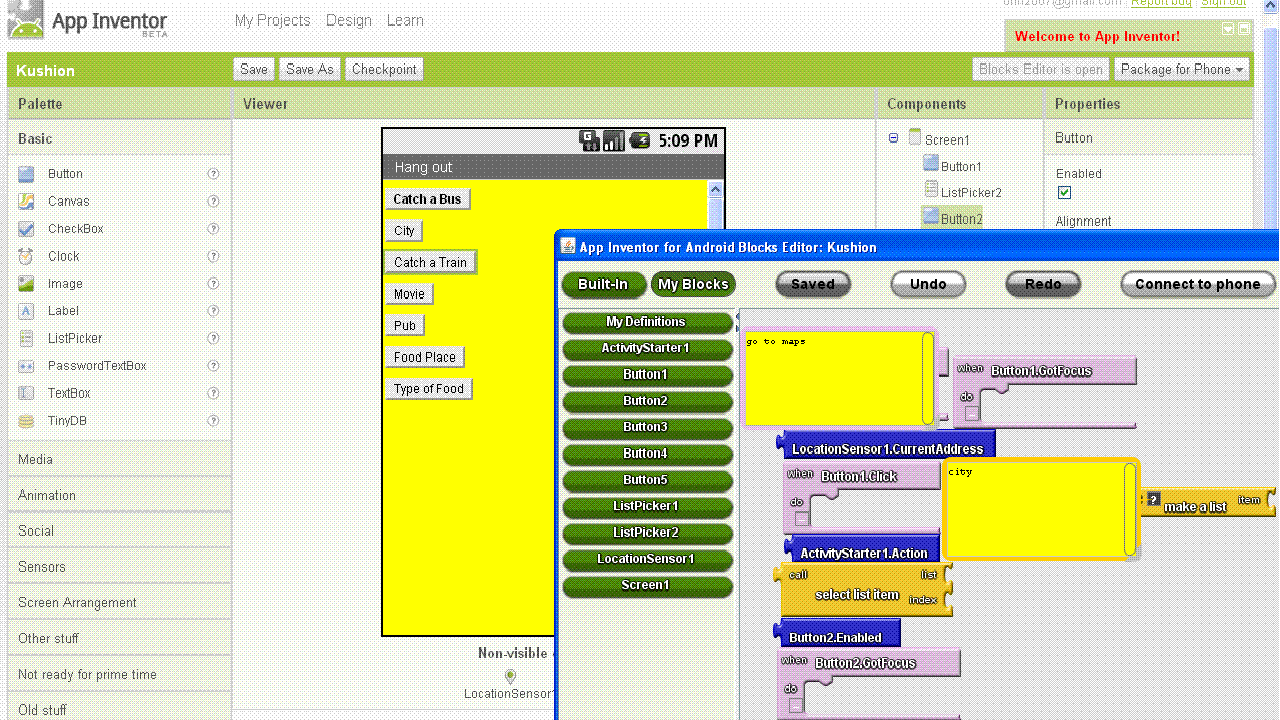
Here is a not so statistical Android App I am trying to create called Hang-Out

using the current GPS location of your phone to find nearest Pub, Movie or Diner and catch Bus- Train based on your location city, the GPS and time of request and schedule of those cities public transport- very much WIP
Data Mining 2010:SAS Conference in Vegas

An interesting conference which I attended last year, this year one of the main guests is an ex professor of mine at UTenn. I am India bound this year though for family reasons.

http://www.sas.com/events/dmconf/over.html

Latest News

Early Bird Special
Register for M2010 before Sept. 17 and save $200 on conference fees!

Additional Data Mining Resources
Find additional data mining resouces including links to whitepapers, webinars, audio seminars, videos, blogs and online communities.

Location
Caesars Palace
Las Vegas, NV

Conference: October 25-26
Pre-conference workshops: October 24
Post-conference training: October 27-29

The M2010 Data Mining Conference is an international educational conference and exhibition for data mining practitioners including analysts, statisticians, programmers, consultants and anyone involved with data management within their organization, Hosted by SAS, M2010 is now in its 13th year and has become the world’s largest data mining conference, attracting over 600 people from various industries including Financial Services, Retail, Insurance, Technology, Education, Healthcare, Pharmaceutical, Government and more.

This conference is the top-choice for serious education and career networking. Conference highlights include

  • 6 keynotes
  • 36 sessions
  • 6 session tracks
  • exhibit hall
  • poster session
  • SAS software training
  • educational workshops
  • special events
  • networking opportunities
  • predictive modeling certification testing event.

Session Topics

  • Business applications
  • Data augmentation
  • Perspectives from the financial services industry
  • Fraud detection
  • Perspectives from the healthcare industry
  • New and emerging technologies
  • Perspectives from the retail industry
  • Data mining in marketing
  • Retention and Life Cycle Analysis
  • Text mining
  • And more! (View session abstracts.)

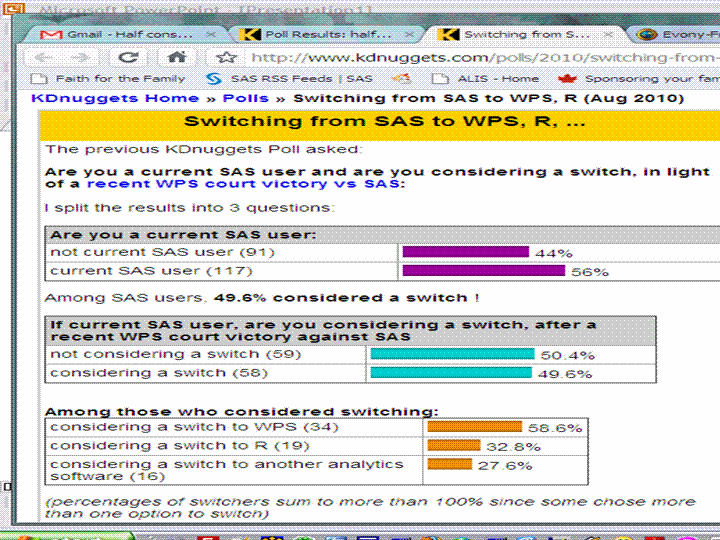
KDNuggets Poll on SAS: Churn in Analytics Users

Here are the some surprising results from the Bible of all Data Miners , KDNuggets.com with some interesting comments about SAS being the Microsoft of analytics.

I believe technically advanced users will probably want to try out R before going in for a commercial license from Revolution Analytics as it is free to try out. Also WPS offers a one month free preview for its software- the latest release of it competes with SAS/Stat and SAS/Access, SAS/Graph and Base SAS- so anyone having these installations on a server would be interested to atleast test it for free. Also WPS would be interested in increasing engines (like they have for Oracle and Teradata).

One very crucial difference for SAS is it’s ability to pull in data from almost all data formats- so if you are using SAS/Connect to remote submit code- then you may not be able to switch soon.

Also the more license heavy customers are not the kind of cutomers who have lots of data in their local desktops but is usually pulled and then crunched before analysed. R has recently made some strides with the RevoScaler package from Revolution Analytics but it’s effectiveness would be tested and tried in the coming months- it seems like a great step in the right direction.

For SAS, the feedback should be a call to improve their product bundling – some of which can feel like over selling at times- but they have been fighting off challenges since past 4 decades and have the pockets and intention to sustain market share battles including discounts ( for repeat customers SAS can be much cheaper than say a first time user of WPS or R)

http://teamwpc.co.uk/home

This really should come as a surprise to some people. You can see the comments on WPS and R at the site itself. Interesting stufff and we can see after say 1 year to see how many actually DID switch.

http://www.kdnuggets.com/polls/2010/switching-from-sas-to-wps.html

Business Analytics Analyst Relations /Ethics/White Papers

Curt Monash, whom I respect and have tried to interview (unsuccessfully) points out suitable ethical dilemmas and gray areas in Analyst Relations in Business Intelligence here at http://www.dbms2.com/2010/07/30/advice-for-some-non-clients/

If you dont know what Analyst Relations are, well it’s like credit rating agencies for BI software. Read Curt and his landscaping of the field here ( I am quoting a summary) at http://www.strategicmessaging.com/the-ethics-of-white-papers/2010/08/01/

Vendors typically pay for

  1. They want to connect with sales prospects.
  2. They want general endorsement from the analyst.
  3. They specifically want endorsement from the analyst for their marketing claims.
  4. They want the analyst to do a better job of explaining something than they think they could do themselves.
  5. They want to give the analyst some money to enhance the relationship,

Merv Adrian (I interviewed Merv here at http://www.dudeofdata.com/?p=2505) has responded well here at http://www.enterpriseirregulars.com/23040/white-paper-sponsorship-and-labeling/

None of the sites I checked clearly identify the work as having been sponsored in any way I found obvious in my (admittefly) quick scan. So this is an issue, but it’s not confined to Oracle.

My 2 cents (not being so well paid 😉 are-

I think Curt was calling out Oracle (which didnt respond) and not Merv ( whose subsequent blog post does much to clarify).

As a comparative new /younger blogger in this field,
I applaud both Curt to try and bell the cat ( or point out what everyone in AR winks at) and for Merv for standing by him.

In the long run, it would strengthen analyst relations as a channel if they separate financial payment of content from bias. An example is credit rating agencies who forgot to do so in BFSI and see what happened.

Customers invest millions of dollars in BI systems trusting marketing collateral/white papers/webinars/tests etc. Perhaps it’s time for an industry association for analysts so that individual analysts don’t knuckle down under vendor pressure.

It is easier for someone of Curt, Merv’s stature to declare editing policy and disclosures before they write a white paper.It is much harder for everyone else who is not so well established.

White papers can take as much as 25,000$ to produce- and I know people who in Business Analytics (as opposed to Business Intelligence) slog on cents per hour cranking books on R, SAS , webinars, trainings but there are almost no white papers in BA. Are there any analytics independent analysts who are not biased by R or SAS or SPSS or etc etc. I am not sure but this looks like a good line to  pursue 😉 – provided ethical checks and balances are established.

Personally I know of many so called analytics communities go all out to please their sponsors so bias in writing does exist (you cant praise SAS on a R Blogging Forum or R USers Meet and you cant write on WPS at SAS Community.org )

– at the same time someone once told me- It is tough to make a living as a writer, and that choice between easy money and credible writing needs to be respected.

Most sponsored white papers I read are pure advertisements, directed at CEOs rather than the techie community at large.

Almost every BI vendor claims to have the fastest database with 5X speed- and benchmarking in technical terms could be something they could do too.

Just like Gadget sites benchmark products, you can not benchmark BI or even BA products as it is written not to do so  in many licensing terms.

Probably that is the reason Billions are spent in BI and the positive claims are doubtful ( except by the sellers). Similarly in Analytics, many vendors would have difficulty justifying their claims or prices if they are subjected to a side by side comparison. Unfortunately the resulting confusion results in shoddy technology coming stronger due to more aggressive marketing.

My latest creation

I have just teamed up to create my latest venture called Kush Cognitives (Kush is my son). The firm is gonna make websites, build statistical analysis and offer social media offerings. It’s my latest venture and it merges all my previous ones and skills. After almost 3 years of working on and off with multiple people, this one is with a friend in the US.

Over the years (since 2007) I have made http://virtua-analytics.com (defunct), Swarajya Analytics Private Limited (www.swanplc.com – now sold) and now Kush Cognitives. I have gone through the models of proprietorship and corporation and now partnership.

Kush Cognitives is hosted at Decisionstats.com (as our flagship website) and we have shifted the blog to Decisionstats.Wordpress.com

We are aiming at the startups and small and medium segments first, but we retain capabilities for bigger clients as well. Lesser Bullshit and More Bang for your Buck.

So wish us luck- and if you need any social media advice, statistical analysis to be done, or technical matters of creating websites-This also includes training customization in R , SAS  , and statistical software but from a more practical point of view from a user angle. We are able to cater to both US and Indian clients.

give us a buzz at http://decisionstats.com

regards

Ajay Ohri

Image Courtesy-michelangelo

SAS Sentiment Analysis wins Award

From Business Wire, the new Sentiment Analysis product by SAS Institute (created by acquisition Teragram ) wins an award. As per wikipedia

http://en.wikipedia.org/wiki/Sentiment_analysis

Sentiment analysis or opinion mining refers to a broad (definitionally challenged) area of natural language processingcomputational linguistics and text mining. Generally speaking, it aims to determine the attitude of a speaker or a writer with respect to some topic. The attitude may be their judgment or evaluation (see appraisal theory), their affective state (that is to say, the emotional state of the author when writing) or the intended emotional communication (that is to say, the emotional effect the author wishes to have on the reader).

It was developed by Teragram. Here is another Sentiment Analysis tool from Stanford Grad school at http://twittersentiment.appspot.com/search?query=sas

See-

Sentiment analysis for sas

Image Citation-

http://threeminds.organic.com/2009/09/five_reasons_sentiment_analysi.html

Read an article on sentiment analysis here at http://www.nytimes.com/2009/08/24/technology/internet/24emotion.html

And the complete press release at http://goo.gl/iVzf`

SAS Sentiment Analysis delivers insights on customer, competitor and organizational opinions to a degree never before possible via manual review of electronic text. As a result, SAS, the leader in business analytics software and services, has earned the prestigious Communications Solutions Product of the Year Award fromTechnology Marketing Corporation (TMC).

“SAS has automated the time-consuming process of reading individual documents and manually extracting relevant information”

“SAS Sentiment Analysis has shown benefits for its customers and it provides ROI for the companies that use it,” said Rich Tehrani, CEO, TMC. “Congratulations to the entire team at SAS, a company distinguished by its dedication to software quality and superiority to address marketplace needs.”

Derive positive and negative opinions, evaluations and emotions

SAS Sentiment Analysis’ high-performance crawler locates and extracts sentiment from digital content sources, including mainstream websites, social media outlets, internal servers and incoming news feeds. SAS’ unique hybrid approach combines powerful statistical techniques with linguistics rules to improve accuracy to the detailed feature level. It summarizes the sentiment expressed in all available text collections – identifying trends and creating graphical reports that describe the expressed feelings of consumers, partners, employees and competitors in real time. Output from SAS Sentiment Analysis can be stored in document repositories, surfaced in corporate portals and used as input to additional SAS Text Analytics software or search engines to help decision makers evaluate trends, predict future outcomes, minimize risks and capitalize on opportunities.

“SAS has automated the time-consuming process of reading individual documents and manually extracting relevant information,” said Fiona McNeill, Global Analytics Product Marketing Manager at SAS. “Our integrated analytics framework helps organizations maximize the value of information to improve their effectiveness.”

SAS Sentiment Analysis is included in the SAS Text Analytics suite, which helps organizations discover insights from electronic text materials, associate them for delivery to the right person or place, and provide intelligence to select the best course of action. Whether answering complex search-and-retrieval questions, ensuring appropriate content is presented to internal or external constituencies, or predicting which activity or channel will produce the best effect on existing sentiments, SAS Text Analytics provides exceptional real-time processing speeds for large volumes of text.

SAS Text Analytics solutions are part of the SAS Business Analytics Framework, backed by the industry’s most comprehensive range of consulting, training and support services, ensuring customers maximum return from their IT investments.

Recognizing vision

The Communications Solutions Product of the Year Award recognizes vision, leadership and thoroughness. The most innovative products and services brought to the market from March 2008 through March 2009 were chosen as winners of this Product of the Year Award and are published on the INTERNET TELEPHONY and Customer Interaction Solutions websites.

Towards better analytical software

Here are some thoughts on using existing statistical software for better analytics and/or business intelligence (reporting)-

1) User Interface Design Matters- Most stats software have a legacy approach to user interface design. While the Graphical User Interfaces need to more business friendly and user friendly- example you can call a button T Test or You can call it Compare > Means of Samples (with a highlight called T Test). You can call a button Chi Square Test or Call it Compare> Counts Data. Also excessive reliance on drop down ignores the next generation advances in OS- namely touchscreen instead of mouse click and point.

Given the fact that base statistical procedures are the same across softwares, a more thoughtfully designed user interface (or revamped interface) can give softwares an edge over legacy designs.

2) Branding of Software Matters- One notable whine against SAS Institite products is a premier price. But really that software is actually inexpensive if you see other reporting software. What separates a Cognos from a Crystal Reports to a SAS BI is often branding (and user interface design). This plays a role in branding events – social media is often the least expensive branding and marketing channel. Same for WPS and Revolution Analytics.

3) Alliances matter- The alliances of parent companies are reflected in the sales of bundled software. For a complete solution , you need a database plus reporting plus analytical software. If you are not making all three of the above, you need to partner and cross sell. Technically this means that software (either DB, or Reporting or Analytics) needs to talk to as many different kinds of other softwares and formats. This is why ODBC in R is important, and alliances for small companies like Revolution Analytics, WPS and Netezza are just as important as bigger companies like IBM SPSS, SAS Institute or SAP. Also tie-ins with Hadoop (like R and Netezza appliance)  or  Teradata and SAS help create better usage.

4) Cloud Computing Interfaces could be the edge- Maybe cloud computing is all hot air. Prudent business planing demands that any software maker in analytics or business intelligence have an extremely easy to load interface ( whether it is a dedicated on demand website) or an Amazon EC2 image. Easier interfaces win and with the cloud still in early stages can help create an early lead. For R software makers this is critical since R is bad in PC usage for larger sets of data in comparison to counterparts. On the cloud that disadvantage vanishes. An easy to understand cloud interface framework is here ( its 2 years old but still should be okay) http://knol.google.com/k/data-mining-through-cloud-computing#

5) Platforms matter- Softwares should either natively embrace all possible platforms or bundle in middle ware themselves.

Here is a case study SAS stopped supporting Apple OS after Base SAS 7. Today Apple OS is strong  ( 3.47 million Macs during the most recent quarter ) and the only way to use SAS on a Mac is to do either

http://goo.gl/QAs2

or do a install of Ubuntu on the Mac ( https://help.ubuntu.com/community/MacBook ) and do this

http://ubuntuforums.org/showthread.php?t=1494027

Why does this matter? Well SAS is free to academics and students  from this year, but Mac is a preferred computer there. Well WPS can be run straight away on the Mac (though they are curiously not been able to provide academics or discounted student copies 😉 ) as per

http://goo.gl/aVKu

Does this give a disadvantage based on platform. Yes. However JMP continues to be supported on Mac. This is also noteworthy given the upcoming Chromium OS by Google, Windows Azure platform for cloud computing.