
Jim Goodnight for US Senate: Op Ed

Jim Goodnight, Chief Executive Officer, SAS, U...
Image via Wikipedia

This is NOT an April fool joke or a publicity stunt. It is also not meant to provoke discussion for the sake of provocation.

For a time, as I have studied both US and India , in what makes Government work or fail, academia work or fail, or businesses to work or fail- a common thread is the quality of people involved. Someone who is a wasteful businessman, will be a wasteful politician. Someone who is a flamboyant businessman with flair more than substance will continue that in public life.
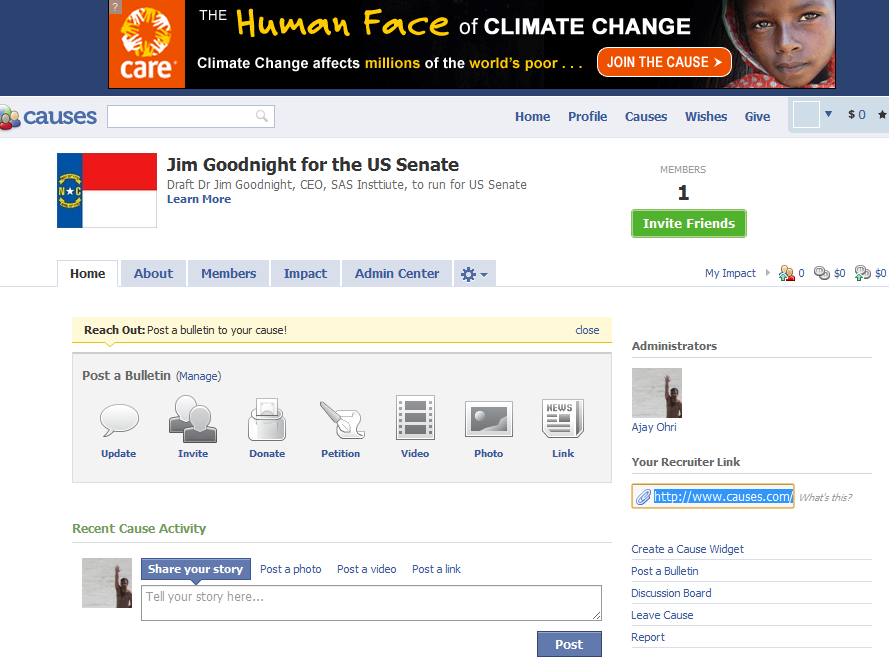
Accordingly I have created a Facebook cause-

Jim Goodnight for the US Senate

http://www.causes.com/causes/600220-jim-goodnight-for-the-us-senate

If Donald Trump can run for President, I can think of no one who has done more for the American South. Unlike the tech heavy, Stanford dominated boom in California, the Mid West and South have been declining centers of influence. Cities like Austin Texas or Raleigh, North California are the exception rather than norm there. A friend who went to Duke once told me, the worst thing is to be borne a rural white male who is poor in America. There are no groups lobbying for education or internet hi fi blazing speeds for you. Socially you are expected to walk and thrive alone.

The Southern Baptist Church has managed to infiltrate and influence young minds there- the average conservative American seemed better off and happier in his moderated social behaviour. But the Church exacts a 10 % tithe, and it is efficient in stretching every dollar and every cent of church donations. Government works with the best intentions, but spending someone else’s money (your tax money money by a bureaucrat) is always more inefficient than the actual owner spending it alone. Taxes are higher than the 10 % tithe and seem to accomplish much less social change. You would rather go to work or go to war?

Accordingly I find that on the West Coast there are very few tech savvy leaders with a track record of both fiscal pragmatism, educational reform and job creation. Certainly the industry lobbyist is smarter at evading taxes than the average Joe, and campaign financing is still dependent on deep pockets despite the innovations of internet retail fund raising.

Would you like your Senator to be as considerate of creating jobs as entrepreneurs are. Jim Goodnight here is a metaphor for all entrepreneurs who dont believe in reckless hire-fire,outsourcing and long term views on people.

Click here to spread this cause- perhaps it will make existing politicians more efficient just by the threat of new competition.

http://www.causes.com/causes/600220-jim-goodnight-for-the-us-senate?recruiter_id=8347178


Apres la nuit

Devil idle


lying on a bed or a couch half awake
half sleepy from last nights celebration
thinking in slow motion unsteadily
maybe i am getting too old for inebriation

still yesterday was a great day
we fought and celebrated a glorious win after long
hard work coupled with some luck
always leaves you humming a sweet song

i check my mails idly surf my social net
the net is quiet this morning
as if it too celebrated a lot last night
but check on it , it will be partying by evening

now tasks have to be done
daily chores yet to be begun
so we shake off the idleness like a shaggy dog who got wet
prepare to carpe diem ready get set

still an idle shrug and an occasional yawn
reminds aging bones to rest before dawn


Libre Office turns six

On September 28th, 2010, The Document Foundation was announced. The last six months, it feels, have just passed within a short glimpse of time. Not only did we release three LibreOffice versions within three months, have created the LibreOffice-Box DVD image, and brought LibreOffice Portable on its way. We also have announced the LibreOffice Conference for October 2011 and have taken part in lots of events worldwide, with FOSDEM and CeBIT being the most prominent ones.

People follow us at Twitter, Identi.ca, XING, LinkedIn and a Facebook group and fan page, they discuss on our mailing lists with more than 6.000 subscriptions, collaborate in our wiki, get insight on our daily work in our blog, and post and blog themselves. From the very first day, openness, transparency and meritocracy have been shaping the framework we want to work in. Our discussions and decisions take place on a public mailing list, and regularly, we hold phone conferences for the Steering Committee and for the marketing teams, where everyone is invited to join. Our ideas and visions have made their way into our Next Decade Manifesto.

We have joined the Open Invention Network as well as the OpenDoc Society, and just last week have become an SPI-associated project, and we see a wide range of support from all over the world. Not only do Novell and Red Hat support our efforts with developers, but just recently, Canonical, creators of Ubuntu, joined as well. All major Linux distributions deliver LibreOffice with their operating systems, and more follow every day.

One of the most stunning contributions, that still leaves us speechless, is the support that we receive from the community. When we asked for 50,000 € capital stock for a German-based foundation, the community showed their support, appreciation and their power, and not only donated it in just eight days, but up to now has supported us with close to 100,000 €! Another one is that driven by our open, vendor neutral approach, combined with our easy hacks, we have included code contributions from over 150 entirely new developers to the project, alongside localisations from over 50 localizers. The community has developed itself better than we could ever dream of, and first meetings like the project’s weekend or the QA meeting of the Germanophone group are already being organized.

What we have seen now is just the beginning of something very big. The Document Foundation has a vision, and the creation of the foundation in Germany is about to happen soon. LibreOffice has been downloaded over 350,000 times within the first week, and we just counted more than 1,3 million downloads just from our download system — not counting packages directly delivered by Linux distributors, other download sites or DVDs included in magazines and newspapers — supported by 65 mirrors from all over the world, and millions already use and contribute to it worldwide. With our participation in the Google Summer of Code, we will engage more students and young developers to be part of our community. Our improved release schedule will ensure that new features and improvements will make their way to end-users soon, and for testers, we even provide daily builds.

We are so excited by what has been achieved over the last six months, and we are immensely grateful to all those who have supported the project in whatever ways they can. It is an honour to be working with you, to be part of one united community! The future as we are shaping it has just begun, and it will be bright and excellent.


from-

List archive: http://listarchives.documentfoundation.org/www/announce/

Using Views in R and comparing functions across multiple packages

Some RDF hacking relating to updating probabil...
Image via Wikipedia

R has almost 2923 available packages

This makes the task of searching among these packages and comparing functions for the same analytical task across different packages a bit tedious and prone to manual searching (of reading multiple Pdfs of help /vignette of packages) or sending an email to the R help list.

However using R Views is a slightly better way of managing all your analytical requirements for software rather than the large number of packages (see Graphics view below).

CRAN Task Views allow you to browse packages by topic and provide tools to automatically install all packages for special areas of interest. Currently, 28 views are available. http://cran.r-project.org/web/views/

Bayesian Bayesian Inference
ChemPhys Chemometrics and Computational Physics
ClinicalTrials Clinical Trial Design, Monitoring, and Analysis
Cluster Cluster Analysis & Finite Mixture Models
Distributions Probability Distributions
Econometrics Computational Econometrics
Environmetrics Analysis of Ecological and Environmental Data
ExperimentalDesign Design of Experiments (DoE) & Analysis of Experimental Data
Finance Empirical Finance
Genetics Statistical Genetics
Graphics Graphic Displays & Dynamic Graphics & Graphic Devices & Visualization
gR gRaphical Models in R
HighPerformanceComputing High-Performance and Parallel Computing with R
MachineLearning Machine Learning & Statistical Learning
MedicalImaging Medical Image Analysis
Multivariate Multivariate Statistics
NaturalLanguageProcessing Natural Language Processing
OfficialStatistics Official Statistics & Survey Methodology
Optimization Optimization and Mathematical Programming
Pharmacokinetics Analysis of Pharmacokinetic Data
Phylogenetics Phylogenetics, Especially Comparative Methods
Psychometrics Psychometric Models and Methods
ReproducibleResearch Reproducible Research
Robust Robust Statistical Methods
SocialSciences Statistics for the Social Sciences
Spatial Analysis of Spatial Data
Survival Survival Analysis
TimeSeries Time Series Analysis

To automatically install these views, the ctv package needs to be installed, e.g., via

install.packages("ctv")
library("ctv")
Created by Pretty R at inside-R.org


and then the views can be installed via install.views or update.views (which first assesses which of the packages are already installed and up-to-date), e.g.,

install.views("Econometrics")
 update.views("Econometrics")
 Created by Pretty R at inside-R.org

CRAN Task View: Graphic Displays & Dynamic Graphics & Graphic Devices & Visualization

Maintainer: Nicholas Lewin-Koh
Contact: nikko at hailmail.net
Version: 2009-10-28

R is rich with facilities for creating and developing interesting graphics. Base R contains functionality for many plot types including coplots, mosaic plots, biplots, and the list goes on. There are devices such as postscript, png, jpeg and pdf for outputting graphics as well as device drivers for all platforms running R. lattice and grid are supplied with R’s recommended packages and are included in every binary distribution. lattice is an R implementation of William Cleveland’s trellis graphics, while grid defines a much more flexible graphics environment than the base R graphics.

R’s base graphics are implemented in the same way as in the S3 system developed by Becker, Chambers, and Wilks. There is a static device, which is treated as a static canvas and objects are drawn on the device through R plotting commands. The device has a set of global parameters such as margins and layouts which can be manipulated by the user using par() commands. The R graphics engine does not maintain a user visible graphics list, and there is no system of double buffering, so objects cannot be easily edited without redrawing a whole plot. This situation may change in R 2.7.x, where developers are working on double buffering for R devices. Even so, the base R graphics can produce many plots with extremely fine graphics in many specialized instances.

One can quickly run into trouble with R’s base graphic system if one wants to design complex layouts where scaling is maintained properly on resizing, nested graphs are desired or more interactivity is needed. grid was designed by Paul Murrell to overcome some of these limitations and as a result packages like latticeggplot2vcd or hexbin (on Bioconductor ) use grid for the underlying primitives. When using plots designed with grid one needs to keep in mind that grid is based on a system of viewports and graphic objects. To add objects one needs to use grid commands, e.g., grid.polygon() rather than polygon(). Also grid maintains a stack of viewports from the device and one needs to make sure the desired viewport is at the top of the stack. There is a great deal of explanatory documentation included with grid as vignettes.

The graphics packages in R can be organized roughly into the following topics, which range from the more user oriented at the top to the more developer oriented at the bottom. The categories are not mutually exclusive but are for the convenience of presentation:

  • Plotting : Enhancements for specialized plots can be found in plotrix, for polar plotting, vcd for categorical data, hexbin (on Bioconductor ) for hexagon binning, gclus for ordering plots and gplots for some plotting enhancements. Some specialized graphs, like Chernoff faces are implemented in aplpack, which also has a nice implementation of Tukey’s bag plot. For 3D plots latticescatterplot3d and misc3d provide a selection of plots for different kinds of 3D plotting. scatterplot3d is based on R’s base graphics system, while misc3d is based on rgl. The package onion for visualizing quaternions and octonions is well suited to display 3D graphics based on derived meshes.
  • Graphic Applications : This area is not much different from the plotting section except that these packages have tools that may not for display, but can aid in creating effective displays. Also included are packages with more esoteric plotting methods. For specific subject areas, like maps, or clustering the excellent task views contributed by other dedicated useRs is an excellent place to start.
    • Effect ordering : The gclus package focuses on the ordering of graphs to accentuate cluster structure or natural ordering in the data. While not for graphics directly cba and seriation have functions for creating 1 dimensional orderings from higher dimensional criteria. For ordering an array of displays, biclust can be useful.
    • Large Data Sets : Large data sets can present very different challenges from moderate and small datasets. Aside from overplotting, rendering 1,000,000 points can tax even modern GPU’s. For univariate datalvplot produces letter value boxplots which alleviate some of the problems that standard boxplots exhibit for large data sets. For bivariate data ash can produce a bivariate smoothed histogram very quickly, and hexbin, on Bioconductor , can bin bivariate data onto a hexagonal lattice, the advantage being that the irregular lines and orientation of hexagons do not create linear artifacts. For multivariate data, hexbin can be used to create a scatterplot matrix, combined with lattice. An alternative is to use scagnostics to produce a scaterplot matrix of “data about the data”, and look for interesting combinations of variables.
    • Trees and Graphs ape and ade4 have functions for plotting phylogenetic trees, which can be used for plotting dendrograms from clustering procedures. While these packages produce decent graphics, they do not use sophisticated algorithms for node placement, so may not be useful for very large trees. igraph has the Tilford-Rheingold algorithm implementead and is useful for plotting larger trees. diagram as facilities for flow diagrams and simple graphs. For more sophisticated graphs Rgraphviz and igraph have functions for plotting and layout, especially useful for representing large networks.
  • Graphics Systems lattice is built on top of the grid graphics system and is an R implementation of William Cleveland’s trellis system for S-PLUS. lattice allows for building many types of plots with sophisticated layouts based on conditioning. ggplot2 is an R implementation of the system described in “A Grammar of Graphics” by Leland Wilkinson. Like latticeggplot (also built on top of grid) assists in trellis-like graphics, but allows for much more. Since it is built on the idea of a semantics for graphics there is much more emphasis on reshaping data, transformation, and assembling the elements of a plot.
  • Devices : Whereas grid is built on top of the R graphics engine, many in the R community have found the R graphics engine somewhat inflexible and have written separate device drivers that either emphasize interactivity or plotting in various graphics formats. R base supplies devices for PostScript, PDF, JPEG and other formats. Devices on CRAN include cairoDevice which is a device based libcairo, which can actually render to many device types. The cairo device is desgned to work with RGTK2, which is an interface to the Gimp Tool Kit, similar to pyGTK2. GDD provides device drivers for several bitmap formats, including GIF and BMP. RSvgDevice is an SVG device driver and interfaces well with with vector drawing programs, or R web development packages, such as Rpad. When SVG devices are for web display developers should be aware that internet explorer does not support SVG, but has their own standard. Trust Microsoft. rgl provides a device driver based on OpenGL, and is good for 3D and interactive development. Lastly, the Augsburg group supplies a set of packages that includes a Java-based device, JavaGD.
  • Colors : The package colorspace provides a set of functions for transforming between color spaces and mixcolor() for mixing colors within a color space. Based on the HCL colors provided in colorspacevcdprovides a set of functions for choosing color palettes suitable for coding categorical variables ( rainbow_hcl()) and numerical information ( sequential_hcl()diverge_hcl()). Similar types of palettes are provided in RColorBrewer and dichromat is focused on palettes for color-impaired viewers.
  • Interactive Graphics : There are several efforts to implement interactive graphics systems that interface well with R. In an interactive system the user can interactively query the graphics on the screen with the mouse, or a moveable brush to zoom, pan and query on the device as well as link with other views of the data. rggobi embeds the GGobi interactive graphics system within R, so that one can display a data frame or several in GGobi directly from R. The package has functions to support longitudinal data, and graphs using GGobi’s edge set functionality. The RoSuDA repository maintained and developed by the University of Augsburg group has two packages, iplots and iwidgets as well as their Java development environment including a Java device, JavaGD. Their interactive graphics tools contain functions for alpha blending, which produces darker shading around areas with more data. This is exceptionally useful for parallel coordinate plots where many lines can quickly obscure patterns. playwith has facilities for building interactive versions of R graphics using the cairoDevice and RGtk2. Lastly, the rgl package has mechanisms for interactive manipulation of plots, especially 3D rotations and surfaces.
  • Development : For development of specialized graphics packages in R, grid should probably be the first consideration for any new plot type. rgl has better tools for 3D graphics, since the device is interactive, though it can be slow. An alternative is to use Java and the Java device in the RoSuDA packages, though Java has its own drawbacks. For porting plotting code to grid, using the package gridBase presents a nice intermediate step to embed base graphics in grid graphics and vice versa.

It's a code code summer

East-German pupils ("Junge Pioniere"...
Image via Wikipedia

and soc is back!

also expecting some #Rstats entries (open source!)

from https://code.google.com/soc/

Google Summer of Code 2011

Visit the Google Summer of Code 2011 site for more details about the program this year.

For a detailed timeline and further information about the program, review our Frequently Asked Questions.

About Google Summer of Code

Google Summer of Code is a global program that offers student developers stipends to write code for various open source software projects. We have worked with several open source, free software, and technology-related groups to identify and fund several projects over a three month period. Since its inception in 2005, the program has brought together over 4500 successful student participants and over 3000 mentors from over 100 countries worldwide, all for the love of code. Through Google Summer of Code, accepted student applicants are paired with a mentor or mentors from the participating projects, thus gaining exposure to real-world software development scenarios and the opportunity for employment in areas related to their academic pursuits. In turn, the participating projects are able to more easily identify and bring in new developers. Best of all, more source code is created and released for the use and benefit of all.

To learn more about the program, peruse our 2011 Frequently Asked Questions page. You can also subscribe to the Google Open Source Blog or the Google Summer of Code Discussion Group to keep abreast of the latest announcements.

Participating in Google Summer of Code

For those of you who would like to participate in the program, there are many resources available for you to learn more. Check out the information pages from the 20052006200720082009, and 2010 instances of the program to get a better sense of which projects have participated as mentoring organizations in Google Summer of Code each year. If you are interested in a particular mentoring organization, just click on its name and you’ll find more information about the project, a summary of their students’ work and actual source code produced by student participants. You may also find the program Frequently Asked Questions (FAQs) pages for each year to be useful. Finally, check out all the great content and advice on participation produced by the community, for the community, on our program wiki.

If you don’t find what you need in the documentation, you can always ask questions on our program discussion list or the program IRC channel, #gsoc on Freenode.


The Mommy Track

Wage_labour
Image via Wikipedia

A new paper quantitatively analyzes the impact of child bearing on women. Summary-

Women [who score in the upper third on a standardized test] have a net 8 percent reduction in pay during the first five years after giving birth

From http://papers.nber.org/papers/w16582

Having a child lowers a woman’s lifetime earnings, but how much depends upon her skill level. In The Mommy Track Divides: The Impact of Childbearing on Wages of Women of Differing Skill Levels (NBER Working Paper No. 16582), co-authors Elizabeth Ty Wilde, Lily Batchelder, and David Ellwood estimate that having a child costs the average high skilled woman $230,000 in lost lifetime wages relative to similar women who never gave birth. By comparison, low skilled women experience a lifetime wage loss of only $49,000.

Using the 1979 National Longitudinal Survey of Youth (NLSY), Wilde et. al. divided women into high, medium, and low skill categories based on their Armed Forces Qualification Test (AFQT) scores. The authors use these skill categories, combined with earnings, labor force participation, and family formation data, to chart the labor market progress of women before and after childbirth, from ages 14-to-21 in 1979 through 41-to-49 in 2006, this study’s final sample year.

High scoring and low scoring women differed in a number of ways. While 70-75 percent of higher scoring women work full-time all year prior to their first birth, only 55-60 percent of low scoring women do. As they age, the high scoring women enjoy steeper wage growth than low scoring women; low scoring women’s wages do not change much if they reenter the labor market after they have their first child. Five years after the first birth, about 35 percent of each group is working full-time. However, the high scoring women who are not working full-time are more likely to be working part-time than the low scoring women, who are more likely to leave the workforce entirely.

and

Men’s earning profiles are relatively unaffected by having children although men who never have children earn less on average than those who do. High scoring women who have children late also tend to earn more than high scoring childless women. Their earnings advantage occurs before they have children and narrows substantially after they become mothers.

PMML Plugin for Greenplum now available

Predictive Model Markup Language
Image via Wikipedia

From a press release from Zementis.


, the Universal PMML Plug-in for in-database scoring. Available now for the EMC Greenplum Database, a high-performance massively parallel processing (MPP) database, the plug-in leverages the Predictive Model Markup Language (PMML) to execute predictive models directly within EMC Greenplum, for highly optimized in-database scoring.

Universal PMML Plug-in

Developed by the Data Mining Group (DMG), PMML is supported by all major data mining vendors, e.g., IBM SPSS, SAS, Teradata, FICO, STASTICA, Microstrategy, TIBCO and Revolution Analytics as well as open source tools like R, KNIME and RapidMiner. With PMML, models built in any of these data mining tools can now instantly be deployed in the EMC Greenplum database. The net result is the ability to leverage the power of standards-based predictive analytics on a massive scale, right where the data resides.

“By partnering with Zementis, a true PMML innovator, we are able to offer a vendor-agnostic solution for moving enterprise-level predictive analytics into the database execution environment,” said Dr. Steven Hillion, Vice President of Analytics at EMC Greenplum. “With Zementis and PMML, the de-facto standard for representing data mining models, we are eliminating the need to recode predictive analytic models in order to deploy them within our database. In turn, this enables an analyst to reduce the time to insight required in most businesses today.”

Want to learn more?
 

To learn more about how the EMC Greenplum Database and the Universal PMML Plug-in work together, feel free to:

  1. Visit the PMML Plug-in product page
  2. Download the white paper

The Universal PMML Plug-in for the EMC Greenplum Database is available now. Contact us today for more information.

Michael Zeller, CEO, Zementis