R Commander Plugins-20 and growing!

First graphical user interface in 1973.
Image via Wikipedia
R Commander Extensions: Enhancing a Statistical Graphical User Interface by extending menus to statistical packages

R Commander ( see paper by Prof J Fox at http://www.jstatsoft.org/v14/i09/paper ) is a well known and established graphical user interface to the R analytical environment.
While the original GUI was created for a basic statistics course, the enabling of extensions (or plug-ins  http://www.r-project.org/doc/Rnews/Rnews_2007-3.pdf ) has greatly enhanced the possible use and scope of this software. Here we give a list of all known R Commander Plugins and their uses along with brief comments.

  1. DoE – http://cran.r-project.org/web/packages/RcmdrPlugin.DoE/RcmdrPlugin.DoE.pdf
  2. doex
  3. EHESampling
  4. epack- http://cran.r-project.org/web/packages/RcmdrPlugin.epack/RcmdrPlugin.epack.pdf
  5. Export- http://cran.r-project.org/web/packages/RcmdrPlugin.Export/RcmdrPlugin.Export.pdf
  6. FactoMineR
  7. HH
  8. IPSUR
  9. MAc- http://cran.r-project.org/web/packages/RcmdrPlugin.MAc/RcmdrPlugin.MAc.pdf
  10. MAd
  11. orloca
  12. PT
  13. qcc- http://cran.r-project.org/web/packages/RcmdrPlugin.qcc/RcmdrPlugin.qcc.pdf and http://cran.r-project.org/web/packages/qcc/qcc.pdf
  14. qual
  15. SensoMineR
  16. SLC
  17. sos
  18. survival-http://cran.r-project.org/web/packages/RcmdrPlugin.survival/RcmdrPlugin.survival.pdf
  19. SurvivalT
  20. Teaching Demos

Note the naming convention for above e plugins is always with a Prefix of “RCmdrPlugin.” followed by the names above
Also on loading a Plugin, it must be already installed locally to be visible in R Commander’s list of load-plugin, and R Commander loads the e-plugin after restarting.Hence it is advisable to load all R Commander plugins in the beginning of the analysis session.

However the notable E Plugins are
1) DoE for Design of Experiments-
Full factorial designs, orthogonal main effects designs, regular and non-regular 2-level fractional
factorial designs, central composite and Box-Behnken designs, latin hypercube samples, and simple D-optimal designs can currently be generated from the GUI. Extensions to cover further latin hypercube designs as well as more advanced D-optimal designs (with blocking) are planned for the future.
2) Survival- This package provides an R Commander plug-in for the survival package, with dialogs for Cox models, parametric survival regression models, estimation of survival curves, and testing for differences in survival curves, along with data-management facilities and a variety of tests, diagnostics and graphs.
3) qcc -GUI for  Shewhart quality control charts for continuous, attribute and count data. Cusum and EWMA charts. Operating characteristic curves. Process capability analysis. Pareto chart and cause-and-effect chart. Multivariate control charts
4) epack- an Rcmdr “plug-in” based on the time series functions. Depends also on packages like , tseries, abind,MASS,xts,forecast. It covers Log-Exceptions garch
and following Models -Arima, garch, HoltWinters
5)Export- The package helps users to graphically export Rcmdr output to LaTeX or HTML code,
via xtable() or Hmisc::latex(). The plug-in was originally intended to facilitate exporting Rcmdr
output to formats other than ASCII text and to provide R novices with an easy-to-use,
easy-to-access reference on exporting R objects to formats suited for printed output. The
package documentation contains several pointers on creating reports, either by using
conventional word processors or LaTeX/LyX.
6) MAc- This is an R-Commander plug-in for the MAc package (Meta-Analysis with
Correlations). This package enables the user to conduct a meta-analysis in a menu-driven,
graphical user interface environment (e.g., SPSS), while having the full statistical capabilities of
R and the MAc package. The MAc package itself contains a variety of useful functions for
conducting a research synthesis with correlational data. One of the unique features of the MAc
package is in its integration of user-friendly functions to complete the majority of statistical steps
involved in a meta-analysis with correlations. It uses recommended procedures as described in
The Handbook of Research Synthesis and Meta-Analysis (Cooper, Hedges, & Valentine, 2009).

A query to help for ??Rcmdrplugins reveals the following information which can be quite overwhelming given that almost 20 plugins are now available-

RcmdrPlugin.DoE::DoEGlossary
Glossary for DoE terminology as used in
RcmdrPlugin.DoE
RcmdrPlugin.DoE::Menu.linearModelDesign
RcmdrPlugin.DoE Linear Model Dialog for
experimental data
RcmdrPlugin.DoE::Menu.rsm
RcmdrPlugin.DoE response surface model Dialog
for experimental data
RcmdrPlugin.DoE::RcmdrPlugin.DoE-package
R-Commander plugin package that implements
design of experiments facilities from packages
DoE.base, FrF2 and DoE.wrapper into the
R-Commander
RcmdrPlugin.DoE::RcmdrPlugin.DoEUndocumentedFunctions
Functions used in menus
RcmdrPlugin.doex::ranblockAnova
Internal RcmdrPlugin.doex objects
RcmdrPlugin.doex::RcmdrPlugin.doex-package
Install the DOEX Rcmdr Plug-In
RcmdrPlugin.EHESsampling::OpenSampling1
Internal functions for menu system of
RcmdrPlugin.EHESsampling
RcmdrPlugin.EHESsampling::RcmdrPlugin.EHESsampling-package
Help with EHES sampling
RcmdrPlugin.Export::RcmdrPlugin.Export-package
Graphically export objects to LaTeX or HTML
RcmdrPlugin.FactoMineR::defmacro
Internal RcmdrPlugin.FactoMineR objects
RcmdrPlugin.FactoMineR::RcmdrPlugin.FactoMineR
Graphical User Interface for FactoMineR
RcmdrPlugin.IPSUR::IPSUR-package
An IPSUR Plugin for the R Commander
RcmdrPlugin.MAc::RcmdrPlugin.MAc-package
Meta-Analysis with Correlations (MAc) Rcmdr
Plug-in
RcmdrPlugin.MAd::RcmdrPlugin.MAd-package
Meta-Analysis with Mean Differences (MAd) Rcmdr
Plug-in
RcmdrPlugin.orloca::activeDataSetLocaP
RcmdrPlugin.orloca: A GUI for orloca-package
(internal functions)
RcmdrPlugin.orloca::RcmdrPlugin.orloca-package
RcmdrPlugin.orloca: A GUI for orloca-package
RcmdrPlugin.orloca::RcmdrPlugin.orloca.es
RcmdrPlugin.orloca.es: Una interfaz grafica
para el paquete orloca
RcmdrPlugin.qcc::RcmdrPlugin.qcc-package
Install the Demos Rcmdr Plug-In
RcmdrPlugin.qual::xbara
Internal RcmdrPlugin.qual objects
RcmdrPlugin.qual::RcmdrPlugin.qual-package
Install the quality Rcmdr Plug-In
RcmdrPlugin.SensoMineR::defmacro
Internal RcmdrPlugin.SensoMineR objects
RcmdrPlugin.SensoMineR::RcmdrPlugin.SensoMineR
Graphical User Interface for SensoMineR
RcmdrPlugin.SLC::Rcmdr.help.RcmdrPlugin.SLC
RcmdrPlugin.SLC: A GUI for slc-package
(internal functions)
RcmdrPlugin.SLC::RcmdrPlugin.SLC-package
RcmdrPlugin.SLC: A GUI for SLC R package
RcmdrPlugin.sos::RcmdrPlugin.sos-package
Efficiently search R Help pages
RcmdrPlugin.steepness::Rcmdr.help.RcmdrPlugin.steepness
RcmdrPlugin.steepness: A GUI for
steepness-package (internal functions)
RcmdrPlugin.steepness::RcmdrPlugin.steepness
RcmdrPlugin.steepness: A GUI for steepness R
package
RcmdrPlugin.survival::allVarsClusters
Internal RcmdrPlugin.survival Objects
RcmdrPlugin.survival::RcmdrPlugin.survival-package
Rcmdr Plug-In Package for the survival Package
RcmdrPlugin.TeachingDemos::RcmdrPlugin.TeachingDemos-package
Install the Demos Rcmdr Plug-In


Chapman/Hall announces new series on R

Rice University, Houston, Texas, USA - Cohen H...
Image via Wikipedia
R Authors get more choice and variety now-
http://www.mail-archive.com/r-help@r-project.org/msg122965.html
We are pleased to announce the launch of a new series of books on R. 

Chapman & Hall/CRC: The R Series

Aims and Scope
This book series reflects the recent rapid growth in the development and 
application of R, the programming language and software environment for 
statistical computing and graphics. R is now widely used in academic research, 
education, and industry. It is constantly growing, with new versions of the 
core software released regularly and more than 2,600 packages available. It is 
difficult for the documentation to keep pace with the expansion of the 
software, and this vital book series provides a forum for the publication of 
books covering many aspects of the development and application of R.

The scope of the series is wide, covering three main threads:
• Applications of R to specific disciplines such as biology, epidemiology, 
genetics, engineering, finance, and the social sciences.
• Using R for the study of topics of statistical methodology, such as linear 
and mixed modeling, time series, Bayesian methods, and missing data.
• The development of R, including programming, building packages, and graphics.

The books will appeal to programmers and developers of R software, as well as 
applied statisticians and data analysts in many fields. The books will feature 
detailed worked examples and R code fully integrated into the text, ensuring 
their usefulness to researchers, practitioners and students.

Series Editors
John M. Chambers (Department of Statistics, Stanford University, USA; 
j...@stat.stanford.edu)
Torsten Hothorn (Institut für Statistik, Ludwig-Maximilians-Universität, 
München, Germany; torsten.hoth...@stat.uni-muenchen.de)
Duncan Temple Lang (Department of Statistics, University of California, Davis, 
USA; dun...@wald.ucdavis.edu)
Hadley Wickham (Department of Statistics, Rice University, Houston, Texas, USA; 
had...@rice.edu)

Call for Proposals
We are interested in books covering all aspects of the development and 
application of R software. If you have an idea for a book, please contact one 
of the series editors above or one of the Chapman & Hall/CRC statistics 
acquisitions editors below. Please provide brief details of topic, audience, 
aims and scope, and include an outline if possible.

We look forward to hearing from you.

Best regards,Rob Calver (rob.cal...@informa.com)
David Grubbs (david.gru...@taylorandfrancis.com)
John Kimmel (john.kim...@taylorandfrancis.com)


Common Analytical Tasks

WorldWarII-DeathsByCountry-Barchart
Image via Wikipedia


Some common analytical tasks from the diary of the glamorous life of a business analyst-

1) removing duplicates from a dataset based on certain key values/variables
2) merging two datasets based on a common key/variable/s
3) creating a subset based on a conditional value of a variable
4) creating a subset based on a conditional value of a time-date variable
5) changing format from one date time variable to another
6) doing a means grouped or classified at a level of aggregation
7) creating a new variable based on if then condition
8) creating a macro to run same program with different parameters
9) creating a logistic regression model, scoring dataset,
10) transforming variables
11) checking roc curves of model
12) splitting a dataset for a random sample (repeatable with random seed)
13) creating a cross tab of all variables in a dataset with one response variable
14) creating bins or ranks from a certain variable value
15) graphically examine cross tabs
16) histograms
17) plot(density())
18)creating a pie chart
19) creating a line graph, creating a bar graph
20) creating a bubbles chart
21) running a goal seek kind of simulation/optimization
22) creating a tabular report for multiple metrics grouped for one time/variable
23) creating a basic time series forecast

and some case studies I could think of-


As the Director, Analytics you have to examine current marketing efficiency as well as help optimize sales force efficiency across various channels. In addition you have to examine multiple sales channels including inbound telephone, outgoing direct mail, internet email campaigns. The datawarehouse is an RDBMS but it has multiple data quality issues to be checked for. In addition you need to submit your budget estimates for next year’s annual marketing budget to maximize sales return on investment.

As the Director, Risk you have to examine the overdue mortgages book that your predecessor left you. You need to optimize collections and minimize fraud and write-offs, and your efforts would be measured in maximizing profits from your department.

As a social media consultant you have been asked to maximize social media analytics and social media exposure to your client. You need to create a mechanism to report particular brand keywords, as well as automated triggers between unusual web activity, and statistical analysis of the website analytics metrics. Above all it needs to be set up in an automated reporting dashboard .

As a consultant to a telecommunication company you are asked to monitor churn and review the existing churn models. Also you need to maximize advertising spend on various channels. The problem is there are a large number of promotions always going on, some of the data is either incorrectly coded or there are interaction effects between the various promotions.

As a modeller you need to do the following-
1) Check ROC and H-L curves for existing model
2) Divide dataset in random splits of 40:60
3) Create multiple aggregated variables from the basic variables

4) run regression again and again
5) evaluate statistical robustness and fit of model
6) display results graphically
All these steps can be broken down in little little pieces of code- something which i am putting down a list of.
Are there any common data analysis tasks that you think I am missing out- any common case studies ? let me know.


Using R from within Python

Python logo
Image via Wikipedia

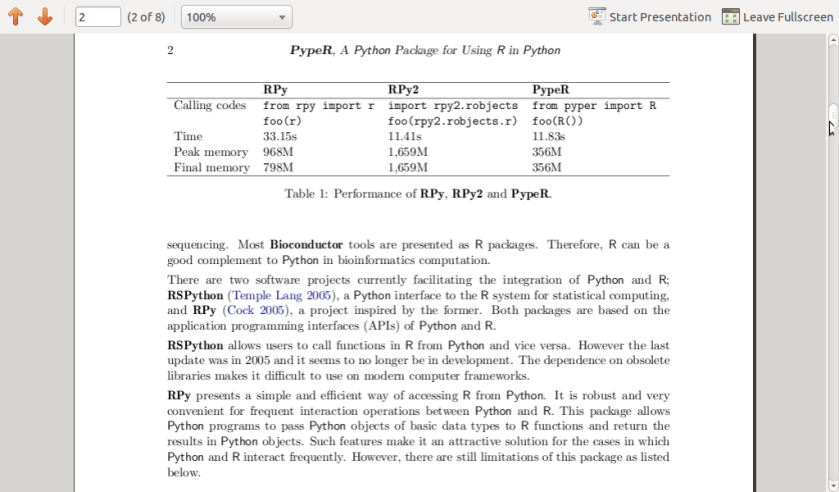
I came across this excellent JSS paper at www.jstatsoft.org/v35/c02/paper

on a Python package called PypeR which allows you to use R from within Python using the pipe functionality.

It is an interesting package and given Python’s increasing buzz , one worthy to be checked out by people using or thinking Python in their packages.


Citation:
	@article{Xia:McClelland:Wang:2010:JSSOBK:v35c02,
	  author =	"Xiao-Qin Xia and Michael McClelland and Yipeng Wang",
	  title =	"PypeR, A Python Package for Using R in Python",
	  journal =	"Journal of Statistical Software, Code Snippets",
	  volume =	"35",
	  number =	"2",
	  pages =	"1--8",
	  day =  	"30",
	  month =	"7",
	  year = 	"2010",
	  CODEN =	"JSSOBK",
	  ISSN = 	"1548-7660",
	  bibdate =	"2010-03-23",
	  URL =  	"http://www.jstatsoft.org/v35/c02",
	  accepted =	"2010-03-23",
	  acknowledgement = "",
	  keywords =	"",
	  submitted =	"2009-10-23",
	}


Assumptions on Guns

This is a very crude yet functional homemade g...
Image via Wikipedia

While sitting in Delhi, India- I sometimes notice that there is one big new worthy gun related incident in the United States every six months (latest incident Gabrielle giffords incident) and the mythical NRA (which seems just as powerful as equally mythical Jewish American or Cuban American lobby ) . As someone who once trained to fire guns (.22 and SLR -rifles actually), comes from a gun friendly culture (namely Punjabi-North Indian), my dad carried a gun sometimes as a police officer during his 30 plus years of service, I dont really like guns (except when they are in a movie). My 3 yr old son likes guns a lot (for some peculiar genetic reason even though we are careful not to show him any violent TV or movie at all).

So to settle the whole guns are good- guns are bad thing I turned to the one resource -Internet

Here are some findings-

1) A lot of hard statistical data on guns is biased by the perspective of the writer- it reminds me of the old saying Lies, True lies and Statistics.

2) There is not a lot of hard data in terms of a universal research which can be quoted- unlike say lung cancer is caused by cigarettes- no broad research which can be definitive in this regards.

3) American , European and Asian attitudes on guns actually seem a function of historical availability , historic crime rates and cultural propensity for guns.

Switzerland and United States are two extreme outlier examples on gun causing violence causal statistics.

4) Lot of old and outdated data quoted selectively.

It seems you can fudge data about guns in the following ways-

1) Use relative per capita numbers vis a vis aggregate numbers

2) Compare and contrast gun numbers with crime numbers selectively

3) Remove drill down of type of firearm- like hand guns, rifles, automatic, semi automatic

Maybe I am being simplistic-but I found it easier to list credible data sources on guns than to summarize all assumptions on guns. Are guns good or bad- i dont know -it depends? Any research you can quote is welcome.

Data Sources on Guns and Firearms and Crime-

1) http://www.justfacts.com/guncontrol.asp

Ownership

* As of 2009, the United States has a population of 307 million people.[5]

* Based on production data from firearm manufacturers,[6] there are roughly 300 million firearms owned by civilians in the United States as of 2010. Of these, about 100 million are handguns.[7]

* Based upon surveys, the following are estimates of private firearm ownership in the U.S. as of 2010:

Households With a Gun Adults Owning a Gun Adults Owning a Handgun
Percentage 40-45% 30-34% 17-19%
Number 47-53 million 70-80 million 40-45 million

[8]

* A 2005 nationwide Gallup poll of 1,012 adults found the following levels of firearm ownership:

Category Percentage Owning 

a Firearm

Households 42%
Individuals 30%
Male 47%
Female 13%
White 33%
Nonwhite 18%
Republican 41%
Independent 27%
Democrat 23%

[9]

* In the same poll, gun owners stated they own firearms for the following reasons:

Protection Against Crime 67%
Target Shooting 66%
Hunting 41%

2) NationMaster.com

http://www.nationmaster.com/graph/cri_mur_wit_fir-crime-murders-with-firearms

VIEW DATA: Totals Per capita
Definition Source Printable version
Bar Graph Pie Chart Map

Showing latest available data.

Rank Countries Amount
# 1 South Africa: 31,918
# 2 Colombia: 21,898
# 3 Thailand: 20,032
# 4 United States: 9,369
# 5 Philippines: 7,708
# 6 Mexico: 2,606
# 7 Slovakia: 2,356
# 8 El Salvador: 1,441
# 9 Zimbabwe: 598
# 10 Peru: 442
# 11 Germany: 269
# 12 Czech Republic: 181
# 13 Ukraine: 173
# 14 Canada: 144
# 15 Albania: 135
# 16 Costa Rica: 131
# 17 Azerbaijan: 120
# 18 Poland: 111
# 19 Uruguay: 109
# 20 Spain: 97
# 21 Portugal: 90
# 22 Croatia: 76
# 23 Switzerland: 68
# 24 Bulgaria: 63
# 25 Australia: 59
# 26 Sweden: 58
# 27 Bolivia: 52
# 28 Japan: 47
# 29 Slovenia: 39
= 30 Hungary: 38
= 30 Belarus: 38
# 32 Latvia: 28
# 33 Burma: 27
# 34 Macedonia, The Former Yugoslav Republic of: 26
# 35 Austria: 25
# 36 Estonia: 21
# 37 Moldova: 20
# 38 Lithuania: 16
= 39 United Kingdom: 14
= 39 Denmark: 14
# 41 Ireland: 12
# 42 New Zealand: 10
# 43 Chile: 9
# 44 Cyprus: 4
# 45 Morocco: 1
= 46 Iceland: 0
= 46 Luxembourg: 0
= 46 Oman: 0
Total: 100,693
Weighted average: 2,097.8

DEFINITION: Total recorded intentional homicides committed with a firearm. Crime statistics are often better indicators of prevalence of law enforcement and willingness to report crime, than actual prevalence.

SOURCE: The Eighth United Nations Survey on Crime Trends and the Operations of Criminal Justice Systems (2002) (United Nations Office on Drugs and Crime, Centre for International Crime Prevention)

3)

Bureau of Justice Statistics

see

http://bjs.ojp.usdoj.gov/dataonline/Search/Homicide/State/RunHomTrendsInOneVar.cfm

or the brand new website (till 2009) on which I CANNOT get gun crime but can get total

http://www.ucrdatatool.gov/

Estimated  murder rate *
Year United States-Total

1960 5.1
1961 4.8
1962 4.6
1963 4.6
1964 4.9
1965 5.1
1966 5.6
1967 6.2
1968 6.9
1969 7.3
1970 7.9
1971 8.6
1972 9.0
1973 9.4
1974 9.8
1975 9.6
1976 8.7
1977 8.8
1978 9.0
1979 9.8
1980 10.2
1981 9.8
1982 9.1
1983 8.3
1984 7.9
1985 8.0
1986 8.6
1987 8.3
1988 8.5
1989 8.7
1990 9.4
1991 9.8
1992 9.3
1993 9.5
1994 9.0
1995 8.2
1996 7.4
1997 6.8
1998 6.3
1999 5.7
2000 5.5
2001 5.6
2002 5.6
2003 5.7
2004 5.5
2005 5.6
2006 5.7
2007 5.6
2008 5.4
2009 5.0
Notes: National or state offense totals are based on data from all reporting agencies and estimates for unreported areas.
* Rates are the number of reported offenses per 100,000 population
  • United States-Total –
    • The 168 murder and nonnegligent homicides that occurred as a result of the bombing of the Alfred P. Murrah Federal Building in Oklahoma City in 1995 are included in the national estimate.
    • The 2,823 murder and nonnegligent homicides that occurred as a result of the events of September 11, 2001, are not included in the national estimates.


  • Sources: 


    FBI, Uniform Crime Reports as prepared by the National Archive of Criminal Justice Data


    4) united nation statistics of 2002  were too old in my opinion.
    wikipedia seems too broad based to qualify as a research article but is easily accessible http://en.wikipedia.org/wiki/Gun_violence_in_the_United_States
    to actually buy a gun or see guns available for purchase in United States see
    http://www.usautoweapons.com/

    America's Data Book: Census Abstract 2011

    U.S. Census Bureau Regions, Partnership and Da...
    Image via Wikipedia

    An excellent summary of 2011 Census Statistical abstract was given by NYTimes at

    http://www.nytimes.com/interactive/2011/01/07/us/CENSUS.html?hp

    Like more white people now enjoy jazz than black people now (presumably who have got rap music), but not details enough on ahem country music

    The Data book is at http://www.census.gov/compendia/statab/

    What is the Statistical Abstract?

    The Statistical Abstract of the United States, published since 1878, is the authoritative and comprehensive summary of statistics on the social, political, and economic organization of the United States.

    Use the Abstract as a convenient volume for statistical reference, and as a guide to sources of more information both in print and on the Web.

    Sources of data include the Census Bureau, Bureau of Labor Statistics, Bureau of Economic Analysis, and many other Federal agencies and private organizations.

    Tables of Interest

    1060 – Shopping Centers–Number and Gross Leasable Area [Excel 31K] | [PDF 59K]

    1170 – Flow of Funds Accounts-Liabilities of Households and Nonprofit Organizations [Excel 41K] | [PDF 66K]

    1172 – Amount of Debt Held by Families-Percent Distribution [Excel 29K] | [PDF 66K]

    1173 – Ratios of Debt Payments to Family Income [Excel 857K] | [PDF 64K]

    327 – Law Enforcement Officers Killed and Assaulted [Excel 34k] | [PDF 468k]

    From the last table you can see , while the number of officers killed or feloniously killed decreased by 20% in past five years, the number of officers assaulted by firearms grew by 20% in the same period.