Every Revolution Needs a Poet

Every revolution needs a poet.

Every poet needs a revolution.

Every bird needs a branch to sit.

Every tree wishes for some birds to meet.

Every hacker deserves some respect.

Every corporation needs to pay its bills.

Every scumbag was once a human baby.

Every baby will grow up to do atleast one horrible thing.

Forget and Forgive.

Let it be and let it go.

And if you cant forget, forgive then fight

Will each cell in your brain, each sinew in your fingers

Kill all the killers if you cannot forgive the killing

Hack all the servers, tear them root by root,

if you cannot forgive the deceptions.

Violent begets violence,

be aware and beware.

Protected: Happy Labour Day to American Stats-ical Association

This content is password-protected. To view it, please enter the password below.

LibreOffice 3.3.2

Graph of internet users per 100 inhabitants be...
Image via Wikipedia

the latest freest office productivity software in the world.

The Document Foundation maintains its release schedule thanks to a growing and vibrant community of developers

The Internet, March 22, 2011 – The Document Foundation announces LibreOffice 3.3.2, the second micro release of the free office suite for personal productivity, which further improves the stability of the software and sets the platform for the next release 3.4, due in mid May. The community of developers has been able to maintain the tight schedule thanks to the increase in the number of contributors, and to the fact that those that have started with easy hacks in September 2010 are now working at substantial features. In addition, they have almost completed the code cleaning process, getting rid of German comments and obsolete functionalities.

“I have started hacking LibreOffice code on September 28, 2010, just a few hours after the announcement of the project, and I found a very welcoming community, where senior developers went out of their way to help newbies like me to become productive. After a few hours I submitted a small patch removing 5 or 6 lines of dead code… enough to get my feet wet and learn the workflow”, says Norbert, a French developer living in the United States. “In a short time, I ended up removing the VOS library – deprecated for a decade – from LibreOffice, and finding and fixing various threading issues in the process”.

LibreOffice 3.3.2 is being released just one day after the closing of the first funding round launched by The Document Foundation to collect donations towards the 50,000-euro capital needed to establish a Stiftung in Germany. In five weeks, the community has donated twice as much, i.e. around 100,000 euros. All additional funds will be used for operating expenses such as infrastructure costs and registration of domain names and trademarks, as well as for community development expenses such as travel funding for TDF representatives speaking at conferences, booth fees for trade shows, and initial financing of merchandising items, DVDs and printed material.

Italo Vignoli, a founder and a steering committee member of The Document Foundation, will be keynoting at Flourish 2011 in Chicago on Sunday, April 3, at 10:30AM, about getting independent from OpenOffice and Oracle, starting The Document Foundation, raising the capital and the first community budget, organizing developers and other work, and outlining a roadmap for future releases and features.

The Document Foundation is at http://documentfoundation.org, while LibreOffice is at http://www.libreoffice.org. LibreOffice 3.3.2 is immediately available from the download page.

*** About The Document Foundation

The Document Foundation has the mission of facilitating the evolution of the LibreOffice Community into a new, open, independent, and meritocratic organization within the next few months. An independent foundation is a better reflection of the values of our contributors, users and supporters, and will enable a more effective, efficient and transparent community. TDF will protect past investments by building on the achievements of the first decade, will encourage wide participation within the community, and will co-ordinate activity across the community.

*** Media contacts for TDF

Florian Effenberger (Germany)
Mobile: +49 151 14424108 – E-mail: floeff@documentfoundation.org
Olivier Hallot (Brazil)
Mobile: +55 21 88228812 – E-mail: olivier.hallot@documentfoundation.org
Charles H. Schulz (France)
Mobile: +33 6 98655424 – E-mail: charles.schulz@documentfoundation.org
Italo Vignoli (Italy)
Mobile: +39 348 5653829 – E-mail: italo.vignoli@documentfoundation.org


Italo Vignoli – The Document Foundation
email italo.vignoli@documentfoundation.org
phone +39.348.5653829 – VoIP +39.02.320621813
skype italovignoli – italo.vignoli@gmail.com

LibreOffice Stable Release launched

Non Oracle Open Office completes important milestone- from the press release

The Document Foundation launches LibreOffice 3.3

The first stable release of the free office suite is available for download

The Internet, January 25, 2011 – The Document Foundation launches LibreOffice 3.3, the first stable release of the free office suite developed by the community. In less than four months, the number of developers hacking LibreOffice has grown from less than twenty in late September 2010, to well over one hundred today. This has allowed us to release ahead of the aggressive schedule set by the project.

Not only does it ship a number of new and original features, LibreOffice 3.3 is also a significant achievement for a number of reasons:

– the developer community has been able to build their own and independent process, and get up and running in a very short time (with respect to the size of the code base and the project’s strong ambitions);

– thanks to the high number of new contributors having been attracted into the project, the source code is quickly undergoing a major clean-up to provide a better foundation for future development of LibreOffice;

– the Windows installer, which is going to impact the largest and most diverse user base, has been integrated into a single build containing all language versions, thus reducing the size for download sites from 75 to 11GB, making it easier for us to deploy new versions more rapidly and lowering the carbon footprint of the entire infrastructure.

Caolán McNamara from RedHat, one of the developer community leaders, comments, “We are excited: this is our very first stable release, and therefore we are eager to get user feedback, which will be integrated as soon as possible into the code, with the first enhancements being released in February. Starting from March, we will be moving to a real time-based, predictable, transparent and public release schedule, in accordance with Engineering Steering Committee’s goals and users’ requests”. The LibreOffice development roadmap is available at http://wiki.documentfoundation.org/ReleasePlan

LibreOffice 3.3 brings several unique new features. The 10 most-popular among community members are, in no particular order:

  1. the ability to import and work with SVG files;
  2. an easy way to format title pages and their numbering in Writer;
  3. a more-helpful Navigator Tool for Writer;
  4. improved ergonomics in Calc for sheet and cell management;
  5. and Microsoft Works and Lotus Word Pro document import filters.

In addition, many great extensions are now bundled, providing

PDF import,

a slide-show presenter console,

a much improved report builder, and more besides.

A more-complete and detailed list of all the new features offered by LibreOffice 3.3 is viewable on the following web page: http://www.libreoffice.org/download/new-features-and-fixes/

LibreOffice 3.3 also provides all the new features of OpenOffice.org 3.3, such as new custom properties handling; embedding of standard PDF fonts in PDF documents; new Liberation Narrow font; increased document protection in Writer and Calc; auto decimal digits for “General” format in Calc; 1 million rows in a spreadsheet; new options for CSV import in Calc; insert drawing objects in Charts; hierarchical axis labels for Charts; improved slide layout handling in Impress; a new easier-to-use print interface; more options for changing case; and colored sheet tabs in Calc. Several of these new features were contributed by members of the LibreOffice team prior to the formation of The Document Foundation.

LibreOffice hackers will be meeting at FOSDEM in Brussels on February 5 and 6, and will be presenting their work during a one-day workshop on February 6, with speeches and hacking sessions coordinated by several members of the project.

The home of The Document Foundation is at http://www.documentfoundation.org

The home of LibreOffice is at http://www.libreoffice.org where the download page has been redesigned by the community to be more user-friendly.

*** About The Document Foundation

The Document Foundation has the mission of facilitating the evolution of the OOo Community into a new, open, independent, and meritocratic organization within the next few months. An independent Foundation is a better reflection of the values of our contributors, users and supporters, and will enable a more effective, efficient and transparent community. TDF will protect past investments by building on the achievements of the first decade, will encourage wide participation within the community, and will co-ordinate activity across the community.

*** Media Contacts for TDF

Florian Effenberger (Germany)

Mobile: +49 151 14424108 – E-mail: floeff@documentfoundation.org

Olivier Hallot (Brazil)

Mobile: +55 21 88228812 – E-mail: olivier.hallot@documentfoundation.org

Charles H. Schulz (France)

Mobile: +33 6 98655424 – E-mail: charles.schulz@documentfoundation.org

Italo Vignoli (Italy)

Mobile: +39 348 5653829 – E-mail: italo.vignoli@documentfoundation.org

Google Books Ngram Viewer

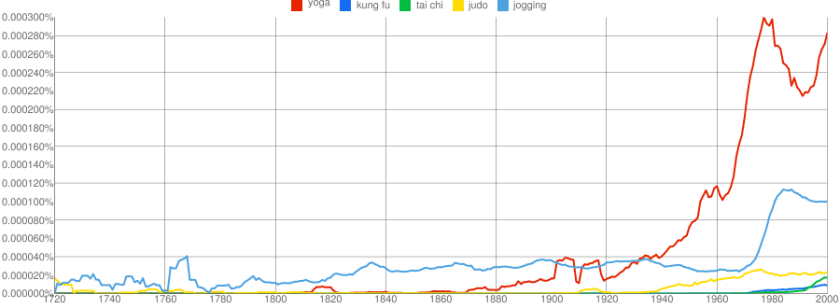
Here is a terrific data visualization from Google based on their digitized books collection. How does it work, basically you can test the frequency of various words across time periods from 1700s to 2010.

Like the frequency and intensity of kung fu vs yoga, or pizza versus hot dog. The basic datasets scans millions /billions of words.

Here is my yoga vs kung fu vs judo graph.

http://ngrams.googlelabs.com/info

What’s all this do?

When you enter phrases into the Google Books Ngram Viewer, it displays a graph showing how those phrases have occurred in a corpus of books (e.g., “British English”, “English Fiction”, “French”) over the selected years. Let’s look at a sample graph:

This shows trends in three ngrams from 1950 to 2000: “nursery school” (a 2-gram or bigram), “kindergarten” (a 1-gram or unigram), and “child care” (another bigram). What the y-axis shows is this: of all the bigrams contained in our sample of books written in English and published in the United States, what percentage of them are “nursery school” or “child care”? Of all the unigrams, what percentage of them are “kindergarten”? Here, you can see that use of the phrase “child care” started to rise in the late 1960s, overtaking “nursery school” around 1970 and then “kindergarten” around 1973. It peaked shortly after 1990 and has been falling steadily since.

(Interestingly, the results are noticeably different when the corpus is switched to British English.)

Corpora

Below are descriptions of the corpora that can be searched with the Google Books Ngram Viewer. All of these corpora were generated in July 2009; we will update these corpora as our book scanning continues, and the updated versions will have distinct persistent identifiers.

Informal corpus name Persistent identifier Description
American English googlebooks-eng-us-all-20090715 Same filtering as the English corpus but further restricted to books published in the United States.
British English googlebooks-eng-gb-all-20090715 Same filtering as the English corpus but further restricted to books published in Great Britain.