I like the Google Plus Pages

https://plus.google.com/100342444795999377790/posts

and unlike Scoble, my only wish is they fix the badge page

https://developers.google.com/+/plugins/badge/config?pageId=100342444795999377790&hl=en

Customize your badge

 Customize name:

Get the code

Copy and paste the following code into your site:

<!– script coming soon –!>


The Amazing Microsoft Robotics

Amazing stuff from the makers of Kinetic-

Operating systems of Robots may be the future cash cow of Microsoft , while the pirates of Silicon Valley fight fascinating cloudy wars! 🙂

http://www.microsoft.com/robotics/#Product


Product Information

Microsoft Robotics Developer Studio 4 beta (RDS4 beta) provides a wide range of support to help make it easy to develop robot applications. RDS4 beta includes a programming model that helps make it easy to develop asynchronous, state-driven applications. RDS4 beta provides a common programming framework that can be applied to support a wide variety of robots, enabling code and skill transfer.

RDS4 beta includes a lightweight asynchronous services-oriented runtime, a set of visual authoring and simulation tools, as well as templates, tutorials, and sample code to help you get started.

Microsoft Robotics Developer Studio 4 beta Datasheet – English (PDF Format)

Product VideoView the product video on Channel 9!

This release has extensive support for the Kinect sensor hardware throug the Kinect for Windows SDK allowing developers to create Kinect-enabled robots in the Visual Simulation Environment and in real life. Along with this release comes a standardized reference spec for building a Kinect-based robot.

See how Microsoft Robotics Developer Studio 4 beta is being used to bring ideas to life in the Microsoft Robotics@Home competition.

Lightweight Asynchronous ServicesOriented Runtime

Lightweight Asynchronous ServicesOriented Runtime

Concurrency and Coordination Runtime (CCR) helps make it easier to handle asynchronous input and output by eliminating the conventional complexities of manual threading, locks, and semaphores. Lightweight state-oriented Decentralized Software Services (DSS) framework enables you to create program modules that can interoperate on a robot and connected PCs by using a relatively simple, open protocol.

Visual Programming Language (VPL)

Visual Programming Language

Visual Programming Language (VPL) provides a relatively simple drag-and-drop visual programming language tool that helps make it easy to create robotics applications. VPL also provides the ability to take a collection of connected blocks and reuse them as a single block elsewhere in your program. VPL is also capable of generating human-readable C#.

DSS Manifest Editor

DSS Manifest Editor

DSS Manifest Editor (DSSME) provides a relatively simple creation of application configuration and distribution scenarios.

DSS Log Analyzer

DSS Log Analyzer

The DSS Log Analyzer tool allows you to view message flows across multiple DSS services. DSS Log Analyzer also allows you to inspect message details.

Visual Simulation Environment (VSE)

Visual Simulation Environment

Visual Simulation Environment (VSE) provides the ability to simulate and test robotic applications using a 3D physics-based simulation tool. This allows developers to create robotics applications without the hardware. Sample simulation models and environments enable you to test your application in a variety of 3D virtual environments.

Google Dart a new programming language for web applications

From Google a new language for structured web applications-

http://www.dartlang.org/docs/technical-overview/index.html ( a rather unstructured website, if I may add)

Dart is a new class-based programming language for creating structured web applications. Developed with the goals of simplicity, efficiency, and scalability, the Dart language combines powerful new language features with familiar language constructs into a clear, readable syntax.

  • structured yet flexible programming language for the web.
  • Make Dart feel familiar and natural to programmers and thus easy to learn.
  • Ensure that all Dart language constructs allow high performance and fast application startup.
  • Make Dart appropriate for the full range of devices on the web—including phones, tablets, laptops, and servers.
  • Provide tools that make Dart run fast across all major modern browsers.

These design goals address the following problems currently facing web developers:

  • Small scripts often evolve into large web applications with no apparent structure—they’re hard to debug and difficult to maintain. In addition, these monolithic apps can’t be split up so that different teams can work on them independently. It’s difficult to be productive when a web application gets large.
  • Scripting languages are popular because their lightweight nature makes it easy to write code quickly. Generally, the contracts with other parts of an application are conveyed in comments rather than in the language structure itself. As a result, it’s difficult for someone other than the author to read and maintain a particular piece of code.
  • With existing languages, the developer is forced to make a choice between static and dynamic languages. Traditional static languages require heavyweight toolchains and a coding style that can feel inflexible and overly constrained.
  • Developers have not been able to create homogeneous systems that encompass both client and server, except for a few cases such as Node.js and Google Web Toolkit (GWT).
  • Different languages and formats entail context switches that are cumbersome and add complexity to the coding process.

Knowledge Discovery in Databases -KDD using PostgreSQL and #Rstats

Here is a small brief primer for beginners on configuring an open source database and using an open source analytics package.

All you need to know – is to read!


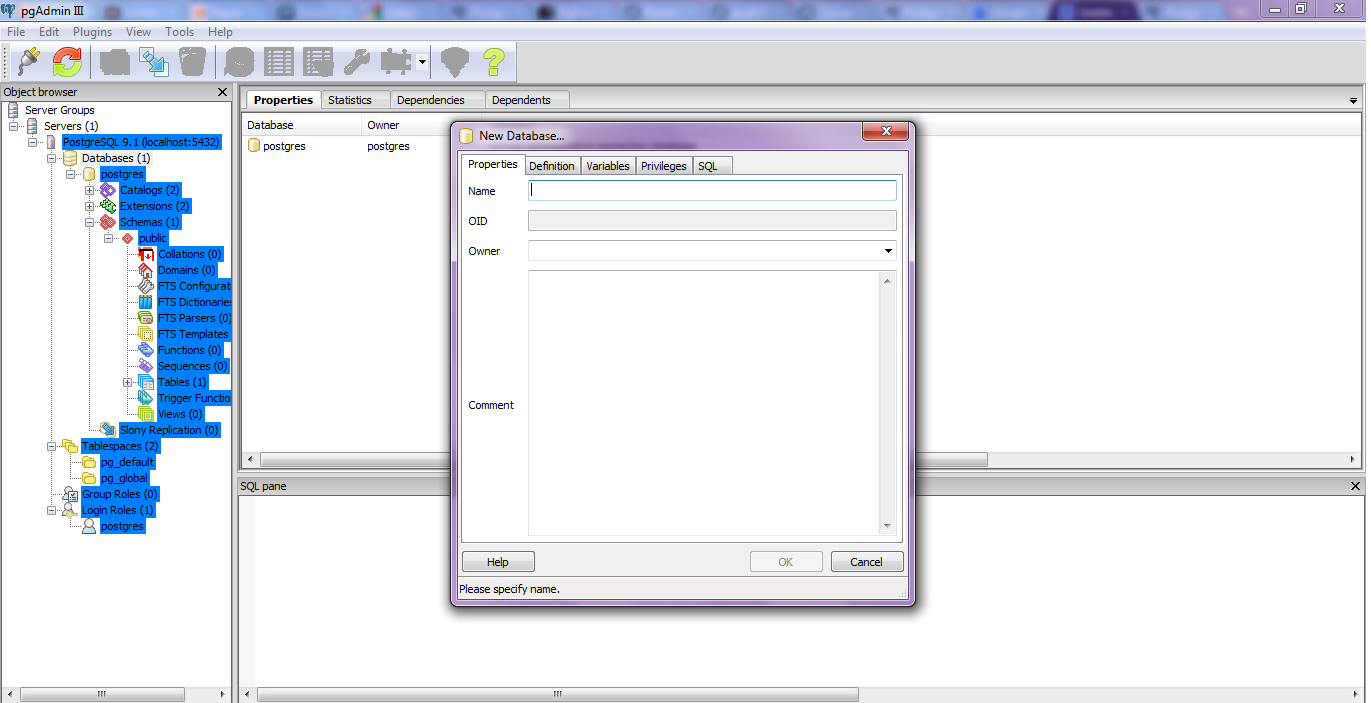
1. download PostgreSQL from
http://www.postgresql.org/download/windowsInstall PostgreSQL

Remember to store /memorize the password for the user postgres!

Create a connection using pgAdmin feature in Start Menu

2. download ODBC driver from
http://www.postgresql.org/ftp/odbc/versions/msi/
and the Win 64 edition from
http://wwwmaster.postgresql.org/download/mirrors-ftp/odbc/versions/msi/psqlodbc_09_00_0310-x64.zip

install ODBC driver

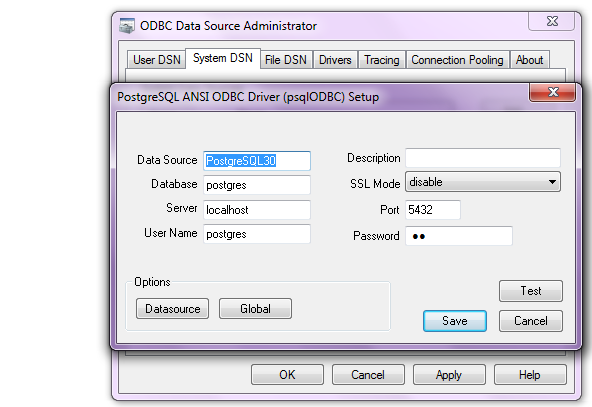
3. Go to

Start Menu\Control Panel\All Control Panel Items\Administrative Tools\Data Sources (ODBC)

4. Configure the following details in System DSN and  User DSN using the ADD tabs .Test connection to check if connection is working

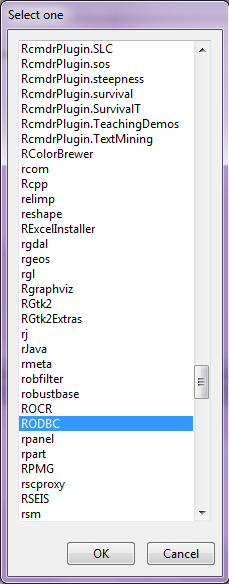
5. Start R and install and load library RODBC

6. Use following initial code for R- if you know SQL you can  do the rest
> library(RODBC)

> odbcDataSources(type = c(“all”, “user”, “system”))
SQLServer              PostgreSQL30             PostgreSQL35W
“SQL Server”    “PostgreSQL ANSI(x64)” “PostgreSQL Unicode(x64)”

> ajay=odbcConnect(“PostgreSQL30”, uid = “postgres”, pwd = “XX”)

> sqlTables(ajay)
TABLE_QUALIFIER TABLE_OWNER TABLE_NAME TABLE_TYPE REMARKS
1        postgres      public      names      TABLE

> crimedat <- sqlFetch(ajay, “names”)

10 Ways We will miss Steve Jobs

I am not an Apple fanboy.In fact I dont use a Mac (because Linux works well for me at much cheaper rates)

I am going to miss Steve Jobs like I miss …… still.

1) The Original Pirate – I liked Steve Jobs ever since I saw Pirates of Silicon Valley, I wanted to be like the Jobs who created jobs http://en.wikipedia.org/wiki/Pirates_of_Silicon_Valley

Artists steal. Yeah baby!

2) Music -Itunes Improbably the man who came up with the idea of music @ 99 cents helped more artists earn money in the era of Napster. Music piracy is not dead, but at 99 cents you CAN afford the songs

3) Aesthetics- and Design- as competitive barriers. It was all about the interface. People care about interfaces. Shoody software wont sell.

4) Portable Music- yes I once wrote a poem on my first Ipod. http://www.decisionstats.com/ode-to-an-ipod/ No , it doesnot rank as the top ten poems on Ipod in SERP

Walkman ‘s evolution was the Ipod – and it was everywhere.

5) Big Phones can be cool too- I loved my IPhone and so did everyone. But thats because making cool phones before that was all about making the tiniest thinnest phone. Using Videochat on Iphone and webs surfing were way much cooler than anything before or since.

6) Apps for Money for Geeks. Yes the Apps marketplace was more enriching to the geek universe than all open source put together.

7) Turtleneck Steve- You know when Steve Jobs was about to make a presentation because one week before and one week later the whole tech media behaved like either a fanboy or we are too cool to be an Apple fanboy but we will report it still. The man who wrote no code sold more technology than everyone else using just a turtleneck and presentations.

8) Pixar toons- Yes Pixar toons made sure cartoons were pieces of art and not just funny stuff anymore. This one makes me choke up

9) Kicking Microsoft butt- Who else but Steve can borrow money from MS and then beat it in every product it wanted to.

10) Not being evil. Steve Jobs made more money for more geeks than anyone. and he made it look good! The original DONT BE EVIL guy who never needed to say it aloud

Take a bow Steve Jobs (or touch the first Apple product that comes to your hand after reading this!)

The article was first written on Aug 25,2011 on Steve Jobs resignation news.It has been updated to note his departing from this planet as of yesterday.


Rcpp Workshop in San Francisco Oct 8th

 Rcpp Workshop in San Francisco  Oct 8th 

Following the successful one-day master class on Rcpp preceding this year’s R/Finance conference, a full-day master class on Rcpp and related topics which will be held on Saturday, October 8, in San Francisco.

Join Dirk Eddelbuettel for six hours of detailed and hands-on instructions and discussions aroundRcppinline,  RInsideRcppArmadilloRcppGSLRcppEigen and other packages—in an intimate small-group setting.

The full-day format allows combining an introductory morning session with a more advanced afternoon session while leaving room for sufficient breaks. We plan on having about six hours of instructions, a one-hour lunch break and two half-hour coffee breaks (and lunch and refreshments will be provided).

Morning session: “A Hands-on Introduction to R and C++”

The morning session will provide a practical introduction to the Rcpp package (and other related packages).  The focus will be on simple and straightforward applications of Rcpp in order to extend R and/or to significantly accelerate the execution of simple functions.

The tutorial will cover the inline package which permits embedding of self-contained C, C++ or FORTRAN code in R scripts. We will also discuss  RInside, to easily embed the R engine code in C++ applications, as well as standard Rcpp extension packages such as RcppArmadillo and RcppEigen for linear algebra (via highly expressive templated C++ libraries) and RcppGSL.

Afternoon session: “Advanced R and C++ Topics”

The afternoon tutorial will provide a hands-on introduction to more advanced Rcpp features. It will cover topics such as writing packages that use Rcpp, how Rcpp modules and the new R ReferenceClasses interact, and how Rcpp sugar lets us write C++ code that is often as expressive as R code. Another possible topic, time permitting, may be writing glue code to extend Rcpp to other C++ projects.

We also expect to leave some time to discuss problems brought by the class participants.

October 8, 2011 – San Franciso

AMA Executive Conference Center
@ the Marriott Hotel
55 4th Street, 2nd Level
San Francisco, CA 94103
Tel.             415-442-6770

Register Now!

Instructor Bio

Dirk Eddelbuettel Dirk E has been contributing packages to CRAN for nearly a decade. Among these are RQuantLib, digest, littler, random, RPostgreSQL, as well the Rcpp family of packages comprising Rcpp, RInside, RcppClassic, RcppExamples, RcppDE, RcppArmadillo and RcppEigen. He maintains the CRAN Task Views for Finance as well as High-Performance Computing, and is a founding co-organiser of the annual R / Finance conferences in Chicago. He has Ph.D. in Financial Econometrics from EHESS (Paris), and works in Chicago as a Quantitative Strategist.

Open Source Analytics

My guest blog at Allanalytics.com is now up

http://www.allanalytics.com/ is the exciting community which looks at the business aspects to the analytics market with a great lineup of pedigree writers.

It is basically a point/counterpoint for and against open source analytics. I feel there is a scope of lot of improvement before open source dominates the world of analytics software like Android, Linux Web Server do in their markets. Part of this reason is – there needs to be more , much more investment in analytics research, development, easier to use interfaces, Big Data integration and rewarding ALL the writers of code regardless of whether the code is proprietary or open source.

A last word- I think open source analytics AND proprietary analytics software will have to learn to live with one another, with game theory dictating their response and counter-response. More competition is good, and open source is an AND option not an OR option to existing status quo.

You can read the full blog discussion at http://www.allanalytics.com/author.asp?section_id=1408&doc_id=233454&piddl_msgorder=thrd#msgs

Hopefully discussion would be more analytical than passionate 🙂 and greater investments in made in analytics by all sides.