Using Google Adwords to target Vic Gundotra and Matt Cutts stochastically

Over the Christmas break, I created a Google Adwords campaign using the $100 credit generously given by Google. I did it using my alumni id, even though I have a perfectly normal gmail id. I guess if Google allows me to use the credit on any account- well I will take it. and so a free experiment was borne.

But whom to target -with Google- but Google itself. It seemed logical

So I created a campaign for the names of prominent Googlers  (from a list of Google + at https://plus.google.com/103399926392582289066/posts/LX4g7577DqD ) and limited the ad location to Mountain View, California.

NULL HYPOTHESIS- People who are googled a lot from within the office are either popular or just checking themselves.

Since Google’s privacy policy is great, has been now shown billions of times, well I guess what’s a little ad targetting between brother geeks. Right?

My ad was-

Hire Ajay Ohri
He is
Awesome
linkedin.com/in/ajayohri 

or see screenshot below.

Here are the results-88 clicks and 43000 impressions (and 83$ of Google’s own money)

clearly Vic Gundotra is googled a lot within Mountain View, California. Does He Google himself.

so is Matt Cutts. Does HE Google himself or does he get elves to help him.

to my disappointment not many people clicked my LI offer, I am still blogging

and there were few clicks on Marissa Myers. Why Google her when she is right down the corridor.

The null hypothesis is thus rejected. Also most clicks were from display and not from search.

I need to do something better to do with Christmas break this year. I still got a credit of 16$ left.


Why the West needs China to start moving towards cyber conflict

Hypothesis-

Western countries are running out of people to fight their wars. This is even more acute given the traditional and current demographic trends in both armed forces and general populations.

A shift to cyber conflict can help the West maintain parity over Eastern methods of assymetrical warfare (by human attrition /cyber conflict).

Declining resources will lead to converging conflicts of interest and dynamics in balance of power in the 21 st century.

Assumed Facts

The launch of Sputnik by USSR led to the moon shot rush by the US.1960s

The proposed announcement of StarWars by USA led to unsustainable defence expenditure by USSR.1980s

The threat of cyber conflict and espionage by China (and Russian cyber actions in war with Georgia) has led to increasing budgets for cyber conflict research and defense in USA. -2010s

Assumptions

If we do not learn from history, we are condemned to repeat it.

Declining Populations in the West and Rising Populations in the East in the 21 st century. The difference in military age personnel would be even more severe, due to more rapid aging in the west.

Economic output will be proportional to number of people employed as economies reach similar stages of maturity (Factor-Manufacturing-Services-Innovation)

Data-

http://esa.un.org/unpd/wpp/unpp/panel_population.htm

http://www.census.gov/population/international/

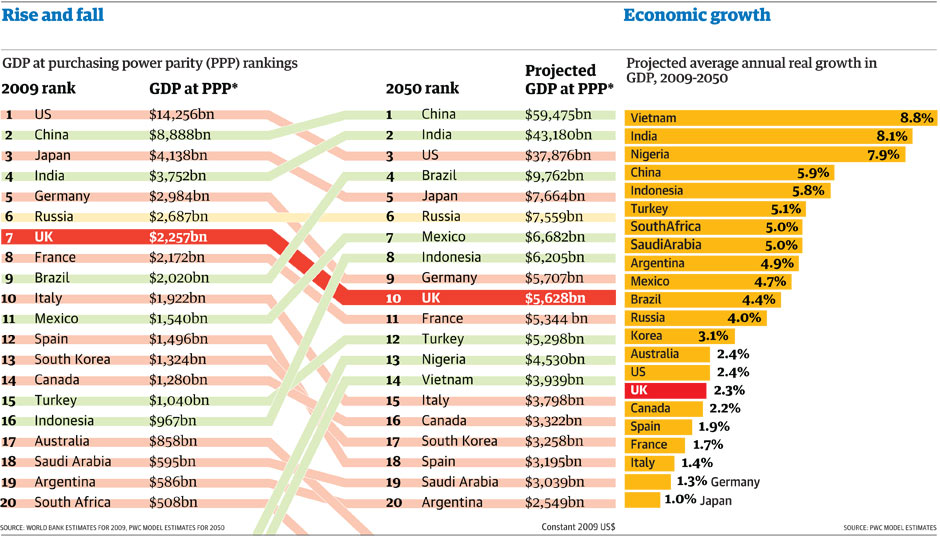
GDP projections to 2050 graphicView larger picture

GDP projections to 2050:
Summary-
Western defence forces would not be able to afford a human attrition intensive war by 2030 given current demographic trends  (both growth and aging). Existing balance of power could be maintained if resources are either shared or warfare is moved to cyber space. Technological advances can help augment resources reducing case for conflict scenarios.
Will the Internet be used by US against China in the 21 st century as Opium was used by GB in the 19th? Time will tell 🙂

Cloud Computing – can be evil

Cloud Computing can be evil because-

1) Most browsers are owned by for profit corporations . Corporations can be evil, sometimes

And corporations can go bankrupt. You can back up data locally, but try backing up a corporation.

2) The content on your web page can be changed using translator extensions . This has interesting ramifications as in George Orwell. You may not be even aware of subtle changes introduced in your browser in the way it renders the html or some words using keywords from a browser extension app.

Imagine a new form of language called Politically Correct Truthspeak, and that can be in English but using machine learning learn to substitute politically sensitive words with Govt sanctioned words.

3) Your DNS and IP settings can be redirected using extensions. This means if a Govt passes a law- you can be denied the websites using just the browser not even the ISP.

Thats an extreme scenario for a authoritative govt creating its own version of Mafiaafire Redirector.

So how to keep the cloud computer honest?Move some stuff to the desktop

How to keep desktop computing efficient?Use some more cloud computing

It is not an OR but an AND function in which some computing can be local, some shared and some in the cloud.

Si?

How to use Bit Torrents

I really liked the software Qbittorent available from http://www.qbittorrent.org/ I think bit torrents should be the default way of sharing huge content especially software downloads. For protecting intellectual property there should be much better codes and software keys than presently available.

The qBittorrent project aims to provide a Free Software alternative to µtorrent. Additionally, qBittorrent runs and provides the same features on all major platforms (Linux, Mac OS X, Windows, OS/2, FreeBSD).

qBittorrent is based on Qt4 toolkit and libtorrent-rasterbar.

qBittorrent v2 Features

  • Polished µTorrent-like User Interface
  • Well-integrated and extensible Search Engine
    • Simultaneous search in most famous BitTorrent search sites
    • Per-category-specific search requests (e.g. Books, Music, Movies)
  • All Bittorrent extensions
    • DHT, Peer Exchange, Full encryption, Magnet/BitComet URIs, …
  • Remote control through a Web user interface
    • Nearly identical to the regular UI, all in Ajax
  • Advanced control over trackers, peers and torrents
    • Torrents queueing and prioritizing
    • Torrent content selection and prioritizing
  • UPnP / NAT-PMP port forwarding support
  • Available in ~25 languages (Unicode support)
  • Torrent creation tool
  • Advanced RSS support with download filters (inc. regex)
  • Bandwidth scheduler
  • IP Filtering (eMule and PeerGuardian compatible)
  • IPv6 compliant
  • Sequential downloading (aka “Download in order”)
  • Available on most platforms: Linux, Mac OS X, Windows, OS/2, FreeBSD
So if you are new to Bit Torrents- here is a brief tutorial
Some terminology from

Tracker

tracker is a server that keeps track of which seeds and peers are in the swarm.

Seed

Seed is used to refer to a peer who has 100% of the data. When a leech obtains 100% of the data, that peer automatically becomes a Seed.

Peer

peer is one instance of a BitTorrent client running on a computer on the Internet to which other clients connect and transfer data.

Leech

leech is a term with two meanings. Primarily leech (or leeches) refer to a peer (or peers) who has a negative effect on the swarm by having a very poor share ratio (downloading much more than they upload, creating a ratio less than 1.0)
1) Download and install the software from  http://www.qbittorrent.org/
2) If you want to search for new files, you can use the nice search features in here
3) If you want to CREATE new bit torrents- go to Tools -Torrent Creator
4) For sharing content- just seed the torrent you just created. What is seeding – hey did you read the terminology in the beginning?
5) Additionally –
From

Trackers: Below are some popular public trackers. They are servers which help peers to communicate.

Here are some good trackers you can use:


http://open.tracker.thepiratebay.org/announce
http://www.torrent-downloads.to:2710/announce
http://denis.stalker.h3q.com:6969/announce
udp://denis.stalker.h3q.com:6969/announce
http://www.sumotracker.com/announce

and

Super-seeding

When a file is new, much time can be wasted because the seeding client might send the same file piece to many different peers, while other pieces have not yet been downloaded at all. Some clients, like ABCVuzeBitTornado, TorrentStorm, and µTorrent have a “super-seed” mode, where they try to only send out pieces that have never been sent out before, theoretically making the initial propagation of the file much faster. However the super-seeding becomes less effective and may even reduce performance compared to the normal “rarest first” model in cases where some peers have poor or limited connectivity. This mode is generally used only for a new torrent, or one which must be re-seeded because no other seeds are available.
Note- you use this tutorial and any or all steps at your own risk. I am not legally responsible for any mishaps you get into. Please be responsible while being an efficient bit tor renter. That means respecting individual property rights.

Interview Michal Kosinski , Concerto Web Based App using #Rstats

Here is an interview with Michal Kosinski , leader of the team that has created Concerto – a web based application using R. What is Concerto? As per http://www.psychometrics.cam.ac.uk/page/300/concerto-testing-platform.htm

Concerto is a web based, adaptive testing platform for creating and running rich, dynamic tests. It combines the flexibility of HTML presentation with the computing power of the R language, and the safety and performance of the MySQL database. It’s totally free for commercial and academic use, and it’s open source

Ajay-  Describe your career in science from high school to this point. What are the various stats platforms you have trained on- and what do you think about their comparative advantages and disadvantages?  

Michal- I started with maths, but quickly realized that I prefer social sciences – thus after one year, I switched to a psychology major and obtained my MSc in Social Psychology with a specialization in Consumer Behaviour. At that time I was mostly using SPSS – as it was the only statistical package that was taught to students in my department. Also, it was not too bad for small samples and the rather basic analyses I was performing at that time.


My more recent research performed during my Mphil course in Psychometrics at Cambridge University followed by my current PhD project in social networks and research work at Microsoft Research, requires significantly more powerful tools. Initially, I tried to squeeze as much as possible from SPSS/PASW by mastering the syntax language. SPSS was all I knew, though I reached its limits pretty quickly and was forced to switch to R. It was a pretty dreary experience at the start, switching from an unwieldy but familiar environment into an unwelcoming command line interface, but I’ve quickly realized how empowering and convenient this tool was.


I believe that a course in R should be obligatory for all students that are likely to come close to any data analysis in their careers. It is really empowering – once you got the basics you have the potential to use virtually any method there is, and automate most tasks related to analysing and processing data. It is also free and open-source – so you can use it wherever you work. Finally, it enables you to quickly and seamlessly migrate to other powerful environments such as Matlab, C, or Python.

Ajay- What was the motivation behind building Concerto?

Michal- We deal with a lot of online projects at the Psychometrics Centre – one of them attracted more than 7 million unique participants. We needed a powerful tool that would allow researchers and practitioners to conveniently build and deliver online tests.

Also, our relationships with the website designers and software engineers that worked on developing our tests were rather difficult. We had trouble successfully explaining our needs, each little change was implemented with a delay and at significant cost. Not to mention the difficulties with embedding some more advanced methods (such as adaptive testing) in our tests.

So we created a tool allowing us, psychometricians, to easily develop psychometric tests from scratch an publish them online. And all this without having to hire software developers.

Ajay -Why did you choose R as the background for Concerto? What other languages and platforms did you consider. Apart from Concerto, how else do you utilize R in your center, department and University?

Michal- R was a natural choice as it is open-source, free, and nicely integrates with a server environment. Also, we believe that it is becoming a universal statistical and data processing language in science. We put increasing emphasis on teaching R to our students and we hope that it will replace SPSS/PASW as a default statistical tool for social scientists.

Ajay -What all can Concerto do besides a computer adaptive test?

Michal- We did not plan it initially, but Concerto turned out to be extremely flexible. In a nutshell, it is a web interface to R engine with a built-in MySQL database and easy-to-use developer panel. It can be installed on both Windows and Unix systems and used over the network or locally.

Effectively, it can be used to build any kind of web application that requires a powerful and quickly deployable statistical engine. For instance, I envision an easy to use website (that could look a bit like SPSS) allowing students to analyse their data using a web browser alone (learning the underlying R code simultaneously). Also, the authors of R libraries (or anyone else) could use Concerto to build user-friendly web interfaces to their methods.

Finally, Concerto can be conveniently used to build simple non-adaptive tests and questionnaires. It might seem to be slightly less intuitive at first than popular questionnaire services (such us my favourite Survey Monkey), but has virtually unlimited flexibility when it comes to item format, test flow, feedback options, etc. Also, it’s free.

Ajay- How do you see the cloud computing paradigm growing? Do you think browser based computation is here to stay?

Michal – I believe that cloud infrastructure is the future. Dynamically sharing computational and network resources between online service providers has a great competitive advantage over traditional strategies to deal with network infrastructure. I am sure the security concerns will be resolved soon, finishing the transformation of the network infrastructure as we know it. On the other hand, however, I do not see a reason why client-side (or browser) processing of the information should cease to exist – I rather think that the border between the cloud and personal or local computer will continually dissolve.

About

Michal Kosinski is Director of Operations for The Psychometrics Centre and Leader of the e-Psychometrics Unit. He is also a research advisor to the Online Services and Advertising group at the Microsoft Research Cambridge, and a visiting lecturer at the Department of Mathematics in the University of Namur, Belgium. You can read more about him at http://www.michalkosinski.com/

You can read more about Concerto at http://code.google.com/p/concerto-platform/ and http://www.psychometrics.cam.ac.uk/page/300/concerto-testing-platform.htm

Interview Prof Benjamin Alamar , Sports Analytics

Here is an interview with Prof Benjamin Alamar, founding editor of the Journal of Quantitative Analysis in Sport, a professor of sports management at Menlo College and the Director of Basketball Analytics and Research for the Oklahoma City Thunder of the NBA.

Ajay – The movie Moneyball recently sparked out mainstream interest in analytics in sports.Describe the role of analytics in sports management

Benjamin- Analytics is impacting sports organizations on both the sport and business side.
On the Sport side, teams are using analytics, including advanced data management, predictive anlaytics, and information systems to gain a competitive edge. The use of analytics results in more accurate player valuations and projections, as well as determining effective strategies against specific opponents.
On the business side, teams are using the tools of analytics to increase revenue in a variety of ways including dynamic ticket pricing and optimizing of the placement of concession stands.
Ajay-  What are the ways analytics is used in specific sports that you have been part of?

Benjamin- A very typical first step for a team is to utilize the tools of predictive analytics to help inform their draft decisions.

Ajay- What are some of the tools, techniques and software that analytics in sports uses?
Benjamin- The tools of sports analytics do not differ much from the tools of business analytics. Regression analysis is fairly common as are other forms of data mining. In terms of software, R is a popular tool as is Excel and many of the other standard analysis tools.
Ajay- Describe your career journey and how you became involved in sports management. What are some of the tips you want to tell young students who wish to enter this field?

Benjamin- I got involved in sports through a company called Protrade Sports. Protrade initially was a fantasy sports company that was looking to develop a fantasy game based on advanced sports statistics and utilize a stock market concept instead of traditional drafting. I was hired due to my background in economics to develop the market aspect of the game.

There I met Roland Beech (who now works for the Mavericks) and Aaron Schatz (owner of footballoutsiders.com) and learned about the developing field of sports statistics. I then changed my research focus from economics to sports statistics and founded the Journal of Quantitative Analysis in Sports. Through the journal and my published research, I was able to establish a reputation of doing quality, useable work.

For students, I recommend developing very strong data management skills (sql and the like) and thinking carefully about what sort of questions a general manager or coach would care about. Being able to demonstrate analytic skills around actionable research will generally attract the attention of pro teams.

About-

Benjamin Alamar, Professor of Sport Management, Menlo College

Benjamin Alamar

Professor Benjamin Alamar is the founding editor of the Journal of Quantitative Analysis in Sport, a professor of sports management at Menlo College and the Director of Basketball Analytics and Research for the Oklahoma City Thunder of the NBA. He has published academic research in football, basketball and baseball, has presented at numerous conferences on sports analytics. He is also a co-creator of ESPN’s Total Quarterback Rating and a regular contributor to the Wall Street Journal. He has consulted for teams in the NBA and NFL, provided statistical analysis for author Michael Lewis for his recent book The Blind Side, and worked with numerous startup companies in the field of sports analytics. Professor Alamar is also an award winning economist who has worked academically and professionally in intellectual property valuation, public finance and public health. He received his PhD in economics from the University of California at Santa Barbara in 2001.

Prof Alamar is a speaker at Predictive Analytics World, San Fransisco and is doing a workshop there

http://www.predictiveanalyticsworld.com/sanfrancisco/2012/agenda.php#day2-17

2:55-3:15pm

All level tracks Track 1: Sports Analytics
Case Study: NFL, MLB, & NBA
Competing & Winning with Sports Analytics

The field of sports analytics ties together the tools of data management, predictive modeling and information systems to provide sports organization a competitive advantage. The field is rapidly developing based on new and expanded data sources, greater recognition of the value, and past success of a variety of sports organizations. Teams in the NFL, MLB, NBA, as well as other organizations have found a competitive edge with the application of sports analytics. The future of sports analytics can be seen through drawing on these past successes and the developments of new tools.

You can know more about Prof Alamar at his blog http://analyticfootball.blogspot.in/ or journal at http://www.degruyter.com/view/j/jqas. His detailed background can be seen at http://menlo.academia.edu/BenjaminAlamar/CurriculumVitae

UseR 2012 Early Registration #rstats

Early Registration Deadline Approaches for UseR 2012

http://biostat.mc.vanderbilt.edu/wiki/Main/UseR-2012

Registration


Deadlines

  • Early Registration: Jan 23 24 – Feb 29
  • Regular Registration: Mar 1 – May 12
  • Late Registration: May 13 – June 4
  • On-site Registration: June 12 – June 15


Fees

Academic Non-Academic Student/Retiree
Registration: Early $290 $440 $145
Registration: Regular $365 $560 $185
Registration: Late $435 $645 $225
Registration: On-site $720 $720 $360
Short Course $200 $300 $100


useR 2012

The 8th International R Users Meeting

Vanderbilt University; Nashville, Tennessee, USA

12th-15th June 2012

http://biostat.mc.vanderbilt.edu/wiki/Main/UseR-2012

Morning
Terri Scott & Frank Harrell Reproducible Research with R, LaTeX, & Sweave
Uwe Ligges Writing efficient and parallel code in R
Dirk Eddelbuettel & Romain Francois Introduction to Rcpp
Douglas Bates Fitting and evaluating mixed models using lme4
Jeremiah Rounds RHIPE: R and Hadoop Integrated Programming Environment
Jeffrey Horner Building R Web Applications with Rook
Brandon Whitcher, Jorg Polzehl, & Karsten Tabelow Medical Image Analysis in R
Richard Heiberger & Martin Maechler Emacs Speaks Statistics
Olivia Lau A Crash Course in R Programming
Afternoon
Hadley Wickham Creating effective visualisations
Josh Paulson, JJ Allaire, & Joe Cheng Getting the Most Out of RStudio
Romain Francois & Dirk Eddelbuettel Advanced Rcpp Usage
Terry Therneau Design of the Survival Packages
Martin Morgan Bioconductor for High-Throughput Sequence Analysis
Max Kuhn Predictive Modeling with R and the caret Package
Robert Muenchen Managing Data with R
Barry Rowlingson Geospatial Data in R and Beyond
Karim Chine Cloud Computing for the R environment


Contact

Stephania McNeal-Goddard
Assistant to the Chair
stephania.mcneal-goddard@vanderbilt.edu
Phone: 615.322.2768
Fax: 615.343.4924
Vanderbilt University School of Medicine
Department of Biostatistics
S-2323 Medical Center North
Nashville, TN 37232-2158