Web R- Elastic R and RevoDeploy R

I had a skype video chat with Karime Chine and he was kind enough to walk me through the new portal Elastic-R at http://www.elastic-r.org

Basically you can work on a collaborative basis in this with multiple users working on excel as well as R projects.

Some screenshots-in a short presentation I made on my notes during K Chine’s presentation

Also, Revolution Analytics is coming out with a Web Services product for R

RevoDeployR: Web Services for R

Both are very powerful uses of R for cloud computing- and it would be interesting if the original cloud computing champion Google gets into the R Project.

Professors and Patches: For a Betterrrr R

Professors sometime throw out provocative statements to ensure intellectual debate. I have had almost 1500+ hits in less than 2 days ( and I am glad I am on wordpress.com , my old beloved server would have crashed))

The remarks from Ross Ihaka, covered before and also at Xian’s blog at

Note most of his remarks are techie- and only a single line refers to Revlution Analytics.

Other senior members of community (read- professors are silent, though brobably some thought may have been ignited behind scenes)

http://xianblog.wordpress.com/2010/09/06/insane/comment-page-4/#comments

Ross Ihaka Says:
September 12, 2010 at 1:23 pm

Since (something like) my name has been taken in vain here, let me
chip in.

I’ve been worried for some time that R isn’t going to provide the base
that we’re going to need for statistical computation in the
future. (It may well be that the future is already upon us.) There
are certainly efficiency problems (speed and memory use), but there
are more fundamental issues too. Some of these were inherited from S
and some are peculiar to R.

One of the worst problems is scoping. Consider the following little
gem.

f =
function() {
if (runif(1) > .5)
x = 10
x
}

The x being returned by this function is randomly local or global.
There are other examples where variables alternate between local and
non-local throughout the body of a function. No sensible language
would allow this. It’s ugly and it makes optimisation really
difficult. This isn’t the only problem, even weirder things happen
because of interactions between scoping and lazy evaluation.

In light of this, I’ve come to the conclusion that rather than
“fixing” R, it would be much more productive to simply start over and
build something better. I think the best you could hope for by fixing
the efficiency problems in R would be to boost performance by a small
multiple, or perhaps as much as an order of magnitude. This probably
isn’t enough to justify the effort (Luke Tierney has been working on R
compilation for over a decade now).

To try to get an idea of how much speedup is possible, a number of us
have been carrying out some experiments to see how much better we
could do with something new. Based on prototyping we’ve been doing at
Auckland, it looks like it should be straightforward to get two orders
of magnitude speedup over R, at least for those computations which are
currently bottle-necked. There are a couple of ways to make this
happen.

First, scalar computations in R are very slow. This in part because
the R interpreter is very slow, but also because there are a no scalar
types. By introducing scalars and using compilation it looks like its
possible to get a speedup by a factor of several hundred for scalar
computations. This is important because it means that many ghastly
uses of array operations and the apply functions could be replaced by
simple loops. The cost of these improvements is that scope
declarations become mandatory and (optional) type declarations are
necessary to help the compiler.

As a side-effect of compilation and the use of type-hinting it should
be possible to eliminate dispatch overhead for certain (sealed)
classes (scalars and arrays in particular). This won’t bring huge
benefits across the board, but it will mean that you won’t have to do
foreign language calls to get efficiency.

A second big problem is that computations on aggregates (data frames
in particular) run at glacial rates. This is entirely down to
unnecessary copying because of the call-by-value semantics.
Preserving call-by-value semantics while eliminating the extra copying
is hard. The best we can probably do is to take a conservative
approach. R already tries to avoid copying where it can, but fails in
an epic fashion. The alternative is to abandon call-by-value and move
to reference semantics. Again, prototyping indicates that several
hundredfold speedup is possible (for data frames in particular).

The changes in semantics mentioned above mean that the new language
will not be R. However, it won’t be all that far from R and it should
be easy to port R code to the new system, perhaps using some form of
automatic translation.

If we’re smart about building the new system, it should be possible to
make use of multi-cores and parallelism. Adding this to the mix might just
make it possible to get a three order-of-magnitude performance boost
with just a fraction of the memory that R uses. I think it’s something
really worth putting some effort into.

I also think one other change is necessary. The license will need to a
better job of protecting work donated to the commons than GPL2 seems
to have done. I’m not willing to have any more of my work purloined by
the likes of Revolution Analytics, so I’ll be looking for better
protection from the license (and being a lot more careful about who I
work with).

The discussion spilled over to Stack Overflow as well

http://stackoverflow.com/questions/3706990/is-r-that-bad-that-it-should-be-rewritten-from-scratch/3710667#3710667

n the past week I’ve been following a discussion where Ross Ihaka wrote (here ):

I’ve been worried for some time that R isn’t going to provide the base that we’re going to need for statistical computation in the future. (It may well be that the future is already upon us.) There are certainly efficiency problems (speed and memory use), but there are more fundamental issues too. Some of these were inherited from S and some are peculiar to R.

He then continued explaining. This discussion started from this post, and was then followed by commentsherehereherehereherehere and maybe some more places I don’t know of.

We all know the problem now.

R can be improved substantially in terms of speed.

For some solutions, here are the patches by Radford-

http://www.cs.toronto.edu/~radford/speed-patches-doc

patch-dollar

    Speeds up access to lists, pairlists, and environments using the
    $ operator.  The speedup comes mainly from avoiding the overhead of 
    calling DispatchOrEval if there are no complexities, from passing
    on the field to extract as a symbol, or a name, or both, as available,
    and then converting only as necessary, from simplifying and inlining
    the pstrmatch procedure, and from not translating string multiple
    times.  

    Relevant timing test script:  test-dollar.r 

    This test shows about a 40% decrease in the time needed to extract
    elements of lists and environments.

    Changes unrelated to speed improvement:

    A small error-reporting bug is fixed, illustrated by the following
    output with r52822:

    > options(warnPartialMatchDollar=TRUE)
    > pl <- pairlist(abc=1,def=2)
    > pl$ab
    [1] 1
    Warning message:
    In pl$ab : partial match of 'ab' to ''

    Some code is changed at the end of R_subset3_dflt because it seems 
    to be more correct, as discussed in code comments. 

patch-evalList

    Speeds up a large number of operations by avoiding allocation of
    an extra CONS cell in the procedures for evaluating argument lists.

    Relevant timing test scripts:  all of them, but will look at test-em.r 

    On test-em.r, the speedup from this patch is about 5%.

patch-fast-base

    Speeds up lookup of symbols defined in the base environment, by
    flagging symbols that have a base environment definition recorded
    in the global cache.  This allows the definition to be retrieved
    quickly without looking in the hash table.  

    Relevant timing test scripts:  all of them, but will look at test-em.r 

    On test-em.r, the speedup from this patch is about 3%.

    Issue:  This patch uses the "spare" bit for the flag.  This bit is
    misnamed, since it is already used elsewhere (for closures).  It is
    possible that one of the "gp" bits should be used instead.  The
    "gp" bits should really be divided up for faster access, and so that
    their present use is apparent in the code.

    In case this use of the "spare" bit proves unwise, the patch code is 
    conditional on FAST_BASE_CACHE_LOOKUP being defined at the start of
    envir.r.

patch-fast-spec

    Speeds up lookup of function symbols that begin with a character
    other than a letter or ".", by allowing fast bypass of non-global
    environments that do not contain (and have never contained) symbols 
    of this sort.  Since it is expected that only functions will be
    given names of this sort, the check is done only in findFun, though
    it could also be done in findVar.

    Relevant timing test scripts:  all of them, but will look at test-em.r 

    On test-em.r, the speedup from this patch is about 8%.    

    Issue:  This patch uses the "spare" bit to flag environments known
    to not have symbols starting with a special character.  See remarks
    on patch-fast-base.

    In case this use of the "spare" bit proves unwise, the patch code is 
    conditional on FAST_SPEC_BYPASS being defined at the start of envir.r.

patch-for

    Speeds up for loops by not allocating new space for the loop
    variable every iteration, unless necessary.  

    Relevant timing test script:  test-for.r

    This test shows a speedup of about 5%.  

    Change unrelated to speed improvement:

    Fixes what I consider to be a bug, in which the loop clobbers a
    global variable, as demonstrated by the following output with r52822:

    > i <- 99
    > f <- function () for (i in 1:3) { print(i); if (i==2) rm(i); }
    > f()
    [1] 1
    [1] 2
    [1] 3
    > print(i)
    [1] 3

patch-matprod

    Speeds up matrix products, including vector dot products.  The
    speed issue here is that the R code checks for any NAs, and 
    does the multiply in the matprod procedure (in array.c) if so,
    since BLAS isn't trusted with NAs.  If this check takes about
    as long as just doing the multiply in matprod, calling a BLAS
    routine makes no sense.  

    Relevant time test script:  test-matprod.r

    With no external BLAS, this patch speeds up long vector-vector 
    products by a factor of about six, matrix-vector products by a
    factor of about three, and some matrix-matrix products by a 
    factor of about two.

    Issue:  The matrix multiply code in matprod using an LDOUBLE
    (long double) variable to accumulate sums, for improved accuracy.  
    On a SPARC system I tested on, operations on long doubles are 
    vastly slower than on doubles, so that the patch produces a 
    large slowdown rather than an improvement.  This is also an issue 
    for the "sum" function, which also uses an LDOUBLE to accumulate
    the sum.  Perhaps an ordinarly double should be used in these
    places, or perhaps the configuration script should define LDOUBLE 
    as double on architectures where long doubles are extraordinarily 
    slow.

    Due to this issue, not defining MATPROD_CAN_BE_DONE_HERE at the
    start of array.c will disable this patch.

patch-parens

    Speeds up parentheses by making "(" a special operator whose
    argument is not evaluated, thereby bypassing the overhead of
    evalList.  Also slightly speeds up curly brackets by inlining
    a function that is stylistically better inline anyway.

    Relevant test script:  test-parens.r

    In the parens part of test-parens.r, the speedup is about 9%.

patch-protect

    Speeds up numerous operations by making PROTECT, UNPROTECT, etc.
    be mostly macros in the files in src/main.  This takes effect
    only for files that include Defn.h after defining the symbol
    USE_FAST_PROTECT_MACROS.  With these macros, code of the form
    v = PROTECT(...) must be replaced by PROTECT(v = ...).  

    Relevant timing test scripts:  all of them, but will look at test-em.r 

    On test-em.r, the speedup from this patch is about 9%.

patch-save-alloc

    Speeds up some binary and unary arithmetic operations by, when
    possible, using the space holding one of the operands to hold
    the result, rather than allocating new space.  Though primarily
    a speed improvement, for very long vectors avoiding this allocation 
    could avoid running out of space.

    Relevant test script:  test-complex-expr.r

    On this test, the speedup is about 5% for scalar operands and about
    8% for vector operands.

    Issues:  There are some tricky issues with attributes, but I think
    I got them right.  This patch relies on NAMED being set correctly 
    in the rest of the code.  In case it isn't, the patch can be disabled 
    by not defining AVOID_ALLOC_IF_POSSIBLE at the top of arithmetic.c.

patch-square

    Speeds up a^2 when a is a long vector by not checking for the
    special case of an exponent of 2 over and over again for every 
    vector element.

    Relevant test script:  test-square.r

    The time for squaring a long vector is reduced in this test by a
    factor of more than five.

patch-sum-prod

    Speeds up the "sum" and "prod" functions by not checking for NA
    when na.rm=FALSE, and other detailed code improvements.

    Relevant test script:  test-sum-prod.r

    For sum, the improvement is about a factor of 2.5 when na.rm=FALSE,
    and about 10% when na.rm=TRUE.

    Issue:  See the discussion of patch-matprod regarding LDOUBLE.
    There is no change regarding this issue due to this patch, however.

patch-transpose

    Speeds up the transpose operation (the "t" function) from detailed
    code improvements.

    Relevant test script:  test-transpose.r

    The improvement for 200x60 matrices is about a factor of two.
    There is little or no improvement for long row or column vectors.

patch-vec-arith

    Speeds up arithmetic on vectors of the same length, or when on
    vector is of length one.  This is done with detailed code improvements.

    Relevant test script:  test-vec-arith.r

    On long vectors, the +, -, and * operators are sped up by about     
    20% when operands are the same length or one operand is of length one.

    Rather mysteriously, when the operands are not length one or the
    same length, there is about a 20% increase in time required, though
    this may be due to some strange C optimizer peculiarity or some 
    strange cache effect, since the C code for this is the same as before,
    with negligible additional overhead getting to it.  Regardless, this 
    case is much less common than equal lengths or length one.

    There is little change for the / operator, which is much slower than
    +, -, or *.

patch-vec-subset

    Speeds up extraction of subsets of vectors or matrices (eg, v[10:20]
    or M[1:10,101:110]).  This is done with detailed code improvements.

    Relevant test script:  test-vec-subset.r

    There are lots of tests in this script.  The most dramatic improvement
    is for extracting many rows and columns of a large array, where the 
    improvement is by about a factor of four.  Extracting many rows from
    one column of a matrix is sped up by about 30%. 

    Changes unrelated to speed improvement:

    Fixes two latent bugs where the code incorrectly refers to NA_LOGICAL
    when NA_INTEGER is appropriate and where LOGICAL and INTEGER types
    are treated as interchangeable.  These cause no problems at the moment,
    but would if representations were changed.

patch-subscript

    (Formerly part of patch-vec-subset)  This patch also speeds up
    extraction, and also replacement, of subsets of vectors or
    matrices, but focuses on the creation of the indexes rather than
    the copy operations.  Often avoids a duplication (see below) and
    eliminates a second scan of the subscript vector for zero
    subscripts, folding it into a previous scan at no additional cost.

    Relevant test script:  test-vec-subset.r

    Speeds up some operations with scalar or short vector indexes by
    about 10%.  Speeds up subscripting with a longer vector of
    positive indexes by about 20%.

    Issues:  The current code duplicates a vector of indexes when it
    seems unnecessary.  Duplication is for two reasons:  to handle
    the situation where the index vector is itself being modified in
    a replace operation, and so that any attributes can be removed, which 
    is helpful only for string subscripts, given how the routine to handle 
    them returns information via an attribute.  Duplication for the
    second reasons can easily be avoided, so I avoided it.  The first
    reason for duplication is sometimes valid, but can usually be avoided
    by first only doing it if the subscript is to be used for replacement
    rather than extraction, and second only doing it if the NAMED field
    for the subscript isn't zero.

    I also removed two layers of procedure call overhead (passing seven
    arguments, so not trivial) that seemed to be doing nothing.  Probably 
    it used to do something, but no longer does, but if instead it is 
    preparation for some future use, then removing it might be a mistake.

Software problems are best solved by writing code or patches in my opinion rather than discussing endlessly
Some other solutions to a BETTERRRR R
1) Complete Code Design Review
2) Version 3 - Tuneup
3) Better Documentation
4) Suing Revolution Analytics for the code - Hand over da code pardner

Linux= Who did what and how much?

A report distributed under Creative Commons 3 and available at

That shows Canonical — the commercial arm of Ubuntu — has contributed only about one percent of the code to the GNOME desktop for Linux. while Red Hat accounts for 17 percent of the code and Novell developers are responsible for about 11 percent. That prompted some heartburn from Mark, creator- founder Cannonical/ Ubuntu at http://www.markshuttleworth.com/archives/517

And it would be a very different story if it weren’t for the Mozilla folks and Netscape before them, and GNOME and KDE, and Google and everyone else who have exercised that stack in so many different ways, making it better along the way. There are tens of thousands of people who are not in any way shape or form associated with Ubuntu, who make this story real. Many of them have been working at it for more than a decade – it takes a long time to make an overnight success :) while Ubuntu has only been on the scene six years. So Ubuntu cannot be credited solely for the delight of its users.
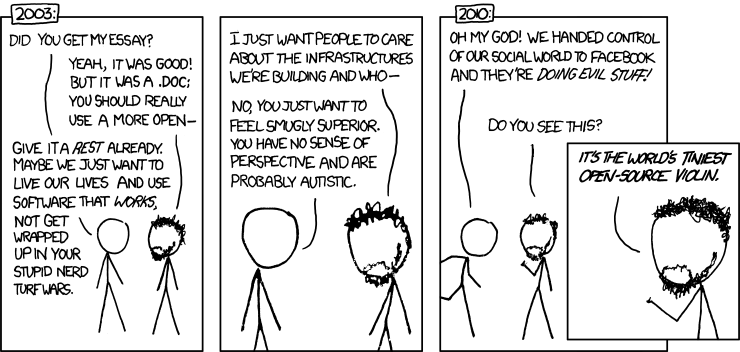
Nevertheless, the Ubuntu Project does bring something unique, special and important to free software: a total commitment to everyday users and use cases, the idea that free software should be “for everyone” both economically and in ease of use, and a willingness to chase down the problems that stand between here and there. I feel that commitment is a gift back to the people who built every one of those packages. If we can bring free software to ten times the audience, we have amplified the value of your generosity by a factor of ten, we have made every hour spent fixing an issue or making something amazing, ten times as valuable. I’m very proud to be spending the time and energy on Ubuntu that I do. Yes, I could do many other things, but I can’t think of another course which would have the same impact on the world.

I recognize that not everybody will feel the same way. Bringing their work to ten times the audience without contributing features might just feel like leeching, or increasing the flow of bug reports 10x. I suppose you could say that no matter how generous we are to downstream users, if upstream is only measuring code, then any generosity other than code won’t be registered. I don’t really know what to do about that – I didn’t found Ubuntu as a vehicle for getting lots of code written, that didn’t seem to me to be what the world needed.

Open source communities work like democracies with all noise whereas R and D within corporates have a stricter hierarchy. Still for all that – Ubuntu and Android have made Linux mainstream just as R has made statistical software available to all.

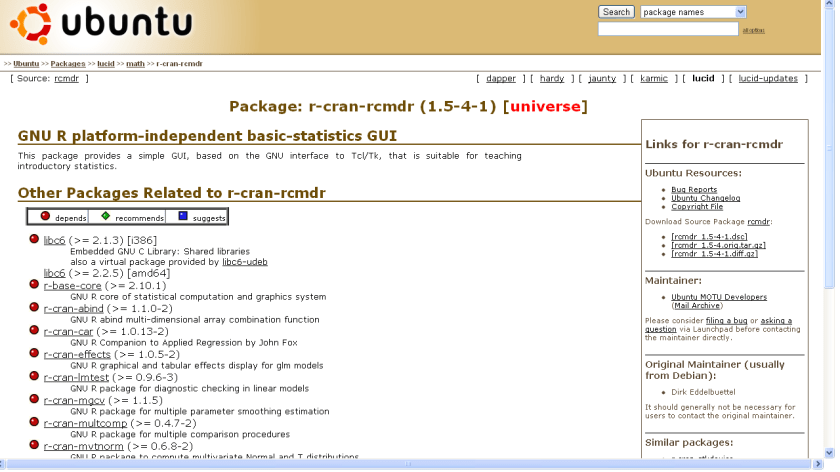
And Ubuntu also has great support for R (particularly the single click R Commander Install and Icon) available at http://packages.ubuntu.com/lucid/math/r-cran-rcmdr

Kill R? Wait a sec

1) Is R efficient? (scripting wise, and performance wise) _ Depends on how you code it- some Packages like foreach can help but basic efficiency come from programmer. XDF formats from Revoscalar -the non open R package further improve programming efficiency

2) Should R be written from scratch?

You got to be kidding- It depends on how you define scratch after 2 million users

This has been done with S, then S Plus and now R.

3) What should be the license of R (if it was made a new)?

GPL license is fine. You need to do a better job of executing the license. Currently interfaces to R exist from SPSS, SAS, KXEN , other companies as well. To my knowledge royalty payments as well as formal code sharing does not agree.

R core needs to do a better job of protecting the work of 2500 package-creators rather than settling for a few snacks at events, sponsorships, Corporate Board Membership for Prof Gentleman, and 4-5 packages donated to it. The only way R developers can currently support their research is write a book (ny Springer mostly)

Eg GGplot and Hmisc are likely to be used more by average corporate user. Do their creators deserve royalty if creators of RevoScalar are getting it?

If some of 2 million users gave 1 $ to R core (compared to 9 million in last round of funding in Revolution Analytics)- you would have enough money to create a 64 bit optimized R for Linux (missing in Enterprise R), Amazon R APIs (like Karim Chine’s efforts), R GUIs (like Rattle’s commercial version) etc etc

The developments are not surprising given that Microsoft and Intel are funding Revolution Analytics http://www.dudeofdata.com/?p=1967

R controversies come and go (this has happened before including the NYT article and shakeup at Revo)

An interesting debate on whether R should be killed to make an upgrade to a more efficient language.

From Tal (creator R Bloggers) and on R help list-

There is currently a (very !) lively discussions happening around the web, surrounding the following topics:
1) Is R efficient? (scripting wise, and performance wise)
2) Should R be written from scratch?
3) What should be the license of R (if it was made a new)?

Very serious people have taken part in the debates so far.  I hope to let you know of the places I came by, so you might be able to follow/participate
in these (IMHO) important discussions.

The discussions started in the response for the following blog post on
Xi’An’s blog:
http://xianblog.wordpress.com/2010/09/06/insane/


Followed by the (short) response post by Ross Ihaka:
http://xianblog.wordpress.com/2010/09/13/simply-start-over-and-build-something-better/


Other discussions started to appear on Andrew Gelman’s blog:
http://www.stat.columbia.edu/~cook/movabletype/archives/2010/09/ross_ihaka_to_r.html

And (many) more responses started to appear in the hackers news website:
http://news.ycombinator.com/item?id=1687054

I hope these discussions will have fruitful results for our community,
Tal

—————-Contact
Details:——————————————————-
Contact me: Tal.Galili@gmail.com |  972-52-7275845
Read me: www.talgalili.com (Hebrew) | www.biostatistics.co.il (Hebrew) |
www.r-statistics.com (English)

My 0 cents ( see it would 2 cents but it;s free)

Trrrouble in land of R…and Open Source Suggestions

Recently some comments by Ross Ihake , founder of R Statistical Software on Revolution Analytics, leading commercial vendor of R….. came to my attention-

http://www.stat.auckland.ac.nz/mail/archive/r-downunder/2010-May/000529.html

[R-downunder] Article on Revolution Analytics

Ross Ihaka ihaka at stat.auckland.ac.nz
Mon May 10 14:27:42 NZST 2010


On 09/05/10 09:52, Murray Jorgensen wrote:
> Perhaps of interest:
>
> http://www.theregister.co.uk/2010/05/06/revolution_commercial_r/

Please note that R is "free software" not "open source".  These guys
are selling a GPLed work without disclosing the source to their part
of the work. I have complained to them and so far they have given me
the brush off. I am now considering my options.

Don't support these guys by buying their product. The are not feeding
back to the rights holders (the University of Auckland and I are rights
holders and they didn't even have the courtesy to contact us).

--
Ross Ihaka                         Email:  ihaka at stat.auckland.ac.nz
Department of Statistics           Phone:  (64-9) 373-7599 x 85054
University of Auckland             Fax:    (64-9) 373-7018
Private Bag 92019, Auckland
New Zealand
and from http://www.theregister.co.uk/2010/05/06/revolution_commercial_r/
Open source purists probably won't be all too happy to learn that Revolution is going to be employing an "open core" strategy, which means the core R programs will remain open source and be given tech support under a license model, but the key add-ons that make R more scalable will be closed source and sold under a separate license fee. Because most of those 2,500 add-ons for R were built by academics and Revolution wants to supplant SPSS and SAS as the tools used by students, Revolution will be giving the full single-user version of the R Enterprise stack away for free to academics. 
Conclusion-
So one co-founder of R is advocating not to buy from Revolution Analytics , which has the other co-founder of R, Gentleman on its board. 
Source- http://www.revolutionanalytics.com/aboutus/leadership.php

2) If Revolution Analytics is using 2500 packages for free but insisting on getting paid AND closing source of it’s packages (which is a technical point- how exactly can you prevent source code of a R package from being seen)

Maybe there can be a PACKAGE marketplace just like Android Apps, Facebook Apps, and Salesforce.com Apps – so atleast some of the thousands of R package developers can earn – sorry but email lists do not pay mortgages and no one is disputing the NEED for commercializing R or rewarding developers.

Though Barr created SAS, he gave up control to Goodnight and Sall https://decisionstats.wordpress.com/2010/06/02/sas-early-days/

and Goodnight and Sall do pay their developers well- to the envy of not so well paid counterparts.

3) I really liked the innovation of Revolution Analytics RevoScalar, and I wish that the default R dataset be converted to XDF dataset so that it basically kills

off the R criticism of being slow on bigger datasets. But I also realize the need for creating an analytics marketplace for R developers and R students- so academic version of R being free and Revolution R being paid seems like a trade off.

Note- You can still get a job faster as a stats student if you mention SAS and not R as a statistical skill- not all stats students go into academics.

4) There can be more elegant ways of handling this than calling for ignoring each other as REVOLUTION and Ihake seem to be doing to each other.

I can almost hear people in Cary, NC chuckling at Norman Nie, long time SPSS opponent and now REVOLUTION CEO, and his antagonizing R’s academicians within 1 year of taking over- so I hope this ends well for all. The road to hell is paved with good intentions- so if REVOLUTION can share some source code with say R Core members (even Microsoft shares source code with partners)- and R Core and Revolution agree on a licensing royalty from each other, they can actually speed up R package creation rather than allow this 2 decade effort to end up like S and S plus and TIBCO did.

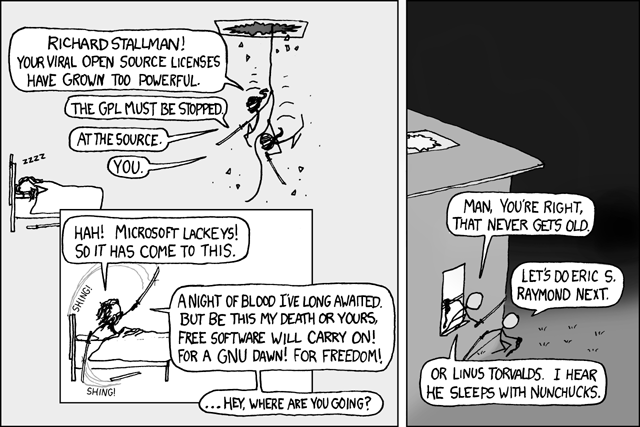
Maybe Richard Stallman can help-or maybe Ihaka has a better sense of where things will go down in a couple of years-he must know something-he invented it, didnt he

On 09/05/10 09:52, Murray Jorgensen wrote:
> Perhaps of interest:
>
> http://www.theregister.co.uk/2010/05/06/revolution_commercial_r/

Please note that R is "free software" not "open source".  These guys
are selling a GPLed work without disclosing the source to their part
of the work. I have complained to them and so far they have given me
the brush off. I am now considering my options.

Don't support these guys by buying their product. The are not feeding
back to the rights holders (the University of Auckland and I are rights
holders and they didn't even have the courtesy to contact us).

--
Ross Ihaka                         Email:  ihaka at stat.auckland.ac.nz
Department of Statistics           Phone:  (64-9) 373-7599 x 85054
University of Auckland             Fax:    (64-9) 373-7018
Private Bag 92019, Auckland
New Zealand

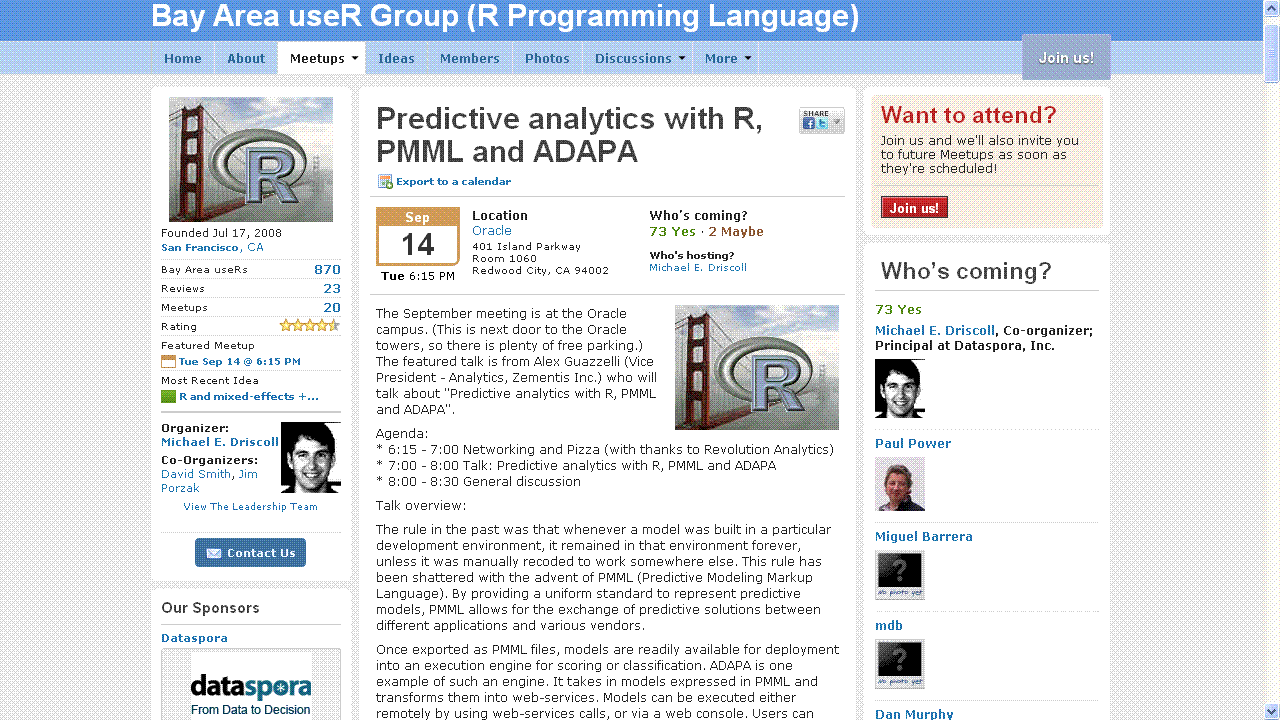
Event: Predictive analytics with R, PMML and ADAPA

From http://www.meetup.com/R-Users/calendar/14405407/

The September meeting is at the Oracle campus. (This is next door to the Oracle towers, so there is plenty of free parking.) The featured talk is from Alex Guazzelli (Vice President – Analytics, Zementis Inc.) who will talk about “Predictive analytics with R, PMML and ADAPA”.

Agenda:
* 6:15 – 7:00 Networking and Pizza (with thanks to Revolution Analytics)
* 7:00 – 8:00 Talk: Predictive analytics with R, PMML and ADAPA
* 8:00 – 8:30 General discussion

Talk overview:

The rule in the past was that whenever a model was built in a particular development environment, it remained in that environment forever, unless it was manually recoded to work somewhere else. This rule has been shattered with the advent of PMML (Predictive Modeling Markup Language). By providing a uniform standard to represent predictive models, PMML allows for the exchange of predictive solutions between different applications and various vendors.

Once exported as PMML files, models are readily available for deployment into an execution engine for scoring or classification. ADAPA is one example of such an engine. It takes in models expressed in PMML and transforms them into web-services. Models can be executed either remotely by using web-services calls, or via a web console. Users can also use an Excel add-in to score data from inside Excel using models built in R.

R models have been exported into PMML and uploaded in ADAPA for many different purposes. Use cases where clients have used the flexibility of R to develop and the PMML standard combined with ADAPA to deploy range from financial applications (e.g., risk, compliance, fraud) to energy applications for the smart grid. The ability to easily transition solutions developed in R to the operational IT production environment helps eliminate the traditional limitations of R, e.g. performance for high volume or real-time transactional systems and memory constraints associated with large data sets.

Speaker Bio:

Dr. Alex Guazzelli has co-authored the first book on PMML, the Predictive Model Markup Language which is the de facto standard used to represent predictive models. The book, entitled PMML in Action: Unleashing the Power of Open Standards for Data Mining and Predictive Analytics, is available on Amazon.com. As the Vice President of Analytics at Zementis, Inc., Dr. Guazzelli is responsible for developing core technology and analytical solutions under ADAPA, a PMML-based predictive decisioning platform that combines predictive analytics and business rules. ADAPA is the first system of its kind to be offered as a service on the cloud.
Prior to joining Zementis, Dr. Guazzelli was involved in not only building but also deploying predictive solutions for large financial and telecommunication institutions around the globe. In academia, Dr. Guazzelli worked with data mining, neural networks, expert systems and brain theory. His work in brain theory and computational neuroscience has appeared in many peer reviewed publications. At Zementis, Dr. Guazzelli and his team have been involved in a myriad of modeling projects for financial, health-care, gaming, chemical, and manufacturing industries.

Dr. Guazzelli holds a Ph.D. in Computer Science from the University of Southern California and a M.S and B.S. in Computer Science from the Federal University of Rio Grande do Sul, Brazil.

IPSUR – A Free R Textbook

Here is a free R textbook called IPSUR-

http://ipsur.r-forge.r-project.org/book/index.php

IPSUR stands for Introduction to Probability and Statistics Using R, ISBN: 978-0-557-24979-4, which is a textbook written for an undergraduate course in probability and statistics. The approximate prerequisites are two or three semesters of calculus and some linear algebra in a few places. Attendees of the class include mathematics, engineering, and computer science majors.

IPSUR is FREE, in the GNU sense of the word. Hard copies are available for purchase here from Lulu and will be available (coming soon) from the other standard online retailers worldwide. The price of the book is exactly the manufacturing cost plus the retailers’ markup. You may be able to get it even cheaper by downloading an electronic copy and printing it yourself, but if you elect this route then be sure to get the publisher-quality PDF from theDownloads page. And double check the price. It was cheaper for my students to buy a perfect-bound paperback from Lulu and have it shipped to their door than it was to upload the PDF to Fed-Ex Kinkos and Xerox a coil-bound copy (and on top of that go pick it up at the store).

If you are going to buy from anywhere other than Lulu then be sure to check the time-stamp on the copyright page. There is a 6 to 8 week delay from Lulu to Amazon and you may not be getting the absolute latest version available.

Refer to the Installation page for instructions to install an electronic copy of IPSUR on your personal computer. See the Feedback page for guidance about questions or comments you may have about IPSUR.

Also see http://ipsur.r-forge.r-project.org/rcmdrplugin/index.php for the R Cmdr Plugin

This plugin for the R Commander accompanies the text Introduction to Probability and Statistics Using R by G. Jay Kerns. The plugin contributes functions unique to the book as well as specific configuration and functionality to R Commander, the pioneering work by John Fox of McMaster University.

RcmdrPlugin.IPSUR’s primary goal is to provide a user-friendly graphical user interface (GUI) to the open-source and freely available R statistical computing environment. RcmdrPlugin.IPSUR is equipped to handle many of the statistical analyses and graphical displays usually encountered by upper division undergraduate mathematics, statistics, and engineering majors. Available features are comparable to many expensive commercial packages such as Minitab, SPSS, and JMP-IN.

Since the audience of RcmdrPlugin.IPSUR is slightly different than Rcmdr’s, certain functionality has been added and selected error-checks have been disabled to permit the student to explore alternative regions of the statistical landscape. The resulting benefit of increased flexibility is balanced by somewhat increased vulnerability to syntax errors and misuse; the instructor should keep this and the academic audience in mind when usingRcmdrPlugin.IPSUR in the classroom