Tableau Interactive "Viz" Contest

The Las Vegas Sign.
Image via Wikipedia
One more contest- open only for US though
but the prizes are hmm okay. The catch is you have to use the software Tableau created 
not R or J or ggobi or ggplot or java

Check out http://www.tableausoftware.com/public/biz-viz-contest/?=decisionstats

Tableau Interactive “Viz” Contest

AS FEATURED AT

Win a trip to Vegas and a chance for $2,000 & an iPad2

Are you a business, finance or real estate geek? This contest is for you! In cooperation with The Economist Ideas Economy conference, the Tableau Software Interactive “Viz” Contest will focus on business, finance and real estate data… Find some data then use Tableau Public to analyze and visualize it. That’s all it takes.

What you’ll win

A 3-day trip to Las Vegas and a chance to win $2,000 & an iPad2

The winner chosen by our judges will also take away a free roundtrip ticket to attend the2011 Tableau Customer Conference. This includes 3 night’s accommodations at theEncore and a chance to compete in the Iron Viz championship with the winners of two other contests. The winner of Iron Viz will take away a new iPad2, and $2,000.

Cash for the crowd favorite

After entering you’ll receive a custom bit.ly link to your viz. Tweet, Facebook and e-mail that link to everyone you can! Whoever gets the most clicks through their link will become our Crowd Favorite and receive a $250 debit card.

Recognition from The Economist Ideas Economy

Your winning entry will be announced live on stage at The Economist Ideas Economy conference, and Tableau will issue a national press release naming the winner.

Everyone who enters gets a t-shirt!

Everyone who enters will get a very cool Tableau t-shirt. The winner will also receive increased Tableau Public limits and a free copy of Tableau Desktop (a $1999 value)!

How it works

(Click on the steps to expand and get the details.)
 Check the box to view all steps and details.

  • Step 1

    Download the FREE Tableau Public tool


  • Step 2

    Create and publish your “viz” to your blog or website


  • Step 3

    Submit your entry formFill out the entry form and submit by June 3, 2011. A panel of judges will evaluate all submissions based on overall appeal, design elements, and data analysis/findings.

Contest Rules Summary

The following contest is open to legal residents of the United Sates only. You must publish your “viz” on your blog or website to be qualified. Submission form must be submitted by June 3, 2011. Winners will be notified by June 7, 2010. Incomplete applications will not be accepted.

Please read all the rules in their entirety before entering.

Interview- Top Data Mining Blogger on Earth , Sandro Saitta

Surajustement Modèle 2
Image via Wikipedia

If you do a Google search for Data Mining Blog- for the past several years one Blog will come on top. data mining blog – Google Search http://bit.ly/kEdPlE

To honor 5 years of Sandro Saitta’s blog (yes thats 5 years!) , we cover an exclusive interview with him where he reveals his unique sauce for cool techie blogging.

Ajay- Describe your journey as a scientist and data miner, from early experiences, to schooling to your work/research/blogging.

Sandro- My first experience with data mining was my master project. I used decision tree to predict pollen concentration for the following week using input data such as wind, temperature and rain. The fact that an algorithm can make a computer learn from experience was really amazing to me. I found it so interesting that I started a PhD in data mining. This time, the field of application was civil engineering. Civil engineers put a lot of sensors on their structure in order to understand how they behave. With all these sensors they generate a lot of data. To interpret these data, I used data mining techniques such as feature selection and clustering. I started my blog, Data Mining Research, during my PhD, to share with other researchers.

I then started applying data mining in the stock market as my first job in industry. I realized the difference between image recognition, where 99% correct classification rate is state of the art, and stock market, where you’re happy with 55%. However, the company ambiance was not as good as I thought, so I moved to consulting. There, I applied data mining in behavioral targeting to increase click-through rates. When you compare the number of customers who click with the ones who don’t, then you really understand what class imbalance mean. A few months ago, I accepted a very good opportunity at SICPA. I’m looking forward to resolving new challenges there.

Ajay- Your blog is the top ranked blog for “data mining blog”. Could you share some tips on better blogging for analytics and technical people

Sandro- It’s always difficult to start a blog, since at the beginning you have no reader. Writing for nobody may seem stupid, but it is not. By writing my first posts during my PhD I was reorganizing my ideas. I was expressing concepts which were not always clear to me. I thus learned a lot and also improved my English level. Of course, it’s still not perfect, but I hope most people can understand me.

Next come the readers. A few dozen each week first. To increase this number, I then started to learn SEO (Search Engine Optimization) by reading books and blogs. I tested many techniques that increased Data Mining Research visibility in the blogosphere. I think SEO is interesting when you already have some content published (which means not at the very beginning of your blog). After a while, once your blog is nicely ranked, the main task is to work on the content of the blog. To be of interest, your content must be particular: original, informative or provocative for example. I also had the chance to have a good visibility thanks to well-known people in the field like Kevin Hillstrom, Gregory Piatetsky-Shapiro, Will Dwinnell / Dean Abbott, Vincent Granville, Matthew Hurst and many others.

Ajay- Whats your favorite statistical software and what are the various softwares that you have worked with.
Could you compare and contrast these software as well.

Sandro- My favorite software at this point is SAS. I worked with it for two years. Once you know the language, you can perform ETL and data mining so easily. It’s also very fast compared to others. There are a lot of tools for data mining, but I cannot think of a tool that is as powerful as SAS and, in the same time, has a high-level programming language behind it.

I also worked with R and Matlab. R is very nice since you have all the up-to-date data mining algorithms implemented. However, working in the memory is not always a good choice, especially for ETL. Matlab is an excellent tool for prototyping. It’s not so fast and certainly not done for ETL, but the price is low regarding all the possibilities for data mining. According to me, SAS is the best choice for ETL and a good choice for data mining. Of course, there is the price.

Ajay- What are your favorite techniques and training resources for learning basics of data mining to say statisticians or business management graduates.

Sandro- I’m the kind of guy who likes to read books. I read data mining books one after the other. The fact that the same concepts are explained differently (and by different people) helps a lot in learning a topic like data mining. Of course, nothing replaces experience in the field. You can read hundreds of books, you will still not be a good practitioner until you really apply data mining in specific fields. My second choice after books is blogs. By reading data mining blogs, you will really see the issues and challenges in the field. It’s still not experience, but we are closer. Finally, web resources and networks such as KDnuggets of course, but also AnalyticBridge and LinkedIn.

Ajay- Describe your hobbies and how they help you ,if at all in your professional life.

Sandro- One of my hobbies is reading. I read a lot of books about data mining, SEO, Google as well as Sci-Fi and Fantasy. I’m a big fan of Asimov by the way. My other hobby is playing tennis. I think I simply use my hobbies as a way to find equilibrium in my life. I always try to find the best balance between work, family, friends and sport.

Ajay- What are your plans for your website for 2011-2012.

Sandro- I will continue to publish guest posts and interviews. I think it is important to let other people express themselves about data mining topics. I will not write about my current applications due to the policies of my current employer. But don’t worry, I still have a lot to write, whether it is technical or not. I will also emphasis more on my experience with data mining, advices for data miners, tips and tricks, and of course book reviews!

Standard Disclosure of Blogging- Sandro awarded me the Peoples Choice award for his blog for 2010 and carried out my interview. There is a lot of love between our respective wordpress blogs, but to reassure our puritan American readers- it is platonic and intellectual.

About Sandro S-


Sandro Saitta is a Data Mining Research Engineer at SICPA Security Solutions. He is also a blogger at Data Mining Research (www.dataminingblog.com). His interests include data mining, machine learning, search engine optimization and website marketing.

You can contact Mr Saitta at his Twitter address- 

https://twitter.com/#!/dataminingblog

Weather Modifying Weapons

OSTM/Jason-2's predecessor TOPEX/Poseidon caug...
Image via Wikipedia

This is part of a continuing series of theoretical weapons. The weapons are theoretical as the United Nations has already banned the weapons (but not banned the building of research of defense from these weapons).

Possible applications of weather modifying weapons.

1) Use surface modifiers on oceans including but not limited to submerged nuclear heaters, airborne solar powered  lasers, surface spreaders like oil slicks. This will help modify the temperature of the ocean in certain critical areas  at critical times, influencing weather esp winds that bring rains.

Example- Modifying or Enhancing El Nino to influence rain to specific countries.

2) Use of air borne or aircraft borne lasers to start forest fires

3) Use of lasers to enhance the rate of melting of strategic glaciers.

4) Modify and interfere with the timing of an active volcano to prevent big rupture, rather to go for controlled releases.

5) Use of harmonics to influence seismic wave activity in geological reasons.

What is a White Paper?

Christine and Jimmy Wales
Image via Wikipedia

As per Jimmy Wales and his merry band at Wiki (pedia not leaky-ah)- The emphasis is mine

What is the best white paper you have read in the past 15 years.

Categories are-

  • Business benefits: Makes a business case for a certain technology or methodology.
  • Technical: Describes how a certain technology works.
  • Hybrid: Combines business benefits with technical details in a single document.
  • Policy: Makes a case for a certain political solution to a societal or economic challenge.
——————————————————————————————————————————————————


white paper is an authoritative report or guide that helps solve a problem. White papers are used to educate readers and help people make decisions, and are often requested and used in politics, policy, business, and technical fields. In commercial use, the term has also come to refer to documents used by businesses as a marketing or sales tool. Policy makers frequently request white papers from universities or academic personnel to inform policy developments with expert opinions or relevant research.

Government white papers

In the Commonwealth of Nations, “white paper” is an informal name for a parliamentary paper enunciating government policy; in the United Kingdom these are mostly issued as “Command papers“. White papers are issued by the government and lay out policy, or proposed action, on a topic of current concern. Although a white paper may on occasion be a consultation as to the details of new legislation, it does signify a clear intention on the part of a government to pass new law. White Papers are a “…. tool of participatory democracy … not [an] unalterable policy commitment.[1] “White Papers have tried to perform the dual role of presenting firm government policies while at the same time inviting opinions upon them.” [2]

In Canada, a white paper “is considered to be a policy document, approved by Cabinet, tabled in the House of Commons and made available to the general public.”[3] A Canadian author notes that the “provision of policy information through the use of white and green papers can help to create an awareness of policy issues among parliamentarians and the public and to encourage an exchange of information and analysis. They can also serve as educational techniques”.[4]

“White Papers are used as a means of presenting government policy preferences prior to the introduction of legislation”; as such, the “publication of a White Paper serves to test the climate of public opinion regarding a controversial policy issue and enables the government to gauge its probable impact”.[5]

By contrast, green papers, which are issued much more frequently, are more open ended. These green papers, also known as consultation documents, may merely propose a strategy to be implemented in the details of other legislation or they may set out proposals on which the government wishes to obtain public views and opinion.

White papers published by the European Commission are documents containing proposals for European Union action in a specific area. They sometimes follow a green paper released to launch a public consultation process.

For examples see the following:

 Commercial white papers

Since the early 1990s, the term white paper has also come to refer to documents used by businesses and so-called think tanks as marketing or sales tools. White papers of this sort argue that the benefits of a particular technologyproduct or policy are superior for solving a specific problem.

These types of white papers are almost always marketing communications documents designed to promote a specific company’s or group’s solutions or products. As a marketing tool, these papers will highlight information favorable to the company authorizing or sponsoring the paper. Such white papers are often used to generate sales leads, establish thought leadership, make a business case, or to educate customers or voters.

There are four main types of commercial white papers:

  • Business benefits: Makes a business case for a certain technology or methodology.
  • Technical: Describes how a certain technology works.
  • Hybrid: Combines business benefits with technical details in a single document.
  • Policy: Makes a case for a certain political solution to a societal or economic challenge.

Resources

  • Stelzner, Michael (2007). Writing White Papers: How to capture readers and keep them engaged. Poway, California: WhitePaperSource Publishing. pp. 214. ISBN 9780977716937.
  • Bly, Robert W. (2006). The White Paper Marketing Handbook. Florence, Kentucky: South-Western Educational Publishing. pp. 256. ISBN 9780324300826.
  • Kantor, Jonathan (2009). Crafting White Paper 2.0: Designing Information for Today’s Time and Attention Challenged Business Reader. Denver,Colorado: Lulu Publishing. pp. 167.ISBN 9780557163243.

East loves Gold and USD. and chokes on it

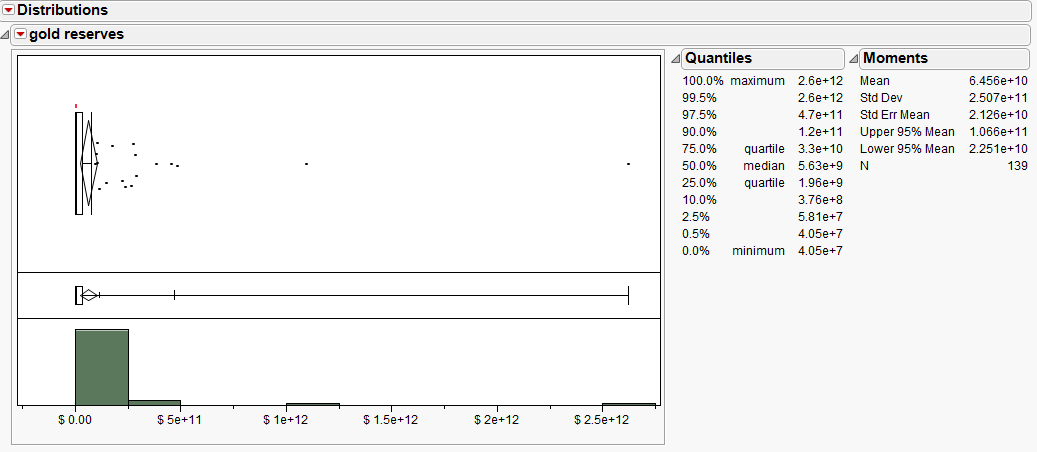
A brief analysis shows how Eastern Hemisphere loves gold and USD so much

I did the graph in JMP since it is an easier GUI for me to use (I do have some learning disabilities).

https://www.cia.gov/library/publications/the-world-factbook/rankorder/2188rank.html

RANK
COUNTRY RESERVES OF FOREIGN EXCHANGE AND GOLD DATE OF INFORMATION
1 China
$ 2,622,000,000,000
31 December 2010 est.
2 Japan
$ 1,096,000,000,000
31 December 2010 est.
3 Russia
$ 483,100,000,000
30 November 2010
4 Saudi Arabia
$ 456,200,000,000
31 December 2010 est.
5 Taiwan
$ 387,200,000,000
31 December 2010 est.
6 Brazil
$ 290,900,000,000
31 December 2010 est.
7 India
$ 284,100,000,000
31 December 2010 est.
8 Korea, South
$ 274,600,000,000
31 December 2010 est.
9 Hong Kong
$ 268,900,000,000
31 December 2010 est.
10 Switzerland
$ 236,600,000,000
31 December 2010
11 Singapore
$ 225,800,000,000
31 December 2010 est.
12 Thailand
$ 176,100,000,000
31 December 2010 est.
13 Algeria
$ 150,100,000,000
31 December 2010 est.
14 Mexico
$ 116,400,000,000
31 December 2010 est.
15 Libya
$ 107,300,000,000
31 December 2010 est.
16 Malaysia
$ 106,500,000,000
31 December 2010 est.
17 Poland
$ 99,760,000,000
31 December 2010 est.
18 Indonesia
$ 96,210,000,000
31 December 2010 est.
19 Turkey
$ 78,000,000,000
31 December 2010 est.
20 Iran
$ 75,060,000,000
31 December 2010 est.
21 Israel
$ 66,980,000,000
31 December 2010 est.
22 Philippines
$ 62,370,000,000
31 December 2010 est.
23 Argentina
$ 53,610,000,000
31 December 2010 est.
24 Romania
$ 50,510,000,000
31 December 2010 est.
25 Iraq
$ 45,680,000,000
31 December 2010 est.
26 South Africa
$ 45,520,000,000
31 December 2010 est.
27 Hungary
$ 44,990,000,000
31 December 2010 est.
28 Peru
$ 44,110,000,000
31 December 2010
29 Nigeria
$ 43,360,000,000
31 December 2010 est.
30 Czech Republic
$ 42,340,000,000
31 December 2010 est.
31 Lebanon
$ 41,570,000,000
31 December 2010 est.
32 United Arab Emirates
$ 39,100,000,000
31 December 2010 est.
33 Australia
$ 38,620,000,000
31 December 2010 est.
34 Egypt
$ 35,720,000,000
31 December 2010 est.
35 Ukraine
$ 32,910,000,000
31 December 2010 est.
36 Kazakhstan
$ 32,440,000,000
31 December 2010 est.
37 Venezuela
$ 29,490,000,000
31 December 2010 est.
38 Colombia
$ 28,500,000,000
31 December 2010 est.
39 Chile
$ 26,080,000,000
31 December 2010 est.
40 Morocco
$ 24,570,000,000
31 December 2010 est.
41 Macau
$ 23,730,000,000
42 Kuwait
$ 22,420,000,000
31 December 2010 est.
43 Qatar
$ 22,410,000,000
31 December 2010 est.
44 Austria
$ 21,890,000,000
31 December 2010 est.
45 Syria
$ 17,960,000,000
31 December 2010 est.
46 New Zealand
$ 17,850,000,000
31 December 2010 est.
47 Bulgaria
$ 17,270,000,000
31 December 2010 est.
48 Angola
$ 16,890,000,000
31 December 2010 est.
49 Pakistan
$ 16,100,000,000
31 December 2010 est.
50 Serbia
$ 15,100,000,000
30 November 2010 est.
51 Oman
$ 14,000,000,000
31 December 2010 est.
52 Croatia
$ 13,790,000,000
31 December 2010 est.
53 Vietnam
$ 13,000,000,000
31 December 2010 est.
54 Jordan
$ 12,640,000,000
31 December 2010 est.
55 Tunisia
$ 11,230,000,000
31 December 2010 est.
56 Turkmenistan
$ 10,810,000,000
31 December 2010 est.
57 Bangladesh
$ 10,790,000,000
31 December 2010 est.
58 Uzbekistan
$ 10,500,000,000
31 December 2010 est.
59 Bolivia
$ 9,730,000,000
31 December 2010 est.
60 Trinidad and Tobago
$ 9,659,000,000
31 December 2010 est.
61 Finland
$ 9,128,000,000
31 December 2010 est.
62 Botswana
$ 7,834,000,000
31 December 2010 est.
63 Uruguay
$ 7,700,000,000
31 December 2010 est.
64 Latvia
$ 7,170,000,000
31 December 2010 est.
65 Lithuania
$ 6,418,000,000
31 December 2010 est.
66 Azerbaijan
$ 6,330,000,000
31 December 2010 est.
67 Belarus
$ 5,755,000,000
31 December 2010 est.
68 Yemen
$ 5,744,000,000
31 December 2010 est.
69 Guatemala
$ 5,709,000,000
31 December 2010 est.
70 Sri Lanka
$ 5,630,000,000
31 December 2010 est.
71 Cuba
$ 4,847,000,000
31 December 2010 est.
72 Kenya
$ 4,585,000,000
31 December 2010 est.
73 Costa Rica
$ 4,584,000,000
31 December 2010 est.
74 Iceland
$ 4,206,000,000
31 December 2010 est.
75 Bosnia and Herzegovina
$ 4,200,000,000
31 December 2010 est.
76 Paraguay
$ 4,130,000,000
31 December 2010 est.
77 Congo, Republic of the
$ 4,123,000,000
31 December 2010 est.
78 Equatorial Guinea
$ 4,086,000,000
31 December 2010 est.
79 Cameroon
$ 4,023,000,000
31 December 2010 est.
80 Cote d’Ivoire
$ 3,985,000,000
31 December 2010 est.
81 Cambodia
$ 3,840,000,000
31 December 2010 est.
82 Ghana
$ 3,800,000,000
31 December 2010 est.
83 Bahrain
$ 3,766,000,000
31 December 2010 est.
84 Burma
$ 3,762,000,000
31 December 2010 est.
85 Uganda
$ 3,743,000,000
31 December 2010 est.
86 Tanzania
$ 3,687,000,000
31 December 2010 est.
87 Estonia
$ 3,641,000,000
31 December 2010 est.
88 Ecuador
$ 3,590,000,000
31 December 2010 est.
89 Panama
$ 3,525,000,000
31 December 2010 est.
90 Papua New Guinea
$ 3,017,000,000
31 December 2010 est.
91 El Salvador
$ 2,882,000,000
31 December 2010 est.
92 Dominican Republic
$ 2,705,000,000
31 December 2010 est.
93 Gabon
$ 2,602,000,000
31 December 2010 est.
94 Mauritius
$ 2,360,000,000
31 December 2010 est.
95 Georgia
$ 2,350,000,000
31 December 2010 est.
96 Honduras
$ 2,302,000,000
31 December 2010 est.
97 Zambia
$ 2,287,000,000
31 December 2010 est.
98 Armenia
$ 2,247,000,000
31 December 2010 est.
99 Macedonia
$ 2,217,000,000
30 November 2010 est.
100 Senegal
$ 2,200,000,000
31 December 2010 est.
101 Ireland
$ 2,104,000,000
31 December 2010
102 Sudan
$ 2,063,000,000
31 December 2010 est.
103 Albania
$ 1,992,000,000
31 December 2010 est.
104 Mozambique
$ 1,982,000,000
31 December 2010 est.
105 Namibia
$ 1,961,000,000
31 December 2010 est.
106 Ethiopia
$ 1,880,000,000
31 December 2010 est.
107 Jamaica
$ 1,850,000,000
31 December 2010 est.
108 Moldova
$ 1,710,000,000
31 December 2010 est.
109 Kyrgyzstan
$ 1,615,000,000
31 December 2010 est.
110 Burkina Faso
$ 1,588,000,000
31 December 2010 est.
111 Haiti
$ 1,587,000,000
31 December 2010 est.
112 Nicaragua
$ 1,580,000,000
31 December 2010 est.
113 Benin
$ 1,254,000,000
31 December 2010 est.
114 Slovakia
$ 1,160,000,000
31 January 2010 est.
115 Madagascar
$ 1,038,000,000
31 December 2010 est.
116 Congo, Democratic Republic of the
$ 1,010,000,000
March 2010 est.
117 Lesotho
$ 893,000,000
31 December 2010 est.
118 Chad
$ 868,000,000
31 December 2010 est.
119 Rwanda
$ 816,000,000
31 December 2010 est.
120 Laos
$ 756,000,000
31 December 2010 est.
121 Swaziland
$ 708,000,000
31 December 2010 est.
122 Togo
$ 686,000,000
31 December 2010 est.
123 Barbados
$ 620,000,000
2007
124 Malta
$ 522,000,000
31 December 2010 est.
125 Guyana
$ 506,000,000
31 December 2010 est.
126 Zimbabwe
$ 376,000,000
31 December 2010 est.
127 Burundi
$ 320,000,000
31 December 2010 est.
128 Tajikistan
$ 303,000,000
31 December 2010 est.
129 Malawi
$ 301,000,000
31 December 2010 est.
130 Cape Verde
$ 296,000,000
31 December 2010 est.
131 Suriname
$ 263,300,000
2006
132 Belize
$ 219,000,000
31 December 2010 est.
133 Gambia, The
$ 203,000,000
31 December 2010 est.
134 Seychelles
$ 193,000,000
31 December 2010 est.
135 Eritrea
$ 104,000,000
31 December 2010 est.
136 Samoa
$ 70,150,000
FY03/04
137 Sao Tome and Principe
$ 46,000,000
31 December 2010 est.
138 Tonga
$ 40,830,000
FY04/05
139 Vanuatu
$ 40,540,000
2003

Weather Weapons

water table high.
Image by glassblower via Flickr

possible weapons to modify weather and /or influence psychological reactions in people/mass events.

1) use of lasers to create hot spots on ocean ,sea surfaces for clouds and pressure winds

2) controlled demolitions to alter river trajectory

3) controlled sub terranean demolitions to influence water table levels

4) introduction of aerial oxidants and chemical leaching agents to alter soil productivity, water retention.

5) controlled sub nuclear explosions on glaciers as well as ice deposits.

6) MODIFICATION of ambient light /rain/sleet to influence or encourage dissent in populations usually in combination with some or all of the above.

the name of the game is the art of fighting a war without fighting a war. subtlety does it.

countries doing it are us, supported by pan democracies, china, and russia. may we live in interesting times

http://www.asitis.com/2/41.html

TRANSLATION

Those who are on this path are resolute in purpose, and their aim is one. O beloved child of the Kurus, the intelligence of those who are irresolute is many-branched.

Heritage offers 3 million chump change for Monkeys

My perspective is life is not fair, and if someone offers me 1 mill a year so they make 1 bill a year, I would still take it, especially if it leads to better human beings and better humanity on this planet. Health care isnt toothpaste.

Unless there are even more fine print changes involved- there exist several players in the pharma sector who do build and deploy models internally for denying claims or prospecting medical doctors with freebies, but they might just get caught with the new open data movement

————————————————————————————————–

A note from KDNuggets-

Heritage Health Prizereleased a second set of data on May 4. They also recently modified their ruleswhich now demand complete exclusivity and seem to disallow use of other tools (emphasis mine – Gregory PS)

21. LICENSE
By registering for the Competition, each Entrant (a) grants to Sponsor and its designees a worldwide, exclusive (except with respect to Entrant) , sub-licensable (through multiple tiers), transferable, fully paid-up, royalty-free, perpetual, irrevocable right to use, not use, reproduce, distribute (through multiple tiers), create derivative works of, publicly perform, publicly display, digitally perform, make, have made, sell, offer for sale and import the entry and the algorithm used to produce the entry, as well as any other algorithm, data or other information whatsoever developed or produced at any time using the data provided to Entrant in this Competition (collectively, the “Licensed Materials”), in any media now known or hereafter developed, for any purpose whatsoever, commercial or otherwise, without further approval by or payment to Entrant (the “License”) and
(b) represents that he/she/it has the unrestricted right to grant the License. 
Entrant understands and agrees that the License is exclusive except with respect to Entrant: Entrant may use the Licensed Materials solely for his/her/its own patient management and other internal business purposes but may not grant or otherwise transfer to any third party any rights to or interests in the Licensed Materials whatsoever.

This has lead to a call to boycott the competition by Tristan, who also notes that academics cannot publish their results without prior written approval of the Sponsor.

Anthony Goldbloom, CEO of Kaggle, emailed the HHP participants on May 4

HPN have asked me to pass on the following message: “The Heritage Provider Network is sponsoring the Heritage Health Prize to spur innovation and creative thinking in healthcare. HPN, however, is a medical group and must retain an exclusive license to the algorithms created using its data so as to ensure that the algorithms are used responsibly, and are only used to provide better health care to patients and not for improper purposes.
Put simply, while the competition hopes to spur innovation, this is not a competition regarding movie ratings or chess results. We hope that the clarifications we have made to the Rules and the FAQ adequately address your concerns and look forward to your participation in the competition.”

What do you think? Will the exclusive license prevent you from participating?