Libre Office turns six

On September 28th, 2010, The Document Foundation was announced. The last six months, it feels, have just passed within a short glimpse of time. Not only did we release three LibreOffice versions within three months, have created the LibreOffice-Box DVD image, and brought LibreOffice Portable on its way. We also have announced the LibreOffice Conference for October 2011 and have taken part in lots of events worldwide, with FOSDEM and CeBIT being the most prominent ones.

People follow us at Twitter, Identi.ca, XING, LinkedIn and a Facebook group and fan page, they discuss on our mailing lists with more than 6.000 subscriptions, collaborate in our wiki, get insight on our daily work in our blog, and post and blog themselves. From the very first day, openness, transparency and meritocracy have been shaping the framework we want to work in. Our discussions and decisions take place on a public mailing list, and regularly, we hold phone conferences for the Steering Committee and for the marketing teams, where everyone is invited to join. Our ideas and visions have made their way into our Next Decade Manifesto.

We have joined the Open Invention Network as well as the OpenDoc Society, and just last week have become an SPI-associated project, and we see a wide range of support from all over the world. Not only do Novell and Red Hat support our efforts with developers, but just recently, Canonical, creators of Ubuntu, joined as well. All major Linux distributions deliver LibreOffice with their operating systems, and more follow every day.

One of the most stunning contributions, that still leaves us speechless, is the support that we receive from the community. When we asked for 50,000 € capital stock for a German-based foundation, the community showed their support, appreciation and their power, and not only donated it in just eight days, but up to now has supported us with close to 100,000 €! Another one is that driven by our open, vendor neutral approach, combined with our easy hacks, we have included code contributions from over 150 entirely new developers to the project, alongside localisations from over 50 localizers. The community has developed itself better than we could ever dream of, and first meetings like the project’s weekend or the QA meeting of the Germanophone group are already being organized.

What we have seen now is just the beginning of something very big. The Document Foundation has a vision, and the creation of the foundation in Germany is about to happen soon. LibreOffice has been downloaded over 350,000 times within the first week, and we just counted more than 1,3 million downloads just from our download system — not counting packages directly delivered by Linux distributors, other download sites or DVDs included in magazines and newspapers — supported by 65 mirrors from all over the world, and millions already use and contribute to it worldwide. With our participation in the Google Summer of Code, we will engage more students and young developers to be part of our community. Our improved release schedule will ensure that new features and improvements will make their way to end-users soon, and for testers, we even provide daily builds.

We are so excited by what has been achieved over the last six months, and we are immensely grateful to all those who have supported the project in whatever ways they can. It is an honour to be working with you, to be part of one united community! The future as we are shaping it has just begun, and it will be bright and excellent.


from-

List archive: http://listarchives.documentfoundation.org/www/announce/

It's a code code summer

East-German pupils ("Junge Pioniere"...
Image via Wikipedia

and soc is back!

also expecting some #Rstats entries (open source!)

from https://code.google.com/soc/

Google Summer of Code 2011

Visit the Google Summer of Code 2011 site for more details about the program this year.

For a detailed timeline and further information about the program, review our Frequently Asked Questions.

About Google Summer of Code

Google Summer of Code is a global program that offers student developers stipends to write code for various open source software projects. We have worked with several open source, free software, and technology-related groups to identify and fund several projects over a three month period. Since its inception in 2005, the program has brought together over 4500 successful student participants and over 3000 mentors from over 100 countries worldwide, all for the love of code. Through Google Summer of Code, accepted student applicants are paired with a mentor or mentors from the participating projects, thus gaining exposure to real-world software development scenarios and the opportunity for employment in areas related to their academic pursuits. In turn, the participating projects are able to more easily identify and bring in new developers. Best of all, more source code is created and released for the use and benefit of all.

To learn more about the program, peruse our 2011 Frequently Asked Questions page. You can also subscribe to the Google Open Source Blog or the Google Summer of Code Discussion Group to keep abreast of the latest announcements.

Participating in Google Summer of Code

For those of you who would like to participate in the program, there are many resources available for you to learn more. Check out the information pages from the 20052006200720082009, and 2010 instances of the program to get a better sense of which projects have participated as mentoring organizations in Google Summer of Code each year. If you are interested in a particular mentoring organization, just click on its name and you’ll find more information about the project, a summary of their students’ work and actual source code produced by student participants. You may also find the program Frequently Asked Questions (FAQs) pages for each year to be useful. Finally, check out all the great content and advice on participation produced by the community, for the community, on our program wiki.

If you don’t find what you need in the documentation, you can always ask questions on our program discussion list or the program IRC channel, #gsoc on Freenode.


What to do if you see a possible GPL violation

GNU Lesser General Public License
Image via Wikipedia

Well I have played with software (mostly but not exclusively) analytical, and I admire the zeal and energy of both open source and closed source practioners- all having relatively decent people executing strategies their investors or owners tell them to do (closed source) or motivated by their own self sense of cool-change the world-openness (open source)

What I dont get is people stealing open source code- repackaging without adding major contributions- claiming patent pending stuff- and basically making money by creating CLOSED source from the open source software-(as open source is yet to break the enterprise glass cieling)

you are either open source or you arent.

bi- sexuality is okay. bi-codability is not.

Next time you see someone stealing some community’s open source code- refer to this excellent link.


But, we cannot act on our own if we do not hold copyright. Thus, be sure to find out who the copyright holders of the software are before reporting a violation.

http://www.gnu.org/licenses/gpl-violation.html

Violations of the GNU Licenses

If you think you see a violation of the GNU GPLLGPLAGPL, or FDL, the first thing you should do is double-check the facts:

  • Does the distribution contain a copy of the License?
  • Does it clearly state which software is covered by the License? Does it say anything misleading, perhaps giving the impression that something is covered by the License when in fact it is not?
  • Is source code included in the distribution?
  • Is a written offer for source code included with a distribution of just binaries?
  • Is the available source code complete, or is it designed for linking in other non-free modules?

If there seems to be a real violation, the next thing you need to do is record the details carefully:

  • the precise name of the product
  • the name of the person or organization distributing it
  • email addresses, postal addresses and phone numbers for how to contact the distributor(s)
  • the exact name of the package whose license is violated
  • how the license was violated:
    • Is the copyright notice of the copyright holder included?
    • Is the source code completely missing?
    • Is there a written offer for source that’s incomplete in some way? This could happen if it provides a contact address or network URL that’s somehow incorrect.
    • Is there a copy of the license included in the distribution?
    • Is some of the source available, but not all? If so, what parts are missing?

The more of these details that you have, the easier it is for the copyright holder to pursue the matter.

Once you have collected the details, you should send a precise report to the copyright holder of the packages that are being misused. The copyright holder is the one who is legally authorized to take action to enforce the license.

If the copyright holder is the Free Software Foundation, please send the report to <license-violation@gnu.org>. It’s important that we be able to write back to you to get more information about the violation or product. So, if you use an anonymous remailer, please provide a return path of some sort. If you’d like to encrypt your correspondence, just send a brief mail saying so, and we’ll make appropriate arrangements.

Note that the GPL, and other copyleft licenses, are copyright licenses. This means that only the copyright holders are empowered to act against violations. The FSF acts on all GPL violations reported on FSF copyrighted code, and we offer assistance to any other copyright holder who wishes to do the same.

But, we cannot act on our own if we do not hold copyright. Thus, be sure to find out who the copyright holders of the software are before reporting a violation.


Google Snappy

Diagram of how a 32-bit integer is arranged in...
Image via Wikipedia

a cool sounding software- yet again by the guys from California, this one enables to zip and unzip Big Data much much faster

http://news.ycombinator.com/item?id=2356735

and

https://code.google.com/p/snappy/

Snappy is a compression/decompression library. It does not aim for maximum compression, or compatibility with any other compression library; instead, it aims for very high speeds and reasonable compression. For instance, compared to the fastest mode of zlib, Snappy is an order of magnitude faster for most inputs, but the resulting compressed files are anywhere from 20% to 100% bigger. On a single core of a Core i7 processor in 64-bit mode, Snappy compresses at about 250 MB/sec or more and decompresses at about 500 MB/sec or more.

Snappy is widely used inside Google, in everything from BigTable and MapReduce to our internal RPC systems. (Snappy has previously been referred to as “Zippy” in some presentations and the likes.)

For more information, please see the README. Benchmarks against a few other compression libraries (zlib, LZO, LZF, FastLZ, and QuickLZ) are included in the source code distribution.

Introduction
============
Snappy is a compression/decompression library. It does not aim for maximum
compression, or compatibility with any other compression library; instead,
it aims for very high speeds and reasonable compression. For instance,
compared to the fastest mode of zlib, Snappy is an order of magnitude faster
for most inputs, but the resulting compressed files are anywhere from 20% to
100% bigger. (For more information, see “Performance”, below.)
Snappy has the following properties:
* Fast: Compression speeds at 250 MB/sec and beyond, with no assembler code.
See “Performance” below.
* Stable: Over the last few years, Snappy has compressed and decompressed
petabytes of data in Google’s production environment. The Snappy bitstream
format is stable and will not change between versions.
* Robust: The Snappy decompressor is designed not to crash in the face of
corrupted or malicious input.
* Free and open source software: Snappy is licensed under the Apache license,
version 2.0. For more information, see the included COPYING file.
Snappy has previously been called “Zippy” in some Google presentations
and the like.
Performance
===========
Snappy is intended to be fast. On a single core of a Core i7 processor
in 64-bit mode, it compresses at about 250 MB/sec or more and decompresses at
about 500 MB/sec or more. (These numbers are for the slowest inputs in our
benchmark suite; others are much faster.) In our tests, Snappy usually
is faster than algorithms in the same class (e.g. LZO, LZF, FastLZ, QuickLZ,
etc.) while achieving comparable compression ratios.
Typical compression ratios (based on the benchmark suite) are about 1.5-1.7x
for plain text, about 2-4x for HTML, and of course 1.0x for JPEGs, PNGs and
other already-compressed data. Similar numbers for zlib in its fastest mode
are 2.6-2.8x, 3-7x and 1.0x, respectively. More sophisticated algorithms are
capable of achieving yet higher compression rates, although usually at the
expense of speed. Of course, compression ratio will vary significantly with
the input.
Although Snappy should be fairly portable, it is primarily optimized
for 64-bit x86-compatible processors, and may run slower in other environments.
In particular:
– Snappy uses 64-bit operations in several places to process more data at
once than would otherwise be possible.
– Snappy assumes unaligned 32- and 64-bit loads and stores are cheap.
On some platforms, these must be emulated with single-byte loads
and stores, which is much slower.
– Snappy assumes little-endian throughout, and needs to byte-swap data in
several places if running on a big-endian platform.
Experience has shown that even heavily tuned code can be improved.
Performance optimizations, whether for 64-bit x86 or other platforms,
are of course most welcome; see “Contact”, below.
Usage
=====
Note that Snappy, both the implementation and the interface,
is written in C++.
To use Snappy from your own program, include the file “snappy.h” from
your calling file, and link against the compiled library.
There are many ways to call Snappy, but the simplest possible is
snappy::Compress(input, &output);
and similarly
snappy::Uncompress(input, &output);
where “input” and “output” are both instances of std::string.

Top 10 Games on Linux -sudo update

The phrase "Doom clone" was initiall...
Image via Wikipedia

Here are some cool games I like to play on my Ubuntu 10.10 – I think they run on most other versions of Linux as well. 1) Open ArenaFirst person Shooter– This is like Quake Arena- very very nice graphics and good for playing for a couple of hours while taking a break. It is available here- http://openarena.ws/smfnews.php ideally if you have a bunch of gaming friends, playing on a local network or internet is quite mind blowing entertaining. And it’s free! 2) Armagetron– This is based on the TRON game of light cycles-It is available here at http://www.armagetronad.net/ or you can use Synaptic packages manager for all the games mentioned here

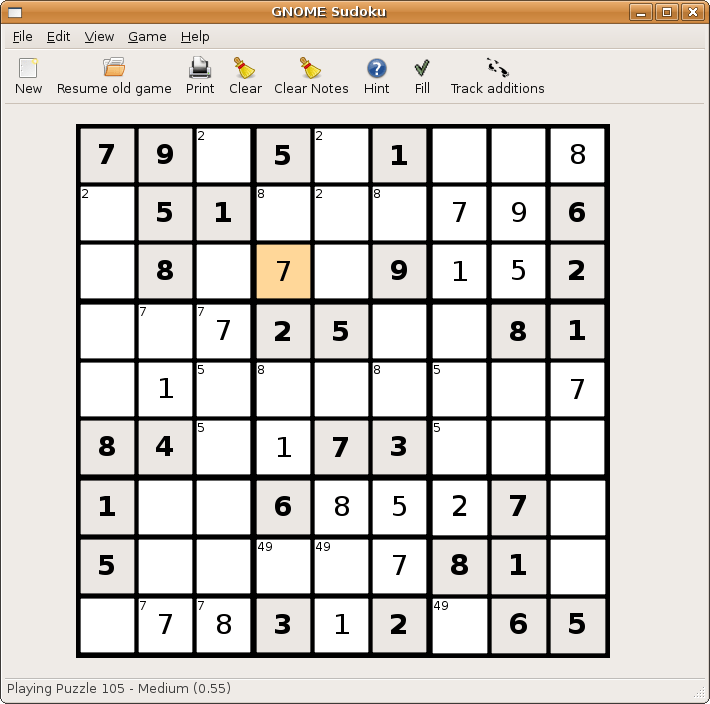
If violence or cars is not your stuff and you like puzzles like Sudoko, well just install the application Sudoko from http://gnome-sudoku.sourceforge.net/ Also recommended for people of various ages as it has multiple levels.

If you ever liked Pinball play the open source version from download at http://pinball.sourceforge.net/ Alternatively you can go to Ubuntu Software Centre>Games>Arcade>Emilio>Pinball and you can also build your own pinball if you like the game well enough. 5) Pacman/Njam- Clone of the original classic game.  Downloadable from http://www.linuxcompatible.org/news/story/pacman_for_linux.html 6) Gweled– This is free clone version of Bejeweled. It now has a new website at http://gweled.org/ http://linux.softpedia.com/progDownload/Gweled-Download-3449.html

Gweled is a GNOME version of a popular PalmOS/Windows/Java game called “Bejeweled” or “Diamond Mine”. The aim of the game is to make alignment of 3 or more gems, both vertically or horizontally by swapping adjacent gems. The game ends when there are no possible moves left. Here are some key features of “Gweled”: · exact same gameplay as the commercial versions · SVG original graphics

7) Hearts – For this card game classis you can use Ubuntu software to install the package or go to http://linuxappfinder.com/package/gnome-hearts 8) Card Games- KPatience has almost 14 card games including solitaire, and free cell. 9) Sauerbraten -First person shooter with good network play, edit maps capabilities. You can read more here- http://sauerbraten.org/ 10) Tetris-KBlocks Tetris is the classic game. If you like classic slow games- Tetris is the best. and I like the toughest Tetris game -Bastet http://fph.altervista.org/prog/bastet.html Even an xkcd toon for it

Protected: Using SAS and C/C++ together

This content is password-protected. To view it, please enter the password below.

PMML Plugin for Greenplum now available

Predictive Model Markup Language
Image via Wikipedia

From a press release from Zementis.


, the Universal PMML Plug-in for in-database scoring. Available now for the EMC Greenplum Database, a high-performance massively parallel processing (MPP) database, the plug-in leverages the Predictive Model Markup Language (PMML) to execute predictive models directly within EMC Greenplum, for highly optimized in-database scoring.

Universal PMML Plug-in

Developed by the Data Mining Group (DMG), PMML is supported by all major data mining vendors, e.g., IBM SPSS, SAS, Teradata, FICO, STASTICA, Microstrategy, TIBCO and Revolution Analytics as well as open source tools like R, KNIME and RapidMiner. With PMML, models built in any of these data mining tools can now instantly be deployed in the EMC Greenplum database. The net result is the ability to leverage the power of standards-based predictive analytics on a massive scale, right where the data resides.

“By partnering with Zementis, a true PMML innovator, we are able to offer a vendor-agnostic solution for moving enterprise-level predictive analytics into the database execution environment,” said Dr. Steven Hillion, Vice President of Analytics at EMC Greenplum. “With Zementis and PMML, the de-facto standard for representing data mining models, we are eliminating the need to recode predictive analytic models in order to deploy them within our database. In turn, this enables an analyst to reduce the time to insight required in most businesses today.”

Want to learn more?
 

To learn more about how the EMC Greenplum Database and the Universal PMML Plug-in work together, feel free to:

  1. Visit the PMML Plug-in product page
  2. Download the white paper

The Universal PMML Plug-in for the EMC Greenplum Database is available now. Contact us today for more information.

Michael Zeller, CEO, Zementis