John M. Chambers Statistical Software Award – 2011

Write code, win cash, and the glory. Deep bow to Father John M Chambers, inventor of S ,for endowing this award for statistical software creation by grads and undergrads.

An effort to be matched by companies like SAS, SPSS which after all came from grad school work. Now back to the competition, I gotta get my homies from U Tenn in a team ( I was a grad student last year though taking this year off due to medico- financial reasons)

John M. Chambers Statistical Software Award – 2011
Statistical Computing Section
American Statistical Association

The Statistical Computing Section of the American Statistical
Association announces the competition for the John M.  Chambers
Statistical Software Award. In 1998 the Association for Computing
Machinery presented its Software System Award to John Chambers for the
design and development of S. Dr. Chambers generously donated his award
to the Statistical Computing Section to endow an annual prize for
statistical software written by an undergraduate or graduate student.
The prize carries with it a cash award of $1000, plus a substantial
allowance for travel to the annual Joint Statistical Meetings where
the award will be presented.

Teams of up to 3 people can participate in the competition, with the
cash award being split among team members. The travel allowance will
be given to just one individual in the team, who will be presented the
award at JSM.  To be eligible, the team must have designed and
implemented a piece of statistical software.
The individual within
the team indicated to receive the travel allowance must have begun the
development while a student, and must either currently be a student,
or have completed all requirements for her/his last degree after
January 1, 2009.  To apply for the award, teams must provide the
following materials:

Current CV’s of all team members.

A letter from a faculty mentor at the academic institution of the
individual indicated to receive the travel award.  The letter
should confirm that the individual had substantial participation in
the development of the software, certify her/his student status
when the software began to be developed (and either the current
student status or the date of degree completion), and briefly
discuss the importance of the software to statistical practice.

A brief, one to two page description of the software, summarizing
what it does, how it does it, and why it is an important
contribution.  If the team member competing for the travel
allowance has continued developing the software after finishing
her/his studies, the description should indicate what was developed
when the individual was a student and what has been added since.

An installable software package with its source code for use by the
award committee. It should be accompanied by enough information to allow
the judges to effectively use and evaluate the software (including
its design considerations.)  This information can be provided in a
variety of ways, including but not limited to a user manual (paper
or electronic), a paper, a URL, and online help to the system.

All materials must be in English.  We prefer that electronic text be
submitted in Postscript or PDF.  The entries will be judged on a
variety of dimensions, including the importance and relevance for
statistical practice of the tasks performed by the software, ease of
use, clarity of description, elegance and availability for use by the
statistical community. Preference will be given to those entries that
are grounded in software design rather than calculation.  The decision
of the award committee is final.

All application materials must be received by 5:00pm EST, Monday,
February 21, 2011 at the address below.  The winner will be announced
in May and the award will be given at the 2011 Joint Statistical
Meetings.

Information on the competition can also be accessed on the website of
the Statistical Computing Section (www.statcomputing.org or see the
ASA website, www.amstat.org for a pointer), including the names and
contributions of previous winners.  Inquiries and application
materials should be emailed or mailed to:

Chambers Software Award
c/o Fei Chen
Avaya Labs
233 Mt Airy Rd.
Basking Ridge, NJ 07920
feic@avaya.com
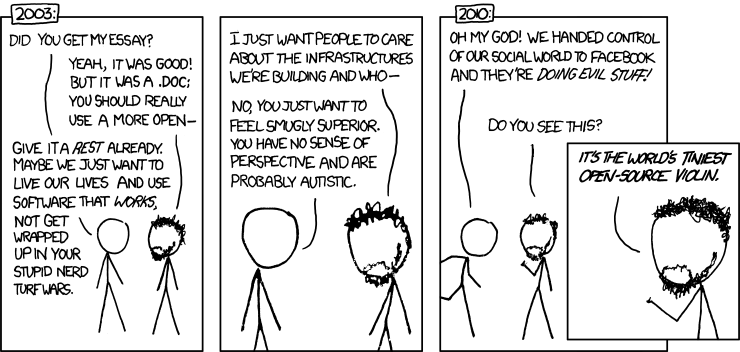
Kill R? Wait a sec

1) Is R efficient? (scripting wise, and performance wise) _ Depends on how you code it- some Packages like foreach can help but basic efficiency come from programmer. XDF formats from Revoscalar -the non open R package further improve programming efficiency

2) Should R be written from scratch?

You got to be kidding- It depends on how you define scratch after 2 million users

This has been done with S, then S Plus and now R.

3) What should be the license of R (if it was made a new)?

GPL license is fine. You need to do a better job of executing the license. Currently interfaces to R exist from SPSS, SAS, KXEN , other companies as well. To my knowledge royalty payments as well as formal code sharing does not agree.

R core needs to do a better job of protecting the work of 2500 package-creators rather than settling for a few snacks at events, sponsorships, Corporate Board Membership for Prof Gentleman, and 4-5 packages donated to it. The only way R developers can currently support their research is write a book (ny Springer mostly)

Eg GGplot and Hmisc are likely to be used more by average corporate user. Do their creators deserve royalty if creators of RevoScalar are getting it?

If some of 2 million users gave 1 $ to R core (compared to 9 million in last round of funding in Revolution Analytics)- you would have enough money to create a 64 bit optimized R for Linux (missing in Enterprise R), Amazon R APIs (like Karim Chine’s efforts), R GUIs (like Rattle’s commercial version) etc etc

The developments are not surprising given that Microsoft and Intel are funding Revolution Analytics http://www.dudeofdata.com/?p=1967

R controversies come and go (this has happened before including the NYT article and shakeup at Revo)

An interesting debate on whether R should be killed to make an upgrade to a more efficient language.

From Tal (creator R Bloggers) and on R help list-

There is currently a (very !) lively discussions happening around the web, surrounding the following topics:
1) Is R efficient? (scripting wise, and performance wise)
2) Should R be written from scratch?
3) What should be the license of R (if it was made a new)?

Very serious people have taken part in the debates so far.  I hope to let you know of the places I came by, so you might be able to follow/participate
in these (IMHO) important discussions.

The discussions started in the response for the following blog post on
Xi’An’s blog:
http://xianblog.wordpress.com/2010/09/06/insane/


Followed by the (short) response post by Ross Ihaka:
http://xianblog.wordpress.com/2010/09/13/simply-start-over-and-build-something-better/


Other discussions started to appear on Andrew Gelman’s blog:
http://www.stat.columbia.edu/~cook/movabletype/archives/2010/09/ross_ihaka_to_r.html

And (many) more responses started to appear in the hackers news website:
http://news.ycombinator.com/item?id=1687054

I hope these discussions will have fruitful results for our community,
Tal

—————-Contact
Details:——————————————————-
Contact me: Tal.Galili@gmail.com |  972-52-7275845
Read me: www.talgalili.com (Hebrew) | www.biostatistics.co.il (Hebrew) |
www.r-statistics.com (English)

My 0 cents ( see it would 2 cents but it;s free)

Trrrouble in land of R…and Open Source Suggestions

Recently some comments by Ross Ihake , founder of R Statistical Software on Revolution Analytics, leading commercial vendor of R….. came to my attention-

http://www.stat.auckland.ac.nz/mail/archive/r-downunder/2010-May/000529.html

[R-downunder] Article on Revolution Analytics

Ross Ihaka ihaka at stat.auckland.ac.nz
Mon May 10 14:27:42 NZST 2010


On 09/05/10 09:52, Murray Jorgensen wrote:
> Perhaps of interest:
>
> http://www.theregister.co.uk/2010/05/06/revolution_commercial_r/

Please note that R is "free software" not "open source".  These guys
are selling a GPLed work without disclosing the source to their part
of the work. I have complained to them and so far they have given me
the brush off. I am now considering my options.

Don't support these guys by buying their product. The are not feeding
back to the rights holders (the University of Auckland and I are rights
holders and they didn't even have the courtesy to contact us).

--
Ross Ihaka                         Email:  ihaka at stat.auckland.ac.nz
Department of Statistics           Phone:  (64-9) 373-7599 x 85054
University of Auckland             Fax:    (64-9) 373-7018
Private Bag 92019, Auckland
New Zealand
and from http://www.theregister.co.uk/2010/05/06/revolution_commercial_r/
Open source purists probably won't be all too happy to learn that Revolution is going to be employing an "open core" strategy, which means the core R programs will remain open source and be given tech support under a license model, but the key add-ons that make R more scalable will be closed source and sold under a separate license fee. Because most of those 2,500 add-ons for R were built by academics and Revolution wants to supplant SPSS and SAS as the tools used by students, Revolution will be giving the full single-user version of the R Enterprise stack away for free to academics. 
Conclusion-
So one co-founder of R is advocating not to buy from Revolution Analytics , which has the other co-founder of R, Gentleman on its board. 
Source- http://www.revolutionanalytics.com/aboutus/leadership.php

2) If Revolution Analytics is using 2500 packages for free but insisting on getting paid AND closing source of it’s packages (which is a technical point- how exactly can you prevent source code of a R package from being seen)

Maybe there can be a PACKAGE marketplace just like Android Apps, Facebook Apps, and Salesforce.com Apps – so atleast some of the thousands of R package developers can earn – sorry but email lists do not pay mortgages and no one is disputing the NEED for commercializing R or rewarding developers.

Though Barr created SAS, he gave up control to Goodnight and Sall https://decisionstats.wordpress.com/2010/06/02/sas-early-days/

and Goodnight and Sall do pay their developers well- to the envy of not so well paid counterparts.

3) I really liked the innovation of Revolution Analytics RevoScalar, and I wish that the default R dataset be converted to XDF dataset so that it basically kills

off the R criticism of being slow on bigger datasets. But I also realize the need for creating an analytics marketplace for R developers and R students- so academic version of R being free and Revolution R being paid seems like a trade off.

Note- You can still get a job faster as a stats student if you mention SAS and not R as a statistical skill- not all stats students go into academics.

4) There can be more elegant ways of handling this than calling for ignoring each other as REVOLUTION and Ihake seem to be doing to each other.

I can almost hear people in Cary, NC chuckling at Norman Nie, long time SPSS opponent and now REVOLUTION CEO, and his antagonizing R’s academicians within 1 year of taking over- so I hope this ends well for all. The road to hell is paved with good intentions- so if REVOLUTION can share some source code with say R Core members (even Microsoft shares source code with partners)- and R Core and Revolution agree on a licensing royalty from each other, they can actually speed up R package creation rather than allow this 2 decade effort to end up like S and S plus and TIBCO did.

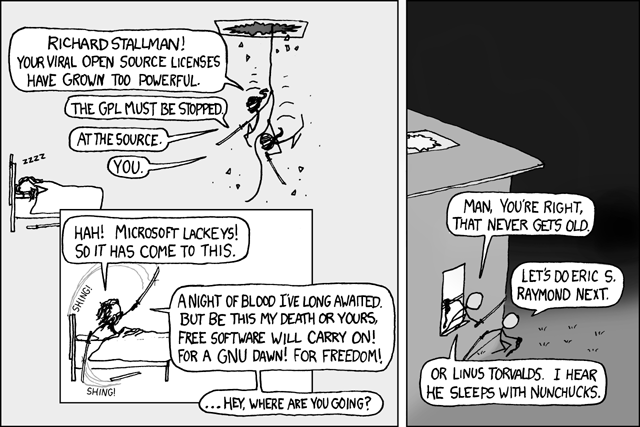
Maybe Richard Stallman can help-or maybe Ihaka has a better sense of where things will go down in a couple of years-he must know something-he invented it, didnt he

On 09/05/10 09:52, Murray Jorgensen wrote:
> Perhaps of interest:
>
> http://www.theregister.co.uk/2010/05/06/revolution_commercial_r/

Please note that R is "free software" not "open source".  These guys
are selling a GPLed work without disclosing the source to their part
of the work. I have complained to them and so far they have given me
the brush off. I am now considering my options.

Don't support these guys by buying their product. The are not feeding
back to the rights holders (the University of Auckland and I are rights
holders and they didn't even have the courtesy to contact us).

--
Ross Ihaka                         Email:  ihaka at stat.auckland.ac.nz
Department of Statistics           Phone:  (64-9) 373-7599 x 85054
University of Auckland             Fax:    (64-9) 373-7018
Private Bag 92019, Auckland
New Zealand

Google AppInventor -Android and Business Intelligence

Here is a great new tool for techies to start creating Android Apps right away- even if you have no knowledge of the platform. Of course there are existing great number of apps- including my favorite Android Data Mining App in R – called AnalyticDroid http://analyticdroid.togaware.com/

Basically it calls the Rattle (R Analytical Tool To Learn Easily) Data Mining GUI -enabling data mining from an Android Mobile using remote computing.

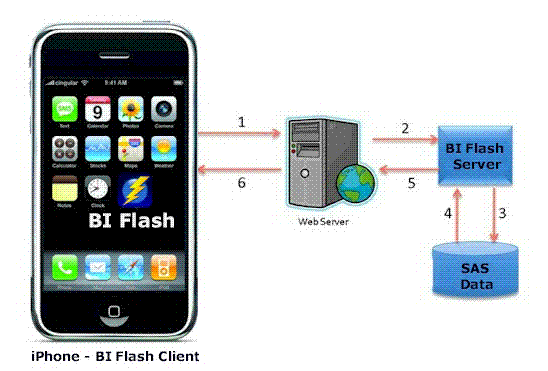
I dont know if any other statistical application is available on Android Mobiles- though SAS did have a presentation on using SAS on IPhone

http://www.wuss.org/proceedings09/09WUSSProceedings/papers/dpr/DPR-Truong.pdf


SAS Mobile -Iphone App

All you need to do is go to http://appinventor.googlelabs.com/about/index.html and request access (yes there is a 2 week approval waiting line)

Because App Inventor provides access to a GPS-location sensor, you can build apps that know where you are. You can build an app to help you remember where you parked your car, an app that shows the location of your friends or colleagues at a concert or conference, or your own custom tour app of your school, workplace, or a museum.
You can write apps that use the phone features of an Android phone. You can write an app that periodically texts “missing you” to your loved ones, or an app “No Text While Driving” that responds to all texts automatically with “sorry, I’m driving and will contact you later”. You can even have the app read the incoming texts aloud to you (though this might lure you into responding).
App Inventor provides a way for you to communicate with the web. If you know how to write web apps, you can use App Inventor to write Android apps that talk to your favorite web sites, such as Amazon and Twitter.

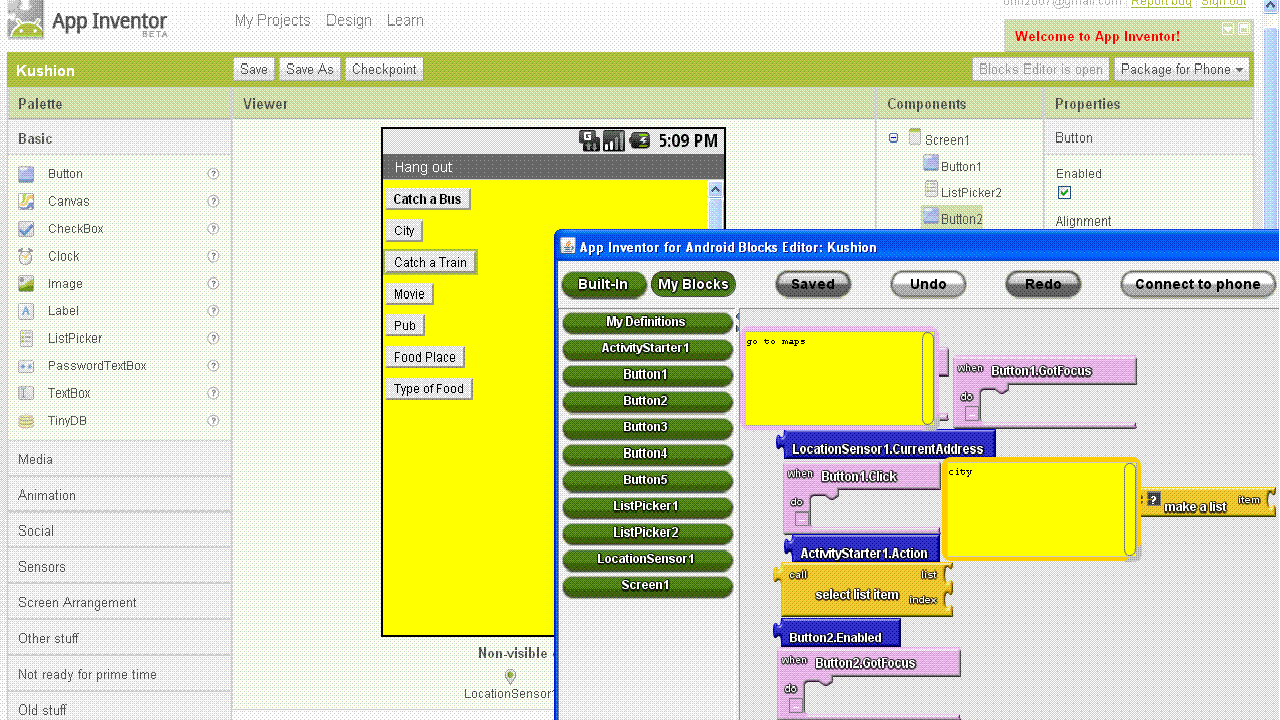
Here is a not so statistical Android App I am trying to create called Hang-Out

using the current GPS location of your phone to find nearest Pub, Movie or Diner and catch Bus- Train based on your location city, the GPS and time of request and schedule of those cities public transport- very much WIP

Open Source Business Intelligence: Pentaho and Jaspersoft

Here are two products that are used widely for Business Intelligence_ They are open source and both have free preview.

Jaspersoft-For the Enterprise version click on the screenshot while for the free community version you can go to

http://jasperforge.org/projects/jasperserver

Interestingly (and not surprisingly) Revolution Analytics is teaming up with Jaspersoft to use R for reporting along with the Jaspersoft BI stack.

ADVANCED ANALYTICS ON DEMAND IN APPLICATIONS, IN DASHBOARDS, AND ON THE WEB

FREE WEBINAR WEDNESDAY, SEPTEMBER 22ND @9AM PACIFIC

DEPLOYING R: ADVANCED ANALYTICS ON DEMAND IN APPLICATIONS, IN DASHBOARDS, AND ON THE WEB

A JOINT WEBINAR FROM REVOLUTION ANALYTICS AND JASPERSOFT

Date: Wednesday, September 22, 2010
Time: 9:00am PDT (12:00pm EDT; 4:00pm GMT)
Presenters: David Smith, Vice President of Marketing, Revolution Analytics
Andrew Lampitt, Senior Director of Technology Alliances, Jaspersoft
Matthew Dahlman, Business Development Engineer, Jaspersoft
Registration: Click here to register now!

R is a popular and powerful system for creating custom data analysis, statistical models, and data visualizations. But how can you make the results of these R-based computations easily accessible to others? A PhD statistician could use R directly to run the forecasting model on the latest sales data, and email a report on request, but then the process is just going to have to be repeated again next month, even if the model hasn’t changed. Wouldn’t it be better to empower the Sales manager to run the model on demand from within the BI application she already uses—daily, even!—and free up the statistician to build newer, better models for others?

In this webinar, David Smith (VP of Marketing, Revolution Analytics) will introduce the new “RevoDeployR” Web Services framework for Revolution R Enterprise, which is designed to make it easy to integrate dynamic R-based computations into applications for business users. RevoDeployR empowers data analysts working in R to publish R scripts to a server-based installation of Revolution R Enterprise. Application developers can then use the RevoDeployR Web Services API to securely and scalably integrate the results of these scripts into any application, without needing to learn the R language. With RevoDeployR, authorized users of hosted or cloud-based interactive Web applications, desktop applications such as Microsoft Excel, and BI applications like Jaspersoft can all benefit from on-demand analytics and visualizations developed by expert R users.

To demonstrate the power of deploying R-based computations to business users, Andrew Lampitt will introduce Jaspersoft commercial open source business intelligence, the world’s most widely used BI software. In a live demonstration, Matt Dahlman will show how to supercharge the BI process by combining Jaspersoft and Revolution R Enterprise, giving business users on-demand access to advanced forecasts and visualizations developed by expert analysts.

Click here to register for the webinar.

Speaker Biographies:

David Smith is the Vice President of Marketing at Revolution Analytics, the leading commercial provider of software and support for the open source “R” statistical computing language. David is the co-author (with Bill Venables) of the official R manual An Introduction to R. He is also the editor of Revolutions (http://blog.revolutionanalytics.com), the leading blog focused on “R” language, and one of the originating developers of ESS: Emacs Speaks Statistics. You can follow David on Twitter as @revodavid.

Andrew Lampitt is Senior Director of Technology Alliances at Jaspersoft. Andrew is responsible for strategic initiatives and partnerships including cloud business intelligence, advanced analytics, and analytic databases. Prior to Jaspersoft, Andrew held other business positions with Sunopsis (Oracle), Business Objects (SAP), and Sybase (SAP). Andrew earned a BS in engineering from the University of Illinois at Urbana Champaign.

Matthew Dahlman is Jaspersoft’s Business Development Engineer, responsible for technical aspects of technology alliances and regional business development. Matt has held a wide range of technical positions including quality assurance, pre-sales, and technical evangelism with enterprise software companies including Sybase, Netonomy (Comverse), and Sunopsis (Oracle). Matt earned a BA in mathematics from Carleton College in Northfield, Minnesota.


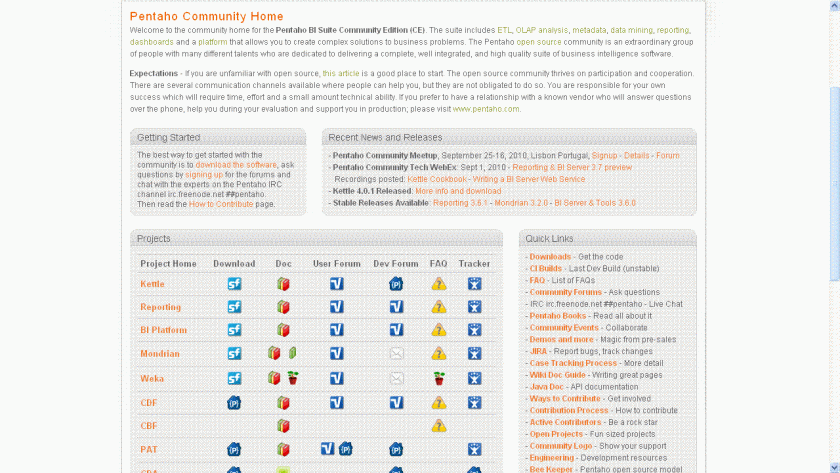
The second widely used BI stack in open source is Pentaho.

You can download it here to evaluate it or click on screenshot to read more at

http://community.pentaho.com/

http://sourceforge.net/projects/pentaho/files/Business%20Intelligence%20Server/

Event: Predictive analytics with R, PMML and ADAPA

From http://www.meetup.com/R-Users/calendar/14405407/

The September meeting is at the Oracle campus. (This is next door to the Oracle towers, so there is plenty of free parking.) The featured talk is from Alex Guazzelli (Vice President – Analytics, Zementis Inc.) who will talk about “Predictive analytics with R, PMML and ADAPA”.

Agenda:
* 6:15 – 7:00 Networking and Pizza (with thanks to Revolution Analytics)
* 7:00 – 8:00 Talk: Predictive analytics with R, PMML and ADAPA
* 8:00 – 8:30 General discussion

Talk overview:

The rule in the past was that whenever a model was built in a particular development environment, it remained in that environment forever, unless it was manually recoded to work somewhere else. This rule has been shattered with the advent of PMML (Predictive Modeling Markup Language). By providing a uniform standard to represent predictive models, PMML allows for the exchange of predictive solutions between different applications and various vendors.

Once exported as PMML files, models are readily available for deployment into an execution engine for scoring or classification. ADAPA is one example of such an engine. It takes in models expressed in PMML and transforms them into web-services. Models can be executed either remotely by using web-services calls, or via a web console. Users can also use an Excel add-in to score data from inside Excel using models built in R.

R models have been exported into PMML and uploaded in ADAPA for many different purposes. Use cases where clients have used the flexibility of R to develop and the PMML standard combined with ADAPA to deploy range from financial applications (e.g., risk, compliance, fraud) to energy applications for the smart grid. The ability to easily transition solutions developed in R to the operational IT production environment helps eliminate the traditional limitations of R, e.g. performance for high volume or real-time transactional systems and memory constraints associated with large data sets.

Speaker Bio:

Dr. Alex Guazzelli has co-authored the first book on PMML, the Predictive Model Markup Language which is the de facto standard used to represent predictive models. The book, entitled PMML in Action: Unleashing the Power of Open Standards for Data Mining and Predictive Analytics, is available on Amazon.com. As the Vice President of Analytics at Zementis, Inc., Dr. Guazzelli is responsible for developing core technology and analytical solutions under ADAPA, a PMML-based predictive decisioning platform that combines predictive analytics and business rules. ADAPA is the first system of its kind to be offered as a service on the cloud.
Prior to joining Zementis, Dr. Guazzelli was involved in not only building but also deploying predictive solutions for large financial and telecommunication institutions around the globe. In academia, Dr. Guazzelli worked with data mining, neural networks, expert systems and brain theory. His work in brain theory and computational neuroscience has appeared in many peer reviewed publications. At Zementis, Dr. Guazzelli and his team have been involved in a myriad of modeling projects for financial, health-care, gaming, chemical, and manufacturing industries.

Dr. Guazzelli holds a Ph.D. in Computer Science from the University of Southern California and a M.S and B.S. in Computer Science from the Federal University of Rio Grande do Sul, Brazil.

Rapid Miner- R Extension

Here is a new video which shows exactly how you can use Rapid Miner and R together. Advantages of using both together is using Rapid Miner’s GUI (including the flowchart style for data mning) and adding R statistical functionality to it.

From http://rapid-i.com/content/view/219/1/

The web site features a video showing how easy R models and scripts can be integrated into the RapidMiner analysis processes. RapidMiner offers a new R perspective consisting of the known R console together with the great plotting facilities of R. All variables as well as R scripts can be stored in the RapidMiner Repository and used from there which helps to organize the usually large number of scripts. Furthermore, widely used modeling methods are directly integrated as RapidMiner operators as usual.

“This is a huge step for open source data analysis. RapidMiner offers a great user interface, a clear process structure and lots of ETL and analysis capabilities necessary for real-world problems. R adds a lot of flexibility and many analysis and data manipulation methods. The result is the by far most powerful data transformation and analysis solution worldwide. And this analysis power is now combined with the ease-of-use already known from RapidMiner.” states Dr. Ingo Mierswa, CEO of Rapid-I.

Visit the RCOMM 2010 and learn more about how to integrate analysis and preprocessing methods offered by R as well as how to use the new R perspective offering a full R console and access to all R plotters.

Thus Rapid Miner is one more mainstream software (after SPSS, SAS etc) to add R functionality to it.