Linux= Who did what and how much?

A report distributed under Creative Commons 3 and available at

That shows Canonical — the commercial arm of Ubuntu — has contributed only about one percent of the code to the GNOME desktop for Linux. while Red Hat accounts for 17 percent of the code and Novell developers are responsible for about 11 percent. That prompted some heartburn from Mark, creator- founder Cannonical/ Ubuntu at http://www.markshuttleworth.com/archives/517

And it would be a very different story if it weren’t for the Mozilla folks and Netscape before them, and GNOME and KDE, and Google and everyone else who have exercised that stack in so many different ways, making it better along the way. There are tens of thousands of people who are not in any way shape or form associated with Ubuntu, who make this story real. Many of them have been working at it for more than a decade – it takes a long time to make an overnight success :) while Ubuntu has only been on the scene six years. So Ubuntu cannot be credited solely for the delight of its users.

Nevertheless, the Ubuntu Project does bring something unique, special and important to free software: a total commitment to everyday users and use cases, the idea that free software should be “for everyone” both economically and in ease of use, and a willingness to chase down the problems that stand between here and there. I feel that commitment is a gift back to the people who built every one of those packages. If we can bring free software to ten times the audience, we have amplified the value of your generosity by a factor of ten, we have made every hour spent fixing an issue or making something amazing, ten times as valuable. I’m very proud to be spending the time and energy on Ubuntu that I do. Yes, I could do many other things, but I can’t think of another course which would have the same impact on the world.

I recognize that not everybody will feel the same way. Bringing their work to ten times the audience without contributing features might just feel like leeching, or increasing the flow of bug reports 10x. I suppose you could say that no matter how generous we are to downstream users, if upstream is only measuring code, then any generosity other than code won’t be registered. I don’t really know what to do about that – I didn’t found Ubuntu as a vehicle for getting lots of code written, that didn’t seem to me to be what the world needed.

Open source communities work like democracies with all noise whereas R and D within corporates have a stricter hierarchy. Still for all that – Ubuntu and Android have made Linux mainstream just as R has made statistical software available to all.

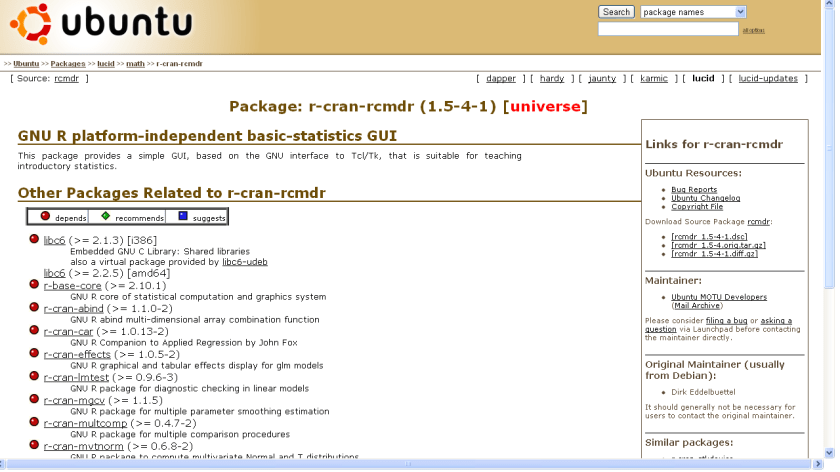
And Ubuntu also has great support for R (particularly the single click R Commander Install and Icon) available at http://packages.ubuntu.com/lucid/math/r-cran-rcmdr

Amazon announces Micro Instances for cloud computing

From Amazon http://aws.amazon.com/ec2

Micro instances provide 613 MB of memory and support 32-bit and 64-bit platforms on both Linux and Windows. Micro instance pricing for On-Demand instances starts at $0.02 per hour for Linux and $0.03 per hour for Windows.

Customers have asked us for a lower priced instance type that could satisfy the needs of their less demanding applications. Micro instances are optimized for applications that require lower throughput, but which still may consume significant compute cycles periodically. Micro instances provide a small amount of consistent CPU resources, and also allow you to burst CPU capacity when additional cycles are available.

Micro instances are available immediately in all regions, and we invite you to go and try one out for yourself today! Learn more about Amazon EC2’s new Micro instances ataws.amazon.com/ec2.

Micro Instances

Instances of this family provide a small amount of consistent CPU resources and allow you to burst CPU capacity when additional cycles are available. They are well suited for lower throughput applications and web sites that consume significant compute cycles periodically.

  • Micro Instance 613 MB of memory, up to 2 ECUs (for short periodic bursts), EBS storage only, 32-bit or 64-bit platform

So dont buy that new CPU yet- use existing hardware in tandem with these micro instances (and internet) to compute- (but  only if your corporate IP administrator wasn’t trained in Windows only certifications 😉

Big Data and R: New Product Release by Revolution Analytics

Press Release by the Guys in Revolution Analytics- this time claiming to enable terabyte level analytics with R. Interesting stuff but techie details are awaited.

Revolution Analytics Brings

Big Data Analysis to R

The world’s most powerful statistics language can now tackle terabyte-class data sets using

Revolution R Enterpriseat a fraction of the cost of legacy analytics products


JSM 2010 – VANCOUVER (August 3, 2010) — Revolution Analytics today introduced ‘Big Data’ analysis to its Revolution R Enterprise software, taking the popular R statistics language to unprecedented new levels of capacity and performance for analyzing very large data sets. For the first time, R users will be able to process, visualize and model terabyte-class data sets in a fraction of the time of legacy products—without employing expensive or specialized hardware.

The new version of Revolution R Enterprise introduces an add-on package called RevoScaleR that provides a new framework for fast and efficient multi-core processing of large data sets. It includes:

  • The XDF file format, a new binary ‘Big Data’ file format with an interface to the R language that provides high-speed access to arbitrary rows, blocks and columns of data.
  • A collection of widely-used statistical algorithms optimized for Big Data, including high-performance implementations of Summary Statistics, Linear Regression, Binomial Logistic Regressionand Crosstabs—with more to be added in the near future.
  • Data Reading & Transformation tools that allow users to interactively explore and prepare large data sets for analysis.
  • Extensibility, expert R users can develop and extend their own statistical algorithms to take advantage of Revolution R Enterprise’s new speed and scalability capabilities.

“The R language’s inherent power and extensibility has driven its explosive adoption as the modern system for predictive analytics,” said Norman H. Nie, president and CEO of Revolution Analytics. “We believe that this new Big Data scalability will help R transition from an amazing research and prototyping tool to a production-ready platform for enterprise applications such as quantitative finance and risk management, social media, bioinformatics and telecommunications data analysis.”

Sage Bionetworks is the nonprofit force behind the open-source collaborative effort, Sage Commons, a place where data and disease models can be shared by scientists to better understand disease biology. David Henderson, Director of Scientific Computing at Sage, commented: “At Sage Bionetworks, we need to analyze genomic databases hundreds of gigabytes in size with R. We’re looking forward to using the high-speed data-analysis features of RevoScaleR to dramatically reduce the times it takes us to process these data sets.”

Take Hadoop and Other Big Data Sources to the Next Level

Revolution R Enterprise fits well within the modern ‘Big Data’ architecture by leveraging popular sources such as Hadoop, NoSQL or key value databases, relational databases and data warehouses. These products can be used to store, regularize and do basic manipulation on very large datasets—while Revolution R Enterprise now provides advanced analytics at unparalleled speed and scale: producing speed on speed.

“Together, Hadoop and R can store and analyze massive, complex data,” said Saptarshi Guha, developer of the popular RHIPE R package that integrates the Hadoop framework with R in an automatically distributed computing environment. “Employing the new capabilities of Revolution R Enterprise, we will be able to go even further and compute Big Data regressions and more.”

Platforms and Availability

The new RevoScaleR package will be delivered as part of Revolution R Enterprise 4.0, which will be available for 32-and 64-bit Microsoft Windows in the next 30 days. Support for Red Hat Enterprise Linux (RHEL 5) is planned for later this year.

On its website (http://www.revolutionanalytics.com/bigdata), Revolution Analytics has published performance and scalability benchmarks for Revolution R Enterprise analyzing a 13.2 gigabyte data set of commercial airline information containing more than 123 million rows, and 29 columns.

Additionally, the company will showcase its new Big Data solution in a free webinar on August 25 at 9:00 a.m. Pacific.

Additional Resources

•      Big Data Benchmark whitepaper

•      The Revolution Analytics Roadmap whitepaper

•      Revolutions Blog

•      Download free academic copy of Revolution R Enterprise

•      Visit Inside-R.org for the most comprehensive set of information on R

•      Spread the word: Add a “Download R!” badge on your website

•      Follow @RevolutionR on Twitter

About Revolution Analytics

Revolution Analytics (http://www.revolutionanalytics.com) is the leading commercial provider of software and support for the popular open source R statistics language. Its Revolution R products help make predictive analytics accessible to every type of user and budget. The company is headquartered in Palo Alto, Calif. and backed by North Bridge Venture Partners and Intel Capital.

Media Contact

Chantal Yang
Page One PR, for Revolution Analytics
Tel: +1 415-875-7494

Email:  revolution@pageonepr.com

New Year Resolution Presentation

Here is a short clip I made using two softwares-

1) Prezi Desktop

This is an innovative single slide way of creating macromedia presentations. Recommended for offbeat new look presentations.

2) Xvidcap screencapture- For capturing and creating a video based on screen capture. This is the Linux Version of Camtasia- there is only one drawback the default rate is a bit fast- so audio and frame capture settings in a multi frame need to be tweaked.

3) I Phone- For Photography- It’s still the handiest camera around.

(Note- The Collage and Presentation are works of fiction)

WHAT I DID IN 2009 THAT I DONT WANT TO DO IN 2010

and here is a more offbeat version

Using Ipod and Iphone with your Ubuntu Laptop

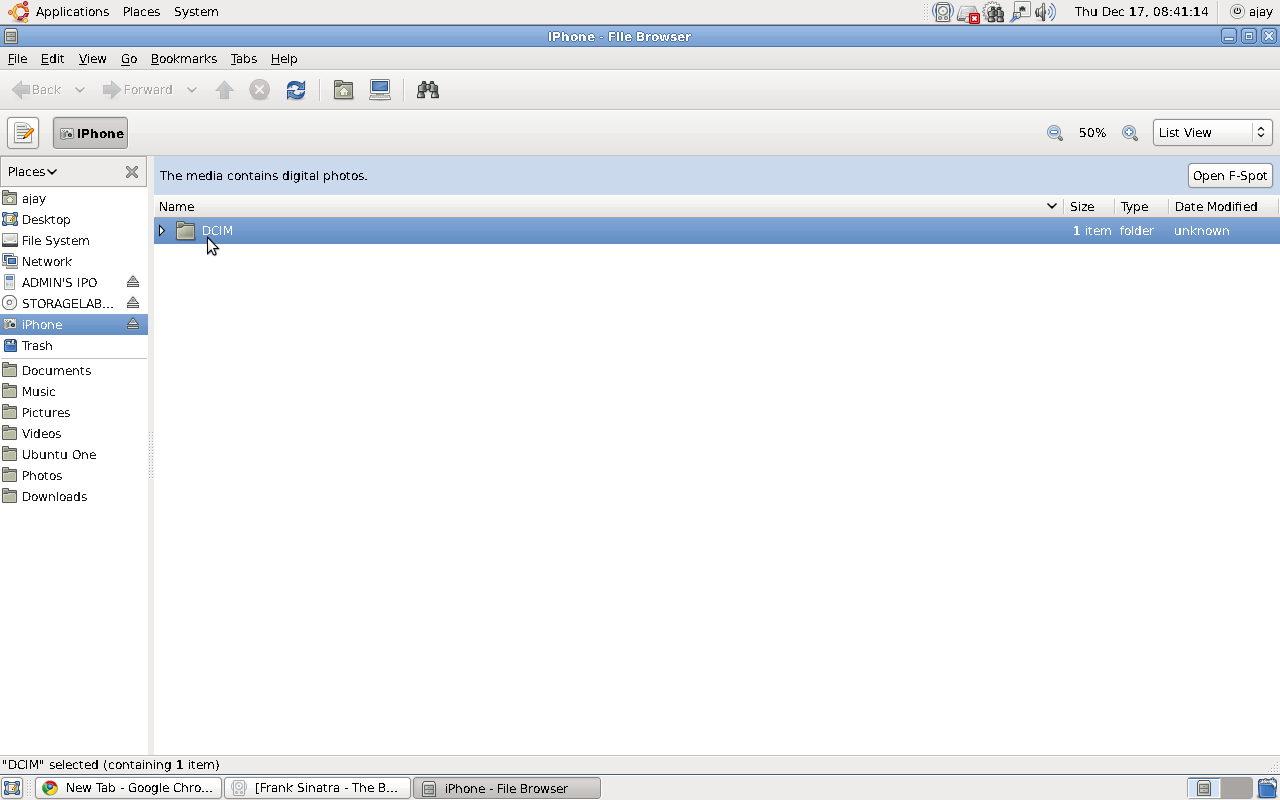
If you love your  Apple iPhone / iPod, the latest release of Ubuntu from Canonical called Karmic Koala ( the counter part to Microsoft’s Windows 7) is totally compatible for USB connection

If you love your  Apple iPhone / iPod, the latest release of Ubuntu from Canonical called Karmic Koala ( the counter part to Microsoft’s Windows 7) is totally compatible for USB connection.

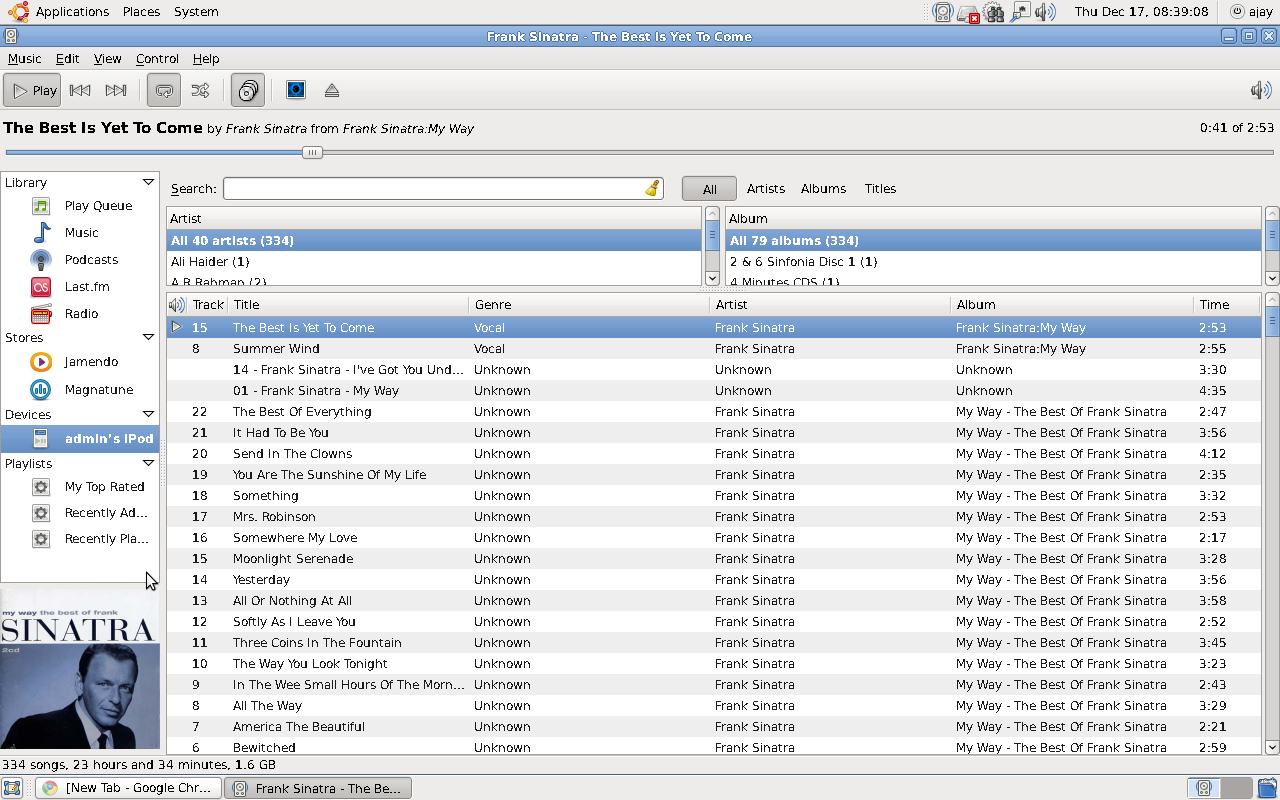
Ubuntu uses Rhythmbox for playing songs and uses FSpot and Gimp for images. The audio quality is excellent ( even if you are using very old hardware like I do) and Gimp is the best image manipulation software -comparable to ones from Adobe- intuitive and easy.

R , Ubuntu, RCmdr Updates

Some nice updates for R followers-

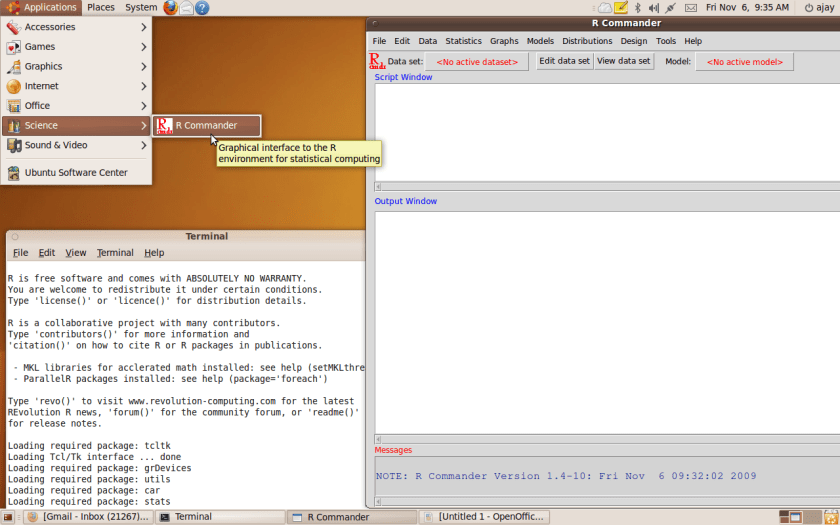
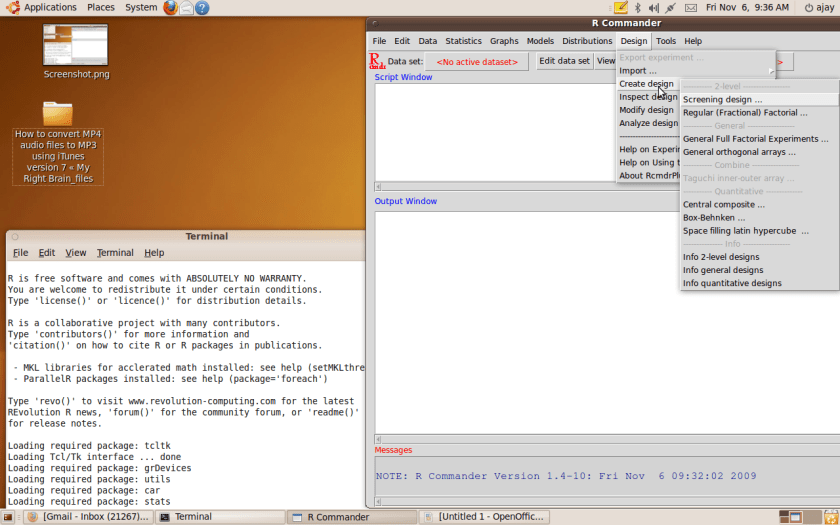
1) Rather than have an Icon for R – There is a seperate icon for RCmdr in Ubuntu Karmic Koala – Thus the default screen on opening is R Cmdr.

2) REvolution Computing has managed a coup with their bundling of their libraries with the R Distribution in Ubuntu Karmic Koala( see screenshot). We however still are waiting for who gets the credit for that ( Daneese Cooper or the long suffering Mr Smith)

Screenshot


3)Karmic Koala offers 2 GB free space  for storing data in the cloud for every user and 50 GB at 10$ a month. This helps with your storage costs. Data is protected thanks to an oauth login id and machine specific tie-in.

4) RCmdr has a great new plugin for DOE (Design off Experiments) students. DOE is a powerful and under utilized technique especially in Web Analytics. This is promising given that Dr John Fox ( whom we interviewed on this website) has going on ahead and seems clearly to have established RCmdr as the introductory GUI for beginners to R.

(see screenshot 2 below)

5) The Karmic Koala is very easy to install and very intuitive to use- Don’t want to give up your Windows ( well just install a dual boot which takes less than 1 hour on a fast internet connection or 15 minutes if you have a DVD)


Screenshot-1

6) What are other Statistics softwares doing? If they are not too keen on helping Microsoft get more sales ( especially student OS licenses) why don’t they offer the Ubuntu version free for students ( and besides once and for all put to rest the open source credential controversy)


Karmic Koala Ubuntu/Linux 9.2 Preview

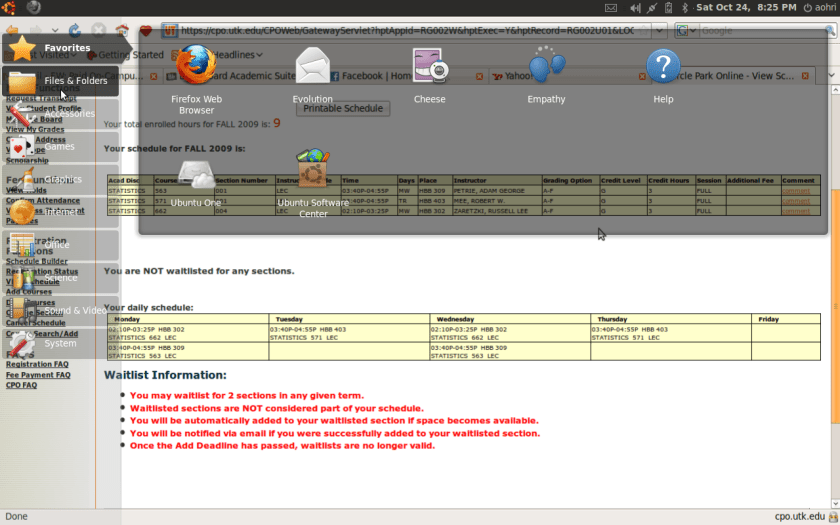
I am just about testing the Karmic Koala which is due for launch next week. There is significant amount of Browser Based Operating System in it- it seems like a Cloud OS and Firefox have been integrated. See the following screenshots-

Screenshot-30

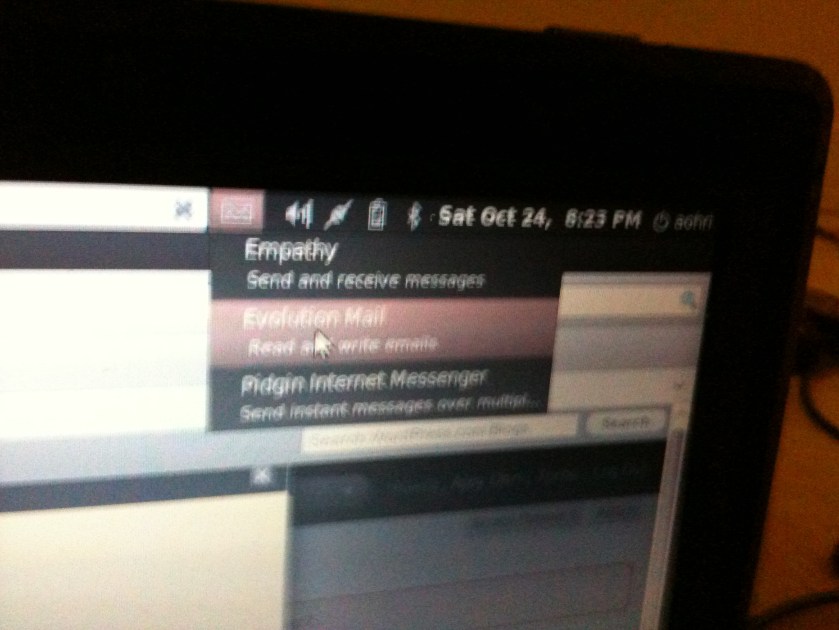
Note the ability to send email from the toolbar itself- Also the system speeded up considerably after the upgrade was installed. The striking change was in design and folder structure (it seems that they analyzed the usage data in Canonical to decide what design feature to keep and what not to keep)

Here are more views, and yes the Website http://www.ubuntu.com just went for an upgrade maintenance to cope with next week’s heavy rush or downloading.

Caveat- this is just the beta version but 5 days before launch beta version generally stay faithful to design changes.

Visit http://www.ubuntu.com for a better look- I believe dual boot Windows 7 and Koala are supported that helps you with

trying Ubuntu for fun and Windows for your original work.

IMG_0354

IMG_0356