Big Data and R: New Product Release by Revolution Analytics

Press Release by the Guys in Revolution Analytics- this time claiming to enable terabyte level analytics with R. Interesting stuff but techie details are awaited.

Revolution Analytics Brings

Big Data Analysis to R

The world’s most powerful statistics language can now tackle terabyte-class data sets using

Revolution R Enterpriseat a fraction of the cost of legacy analytics products


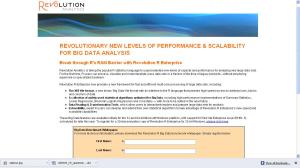
JSM 2010 – VANCOUVER (August 3, 2010) — Revolution Analytics today introduced ‘Big Data’ analysis to its Revolution R Enterprise software, taking the popular R statistics language to unprecedented new levels of capacity and performance for analyzing very large data sets. For the first time, R users will be able to process, visualize and model terabyte-class data sets in a fraction of the time of legacy products—without employing expensive or specialized hardware.

The new version of Revolution R Enterprise introduces an add-on package called RevoScaleR that provides a new framework for fast and efficient multi-core processing of large data sets. It includes:

  • The XDF file format, a new binary ‘Big Data’ file format with an interface to the R language that provides high-speed access to arbitrary rows, blocks and columns of data.
  • A collection of widely-used statistical algorithms optimized for Big Data, including high-performance implementations of Summary Statistics, Linear Regression, Binomial Logistic Regressionand Crosstabs—with more to be added in the near future.
  • Data Reading & Transformation tools that allow users to interactively explore and prepare large data sets for analysis.
  • Extensibility, expert R users can develop and extend their own statistical algorithms to take advantage of Revolution R Enterprise’s new speed and scalability capabilities.

“The R language’s inherent power and extensibility has driven its explosive adoption as the modern system for predictive analytics,” said Norman H. Nie, president and CEO of Revolution Analytics. “We believe that this new Big Data scalability will help R transition from an amazing research and prototyping tool to a production-ready platform for enterprise applications such as quantitative finance and risk management, social media, bioinformatics and telecommunications data analysis.”

Sage Bionetworks is the nonprofit force behind the open-source collaborative effort, Sage Commons, a place where data and disease models can be shared by scientists to better understand disease biology. David Henderson, Director of Scientific Computing at Sage, commented: “At Sage Bionetworks, we need to analyze genomic databases hundreds of gigabytes in size with R. We’re looking forward to using the high-speed data-analysis features of RevoScaleR to dramatically reduce the times it takes us to process these data sets.”

Take Hadoop and Other Big Data Sources to the Next Level

Revolution R Enterprise fits well within the modern ‘Big Data’ architecture by leveraging popular sources such as Hadoop, NoSQL or key value databases, relational databases and data warehouses. These products can be used to store, regularize and do basic manipulation on very large datasets—while Revolution R Enterprise now provides advanced analytics at unparalleled speed and scale: producing speed on speed.

“Together, Hadoop and R can store and analyze massive, complex data,” said Saptarshi Guha, developer of the popular RHIPE R package that integrates the Hadoop framework with R in an automatically distributed computing environment. “Employing the new capabilities of Revolution R Enterprise, we will be able to go even further and compute Big Data regressions and more.”

Platforms and Availability

The new RevoScaleR package will be delivered as part of Revolution R Enterprise 4.0, which will be available for 32-and 64-bit Microsoft Windows in the next 30 days. Support for Red Hat Enterprise Linux (RHEL 5) is planned for later this year.

On its website (http://www.revolutionanalytics.com/bigdata), Revolution Analytics has published performance and scalability benchmarks for Revolution R Enterprise analyzing a 13.2 gigabyte data set of commercial airline information containing more than 123 million rows, and 29 columns.

Additionally, the company will showcase its new Big Data solution in a free webinar on August 25 at 9:00 a.m. Pacific.

Additional Resources

•      Big Data Benchmark whitepaper

•      The Revolution Analytics Roadmap whitepaper

•      Revolutions Blog

•      Download free academic copy of Revolution R Enterprise

•      Visit Inside-R.org for the most comprehensive set of information on R

•      Spread the word: Add a “Download R!” badge on your website

•      Follow @RevolutionR on Twitter

About Revolution Analytics

Revolution Analytics (http://www.revolutionanalytics.com) is the leading commercial provider of software and support for the popular open source R statistics language. Its Revolution R products help make predictive analytics accessible to every type of user and budget. The company is headquartered in Palo Alto, Calif. and backed by North Bridge Venture Partners and Intel Capital.

Media Contact

Chantal Yang
Page One PR, for Revolution Analytics
Tel: +1 415-875-7494

Email:  revolution@pageonepr.com
Towards better analytical software

Here are some thoughts on using existing statistical software for better analytics and/or business intelligence (reporting)-

1) User Interface Design Matters- Most stats software have a legacy approach to user interface design. While the Graphical User Interfaces need to more business friendly and user friendly- example you can call a button T Test or You can call it Compare > Means of Samples (with a highlight called T Test). You can call a button Chi Square Test or Call it Compare> Counts Data. Also excessive reliance on drop down ignores the next generation advances in OS- namely touchscreen instead of mouse click and point.

Given the fact that base statistical procedures are the same across softwares, a more thoughtfully designed user interface (or revamped interface) can give softwares an edge over legacy designs.

2) Branding of Software Matters- One notable whine against SAS Institite products is a premier price. But really that software is actually inexpensive if you see other reporting software. What separates a Cognos from a Crystal Reports to a SAS BI is often branding (and user interface design). This plays a role in branding events – social media is often the least expensive branding and marketing channel. Same for WPS and Revolution Analytics.

3) Alliances matter- The alliances of parent companies are reflected in the sales of bundled software. For a complete solution , you need a database plus reporting plus analytical software. If you are not making all three of the above, you need to partner and cross sell. Technically this means that software (either DB, or Reporting or Analytics) needs to talk to as many different kinds of other softwares and formats. This is why ODBC in R is important, and alliances for small companies like Revolution Analytics, WPS and Netezza are just as important as bigger companies like IBM SPSS, SAS Institute or SAP. Also tie-ins with Hadoop (like R and Netezza appliance)  or  Teradata and SAS help create better usage.

4) Cloud Computing Interfaces could be the edge- Maybe cloud computing is all hot air. Prudent business planing demands that any software maker in analytics or business intelligence have an extremely easy to load interface ( whether it is a dedicated on demand website) or an Amazon EC2 image. Easier interfaces win and with the cloud still in early stages can help create an early lead. For R software makers this is critical since R is bad in PC usage for larger sets of data in comparison to counterparts. On the cloud that disadvantage vanishes. An easy to understand cloud interface framework is here ( its 2 years old but still should be okay) http://knol.google.com/k/data-mining-through-cloud-computing#

5) Platforms matter- Softwares should either natively embrace all possible platforms or bundle in middle ware themselves.

Here is a case study SAS stopped supporting Apple OS after Base SAS 7. Today Apple OS is strong  ( 3.47 million Macs during the most recent quarter ) and the only way to use SAS on a Mac is to do either

http://goo.gl/QAs2

or do a install of Ubuntu on the Mac ( https://help.ubuntu.com/community/MacBook ) and do this

http://ubuntuforums.org/showthread.php?t=1494027

Why does this matter? Well SAS is free to academics and students  from this year, but Mac is a preferred computer there. Well WPS can be run straight away on the Mac (though they are curiously not been able to provide academics or discounted student copies 😉 ) as per

http://goo.gl/aVKu

Does this give a disadvantage based on platform. Yes. However JMP continues to be supported on Mac. This is also noteworthy given the upcoming Chromium OS by Google, Windows Azure platform for cloud computing.

Certifications in Analytics and Business Intelligence

I sometimes get a chat message on Twitter/ Facebook asking for help on some specific data issue. More often than not it is something like – How do I get started in BI/BA /Data stuff. So here is a list of certifications which I think are quite nice as beginning points or even CV multipliers.

[tweetmeme=”Decisionstats”]

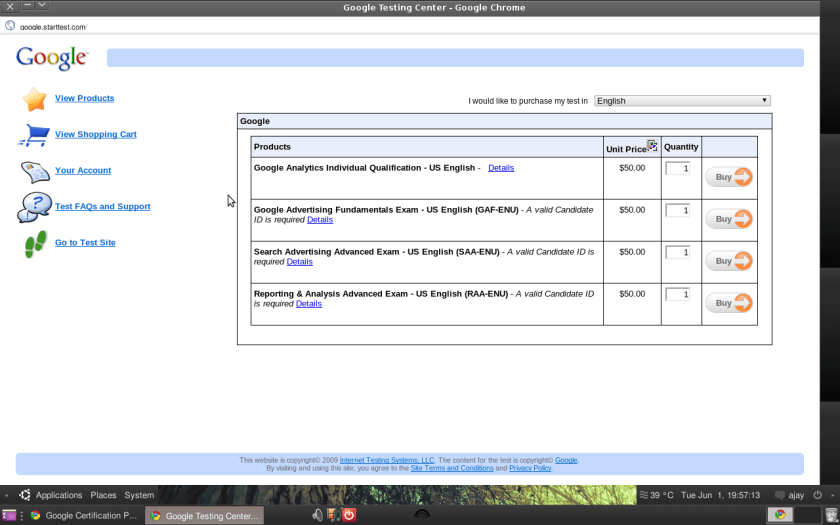
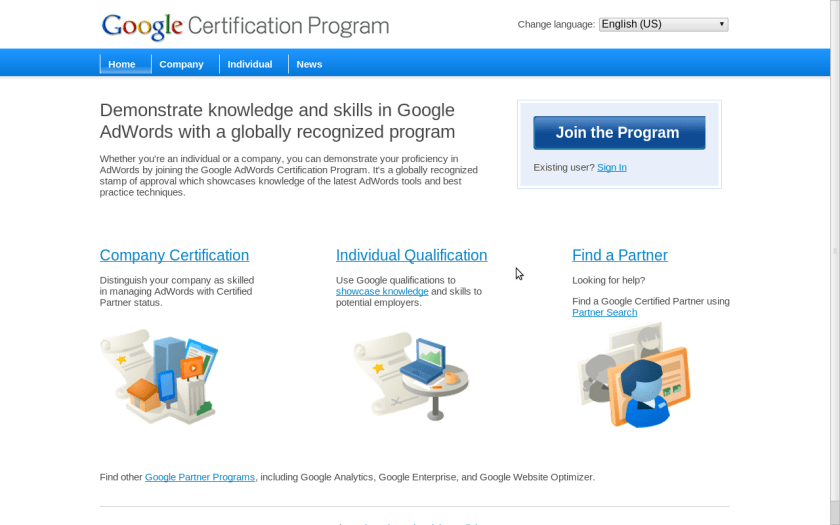
1) Google’s Certifications

http://www.google.com/intl/en/adwords/professionals/

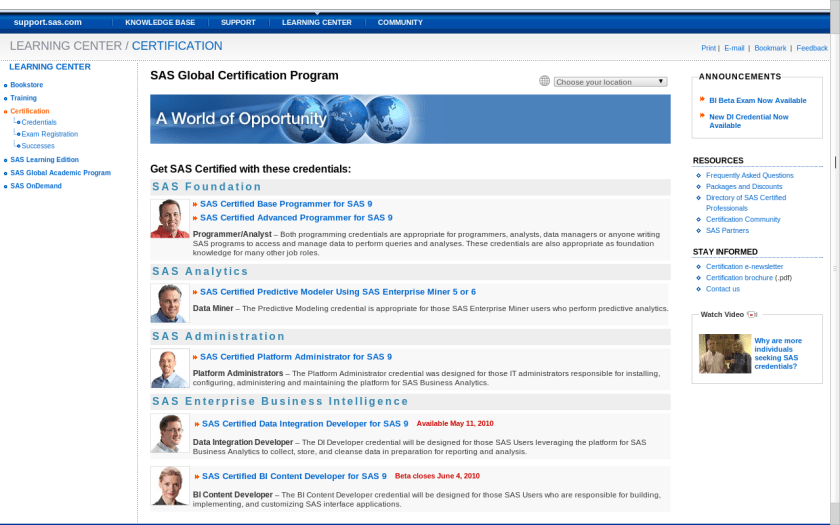
2) SAS Certifications

Quite well established and easily one of the best structured certification programs in the industry.

http://support.sas.com/certify/index.html

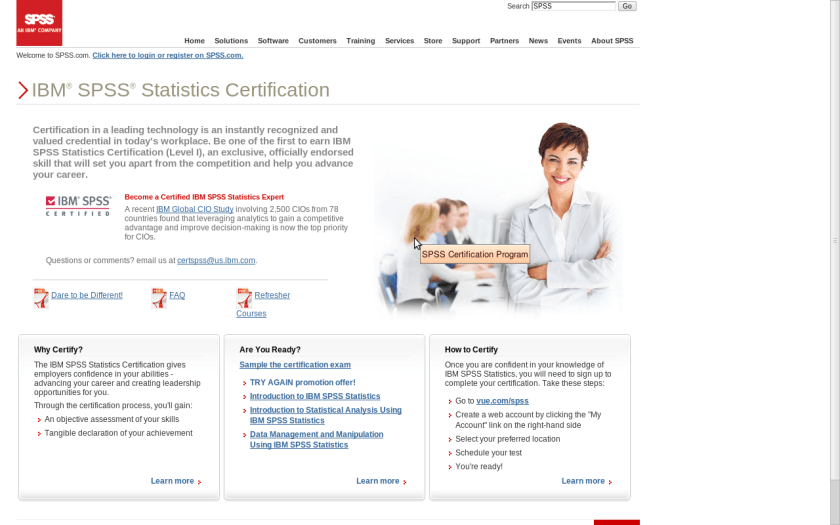
3) SPSS

The SPSS certification began last year and it helps provide a valuable skill set for both your practice as well as your resume. Also useful to have a second skill set apart from SAS in terms of statistical software.

http://www.spss.com/certification/

At this point I would like you to pause and think if the above certifications are useful or cost  effective for you as they are broadly general qualifications in statistical platforms as well as in applying them for the web analytics ( a key area for business analytics).

For more specialized certifications here are some more-

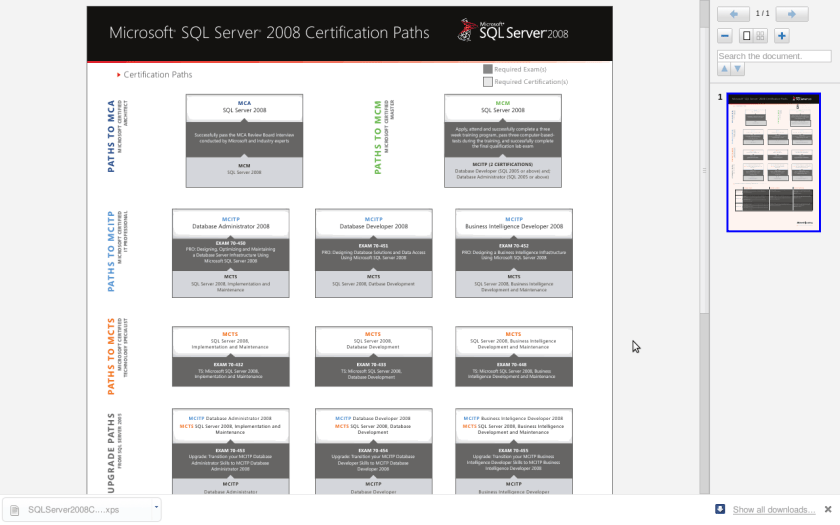
1) Microsoft SQL Server

http://www.microsoft.com/learning/en/us/certification/cert-sql-server.aspx

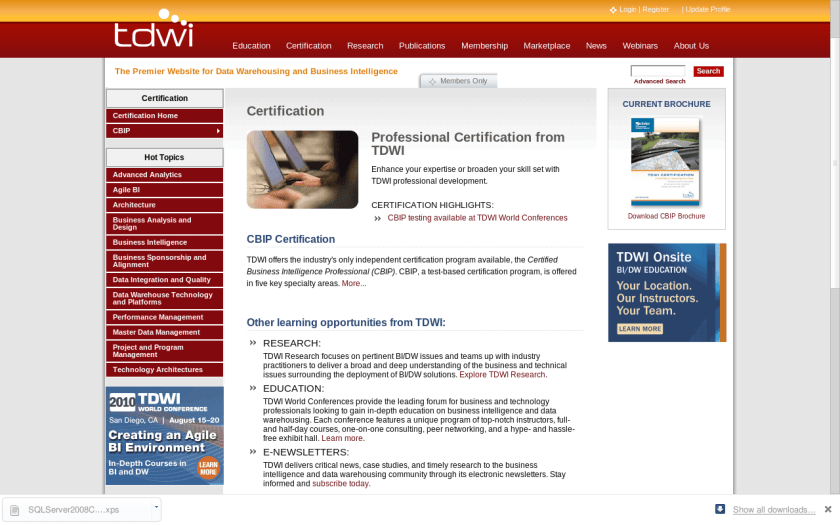
2) TDWI Certification

http://tdwi.org/pages/certification/index.aspx

3) IBM

Not sure how updated these are so caveat emptor!

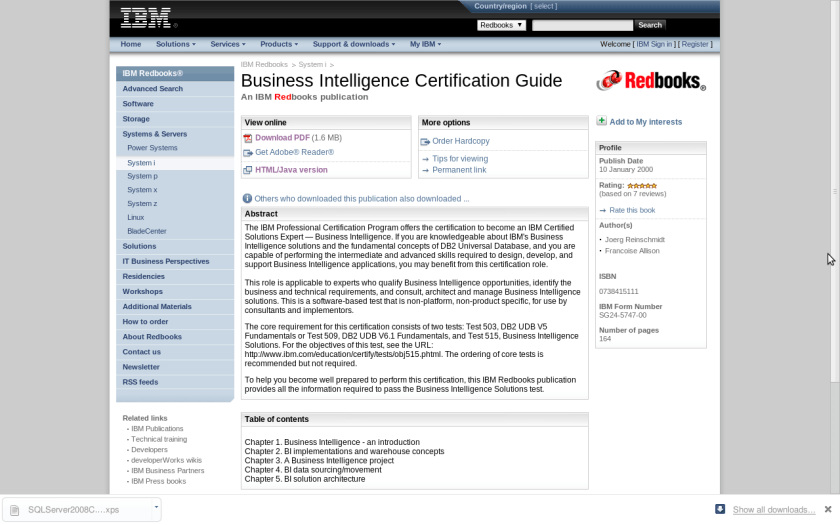
http://www.redbooks.ibm.com/abstracts/sg245747.html

If you are knowledgeable about IBM’s Business Intelligence solutions and the fundamental concepts of DB2 Universal Database, and you are capable of performing the intermediate and advanced skills required to design, develop, and support Business Intelligence applications

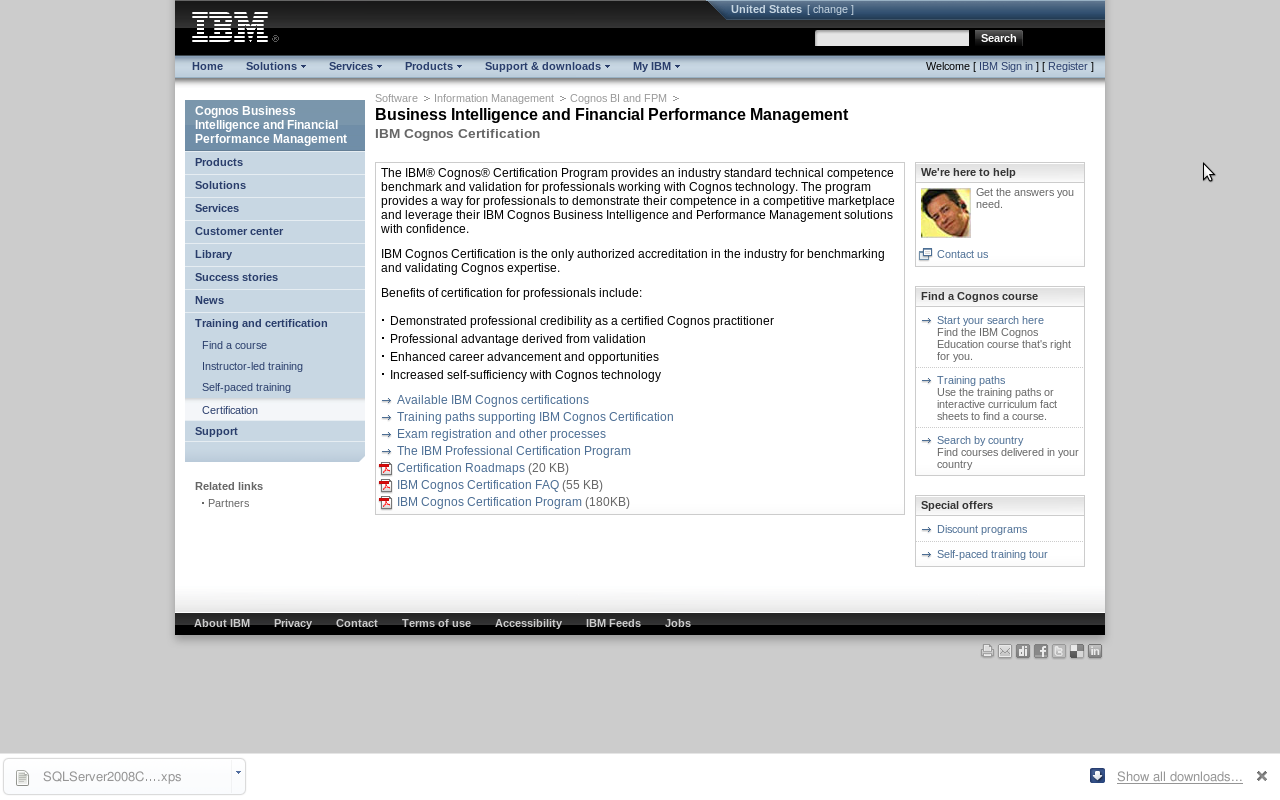
Also IBM Cognos Certifications

http://www-01.ibm.com/software/data/education/cognos-cert.html

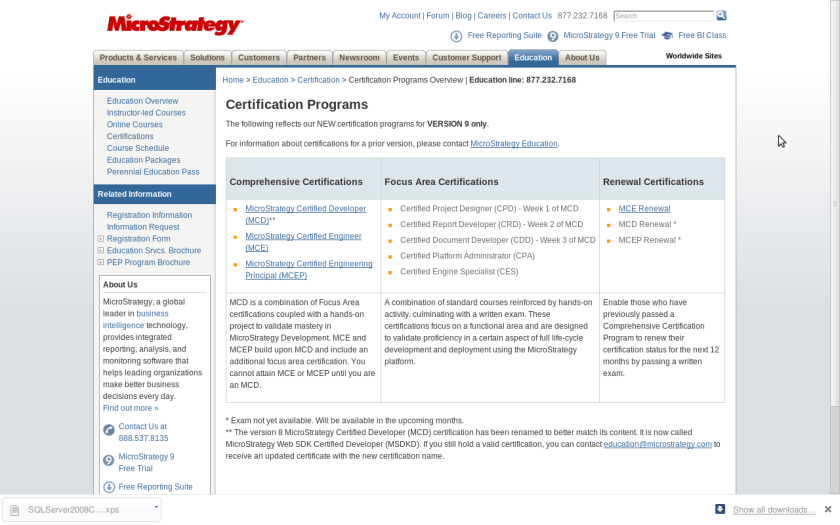
4) MicroStrategy

http://www.microstrategy.com/education/Certification/

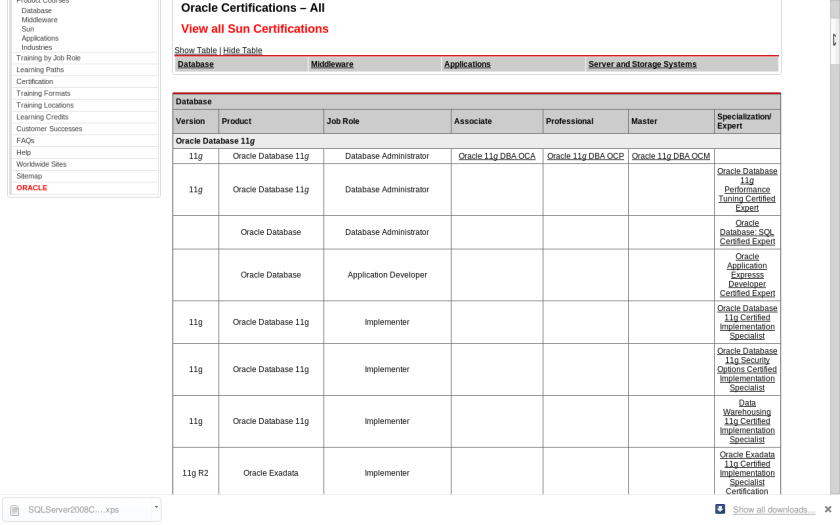
5) Oracle

Included the all new Sun Certifications as well.

http://certification.oracle.com/

and http://blogs.oracle.com/certification/

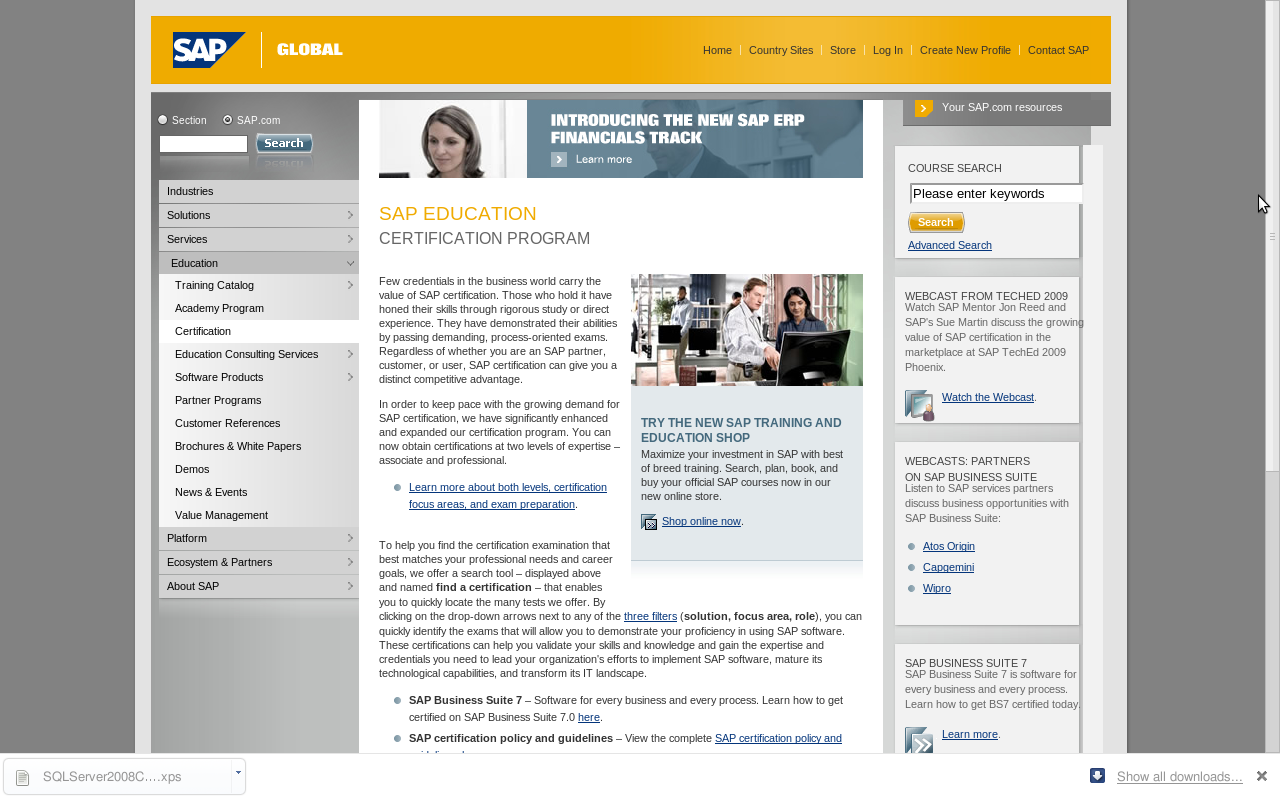
6) SAP Certifications

http://www.sap.com/services/education/certification/index.epx

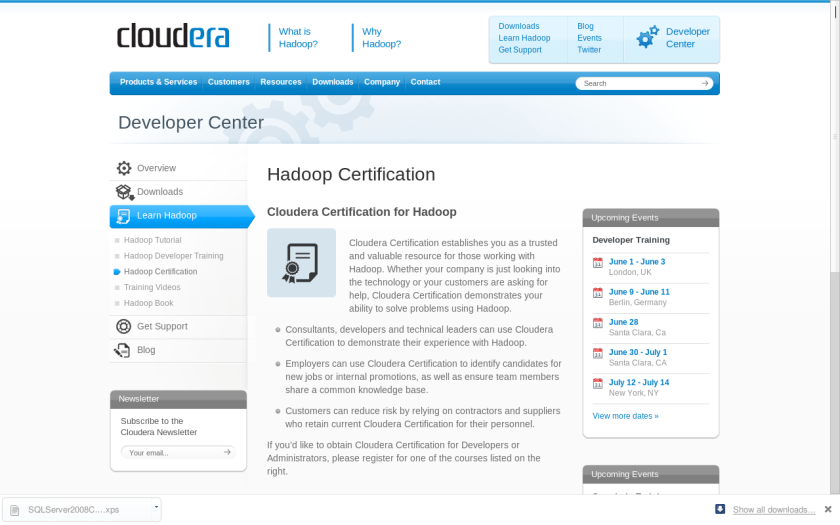
7) Cloudera’s Hadoop Certification

http://www.cloudera.com/developers/learn-hadoop/hadoop-certification/

These are some Business Intelligence and Business Analytics related certifications that I assembled in a list. Many other programs were either too software development specific or did not have a certification for general usage (like many R trainings or company tool specific trainings). Please feel free to add in any suggestions.

Advanced Analytics on Multi-Terabyte Datasets- Conferences

Some news on Data Mining 2009 by Aster Data –

SAS and Aster Data to Present “Advanced Analytics on Multi-Terabyte Datasets” at M2009 in Las Vegas – Oct. 26-27
Learn how the tight coupling of SQL and MapReduce provided by Aster Data creates new ‘big data’ analytics opportunities when combined with SAS. Aster Data will exhibit throughout the event.
More

And also a nice  webcast by Curt Monash on the same Big Data topic-

Mastering MapReduce Webinar Series, Session 1
“Big Data Reality: The Role of MapReduce in Big Data Management and Analysis”- Oct. 15
Industry analyst Curt Monash explains the basics of MapReduce, key uses cases, and which industries and applications are heavily using MapReduce. Topics include recommendations for integrating MapReduce in an enterprise business intelligence and data warehousing environment.
More

Also,

Here is a brief synopsis on the Aster Data ( http://www.facebook.com/pages/Aster-Data-Systems/5601042375) Sponsored Big Data Summit  ( http://www.facebook.com/pages/Big-Data-Summit/143312171156 )which I attended-

  • A Plan for Large Scale Data Analytics: How to Utilize Aster nCluster and Hadoop in a Symbiotic
    Relationship to Support Processing in Excess of 100 Billion Rows Per Month
    – Michael Brown and Will Duckworth
    (EVP, Software Engineering, comScore, Inc. and Director, Software Engineering, comScore, Inc.)

This talked of the special needs of Com Score in handling big data and why Map Reduce and Hadoop seem to be the cost effective solutions for big big data while RDBMS seems stuck in the middle of middle data. Broadly informative on the statistical challenges of the future given the explosion of data as well.

  • Making Sense of Hadoop – Its Fit With Data Warehouses – Colin White
    (President and Founder of BI Research)

Colin brought a nice perspective on the open source Hadoop vis a vis the Properietary packages and the traditional DBMS. His perspective on the solution is no software is perfect for all needs while all softwares that sell have their own good points while the converging solution could be a heterogeneous solution of the above.

  • MapReduce Inside a Database System – When and How Case Studies from ShareThis, Specific Media, and Other – Tasso Argyros (Chief Technology Officer and Co-Founder of Aster Data)

This was a more detailed look at the Big Product Launch ( the Hadoop Connector) by Tasso and an interesting look at time series analysis using nPath rather than SQL . Interesting given the ongoing convergence analytics and business intelligence.

Also Tasso lived up to his presenting charm with an excellent pitch on nPath (as his interview said ).

  • Large-Scale Analytics at LinkedIn – Jonathan Goldman
    (Former Principal Scientist at LinkedIn)

This was nice given Jonathan’s perscpective ( he has Phd In Physics) and now does consulting for LinkedIn while maintaining his interests in education- the special needs for social media websites, designing experiments on the fly with huge real time datasets as well as some interesting visualizations (like India and America have the second biggest cross country Li connections after USA- UK. Apparently Linkedin ( http://www.facebook.com/group.php?gid=2211231478 ) does not sound so good when translated in Chinese ( AT Dinner I learnt from a fellow Chinese student that China censors Facebook – sigh!).

  • Networking Mixer: Beer, wine, hot hors d’oeuvres

I got interviewed ( AFTER) I had mixed some Beer and Wine for myself. The Video interview which was the first video interview I have given ( You know- I have taken SOME interviews by Email and plan to do some more while in Vegas for the Data Mining 2009  with SAS http://www.facebook.com/group.php?gid=2227381262)

They are still editing that interview 😉

—That was all – you need to send me a Facebook invite to see the rest of the NY trip or better still just join the Facebook page of Decision Stats at

http://www.facebook.com/pages/DecisionStats/191421035186

After two weeks I hope to have some more coverage on Data Mining 2009 while at the same time enjoying my much needed Fall Break-  Life at University at Tennessee is looking up ( since we beat Georgia 45-19 🙂 )

r*xE5HeUJa(%

The Big Data Event- Why am I here?

I am here braving New York’s cold weather, as I prepare for this evening’s events. If you follow this blog closely ( including the poems) ,it is a welcome change— New York is a nice city people are friendly if you ask them nicely and the bus is a great way to watch the city – best of all I like the crowds which I have grown used while living in India.

Why Am I here?

Because the topics that are discussed here are cutting edge to the point that I cannot find anyone willing to teach me Hadoop and Map-Reduce while in University and at the same time teach me statistics on them as well ( as in how do we do a K Means clustering on a 1 terabyte dataset).

I asked the organizers on what makes the event special ( every event promises special Mojo after all).

This is what they said-

What is the unique value proposition of the event that will help developers and both current and potential customers-

The essence of the event is to explore new innovations in massively-parallel processing data warehousing technology and how it can help companies gain more insight from their data.  Applications include fraud detection, behavioral targeting, social network analysis, better predictions/forecasting, bioinformatics, etc.  We are exploring how MapReduce and Hadoop can be integrated into the enterprise IT system to help evolve data warehousing/BI/data mining

and to put it even more nicely’

The industry’s first big data event, Big Data Summit ‘09, being held this evening in New York City, will showcase Hadoop’s fit with MPP data warehouses. Aster Data will be presenting alongside Colin White, President and Founder of BI Research, Mike Brown of comScore Inc., and Jonathan Goldman, who represents LinkedIn.”

That’s good enough for me to drop into Roosevelt Hotel on East 45th Street at around 6 pm for some reluctant networking ( read: beers). 5 years ago whie working for GE , I used to run queries using SAS on a 147 million row database (the size of the DB) and wait 3 hours for it to come back. Today that much data fits very snugly in my laptop. How soon will we have Terabyte level personal computing, and Petabyte level business computing and the challenges it poses to standard statistical assumptions and synching of hardware and software- Big Big Data is an interesting area to watch.

Interview Shawn Kung Sr Director Aster Data

Here is an interview with Shawn Kung, Senior Director of Product Management at Aster Data. Shawn explains the difference between the various database technologies, Aster’s rising appeal to its unique technological approach and touches upon topics of various other interests as well to people in the BI and technology space.

image001

Ajay -Describe your career journey from a high school student of science till today .Do you think science is a more lucrative career?

Shawn: My career journey has spanned over a decade in several Silicon Valley technology companies.  In both high school and my college studies at Princeton, I had a fervent interest in math and quantitative economics.  Silicon Valley drew me to companies like upstart procurement software maker Ariba and database giant Oracle.  I continued my studies by returning to get a Master’s in Management Science at Stanford before going on to lead core storage systems for nearly 5 years at NetApp and subsequently Aster.

Science (whether it is math, physics, economics, or the hard engineering sciences) provides a solid foundation.  It teaches you to think and test your assumptions – those are valuable skills that can lead to a both a financially lucrative and personally inspiring career.

Ajay- How would you describe the difference between Map Reduce and Hadoop and Oracle and SAS, DBMS and Teradata and Aster Data products to a class of undergraduate engineers ?

Shawn: Let’s start with the database guys – Oracle and Teradata.  They focus on structured data – data that has a logical schema and is manipulated via a standards-based structured query language (SQL).  Oracle tries to be everything to everyone – it does OLTP (low-latency transactions like credit card or stock trade execution apps) and some data warehousing (typically summary reporting).  Oracle’s data warehouse is not known for large-scale data warehousing and is more often used for back-office reporting.

Teradata is focused on data warehousing and scales very well, but is extremely expensive – it runs on high-end custom hardware and takes a mainframe approach to data processing.  This approach makes less sense as commodity hardware becomes more compute-rich and better software comes along to support large-scale MPP data warehousing.

SAS is very different – it’s not a relational database. It really offers an application platform for data analysis, specifically data mining.  Unlike Oracle and Teradata which is used by SQL developers and managed by DBAs, SAS is typically run in business units by data analysts – for example a quantitative marketing analyst, a statistician/mathematician, or a savvy engineer with a data mining/math background.  SAS is used to try to find patterns, understand behaviors, and offer predictive analytics that enable businesses to identify trends and make smarter decisions than their competitors.

Hadoop offers an open-source framework for large-scale data processing.  MapReduce is a component of Hadoop, which also contains multiple other modules including a distributed filesystem (HDFS).  MapReduce offers a programming paradigm for distributed computing (a parallel data flow processing framework).

Both Hadoop and MapReduce are catered toward the application developer or programmer.  It’s not catered for enterprise data centers or IT.  If you have a finite project in a line of business and want to get it done, Hadoop offers a low-cost way to do this.  For example, if you want to do large-scale data munging like aggregations, transformations, manipulations of unstructured data – Hadoop offers a solution for this without compromising on the performance of your main data warehouse.  Once the data munging is finished, the post-processed data set can be loaded into a database for interactive analysis or analytics. It is a great combination of big data technologies for certain use-cases.

Aster takes a very unique approach.  Our Aster nCluster software offers the best of all worlds – we offer the potential for deep analytics of SAS, the low-cost scalability and parallel processing of Hadoop/MapReduce, and the structured data advantages (schema, SQL, ACID compliance and transactional integrity, indexes, etc) of a relational database like Teradata and Oracle.  Often, we find complementary approaches and therefore view SAS and Hadoop/MapReduce as synergistic to a complete solution.  Data warehouses like Teradata and Oracle tend to be more competitive.

Ajay- What exciting products have you launched so far and what makes them unique both from a technical developer perspective and a business owner perspective

Shawn: Aster was the first-to-market to offer In-Database MapReduce, which provides the standards and familiarity of SQL and databases with the analytic power of MapReduce.  This is very unique as it offers technical developers and application programmers to write embedded procedural algorithms once, upload it, and allow business analysts or IT folks (SQL developers, DBAs, etc) to invoke these SQL-MapReduce functions forever.

It is highly polymorphic (re-usable), highly fault-tolerant, highly flexible (any language – Java, Python, Ruby, Perl, R statistical language, C# in the .NET world, etc) and natively massively parallel – all of which differentiate these SQL extensions from traditional dumb user-defined functions (UDFs).

Ajay- “I am happy with my databases and I don’t need too much diversity or experimentation in my systems”, says a CEO to you.

How do you convince him using quantitative numbers and not marketing adjectives?

Shawn: Aster has dozens of production customers including big-names like MySpace, LinkedIn, Akamai, Full Tilt Poker, comScore, and several yet-to-be-named retail and financial service accounts.  We have quantified proof points that show orders of magnitude improvements in scalability, performance, and analytic insights compared to incumbent or competitor solutions.  Our highly referenceable customers would be happy to discuss their positive experiences with the CEO.

But taking a step back, there’s a fundamental concept that this CEO needs to first understand.  The world is changing – data growth is proliferating due to the digitization of so many applications and the emergence of unstructured data and new data types.  Like the book “Competing on Analytics”, the world is shifting to a paradigm where companies that don’t take risks and push the limits on analytics will die like the dinosaurs.

IDC is projecting 10x+ growth in data over the next few years to zetabytes of aggregate data driven by digitization (Internet, digital television, RFID, etc).  The data is there and in order to compete effectively and understand your customers more intimately, you need a large-scale analytics solution like the one Aster nCluster offers.  If you hold off on experimentation and innovation, it will be too late by the time you realize you have a problem at hand.

Ajay- How important is work life balance for you?

Shawn: Very important.  I hang out with my wife most weekends – we do a lot of outdoors activities like hiking and gardening.  In Silicon Valley, it’s all too easy to get caught up in the rush of things.  Taking breaks, especially during the weekend, is important to recharge and re-energize to be as productive as possible.

Ajay- Are you looking for college interns and new hires what makes aster exciting for you so you are pumped up every day to go to work?

Shawn: We’re always looking for smart, innovative, and entrepreneurial new college grads and interns, especially on the technical side.  So if you are a computer science major or recent grad or graduate student, feel free to contact us for opportunities.

What makes Aster exciting is 2 things –

first, the people.  Everyone is very smart and innovative so you learn a tremendous amount, which is personally gratifying and professionally useful long-term.

Second, Aster is changing the world!

Distributed systems computing focused on big data processing and analytics – these are massive game-changers that will fundamentally change the landscape in data warehousing and analytics.  Traditional databases have been a oligopoly for over a generation – they haven’t been challenged and so the 1970’s based technology has stuck around.  The emergence of big data and low-cost commodity hardware has created a unique opportunity to carve out a brand new market…

what gets me pumped every day is I have the ability to contribute to a pioneer that is quickly becoming Silicon Valley’s next great success story!

Biography-

Over the past decade, Shawn has led product management for some of Silicon Valley’s most successful and innovative technology companies.  Most recently, he spent nearly 5 years at Network Appliance leading Core Systems storage product management, where he oversaw the development of high availability software and Storage Systems hardware products that grew in annual revenue from $200M to nearly $800M.  Prior to NetApp, Shawn held senior product management and corporate strategy roles at Oracle Corporation and Ariba Inc.

Shawn holds an M.S. in Management Science and engineering from Stanford University, where he was awarded the Valentine Fellowship (endowed by Don Valentine of Sequoia Capital).  He also received a B.A. with high honors from Princeton University.

About Aster

Aster Data Systems is a proven leader in high-performance database systems for data warehousing and analytics – the first DBMS to tightly integrate SQL with MapReduce – providing deep insights on data analyzed on clusters of low-cost commodity hardware. The AsternCluster database cost-effectively powers frontline analytic applications for companies such as MySpace, aCerno (an Akamai company), and ShareThis.

Running on low-cost off-the-shelf hardware, and providing ‘hands-free’ administration, Aster enables enterprises to meet their data warehousing needs within their budget. Aster is headquartered in San Carlos, California and is backed by Sequoia Capital, JAFCO Ventures, IVP, Cambrian Ventures, and First-Round Capital, as well as industry visionaries including David Cheriton and Ron Conway.