Changes in R software

The newest version of R is now available for download. R 2.13 is ready !!


http://cran.at.r-project.org/bin/windows/base/CHANGES.R-2.13.0.html


Windows-specific changes to R

CHANGES IN R VERSION 2.13.0


WINDOWS VERSION


  • Windows 2000 is no longer supported. (It went end-of-life in July 2010.)


NEW FEATURES


  • win_iconv has been updated: this version has a change in the behaviour with BOMs on UTF-16 and UTF-32 files – it removes BOMs when reading and adds them when writing. (This is consistent with Microsoft applications, but Unix versions of iconv usually ignore them.) 


  • Support for repository type win64.binary (used for 64-bit Windows binaries for R 2.11.x only) has been removed. 


  • The installers no longer put an ‘Uninstall’ item on the start menu (to conform to current Microsoft UI guidelines). 


  • Running R always sets the environment variable R_ARCH (as it does on a Unix-alike from the shell-script front-end). 


  • The defaults for options("browser") and options("pdfviewer") are now set from environment variables R_BROWSER and R_PDFVIEWER respectively (as on a Unix-alike). A value of "false" suppresses display (even if there is no false.exe present on the path). 


  • If options("install.lock") is set to TRUE, binary package installs are protected against failure similar to the way source package installs are protected. 


  • file.exists() and unlink() have more support for files > 2GB. 


  • The versions of R.exe in ‘R_HOME/bin/i386,x64/bin’ now support options such as R --vanilla CMD: there is no comparable interface for ‘Rcmd.exe’. 


  • A few more file operations will now work with >2GB files. 


  • The environment variable R_HOME in an R session now uses slash as the path separator (as it always has when set by Rcmd.exe). 


  • Rgui has a new menu item for the PDF ‘Sweave User Manual’.


DEPRECATED


  • zip.unpack() is deprecated: use unzip().


INSTALLATION


  • There is support for libjpeg-turbo via setting JPEGDIR to that value in ‘MkRules.local’. 

    Support for jpeg-6b has been removed.


  • The sources now work with libpng-1.5.1, jpegsrc.v8c (which are used in the CRAN builds) and tiff-4.0.0beta6 (CRAN builds use 3.9.1). It is possible that they no longer work with older versions than libpng-1.4.5.


BUG FIXES


  • Workaround for the incorrect values given by Windows’ casinh function on the branch cuts.
  • Bug fixes for drawing raster objects on windows(). The symptom was the occasional raster image not being drawn, especially when drawing multiple raster images in a single expression. Thanks to Michael Sumner for report and testing.
  • Printing extremely long string values could overflow the stack and cause the GUI to crash. (PR#14543)

Tonnes of changes!!

http://cran.at.r-project.org/src/base/NEWS

CHANGES IN R VERSION 2.13.0:

  SIGNIFICANT USER-VISIBLE CHANGES:

    • replicate() (by default) and vapply() (always) now return a
      higher-dimensional array instead of a matrix in the case where
      the inner function value is an array of dimension >= 2.

    • Printing and formatting of floating point numbers is now using
      the correct number of digits, where it previously rarely differed
      by a few digits. (See “scientific” entry below.)  This affects
      _many_ *.Rout.save checks in packages.

  NEW FEATURES:

    • normalizePath() has been moved to the base package (from utils):
      this is so it can be used by library() and friends.

      It now does tilde expansion.

      It gains new arguments winslash (to select the separator on
      Windows) and mustWork to control the action if a canonical path
      cannot be found.

    • The previously barely documented limit of 256 bytes on a symbol
      name has been raised to 10,000 bytes (a sanity check).  Long
      symbol names can sometimes occur when deparsing expressions (for
      example, in model.frame).

    • reformulate() gains a intercept argument.

    • cmdscale(add = FALSE) now uses the more common definition that
      there is a representation in n-1 or less dimensions, and only
      dimensions corresponding to positive eigenvalues are used.
      (Avoids confusion such as PR#14397.)

    • Names used by c(), unlist(), cbind() and rbind() are marked with
      an encoding when this can be ascertained.

    • R colours are now defined to refer to the sRGB color space.

      The PDF, PostScript, and Quartz graphics devices record this
      fact.  X11 (and Cairo) and Windows just assume that your screen
      conforms.

    • system.file() gains a mustWork argument (suggestion of Bill
      Dunlap).

    • new.env(hash = TRUE) is now the default.

    • list2env(envir = NULL) defaults to hashing (with a suitably sized
      environment) for lists of more than 100 elements.

    • text() gains a formula method.

    • IQR() now has a type argument which is passed to quantile().

    • as.vector(), as.double() etc duplicate less when they leave the
      mode unchanged but remove attributes.

      as.vector(mode = "any") no longer duplicates when it does not
      remove attributes.  This helps memory usage in matrix() and
      array().

      matrix() duplicates less if data is an atomic vector with
      attributes such as names (but no class).

      dim(x) <- NULL duplicates less if x has neither dimensions nor
      names (since this operation removes names and dimnames).

    • setRepositories() gains an addURLs argument.

    • chisq.test() now also returns a stdres component, for
      standardized residuals (which have unit variance, unlike the
      Pearson residuals).

    • write.table() and friends gain a fileEncoding argument, to
      simplify writing files for use on other OSes (e.g. a spreadsheet
      intended for Windows or Mac OS X Excel).

    • Assignment expressions of the form foo::bar(x) <- y and
      foo:::bar(x) <- y now work; the replacement functions used are
      foo::`bar<-` and foo:::`bar<-`.

    • Sys.getenv() gains a names argument so Sys.getenv(x, names =
      FALSE) can replace the common idiom of as.vector(Sys.getenv()).
      The default has been changed to not name a length-one result.

    • Lazy loading of environments now preserves attributes and locked
      status. (The locked status of bindings and active bindings are
      still not preserved; this may be addressed in the future).

    • options("install.lock") may be set to FALSE so that
      install.packages() defaults to --no-lock installs, or (on
      Windows) to TRUE so that binary installs implement locking.

    • sort(partial = p) for large p now tries Shellsort if quicksort is
      not appropriate and so works for non-numeric atomic vectors.

    • sapply() gets a new option simplify = "array" which returns a
      “higher rank” array instead of just a matrix when FUN() returns a
      dim() length of two or more.

      replicate() has this option set by default, and vapply() now
      behaves that way internally.

    • aperm() becomes S3 generic and gets a table method which
      preserves the class.

    • merge() and as.hclust() methods for objects of class "dendrogram"
      are now provided.

    • as.POSIXlt.factor() now passes ... to the character method
      (suggestion of Joshua Ulrich).

    • The character method of as.POSIXlt() now tries to find a format
      that works for all non-NA inputs, not just the first one.

    • str() now has a method for class "Date" analogous to that for
      class "POSIXt".

    • New function file.link() to create hard links on those file
      systems (POSIX, NTFS but not FAT) that support them.

    • New Summary() group method for class "ordered" implements min(),
      max() and range() for ordered factors.

    • mostattributes<-() now consults the "dim" attribute and not the
      dim() function, making it more useful for objects (such as data
      frames) from classes with methods for dim().  It also uses
      attr<-() in preference to the generics name<-(), dim<-() and
      dimnames<-().  (Related to PR#14469.)

    • There is a new option "browserNLdisabled" to disable the use of
      an empty (e.g. via the ‘Return’ key) as a synonym for c in
      browser() or n under debug().  (Wish of PR#14472.)

    • example() gains optional new arguments character.only and
      give.lines enabling programmatic exploration.

    • serialize() and unserialize() are no longer described as
      ‘experimental’.  The interface is now regarded as stable,
      although the serialization format may well change in future
      releases.  (serialize() has a new argument version which would
      allow the current format to be written if that happens.)

      New functions saveRDS() and readRDS() are public versions of the
      ‘internal’ functions .saveRDS() and .readRDS() made available for
      general use.  The dot-name versions remain available as several
      package authors have made use of them, despite the documentation.

      saveRDS() supports compress = "xz".

    • Many functions when called with a not-open connection will now
      ensure that the connection is left not-open in the event of
      error.  These include read.dcf(), dput(), dump(), load(),
      parse(), readBin(), readChar(), readLines(), save(), writeBin(),
      writeChar(), writeLines(), .readRDS(), .saveRDS() and
      tools::parse_Rd(), as well as functions calling these.

    • Public functions find.package() and path.package() replace the
      internal dot-name versions.

    • The default method for terms() now looks for a "terms" attribute
      if it does not find a "terms" component, and so works for model
      frames.

    • httpd() handlers receive an additional argument containing the
      full request headers as a raw vector (this can be used to parse
      cookies, multi-part forms etc.). The recommended full signature
      for handlers is therefore function(url, query, body, headers,
      ...).

    • file.edit() gains a fileEncoding argument to specify the encoding
      of the file(s).

    • The format of the HTML package listings has changed.  If there is
      more than one library tree , a table of links to libraries is
      provided at the top and bottom of the page.  Where a library
      contains more than 100 packages, an alphabetic index is given at
      the top of the section for that library.  (As a consequence,
      package names are now sorted case-insensitively whatever the
      locale.)

    • isSeekable() now returns FALSE on connections which have
      non-default encoding.  Although documented to record if ‘in
      principle’ the connection supports seeking, it seems safer to
      report FALSE when it may not work.

    • R CMD REMOVE and remove.packages() now remove file R.css when
      removing all remaining packages in a library tree.  (Related to
      the wish of PR#14475: note that this file is no longer
      installed.)

    • unzip() now has a unzip argument like zip.file.extract().  This
      allows an external unzip program to be used, which can be useful
      to access features supported by Info-ZIP's unzip version 6 which
      is now becoming more widely available.

    • There is a simple zip() function, as wrapper for an external zip
      command.

    • bzfile() connections can now read from concatenated bzip2 files
      (including files written with bzfile(open = "a")) and files
      created by some other compressors (such as the example of
      PR#14479).

    • The primitive function c() is now of type BUILTIN.

    • plot(<dendrogram>, .., nodePar=*) now obeys an optional xpd
      specification (allowing clipping to be turned off completely).

    • nls(algorithm="port") now shares more code with nlminb(), and is
      more consistent with the other nls() algorithms in its return
      value.

    • xz has been updated to 5.0.1 (very minor bugfix release).

    • image() has gained a logical useRaster argument allowing it to
      use a bitmap raster for plotting a regular grid instead of
      polygons. This can be more efficient, but may not be supported by
      all devices. The default is FALSE.

    • list.files()/dir() gains a new argument include.dirs() to include
      directories in the listing when recursive = TRUE.

    • New function list.dirs() lists all directories, (even empty
      ones).

    • file.copy() now (by default) copies read/write/execute
      permissions on files, moderated by the current setting of
      Sys.umask().

    • Sys.umask() now accepts mode = NA and returns the current umask
      value (visibly) without changing it.

    • There is a ! method for classes "octmode" and "hexmode": this
      allows xor(a, b) to work if both a and b are from one of those
      classes.

    • as.raster() no longer fails for vectors or matrices containing
      NAs.

    • New hook "before.new.plot" allows functions to be run just before
      advancing the frame in plot.new, which is potentially useful for
      custom figure layout implementations.

    • Package tools has a new function compactPDF() to try to reduce
      the size of PDF files _via_ qpdf or gs.

    • tar() has a new argument extra_flags.

    • dotchart() accepts more general objects x such as 1D tables which
      can be coerced by as.numeric() to a numeric vector, with a
      warning since that might not be appropriate.

    • The previously internal function create.post() is now exported
      from utils, and the documentation for bug.report() and
      help.request() now refer to that for create.post().

      It has a new method = "mailto" on Unix-alikes similar to that on
      Windows: it invokes a default mailer via open (Mac OS X) or
      xdg-open or the default browser (elsewhere).

      The default for ccaddress is now getOption("ccaddress") which is
      by default unset: using the username as a mailing address
      nowadays rarely works as expected.

    • The default for options("mailer") is now "mailto" on all
      platforms.

    • unlink() now does tilde-expansion (like most other file
      functions).

    • file.rename() now allows vector arguments (of the same length).

    • The "glm" method for logLik() now returns an "nobs" attribute
      (which stats4::BIC() assumed it did).

      The "nls" method for logLik() gave incorrect results for zero
      weights.

    • There is a new generic function nobs() in package stats, to
      extract from model objects a suitable value for use in BIC
      calculations.  An S4 generic derived from it is defined in
      package stats4.

    • Code for S4 reference-class methods is now examined for possible
      errors in non-local assignments.

    • findClasses, getGeneric, findMethods and hasMethods are revised
      to deal consistently with the package= argument and be consistent
      with soft namespace policy for finding objects.

    • tools::Rdiff() now has the option to return not only the status
      but a character vector of observed differences (which are still
      by default sent to stdout).

    • The startup environment variables R_ENVIRON_USER, R_ENVIRON,
      R_PROFILE_USER and R_PROFILE are now treated more consistently.
      In all cases an empty value is considered to be set and will stop
      the default being used, and for the last two tilde expansion is
      performed on the file name.  (Note that setting an empty value is
      probably impossible on Windows.)

    • Using R --no-environ CMD, R --no-site-file CMD or R
      --no-init-file CMD sets environment variables so these settings
      are passed on to child R processes, notably those run by INSTALL,
      check and build. R --vanilla CMD sets these three options (but
      not --no-restore).

    • smooth.spline() is somewhat faster.  With cv=NA it allows some
      leverage computations to be skipped,

    • The internal (C) function scientific(), at the heart of R's
      format.info(x), format(x), print(x), etc, for numeric x, has been
      re-written in order to provide slightly more correct results,
      fixing PR#14491, notably in border cases including when digits >=
      16, thanks to substantial contributions (code and experiments)
      from Petr Savicky.  This affects a noticable amount of numeric
      output from R.

    • A new function grepRaw() has been introduced for finding subsets
      of raw vectors. It supports both literal searches and regular
      expressions.

    • Package compiler is now provided as a standard package.  See
      ?compiler::compile for information on how to use the compiler.
      This package implements a byte code compiler for R: by default
      the compiler is not used in this release.  See the ‘R
      Installation and Administration Manual’ for how to compile the
      base and recommended packages.

    • Providing an exportPattern directive in a NAMESPACE file now
      causes classes to be exported according to the same pattern, for
      example the default from package.skeleton() to specify all names
      starting with a letter.  An explicit directive to
      exportClassPattern will still over-ride.

    • There is an additional marked encoding "bytes" for character
      strings.  This is intended to be used for non-ASCII strings which
      should be treated as a set of bytes, and never re-encoded as if
      they were in the encoding of the currrent locale: useBytes = TRUE
      is autmatically selected in functions such as writeBin(),
      writeLines(), grep() and strsplit().

      Only a few character operations are supported (such as substr()).

      Printing, format() and cat() will represent non-ASCII bytes in
      such strings by a \xab escape.

    • The new function removeSource() removes the internally stored
      source from a function.

    • "srcref" attributes now include two additional line number
      values, recording the line numbers in the order they were parsed.

    • New functions have been added for source reference access:
      getSrcFilename(), getSrcDirectory(), getSrcLocation() and
      getSrcref().

    • Sys.chmod() has an extra argument use_umask which defaults to
      true and restricts the file mode by the current setting of umask.
      This means that all the R functions which manipulate
      file/directory permissions by default respect umask, notably R
      CMD INSTALL.

    • tempfile() has an extra argument fileext to create a temporary
      filename with a specified extension.  (Suggestion and initial
      implementation by Dirk Eddelbuettel.)

      There are improvements in the way Sweave() and Stangle() handle
      non-ASCII vignette sources, especially in a UTF-8 locale: see
      ‘Writing R Extensions’ which now has a subsection on this topic.

    • factanal() now returns the rotation matrix if a rotation such as
      "promax" is used, and hence factor correlations are displayed.
      (Wish of PR#12754.)

    • The gctorture2() function provides a more refined interface to
      the GC torture process.  Environment variables R_GCTORTURE,
      R_GCTORTURE_WAIT, and R_GCTORTURE_INHIBIT_RELEASE can also be
      used to control the GC torture process.

    • file.copy(from, to) no longer regards it as an error to supply a
      zero-length from: it now simply does nothing.

    • rstandard.glm gains a type argument which can be used to request
      standardized Pearson residuals.

    • A start on a Turkish translation, thanks to Murat Alkan.

    • .libPaths() calls normalizePath(winslash = "/") on the paths:
      this helps (usually) present them in a user-friendly form and
      should detect duplicate paths accessed via different symbolic
      links.

  SWEAVE CHANGES:

    • Sweave() has options to produce PNG and JPEG figures, and to use
      a custom function to open a graphics device (see ?RweaveLatex).
      (Based in part on the contribution of PR#14418.)

    • The default for Sweave() is to produce only PDF figures (rather
      than both EPS and PDF).

    • Environment variable SWEAVE_OPTIONS can be used to supply
      defaults for existing or new options to be applied after the
      Sweave driver setup has been run.

    • The Sweave manual is now included as a vignette in the utils
      package.

    • Sweave() handles keep.source=TRUE much better: it could duplicate
      some lines and omit comments. (Reported by John Maindonald and
      others.)

  C-LEVEL FACILITIES:

    • Because they use a C99 interface which a C++ compiler is not
      required to support, Rvprintf and REvprintf are only defined by
      R_ext/Print.h in C++ code if the macro R_USE_C99_IN_CXX is
      defined when it is included.

    • pythag duplicated the C99 function hypot.  It is no longer
      provided, but is used as a substitute for hypot in the very
      unlikely event that the latter is not available.

    • R_inspect(obj) and R_inspect3(obj, deep, pvec) are (hidden)
      C-level entry points to the internal inspect function and can be
      used for C-level debugging (e.g., in conjunction with the p
      command in gdb).

    • Compiling R with --enable-strict-barrier now also enables
      additional checking for use of unprotected objects. In
      combination with gctorture() or gctorture2() and a C-level
      debugger this can be useful for tracking down memory protection
      issues.

  UTILITIES:

    • R CMD Rdiff is now implemented in R on Unix-alikes (as it has
      been on Windows since R 2.12.0).

    • R CMD build no longer does any cleaning in the supplied package
      directory: all the cleaning is done in the copy.

      It has a new option --install-args to pass arguments to R CMD
      INSTALL for --build (but not when installing to rebuild
      vignettes).

      There is new option, --resave-data, to call
      tools::resaveRdaFiles() on the data directory, to compress
      tabular files (.tab, .csv etc) and to convert .R files to .rda
      files.  The default, --resave-data=gzip, is to do so in a way
      compatible even with years-old versions of R, but better
      compression is given by --resave-data=best, requiring R >=
      2.10.0.

      It now adds a datalist file for data directories of more than
      1Mb.

      Patterns in .Rbuildignore are now also matched against all
      directory names (including those of empty directories).

      There is a new option, --compact-vignettes, to try reducing the
      size of PDF files in the inst/doc directory.  Currently this
      tries qpdf: other options may be used in future.

      When re-building vignettes and a inst/doc/Makefile file is found,
      make clean is run if the makefile has a clean: target.

      After re-building vignettes the default clean-up operation will
      remove any directories (and not just files) created during the
      process: e.g. one package created a .R_cache directory.

      Empty directories are now removed unless the option
      --keep-empty-dirs is given (and a few packages do deliberately
      include empty directories).

      If there is a field BuildVignettes in the package DESCRIPTION
      file with a false value, re-building the vignettes is skipped.

    • R CMD check now also checks for filenames that are
      case-insensitive matches to Windows' reserved file names with
      extensions, such as nul.Rd, as these have caused problems on some
      Windows systems.

      It checks for inefficiently saved data/*.rda and data/*.RData
      files, and reports on those large than 100Kb.  A more complete
      check (including of the type of compression, but potentially much
      slower) can be switched on by setting environment variable
      _R_CHECK_COMPACT_DATA2_ to TRUE.

      The types of files in the data directory are now checked, as
      packages are _still_ misusing it for non-R data files.

      It now extracts and runs the R code for each vignette in a
      separate directory and R process: this is done in the package's
      declared encoding.  Rather than call tools::checkVignettes(), it
      calls tool::buildVignettes() to see if the vignettes can be
      re-built as they would be by R CMD build.  Option --use-valgrind
      now applies only to these runs, and not when running code to
      rebuild the vignettes.  This version does a much better job of
      suppressing output from successful vignette tests.

      The 00check.log file is a more complete record of what is output
      to stdout: in particular contains more details of the tests.

      It now check all syntactically valid Rd usage entries, and warns
      about assignments (unless these give the usage of replacement
      functions).

      .tar.xz compressed tarballs are now allowed, if tar supports them
      (and setting environment variable TAR to internal ensures so on
      all platforms).

    • R CMD check now warns if it finds inst/doc/makefile, and R CMD
      build renames such a file to inst/doc/Makefile.

  INSTALLATION:

    • Installing R no longer tries to find perl, and R CMD no longer
      tries to substitute a full path for awk nor perl - this was a
      legacy from the days when they were used by R itself.  Because a
      couple of packages do use awk, it is set as the make (rather than
      environment) variable AWK.

    • make check will now fail if there are differences from the
      reference output when testing package examples and if environment
      variable R_STRICT_PACKAGE_CHECK is set to a true value.

    • The C99 double complex type is now required.

      The C99 complex trigonometric functions (such as csin) are not
      currently required (FreeBSD lacks most of them): substitutes are
      used if they are missing.

    • The C99 system call va_copy is now required.

    • If environment variable R_LD_LIBRARY_PATH is set during
      configuration (for example in config.site) it is used unchanged
      in file etc/ldpaths rather than being appended to.

    • configure looks for support for OpenMP and if found compiles R
      with appropriate flags and also makes them available for use in
      packages: see ‘Writing R Extensions’.

      This is currently experimental, and is only used in R with a
      single thread for colSums() and colMeans().  Expect it to be more
      widely used in later versions of R.

      This can be disabled by the --disable-openmp flag.

  PACKAGE INSTALLATION:

    • R CMD INSTALL --clean now removes copies of a src directory which
      are created when multiple sub-architectures are in use.
      (Following a comment from Berwin Turlach.)

    • File R.css is now installed on a per-package basis (in the
      package's html directory) rather than in each library tree, and
      this is used for all the HTML pages in the package.  This helps
      when installing packages with static HTML pages for use on a
      webserver.  It will also allow future versions of R to use
      different stylesheets for the packages they install.

    • A top-level file .Rinstignore in the package sources can list (in
      the same way as .Rbuildignore) files under inst that should not
      be installed.  (Why should there be any such files?  Because all
      the files needed to re-build vignettes need to be under inst/doc,
      but they may not need to be installed.)

    • R CMD INSTALL has a new option --compact-docs to compact any PDFs
      under the inst/doc directory.  Currently this uses qpdf, which
      must be installed (see ‘Writing R Extensions’).

    • There is a new option --lock which can be used to cancel the
      effect of --no-lock or --pkglock earlier on the command line.

    • Option --pkglock can now be used with more than one package, and
      is now the default if only one package is specified.

    • Argument lock of install.packages() can now be use for Mac binary
      installs as well as for Windows ones.  The value "pkglock" is now
      accepted, as well as TRUE and FALSE (the default).

    • There is a new option --no-clean-on-error for R CMD INSTALL to
      retain a partially installed package for forensic analysis.

    • Packages with names ending in . are not portable since Windows
      does not work correctly with such directory names.  This is now
      warned about in R CMD check, and will not be allowed in R 2.14.x.

    • The vignette indices are more comprehensive (in the style of
      browseVignetttes()).

  DEPRECATED & DEFUNCT:

    • require(save = TRUE) is defunct, and use of the save argument is
      deprecated.

    • R CMD check --no-latex is defunct: use --no-manual instead.

    • R CMD Sd2Rd is defunct.

    • The gamma argument to hsv(), rainbow(), and rgb2hsv() is
      deprecated and no longer has any effect.

    • The previous options for R CMD build --binary (--auto-zip,
      --use-zip-data and --no-docs) are deprecated (or defunct): use
      the new option --install-args instead.

    • When a character value is used for the EXPR argument in switch(),
      only a single unnamed alternative value is now allowed.

    • The wrapper utils::link.html.help() is no longer available.

    • Zip-ing data sets in packages (and hence R CMD INSTALL options
      --use-zip-data and --auto-zip, as well as the ZipData: yes field
      in a DESCRIPTION file) is defunct.

      Installed packages with zip-ed data sets can still be used, but a
      warning that they should be re-installed will be given.

    • The ‘experimental’ alternative specification of a name space via
      .Export() etc is now defunct.

    • The option --unsafe to R CMD INSTALL is deprecated: use the
      identical option --no-lock instead.

    • The entry point pythag in Rmath.h is deprecated in favour of the
      C99 function hypot.  A wrapper for hypot is provided for R 2.13.x
      only.

    • Direct access to the "source" attribute of functions is
      deprecated; use deparse(fn, control="useSource") to access it,
      and removeSource(fn) to remove it.

    • R CMD build --binary is now formally deprecated: R CMD INSTALL
      --build has long been the preferred alternative.

    • Single-character package names are deprecated (and R is already
      disallowed to avoid confusion in Depends: fields).

  BUG FIXES:

    • drop.terms and the [ method for class "terms" no longer add back
      an intercept.  (Reported by Niels Hansen.)

    • aggregate preserves the class of a column (e.g. a date) under
      some circumstances where it discarded the class previously.

    • p.adjust() now always returns a vector result, as documented.  In
      previous versions it copied attributes (such as dimensions) from
      the p argument: now it only copies names.

    • On PDF and PostScript devices, a line width of zero was recorded
      verbatim and this caused problems for some viewers (a very thin
      line combined with a non-solid line dash pattern could also cause
      a problem).  On these devices, the line width is now limited at
      0.01 and for very thin lines with complex dash patterns the
      device may force the line dash pattern to be solid.  (Reported by
      Jari Oksanen.)

    • The str() method for class "POSIXt" now gives sensible output for
      0-length input.

    • The one- and two-argument complex maths functions failed to warn
      if NAs were generated (as their numeric analogues do).

    • Added .requireCachedGenerics to the dont.mind list for library()
      to avoid warnings about duplicates.

    • $<-.data.frame messed with the class attribute, breaking any S4
      subclass.  The S4 data.frame class now has its own $<- method,
      and turns dispatch on for this primitive.

    • Map() did not look up a character argument f in the correct
      frame, thanks to lazy evaluation.  (PR#14495)

    • file.copy() did not tilde-expand from and to when to was a
      directory.  (PR#14507)

    • It was possible (but very rare) for the loading test in R CMD
      INSTALL to crash a child R process and so leave around a lock
      directory and a partially installed package.  That test is now
      done in a separate process.

    • plot(<formula>, data=<matrix>,..) now works in more cases;
      similarly for points(), lines() and text().

    • edit.default() contained a manual dispatch for matrices (the
      "matrix" class didn't really exist when it was written).  This
      caused an infinite recursion in the no-GUI case and has now been
      removed.

    • data.frame(check.rows = TRUE) sometimes worked when it should
      have detected an error.  (PR#14530)

    • scan(sep= , strip.white=TRUE) sometimes stripped trailing spaces
      from within quoted strings.  (The real bug in PR#14522.)

    • The rank-correlation methods for cor() and cov() with use =
      "complete.obs" computed the ranks before removing missing values,
      whereas the documentation implied incomplete cases were removed
      first.  (PR#14488)

      They also failed for 1-row matrices.

    • The perpendicular adjustment used in placing text and expressions
      in the margins of plots was not scaled by par("mex"). (Part of
      PR#14532.)

    • Quartz Cocoa device now catches any Cocoa exceptions that occur
      during the creation of the device window to prevent crashes.  It
      also imposes a limit of 144 ft^2 on the area used by a window to
      catch user errors (unit misinterpretation) early.

    • The browser (invoked by debug(), browser() or otherwise) would
      display attributes such as "wholeSrcref" that were intended for
      internal use only.

    • R's internal filename completion now properly handles filenames
      with spaces in them even when the readline library is used.  This
      resolves PR#14452 provided the internal filename completion is
      used (e.g., by setting rc.settings(files = TRUE)).

    • Inside uniroot(f, ...), -Inf function values are now replaced by
      a maximally *negative* value.

    • rowsum() could silently over/underflow on integer inputs
      (reported by Bill Dunlap).

    • as.matrix() did not handle "dist" objects with zero rows.

CHANGES IN R VERSION 2.12.2 patched:

  NEW FEATURES:

    • max() and min() work harder to ensure that NA has precedence over
      NaN, so e.g. min(NaN, NA) is NA.  (This was not previously
      documented except for within a single numeric vector, where
      compiler optimizations often defeated the code.)

  BUG FIXES:

    • A change to the C function R_tryEval had broken error messages in
      S4 method selection; the error message is now printed.

    • PDF output with a non-RGB color model used RGB for the line
      stroke color.  (PR#14511)

    • stats4::BIC() assumed without checking that an object of class
      "logLik" has an "nobs" attribute: glm() fits did not and so BIC()
      failed for them.

    • In some circumstances a one-sided mantelhaen.test() reported the
      p-value for the wrong tail.  (PR#14514)

    • Passing the invalid value lty = NULL to axis() sent an invalid
      value to the graphics device, and might cause the device to
      segfault.

    • Sweave() with concordance=TRUE could lead to invalid PDF files;
      Sweave.sty has been updated to avoid this.

    • Non-ASCII characters in the titles of help pages were not
      rendered properly in some locales, and could cause errors or
      warnings.    • checkRd() gave a spurious error if the \href macro was used.


SAS Lawsuit against WPS- Application Dismissed

I saw Phil Rack http://twitter.com/#!/PhilRack (whom I have interviewed before at https://decisionstats.com/2009/02/03/interview-phil-rack/ ) and whom I dont talk to since Obama won the election-


well Phil -creator of Bridge to R- first SAS language to R language interface- mentioned this judgment and link.


Probably Phil should revise the documentation of Bridge to R- lest he is sued himself!!!

Conclusion
It was for these reasons that I decided to dismiss SAS’s application.

From-

http://www.bailii.org/cgi-bin/markup.cgi?doc=/ew/cases/EWHC/Ch/2010/3012.html


Neutral Citation Number: [2010] EWHC 3012 (Ch)
Case No: HC09C03293

IN THE HIGH COURT OF JUSTICE
CHANCERY DIVISION
Royal Courts of Justice
Strand, London, WC2A 2LL
22 November 2010

B e f o r e :

THE HON MR JUSTICE ARNOLD
____________________
Between:
SAS INSTITUTE INC. Claimant
– and –

WORLD PROGRAMMING LIMITED Defendant

____________________

Michael Hicks (instructed by Bristows) for the Claimant
Martin Howe QC and Isabel Jamal (instructed by Speechly Bircham LLP) for the Defendant
Hearing date: 18 November 2010
____________________

HTML VERSION OF JUDGMENT
____________________

Crown Copyright ©

MR. JUSTICE ARNOLD :

Introduction
By order dated 28 July 2010 I referred certain questions concerning the interpretation of Council Directive 91/250/EEC of 14 May 1991 on the legal protection of computer programs, which was recently codified as European Parliament and Council Directive 2009/24/EC of 23 April 2009, and European Parliament and Council Directive 2001/29/EC of 22 May 2001 on the harmonisation of certain aspects of copyright and related rights in the information society to the Court of Justice of the European Union under Article 267 of the Treaty on the Functioning of the European Union. The background to the reference is set out in full in my judgment dated 23 July 2010 [2010] EWHC 1829 (Ch). The reference is presently pending before the Court of Justice as Case C-406/10. By an application notice issued on 11 October 2010 SAS applied for the wording of the questions to be amended in a number of respects. I heard that application on 18 November 2010 and refused it for reasons to be given later. This judgment contains those reasons.

The questions and the proposed amendments
I set out below the questions referred with the amendments proposed by SAS shown by strikethrough and underlining:

“A. On the interpretation of Council Directive 91/250/EEC of 14 May 1991 on the legal protection of computer programs and of Directive 2009/24/EC of the European Parliament and of the Council of 23 April 2009 (codified version):
1. Where a computer program (‘the First Program’) is protected by copyright as a literary work, is Article 1(2) to be interpreted as meaning that it is not an infringement of the copyright in the First Program for a competitor of the rightholder without access to the source code of the First Program, either directly or via a process such as decompilation of the object code, to create another program (‘the Second Program’) which replicates by copying the functions of the First Program?
2. Is the answer to question 1 affected by any of the following factors:
(a) the nature and/or extent of the functionality of the First Program;
(b) the nature and/or extent of the skill, judgment and labour which has been expended by the author of the First Program in devising and/or selecting the functionality of the First Program;
(c) the level of detail to which the functionality of the First Program has been reproduced in the Second Program;
(d) if, the Second Program includes the following matters as a result of copying directly or indirectly from the First Program:
(i) the selection of statistical operations which have been implemented in the First Program;
(ii) the selection of mathematical formulae defining the statistical operations which the First Program carries out;
(iii) the particular commands or combinations of commands by which those statistical operations may be invoked;
(iv) the options which the author of the First Program has provided in respect of various commands;
(v) the keywords and syntax recognised by the First Program;
(vi) the defaults which the author of the First Program has chosen to implement in the event that a particular command or option is not specified by the user;
(vii) the number of iterations which the First Program will perform in certain circumstances;
(e)(d) if the source code for the Second Program reproduces by copying aspects of the source code of the First Program to an extent which goes beyond that which was strictly necessary in order to produce the same functionality as the First Program?
3. Where the First Program interprets and executes application programs written by users of the First Program in a programming language devised by the author of the First Program which comprises keywords devised or selected by the author of the First Program and a syntax devised by the author of the First Program, is Article 1(2) to be interpreted as meaning that it is not an infringement of the copyright in the First Program for the Second Program to be written so as to interpret and execute such application programs using the same keywords and the same syntax?
4. Where the First Program reads from and writes to data files in a particular format devised by the author of the First Program, is Article 1(2) to be interpreted as meaning that it is not an infringement of the copyright in the First Program for the Second Program to be written so as to read from and write to data files in the same format?
5. Does it make any difference to the answer to questions 1, 2, 3 and 4 if the author of the Second Program created the Second Program without access to the source code of the First Program, either directly or via decompilation of the object code by:
(a) observing, studying and testing the functioning of the First Program; or
(b) reading a manual created and published by the author of the First Program which describes the functions of the First Program (“the Manual”) and by implementing in the Second Program the functions described in the Manual; or
(c) both (a) and (b)?
6. Where a person has the right to use a copy of the First Program under a licence, is Article 5(3) to be interpreteding as meaning that the licensee is entitled, without the authorisation of the rightholder, to perform acts of loading, running and storing the program in order to observe, test or study the functioning of the First Program so as to determine the ideas and principles which underlie any element of the program, if the licence permits the licensee to perform acts of loading, running and storing the First Program when using it for the particular purpose permitted by the licence, but the acts done in order to observe, study or test the First Program extend outside the scope of the purpose permitted by the licence and are therefore acts for which the licensee has no right to use the copy of the First Program under the licence?
7. Is Article 5(3) to be interpreted as meaning that acts of observing, testing or studying of the functioning of the First Program are to be regarded as being done in order to determine the ideas or principles which underlie any element of the First Program where they are done:
(a) to ascertain the way in which the First Program functions, in particular details which are not described in the Manual, for the purpose of writing the Second Program in the manner referred to in question 1 above;
(b) to ascertain how the First Program interprets and executes statements written in the programming language which it interprets and executes (see question 3 above);
(c) to ascertain the formats of data files which are written to or read by the First Program (see question 4 above);
(d) to compare the performance of the Second Program with the First Program for the purpose of investigating reasons why their performances differ and to improve the performance of the Second Program;
(e) to conduct parallel tests of the First Program and the Second Program in order to compare their outputs in the course of developing the Second Program, in particular by running the same test scripts through both the First Program and the Second Program;
(f) to ascertain the output of the log file generated by the First Program in order to produce a log file which is identical or similar in appearance;
(g) to cause the First Program to output data (in fact, data correlating zip codes to States of the USA) for the purpose of ascertaining whether or not it corresponds with official databases of such data, and if it does not so correspond, to program the Second Program so that it will respond in the same way as the First Program to the same input data.
B. On the interpretation of Directive 2001/29/EC of the European Parliament and of the Council of 22 May 2001 on the harmonisation of certain aspects of copyright and related rights in the information society:
8. Where the Manual is protected by copyright as a literary work, is Article 2(a) to be interpreted as meaning that it is an infringement of the copyright in the Manual for the author of the Second Program to reproduce or substantially reproduce in the Second Program any or all of the following matters described in the Manual:
(a) the selection of statistical operations which have been described in the Manual as being implemented in the First Program;
(b) the mathematical formulae used in the Manual to describe those statistical operations;
(c) the particular commands or combinations of commands by which those statistical operations may be invoked;
(d) the options which the author of the First Program has provided in respect of various commands;
(e) the keywords and syntax recognised by the First Program;
(f) the defaults which the author of the First Program has chosen to implement in the event that a particular command or option is not specified by the user;
(g) the number of iterations which the First Program will perform in certain circumstances?
9. Is Article 2(a) to be interpreted as meaning that it is an infringement of the copyright in the Manual for the author of the Second Program to reproduce or substantially reproduce in a manual describing the Second Program the keywords and syntax recognised by the First Program?”

Jurisdiction
It was common ground between counsel that, although there is no direct authority on the point, it appears that the Court of Justice would accept an amendment to questions which had previously been referred by the referring court. The Court of Justice has stated that “national courts have the widest discretion in referring matters”: see Case 166/73 Rheinmühlen Düsseldorf v Einfuhr-und Vorratstelle für Getreide under Futtermittel [1974] ECR 33 at [4]. If an appeal court substitutes questions for those referred by a lower court, the substituted questions will be answered: Case 65/77 Razanatsimba [1977] ECR 2229. Sometimes the Court of Justice itself invites the referring court to clarify its questions, as occurred in Interflora Inc v Marks & Spencer plc (No 2) [2010] EWHC 925 (Ch). In these circumstances, there does not appear to be any reason to think that, if the referring court itself had good reason to amend its questions, the Court of Justice would disregard the amendment.

Counsel for WPL submitted, however, that, as a matter of domestic procedural law, this Court had no jurisdiction to vary an order for reference once sealed unless either there had been a material change of circumstances since the order (as in Interflora) or it had subsequently emerged that the Court had made the order on a false basis. He submitted that neither of those conditions was satisfied here. In those circumstances, the only remedy of a litigant in the position of SAS was to seek to appeal to the Court of Appeal.

As counsel for WPL pointed out, CPR rule 3.1(7) confers on courts what appears to be a general power to vary or revoke their own orders. The proper exercise of that power was considered by the Court of Appeal in Collier v Williams [2006] EWCA Civ 20, [2006] 1 WLR 1945 and Roult v North West Strategic Health Authority [2009] EWCA Civ 444, [2010] 1 WLR 487.

In Collier Dyson LJ (as he then was) giving the judgment of the Court of Appeal said:

“39. We now turn to the third argument. CPR 3.1(7) gives a very general power to vary or revoke an order. Consideration was given to the circumstances in which that power might be used by Patten J in Lloyds Investment (Scandinavia) Limited v Christen Ager-Hanssen [2003] EWHC 1740 (Ch). He said at paragraph 7:
‘The Deputy Judge exercised a discretion under CPR Part 13.3. It is not open to me as a judge exercising a parallel jurisdiction in the same division of the High Court to entertain what would in effect be an appeal from that order. If the Defendant wished to challenge whether the order made by Mr Berry was disproportionate and wrong in principle, then he should have applied for permission to appeal to the Court of Appeal. I have been given no real reasons why this was not done. That course remains open to him even today, although he will have to persuade the Court of Appeal of the reasons why he should have what, on any view, is a very considerable extension of time. It seems to me that the only power available to me on this application is that contained in CPR Part 3.1(7), which enables the Court to vary or revoke an order. This is not confined to purely procedural orders and there is no real guidance in the White Book as to the possible limits of the jurisdiction. Although this is not intended to be an exhaustive definition of the circumstances in which the power under CPR Part 3.1(7) is exercisable, it seems to me that, for the High Court to revisit one of its earlier orders, the Applicant must either show some material change of circumstances or that the judge who made the earlier order was misled in some way, whether innocently or otherwise, as to the correct factual position before him. The latter type of case would include, for example, a case of material non-disclosure on an application for an injunction. If all that is sought is a reconsideration of the order on the basis of the same material, then that can only be done, in my judgment, in the context of an appeal. Similarly it is not, I think, open to a party to the earlier application to seek in effect to re-argue that application by relying on submissions and evidence which were available to him at the time of the earlier hearing, but which, for whatever reason, he or his legal representatives chose not to employ. It is therefore clear that I am not entitled to entertain this application on the basis of the Defendant’s first main submission, that Mr Berry’s order was in any event disproportionate and wrong in principle, although I am bound to say that I have some reservations as to whether he was right to impose a condition of this kind without in terms enquiring whether the Defendant had any realistic prospects of being able to comply with the condition.’
We endorse that approach. We agree that the power given by CPR 3.1(7) cannot be used simply as an equivalent to an appeal against an order with which the applicant is dissatisfied. The circumstances outlined by Patten J are the only ones in which the power to revoke or vary an order already made should be exercised under 3.1(7).”
In Roult Hughes LJ, with whom Smith and Carnwath LJJ agreed, said at [15]:

“There is scant authority upon Rule 3.1(7) but such as exists is unanimous in holding that it cannot constitute a power in a judge to hear an appeal from himself in respect of a final order. Neuberger J said as much in Customs & Excise v Anchor Foods (No 3) [1999] EWHC 834 (Ch). So did Patten J in Lloyds Investment (Scandinavia) Ltd v Ager-Hanssen [2003] EWHC 1740 (Ch). His general approach was approved by this court, in the context of case management decisions, in Collier v Williams [2006] EWCA Civ 20. I agree that in its terms the rule is not expressly confined to procedural orders. Like Patten J in Ager-Hanssen I would not attempt any exhaustive classification of the circumstances in which it may be proper to invoke it. I am however in no doubt that CPR 3.1(7) cannot bear the weight which Mr Grime’s argument seeks to place upon it. If it could, it would come close to permitting any party to ask any judge to review his own decision and, in effect, to hear an appeal from himself, on the basis of some subsequent event. It would certainly permit any party to ask the judge to review his own decision when it is not suggested that he made any error. It may well be that, in the context of essentially case management decisions, the grounds for invoking the rule will generally fall into one or other of the two categories of (i) erroneous information at the time of the original order or (ii) subsequent event destroying the basis on which it was made. The exigencies of case management may well call for a variation in planning from time to time in the light of developments. There may possibly be examples of non-procedural but continuing orders which may call for revocation or variation as they continue – an interlocutory injunction may be one. But it does not follow that wherever one or other of the two assertions mentioned (erroneous information and subsequent event) can be made, then any party can return to the trial judge and ask him to re-open any decision…..”
In the present case there has been no material change of circumstances since I made the Order dated 28 July 2010. Nor did counsel for SAS suggest that I had made the Order upon a false basis. Counsel for SAS did submit, however, that the Court of Appeal had left open the possibility that it might be proper to exercise the power conferred by rule 3.1(7) even if there had no been material change of circumstances and it was not suggested that the order in question had been made on a false basis. Furthermore, he relied upon paragraph 1.1 of the Practice Direction to CPR Part 68, which provides that “responsibility for settling the terms of the reference lies with the English court and not with the parties”. He suggested that this meant that orders for references were not subject to the usual constraints on orders made purely inter partes.

In my judgment PD68 paragraph 1.1 does not justify exercising the power conferred by rule 3.1(7) in circumstances falling outside those identified in Collier and Roult. I am therefore very doubtful that it would be a proper exercise of the power conferred on me by CPR r. 3.1(7) to vary the Order dated 28 July 2010 in the present circumstances. I prefer, however, not to rest my decision on that ground.

Discretion
Counsel for WPL also submitted that, even if this Court had jurisdiction to amend the questions, I should exercise my discretion by refusing to do so for two reasons. First, because the application was made too late. Secondly, because there was no sufficient justification for the amendments anyway. I shall consider these points separately.

Delay
The relevant dates are as follows. The judgment was handed down on 23 July 2010, a draft having been made available to the parties a few days before that. There was a hearing to consider the form of the order, and in particular the wording of the questions to be referred, on 28 July 2010. Prior to that hearing both parties submitted drafts of the questions, and the respective drafts were discussed at the hearing. Following the hearing I settled the Order, and in particular the questions. The Order was sealed on 2 August 2010. The sealed Order was received by the parties between 3 and 5 August 2010. At around the same time the Senior Master of the Queen’s Bench Division transmitted the Order to the Court of Justice. On 15 September 2010 the Registry of the Court of Justice notified the parties, Member States and EU institutions of the reference. On 1 October 2010 the United Kingdom Intellectual Property Office advertised the reference on its website and invited comments by interested parties by 7 October 2010. The latest date on which written observations on the questions referred may be filed at the Court of Justice is 8 December 2010 (two months from the date of the notification plus 10 days extension on account of distance where applicable). This period is not extendable in any circumstances.

As noted above, the application was not issued until 11 October 2010. No justification has been provided by SAS for the delay in making the application. The only explanation offered by counsel for SAS was that the idea of proposing the amendments had only occurred to those representing SAS when starting work on SAS’s written observations.

Furthermore, the application notice requested that the matter be dealt with without a hearing. In my view that was not appropriate: the application was plainly one which was likely to require at least a short hearing. Furthermore, the practical consequence of proceeding in that way was to delay the hearing of the application. The paper application was put before me on 22 October 2010. On the same day I directed that the matter be listed for hearing. In the result it was not listed for hearing until 18 November 2010. If SAS had applied for the matter to be heard urgently, I am sure that it could have been dealt with sooner.

As counsel for WPL submitted, it is likely that the parties, Member States and institutions who intend to file written observations are now at an advanced stage of preparing those observations. Indeed, it is likely that preparations would have been well advanced even on 11 October 2010. To amend the questions at this stage in the manner proposed by SAS would effectively require the Court of Justice to re-start the written procedure all over again. The amended questions would have to be translated into all the EU official languages; the parties, Member States and EU institutions would have to be notified of the amended questions; and the time for submitting written observations would have to be re-set. This would have two consequences. First, a certain amount of time, effort and money on the part of those preparing written observations would be wasted. Secondly, the progress of the case would be delayed. Those are consequences that could have been avoided if SAS had moved promptly after receiving the sealed Order.

In these circumstances, it would not in my judgment be proper to exercise any discretion I may have in favour of amending the questions.

No sufficient justification
Counsel for WPL submitted that in any event SAS’s proposed amendments were not necessary in order to enable the Court of Justice to provide guidance on the issues in this case, and therefore there was no sufficient justification for making the amendments.

Before addressing that submission directly, I think it is worth commenting more generally on the formulation of questions. As is common ground, and reflected in paragraph 1.1 of PD68, it is well established that the questions posed on a reference under Article 267 are the referring court’s questions, not the parties’. The purpose of the procedure is for the Court of Justice to provide the referring court with the guidance it needs in order to deal with the issues before it. It follows that it is for the referring court to decide how to formulate the questions.

In my view it is usually helpful for the court to have the benefit of the parties’ comments on the wording of the proposed questions, as envisaged in paragraph 1.1 of PD68. There are two main reasons for this. The first is to try to ensure that the questions are sufficiently comprehensive to enable all the issues arising to be addressed by the Court of Justice, and thus avoid the need for a further reference at a later stage of the proceedings, as occurred in the Boehringer Ingelheim v Swingward litigation. In that case Laddie J referred questions to the Court of Justice, which were answered in Case C-143/00 [2002] ECR I-3759. The Court of Appeal subsequently concluded, with regret, that the answers to those questions did not suffice to enable it to deal with the case, and referred further questions to the Court of Justice: [2004] EWCA Civ 575, [2004] ETMR 65. Those questions were answered in Case C-348/04 [2007] ECR I-3391. The second main reason is to try to ensure that the questions are clear and free from avoidable ambiguity or obscurity.

In my experience it is not uncommon for parties addressing the court on the formulation of the questions to attempt to ensure that the questions are worded in a leading manner, that is to say, in a way which suggests the desired answer. In my view that is neither proper nor profitable. It is not proper because the questions should so far as possible be impartially worded. It is not profitable because experience shows that the Court of Justice is usually not concerned with the precise wording of the questions referred, but with their legal substance. Thus the Court of Justice frequently reformulates the question in giving its answer.

As counsel for WPL pointed out, and as I have already mentioned, in the present case the parties provided me with draft questions which were discussed at a hearing. In settling the questions I took into account the parties’ drafts and their comments on each other’s drafts, but the final wording is, for better or worse, my own.

As counsel for WPL submitted, at least to some extent SAS’s proposed amendments to the questions appear designed to bring the wording closer to that originally proposed by SAS. This is particularly true of the proposed amendment to question 1. In my judgment it would not be a proper exercise of any discretion that I may have to permit such an amendment, both because it appears to be an attempt by SAS to have the question worded in a manner which it believes favours its case and because its proper remedy if it objected to my not adopting the wording it proposed was to seek to appeal to the Court of Appeal. In saying this, I do not overlook the fact that SAS proposes to move some of the words excised from question 1 to question 5.

In any event, I am not satisfied that any of the amendments are necessary either to enable the parties to present their respective arguments to the Court of Justice or to enable the Court to give guidance on any of the issues arising in this case. On the contrary, I consider that the existing questions are sufficient for these purposes. By way of illustration, I will take the biggest single amendment, which is the proposed insertion of new paragraph (d) in question 2. In my view, the matters referred to in paragraph (d) are matters that are encompassed within paragraphs (b) and/or (c); or at least can be addressed by the parties, and hence the Court of Justice, in the context provided by paragraphs (b) and/or (c). When I put this to counsel for SAS during the course of argument, he accepted it.

Other amendments counsel for SAS himself presented as merely being minor matters of clarification. In my view none of them amount to the elimination of what would otherwise be ambiguities or obscurities in the questions.

It is fair to say that SAS have identified a small typographical error in question 2 (“interpreting” should read “interpreted”), but in my view this is an obvious error which will not cause any difficulty in the proceedings before the Court of Justice.

Conclusion
It was for these reasons that I decided to dismiss SAS’s application

R Apache – The next frontier of R Computing

I am currently playing/ trying out RApache- one more excellent R product from Vanderbilt’s excellent Dept of Biostatistics and it’s prodigious coder Jeff Horner.

The big ninja himself

I really liked the virtual machine idea- you can download a virtual image of Rapache and play with it- .vmx is easy to create and great to share-

http://rapache.net/vm.html

Basically using R Apache (with an EC2 on backend) can help you create customized dashboards, BI apps, etc all using R’s graphical and statistical capabilities.

What’s R Apache?

As  per

http://biostat.mc.vanderbilt.edu/wiki/Main/RapacheWebServicesReport

Rapache embeds the R interpreter inside the Apache 2 web server. By doing this, Rapache realizes the full potential of R and its facilities over the web. R programmers configure appache by mapping Universal Resource Locaters (URL’s) to either R scripts or R functions. The R code relies on CGI variables to read a client request and R’s input/output facilities to write the response.

One advantage to Rapache’s architecture is robust multi-process management by Apache. In contrast to Rserve and RSOAP, Rapache is a pre-fork server utilizing HTTP as the communications protocol. Another advantage is a clear separation, a loose coupling, of R code from client code. With Rserve and RSOAP, the client must send data and R commands to be executed on the server. With Rapache the only client requirements are the ability to communicate via HTTP. Additionally, Rapache gains significant authentication, authorization, and encryption mechanism by virtue of being embedded in Apache.

Existing Demos of Architechture based on R Apache-

  1. http://rweb.stat.ucla.edu/ggplot2/ An interactive web dashboard for plotting graphics based on csv or Google Spreadsheet Data
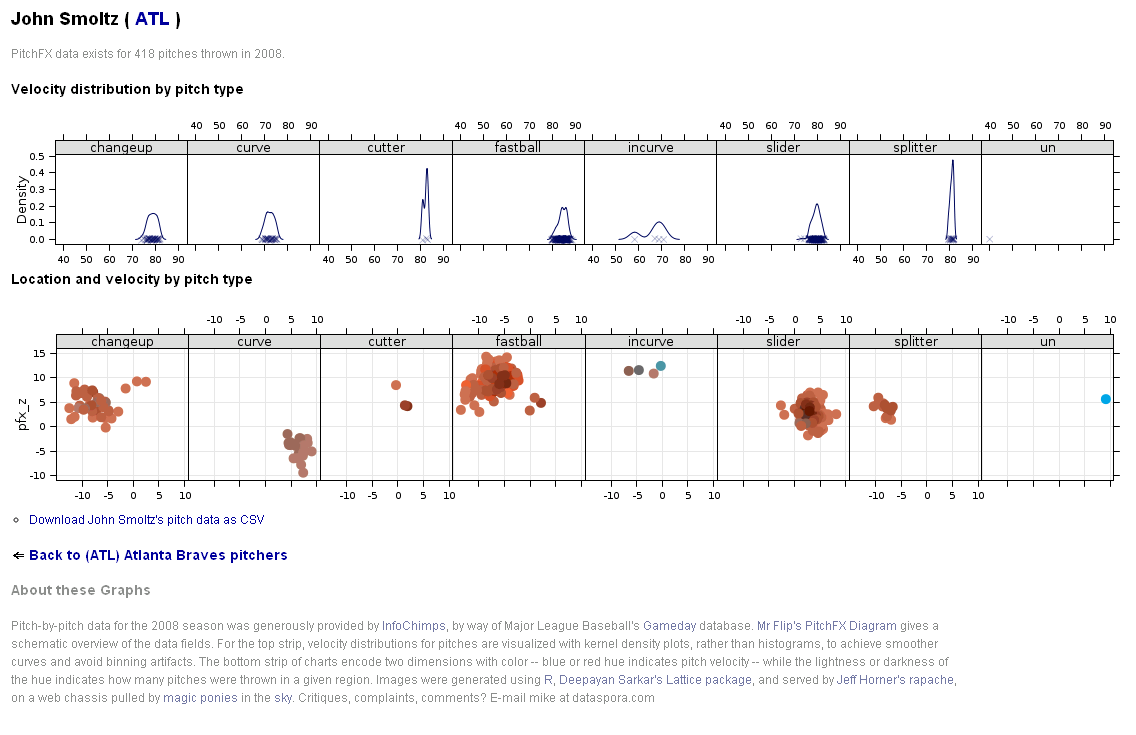
  2. http://labs.dataspora.com/gameday/ A demo visualization of a web based dashboard system of baseball pitches by pitcher by player 


3. http://data.vanderbilt.edu/rapache/bbplot For baseball results – a demo of a query based web dashboard system- very good BI feel.

Whats coming next in R Apache?

You can  download version 1.1.10 of rApache now. There
are only two significant changes and you don’t have to edit your
apache config or change any code (just recompile rApache and
reinstall):

1) Error reporting should be more informative. both when you
accidentally introduce errors in the Apache config, and when your code
introduces warnings and errors from web requests.

I’ve struggled with this one for awhile, not really knowing what
strategy would be best. Basically, rApache hooks into the R I/O layer
at such a low level that it’s hard to capture all warnings and errors
as they occur and introduce them to the user in a sane manner. In
prior releases, when ROutputErrors was in effect (either the apache
directive or the R function) one would typically see a bunch of grey
boxes with a red outline with a title of RApache Warning/Error!!!.
Unfortunately those grey boxes could contain empty lines, one line of
error, or a few that relate to the lines in previously displayed
boxes. Really a big uninformative mess.

The new approach is to print just one warning box with the title
“”Oops!!! <b>rApache</b> has something to tell you. View source and
read the HTML comments at the end.” and then as the title implies you
can read the HTML comment located at the end of the file… after the
closing html. That way, you’re actually reading how R would present
the warnings and errors to you as if you executed the code at the R
command prompt. And if you don’t use ROutputErrors, the warning/error
messages are printed in the Apache log file, just as they were before,
but nicer 😉

2) Code dispatching has changed so please let me know if I’ve
introduced any strange behavior.

This was necessary to enhance error reporting. Prior to this release,
rApache would use R’s C API exclusively to build up the call to your
code that is then passed to R’s evaluation engine. The advantage to
this approach is that it’s much more efficient as there is no parsing
involved, however all information about parse errors, files which
produced errors, etc. were lost. The new approach uses R’s built-in
parse function to build up the call and then passes it of to R. A
slight overhead, but it should be negligible. So, if you feel that
this approach is too slow OR I’ve introduced bugs or strange behavior,
please let me know.

FUTURE PLANS

I’m gaining more experience building Debian/Ubuntu packages each day,
so hopefully by some time in 2011 you can rely on binary releases for
these distributions and not install rApache from source! Fingers
crossed!

Development on the rApache 1.1 branch will be winding down (save bug
fix releases) as I transition to the 1.2 branch. This will involve
taking out a small chunk of code that defines the rApache development
environment (all the CGI variables and the functions such as
setHeader, setCookie, etc) and placing it in its own R package…
unnamed as of yet. This is to facilitate my development of the ralite
R package, a small single user cross-platform web server.

The goal for ralite is to speed up development of R web applications,
take out a bit of friction in the development process by not having to
run the full rApache server. Plus it would allow users to develop in
the rApache enronment while on windows and later deploy on more
capable server environments. The secondary goal for ralite is it’s use
in other web server environments (nginx and IIS come to mind) as a
persistent per-client process.

And finally, wiki.rapache.net will be the new www.rapache.net once I
translate the manual over… any day now.

From –http://biostat.mc.vanderbilt.edu/wiki/Main/JeffreyHorner


Not convinced ?- try the demos above.

Doing Time Series using a R GUI

The Xerox Star Workstation introduced the firs...
Image via Wikipedia

Until recently I had been thinking that RKWard was the only R GUI supporting Time Series Models-

however Bob Muenchen of http://www.r4stats.com/ was helpful to point out that the Epack Plugin provides time series functionality to R Commander.

Note the GUI helps explore various time series functionality.

Using Bulkfit you can fit various ARMA models to dataset and choose based on minimum AIC


> bulkfit(AirPassengers$x)
$res
ar d ma      AIC
[1,]  0 0  0 1790.368
[2,]  0 0  1 1618.863
[3,]  0 0  2 1522.122
[4,]  0 1  0 1413.909
[5,]  0 1  1 1397.258
[6,]  0 1  2 1397.093
[7,]  0 2  0 1450.596
[8,]  0 2  1 1411.368
[9,]  0 2  2 1394.373
[10,]  1 0  0 1428.179
[11,]  1 0  1 1409.748
[12,]  1 0  2 1411.050
[13,]  1 1  0 1401.853
[14,]  1 1  1 1394.683
[15,]  1 1  2 1385.497
[16,]  1 2  0 1447.028
[17,]  1 2  1 1398.929
[18,]  1 2  2 1391.910
[19,]  2 0  0 1413.639
[20,]  2 0  1 1408.249
[21,]  2 0  2 1408.343
[22,]  2 1  0 1396.588
[23,]  2 1  1 1378.338
[24,]  2 1  2 1387.409
[25,]  2 2  0 1440.078
[26,]  2 2  1 1393.882
[27,]  2 2  2 1392.659
$min
ar        d       ma      AIC
2.000    1.000    1.000 1378.338
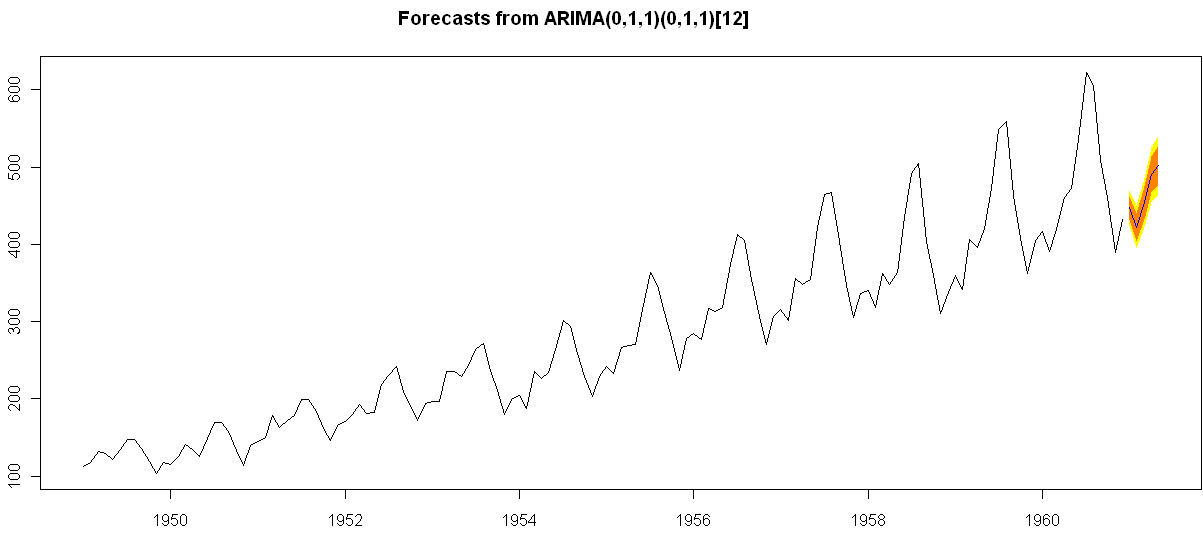
> ArimaModel.5 <- Arima(AirPassengers$x,order=c(0,1,1),
+ include.mean=1,
+   seasonal=list(order=c(0,1,1),period=12))
> ArimaModel.5
Series: AirPassengers$x
ARIMA(0,1,1)(0,1,1)[12]
Call: Arima(x = AirPassengers$x, order = c(0, 1, 1), seasonal = list(order = c(0,      1, 1), period = 12), include.mean = 1)
Coefficients:
ma1     sma1
-0.3087  -0.1074
s.e.   0.0890   0.0828
sigma^2 estimated as 135.4:  log likelihood = -507.5
AIC = 1021   AICc = 1021.19   BIC = 1029.63
> summary(ArimaModel.5, cor=FALSE)
Series: AirPassengers$x
ARIMA(0,1,1)(0,1,1)[12]
Call: Arima(x = AirPassengers$x, order = c(0, 1, 1), seasonal = list(order = c(0,      1, 1), period = 12), include.mean = 1)
Coefficients:
ma1     sma1
-0.3087  -0.1074
s.e.   0.0890   0.0828
sigma^2 estimated as 135.4:  log likelihood = -507.5
AIC = 1021   AICc = 1021.19   BIC = 1029.63
In-sample error measures:
ME        RMSE         MAE         MPE        MAPE        MASE
0.32355285 11.09952005  8.16242469  0.04409006  2.89713514  0.31563730
Dataset79 <- predar3(ArimaModel.5,fore1=5)


And I also found an interesting Ref Sheet for Time Series functions in R-

http://cran.r-project.org/doc/contrib/Ricci-refcard-ts.pdf

and a slightly more exhaustive time series ref card

http://www.statistische-woche-nuernberg-2010.org/lehre/bachelor/datenanalyse/Refcard3.pdf

Also of interest a matter of opinion on issues in Time Series Analysis in R at

http://www.stat.pitt.edu/stoffer/tsa2/Rissues.htm

Of course , if I was the sales manager for SAS ETS I would be worried given the increasing capabilities in Time Series in R. But then again some deficiencies in R GUI for Time Series-

1) Layout is not very elegant

2) Not enough documented help (atleast for the Epack GUI- and no integrated help ACROSS packages-)

3) Graphical capabilties need more help documentation to interpret the output (especially in ACF and PACF plots)

More resources on Time Series using R.

http://people.bath.ac.uk/masgs/time%20series/TimeSeriesR2004.pdf

and http://www.statoek.wiso.uni-goettingen.de/veranstaltungen/zeitreihen/sommer03/ts_r_intro.pdf

and books

http://www.springer.com/economics/econometrics/book/978-0-387-77316-2

http://www.springer.com/statistics/statistical+theory+and+methods/book/978-0-387-75960-9

http://www.springer.com/statistics/statistical+theory+and+methods/book/978-0-387-75958-6

http://www.springer.com/statistics/statistical+theory+and+methods/book/978-0-387-75966-1

So what's new in R 2.12.0

PoissonCDF
Image via Wikipedia

and as per http://cran.r-project.org/src/base/NEWS

the answer is plenty is new in the newR.

While you and me, were busy writing and reading blogs, or generally writing code for earning more money, or our own research- Uncle Peter D and his band of merry men have been really busy in a much more upgraded R.

————————————–

CHANGES————————-

NEW FEATURES:

    • Reading a packages's CITATION file now defaults to ASCII rather
      than Latin-1: a package with a non-ASCII CITATION file should
      declare an encoding in its DESCRIPTION file and use that encoding
      for the CITATION file.

    • difftime() now defaults to the "tzone" attribute of "POSIXlt"
      objects rather than to the current timezone as set by the default
      for the tz argument.  (Wish of PR#14182.)

    • pretty() is now generic, with new methods for "Date" and "POSIXt"
      classes (based on code contributed by Felix Andrews).

    • unique() and match() are now faster on character vectors where
      all elements are in the global CHARSXP cache and have unmarked
      encoding (ASCII).  Thanks to Matthew Dowle for suggesting
      improvements to the way the hash code is generated in unique.c.

    • The enquote() utility, in use internally, is exported now.

    • .C() and .Fortran() now map non-zero return values (other than
      NA_LOGICAL) for logical vectors to TRUE: it has been an implicit
      assumption that they are treated as true.

    • The print() methods for "glm" and "lm" objects now insert
      linebreaks in long calls in the same way that the print() methods
      for "summary.[g]lm" objects have long done.  This does change the
      layout of the examples for a number of packages, e.g. MASS.
      (PR#14250)

    • constrOptim() can now be used with method "SANN".  (PR#14245)

      It gains an argument hessian to be passed to optim(), which
      allows all the ... arguments to be intended for f() and grad().
      (PR#14071)

    • curve() now allows expr to be an object of mode "expression" as
      well as "call" and "function".

    • The "POSIX[cl]t" methods for Axis() have been replaced by a
      single method for "POSIXt".

      There are no longer separate plot() methods for "POSIX[cl]t" and
      "Date": the default method has been able to handle those classes
      for a long time.  This _inter alia_ allows a single date-time
      object to be supplied, the wish of PR#14016.

      The methods had a different default ("") for xlab.

    • Classes "POSIXct", "POSIXlt" and "difftime" have generators
      .POSIXct(), .POSIXlt() and .difftime().  Package authors are
      advised to make use of them (they are available from R 2.11.0) to
      proof against planned future changes to the classes.

      The ordering of the classes has been changed, so "POSIXt" is now
      the second class.  See the document ‘Updating packages for
      changes in R 2.12.x’ on  for
      the consequences for a handful of CRAN packages.

    • The "POSIXct" method of as.Date() allows a timezone to be
      specified (but still defaults to UTC).

    • New list2env() utility function as an inverse of
      as.list() and for fast multi-assign() to existing
      environment.  as.environment() is now generic and uses list2env()
      as list method.

    • There are several small changes to output which ‘zap’ small
      numbers, e.g. in printing quantiles of residuals in summaries
      from "lm" and "glm" fits, and in test statisics in print.anova().

    • Special names such as "dim", "names", etc, are now allowed as
      slot names of S4 classes, with "class" the only remaining
      exception.

    • File .Renviron can have architecture-specific versions such as
      .Renviron.i386 on systems with sub-architectures.

    • installed.packages() has a new argument subarch to filter on
      sub-architecture.

    • The summary() method for packageStatus() now has a separate
      print() method.

    • The default summary() method returns an object inheriting from
      class "summaryDefault" which has a separate print() method that
      calls zapsmall() for numeric/complex values.

    • The startup message now includes the platform and if used,
      sub-architecture: this is useful where different
      (sub-)architectures run on the same OS.

    • The getGraphicsEvent() mechanism now allows multiple windows to
      return graphics events, through the new functions
      setGraphicsEventHandlers(), setGraphicsEventEnv(), and
      getGraphicsEventEnv().  (Currently implemented in the windows()
      and X11() devices.)

    • tools::texi2dvi() gains an index argument, mainly for use by R
      CMD Rd2pdf.

      It avoids the use of texindy by texinfo's texi2dvi >= 1.157,
      since that does not emulate 'makeindex' well enough to avoid
      problems with special characters (such as (, {, !) in indices.

    • The ability of readLines() and scan() to re-encode inputs to
      marked UTF-8 strings on Windows since R 2.7.0 is extended to
      non-UTF-8 locales on other OSes.

    • scan() gains a fileEncoding argument to match read.table().

    • points() and lines() gain "table" methods to match plot().  (Wish
      of PR#10472.)

    • Sys.chmod() allows argument mode to be a vector, recycled along
      paths.

    • There are |, & and xor() methods for classes "octmode" and
      "hexmode", which work bitwise.

    • Environment variables R_DVIPSCMD, R_LATEXCMD, R_MAKEINDEXCMD,
      R_PDFLATEXCMD are no longer used nor set in an R session.  (With
      the move to tools::texi2dvi(), the conventional environment
      variables LATEX, MAKEINDEX and PDFLATEX will be used.
      options("dvipscmd") defaults to the value of DVIPS, then to
      "dvips".)

    • New function isatty() to see if terminal connections are
      redirected.

    • summaryRprof() returns the sampling interval in component
      sample.interval and only returns in by.self data for functions
      with non-zero self times.

    • print(x) and str(x) now indicate if an empty list x is named.

    • install.packages() and remove.packages() with lib unspecified and
      multiple libraries in .libPaths() inform the user of the library
      location used with a message rather than a warning.

    • There is limited support for multiple compressed streams on a
      file: all of [bgx]zfile() allow streams to be appended to an
      existing file, but bzfile() reads only the first stream.

    • Function person() in package utils now uses a given/family scheme
      in preference to first/middle/last, is vectorized to handle an
      arbitrary number of persons, and gains a role argument to specify
      person roles using a controlled vocabulary (the MARC relator
      terms).

    • Package utils adds a new "bibentry" class for representing and
      manipulating bibliographic information in enhanced BibTeX style,
      unifying and enhancing the previously existing mechanisms.

    • A bibstyle() function has been added to the tools package with
      default JSS style for rendering "bibentry" objects, and a
      mechanism for registering other rendering styles.

    • Several aspects of the display of text help are now customizable
      using the new Rd2txt_options() function.
      options("help_text_width") is no longer used.

    • Added \href tag to the Rd format, to allow hyperlinks to URLs
      without displaying the full URL.

    • Added \newcommand and \renewcommand tags to the Rd format, to
      allow user-defined macros.

    • New toRd() generic in the tools package to convert objects to
      fragments of Rd code, and added "fragment" argument to Rd2txt(),
      Rd2HTML(), and Rd2latex() to support it.

    • Directory R_HOME/share/texmf now follows the TDS conventions, so
      can be set as a texmf tree (‘root directory’ in MiKTeX parlance).

    • S3 generic functions now use correct S4 inheritance when
      dispatching on an S4 object.  See ?Methods, section on “Methods
      for S3 Generic Functions” for recommendations and details.

    • format.pval() gains a ... argument to pass arguments such as
      nsmall to format().  (Wish of PR#9574)

    • legend() supports title.adj.  (Wish of PR#13415)

    • Added support for subsetting "raster" objects, plus assigning to
      a subset, conversion to a matrix (of colour strings), and
      comparisons (== and !=).

    • Added a new parseLatex() function (and related functions
      deparseLatex() and latexToUtf8()) to support conversion of
      bibliographic entries for display in R.

    • Text rendering of \itemize in help uses a Unicode bullet in UTF-8
      and most single-byte Windows locales.

    • Added support for polygons with holes to the graphics engine.
      This is implemented for the pdf(), postscript(),
      x11(type="cairo"), windows(), and quartz() devices (and
      associated raster formats), but not for x11(type="Xlib") or
      xfig() or pictex().  The user-level interface is the polypath()
      function in graphics and grid.path() in grid.

    • File NEWS is now generated at installation with a slightly
      different format: it will be in UTF-8 on platforms using UTF-8,
      and otherwise in ASCII.  There is also a PDF version, NEWS.pdf,
      installed at the top-level of the R distribution.

    • kmeans(x, 1) now works.  Further, kmeans now returns between and
      total sum of squares.

    • arrayInd() and which() gain an argument useNames.  For arrayInd,
      the default is now false, for speed reasons.

    • As is done for closures, the default print method for the formula
      class now displays the associated environment if it is not the
      global environment.

    • A new facility has been added for inserting code into a package
      without re-installing it, to facilitate testing changes which can
      be selectively added and backed out.  See ?insertSource.

    • New function readRenviron to (re-)read files in the format of
      ~/.Renviron and Renviron.site.

    • require() will now return FALSE (and not fail) if loading the
      package or one of its dependencies fails.

    • aperm() now allows argument perm to be a character vector when
      the array has named dimnames (as the results of table() calls
      do).  Similarly, array() allows MARGIN to be a character vector.
      (Based on suggestions of Michael Lachmann.)

    • Package utils now exports and documents functions
      aspell_package_Rd_files() and aspell_package_vignettes() for
      spell checking package Rd files and vignettes using Aspell,
      Ispell or Hunspell.

    • Package news can now be given in Rd format, and news() prefers
      these inst/NEWS.Rd files to old-style plain text NEWS or
      inst/NEWS files.

    • New simple function packageVersion().

    • The PCRE library has been updated to version 8.10.

    • The standard Unix-alike terminal interface declares its name to
      readline as 'R', so that can be used for conditional sections in
      ~/.inputrc files.

    • ‘Writing R Extensions’ now stresses that the standard sections in
      .Rd files (other than \alias, \keyword and \note) are intended to
      be unique, and the conversion tools now drop duplicates with a
      warning.

      The .Rd conversion tools also warn about an unrecognized type in
      a \docType section.

    • ecdf() objects now have a quantile() method.

    • format() methods for date-time objects now attempt to make use of
      a "tzone" attribute with "%Z" and "%z" formats, but it is not
      always possible.  (Wish of PR#14358.)

    • tools::texi2dvi(file, clean = TRUE) now works in more cases (e.g.
      where emulation is used and when file is not in the current
      directory).

    • New function droplevels() to remove unused factor levels.

    • system(command, intern = TRUE) now gives an error on a Unix-alike
      (as well as on Windows) if command cannot be run.  It reports a
      non-success exit status from running command as a warning.

      On a Unix-alike an attempt is made to return the actual exit
      status of the command in system(intern = FALSE): previously this
      had been system-dependent but on POSIX-compliant systems the
      value return was 256 times the status.

    • system() has a new argument ignore.stdout which can be used to
      (portably) ignore standard output.

    • system(intern = TRUE) and pipe() connections are guaranteed to be
      avaliable on all builds of R.

    • Sys.which() has been altered to return "" if the command is not
      found (even on Solaris).

    • A facility for defining reference-based S4 classes (in the OOP
      style of Java, C++, etc.) has been added experimentally to
      package methods; see ?ReferenceClasses.

    • The predict method for "loess" fits gains an na.action argument
      which defaults to na.pass rather than the previous default of
      na.omit.

      Predictions from "loess" fits are now named from the row names of
      newdata.

    • Parsing errors detected during Sweave() processing will now be
      reported referencing their original location in the source file.

    • New adjustcolor() utility, e.g., for simple translucent color
      schemes.

    • qr() now has a trivial lm method with a simple (fast) validity
      check.

    • An experimental new programming model has been added to package
      methods for reference (OOP-style) classes and methods.  See
      ?ReferenceClasses.

    • bzip2 has been updated to version 1.0.6 (bug-fix release).
      --with-system-bzlib now requires at least version 1.0.6.

    • R now provides jss.cls and jss.bst (the class and bib style file
      for the Journal of Statistical Software) as well as RJournal.bib
      and Rnews.bib, and R CMD ensures that the .bst and .bib files are
      found by BibTeX.

    • Functions using the TAR environment variable no longer quote the
      value when making system calls.  This allows values such as tar
      --force-local, but does require additional quotes in, e.g., TAR =
      "'/path with spaces/mytar'".

  DEPRECATED & DEFUNCT:

    • Supplying the parser with a character string containing both
      octal/hex and Unicode escapes is now an error.

    • File extension .C for C++ code files in packages is now defunct.

    • R CMD check no longer supports configuration files containing
      Perl configuration variables: use the environment variables
      documented in ‘R Internals’ instead.

    • The save argument of require() now defaults to FALSE and save =
      TRUE is now deprecated.  (This facility is very rarely actually
      used, and was superseded by the Depends field of the DESCRIPTION
      file long ago.)

    • R CMD check --no-latex is deprecated in favour of --no-manual.

    • R CMD Sd2Rd is formally deprecated and will be removed in R
      2.13.0.

  PACKAGE INSTALLATION:

    • install.packages() has a new argument libs_only to optionally
      pass --libs-only to R CMD INSTALL and works analogously for
      Windows binary installs (to add support for 64- or 32-bit
      Windows).

    • When sub-architectures are in use, the installed architectures
      are recorded in the Archs field of the DESCRIPTION file.  There
      is a new default filter, "subarch", in available.packages() to
      make use of this.

      Code is compiled in a copy of the src directory when a package is
      installed for more than one sub-architecture: this avoid problems
      with cleaning the sources between building sub-architectures.

    • R CMD INSTALL --libs-only no longer overrides the setting of
      locking, so a previous version of the package will be restored
      unless --no-lock is specified.

  UTILITIES:

    • R CMD Rprof|build|check are now based on R rather than Perl
      scripts.  The only remaining Perl scripts are the deprecated R
      CMD Sd2Rd and install-info.pl (used only if install-info is not
      found) as well as some maintainer-mode-only scripts.

      *NB:* because these have been completely rewritten, users should
      not expect undocumented details of previous implementations to
      have been duplicated.

      R CMD no longer manipulates the environment variables PERL5LIB
      and PERLLIB.

    • R CMD check has a new argument --extra-arch to confine tests to
      those needed to check an additional sub-architecture.

      Its check for “Subdirectory 'inst' contains no files” is more
      thorough: it looks for files, and warns if there are only empty
      directories.

      Environment variables such as R_LIBS and those used for
      customization can be set for the duration of checking _via_ a
      file ~/.R/check.Renviron (in the format used by .Renviron, and
      with sub-architecture specific versions such as
      ~/.R/check.Renviron.i386 taking precedence).

      There are new options --multiarch to check the package under all
      of the installed sub-architectures and --no-multiarch to confine
      checking to the sub-architecture under which check is invoked.
      If neither option is supplied, a test is done of installed
      sub-architectures and all those which can be run on the current
      OS are used.

      Unless multiple sub-architectures are selected, the install done
      by check for testing purposes is only of the current
      sub-architecture (_via_ R CMD INSTALL --no-multiarch).

      It will skip the check for non-ascii characters in code or data
      if the environment variables _R_CHECK_ASCII_CODE_ or
      _R_CHECK_ASCII_DATA_ are respectively set to FALSE.  (Suggestion
      of Vince Carey.)

    • R CMD build no longer creates an INDEX file (R CMD INSTALL does
      so), and --force removes (rather than overwrites) an existing
      INDEX file.

      It supports a file ~/.R/build.Renviron analogously to check.

      It now runs build-time \Sexpr expressions in help files.

    • R CMD Rd2dvi makes use of tools::texi2dvi() to process the
      package manual.  It is now implemented entirely in R (rather than
      partially as a shell script).

    • R CMD Rprof now uses utils::summaryRprof() rather than Perl.  It
      has new arguments to select one of the tables and to limit the
      number of entries printed.

    • R CMD Sweave now runs R with --vanilla so the environment setting
      of R_LIBS will always be used.

  C-LEVEL FACILITIES:

    • lang5() and lang6() (in addition to pre-existing lang[1-4]())
      convenience functions for easier construction of eval() calls.
      If you have your own definition, do wrap it inside #ifndef lang5
      .... #endif to keep it working with old and new R.

    • Header R.h now includes only the C headers it itself needs, hence
      no longer includes errno.h.  (This helps avoid problems when it
      is included from C++ source files.)

    • Headers Rinternals.h and R_ext/Print.h include the C++ versions
      of stdio.h and stdarg.h respectively if included from a C++
      source file.

  INSTALLATION:

    • A C99 compiler is now required, and more C99 language features
      will be used in the R sources.

    • Tcl/Tk >= 8.4 is now required (increased from 8.3).

    • System functions access, chdir and getcwd are now essential to
      configure R.  (In practice they have been required for some
      time.)

    • make check compares the output of the examples from several of
      the base packages to reference output rather than the previous
      output (if any).  Expect some differences due to differences in
      floating-point computations between platforms.

    • File NEWS is no longer in the sources, but generated as part of
      the installation.  The primary source for changes is now
      doc/NEWS.Rd.

    • The popen system call is now required to build R.  This ensures
      the availability of system(intern = TRUE), pipe() connections and
      printing from postscript().

    • The pkg-config file libR.pc now also works when R is installed
      using a sub-architecture.

    • R has always required a BLAS that conforms to IE60559 arithmetic,
      but after discovery of more real-world problems caused by a BLAS
      that did not, this is tested more thoroughly in this version.

  BUG FIXES:

    • Calls to selectMethod() by default no longer cache inherited
      methods.  This could previously corrupt methods used by as().

    • The densities of non-central chi-squared are now more accurate in
      some cases in the extreme tails, e.g. dchisq(2000, 2, 1000), as a
      series expansion was truncated too early.  (PR#14105)

    • pt() is more accurate in the left tail for ncp large, e.g.
      pt(-1000, 3, 200).  (PR#14069)

    • The default C function (R_binary) for binary ops now sets the S4
      bit in the result if either argument is an S4 object.  (PR#13209)

    • source(echo=TRUE) failed to echo comments that followed the last
      statement in a file.

    • S4 classes that contained one of "matrix", "array" or "ts" and
      also another class now accept superclass objects in new().  Also
      fixes failure to call validObject() for these classes.

    • Conditional inheritance defined by argument test in
      methods::setIs() will no longer be used in S4 method selection
      (caching these methods could give incorrect results).  See
      ?setIs.

    • The signature of an implicit generic is now used by setGeneric()
      when that does not use a definition nor explicitly set a
      signature.

    • A bug in callNextMethod() for some examples with "..." in the
      arguments has been fixed.  See file
      src/library/methods/tests/nextWithDots.R in the sources.

    • match(x, table) (and hence %in%) now treat "POSIXlt" consistently
      with, e.g., "POSIXct".

    • Built-in code dealing with environments (get(), assign(),
      parent.env(), is.environment() and others) now behave
      consistently to recognize S4 subclasses; is.name() also
      recognizes subclasses.

    • The abs.tol control parameter to nlminb() now defaults to 0.0 to
      avoid false declarations of convergence in objective functions
      that may go negative.

    • The standard Unix-alike termination dialog to ask whether to save
      the workspace takes a EOF response as n to avoid problems with a
      damaged terminal connection.  (PR#14332)

    • Added warn.unused argument to hist.default() to allow suppression
      of spurious warnings about graphical parameters used with
      plot=FALSE.  (PR#14341)

    • predict.lm(), summary.lm(), and indeed lm() itself had issues
      with residual DF in zero-weighted cases (the latter two only in
      connection with empty models). (Thanks to Bill Dunlap for
      spotting the predict() case.)

    • aperm() treated resize = NA as resize = TRUE.

    • constrOptim() now has an improved convergence criterion, notably
      for cases where the minimum was (very close to) zero; further,
      other tweaks inspired from code proposals by Ravi Varadhan.

    • Rendering of S3 and S4 methods in man pages has been corrected
      and made consistent across output formats.

    • Simple markup is now allowed in \title sections in .Rd files.

    • The behaviour of as.logical() on factors (to use the levels) was
      lost in R 2.6.0 and has been restored.

    • prompt() did not backquote some default arguments in the \usage
      section.  (Reported by Claudia Beleites.)

    • writeBin() disallows attempts to write 2GB or more in a single
      call. (PR#14362)

    • new() and getClass() will now work if Class is a subclass of
      "classRepresentation" and should also be faster in typical calls.

    • The summary() method for data frames makes a better job of names
      containing characters invalid in the current locale.

    • [[ sub-assignment for factors could create an invalid factor
      (reported by Bill Dunlap).

    • Negate(f) would not evaluate argument f until first use of
      returned function (reported by Olaf Mersmann).

    • quietly=FALSE is now also an optional argument of library(), and
      consequently, quietly is now propagated also for loading
      dependent packages, e.g., in require(*, quietly=TRUE).

    • If the loop variable in a for loop was deleted, it would be
      recreated as a global variable.  (Reported by Radford Neal; the
      fix includes his optimizations as well.)

    • Task callbacks could report the wrong expression when the task
      involved parsing new code. (PR#14368)

    • getNamespaceVersion() failed; this was an accidental change in
      2.11.0. (PR#14374)

    • identical() returned FALSE for external pointer objects even when
      the pointer addresses were the same.

    • L$a@x[] <- val did not duplicate in a case it should have.

    • tempfile() now always gives a random file name (even if the
      directory is specified) when called directly after startup and
      before the R RNG had been used.  (PR#14381)

    • quantile(type=6) behaved inconsistently.  (PR#14383)

    • backSpline(.) behaved incorrectly when the knot sequence was
      decreasing.  (PR#14386)

    • The reference BLAS included in R was assuming that 0*x and x*0
      were always zero (whereas they could be NA or NaN in IEC 60559
      arithmetic).  This was seen in results from tcrossprod, and for
      example that log(0) %*% 0 gave 0.

    • The calculation of whether text was completely outside the device
      region (in which case, you draw nothing) was wrong for screen
      devices (which have [0, 0] at top-left).  The symptom was (long)
      text disappearing when resizing a screen window (to make it
      smaller).  (PR#14391)

    • model.frame(drop.unused.levels = TRUE) did not take into account
      NA values of factors when deciding to drop levels. (PR#14393)

    • library.dynam.unload required an absolute path for libpath.
      (PR#14385)

      Both library() and loadNamespace() now record absolute paths for
      use by searchpaths() and getNamespaceInfo(ns, "path").

    • The self-starting model NLSstClosestX failed if some deviation
      was exactly zero.  (PR#14384)

    • X11(type = "cairo") (and other devices such as png using
      cairographics) and which use Pango font selection now work around
      a bug in Pango when very small fonts (those with sizes between 0
      and 1 in Pango's internal units) are requested.  (PR#14369)

    • Added workaround for the font problem with X11(type = "cairo")
      and similar on Mac OS X whereby italic and bold styles were
      interchanged.  (PR#13463 amongst many other reports.)

    • source(chdir = TRUE) failed to reset the working directory if it
      could not be determined - that is now an error.

    • Fix for crash of example(rasterImage) on x11(type="Xlib").

    • Force Quartz to bring the on-screen display up-to-date
      immediately before the snapshot is taken by grid.cap() in the
      Cocoa implementation. (PR#14260)

    • model.frame had an unstated 500 byte limit on variable names.
      (Example reported by Terry Therneau.)

    • The 256-byte limit on names is now documented.    • Subassignment by [, [[ or $ on an expression object with value
      NULL coerced the object to a list.


John Sall sets JMP 9 free to tango with R


Diagnostic graphs produced by plot.lm() functi...
Image via Wikipedia


John Sall, founder SAS AND JMP , has released the latest blockbuster edition of flagship of JMP 9 (JMP Stands for John’s Macintosh Program).

To kill all birds with one software, it is integrated with R and SAS, and the brochure frankly lists all the qualities. Why am I excited for JMP 9 integration with R and with SAS- well it integrates bigger datasets manipulation (thanks to SAS) with R’s superb library of statistical packages and a great statistical GUI (JMP). This makes JMP the latest software apart from SAS/IML, Rapid Miner,Knime, Oracle Data Miner to showcase it’s R integration (without getting into the GPL compliance need for showing source code– it does not ship R- and advises you to just freely download R). I am sure Peter Dalgaard, and Frankie Harell are all overjoyed that R Base and Hmisc packages would be used by fellow statisticians  and students for JMP- which after all is made in the neighborhood state of North Carolina.

Best of all a JMP 30 day trial is free- so no money lost if you download JMP 9 (and no they dont ask for your credit card number, or do they- but they do have a huuuuuuge form to register before you download. Still JMP 9 the software itself is more thoughtfully designed than the email-prospect-leads-form and the extra functionality in the free 30 day trial is worth it.

Also see “New Features  in JMP 9  http://www.jmp.com/software/jmp9/pdf/new_features.pdf

which has this regarding R.

Working with R

R is a programming language and software environment for statistical computing and graphics. JMP now  supports a set of JSL functions to access R. The JSL functions provide the following options:

• open and close a connection between JMP and R

• exchange data between JMP and R

•submit R code for execution

•display graphics produced by R

JMP and R each have their own sets of computational methods.

R has some methods that JMP does not have. Using JSL functions, you can connect to R and use these R computational methods from within JMP.

Textual output and error messages from R appear in the log window.R must be installed on the same computer as JMP.

JMP is not distributed with a copy of R. You can download R from the Comprehensive R Archive Network Web site:http://cran.r-project.org

Because JMP is supported as both a 32-bit and a 64-bit Windows application, you must install the corresponding 32-bit or 64-bit version of R.

For details, see the Scripting Guide book.

and the download trial page ( search optimized URL) –

http://www.sas.com/apps/demosdownloads/jmptrial9_PROD__sysdep.jsp?packageID=000717&jmpflag=Y

In related news (Richest man in North Carolina also ranks nationally(charlotte.news14.com) , Jim Goodnight is now just as rich as Mark Zuckenberg, creator of Facebook-

though probably they are not creating a movie on Jim yet (imagine a movie titled “The Statistical Software” -not just the same dude feel as “The Social Network”)

See John’s latest interview :

The People Behind the Software: John Sall

http://blogs.sas.com/jmp/index.php?/archives/352-The-People-Behind-the-Software-John-Sall.html

Interview John Sall Founder JMP/SAS Institute

https://decisionstats.com/2009/07/28/interview-john-sall-jmp/

SAS Early Days

https://decisionstats.com/2010/06/02/sas-early-days/