Interview: Hjálmar Gíslason, CEO of DataMarket.com

Here is an interview with Hjálmar Gíslason, CEO of Datamarket.com  . DataMarket is an active marketplace for structured data and statistics. Through powerful search and visual data exploration, DataMarket connects data seekers with data providers.


Ajay-  Describe your journey as an entrepreneur and techie in Iceland. What are the 10 things that surprised you most as a tech entrepreneur.

HG- DataMarket is my fourth tech start-up since at age 20 in 1996. The previous ones have been in gaming, mobile and web search. I come from a technical background but have been moving more and more to the business side over the years. I can still prototype, but I hope there isn’t a single line of my code in production!

Funny you should ask about the 10 things that have surprised me the most on this journey, as I gave a presentation – literally yesterday – titled: “9 things nobody told me about the start-up business”

They are:
* Do NOT generalize – especially not to begin with
* Prioritize – and find a work-flow that works for you
* Meet people – face to face
* You are a sales person – whether you like it or not
* Technology is not a product – it’s the entire experience
* Sell the current version – no matter how amazing the next one is
* Learn from mistakes – preferably others’
* Pick the right people – good people is not enough
* Tell a good story – but don’t make them up

I obviously elaborate on each of these points in the talk, but the points illustrate roughly some of the things I believe I’ve learned … so far 😉

9 things nobody told me about the start-up business

Ajay-

Both Amazon  and Google  have entered the public datasets space. Infochimps  has 14,000+ public datasets. The US has http://www.data.gov/

So clearly the space is both competitive and yet the demand for public data repositories is clearly under served still. 

How does DataMarket intend to address this market in a unique way to differentiate itself from others.

HG- DataMarket is about delivering business data to decision makers. We help data seekers find the data they need for planning and informed decision making, and data publishers reaching this audience. DataMarket.com is the meeting point, where data seekers can come to find the best available data, and data publishers can make their data available whether for free or for a fee. We’ve populated the site with a wealth of data from public sources such as the UN, Eurostat, World Bank, IMF and others, but there is also premium data that is only available to those that subscribe to and pay for the access. For example we resell the entire data offering from the EIU (Economist Intelligence Unit) (link: http://datamarket.com/data/list/?q=provider:eiu)

DataMarket.com allows all this data to be searched, visualized, compared and downloaded in a single place in a standard, unified manner.

We see many of these efforts not as competition, but as valuable potential sources of data for our offering, while others may be competing with parts of our proposition, such as easy access to the public data sets.


Ajay- What are your views on data confidentiality and access to data owned by Governments funded by tax payer money.

HG- My views are very simple: Any data that is gathered or created for taxpayers’ money should be open and free of charge unless higher priorities such as privacy or national security indicate otherwise.

Reflecting that, any data that is originally open and free of charge is still open and free of charge on DataMarket.com, just easier to find and work with.

Ajay-  How is the technology entrepreneurship and venture capital scene in Iceland. What things work and what things can be improved?

HG- The scene is quite vibrant, given the small community. Good teams with promising concepts have been able to get the funding they need to get started and test their footing internationally. When the rapid growth phase is reached outside funding may still be needed.

There are positive and negative things about any location. Among the good things about Iceland from the stand point of a technology start-up are highly skilled tech people and a relatively simple corporate environment. Among the bad things are a tiny local market, lack of skills in international sales and marketing and capital controls that were put in place after the crash of the Icelandic economy in 2008.

I’ve jokingly said that if a company is hot in the eyes of VCs it would get funding even if it was located in the jungles of Congo, while if they’re only lukewarm towards you, they will be looking for any excuse not to invest. Location can certainly be one of them, and in that case being close to the investor communities – physically – can be very important.

We’re opening up our sales and marketing offices in Boston as we speak. Not to be close to investors though, but to be close to our market and current customers.

Ajay- Describe your hobbies when you are not founding amazing tech startups.

HG- Most of my time is spent working – which happens to by my number one hobby.

It is still important to step away from it all every now and then to see things in perspective and come back with a clear mind.

I *love* traveling to exotic places. Me and my wife have done quite a lot of traveling in Africa and S-America: safari, scuba diving, skiing, enjoying nature. When at home I try to do some sports activities 3-4 times a week at least, and – recently – play with my now 8 month old son as much as I can.

About-

http://datamarket.com/p/about/team/

Management

Hjalmar GislasonHjálmar Gíslason, Founder and CEO: Hjalmar is a successful entrepreneur, founder of three startups in the gaming, mobile and web sectors since 1996. Prior to launching DataMarket, Hjalmar worked on new media and business development for companies in the Skipti Group (owners of Iceland Telecom) after their acquisition of his search startup – Spurl. Hjalmar offers a mix of business, strategy and technical expertise. DataMarket is based largely on his vision of the need for a global exchange for structured data.

hjalmar.gislason@datamarket.com

To know more, have a quick  look at  http://datamarket.com/

Teradata Analytics

A recent announcement showing Teradata partnering with KXEN and Revolution Analytics for Teradata Analytics.

http://www.teradata.com/News-Releases/2012/Teradata-Expands-Integrated-Analytics-Portfolio/

The Latest in Open Source Emerging Software Technologies
Teradata provides customers with two additional open source technologies – “R” technology from Revolution Analytics for analytics and GeoServer technology for spatial data offered by the OpenGeo organization – both of which are able to leverage the power of Teradata in-database processing for faster, smarter answers to business questions.

In addition to the existing world-class analytic partners, Teradata supports the use of the evolving “R” technology, an open source language for statistical computing and graphics. “R” technology is gaining popularity with data scientists who are exploiting its new and innovative capabilities, which are not readily available. The enhanced “R add-on for Teradata” has a 50 percent performance improvement, it is easier to use, and its capabilities support large data analytics. Users can quickly profile, explore, and analyze larger quantities of data directly in the Teradata Database to deliver faster answers by leveraging embedded analytics.

Teradata has partnered with Revolution Analytics, the leading commercial provider of “R” technology, because of customer interest in high-performing R applications that deliver superior performance for large-scale data. “Our innovative customers understand that big data analytics takes a smart approach to the entire infrastructure and we will enable them to differentiate their business in a cost-effective way,” said David Rich, chief executive officer, Revolution Analytics. “We are excited to partner with Teradata, because we see great affinity between Teradata and Revolution Analytics – we embrace parallel computing and the high performance offered by multi-core and multi-processor hardware.”

and

The Teradata Data Lab empowers business users and leading analytic partners to start building new analytics in less than five minutes, as compared to waiting several weeks for the IT department’s assistance.

“The Data Lab within the Teradata database provides the perfect foundation to enable self-service predictive analytics with KXEN InfiniteInsight,” said John Ball, chief executive officer, KXEN. “Teradata technologies, combined with KXEN’s automated modeling capabilities and in-database scoring, put the power of predictive analytics and data mining directly into the hands of business users. This powerful combination helps our joint customers accelerate insight by delivering top-quality models in orders of magnitude faster than traditional approaches.”

Read more at

http://www.sacbee.com/2012/03/06/4315500/teradata-expands-integrated-analytics.html

Using Cloud Computing for Hacking

This is not about hacking the cloud. Instead this is about using the cloud to hack


Some articles last year wrote on how hackers used Amazon Ec2 for hacking/ddos attacks.

http://www.pcworld.com/businesscenter/article/216434/cloud_computing_used_to_hack_wireless_passwords.html

Roth claims that a typical wireless password can be guessed by EC2 and his software in about six minutes. He proved this by hacking networks in the area where he lives. The type of EC2 computers used in the attack costs 28 cents per minute, so $1.68 is all it could take to lay open a wireless network.

and

http://www.bloomberg.com/news/2011-05-15/sony-attack-shows-amazon-s-cloud-service-lures-hackers-at-pennies-an-hour.html

Cloud services are also attractive for hackers because the use of multiple servers can facilitate tasks such as cracking passwords, said Ray Valdes, an analyst at Gartner Inc. Amazon could improve measures to weed out bogus accounts, he said.


and this article by Anti-Sec pointed out how one can obtain a debit card anonymously

https://www.facebook.com/notes/lulzsec/want-to-be-a-ghost-on-the-internet/230293097062823

VPN Account without paper trail

  • Purchase prepaid visa card with cash
  • Purchase Bitcoins with Money Order
  • Donate Bitcoins to different account


Masking your IP address to log on is done by TOR

https://www.torproject.org/download/download.html.en

and the actual flooding is done by tools like LOIC or HOIC

http://sourceforge.net/projects/loic/

and

http://www.4shared.com/rar/UmCu0ds1/hoic.html


So what safeguards can be expected from the next wave of Teenage Mutant Ninjas..?


Using Google Adwords to target Vic Gundotra and Matt Cutts stochastically

Over the Christmas break, I created a Google Adwords campaign using the $100 credit generously given by Google. I did it using my alumni id, even though I have a perfectly normal gmail id. I guess if Google allows me to use the credit on any account- well I will take it. and so a free experiment was borne.

But whom to target -with Google- but Google itself. It seemed logical

So I created a campaign for the names of prominent Googlers  (from a list of Google + at https://plus.google.com/103399926392582289066/posts/LX4g7577DqD ) and limited the ad location to Mountain View, California.

NULL HYPOTHESIS- People who are googled a lot from within the office are either popular or just checking themselves.

Since Google’s privacy policy is great, has been now shown billions of times, well I guess what’s a little ad targetting between brother geeks. Right?

My ad was-

Hire Ajay Ohri
He is
Awesome
linkedin.com/in/ajayohri 

or see screenshot below.

Here are the results-88 clicks and 43000 impressions (and 83$ of Google’s own money)

clearly Vic Gundotra is googled a lot within Mountain View, California. Does He Google himself.

so is Matt Cutts. Does HE Google himself or does he get elves to help him.

to my disappointment not many people clicked my LI offer, I am still blogging

and there were few clicks on Marissa Myers. Why Google her when she is right down the corridor.

The null hypothesis is thus rejected. Also most clicks were from display and not from search.

I need to do something better to do with Christmas break this year. I still got a credit of 16$ left.


Why the West needs China to start moving towards cyber conflict

Hypothesis-

Western countries are running out of people to fight their wars. This is even more acute given the traditional and current demographic trends in both armed forces and general populations.

A shift to cyber conflict can help the West maintain parity over Eastern methods of assymetrical warfare (by human attrition /cyber conflict).

Declining resources will lead to converging conflicts of interest and dynamics in balance of power in the 21 st century.

Assumed Facts

The launch of Sputnik by USSR led to the moon shot rush by the US.1960s

The proposed announcement of StarWars by USA led to unsustainable defence expenditure by USSR.1980s

The threat of cyber conflict and espionage by China (and Russian cyber actions in war with Georgia) has led to increasing budgets for cyber conflict research and defense in USA. -2010s

Assumptions

If we do not learn from history, we are condemned to repeat it.

Declining Populations in the West and Rising Populations in the East in the 21 st century. The difference in military age personnel would be even more severe, due to more rapid aging in the west.

Economic output will be proportional to number of people employed as economies reach similar stages of maturity (Factor-Manufacturing-Services-Innovation)

Data-

http://esa.un.org/unpd/wpp/unpp/panel_population.htm

http://www.census.gov/population/international/

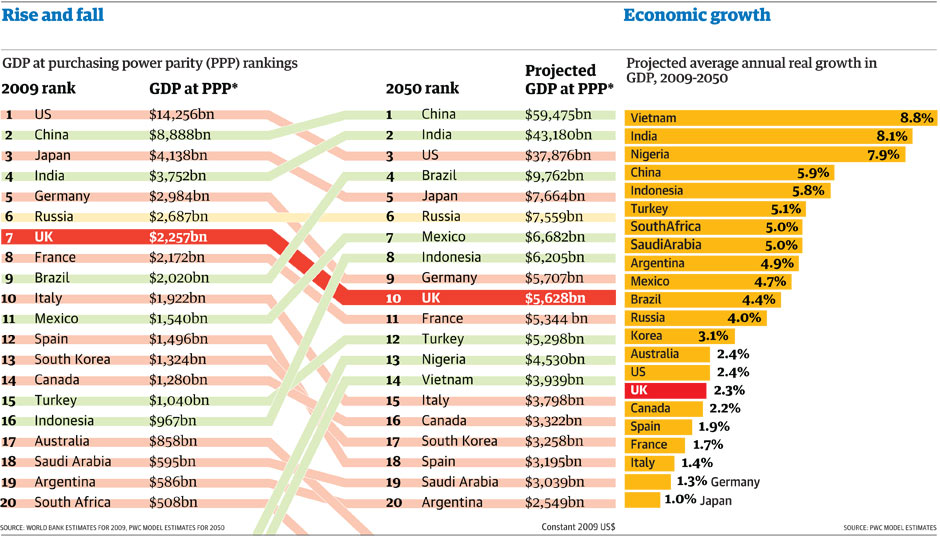
GDP projections to 2050 graphicView larger picture

GDP projections to 2050:
Summary-
Western defence forces would not be able to afford a human attrition intensive war by 2030 given current demographic trends  (both growth and aging). Existing balance of power could be maintained if resources are either shared or warfare is moved to cyber space. Technological advances can help augment resources reducing case for conflict scenarios.
Will the Internet be used by US against China in the 21 st century as Opium was used by GB in the 19th? Time will tell 🙂