Here are some reasons why cloud computing is very helpful to small business owners like me- and can be very helpful to even bigger people.
1) Infrastructure Overhead becomes zero
– I need NOT invest in secure powerbackups (like a big battery for electricity power-outs-true in India), data disaster management (read raid), software licensing compliance.
All this is done for me by infrastructure providers like Google and Amazon.
For simple office productivity, I type on Google Docs that auto-saves my data,writing on cloud. I need not backup- Google does it for me. Ditto for presentations and spreadsheets. Amazon gets me the latest Window software installed whenever I logon- I need not be bothered by software contracts (read bug fixes and patches) any more.
2) Renting Hardware by the hour- A small business owner cannot invest too much in computing hardware (or software). The pay as you use makes sense for them. I could never afford a 8 cores desktop with 25 gb RAM- but I sure can rent and use it to bid for heavier data projects that I would have had to let go in the past.
3) Renting software by the hour- You may have bought your last PC for all time
An example- A windows micro instance costs you 3 cents per hour on Amazon. If you take a mathematical look at upgrading your PC to latest Windows, buying more and more upgraded desktops just to keep up, those costs would exceed 3 cents per hour. For Unix, it is 2 cents per hour, and those softwares (like Red Hat Linux and Ubuntu have increasingly been design friendly even for non techie users)
Some other software companies especially in enterprise software plan to and already offer paid machine images that basically adds their software layer on top of the OS and you can rent software for the hour.
It does not make sense for customers to effectively subsidize golf tournaments, rock concerts, conference networks by their own money- as they can rent software by the hour and switch to pay per use.
People especially SME consultants, academics and students and cost conscious customers – in Analytics would love to see a world where they could say run SAS Enterprise Miner for 10 dollars a hour for two hours to build a data mining model on 25 gb RAM, rather than hurt their pockets and profitability in Annual license models. Ditto for SPSS, JMP, KXEN, Revolution R, Oracle Data Mining (already available on Amazon) , SAP (??), WPS ( on cloud ???? ) . It’s the economy, stupid.
Corporates have realized that cutting down on Hardware and software expenses is more preferable to cutting down people. Would you rather fire people in your own team to buy that big HP or Dell or IBM Server (effectively subsidizing jobs in those companies). IF you had to choose between an annual license renewal for your analytics software TO renting software by the hour and using those savings for better benefits for your employees, what makes business sense for you to invest in.
Goodbye annual license fees. Welcome brave new world.
The United States Government is planning a new initiative at providing employable skills to people, to cope with unemployment. One skill perpetually in shortage is analytics training along with skills in statistics.
It is time that corporates like IBMSPSS, SAS Institute and Revolution Analytics as well as offshore companies in India or Asia can ramp up their on demand trainings, certification as well as academic partnership bundles. Indeed offshroing companies can earn revenue as well as goodwill if they help in with trainers available via video- conferencing. The new Deal initiative would require creative thinking as well as direct top management support to focus their best internal brains at developing this new revenue stream. Again the company that trains the most users (be it Revolution for R, IBM for SPSS-Cognos, SAS Institute for Base SAS-JMP, WPS for SAS language) is going to get a bigger chunk of new users and analysts.
Analytics skills are hot. There is big new demand for hot new skills by millions of unemployed Americans and Asians. How do you think this services market will play out?
If the US government could pump 800 Billion for bailouts, how much is your opinion it should spend on training programs to help citizens compete globally?
The national program is a response to frustrations from both workers and employers who complain that public retraining programs frequently do not provide students with employable skills. This new initiative is intended to help better align community college curriculums with the demands of local companies.
In tough economic times, it is more important than ever that companies be able to make better decisions using analytics. SAS is involved in two programs this summer that offer MBAs and unemployed technology workers the opportunity to learn and enhance analytics skills, and increase their marketability.
SAS is a partner in TechEngage, a week-long program of training classes that offer unemployed technology professionals new skills at a low cost to help them compete effectively in the marketplace.”
. “Fordham has a long history of collaboration with IBM that has brought innovative new skills to our curriculum to prepare students for future jobs. With this effort, Fordham is preparing students with marketable skills for a coming wave of jobs in healthcare, sustainability, and social services where analytics can be applied to everyday challenges.”
and R
Well TIBCO and Revolution ….hmmm…mmmm
I am not sure there is even a R Analytics Certification program at the least.
Using the R Connect() JSL command and assigning it to the object “rconn”, the code sends messages to the JSL scriptable object “rconn” to submit R code via the Submit() command and to retrieve R matrices containing the bootstrap confidence intervals back via the Get() commands.
and I also found interesting what the write has to say about using JMP (for visual analysis) and SAS (bigger datasets handling) and R (for advanced statistics) together
Other standard JMP tools such as the Data Filter can help to explore these results in ways that cannot easily and quickly be done in R
and
With a little JSL and the statistical and graphics platforms of JMP coupled with the breadth and variety of packages and functions in R, one can build complete easy-to-use applications for statistical analysis.
JMP can also integrate with SAS, which adds the ability to work with large-scale data through the file-based system as well as the depth and advanced capabilities of SAS procedures. With these seamless integrations, JMP can become a hub that enables you to connect with both SAS and R, as well as provide unique statistical features such as the JMP Profiler and interactive graphic features such as Graph Builder
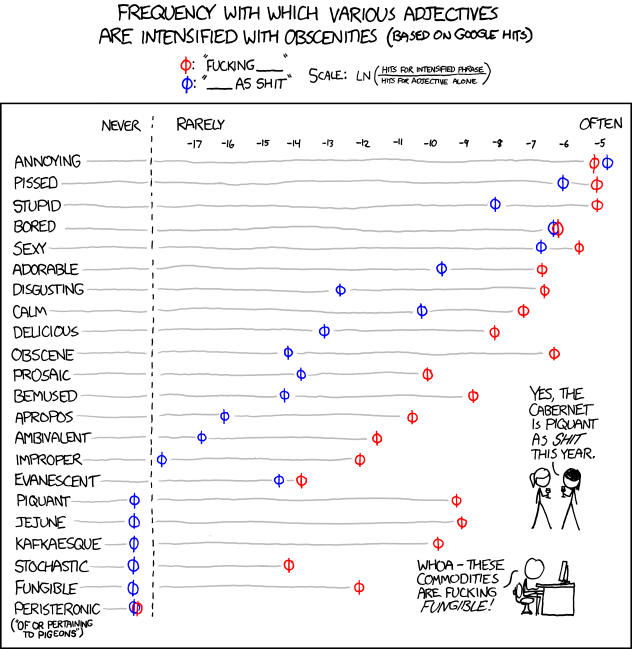
and in the meanwhile here is a data visualization of a frequency analysis of various words bundled together from xkcd.com
Parallel Computing Toolbox™ lets you solve computationally and data-intensive problems using multicore processors, GPUs, and computer clusters. High-level constructs—parallel for-loops, special array types, and parallelized numerical algorithms—let you parallelize MATLAB® applications without CUDA or MPI programming. You can use the toolbox with Simulink® to run multiple simulations of a model in parallel.
The toolbox provides eight workers (MATLAB computational engines) to execute applications locally on a multicore desktop. Without changing the code, you can run the same application on a computer cluster or a grid computing service (using MATLAB Distributed Computing Server™). You can run parallel applications interactively or in batch.
The gputools package by Buckner provides several common data-mining algorithms which are implemented using a mixture of nVidia‘s CUDA langauge and cublas library. Given a computer with an nVidia GPU these functions may be substantially more efficient than native R routines. The rpud package provides an optimised distance metric for NVidia-based GPUs.
The cudaBayesreg package by da Silva implements the rhierLinearModel from the bayesm package using nVidia’s CUDA langauge and tools to provide high-performance statistical analysis of fMRI voxels.
The rgpu package (see below for link) aims to speed up bioinformatics analysis by using the GPU.
The magma package provides an interface to the hybrid GPU/CPU library Magma (see below for link).
The gcbd package implements a benchmarking framework for BLAS and GPUs (using gputools).
I tried to search for SAS and GPU and SPSS and GPU but got nothing. Maybe they would do well to atleast test these alternative hardwares-
Also see Matlab on GPU comparison for the product Jacket vs Parallel Computing Toolbox
The deal values Netezza at $27 a share, a 9.8 percent premium to its closing price on Friday.
Since Netezza was an existing SAS partner, probably it would impact it more if at all, since IBM-SPSS acquisition. Also Netezza was one of the foremost BI companies for both using and expounding R-
JMP 9 releases on Oct 12- it is a very good reliable data visualization and analytical tool ( AND available on Mac as well)
AND IT is advertising R Graphics as well (lol- I can visualize the look on some ahem SAS fans in the R Project)
Updated Pricing- note I am not sure why they are charging US academics 495$ when SAS On Demand is free for academics. Shouldnt JMP be free to students- maybe John Sall and his people can do a tradeoff analysis for this given JMP’s graphics are better than Base SAS (which is under some pressure from WPS and R)
Be First in Line for JMP® 9
Save up to $300 when you pre-order a
single-user license by Oct. 11
Make JMP your analytic hub for visual data discovery with this special offer, good through Oct. 11, 2010. Pre-order a single-user license of JMP 9 – for a discount of up to $300 – and get ready for a leap in data interactivity.
Order now and enjoy the compelling new features of JMP 9 when the software is released Oct. 12. New capabilities in JMP 9 let you:
Optimize and simulate using your Microsoft Excel spreadsheets.
Use maps to find patterns in your geographic data.
Enjoy the updated look and flexibility of JMP 9 on Microsoft Windows.
Create and share custom add-ins that extend JMP.
Leverage an expanded array of advanced statistical methodologies.
Display analytic results from R using interactive graphics.
What if I already have a JMP 8 single-user license?
Great news! You can upgrade to JMP 9 for less than half the regular price.
What if I’m an annual license customer?
Don’t worry, we’ve got you covered. Annual license customers enjoy priority access to all the latest JMP releases as soon as they become available. JMP 9 will be shipped to you automatically.
What if I work or study in the academic world?
Call 1-877-594-6567 to learn about significant discounts for students and professors through the JMP Academic Program.
His argument of love is not very original though it was first made by these four guys
I am going to argue that “some” R developers should be paid, while the main focus should be volunteers code. These R developers should be paid as per usage of their packages.
Let me expand.
Imagine the following conversation between Ross Ihaka, Norman Nie and Peter Dalgaard.
Norman- Hey Guys, Can you give me some code- I got this new startup.
Ross Ihaka and Peter Dalgaard- Sure dude. Here is 100,000 lines of code, 2000 packages and 2 decades of effort.
Norman- Thanks guys.
Ross Ihaka- Hey, What you gonna do with this code.
Norman- I will better it. Sell it. Finally beat Jim Goodnight and his **** Proc GLM and **** Proc Reg.
Ross- Okay, but what will you give us? Will you give us some code back of what you improve?
Norman – Uh, let me explain this open core …
Peter D- Well how about some royalty?
Norman- Sure, we will throw parties at all conferences, snacks you know at user groups.
Ross – Hmm. That does not sound fair. (walks away in a huff muttering)-He takes our code, sells it and wont share the code
Peter D- Doesnt sound fair. I am back to reading Hamlet, the great Dane, and writing the next edition of my book. I am glad I wrote a book- Ross didnt even write that.
Norman-Uh Oh. (picks his phone)- Hey David Smith, We need to write some blog articles pronto – these open source guys ,man…
———–I think that sums what has been going on in the dynamics of R recently. If Ross Ihaka and R Gentleman had adopted an open core strategy- meaning you can create packages to R but not share the original where would we all be?
At this point if he is reading this, David Smith , long suffering veteran of open source flameouts is rolling his eyes while Tal G is wondering if he will publish this on R Bloggers and if so when or something.
Lets bring in another R veteran- Hadley Wickham who wrote a book on R and also created ggplot. Thats the best quality, most often used graphics package.
In terms of economic utilty to end user- the ggplot package may be as useful if not more as the foreach package developed by Revolution Computing/Analytics.
However lets come to open core licensing ( read it here http://alampitt.typepad.com/lampitt_or_leave_it/2008/08/open-core-licen.html ) which is where the debate is- Revolution takes code- enhances it (in my opinion) substantially with new formats XDF for better efficieny, web services API, and soon coming next year a GUI (thanks in advance , Dr Nie and guys)
and sells this advanced R code to businesses happy to pay ( they are currently paying much more to DR Goodnight and HIS guys)
Why would any sane customer buy it from Revolution- if he could download exactly the same thing from http://r-project.org
Hence the business need for Revolution Analytics to have an enhanced R- as they are using a product based software model not software as a service model.
If Revolution gives away source code of these new enhanced codes to R core team- how will R core team protect the above mentioned intelectual property- given they have 2 decades experience of giving away free code , and back and forth on just code.
Now Revolution also has a marketing budget- and thats how they sponsor some R Core events, conferences, after conference snacks.
How would people decide if they are being too generous or too stingy in their contribution (compared to the formidable generosity of SAS Institute to its employees, stakeholders and even third party analysts).
Would it not be better- IF Revolution can shift that aspect of relationship to its Research and Development budget than it’s marketing budget- come with some sort of incentive for “SOME” developers – even researchers need grants and assistantships, scholarships, make a transparent royalty formula say 17.5 % of the NEW R sales goes to R PACKAGE Developers pool, which in turn examines usage rate of packages and need/merit before allocation- that would require Revolution to evolve from a startup to a more sophisticated corporate and R Core can use this the same way as John M Chambers software award/scholarship
Dont pay all developers- it would be an insult to many of them – say Prof Harrell creator of HMisc to accept – but can Revolution expand its dev base (and prospect for future employees) by even sponsoring some R Scholarships.
And I am sure that if Revolution opens up some more code to the community- they would the rest of the world and it’s help useful. If it cant trust people like R Gentleman with some source code – well he is a board member.
——————————————————————————————–
Now to sum up some technical discussions on NeW R
1) An accepted way of benchmarking efficiencies.
2) Code review and incorporation of efficiencies.
3) Multi threading- Multi core usage are trends to be incorporated.
4) GUIs like R Commander E Plugins for other packages, and Rattle for Data Mining to have focussed (or Deducer). This may involve hiring User Interface Designers (like from Apple 😉 who will work for love AND money ( Even the Beatles charge royalty for that song)
5) More support to cloud computing initiatives like Biocep and Elastic R – or Amazon AMI for using cloud computers- note efficiency arguements dont matter if you just use a Chrome Browser and pay 2 cents a hour for an Amazon Instance. Probably R core needs more direct involvement of Google (Cloud OS makers) and Amazon as well as even Salesforce.com (for creating Force.com Apps). Note even more corporates here need to be involved as cloud computing doesnot have any free and open source infrastructure (YET)
“If something goes wrong with Microsoft, I can phone Microsoft up and have it fixed. With Open Source, I have to rely on the community.”
And the community, as much as we may love it, is unpredictable. It might care about your problem and want to fix it, then again, it may not. Anyone who has ever witnessed something online go “viral”, good or bad, will know what I’m talking about.






 DECISION STATS