Libre Office

Some ambiguity about Libre Office and why it needed to change from Open Office- just when Open Office seemed so threatening on the desktop

FROM- http://www.documentfoundation.org/faq/

Q: So is this a breakaway project?

A: Not at all. The Document Foundation will continue to be focused on developing, supporting, and promoting the same software, and it’s very much business as usual. We are simply moving to a new and more appropriate organisational model for the next decade – a logical development from Sun’s inspirational launch a decade ago.

Q: Why are you calling yourselves “The Document Foundation”?

A: For ten years we have used the same name – “OpenOffice.org” – for both the Community and the software. We’ve decided it removes ambiguity to have a different name for the two, so the Community is now “The Document Foundation”, and the software “LibreOffice”. Note: there are other examples of this usage in the free software community – e.g. the Mozilla Foundation with the Firefox browser.

Q: Does this mean you intend to develop other pieces of software?

A: We would like to have that possibility open to us in the future…

Q: And why are you calling the software “LibreOffice” instead of “OpenOffice.org”?

A: The OpenOffice.org trademark is owned by Oracle Corporation. Our hope is that Oracle will donate this to the Foundation, along with the other assets it holds in trust for the Community, in due course, once legal etc issues are resolved. However, we need to continue work in the meantime – hence “LibreOffice” (“free office”).

Q: Why are you building a new web infrastructure?

A: Since Oracle’s takeover of Sun Microsystems, the Community has been under “notice to quit” from our previous Collabnet infrastructure. With today’s announcement of a Foundation, we now have an entity which can own our emerging new infrastructure.

Q: What does this announcement mean to other derivatives of OpenOffice.org?

A: We want The Document Foundation to be open to code contributions from as many people as possible. We are delighted to announce that the enhancements produced by the Go-OOo team will be merged into LibreOffice, effective immediately. We hope that others will follow suit.

Q: What difference will this make to the commercial products produced by Oracle Corporation, IBM, Novell, Red Flag, etc?

A: The Document Foundation cannot answer for other bodies. However, there is nothing in the licence arrangements to stop companies continuing to release commercial derivatives of LibreOffice. The new Foundation will also mean companies can contribute funds or resources without worries that they may be helping a commercial competitor.

Q: What difference will The Document Foundation make to developers?

A: The Document Foundation sets out deliberately to be as developer friendly as possible. We do not demand that contributors share their copyright with us. People will gain status in our community based on peer evaluation of their contributions – not by who their employer is.

Q: What difference will The Document Foundation make to users of LibreOffice?

A: LibreOffice is The Document Foundation’s reason for existence. We do not have and will not have a commercial product which receives preferential treatment. We only have one focus – delivering the best free office suite for our users – LibreOffice.

—————————————————————————————————-

Non Microsoft and Non Oracle vendors are indeed going to find it useful the possiblities of bundling a free Libre Office that reduces the total cost of ownership for analytics software. Right now, some of the best free advertising for Microsoft OS and Office is done by enterprise software vendors who create Windows Only Products and enable MS Office integration better than  Open Office integration. This is done citing user demand- but it is a chicken egg dilemma- as functionality leads to enhanced demand. Microsoft on the other hand is aware of this dependence and has made SQL Server and SQL Analytics (besides investing in analytics startups like Revolution Analytics) along with it’s own infrastructure -Azure Cloud Platform/EC2 instances.

Awesome new features in Doc Googles

I really liked some awesome new features in Google Docs, and I am mentioning just some of the features I like because they are not there in Windows Office mostly.

Sourcehttp://www.google.com/google-d-s/whatsnew.html

List View and Mobile View Improvements
Now you can see your spreadsheets with all their formatting in List View and on your mobile device, this includes background/foreground colors, borders and text formatting!

Themes for forms
Add a splash of color to your surveys and questionnaires. When you create and edit a form, simply apply one of the 70 themes

  • Forms improvements
    We’ve added a new question type (grid), support for right-to-left languages in forms, and a new color scheme for the forms summary. Also, you can now pre-populate form fields with URL parameters, and if you use Google Apps, you can create forms which require sign-in to access. Learn more

  • Translate document
    You can now translate an entire document into over 40 languages.

    Translate and detect languages in Google spreadsheets
    =GoogleTranslate(“Hola, ¿cómo estás?”,”es”,”en”) gives “Hi, how are you?” (or leave out “en” and we’ll automatically choose the default language of your spreadsheet) What if you don’t know the language? =DetectLanguage(“Hola, ¿cómo estás?”) gives “es”.

    A new curve tool in drawings
    Create smooth curves based on a series of points with this new tool.

    Optical character recognition (OCR)
    You can now upload and convert PDF or image files to text.


    You can read the awesome new ones athttp://www.google.com/google-d-s/whatsnew.html but these are the ones I felt were missing in Windows Office.

    Coming up- a Review of newly forked Libre Office

IBM SPSS 19: Marketing Analytics and RFM

What is RFM Analysis?

Recency Frequency Monetization is basically a technique to classify your entire customer list. You may be a retail player with thousands of customers or a enterprise software seller with only two dozen customers.

RFM Analysis can help you cut through and focus on the real customer that drives your profit.

As per Wikipedia

http://en.wikipedia.org/wiki/RFM

RFM is a method used for analyzing customer behavior and defining market segments. It is commonly used in database marketing and direct marketing and has received particular attention in retail.

RFM stands for

  • Recency – How recently a customer has purchased?
  • Frequency – How often he purchases?
  • Monetary Value – How much does he spend?

To create an RFM analysis, one creates categories for each attribute. For instance, the Recency attribute might be broken into three categories: customers with purchases within the last 90 days; between 91 and 365 days; and longer than 365 days. Such categories may be arrived at by applying business rules, or using a data mining technique, such asCHAID, to find meaningful breaks.

—————————————————————————————————-

Even if you dont know what or how to do a RFM, see below for an easy to do way.

I just got myself an evaluation copy of a fully loaded IBM SPSS 19 Module and did some RFM Analysis on some data- the way SPSS recent version is it makes it very very useful even to non statistical tool- but an extremely useful one to a business or marketing user.

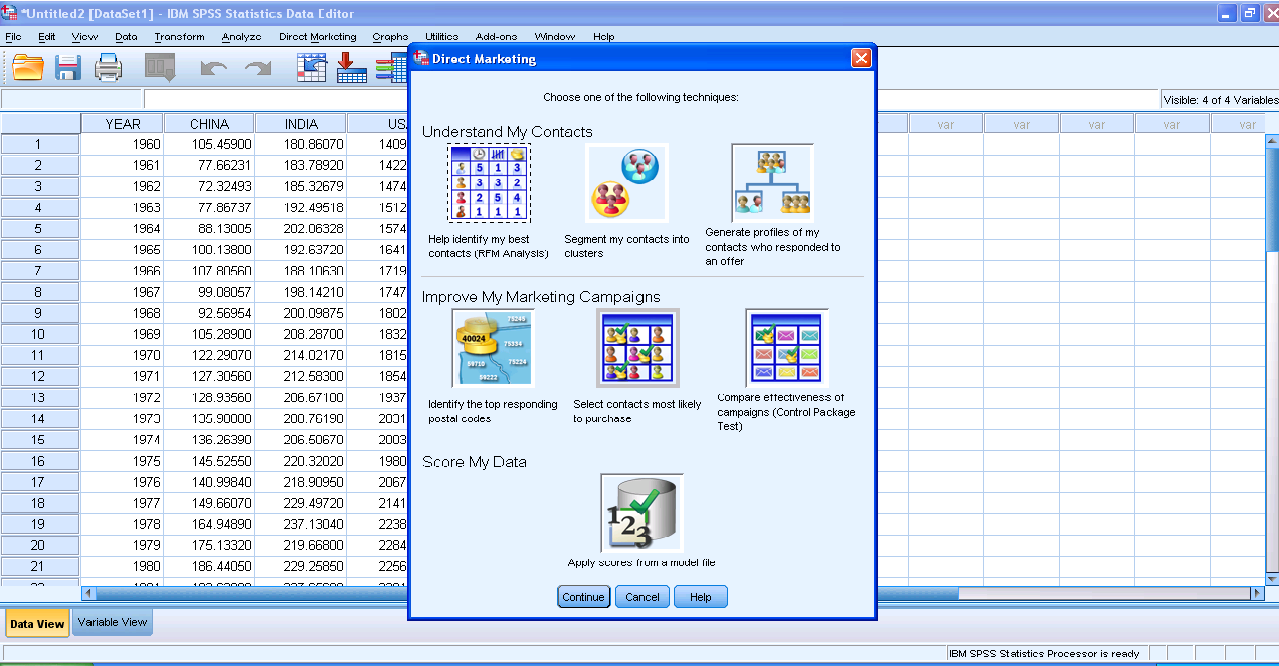
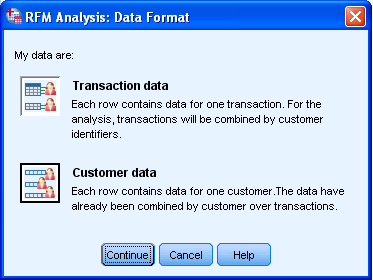
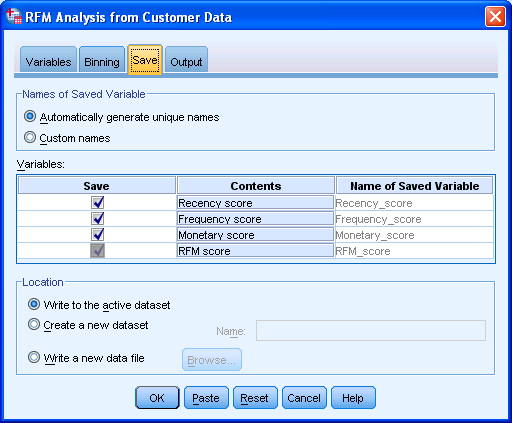
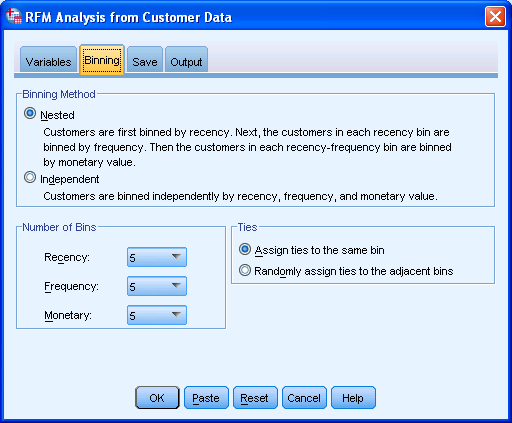
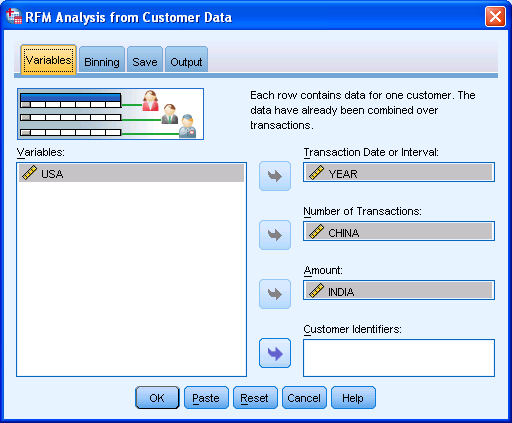
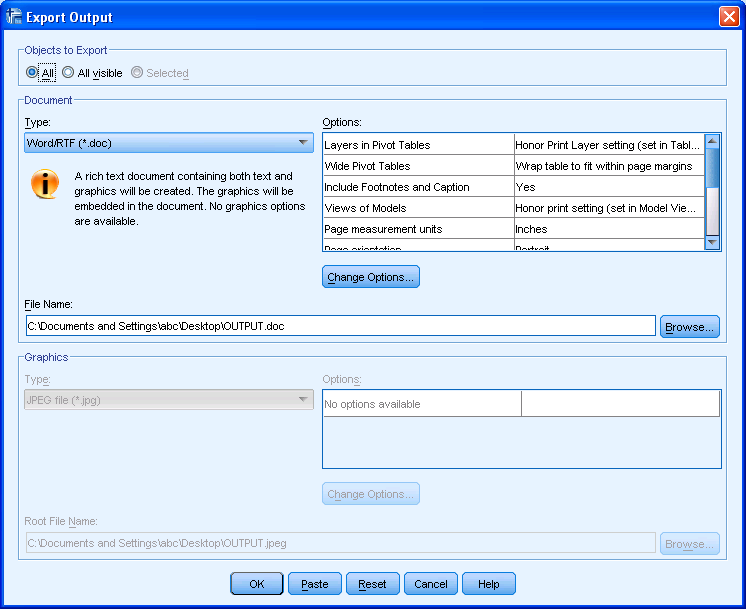
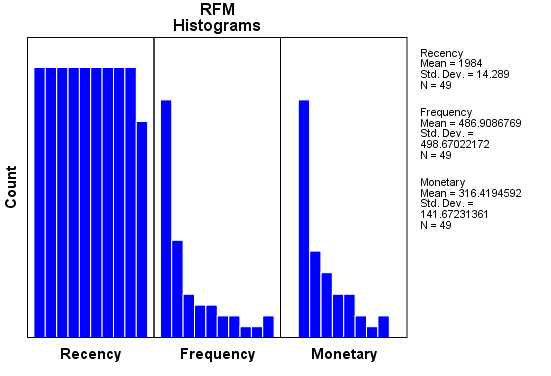
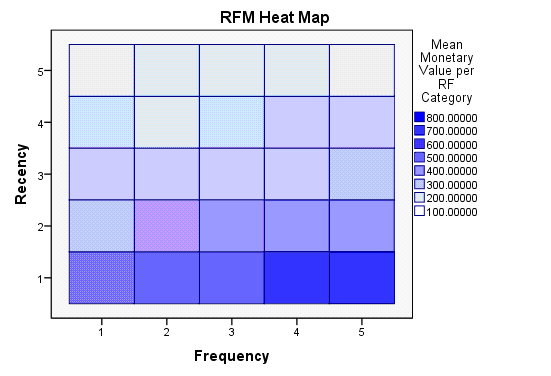
Here are some screenshots to describe the features.

1) A simple dashboard to show functionality (with room for improvement for visual appeal)

2) Simple Intuitive design to inputting data3) Some options in creating marketing scorecards4) Easy to understand features for a business audiences

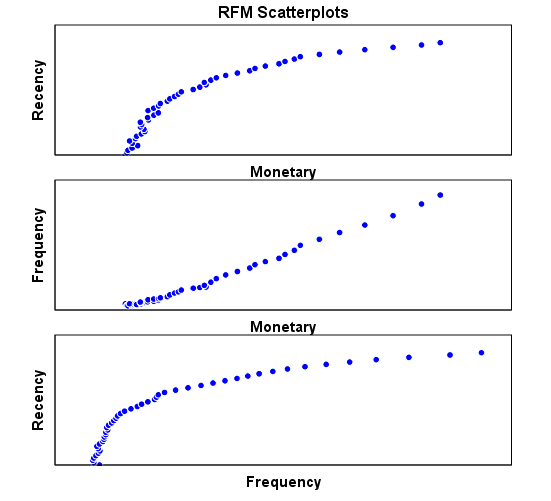
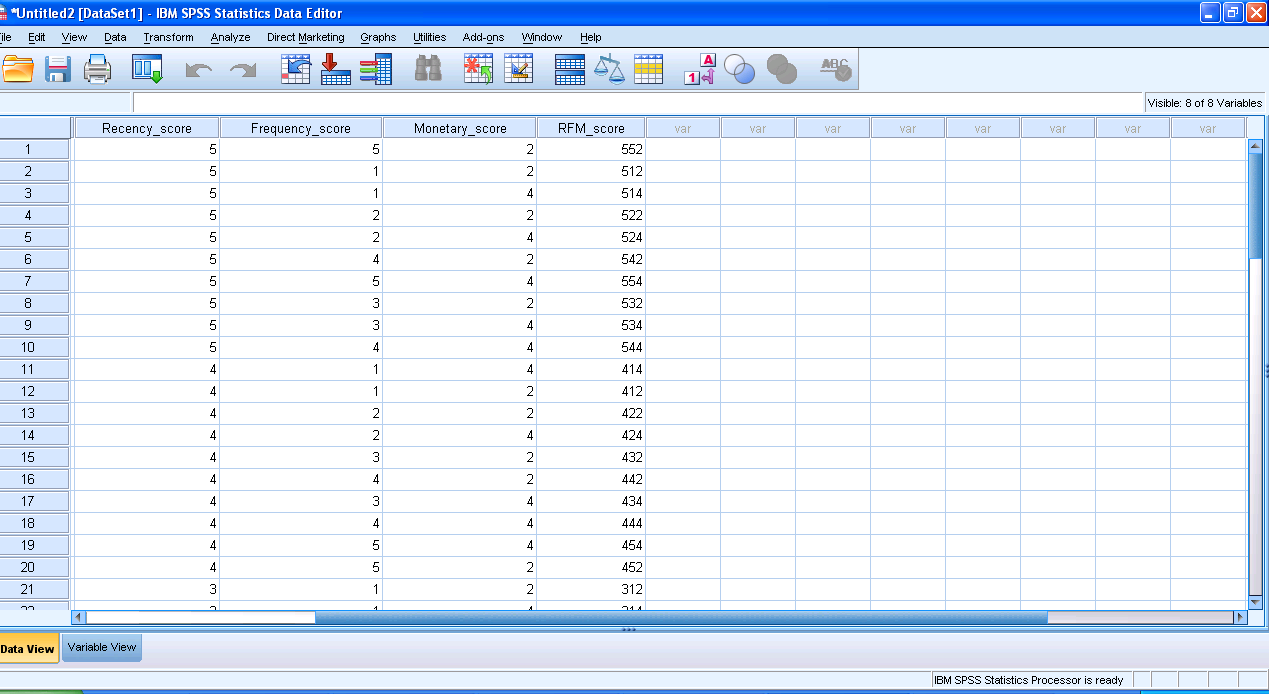
rather than pseudo techie jargon5) Note the clean design of the GUI in specifying data input type6) Again multiple options to export results in a very user friendly manner with options to customize business report7) Graphical output conveniently pasted inside a word document rather than a jumble of images. Auto generated options for customized standard graphs.8) An attractive heatmap to represent monetization for customers. Note the effect that a scale of color shades have in visual representation of data.9) Comparative plots placed side by side with easy to understand explanation (in the output word doc not shown here)10) Auto generated scores attached to data table to enhance usage. 

Note here I am evaluating RFM as a marketing technique (which is well known) but also the GUI of IBM SPSS 19 Marketing Analytics. It is simple, and yet powerful into turning what used to be a purely statistical software for nerds into a beautiful easy to implement tool for business users.

So what else can you do in Marketing Analytics with SPSS 19.

IBM SPSS Direct Marketing

The Direct Marketing add-on option allows organizations to ensure their marketing programs are as effective as possible, through techniques specifically designed for direct marketing, including:

• RFM Analysis. This technique identifies existing customers who are most likely to respond to a new offer.

• Cluster Analysis. This is an exploratory tool designed to reveal natural groupings (or clusters) within your data. For example, it can identify different groups of customers based on various demographic and purchasing characteristics.

• Prospect Profiles. This technique uses results from a previous or test campaign to create descriptive profiles. You can use the profiles to target specific groups of contacts in future campaigns.

• Postal Code Response Rates. This technique uses results from a previous campaign to calculate postal code response rates. Those rates can be used to target specific postal codes in future campaigns.

• Propensity to Purchase. This technique uses results from a test mailing or previous campaign to generate propensity scores. The scores indicate which contacts are most likely to respond.

• Control Package Test. This technique compares marketing campaigns to see if there is a significant difference in effectiveness for different packages or offers.

Click here to find out more about Direct Marketing.

SAS Sentiment Analysis wins Award

From Business Wire, the new Sentiment Analysis product by SAS Institute (created by acquisition Teragram ) wins an award. As per wikipedia

http://en.wikipedia.org/wiki/Sentiment_analysis

Sentiment analysis or opinion mining refers to a broad (definitionally challenged) area of natural language processingcomputational linguistics and text mining. Generally speaking, it aims to determine the attitude of a speaker or a writer with respect to some topic. The attitude may be their judgment or evaluation (see appraisal theory), their affective state (that is to say, the emotional state of the author when writing) or the intended emotional communication (that is to say, the emotional effect the author wishes to have on the reader).

It was developed by Teragram. Here is another Sentiment Analysis tool from Stanford Grad school at http://twittersentiment.appspot.com/search?query=sas

See-

Sentiment analysis for sas

Image Citation-

http://threeminds.organic.com/2009/09/five_reasons_sentiment_analysi.html

Read an article on sentiment analysis here at http://www.nytimes.com/2009/08/24/technology/internet/24emotion.html

And the complete press release at http://goo.gl/iVzf`

SAS Sentiment Analysis delivers insights on customer, competitor and organizational opinions to a degree never before possible via manual review of electronic text. As a result, SAS, the leader in business analytics software and services, has earned the prestigious Communications Solutions Product of the Year Award fromTechnology Marketing Corporation (TMC).

“SAS has automated the time-consuming process of reading individual documents and manually extracting relevant information”

“SAS Sentiment Analysis has shown benefits for its customers and it provides ROI for the companies that use it,” said Rich Tehrani, CEO, TMC. “Congratulations to the entire team at SAS, a company distinguished by its dedication to software quality and superiority to address marketplace needs.”

Derive positive and negative opinions, evaluations and emotions

SAS Sentiment Analysis’ high-performance crawler locates and extracts sentiment from digital content sources, including mainstream websites, social media outlets, internal servers and incoming news feeds. SAS’ unique hybrid approach combines powerful statistical techniques with linguistics rules to improve accuracy to the detailed feature level. It summarizes the sentiment expressed in all available text collections – identifying trends and creating graphical reports that describe the expressed feelings of consumers, partners, employees and competitors in real time. Output from SAS Sentiment Analysis can be stored in document repositories, surfaced in corporate portals and used as input to additional SAS Text Analytics software or search engines to help decision makers evaluate trends, predict future outcomes, minimize risks and capitalize on opportunities.

“SAS has automated the time-consuming process of reading individual documents and manually extracting relevant information,” said Fiona McNeill, Global Analytics Product Marketing Manager at SAS. “Our integrated analytics framework helps organizations maximize the value of information to improve their effectiveness.”

SAS Sentiment Analysis is included in the SAS Text Analytics suite, which helps organizations discover insights from electronic text materials, associate them for delivery to the right person or place, and provide intelligence to select the best course of action. Whether answering complex search-and-retrieval questions, ensuring appropriate content is presented to internal or external constituencies, or predicting which activity or channel will produce the best effect on existing sentiments, SAS Text Analytics provides exceptional real-time processing speeds for large volumes of text.

SAS Text Analytics solutions are part of the SAS Business Analytics Framework, backed by the industry’s most comprehensive range of consulting, training and support services, ensuring customers maximum return from their IT investments.

Recognizing vision

The Communications Solutions Product of the Year Award recognizes vision, leadership and thoroughness. The most innovative products and services brought to the market from March 2008 through March 2009 were chosen as winners of this Product of the Year Award and are published on the INTERNET TELEPHONY and Customer Interaction Solutions websites.