Free and Open Source cannot get basic economics correct

Nutch robots
Image via Wikipedia

Before you rev up those keyboards, and shoot off a snarky comment- consider this statement- there are many ways to run (and ruin economies). But they still have not found a replacement for money. Yes Happiness is important. Search Engine is good.

So unless they start a new branch of economics with lots more motivational theory and psychology and lot less quant especially for open source projects, money ,revenue, sales is the only true measure of success in enterprise software. Particularly if you have competitors who are making more money selling the same class of software.

Popularity contests are for high school quarterbacks —so even if your open source software is popular in downloads, email discussions, stack overflow or Continue reading “Free and Open Source cannot get basic economics correct”

Predictive Analytics World Conference –New York City and London, UK

Please use the following code  to get a 15% discount on the 2 Day Conference Pass:  AJAYNY11.

Predictive Analytics World Conference –New York City and London, UK

October 17-21, 2011 – New York City, NY (pawcon.com/nyc)
Nov 30 – Dec 1, 2011 – London, UK (pawcon.com/london)

Predictive Analytics World (pawcon.com) is the business-focused event for predictive analytics
professionals, managers and commercial practitioners, covering today’s commercial deployment of
predictive analytics, across industries and across software vendors. The conference delivers case
studies, expertise, and resources to achieve two objectives:

1) Bigger wins: Strengthen the business impact delivered by predictive analytics

2) Broader capabilities: Establish new opportunities with predictive analytics

Case Studies: How the Leading Enterprises Do It

Predictive Analytics World focuses on concrete examples of deployed predictive analytics. The leading
enterprises have signed up to tell their stories, so you can hear from the horse’s mouth precisely how
Fortune 500 analytics competitors and other top practitioners deploy predictive modeling, and what
kind of business impact it delivers.

PAW NEW YORK CITY 2011

PAW’s NYC program is the richest and most diverse yet, featuring over 40 sessions across three tracks
– including both X and Y tracks, and an “Expert/Practitioner” track — so you can witness how predictive
analytics is applied at major companies.

PAW NYC’s agenda covers hot topics and advanced methods such as ensemble models, social data,
search marketing, crowdsourcing, blackbox trading, fraud detection, risk management, survey analysis,
and other innovative applications that benefit organizations in new and creative ways.

WORKSHOPS: PAW NYC also features five full-day pre- and post-conference workshops that
complement the core conference program. Workshop agendas include advanced predictive modeling
methods, hands-on training, an intro to R (the open source analytics system), and enterprise decision
management.

For more see http://www.predictiveanalyticsworld.com/newyork/2011/

PAW LONDON 2011

PAW London’s agenda covers hot topics and advanced methods such as risk management, uplift
(incremental lift) modeling, open source analytics, and crowdsourcing data mining. Case study
presentations cover campaign targeting, churn modeling, next-best-offer, selecting marketing channels,
global analytics deployment, email marketing, HR candidate search, and other innovative applications
that benefit organizations in new and creative ways.

Join PAW and access the best keynotes, sessions, workshops, exposition, expert panel, live demos,
networking coffee breaks, reception, birds-of-a-feather lunches, brand-name enterprise leaders, and

industry heavyweights in the business.

For more see http://www.predictiveanalyticsworld.com/london

CROSS-INDUSTRY APPLICATIONS

Predictive Analytics World is the only conference of its kind, delivering vendor-neutral sessions across
verticals such as banking, financial services, e-commerce, education, government, healthcare, high
technology, insurance, non-profits, publishing, social gaming, retail and telecommunications

And PAW covers the gamut of commercial applications of predictive analytics, including response
modeling, customer retention with churn modeling, product recommendations, fraud detection, online
marketing optimization, human resource decision-making, law enforcement, sales forecasting, and
credit scoring.

Why bring together such a wide range of endeavors? No matter how you use predictive analytics, the
story is the same: Predicatively scoring customers optimizes business performance. Predictive analytics
initiatives across industries leverage the same core predictive modeling technology, share similar project
overhead and data requirements, and face common process challenges and analytical hurdles.

RAVE REVIEWS:

“Hands down, best applied, analytics conference I have ever attended. Great exposure to cutting-edge
predictive techniques and I was able to turn around and apply some of those learnings to my work
immediately. I’ve never been able to say that after any conference I’ve attended before!”

Jon Francis
Senior Statistician
T-Mobile

Read more: Articles and blog entries about PAW can be found at http://www.predictiveanalyticsworld.com/
pressroom.php

VENDORS. Meet the vendors and learn about their solutions, software and service. Discover the best
predictive analytics vendors available to serve your needs – learn what they do and see how they
compare

COLLEAGUES. Mingle, network and hang out with your best and brightest colleagues. Exchange
experiences over lunch, coffee breaks and the conference reception connecting with those professionals
who face the same challenges as you.

GET STARTED. If you’re new to predictive analytics, kicking off a new initiative, or exploring new ways
to position it at your organization, there’s no better place to get your bearings than Predictive Analytics
World. See what other companies are doing, witness vendor demos, participate in discussions with the
experts, network with your colleagues and weigh your options!

For more information:
http://www.predictiveanalyticsworld.com

View videos of PAW Washington DC, Oct 2010 — now available on-demand:
http://www.predictiveanalyticsworld.com/online-video.php

What is predictive analytics? See the Predictive Analytics Guide:
http://www.predictiveanalyticsworld.com/predictive_analytics.php

If you’d like our informative event updates, sign up at:
http://www.predictiveanalyticsworld.com/signup-us.php

To sign up for the PAW group on LinkedIn, see:
http://www.linkedin.com/e/gis/1005097

For inquiries e-mail regsupport@risingmedia.com or call (717) 798-3495.

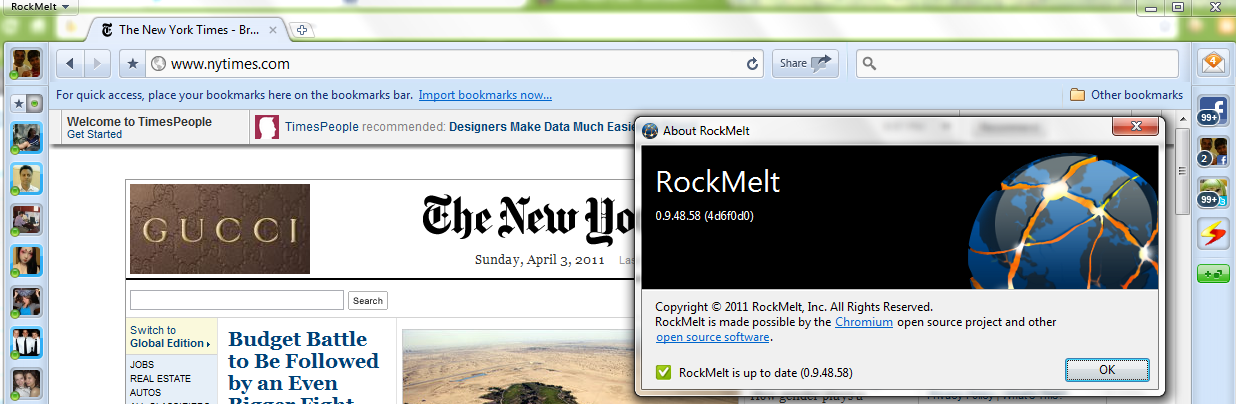
Rockmelt: A chromium based browser with a social layer

I kind of liked the latest browser on the block: Rockmelt.

It is based on Chromium open source project, that is primarily lead by Google. In case Facebook wants to buy a browser it can use Rockmelt–provided the mutual powers and angels agree.

I really liked the idea of a social layer- though I am not sure how the analytics embedded within a browser/report should be used.

Basically it re-designs the interface to put your social networks to the margin, thus quite a boon in you have active social media presence on multiple sites or a power reader/surfer. Timely alerts ping you to status/new messages without cluttering your screen and internet experience. Worth atleast a try or first look for the innovator kind of internet customer.

I still prefer the speed of Chrome– because Rockwell interface is still not easy to transition to – it almost adds in 3 dimensions in terms of where your eyeball should be while surfing (to left/right/margin).


and thats despite the funny fine print in Chrome’s user agreement of “continuing innovation”

type about:terms in your chrome bar to see-

4.3 As part of this continuing innovation, you acknowledge and agree that Google may stop (permanently or temporarily) providing the Services (or any features within the Services) to you or to users generally at Google’s sole discretion, without prior notice to you. You may stop using the Services at any time. You do not need to specifically inform Google when you stop using the Services.

Libre Office turns six

On September 28th, 2010, The Document Foundation was announced. The last six months, it feels, have just passed within a short glimpse of time. Not only did we release three LibreOffice versions within three months, have created the LibreOffice-Box DVD image, and brought LibreOffice Portable on its way. We also have announced the LibreOffice Conference for October 2011 and have taken part in lots of events worldwide, with FOSDEM and CeBIT being the most prominent ones.

People follow us at Twitter, Identi.ca, XING, LinkedIn and a Facebook group and fan page, they discuss on our mailing lists with more than 6.000 subscriptions, collaborate in our wiki, get insight on our daily work in our blog, and post and blog themselves. From the very first day, openness, transparency and meritocracy have been shaping the framework we want to work in. Our discussions and decisions take place on a public mailing list, and regularly, we hold phone conferences for the Steering Committee and for the marketing teams, where everyone is invited to join. Our ideas and visions have made their way into our Next Decade Manifesto.

We have joined the Open Invention Network as well as the OpenDoc Society, and just last week have become an SPI-associated project, and we see a wide range of support from all over the world. Not only do Novell and Red Hat support our efforts with developers, but just recently, Canonical, creators of Ubuntu, joined as well. All major Linux distributions deliver LibreOffice with their operating systems, and more follow every day.

One of the most stunning contributions, that still leaves us speechless, is the support that we receive from the community. When we asked for 50,000 € capital stock for a German-based foundation, the community showed their support, appreciation and their power, and not only donated it in just eight days, but up to now has supported us with close to 100,000 €! Another one is that driven by our open, vendor neutral approach, combined with our easy hacks, we have included code contributions from over 150 entirely new developers to the project, alongside localisations from over 50 localizers. The community has developed itself better than we could ever dream of, and first meetings like the project’s weekend or the QA meeting of the Germanophone group are already being organized.

What we have seen now is just the beginning of something very big. The Document Foundation has a vision, and the creation of the foundation in Germany is about to happen soon. LibreOffice has been downloaded over 350,000 times within the first week, and we just counted more than 1,3 million downloads just from our download system — not counting packages directly delivered by Linux distributors, other download sites or DVDs included in magazines and newspapers — supported by 65 mirrors from all over the world, and millions already use and contribute to it worldwide. With our participation in the Google Summer of Code, we will engage more students and young developers to be part of our community. Our improved release schedule will ensure that new features and improvements will make their way to end-users soon, and for testers, we even provide daily builds.

We are so excited by what has been achieved over the last six months, and we are immensely grateful to all those who have supported the project in whatever ways they can. It is an honour to be working with you, to be part of one united community! The future as we are shaping it has just begun, and it will be bright and excellent.


from-

List archive: http://listarchives.documentfoundation.org/www/announce/

It's a code code summer

East-German pupils ("Junge Pioniere"...
Image via Wikipedia

and soc is back!

also expecting some #Rstats entries (open source!)

from https://code.google.com/soc/

Google Summer of Code 2011

Visit the Google Summer of Code 2011 site for more details about the program this year.

For a detailed timeline and further information about the program, review our Frequently Asked Questions.

About Google Summer of Code

Google Summer of Code is a global program that offers student developers stipends to write code for various open source software projects. We have worked with several open source, free software, and technology-related groups to identify and fund several projects over a three month period. Since its inception in 2005, the program has brought together over 4500 successful student participants and over 3000 mentors from over 100 countries worldwide, all for the love of code. Through Google Summer of Code, accepted student applicants are paired with a mentor or mentors from the participating projects, thus gaining exposure to real-world software development scenarios and the opportunity for employment in areas related to their academic pursuits. In turn, the participating projects are able to more easily identify and bring in new developers. Best of all, more source code is created and released for the use and benefit of all.

To learn more about the program, peruse our 2011 Frequently Asked Questions page. You can also subscribe to the Google Open Source Blog or the Google Summer of Code Discussion Group to keep abreast of the latest announcements.

Participating in Google Summer of Code

For those of you who would like to participate in the program, there are many resources available for you to learn more. Check out the information pages from the 20052006200720082009, and 2010 instances of the program to get a better sense of which projects have participated as mentoring organizations in Google Summer of Code each year. If you are interested in a particular mentoring organization, just click on its name and you’ll find more information about the project, a summary of their students’ work and actual source code produced by student participants. You may also find the program Frequently Asked Questions (FAQs) pages for each year to be useful. Finally, check out all the great content and advice on participation produced by the community, for the community, on our program wiki.

If you don’t find what you need in the documentation, you can always ask questions on our program discussion list or the program IRC channel, #gsoc on Freenode.


It’s a code code summer

East-German pupils ("Junge Pioniere"...
Image via Wikipedia

and soc is back!

also expecting some #Rstats entries (open source!)

from https://code.google.com/soc/

Google Summer of Code 2011

Visit the Google Summer of Code 2011 site for more details about the program this year.

For a detailed timeline and further information about the program, review our Frequently Asked Questions.

About Google Summer of Code

Google Summer of Code is a global program that offers student developers stipends to write code for various open source software projects. We have worked with several open source, free software, and technology-related groups to identify and fund several projects over a three month period. Since its inception in 2005, the program has brought together over 4500 successful student participants and over 3000 mentors from over 100 countries worldwide, all for the love of code. Through Google Summer of Code, accepted student applicants are paired with a mentor or mentors from the participating projects, thus gaining exposure to real-world software development scenarios and the opportunity for employment in areas related to their academic pursuits. In turn, the participating projects are able to more easily identify and bring in new developers. Best of all, more source code is created and released for the use and benefit of all.

To learn more about the program, peruse our 2011 Frequently Asked Questions page. You can also subscribe to the Google Open Source Blog or the Google Summer of Code Discussion Group to keep abreast of the latest announcements.

Participating in Google Summer of Code

For those of you who would like to participate in the program, there are many resources available for you to learn more. Check out the information pages from the 20052006200720082009, and 2010 instances of the program to get a better sense of which projects have participated as mentoring organizations in Google Summer of Code each year. If you are interested in a particular mentoring organization, just click on its name and you’ll find more information about the project, a summary of their students’ work and actual source code produced by student participants. You may also find the program Frequently Asked Questions (FAQs) pages for each year to be useful. Finally, check out all the great content and advice on participation produced by the community, for the community, on our program wiki.

If you don’t find what you need in the documentation, you can always ask questions on our program discussion list or the program IRC channel, #gsoc on Freenode.


What to do if you see a possible GPL violation

GNU Lesser General Public License
Image via Wikipedia

Well I have played with software (mostly but not exclusively) analytical, and I admire the zeal and energy of both open source and closed source practioners- all having relatively decent people executing strategies their investors or owners tell them to do (closed source) or motivated by their own self sense of cool-change the world-openness (open source)

What I dont get is people stealing open source code- repackaging without adding major contributions- claiming patent pending stuff- and basically making money by creating CLOSED source from the open source software-(as open source is yet to break the enterprise glass cieling)

you are either open source or you arent.

bi- sexuality is okay. bi-codability is not.

Next time you see someone stealing some community’s open source code- refer to this excellent link.


But, we cannot act on our own if we do not hold copyright. Thus, be sure to find out who the copyright holders of the software are before reporting a violation.

http://www.gnu.org/licenses/gpl-violation.html

Violations of the GNU Licenses

If you think you see a violation of the GNU GPLLGPLAGPL, or FDL, the first thing you should do is double-check the facts:

  • Does the distribution contain a copy of the License?
  • Does it clearly state which software is covered by the License? Does it say anything misleading, perhaps giving the impression that something is covered by the License when in fact it is not?
  • Is source code included in the distribution?
  • Is a written offer for source code included with a distribution of just binaries?
  • Is the available source code complete, or is it designed for linking in other non-free modules?

If there seems to be a real violation, the next thing you need to do is record the details carefully:

  • the precise name of the product
  • the name of the person or organization distributing it
  • email addresses, postal addresses and phone numbers for how to contact the distributor(s)
  • the exact name of the package whose license is violated
  • how the license was violated:
    • Is the copyright notice of the copyright holder included?
    • Is the source code completely missing?
    • Is there a written offer for source that’s incomplete in some way? This could happen if it provides a contact address or network URL that’s somehow incorrect.
    • Is there a copy of the license included in the distribution?
    • Is some of the source available, but not all? If so, what parts are missing?

The more of these details that you have, the easier it is for the copyright holder to pursue the matter.

Once you have collected the details, you should send a precise report to the copyright holder of the packages that are being misused. The copyright holder is the one who is legally authorized to take action to enforce the license.

If the copyright holder is the Free Software Foundation, please send the report to <license-violation@gnu.org>. It’s important that we be able to write back to you to get more information about the violation or product. So, if you use an anonymous remailer, please provide a return path of some sort. If you’d like to encrypt your correspondence, just send a brief mail saying so, and we’ll make appropriate arrangements.

Note that the GPL, and other copyleft licenses, are copyright licenses. This means that only the copyright holders are empowered to act against violations. The FSF acts on all GPL violations reported on FSF copyrighted code, and we offer assistance to any other copyright holder who wishes to do the same.

But, we cannot act on our own if we do not hold copyright. Thus, be sure to find out who the copyright holders of the software are before reporting a violation.